
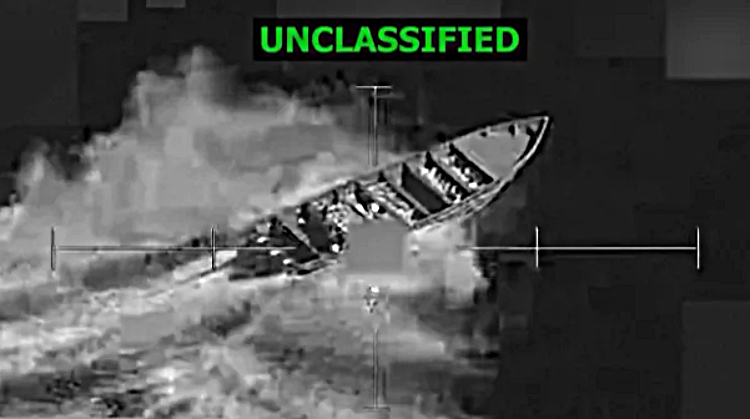
U.S. maritime interdiction efforts against drug-smuggling vessels have saved countless lives and disrupted transnational trafficking networks that threaten national and regional security. The destruction of self-propelled semi-submersibles and high-speed vessels carrying narcotics is often both necessary and justified under well-established law enforcement protocols. Yet even in these legitimate operations, extreme caution must guide decision-making. Those who point to UNCLOS or other UN maritime provisions as blanket justification for lethal force should take a closer look at the law’s actual limits and intent. International maritime enforcement is grounded in proportionality, state authority, and factual verification—not open-ended permission to destroy any vessel judged “unflagged” or suspicious at sea.
Here is the post … one of many providing “justification” for using lethal force against the drug boats:
Aboat in international waters that is not running a national flag is categorized in international law the same way a pirate is. Such boats have absolutely no national or international protections, and you cannot commit a war crime against them.
A vessel in international waters is required under UNCLOS to sail under the flag of a specific nation. If it does not, it is legally considered a stateless vessel. A stateless vessel has no right to the protections normally afforded to ships under a national flag, including immunity from interference by other states.
UNCLOS Articles 92, 94, 110, and customary maritime law spell out the consequences clearly:
1. Stateless vessels have no sovereign protection. A flagged ship is an extension of its flag-state’s sovereignty. A stateless vessel is not. This matters because “war crimes” presuppose protected persons or protected property. A stateless vessel is legally unprotected.
2. Any state may stop, board, search, seize, or disable, a stateless vessel. UNCLOS Article 110 explicitly authorizes boarding and seizure. The law does not require states to risk their own personnel or assets while doing so. Disabling a vessel that refuses inspection, including firing on it, is legally permitted under both UNCLOS and long-established state practice.
3. War crimes require an armed conflict. You cannot commit a “war crime” outside an armed conflict. War crimes occur only within the context of international humanitarian law (IHL). Enforcing maritime law against a stateless vessel is a law enforcement action, not an IHL situation.
No armed conflict = no war crime possible.
4. Lethal force may be used when a vessel refuses lawful orders. The International Maritime Organization’s “Use of Force” guidance for maritime interdiction recognizes that disabling fire, even lethal force, is lawful when a vessel refuses lawful boarding, attempts to flee, poses a threat, or engages in illicit activities such as piracy or narcotics trafficking.
Once again: law enforcement rules apply, not IHL.
5. Sinking a stateless vessel is not prohibited by UNCLOS. UNCLOS permits seizure of a stateless vessel and leaves the means entirely to the enforcing state so long as necessity and proportionality are respected. If the vessel flees, attacks, or refuses lawful commands, sinking it is legally permissible. Many states routinely do this to drug-smuggling vessels (e.g., semi-submersibles) without it ever being treated as a war crime.
6. No flag = no jurisdictional shield. The entire reason international law requires ships to fly a flag is to prevent this exact situation. Flagless vessels are legally vulnerable by design.
Because a stateless vessel has no protected status, because UNCLOS authorizes interdiction of such vessels, because lethal force may be used in maritime law enforcement when necessary, and because war crimes require an armed conflict that is not present here, sinking an unflagged ship in international waters is not a war crime.
Here’s the revised, policy-analysis version with an added paragraph introducing the fishing or recreational vessel scenario for context and real-world relevance.
DANGER WILL ROBINSON!
The assertion that a stateless or unflagged vessel in international waters may lawfully be sunk without consequence represents a serious misinterpretation of international maritime law. While the United Nations Convention on the Law of the Sea (UNCLOS) requires vessels to sail under a national flag and classifies those without registration as “stateless,” this designation does not remove all legal protections or authorize arbitrary use of lethal force by private individuals or uninvolved states.
Under UNCLOS Articles 92, 94, and 110, states are authorized to board, inspect, and seize stateless vessels when acting under legitimate law enforcement mandates. However, the authority to enforce maritime law is tightly constrained by international principles of necessity, proportionality, and accountability. The use of force—especially lethal force—must occur within the scope of lawful state conduct and remain consistent with international human rights and humanitarian norms.
It is also critical to recognize that numerous legitimate vessels may temporarily operate in international waters without an active transponder or visible flag. Small fishing boats, research vessels, or pleasure craft engaged in recreational activity may lose a flag due to weather damage, equipment malfunction, or operator oversight. In such cases, presuming criminal status or treating these vessels as “pirates” invites catastrophic error. Misidentification could lead to unlawful harm against civilians, triggering criminal liability and diplomatic conflict. Maritime enforcement regimes are specifically designed to prevent such escalation through investigation, identification, and controlled interdiction—not summary destruction.
Equating unflagged vessels with pirates or drug traffickers conflates lawful maritime governance with extrajudicial action. Claims that lethal engagement is inherently justified overlook the distinction between peacetime law enforcement and wartime conduct under international humanitarian law. Enforcement actions on the high seas remain governed by the law of the sea and broader international legal frameworks, which prohibit indiscriminate or disproportionate use of force.
Ultimately, UNCLOS grants states the right to interdict and inspect stateless vessels, not to destroy them at their discretion. The lawful exercise of maritime enforcement authority must be deliberate, measured, and guided by rule-of-law principles. Any endorsement of unrestricted force risks eroding the international legal order, destabilizing maritime cooperation, and endangering innocent lives.