
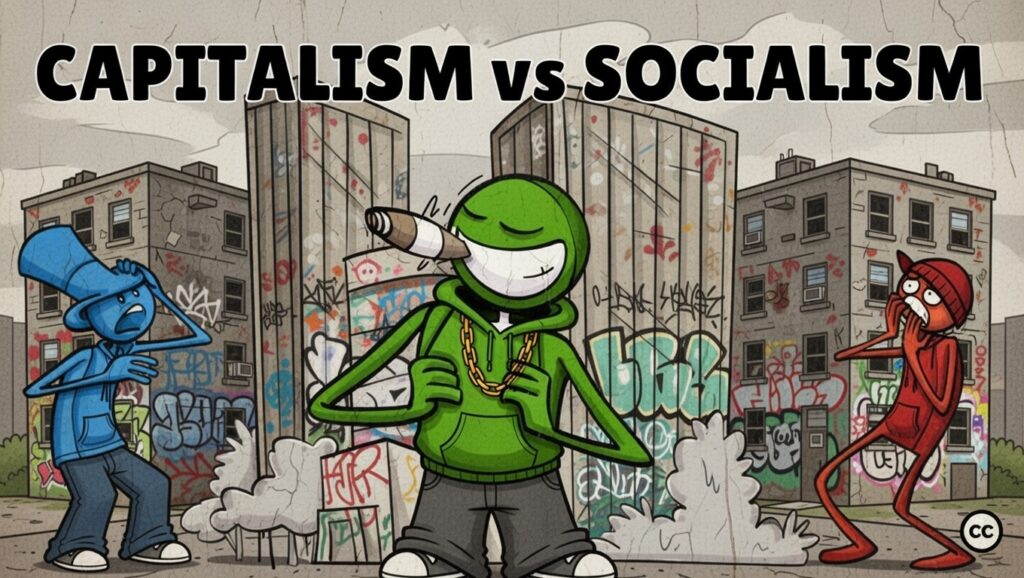
People find fault with capitalism.
Many think they’d prefer socialism.
Why? Because they believe absurd myths about it.
[Click here] to read the full transcript of this video [Click again to close]
JOHN STOSSEL TRANSCRIPTION
(Due to variable audio quality—including background noise, unclear speech, or recording issues—this transcription may contain errors or omissions not present in the original recording. For complete accuracy, please refer to the audio itself.)
Myths About Socialism
The new book, It’s Okay to Be Angry About Capitalism. People eagerly find fault with capitalism. If capitalism works, if this is the best we got, why does it seem to give such a raw deal? A raw deal? Is that what we get? I hear that often. In capitalist society, the people who work the hardest make the least amount of money. We can either have extreme wealth inequality or we can have a fair economy. Many people are upset about America’s big differences in wealth. And they say socialism would just be better. Socialism is the way forward. It’s time to take a closer look at the socialism these people want. This is class war! We are committed to transforming our society into one based on freedom, equality, and solidarity. The belief that socialism will bring that is why it’s now as popular as capitalism among young people. Another big reason is, oddly, this 90-year-old, linguist Noam Chomsky. Students study his work in class, and colleges pay him up to $30,000 to speak. Thanks very much. Yet for generations, Chomsky misled students by calling capitalism a grotesque catastrophe. I thought the fall of Soviet communism would put an end to such nonsense. Surely everyone would now see the catastrophe is socialism. But no, socialism has come back strong. So in this video, we’ll bust five myths about socialism and even more myths about capitalism.
We start with socialism and the claim that that wasn’t real socialism. The Soviet Union, this was about as remote from socialism as you can imagine. It’s absurd to say that the Soviet Union was remote from socialism. Economist Ben Powell reminds us that when the Soviets made private business illegal, that’s about as close as the world ever saw to the pure socialist end of the spectrum. But whenever socialism fails, people always say, that wasn’t real socialism. It doesn’t prove anything about socialism in other countries. Working people have to be in control of production. The Soviet Union is the exact opposite of that. Working people had no control over anything. But that’s the problem. That is what socialism inevitably delivers. Socialism means abolishing private property and the major things that go into production and replacing it with some form of collective ownership. In practice, this means state ownership and control. And the Soviet Union had an abundance of that. Of course, the Soviet Union is now gone, so some say there is no true socialist country that exists today. But there is. Look at Venezuela. Just eating is a luxury.
When I say socialism created a hardship there, people trash me on my own social media. Read a book. Venezuela’s not socialist. Think a bit. I’ll do better than that. I’ll listen to the politician who wrecked Venezuela. Because capitalism is tyranny, Hugo Chavez said his government must take over businesses. That’s socialism. The socialists turned the richest country in Latin America, the nation with the biggest oil reserves in the world, into the poorest country. But it’s not clear that that crisis has anything to do with their socialist policies. That’s myth two. Venezuela’s failure has… …little to do with socialism and a lot to do with poor governance. Some of Chavez’s programs could have been sustainable if he pursued a sound economic policy. Yeah, some of his policies could be sustainable if he had a sound economic policy called capitalism. Why does it have to be capitalism? Oliver is saying if he just managed it better. It’s a story about epic mismanagement. Or here’s how Al Jazeera puts it. Economic policies have failed to adjust to reality. That’s the nature of socialism is for their economic policies to fail to adjust to reality. Because economic reality is evolving every day. It’s millions of decentralized entrepreneurs and consumers who are making fine-tuning adjustments to this.
In our capitalist society, when COVID hit… what did we start seeing? Millions of entrepreneurs adjusting without government orders of how to deliver their products and services. Servers have switched roles to delivery drivers, while bartenders have turned into sales reps. Restaurants installed the heat lamps, expanded patios, did delivery. Although reporters complained about the absence of federal direction, no central authority could possibly direct all these individual adjustments in thousands of different places. In fact, federal direction would have prevented all that. In a market economy, the great thing is everybody’s little adjustments gets tested and we get to see what works. Blockbuster was great, but then people were offered something better. TV shows and movies at your command. By contrast, in a socialist economy, you get a one-size-fits-all adjustment, and you miss out on this learning process where some entrepreneurs copy others when they see things successful, and they stop doing it when it’s not. For example, East Germany’s socialist planners pushed these Trabants. They said the cars were great. But it was a terrible car, hard to drive, and it spewed pollution. Even when West Germans were building Volkswagens, BMWs, and Porsches, East Germans were stuck with Trabants. In a socialist economy, every one of the minor adjustments needs to be commanded. One mind who has to know all of those teeny adjustments, communicate it down and get everybody to do the right thing. That’s impossible. No government department can manage millions of individual decisions in prices. When they try, shortages occur and money loses value. If you work the whole month, you can buy one hamburger.
Here’s another excuse for Venezuela’s failure. Oil prices plummeted in 2014 and Maduro failed to adjust. Vox made this video called The Collapse of Venezuela Explained. In the whole video, they never mention socialism once. They blame falling oil prices. The oil price is a complete distraction. There’s plenty of countries around the world that depend on oil revenue. When oil prices went down, the people there didn’t start losing weight. That just happened in Venezuela. Some people respond to my videos by saying people in Venezuela and Cuba struggle not because of socialism, but because of our sanctions and embargo. They certainly don’t help the people, but it’s an afterthought as a reason for their suffering. In Cuba, they drive around 1950s U.S. cars, but we don’t have a blockade on them. There’s no U.S. Navy destroyers preventing Kia, Fiat, or whoever else around the world from sending them cars. The reason for their suffering is they have an economic system that can’t deliver.
Here’s myth number three. Socialism does bring good things if it’s democratic socialism. The examples of failed socialism that critics use are not socialist democracies, but authoritarian states. Democratic socialists denounce all that. The key word for them, democratic. They believe that both the government and the economy should be run by the people by way of the ballot box. But Venezuela’s socialist was elected. They can start off democratically elected. And then once they centralize control over the economy, it becomes impossible to democratically unelect them. Now, Maduro rules while ordering state employees to vote for him or they lose their job. Maduro blatantly buying votes. They put food aid stations next to polling places and you get rewarded with rations if you vote correctly. Now democracy there is a sham. It always becomes authoritarian? Always? Everywhere you try socialism, that’s what you get. Why? It’s hard to exercise political freedom if you don’t have economic freedoms. You’re dependent upon the state for your livelihood. You lose your ability to use your voice to oppose them because you can be punished. But unfortunately, people don’t realize that when they’re promoting democratic socialism. Democratic socialism is your kid’s public school. It’s the researchers and scientists paid with our taxes. It’s our interstate highway system. We’re not purely capitalist. There are some industries that are government-owned, operated and controlled, socialized, if you will. It’s no accident that when you look at these and think about things that are inefficiently done and underperforming, our public education, our congested streets, these socialized industries don’t work well.
But what about Norway? It’s as socialist as they come. Instead of Cuba or China, think Sweden. Myth four. Socialism does work well in Scandinavia. But Scandinavian countries are not socialist. Sweden isn’t socialist. Volvo is a private company. Go to restaurants, hotels, they’re privately owned. Markets organize the vast majority of Swedish economic activity. But Sweden did have a period in the 1970s and 1980s when we had something that resembled socialism, a big government that taxed and spent heavily. There were waiting lines to get health care. People couldn’t get the pension that they depended on for the future. At that point, the Swedish population just said, enough, we can’t do this. So Sweden cut taxes and cut government spending. They privatized trains, sold state-owned businesses. When I talk about democratic socialism, I’m looking at countries like Denmark. When American politicians wrongly called Scandinavia socialist, Denmark’s prime minister came to America to refute them. Denmark is far from a socialist planned economy. Denmark is a market economy. In fact, Denmark today ranks higher in economic freedom than the U.S. With much freedom to pursue your dreams and live your life.
Finally, myth five. Socialism is completely different from fascism. When a congressman said, the potential is out there for another Hitler socialist like Hitler to come along. Another congressman said he was wrong. It’s the Nazis that’s terrible, not the socialists. They were Nazis who killed Jews, and I would get offended when you compare socialists to Nazis. They were fascists. It’s true that fascism and socialism aren’t exactly the same, but they do have a lot in common. They both replace market decision-making with command and control. While socialism abolishes private property and replaces it with state ownership, fascism leaves private ownership in nominal terms at least, but replaces decision-making with state control and orders. As an average person living your life, whether under socialism or fascism, you lose your autonomy, your control over your own future. Only under capitalism do you have the freedom to say no. Entrepreneurs offer you their services, they offer you employment, you can say no and choose a better path for yourself. You don’t get that same type of choice when someone else is planning the economy. Powell and another economist wrote a book about socialist countries. We went to Socialism 2018, the biggest gathering of young socialists, and they pointed out lots of problems in the United States, problems with migration, with war, with policing. The problems they were identifying were the product of bad government that the U.S. is giving them, not capitalism.
Myths About Capitalism
Socialism appeals because it promises fairness and equality. Resources should be allocated to those who need them. They hear the preaching of socialism about equality, but they don’t look on what it actually delivers. The history of humanity is of poverty, starvation, early death. This was true throughout our history until very recently in the last 20 years, we’ve seen more humans escape extreme poverty than any other time in human history. And that’s because of markets. Right. Free markets. Capitalism. That’s what makes us richer. But everywhere, people trash capitalism. No system has redistributed wealth from the poor to the rich as effectively as our own. I call it slavery by another name. We covered the biggest myths about socialism. Now we’ll bust seven myths about capitalism.
No one ever makes a billion dollars. You take a billion dollars. That’s myth one. Capitalists get rich by taking money from others. Jeff Bezos has what, a hundred billion dollars? Yeah, his wealth is making a lot of people poor. People assume that because they think… we have a finite amount of money. A finite amount. So when they win, you lose. But that’s not true, because entrepreneurs create new wealth. Research shows that when they got rich, they only kept 2.2% of the additional wealth they generated for the economy. Economist Dan Mitchell. In other words, the rest of us captured almost 98% of the benefits. Today, Apple is going to reinvent the phone. Yes, Steve Jobs kept billions. But by creating Apple, he gave us more. So many new jobs. And he added billions to our economy. All by creating tech that makes our lives better. I hope that we get 100 new super billionaires because that means that there’s 100 new people who have figured out ways to make the rest of our lives better off.
Let’s abolish billionaires. This former labor secretary says entrepreneurs like Jeff Bezos would be just as motivated by, say, $100 million or even $50 million. But he misses the most important fact about capitalism. I’m not giving Jeff Bezos any money unless he’s selling me something that I value more than that money. Billionaires. No one deserves to have that much money. None of these zillionaires needs that much money. If you put a cap on how much money someone can make, are they going to continue innovating? No! Maybe you just decide to take it easy. You retire. You sell a yacht around the world. You’re going to start consuming instead of saving and producing. When I say things like that, people call me a complete moron and tweet, more money in the richest hands means money sitting in the bank doing nothing. But that’s an ignorant view of banks. In reality, that money gets lent out, which allows other people to build businesses, buy homes, get educated, new machinery, tools, factories, equipment, technology.
Still, we hear the rich getting richer and the poor getting poorer. That’s myth two. The truth is that the poor and middle class are getting richer too. The economic pie grows. We are much richer than our grandparents and our grandparents were much richer than their grandparents. For thousands of years, the world had almost no wealth creation. Then some countries tried capitalism. You can see that per capita GDP is climbing and climbing and climbing. Capitalists helped everyone, including the poor. They do by bringing cheaper and better food to my supermarket. They do it by providing better goods and services. So high tech, it could only come from Motorola. Look how communications changed. 25 years ago, phones looked like this. Then we got the Blackberry, the iPhone. Way smarter than any mobile device has ever been. Now we have cheap smartphones. When the media say, the middle class is in decline, well, they’re right. But they miss why. It’s shrinking because more and more people are moving into those upper income quintiles. The rich get richer in a capitalist society. But guess what? The rest of us get richer as well. The average family today is almost a third richer than 40 years ago, because capitalists compete to get our dollars.
Of course, this assumes there’s competition. But I’m told that’s no longer true. In fact, I’m a miserable, selfish pig for not saying that monopolies destroyed the free market. Some Republicans and Democrats say that’s why tech companies must be broken up, calling Facebook, Amazon, and Apple all monopolies. But are they really monopolies? We do have monopolies. The government school system, the postal service. Monopolies are almost always a creation of government intervention. Blocking competition, for example. Keeping your phone system the best in the world. Government granted Ma Bell a monopoly on phone calls. And in 30 years, their phones went from this to, well, just this. Always improving. That’s the Bell system for you. A short phone call costs $17. Ma Bell got away with that because government banned competition. In a free market economy, it’s impossible to have a monopoly because if somebody manages to get a lot of market share and they try to raise prices, new competitors are going to spring up and they’re going to draw away the customers. Blockbuster soon went out of business. But people say today’s tech companies are uniquely powerful. No one can compete with them. I use DuckDuckGo as my search engine. I don’t use Google. But guess what? Even if I used Google and Facebook for 10 hours a day, no one’s holding a gun to my head. They’re obviously providing something of value. Heck, they’re providing free search engines, free social media. Just 14 years ago, people called MySpace a monopoly. Then Facebook proved them wrong. Our government once called US Steel, Pan Am, IBM, Internet Explorer, and Kodak monopolies. That’s something to consider next time you hear… Big tech are the robber barons of the 21st century.
Robber barons like Rockefeller and Vanderbilt. And we’ll get to them shortly. But first, myth four. Free markets create unsafe workplaces. Only government through agencies like OSHA can stop that. I’ve had some show-me charts showing, oh, look at how workplace fatalities have come down ever since OSHA was created. Well, I actually went to that same data source and I looked at the decades before OSHA was created. No wonder the bureaucrats don’t show us that. Fatality rates were already going down just as fast. Why? As we become richer, we become safer. The wealth capitalism creates lets us afford safety devices and build machines to do the most dangerous work. In capitalist societies, we have cleaner water, cleaner air, better lifestyles. We need more capitalism because when people get rich, they can afford more safety.
But before government protected us, I’m told unfettered capitalism created evil robber barons collecting great riches at the expense of workers who toiled, often in dangerous conditions, for little pay. But little pay compared to what? When we look back upon factory life 100 years ago, we think, oh my God, that’s terrible. Because by our standards today, it is terrible. But compared to toiling for 14 hours a day on a farm for half as much money, that stage of our economic development was practically nirvana. Still, most people were poor while… the robber barons amassed a huge amount of wealth. Folks like John D. Rockefeller, who created the oil industry. People still call Rockefeller a robber baron, but he wasn’t born rich. And he didn’t rob. Rockefeller got rich by inventing ways to deliver oil for less. John D. Rockefeller kept lowering the price. That’s why he got more market share. No one was forced to buy his oil. And although the media implied that people suffered to support the fat cats, the entrepreneurs’ innovations actually made almost everyone better off. In the 1800s, the era of the so-called robber barons, we went from agricultural poverty to a country characterized by middle-class prosperity. Cornelius Vanderbilt was another tycoon the anti-capitalist media called a robber baron. But he too was no baron. He was born poor. At age 11, he quit school to work on boats. Then he invented ways to make travel cheaper. He cut the New York Hartford Fair from $5 to $1. His competitors didn’t bother because they were used to friendly politicians giving them subsidies. That’s not capitalism. That’s corporatism. Only when politicians leave capitalism largely alone does it create wealth.
Still, I hear that capitalism just isn’t good for us. Capitalism is not designed to optimize our well-being. Does anyone still believe that cheaper iPhones or more Amazon deliveries of plastic garbage from China are going to make us happy? We’re not buying iPhones and plastic garbage unless we think it’s better for us than the dollars that we have in our bank accounts. Capitalism is the only system that gives people the liberty to make their own choices. I want liberty. However, now I’m told. A robot is probably going to take your job. That’s our last myth. Capitalism will take away everyone’s job. 50% of the workforce being completely eliminated, as in no more jobs for them. For years, experts predicted employment will decline. But so far, it’s never happened. When markets are free, some people do lose jobs. And that’s hard on them and their families. If I was a typewriter builder 30 years ago, the personal computer probably destroyed my job. If I was a candle maker, electricity destroyed my job. It’s upsetting when any person loses a job. But overall, capitalism creates millions more jobs. When America began, 90% of workers worked on farms, now fewer than 2% do. Farm workers found better jobs. As long as our economy has the dynamism that free markets allow, we’re going to see more job creation and higher income levels. And that’s what makes the children and grandchildren of typewriter makers so much better off.
And steering on its own. Now, truck drivers rightly fear self-driving trucks. Would you, Tucker Carlson, be in favor of restrictions to use this sort of technology? Are you joking? In a second. In a second. In other words, if I were president, we’re not letting driverless trucks on the road, period. Support the coalition of obsolete industries. But what would happen if politicians did block innovation? This parody lays it out pretty well. I used to have to clean people’s toilets, empty them from the alleyway behind the house, and now flushing toilets and plumbing has taken away my job. Electricity has taken over my profession. Well, that sounds like Tucker being worried about driverless trucks. If we don’t stop progress, how will anyone ever have jobs? Creative destruction does destroy, but what it creates is so much bigger, so much richer, and so much better for us. Better for most everyone, rich and poor. That’s capitalism. That’s something that we should be celebrating. No other system anywhere in the world has ever come close to capitalism’s ability to generate mass prosperity.
An Investigative Analysis of Why Capitalism Continues to Outperform Every Socialist Alternative
Introduction: A Crisis of Economic Understanding
In 2026, America approaches the 250th anniversary of two foundational documents that changed human history: Adam Smith’s The Wealth of Nations and the Declaration of Independence. Both texts celebrated liberty as the cornerstone of human flourishing. Yet this anniversary arrives at a troubling moment when, according to a December 2025 Economist/YouGov poll, only 41 percent of Americans confidently affirm capitalism as the superior economic system, while 38 percent confess they simply don’t know. Perhaps most concerning, Gallup’s September 2025 survey reveals capitalism’s favorability has sunk to its lowest recorded level at just 54 percent.
Among young Americans especially, socialism has gained unexpected traction. From college campuses to coffee shops, a new generation increasingly questions whether capitalism truly delivers on its promises. They hear voices like Democratic Socialist Representative Alexandria Ocasio-Cortez declaring that capitalism gives workers “a raw deal,” or they encounter 90-year-old linguist Noam Chomsky, who has spent decades characterizing capitalism as “a grotesque catastrophe” while earning up to $30,000 per university speaking engagement—an irony apparently lost on many.
But is this renewed enthusiasm for socialism grounded in reality or mythology? When we examine the historical record, analyze economic data, and deconstruct the common claims made by socialism’s modern advocates, a different picture emerges. This investigation will systematically dismantle five pervasive myths about socialism and expose equally misleading misconceptions about capitalism, revealing why free markets remain humanity’s most powerful engine for widespread prosperity.
Myth #1: “That Wasn’t Real Socialism”
The Perpetual Excuse
Perhaps no phrase better encapsulates socialist apologetics than the reflexive response to every failed socialist experiment: “That wasn’t real socialism.” When confronted with the Soviet Union’s catastrophic collapse, modern socialists dismiss it as having nothing to do with authentic socialism. Noam Chomsky himself has claimed the Soviet system was “about as remote from socialism as you can imagine,” a statement that reveals either willful historical blindness or deliberate deception.
Economist Ben Powell provides crucial clarity on this evasion. The Soviet Union’s prohibition of private business represented perhaps the closest approximation to pure socialism the world has ever witnessed. Socialism, by definition, requires abolishing private ownership of the means of production and replacing it with collective—which inevitably means state—control. The USSR embodied exactly this formula. To claim it had nothing to do with socialism requires ignoring socialism’s fundamental economic architecture.
Venezuela: A Contemporary Case Study
For those who argue the Soviet Union belongs to a bygone era, Venezuela offers a modern cautionary tale. When socialist leader Hugo Chavez declared that “capitalism is tyranny” and systematically seized private businesses, he followed socialism’s standard playbook. His successor, Nicolas Maduro, continued these policies even as the nation spiraled into catastrophe.
The results speak volumes. Venezuela, possessing the world’s largest proven oil reserves and once Latin America’s wealthiest nation, descended into economic collapse under socialism. By 2017, Venezuelans had lost an average of 24 pounds due to food scarcity—a phenomenon darkly nicknamed “the Maduro diet.” Yet when confronted with this disaster, socialism’s defenders deploy their familiar arsenal of excuses.
Media outlets like Vox produced entire documentaries about Venezuela’s collapse without mentioning socialism once, instead blaming falling oil prices. This excuse crumbles under scrutiny. As Powell notes, numerous oil-dependent nations weathered the same price decline without their citizens starving. Norway, Kuwait, and the United Arab Emirates—all heavily reliant on petroleum revenues—maintained their prosperity. The distinguishing factor wasn’t oil prices; it was economic systems. Only Venezuela, with its socialist policies, experienced mass starvation.
Similarly, apologists blame U.S. sanctions and embargoes for Cuba’s perpetual poverty. Yet this narrative ignores basic facts. Cuba has access to trade with nearly every nation on earth. No U.S. naval blockade prevents Kia, Fiat, Toyota, or any other manufacturer from shipping modern vehicles to Havana. Cubans drive 1950s American cars not because of sanctions, but because their socialist economy cannot produce or afford better alternatives. The sanctions argument serves as a convenient distraction from socialism’s inherent failures.
The Knowledge Problem: Why Central Planning Always Fails
The deeper issue transcends individual policy mistakes. Socialism faces what economist Friedrich Hayek identified as “the knowledge problem”—the impossibility of centrally coordinating the billions of decisions, preferences, and adjustments that occur daily in a functioning economy.
When COVID-19 struck in 2020, American businesses rapidly adapted without government directives. Restaurants installed outdoor heaters, expanded patios, and pivoted to delivery. Servers became delivery drivers. Bartenders transformed into sales representatives. Manufacturers retooled production lines to create masks and ventilators. This decentralized innovation occurred because millions of entrepreneurs independently identified opportunities and acted on local knowledge that no central authority could possibly possess.
By contrast, socialist economies mandate one-size-fits-all solutions. When East German planners championed the Trabant automobile, they lacked the market feedback mechanisms that would have revealed its inferiority. Even as West Germans drove increasingly sophisticated Volkswagens, BMWs, and Porsches, East Germans remained trapped with pollution-spewing Trabants that were difficult to operate and maintain. Socialist planners had no incentive to innovate and no mechanism to discover their failures because political power, not consumer satisfaction, determined success.
This fundamental flaw explains why every socialist experiment—from the Soviet Union to Venezuela, from Mao’s China to modern Cuba—eventually confronts the same brutal reality: centralized control cannot match the information-processing power of free markets, where prices communicate knowledge and incentives drive innovation. The claim that “real socialism has never been tried” misunderstands the problem. Real socialism has been tried repeatedly. It fails not due to implementation errors, but because of inherent structural impossibilities.
Myth #2: The Rich Get Richer While the Poor Get Poorer
The Zero-Sum Fallacy
One of socialism’s most emotionally resonant claims portrays capitalism as a zero-sum game where billionaires accumulate wealth by exploiting workers. “In capitalist society,” the argument goes, “the people who work the hardest make the least amount of money.” This narrative assumes economic output remains fixed, requiring redistribution from the wealthy to achieve fairness.
The historical record demolishes this myth. For thousands of years, human societies experienced virtually no wealth creation. Then, beginning in the late 18th century, some nations experimented with capitalism. The results transformed human existence. Per capita GDP—essentially stagnant for millennia—suddenly began climbing exponentially. The average person today enjoys material comforts unimaginable to the wealthiest individuals of previous centuries.
The Hoover Institution’s comprehensive analysis, led by economist Edward Lazear, examined income trends across 162 countries and multiple decades. His conclusion challenges the zero-sum narrative: “The general evidence suggests that both across countries and over time within a country, providing more economic freedom improves the incomes of all groups, including the lowest group.”
China’s Market Miracle
Consider China’s transformation. In the 1980s, China’s communist government began cautiously adopting market-based reforms while maintaining political authoritarianism. Critics predicted these reforms would increase inequality—and they were partially correct. Income gaps did widen. But focusing solely on inequality misses the extraordinary outcome: the poorest Chinese citizens today earn five times what they earned just two decades earlier.
As Lazear observes, “Throughout the 1980s and before, a large fraction of the Chinese population lived in abject poverty. Today’s poor in China remain poor by developed-country standards, but there is no denying that they are far better off than they were even two decades ago. Indeed, the rapid lifting of so many out of the worst state of poverty is likely the greatest change in human welfare in world history.”
This pattern repeated in India, South Korea, and Chile. When governments reduced economic controls and allowed markets greater freedom, overall prosperity surged. The rich did get richer, but so did everyone else. The economic pie expanded rather than being redistributed.
America’s Rising Tide
Even in the United States, where inequality concerns dominate political discourse, the data reveals a more nuanced reality. While income gaps have widened, absolute living standards have risen dramatically across all income levels. The average American family today is approximately one-third wealthier than forty years ago in real terms.
More tellingly, the middle class isn’t disappearing downward as often claimed. Instead, it’s shrinking because more households are ascending into upper-income brackets. When we examine consumer goods ownership, the transformation becomes obvious. Technologies once available only to the wealthy—smartphones, high-definition televisions, air conditioning, automobiles—are now standard possessions even among lower-income households.
This improvement stems from capitalism’s competitive dynamics. Entrepreneurs profit only by convincing consumers to voluntarily exchange money for goods or services. As technology entrepreneur and investor Peter Thiel has noted, no one forces consumers to buy iPhones or use Amazon. These companies succeed precisely because they provide value that people freely choose.
Furthermore, the notion that billionaire wealth “sits idle in banks doing nothing” reflects fundamental economic illiteracy. Bank deposits don’t languish in vaults; they’re lent to entrepreneurs starting businesses, families purchasing homes, students financing education, and companies acquiring equipment. Capital accumulation enables investment, which drives productivity growth, which raises wages. Far from harming workers, savings and investment are the mechanisms through which capitalism lifts living standards.
The Historical Arc
The transformation capitalism wrought can scarcely be overstated. Two centuries ago, the vast majority of humans lived in conditions of grinding poverty, with life expectancies in the 30s and most children dying before adulthood. Today, extreme poverty has plummeted from approximately 90 percent of the global population to less than 10 percent. Life expectancies have more than doubled. Infant mortality rates have collapsed.
These improvements didn’t result from government redistribution or socialist central planning. They emerged from the wealth-generating capacity of free markets, where entrepreneurs compete to serve customers, innovation drives productivity, and rising prosperity becomes broadly shared. The rich have indeed gotten richer under capitalism—but they’ve done so primarily by making everyone else richer too.
Myth #3: We Need Mixed Economies Because Pure Capitalism Fails
The Appeal of the Middle Way
Faced with socialism’s dismal track record, many advocates pivot to defending “mixed economies”—systems combining market mechanisms with substantial government intervention. They point to Scandinavian nations as proof that hybrid approaches outperform American-style capitalism. But this argument misconstrues both what these economies actually practice and what outcomes they produce.
European Labor Markets: A Cautionary Tale
Economist Lee Ohanian’s analysis, featured in the Hoover Institution’s Human Prosperity Project, examines how labor market regulations affect employment and prosperity. Compared to the United States, European nations typically feature higher minimum wages, stricter firing restrictions, and more powerful unions—policies intended to protect workers.
Yet Ohanian finds these regulations “discourage employment and result in lower compensation rates.” His research indicates that “policies that enhance the free and efficient operation of the labor market significantly expand opportunities and increase prosperity,” while heavily regulated markets with high taxes substantially reduce economic performance.
The mechanism is straightforward. When governments mandate high minimum wages, employers hire fewer low-skilled workers. When termination becomes legally complex and expensive, companies avoid hiring in the first place. When union power extends beyond negotiation into controlling hiring and work rules, labor markets lose flexibility. The intended beneficiaries—workers—ultimately suffer reduced opportunities.
The Tax-and-Redistribute Trap
What about income redistribution financed through progressive taxation? Surely these programs reduce poverty without harming growth? Economists Joshua Rauh and Gregory Kearney investigated this question by examining European wealth and income taxes. Their findings challenge the redistributive consensus.
Wealth taxes and extremely high marginal income tax rates, they discovered, discourage high-income individuals from investing in affected countries, ultimately reducing overall economic growth. Their analysis concludes that calls to dramatically increase American taxation “come despite a body of evidence showing that the country is already one of the more progressive tax regimes in the world, that wealth confiscation results in worse outcomes for the broader economy.”
The problem extends beyond discouraging investment. Transfer programs also create perverse incentives for recipients. Economist John Cogan and researcher Daniel Heil examined Universal Basic Income (UBI) proposals—cash payments provided with minimal conditions. They found such programs would either require taxation rates that would substantially reduce work and investment incentives, or would necessitate steep benefit phase-outs that penalize recipients who attempt to earn additional income.
Either way, employment rates decline. Individuals who might have developed skills, built careers, and achieved economic independence instead remain trapped in dependency. Short-term assistance becomes long-term stagnation, depriving recipients of the dignity and opportunity that employment provides.
What “Democratic Socialism” Actually Means
Modern American politicians who embrace “democratic socialism” typically propose policies resembling European social democracies: single-payer healthcare, free college tuition, expanded family leave, and higher minimum wages. Yet these proposals ignore crucial context.
First, most Nordic countries combine generous welfare states with highly free-market economies in other respects. Denmark, for instance, has no minimum wage law and ranks highly in economic freedom indexes for business regulation, property rights, and trade openness. Their model isn’t socialism; it’s capitalism with a large welfare state funded by broad-based taxation—including substantial taxes on middle and working-class citizens, not just the wealthy.
Second, even these mixed economies face sustainability challenges. Many European nations are reducing welfare benefits, raising retirement ages, and cutting public payrolls as demographic shifts and global competition strain their fiscal models. The systems are possible in small, culturally homogeneous nations with high trust and strong work ethics, but even there, cracks are appearing.
Third, and most importantly, these nations’ prosperity stems from their capitalist foundations, not their welfare states. Denmark’s comprehensive social programs are affordable precisely because free markets generate the wealth to fund them. When socialist policies begin crowding out market mechanisms—as in Venezuela or Greece—prosperity evaporates regardless of good intentions.
Myth #4: Capitalism Creates Monopolies and Unsafe Workplaces
The Monopoly Myth
Among capitalism’s most persistent critics, few claims resonate more powerfully than the assertion that free markets inevitably produce monopolies that exploit consumers and destroy competition. Politicians from both parties now routinely demand that technology giants like Facebook, Amazon, and Apple be broken up, labeling them “monopolies” and comparing them to the “robber barons” of the 19th century.
But are these companies actually monopolies? The evidence suggests otherwise.
True monopolies—where a single provider controls an entire market without viable alternatives—are extraordinarily rare in free markets. When they do exist, they’re almost invariably creatures of government intervention rather than market forces. The classic example is AT&T, which enjoyed a government-granted monopoly on telephone service for decades. Under this protected status, phone technology stagnated. Over thirty years, AT&T’s phones evolved minimally, and a short long-distance call could cost the equivalent of $17 in today’s currency.
Only when government protection ended and competitors entered the market did innovation explode. Costs plummeted. Features multiplied. Today’s smartphones—orders of magnitude more powerful than AT&T’s best offerings—cost a fraction of what telephone service once did.
By contrast, in genuinely free markets, maintaining market dominance requires continuously serving consumers better than competitors. Companies that achieve large market share through superior products and services—whether Walmart in retail or Microsoft in operating systems—immediately invite challengers. When Blockbuster dominated video rental, its market position seemed unassailable. Then Netflix offered a better service. Blockbuster’s “monopoly” collapsed virtually overnight.
The same pattern holds for today’s technology companies. Google dominates search, but alternatives like DuckDuckGo are freely available. Amazon leads e-commerce, yet consumers can easily shop elsewhere. Facebook controls social media, but only fourteen years ago, MySpace held that crown before Facebook’s superior platform dethroned it. These aren’t monopolies—they’re market leaders whose positions depend on continuing to satisfy customers better than alternatives.
As economist Ben Powell emphasizes, “In a free market economy, it’s impossible to have a monopoly because if somebody manages to get a lot of market share and they try to raise prices, new competitors are going to spring up and they’re going to draw away the customers.” The market’s self-correcting mechanism prevents sustained monopoly absent government interference.
Workplace Safety: Markets vs. Mandates
Another common claim holds that only government regulation through agencies like OSHA prevents capitalism from creating dangerous workplaces. The narrative suggests that before federal intervention, workers suffered horrific conditions while employers maximized profits through callous indifference to safety.
The historical data contradicts this story. Workplace fatality rates were declining steadily for decades before OSHA’s creation in 1970. The downward trend continued at roughly the same pace afterward, suggesting OSHA’s impact was minimal. What actually drove safety improvements? Economic prosperity.
As societies grow wealthier through capitalism, they can afford safety equipment, protective measures, and machines to perform dangerous work. Employers in competitive labor markets must offer safe working conditions to attract workers. Companies with poor safety records face higher insurance costs, legal liability, and difficulty recruiting talent. Market mechanisms—competition for workers, liability exposure, insurance pricing, and consumer pressure—create powerful incentives for safety improvements.
The Hoover Institution’s analysis of economic freedom’s effects on environmental quality reveals the same pattern. Contrary to intuition, countries with greater economic freedom typically demonstrate superior environmental outcomes. As researcher Terry Anderson explains, property rights give individuals incentive to protect resources they own, while government-controlled systems create “tragedy of the commons” problems where no one bears responsibility for preservation.
The adage “no one washes a rental car” captures this dynamic perfectly. In capitalist systems, owners maintain and improve their property. In socialist systems, where the state theoretically owns everything but no individual bears direct costs of mismanagement, environmental degradation flourishes. The Soviet Union’s environmental catastrophes—from the Aral Sea’s destruction to Chernobyl—illustrate this principle at devastating scale.
The Real Robber Barons
But what about the “robber barons” themselves—figures like John D. Rockefeller and Cornelius Vanderbilt whom socialists cite as proof of capitalism’s exploitative nature?
The historical record reveals a different story. Rockefeller didn’t rob anyone. Born to modest circumstances, he revolutionized the oil industry by finding ways to deliver kerosene more efficiently and cheaply. He achieved market dominance by consistently lowering prices—hardly the behavior of an exploitative monopolist. Consumers voluntarily purchased his products because they offered superior value. His wealth resulted from serving millions of customers better than competitors.
Similarly, Vanderbilt started as a poor ferry operator and built his shipping and railroad empire by cutting fares and improving service. His New York-Hartford route fare dropped from $5 to $1, making travel accessible to ordinary citizens. His competitors relied on government subsidies and protection—a form of corporatism, not capitalism. Only when politicians allowed genuine competition did consumers benefit.
The era of these so-called robber barons actually witnessed America’s transformation from agricultural poverty to industrial prosperity. Between 1860 and 1900, real wages increased by 60 percent. Living standards surged. Products previously available only to elites became accessible to the working class. This happened precisely because entrepreneurs like Rockefeller and Vanderbilt drove innovation and efficiency improvements.
The lesson is clear: what critics label “unfettered capitalism” actually produced widespread prosperity. What they should condemn instead is “corporatism”—the unholy alliance of government power and favored businesses that stifles competition and innovation. True capitalism, where success depends entirely on serving customers rather than manipulating politicians, remains the greatest force for human welfare ever discovered.
Myth #5: Automation Will Eliminate Jobs Under Capitalism
The Luddite Fallacy, 2025 Edition
Perhaps no fear grips modern workers more viscerally than the specter of technological unemployment. “A robot is probably going to take your job,” warn pundits and politicians. Some predict 50 percent of the workforce will be “completely eliminated, as in no more jobs for them.” These anxieties fuel calls for government intervention to restrict automation, mandate job guarantees, or implement universal basic income.
Yet this panic isn’t new. For centuries, each wave of technological innovation has triggered identical predictions. All have proven false.
When agriculture mechanized, doomsayers predicted mass unemployment as 90 percent of workers—then employed in farming—would lose their livelihoods. Instead, agricultural productivity gains freed labor for manufacturing and services, creating millions of better-paying jobs. When typewriters appeared, critics warned stenographers would become obsolete. When personal computers arrived, experts predicted secretarial unemployment. When automated teller machines deployed, bank tellers supposedly faced extinction.
In every case, technological change did eliminate specific jobs. Some workers faced difficult transitions. But overall employment didn’t decline—it grew. Why? Because productivity improvements freed resources and labor for entirely new industries and occupations that no one had previously imagined.
Creative Destruction Creates Prosperity
Joseph Schumpeter’s concept of “creative destruction” explains this dynamic. Capitalism’s genius lies not in preserving existing jobs, but in constantly reallocating resources to higher-value uses. When innovation destroys jobs in one sector, it simultaneously creates opportunities in others.
Consider the candle maker whose livelihood electricity destroyed. Tragic for that individual, certainly. But electricity’s benefits—powering factories, enabling night shifts, creating entirely new industries—generated employment opportunities that multiplied far beyond what candle-making could provide. Today’s workers enjoy living standards that would have been impossible if innovation had been frozen to protect candle makers.
The same pattern holds for modern examples. Yes, self-driving trucks may eventually displace some trucking jobs. But this technology will also reduce shipping costs, enabling business expansion that creates other opportunities. It will save lives by reducing accidents. It will enable elderly and disabled individuals to maintain independence. The transition may be difficult for some current drivers, but blocking this progress would impoverish society as a whole.
Tucker Carlson’s response—”Would I be in favor of restrictions on this technology? In a second”—exemplifies the protection-of-obsolete-industries mindset that would have frozen human progress centuries ago. Imagine if political leaders had blocked indoor plumbing to protect the jobs of workers who emptied chamber pots. Or banned electricity to save whale oil lamp makers. Or prohibited automobiles to preserve blacksmiths and stable hands.
Such policies would have condemned billions to poverty. Yet they’re precisely analogous to modern calls for blocking automation. As markets evolve and technology advances, some jobs disappear. But as long as economic freedom permits entrepreneurship and innovation, new and typically better opportunities emerge.
The Evidence From History
The empirical evidence strongly supports this optimistic view. Since America’s founding, the economy has weathered countless technological revolutions. Telegraph replaced pony express. Telephone replaced telegraph. Email replaced postal mail for many purposes. Each transition eliminated jobs—yet unemployment rates show no long-term upward trend. Instead, living standards have consistently risen.
The reason is straightforward: human wants are essentially infinite. As productivity improvements satisfy existing needs with less labor, freed workers move to satisfying previously unmet desires. A century ago, no one employed app developers, social media managers, renewable energy technicians, or data scientists because those industries didn’t exist. Today they employ millions.
This process requires economic dynamism—the freedom for entrepreneurs to experiment, for workers to retrain, for capital to flow to new opportunities. In other words, it requires capitalism. Socialist systems, by contrast, actively resist this creative destruction. Central planners protect existing industries and jobs, preventing the resource reallocation that generates progress. This is why socialist economies stagnate while capitalist ones prosper.
The children and grandchildren of displaced typewriter manufacturers aren’t unemployed. They work in industries their ancestors couldn’t have imagined, earning multiples of what typewriter production paid, and enjoying technologies and comforts that would have seemed like magic just generations ago. That’s the promise capitalism offers: not protection from change, but the freedom to adapt and ultimately flourish.
The Forgotten Wisdom of Adam Smith
As America approaches the 250th anniversary of The Wealth of Nations, Donald Bryson’s recent analysis in RealClearMarkets offers a sobering warning: “America is forgetting what capitalism is.” His observation deserves serious attention.
Smith’s fundamental insight—that self-interested individuals trading freely create prosperity through unintended cooperation—remains as relevant today as in 1776. “It is not from the benevolence of the butcher, the brewer, or the baker that we expect our dinner,” Smith wrote, “but from their regard to their own interest.” In functioning markets, people serve others not from altruism but because doing so represents the most reliable path to their own success.
This voluntary exchange mechanism requires no central coordination, no government direction, no bureaucratic oversight. It simply needs property rights, contract enforcement, and the freedom to trade. When these conditions exist, human ingenuity and self-interest generate abundance.
Yet as Bryson notes, that clarity is fading. Americans increasingly confuse capitalism with corporatism—the corrupt alliance of government power and favored businesses. When the federal government takes equity stakes in private companies, that’s not capitalism. When state governments offer targeted tax breaks to politically connected firms, that’s not capitalism. When success depends more on lobbying than on serving customers, that’s not capitalism.
True capitalism is simple: businesses profit by providing value to consumers, or they fail. Government’s role is protecting property rights and enforcing contracts, not picking winners and directing investment. When politicians abandon this principle—whether through industrial policy, targeted subsidies, or direct ownership stakes—they undermine the very system they claim to support.
This confusion explains much of capitalism’s declining popularity. Americans see government intervention, corporate bailouts, and crony arrangements, then conclude that capitalism has failed. But what they’re witnessing isn’t capitalism’s failure; it’s capitalism’s absence. The solution isn’t more government control—it’s a return to genuine market principles.
Conclusion: The Stakes of Economic Understanding
The debate between capitalism and socialism isn’t academic. It determines whether billions of people live in prosperity or poverty, freedom or oppression, dynamism or stagnation.
The evidence is overwhelming. Every attempt to implement socialism—from the Soviet Union to Venezuela, from Mao’s China to Castro’s Cuba—has produced economic disaster and human suffering. The “democratic socialism” championed by modern progressives represents a slightly milder poison, but poison nonetheless. Heavy regulation, high taxation, and expansive redistribution programs slowly suffocate the wealth-creating dynamism that lifts living standards.
By contrast, capitalism—despite its imperfections and the very real challenges of inequality, transition costs, and market failures—has delivered the greatest increase in human welfare in history. It has taken global extreme poverty from 90 percent to under 10 percent. It has more than doubled life expectancies. It has made technologies once reserved for kings accessible to ordinary citizens.
This achievement wasn’t accidental or inevitable. It required specific institutional arrangements: property rights, rule of law, limited government, freedom of contract, and open competition. When these elements are present, prosperity follows. When they’re absent, poverty persists regardless of natural resources, geography, or population characteristics.
The tragedy of modern economic discourse is that too many people—especially young Americans—don’t understand this reality. They see inequality and assume exploitation. They observe difficult transitions and conclude markets have failed. They hear eloquent critics like Chomsky and assume capitalism must be fundamentally flawed.
But as economist Thomas Sowell has observed, “The first lesson of economics is scarcity: there is never enough of anything to fully satisfy all those who want it. The first lesson of politics is to disregard the first lesson of economics.” Socialists promise abundance through redistribution, ignoring that prosperity must first be created before it can be shared. They promise fairness through government control, ignoring that political power inevitably becomes corrupted.
The choice facing America—and the world—isn’t between perfect capitalism and imperfect socialism. It’s between a system that harnesses human self-interest to create widespread prosperity, and systems that suppress individual initiative while promising utopia but delivering misery. History has run this experiment countless times. The results are unambiguous.
No other system anywhere in the world has ever approached capitalism’s ability to generate mass prosperity. No alternative has lifted more people from poverty, extended more lifespans, or created more opportunity. The question isn’t whether capitalism produces perfect outcomes—no human institution can. The question is whether we’ll preserve the system that, despite its flaws, has done more to improve human welfare than any other.
As John Stossel concludes his examination of these issues: “That’s capitalism. That’s something that we should be celebrating.” Indeed it is. Two hundred and fifty years after Adam Smith explained how free people trading freely could transform the world, we should remember his wisdom. The stakes—nothing less than human flourishing—demand we do.
This article was generated with the assistance of artificial intelligence tools. While efforts have been made to ensure accuracy and relevance, the content reflects AI-generated insights, but it has been carefully edited by this author.
Sources Cited:
- John Stossel, “Myths About Socialism” (video transcription)
- Hoover Institution, “Capitalism Vs. Socialism” (https://www.hoover.org/research/capitalism-vs-socialism-2)
- Donald Bryson, “America Is Forgetting What Capitalism Is,” RealClearMarkets (https://www.realclearmarkets.com/articles/2025/12/18/america_is_forgetting_what_capitalism_is_1154026.html)
- Adam Smith, “An Inquiry into the Nature and Causes of the Wealth of Nations” (https://www.gutenberg.org/cache/epub/3300/pg3300-images.html)
- Economist/YouGov Poll, December 2025
- Gallup Survey, September 2025
- Fraser Institute, “Economic Freedom of the World” index
- Council on Foreign Relations analysis, October 2025