
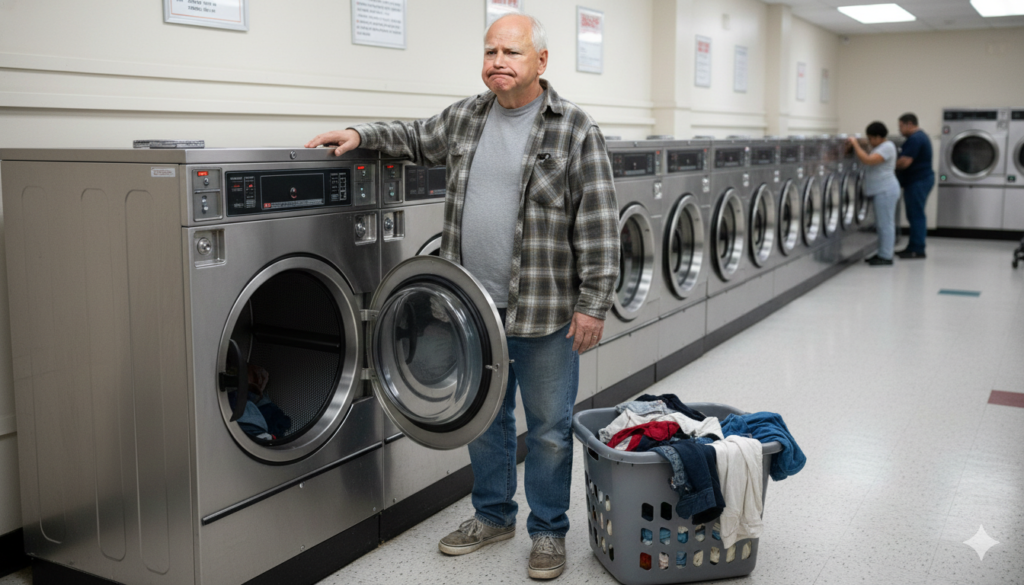
All washed up?
The political obituaries may be premature, but Tim Walz’s future in Minnesota politics has become markedly cloudier following his failed vice-presidential bid alongside Kamala Harris. As Governor of Minnesota, Walz now faces a critical question that haunts many career politicians: What happens when the political music stops?
According to recent reporting, Walz finds himself in an increasingly precarious position. His approval ratings have sagged, with one poll showing him underwater at 46% approval versus 48% disapproval—a troubling sign for any incumbent governor. More concerning still, a November survey revealed he would lose a hypothetical rematch against his 2022 opponent, Dr. Scott Jensen, by three points. For a politician who has spent nearly his entire adult professional life in elected office, these numbers raise an uncomfortable question: Does Tim Walz have anywhere else to go?
A Career Trajectory Rooted in Public Service
To understand Walz’s predicament, it is essential to examine his professional history. After graduating from Chadron State College in Nebraska, Walz joined the Army National Guard in 1981, serving for 24 years before retiring in 2005. He simultaneously worked as a high school teacher, primarily teaching geography and coaching football at Mankato West High School in Minnesota. By all accounts, he was well-regarded in both capacities—the kind of teacher-coach who made an impression on students and the type of guardsman who rose to the rank of Command Sergeant Major.
Yet this is where Walz’s private-sector experience essentially ends. In 2006, he launched his political career by challenging incumbent Republican Congressman Gil Gutknecht in Minnesota’s First Congressional District. His victory marked the beginning of a 12-year congressional career, followed by his election as governor in 2018 and reelection in 2022.
The math is sobering: Walz has been a full-time politician for nearly two decades. His last non-political employment ended around 2006, when he was in his early fifties. He’s now 60 years old.
The Skills Gap That Plagues Political Veterans
Modern politics demands a unique skill set: fundraising acumen, media savvy, the ability to navigate bureaucratic complexities, and a talent for coalition building. These are valuable capabilities, but they don’t always translate seamlessly into private enterprise or even non-political public service.
Walz’s resume does include some potentially transferable assets. His military background demonstrates leadership and organizational skills. His teaching experience shows he can communicate complex ideas and work with diverse populations. His six terms in Congress and time as governor indicate he can manage large organizations and understand policy intricacies.
But here’s the challenge: Teaching positions for 60-year-olds who’ve been absent from the classroom for two decades are scarce. Private companies seeking executives typically want current industry experience, not someone whose last relevant work was managing a high school football team nearly 20 years ago. The corporate world rarely clambers for politicians whose names are now politically divisive.
The Traditional Exit Ramps
Career politicians typically have several well-worn paths when electoral prospects dim. The most lucrative involves lobbying—where political connections and policy knowledge command premium rates. Walz certainly has relationships in both Washington and St. Paul that could prove valuable to corporations, trade associations, or advocacy groups seeking to influence legislation.
Yet this route carries significant reputational risk. Walz has positioned himself as a progressive champion, a “folksy” Midwesterner who connects with working-class voters. Cashing in as a lobbyist for pharmaceutical companies, tech giants, or financial institutions would undermine that carefully crafted image and likely close doors to other options.
The academic circuit offers another possibility. Universities occasionally appoint former governors to teaching positions or administrative roles, particularly at schools of public policy or political science departments. The University of Minnesota or one of the state’s private colleges might find value in Walz’s experience. However, these positions typically pay substantially less than a governor’s salary, and competition is fierce among displaced politicians seeking soft landings.
Think tanks and nonprofit organizations represent a third avenue. Organizations aligned with Democratic priorities might welcome Walz’s expertise on education policy, veterans’ issues, or Midwestern politics. The Aspen Institute, the Center for American Progress, or similar institutions have historically provided homes for former elected officials. Yet these roles often function as expensive sinecures—respectable but not particularly influential or financially rewarding.
The Presidential Pipeline Problem
Walz’s national profile theoretically positions him for federal appointments in a future Democratic administration. His military service could make him a candidate for Secretary of Veterans Affairs. His educational background might suggest the Department of Education. His gubernatorial experience could translate to various cabinet positions.
However, his performance during the 2024 vice-presidential campaign complicates this scenario considerably. Multiple gaffes, questionable statements about his military record, and ineffective debate performances raised doubts about his readiness for national leadership. A botched VP run rarely enhances one’s résumé for subsequent high-level appointments.
The Minnesota Factor
Geography further constrains Walz’s options. He’s built his entire career in Minnesota, where his family has deep roots. Relocating to Washington for a lobbying career or to a coastal city for a think tank position would require uprooting his life. At 60, such moves become increasingly difficult, particularly when they involve leaving behind political relationships that represent his primary professional capital.
Minnesota’s political landscape offers limited alternatives within the state. Both Senate seats are held by Democrats unlikely to retire soon. Other statewide offices require winning elections—precisely what current polling suggests might elude him. Appointment to a state position under a successor seems unlikely, given the ambitions of other DFL politicians positioning themselves for advancement.
The Harris Comparison
Walz shares certain vulnerabilities with Kamala Harris, his running mate in 2024. Both built careers almost entirely within government. Both struggled when thrust onto the national stage. Both face uncertain futures now that their presidential ambitions have been derailed. The difference is that Harris retains her Senate seat through 2029, providing a secure platform and income. Walz’s governorship expires in 2027, with reelection appearing increasingly doubtful.
Brutal.
The walls are literally caving in on Tim Walz.
Odds of the Minnesota governor being charged with a federal crime before 2027 are now at 30%—and House Oversight Chairman James Comer is turning up the heat.
Comer is preparing to bring state employees forward as… https://t.co/6cnRmXA29J pic.twitter.com/Z0oPkllpg1
— Overton (@overton_news) December 29, 2025
The uncomfortable reality is that Tim Walz exemplifies a common political phenomenon: the officeholder whose skills, experience, and professional identity are so thoroughly intertwined with electoral politics that transitioning to private life becomes exceptionally difficult. Unlike governors who came from business backgrounds, legal careers, or other professions to which they could return, Walz faces a landscape where his most marketable asset—his political experience—may be rapidly depreciating.
Whether through lobbying, academia, nonprofits, or some hybrid arrangement, Walz will likely land somewhere. Career politicians rarely end up destitute. But the question isn’t whether he’ll find employment—it’s whether he’ll find work that matches his ambitions, maintains his public image, and provides the influence and income to which he’s become accustomed.
For a man whose entire adult identity has centered on public service and elected office, that remains very much an open question.
This article was generated with the assistance of artificial intelligence tools. While efforts have been made to ensure accuracy and relevance, the content reflects AI-generated insights, but it has been carefully edited by this author.