
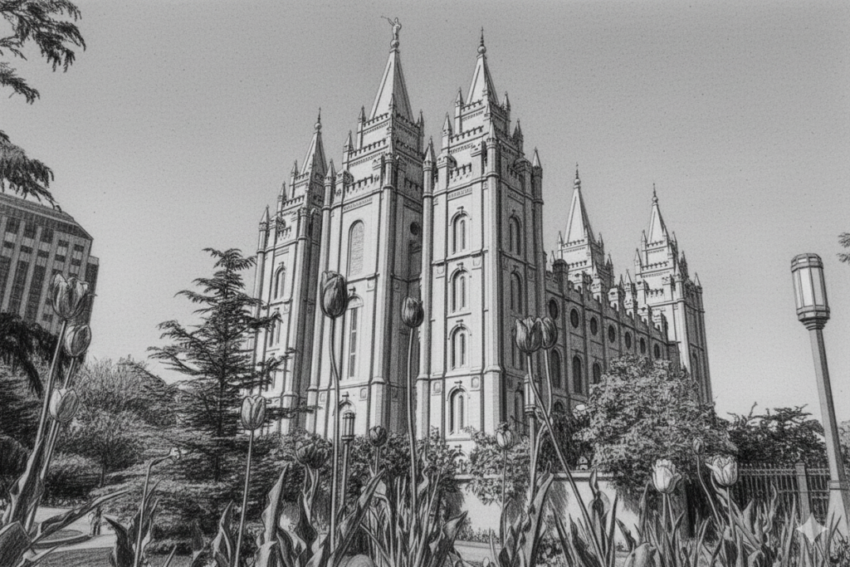
The relationship between The Church of Jesus Christ of Latter-day Saints (LDS) and traditional Christianity remains one of the most debated topics in comparative religion. While members of the LDS Church increasingly identify as Christian—particularly since the heightened public visibility during Mitt Romney’s 2012 presidential campaign—significant theological differences persist that warrant careful examination. This analysis explores four fundamental areas where Mormon doctrine diverges from historic Christian teaching, drawing on authoritative LDS sources and biblical texts to demonstrate why many theologians and church historians conclude these represent incompatible belief systems.
Historical Context: The LDS Church’s Evolving Relationship with Christianity
The foundational narrative of Mormonism begins with Joseph Smith’s reported First Vision, traditionally dated to 1820. According to Smith’s account, recorded in the Pearl of Great Price, he asked God which church he should join. The response he claimed to receive was unequivocal: he must join none of them, “for they were all wrong” and “all their creeds were an abomination in his sight” (Joseph Smith—History 1:19).
This decisive rejection of existing Christianity appears throughout early LDS scripture and teaching. The Book of Mormon text in 1 Nephi 14:10 presents a stark binary: “Behold there are save two churches only; the one is the church of the Lamb of God, and the other is the church of the devil.” Early LDS leadership consistently interpreted this to mean that only their restored church represented God’s true kingdom.
Brigham Young, Smith’s successor and second president of the LDS Church, articulated this position forcefully in his Journal of Discourses sermons. He characterized traditional Christianity as spiritually bankrupt and described Christian ministers as lacking divine authority. John Taylor, the third LDS president, similarly dismissed Christian theology in harsh terms, questioning the coherence of traditional Trinitarian doctrine.
However, scholarly observers have noted a significant shift in LDS public messaging over recent decades. Dr. Richard Mouw, former president of Fuller Theological Seminary, documented this evolution in his book “Talking with Mormons,” noting increased LDS emphasis on shared values with evangelical Christianity. The 2012 Romney campaign represented a watershed moment, forcing both LDS members and evangelical Christians to navigate questions about theological compatibility versus political pragmatism.
Religious studies professor Jana Riess, in her work on Mormon identity, has demonstrated through survey data that younger LDS members increasingly view their faith as fully Christian, representing a generational shift from the more separatist stance of earlier periods. This rebranding, while politically and socially strategic, raises questions about consistency with foundational LDS teachings.
The Testimony of LDS Leadership: A Different Christ
Perhaps no statement better crystallizes the theological divide than Gordon B. Hinckley’s 1998 declaration. As the fifteenth president of the LDS Church, Hinckley told a congregation: “The traditional Christ of whom they speak is not the Christ of whom I speak. For the Christ of whom I speak has been revealed in this the dispensation of the fulness of times.”
This admission carries profound implications. The Apostle Paul’s warning in 2 Corinthians 11:4 addresses precisely this concern: “For if he that cometh preacheth another Jesus, whom we have not preached, or if ye receive another spirit, which ye have not received, or another gospel, which ye have not accepted, ye might well bear with him.” Paul’s subsequent verses make clear that proclaiming “another Jesus” constitutes a serious departure requiring correction, not tolerance.
The distinction Hinckley acknowledged stems from fundamental differences in Christ’s nature and origins. Biblical Christianity, rooted in texts like John 1:1-3 and Colossians 1:15-17, presents Jesus as the eternal Word who existed “in the beginning with God” and through whom “all things were made.” The historic Christian creeds, from Nicaea (325 AD) to Chalcedon (451 AD), affirm Christ as “eternally begotten of the Father, God from God, Light from Light, true God from true God.”
LDS theology, by contrast, teaches a fundamentally different Christology. According to standard LDS doctrine found in works like “Gospel Principles” and articulated by apostles such as Bruce R. McConkie, Jesus Christ was the firstborn spirit child of Heavenly Father in a pre-mortal existence. LDS teaching holds that Christ progressed to godhood through obedience and achievement, representing an exalted man who became divine rather than the eternal Creator who became incarnate.
Doctrinal Difference One: Christ’s Marital Status
Traditional Christianity has consistently understood Jesus as unmarried throughout his earthly ministry. The Gospel accounts, while providing detailed genealogies tracing Joseph’s lineage (Matthew 1) and noting Jesus’ mother and siblings (Mark 6:3), contain no mention of a wife. This silence is particularly significant given the Jewish cultural context, where marriage was normative, and its absence would be noteworthy.
Early LDS teaching, however, proposed that Jesus must have been married based on theological necessity rather than historical evidence. Orson Hyde, a member of the Quorum of the Twelve Apostles, stated in 1857 that Jesus was married at the wedding feast in Cana, with Mary, Martha, and potentially others as his wives. This teaching stems from the LDS doctrine of “exaltation”—the belief that celestial marriage is essential for achieving the highest degree of glory in the afterlife.
Joseph F. Smith, sixth president of the LDS Church, when asked directly, “Was Jesus married?” reportedly answered “Yes,” but advised that this should not be publicly taught. Orson Pratt, another LDS apostle, wrote that Jesus “had a fulness of the glory of the Father” and therefore “had to become the husband of Mary and Martha, and the other Mary.”
This teaching creates tension with biblical passages that emphasize spiritual rather than physical union with Christ. Paul’s first letter to the Corinthians addresses immoral sexual relationships by stating, “he which is joined to an harlot is one body,” but contrasts this with “he that is joined unto the Lord is one spirit” (1 Corinthians 6:16-17). The New Testament consistently presents the church as Christ’s bride in metaphorical, spiritual terms (Ephesians 5:25-32, Revelation 19:7-9), never suggesting literal marriage.
Contemporary LDS sources have largely ceased emphasizing this teaching publicly, though it remains part of the historical record and has not been officially repudiated.
Doctrinal Difference Two: Christ’s Relationship to Satan
Biblical Christianity teaches an absolute ontological distinction between Creator and creation. Jesus, identified with the divine Word in John’s prologue, created all things: “All things were made by him; and without him was not any thing made that was made” (John 1:3). Colossians 1:16 expands this comprehensive creative act: “For by him were all things created, that are in heaven, and that are in earth, visible and invisible, whether they be thrones, or dominions, or principalities, or powers: all things were created by him, and for him.”
This includes Satan, understood in biblical theology as a created angelic being who rebelled against God. Isaiah 14 and Ezekiel 28, traditionally interpreted as references to Satan’s fall, present a created being whose pride led to expulsion from God’s presence. Jesus himself references Satan’s fall in Luke 10:18, and Revelation 12:7-9 describes the war in heaven resulting in Satan’s casting down to earth.
LDS scripture and teaching present a dramatically different account. The Pearl of Great Price book of Abraham, chapter 3, describes a pre-mortal council where God presents His plan for human salvation. Two spirit sons volunteer: one who would become Jesus Christ, and Lucifer. According to the Book of Moses 4:1-4, Lucifer’s proposal was rejected, leading to his rebellion and the war in heaven described in LDS theology.
Brigham Young taught this explicitly: “Jesus Christ and Lucifer, the son of the morning, are brothers.” This teaching appears in various LDS sources and remains part of standard LDS understanding of pre-mortal existence. The official LDS website Gospel Topics essay on “Becoming Like God” acknowledges that LDS doctrine teaches all humanity, including Jesus and Satan, are spirit children of Heavenly Father, though it emphasizes that Jesus is the “Firstborn” and unique in His divine role.
This teaching fundamentally alters Christ’s nature from uncreated Creator to fellow creature, albeit the most exalted. It removes the infinite qualitative distinction between God and creation that characterizes biblical theism.
Doctrinal Difference Three: The Nature of Christ’s Conception
The virgin birth stands as a cornerstone doctrine of historic Christianity, affirmed in the Apostles’ Creed (“born of the Virgin Mary”) and grounded in biblical prophecy and narrative. Isaiah 7:14 prophesied that “a virgin shall conceive, and bear a son,” using the Hebrew term “almah.” Matthew 1:23 applies this prophecy to Jesus, employing the Greek “parthenos” (virgin), and explains that Mary’s pregnancy occurred “before they came together” through the Holy Spirit (Matthew 1:18).
Luke’s account provides Mary’s own testimony to the supernatural nature of this conception. When the angel Gabriel announces she will bear a son, Mary responds, “How shall this be, seeing I know not a man?” (Luke 1:34). The angel explains that “The Holy Ghost shall come upon thee, and the power of the Highest shall overshadow thee” (Luke 1:35). This language emphasizes divine intervention rather than natural procreation.
Early LDS leaders, however, taught that God the Father physically procreated with Mary. Brigham Young stated: “The birth of the Saviour was as natural as are the births of our children; it was the result of natural action. He partook of flesh and blood—was begotten of his Father, as we were of our fathers.”
Heber C. Kimball, first counselor in the First Presidency under Brigham Young, taught similarly: “In relation to the way in which I look upon the works of God and his creatures, I will say that I was naturally begotten; so was my father, and also my Saviour Jesus Christ. According to the Scriptures, he is the first begotten of his father in the flesh, and there was nothing unnatural about it.”
Joseph Fielding Smith, tenth president of the LDS Church, wrote in “Doctrines of Salvation”: “Christ was begotten of God. He was not born without the aid of Man, and that Man was God!”
This teaching directly contradicts the biblical narrative’s emphasis on supernatural conception as the means by which the divine Son took on human nature without inheriting sin through natural generation—a key component of orthodox Christology as articulated by theologians from Athanasius to contemporary systematic theologians.
Doctrinal Difference Four: Christ’s Birthplace
The prophet Micah, writing approximately 700 years before Christ’s birth, specified: “But thou, Bethlehem Ephratah, though thou be little among the thousands of Judah, yet out of thee shall he come forth unto me that is to be ruler in Israel” (Micah 5:2). This prophecy’s fulfillment in Jesus’ birth at Bethlehem is recorded in Matthew 2:1-6 and Luke 2:4-7, with Matthew explicitly citing Micah’s prophecy as fulfilled.
The specificity of Bethlehem as Christ’s birthplace held theological significance for first-century Judaism. John 7:42 records the Jewish expectation: “Hath not the scripture said, That Christ cometh of the seed of David, and out of the town of Bethlehem, where David was?” This connection to David’s city established Jesus’ credentials as the promised Davidic king.
The Book of Mormon, however, contains a problematic statement in Alma 7:10, where the prophet Alma declares: “And behold, he shall be born of Mary, at Jerusalem, which is the land of our forefathers.” Bethlehem lies approximately six miles south of Jerusalem—a distinct town, not a suburb or region of Jerusalem in biblical geography.
LDS apologists have attempted various explanations, suggesting “land of Jerusalem” referred to a broader region. However, this strains the text’s plain reading and contradicts how ancient texts, including other Book of Mormon passages, typically reference Jerusalem. The Book of Mormon itself distinguishes between cities and lands (e.g., “city of Nephi” versus “land of Nephi”), making Alma’s phrasing particularly significant.
Biblical scholar Craig Blomberg notes that while ancient texts sometimes use imprecise geographical references, the specificity of Micah’s prophecy and the Gospel accounts’ emphasis on Bethlehem make this distinction meaningful. The discrepancy becomes especially problematic given that Alma 7:10 also affirms the virgin birth, suggesting the author understood Jesus’ birth as a significant theological event worthy of precise detail.
Conclusion: Irreconcilable Theological Systems
These four doctrinal differences—alongside the broader theological framework they represent—demonstrate why many biblical scholars and church historians conclude that Mormonism and traditional Christianity constitute distinct religious systems rather than variations within Christian orthodoxy.
The Nicene Creed, formulated in 325 AD and accepted by Catholic, Orthodox, and Protestant traditions, establishes boundaries for Christian theology: Christ as “eternally begotten of the Father,” “true God from true God,” through whom “all things were made.” These affirmations stand in direct contradiction to LDS teachings about Christ’s created status, progression to godhood, and brotherhood with Satan.
As Gordon B. Hinckley himself acknowledged, the Christ proclaimed in LDS teaching differs fundamentally from the Christ of historic Christianity. Paul’s warning in 2 Corinthians 11:4 about accepting “another Jesus” suggests this is not a trivial distinction but a matter affecting the gospel’s core. The biblical call remains to test teachings against apostolic doctrine (1 John 4:1-3) and to contend earnestly for “the faith which was once delivered unto the saints” (Jude 1:3).
Understanding these differences serves not to attack Latter-day Saints as individuals—who deserve respect and honest dialogue—but to clarify that despite shared terminology, the theological content differs substantially. Those seeking to follow the biblical Christ must recognize these distinctions and evaluate competing truth claims accordingly, choosing faithfulness to apostolic teaching over contemporary cultural accommodation.