
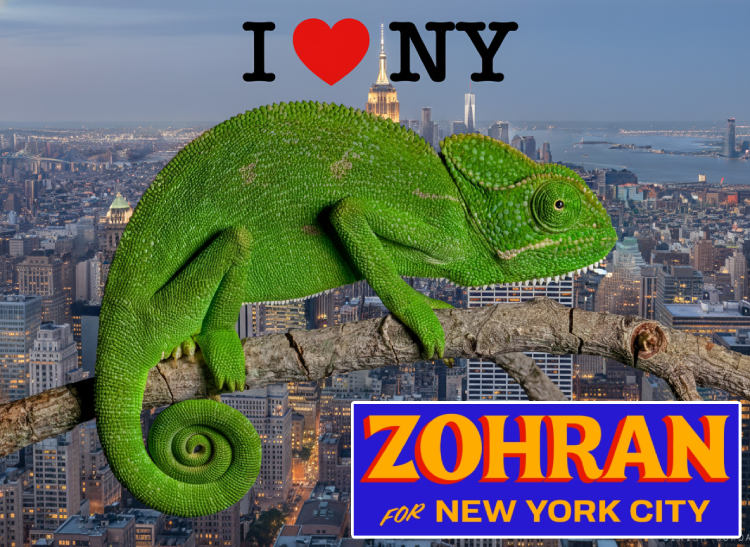
A “religious chameleon” describes someone who changes their religious expression, beliefs, or behavior to fit different social situations or groups, often seen negatively as lacking genuine conviction, being hypocritical, or conforming too much to worldly culture. The term usually implies a shallow faith that prioritizes acceptance over truth, leading to inconsistent actions between church and secular settings.
THE QURAN QUESTION: Examining
Zohran Mamdani’s Faith and Political Identity
Does New York’s New Mayor Truly Believe, or Was His Inauguration Ceremony Merely Political Theater?
When Zohran Mamdani placed his hands on two Qurans at the stroke of midnight on January 1, 2026, becoming New York City’s first Muslim mayor in a decommissioned subway station beneath City Hall, he crystallized a question that has dogged his meteoric political rise: Is his Islamic faith genuine religious conviction, or strategic political branding?
The 34-year-old democratic socialist’s inaugural ceremony was laden with symbolism—his grandfather’s Quran alongside a centuries-old manuscript from the New York Public Library’s Schomburg Center. Later that day, he added his grandmother’s Quran for the public ceremony at City Hall, where Senator Bernie Sanders administered the oath. The carefully curated imagery projected authenticity, heritage, and historical consciousness.
But beneath the pageantry lies a more complex reality that raises legitimate questions about religious consistency and political authenticity.
The Theological Disconnect
Mamdani identifies as a Twelver Shia Muslim—the dominant branch within Shia Islam that forms the theological foundation of Iran’s Islamic Republic. Twelver Shiism holds specific doctrinal positions on governance, sexuality, marriage, and social order derived from centuries of Islamic jurisprudence.
Yet Mamdani’s policy positions contradict nearly every major tenet of orthodox Islamic teaching.
On LGBTQ issues, Mamdani has been unequivocal in his support. He regularly attends Pride events, has been photographed “jumping up and down with joy while holding a transgender flag,” according to the Catholic League, and supports transgender rights without qualification. This stands in stark opposition to Islamic teaching, which the Quran explicitly condemns homosexual acts and restricts sexual relations exclusively to marriage between a man and a woman.
In May 2023, approximately 150 prominent Muslim leaders across America signed a statement warning: “We urge Muslim public figures to uphold the sanctity of our faith and refrain from making erroneous pronouncements on behalf of Islam. We reject any attempt to attribute positions to Islam concerning sexual and gender ethics that contravene well-established Islamic teachings.”
Mamdani has never addressed this theological contradiction publicly.
On assisted suicide, Mamdani has voted for every “medical aid in dying” bill during his tenure in the State Assembly. Islamic jurisprudence across all schools—Sunni and Shia—categorically prohibits suicide and the taking of innocent life, viewing human existence as sacred and belonging to Allah alone. Yet Mamdani’s votes consistently prioritize secular autonomy over Islamic prohibitions.
The Interfaith Complication
Mamdani’s religious identity is further complicated by his upbringing in an interfaith household. His mother, acclaimed filmmaker Mira Nair, is Hindu. Mamdani has acknowledged growing up celebrating Diwali, Holi, and Raksha Bandhan, stating: “Though I identify as Muslim, these Hindu traditions and practices have shaped my worldview.”
This raises questions about the depth and nature of his Islamic commitment. Did Mamdani actively choose Islam through personal conviction, or did he strategically emphasize his father’s faith for political advantage in a city with significant Muslim populations?
Dr. Dilip Amin, writing for Patheos, observed: “Despite his parents’ largely secular and interfaith union—reflected in their religiously distinct first names and overall non-religious outlook—Zohran has adopted a more clearly defined religious identity. Whether his religious identification stems from personal conviction or is shaped in part by political considerations remains open to interpretation.”
New York’s Hindu community has noticed. Many view Mamdani as anti-Hindu, citing his description of Indian Prime Minister Narendra Modi as a “war criminal”—a politically charged position that aligns with his progressive coalition but alienates Hindu constituents who might otherwise support a candidate of Indian heritage.
The Campaign Calculation
The question of authenticity becomes more acute when examining Mamdani’s campaign strategy. By his own admission, he was “discreet about his Shia Muslim identity” for years. His attendance at Jummah prayers and mosques across New York’s five boroughs accelerated dramatically during his mayoral campaign.
This pattern—selective religious visibility timed with political ambition—suggests calculation rather than consistent devotion. Mohamed Gula of Emgage Action, which mobilizes Muslim voters and endorsed Mamdani, celebrated his victory as proof of Muslim political influence. “Our communities showed up,” Gula stated, noting that Mamdani’s campaign conducted extensive canvassing operations at mosques.
The Muslim vote was clearly pivotal. But the question remains: Was Mamdani mobilizing his faith community, or leveraging it?
The Ideological Contradiction
Perhaps most troubling is the fundamental tension between Mamdani’s democratic socialist ideology and Islamic governance principles. As detailed in my earlier article examining this theological dilemma, classical Islamic jurisprudence holds that sovereignty belongs exclusively to Allah, with governance ideally following Sharia law. The Quran explicitly states that “legislation belongs to Allah alone” (12:40).
Democratic socialism, by contrast, vests ultimate authority in collective human decision-making through democratic processes. This represents an irreconcilable philosophical divide. A devout Muslim committed to Sharia principles cannot simultaneously embrace a governance system that derives legitimacy from popular sovereignty rather than divine command.
Mamdani has never addressed this tension. His political platform—universal childcare, city-owned grocery stores, rent freezes, and a $30 minimum wage—represents thoroughly secular progressive politics with no discernible Islamic foundation. Where is the distinctly Islamic vision for governance?
The Iranian Connection
Mamdani’s identification with Twelver Shiism carries additional significance. This branch of Islam provides the theological basis for Iran’s Islamic Republic and the doctrine of Wilayat al-Faqih (Guardianship of the Islamic Jurist)—the principle that religious scholars should exercise political authority in the absence of the Hidden Imam.
While Mamdani has condemned dictatorships in Venezuela and Cuba, he has not addressed Iran’s theocratic governance structure or its systematic oppression of women, religious minorities, and LGBTQ individuals—policies that flow directly from the same Twelver Shiism he claims to practice.
This selective outrage reveals either theological ignorance or political opportunism.
The Islamophobia Shield
When opponents during the campaign questioned Mamdani’s religious positions or raised concerns about Islamic governance principles, he consistently deflected by invoking Islamophobia. A pro-Cuomo mailer that darkened Mamdani’s beard was condemned as “blatant Islamophobia.” Republican Curtis Sliwa’s accusations that Mamdani supported “global jihad” were dismissed as racist fear-mongering.
While some attacks were indeed inflammatory and inappropriate, the Islamophobia charge became a catch-all defense against legitimate theological scrutiny. U.S. Senator Tommy Tuberville’s post-inauguration comment—”The enemy is inside the gates”—was extreme and unhelpful. But it doesn’t invalidate questions about how Mamdani reconciles his faith claims with his policy positions.
Religious consistency matters in public life. Americans regularly examine how Christian politicians’ personal faith aligns with their policy positions. The same scrutiny should apply to Muslim candidates—not because Islam is foreign or threatening, but because intellectual honesty demands consistency between professed beliefs and political action.
The Substance Question
Perhaps the most revealing aspect of Mamdani’s inauguration was what wasn’t said. His inaugural address, delivered to thousands at City Hall, opened with a quote from Eugene Debs, the early 20th-century socialist presidential candidate: “I can see the dawn of a better day for humanity.”
Not the Quran. Not the Prophet Muhammad. Not Islamic teaching on justice, mercy, or community responsibility.
A secular socialist, not a religious figure, provided his inspirational touchstone.
Representative Alexandria Ocasio-Cortez, who delivered opening remarks, framed Mamdani’s mayoralty as a proving ground for progressive politics: “If we can make it here, we can make it anywhere.” This was about exporting democratic socialism, not advancing Islamic principles.
Mamdani himself declared: “I was elected as a democratic socialist, and I will govern as a democratic socialist.” This statement is revealing in what it omits. He didn’t say he would govern as a Muslim, informed by Islamic values. His primary identity, when assuming power, was ideological, not religious.
The Verdict
The evidence suggests Zohran Mamdani is not a faithful zealot committed to Islamic orthodoxy, but rather a progressive politician of Muslim heritage who has strategically emphasized his religious identity for political advantage while systematically rejecting Islamic teaching on virtually every major social issue.
This doesn’t make him hypocritical in the traditional sense—many Muslims in America navigate their faith with flexibility, emphasizing ethical principles over rigid adherence to classical jurisprudence. But it does raise questions about authenticity when religious symbolism is deployed so prominently in public ceremony while religious substance remains conspicuously absent in policy positions.
The three Qurans at his inauguration were indeed theatrical stagecraft—powerful symbols carefully selected for their historical resonance and political optics. What they weren’t was evidence of deep religious commitment shaping governance philosophy.
If Mamdani truly believes in the Quran he swore upon, he must eventually address the yawning gap between Islamic teaching and progressive politics. If he doesn’t believe—if his Muslim identity is primarily cultural and ethnic rather than theological—then he should be honest about that reality rather than leveraging religious imagery for political gain.
New Yorkers deserve clarity. They elected a democratic socialist who happens to be Muslim. What they didn’t elect—and what Mamdani has never claimed to be—is an Islamic leader who will govern according to religious principles.
The question isn’t whether Mamdani can serve effectively. It’s whether he will serve honestly—acknowledging that his political identity has decisively superseded his religious one, despite the symbolism of his inauguration.
Time will tell whether the Qurans were props or principles. But the early evidence points decidedly toward the former.
Dennis Robbins operates Righteous Cause. He is a former law enforcement deputy and serves in ministry leadership at East Valley International Church in Gilbert, Arizona.