
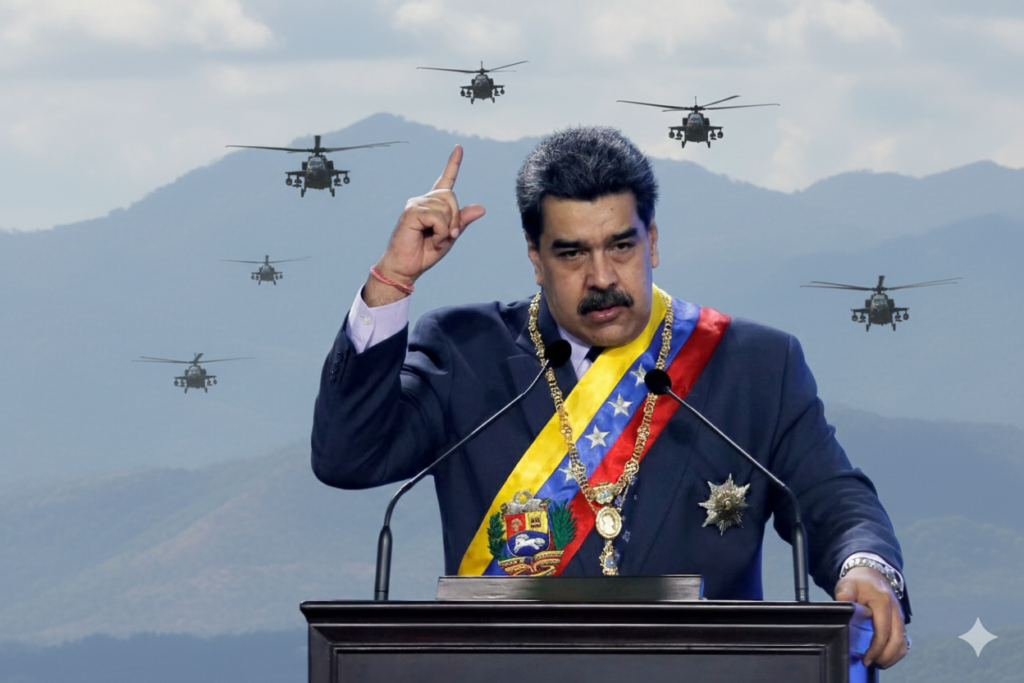
You might wanna look out the window, champ.
An investigation into the systematic dismantling of
democracy in Latin America’s once-prosperous nation
In December 2024, as Venezuelans prepared for what should have been a democratic transition of power, Nicolás Maduro did what dictators do: he arrested over 100 opposition members, declared himself the winner of fraudulent elections, and tightened his grip on a nation he’s systematically destroyed.
This wasn’t new behavior. It was merely the latest chapter in a decade-long masterclass in authoritarian consolidation that has transformed Venezuela from South America’s wealthiest nation into a failed state where seven million citizens have fled—the largest refugee crisis in the Western Hemisphere’s modern history.
The Coronation of a Bus Driver
Maduro’s ascension in 2013 following Hugo Chávez’s death was more coronation than election. A former bus driver and union organizer with minimal formal education, Maduro inherited Chávez’s “Bolivarian Revolution” but lacked his predecessor’s charisma and populist touch. What he possessed instead was ruthlessness and the backing of Cuba’s intelligence apparatus, which had embedded itself deeply within Venezuela’s security forces.
His first “victory” in 2013—winning by just 1.5% amid widespread allegations of fraud—set the pattern. When opposition leaders demanded an audit, Maduro’s government ignored them. When protesters took to the streets, his forces killed them. The international community issued concerned statements. Maduro learned a crucial lesson: democracies would wring their hands while he consolidated power.
Blueprint for Dictatorship: Destroying Democratic Institutions
Maduro’s authoritarian playbook followed a depressingly familiar script, executed with mechanical efficiency:
Judiciary Capture: In 2015, after the opposition won a supermajority in the National Assembly, Maduro simply neutered it. The Supreme Court—packed entirely with regime loyalists—declared virtually every Assembly action unconstitutional. When that wasn’t enough, Maduro created a parallel “Constituent Assembly” in 2017, giving himself a rubber-stamp legislature that bypassed the elected one entirely.
Media Annihilation: Independent media outlets faced a systematic campaign of harassment, license revocations, and outright seizure. Journalists critical of the regime were arrested on terrorism charges. By 2020, Venezuela ranked 148th out of 180 countries in press freedom. State media became pure propaganda arms, while private outlets learned self-censorship or faced destruction.
Electoral Fraud Perfected: The 2018 presidential election represented the complete abandonment of democratic pretense. Major opposition candidates were banned from running. Voting machines were manipulated. Maduro “won” with 68%—in an election boycotted by the opposition and condemned as illegitimate by the U.S., EU, and most Latin American nations. The National Electoral Council, supposedly independent, functioned as Maduro’s electoral arm.
The 2024 elections followed the same script. Despite overwhelming evidence that opposition candidate Edmundo González won decisively, Maduro’s electoral council declared him the victor without releasing precinct-level results. When González had to flee to Spain to avoid arrest, Maduro proved once again that “elections” under dictatorship are mere theater.
The Machinery of Repression
What distinguishes modern dictatorship from historical versions is the sophistication of its repression. Maduro hasn’t just relied on crude violence—though there’s been plenty of that.
The regime employs the SEBIN (Bolivarian Intelligence Service) and DGCIM (military counterintelligence) as domestic terror organizations. They’ve perfected techniques learned from Cuban handlers: targeted assassinations disguised as accidents, disappearances, torture centers hidden in military installations. Political prisoners endure conditions designed to break them psychologically before they break physically.
The colectivos—regime-armed paramilitary groups—provide plausible deniability. When protesters need to be terrorized, these motorcycle gangs do the dirty work while Maduro’s government claims they’re “spontaneous” pro-government supporters. Thousands of documented cases reveal their role in murders, rapes, and disappearances of opposition members.
Most insidiously, Maduro weaponized hunger. The CLAP system—government food distribution boxes—goes preferentially to regime supporters, tracked through the “Carnet de la Patria” (homeland card). Vote wrong or protest, and your family starves. It’s social control through desperation, turning survival itself into a loyalty test.
The Cult of Chávez’s Ghost
Unable to generate genuine popular support, Maduro wrapped himself in Chávez’s legacy, creating a bizarre political necromancy. Giant murals of Chávez cover Caracas. Maduro claims to receive messages from Chávez’s spirit in the form of a little bird. State television endlessly replays Chávez footage, while Maduro poses as the faithful heir.
This isn’t mere propaganda—it’s the classic dictatorial cult of personality adapted for a leader without personality. By tethering himself to Venezuela’s last genuinely popular leader, Maduro attempts to inherit the legitimacy he never earned.
The Catastrophic Cost
The results speak for themselves:
- GDP has collapsed by 75% since 2013
- Inflation exceeded one million percent in 2018
- Average Venezuelans lost 24 pounds due to food scarcity in what’s grimly called “the Maduro diet”
- Seven million refugees have fled—roughly 25% of the population
- Healthcare system has essentially ceased functioning
- Basic services like electricity and water are intermittent luxuries
Venezuela sits atop the world’s largest oil reserves, yet its citizens queue for hours for rationed gasoline. It’s not incompetence—it’s the inevitable outcome when dictatorship prioritizes power over governance.
The International Community’s Failure
Perhaps most damning is how Maduro has survived despite his isolation. Sanctioned by the U.S. and EU, condemned by most democratic nations, he endures through a survival coalition: Cuba provides intelligence expertise, China offers economic lifelines in exchange for oil, Russia supplies weapons and diplomatic cover, and Iran shares technology for sanction-evasion.
This authoritarian alliance enables Maduro’s continued rule while democratic nations issue statements and impose sanctions that hurt ordinary Venezuelans more than regime leaders.
Conclusion: Democracy Doesn’t Die Overnight
Maduro’s dictatorship offers a sobering lesson: democracy dies through a thousand cuts, each one justified as necessary, temporary, or defensive. First, you delegitimize opposition as “terrorists.” Then you capture courts. You control information flow. You make dissent dangerous and survival dependent on loyalty. Finally, you drop the pretense entirely.
Venezuela had democratic institutions, a civil society, and an educated population. Maduro dismantled it all in a decade. His regime stands as both a warning and a blueprint—proof that dictatorship can flourish even in the 21st century when the international community treats tyranny as a policy problem rather than a moral imperative.
The question isn’t whether Maduro is a dictator. The evidence is overwhelming. The real test ahead is whether the United States will be supported by democratic nations worldwide in holding tyrants accountable, or retreat into comfortable neutrality.