
A Comparative Theological Analysis:
“Are Mormons Christian?” Series
Introduction
The question of human origins, the nature of the cosmos, and the relationship between Creator and creation stand at the very heart of Christian theology. For nearly two millennia, the Church has articulated a coherent understanding of these matters, drawing upon Scripture, the apostolic witness, and the careful deliberations of ecumenical councils. The emergence of the Latter-day Saint movement in nineteenth-century America, however, introduced a radically different cosmological framework—one that, despite sharing certain Christian vocabulary, represents a fundamental departure from the theological heritage received from Christ and the apostles.
This article undertakes a systematic examination of LDS teachings concerning cosmology and the pre-existence of souls, placing these doctrines in conversation with orthodox Christian theology as articulated in Scripture and developed through the patristic tradition. The analysis proceeds not from a posture of antagonism but from a commitment to theological clarity—recognizing that the differences between these two systems are not merely peripheral but touch upon the most fundamental questions of human existence, divine identity, and the nature of salvation itself.
The significance of this comparison extends beyond academic interest. In an age of religious pluralism and ecumenical dialogue, precision in theological language becomes essential. When two traditions employ similar terminology while investing those terms with radically different meanings, confusion inevitably results. The faithful Christian, whether layperson or scholar, must understand not only what the Church has always believed but also why alternative formulations—however sincerely held—constitute departures from the apostolic deposit of faith.
Latter-day Saint Theology of Cosmology and Pre-existence
The Pre-mortal Existence of Human Souls
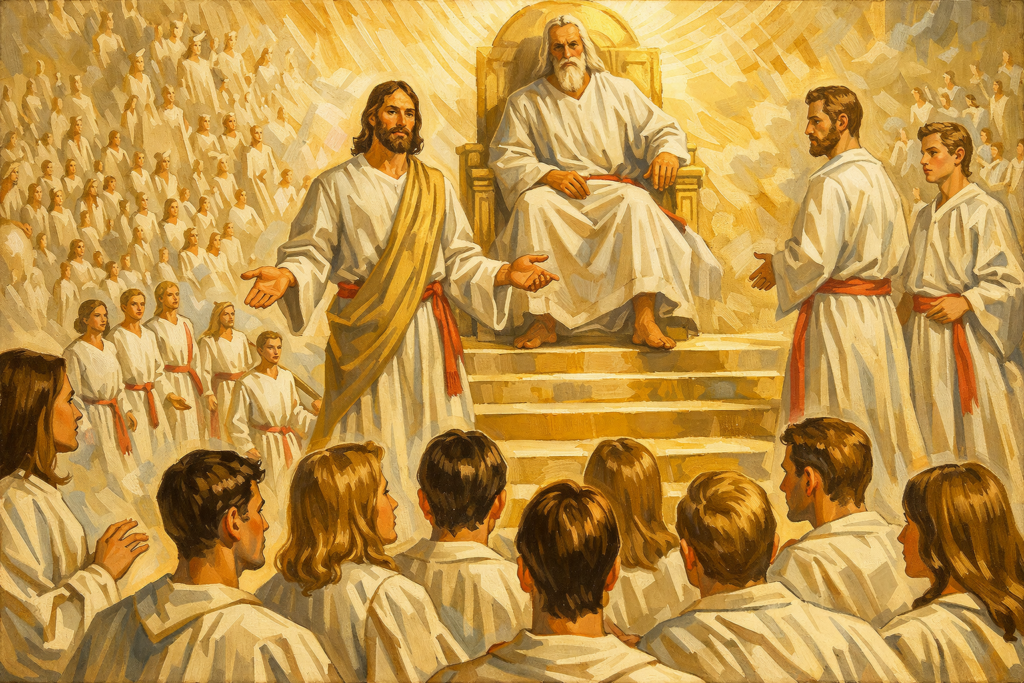
Central to LDS cosmology is the doctrine that all human beings existed as spirit children of Heavenly Parents before their mortal birth. This teaching, absent from traditional Christian theology, posits a pre-mortal realm where intelligences were organized into spirit beings through a process of celestial procreation. The LDS scripture known as the Book of Abraham declares: “Now the Lord had shown unto me, Abraham, the intelligences that were organized before the world was; and among all these there were many of the noble and great ones.” (Abraham 3:22).
Within this pre-mortal existence, LDS theology describes a “war in heaven” in which competing plans for human redemption were presented. According to the Doctrine and Covenants, “an angel of God who was in authority in the presence of God, who rebelled against the Only Begotten Son whom the Father loved and who was in the bosom of the Father, was thrust down from the presence of God and the Son, and was called Perdition.” (D&C 76:25-26). The Pearl of Great Price elaborates: “Satan… sought to destroy the agency of man, which I, the Lord God, had given him, and also, that I should give unto him mine own power; by the power of mine Only Begotten, I caused that he should be cast down.” (Moses 4:3).
Those spirits who remained faithful during this cosmic conflict were permitted to receive mortal bodies and enter into the probationary state of earthly existence. Those who followed Satan in his rebellion were denied this privilege, becoming the demons who now afflict humanity. This framework fundamentally shapes LDS soteriology, anthropology, and ethics, establishing human existence as a continuation of choices made in a pre-mortal sphere.
Matter as Eternal and Uncreated
Equally distinctive is the LDS teaching that matter itself is eternal and uncreated. The Doctrine and Covenants states plainly: “The elements are eternal” (D&C 93:33). Joseph Smith, the founder of the LDS movement, articulated this position with characteristic boldness in his King Follett Discourse: “The pure principles of element are principles which can never be destroyed; they may be organized and reorganized, but not destroyed. They had no beginning, and can have no end.”
This teaching carries profound implications for the doctrine of God. In LDS thought, God did not create the universe ex nihilo—from nothing—but rather organized pre-existing materials into their present form. God is thus understood not as the absolute source of all being but as the supreme organizer of eternal matter. Smith declared: “You ask the learned doctors why they say the world was made out of nothing; and they will answer, ‘Doesn’t the Bible say He created the world?’ And they infer, from the word create, that it must have been made out of nothing. Now, the word create came from the word baurau which does not mean to create out of nothing; it means to organize.”
Joseph Smith’s linguistic claim is demonstrably flawed. The Hebrew word is בָּרָא (bara’), not “baurau,” and while it can describe God organizing or fashioning, its theological significance in Genesis 1:1 lies in its exclusive use for divine activity—bara’ is never predicated of human agents in Scripture. More critically, Smith ignores the broader biblical witness: Hebrews 11:3 explicitly states that “what is seen was not made out of things that are visible,” and Romans 4:17 describes God as one “who calls into existence the things that do not exist.” The doctrine of creatio ex nihilo wasn’t invented by “learned doctors” but emerged from the totality of Scripture’s testimony to God’s absolute sovereignty and ontological distinction from creation—a distinction Mormon theology necessarily collapses by positing eternally existing matter that even God must work within, thereby subordinating the Creator to uncreated stuff.
A Finite, Localized God Within the Universe
Perhaps most striking is the LDS conception of God as a being with a physical body, located in a specific place within the cosmos. The Doctrine and Covenants teaches: “The Father has a body of flesh and bones as tangible as man’s; the Son also.” (D&C 130:22). Early LDS teaching associated God’s dwelling place with the star Kolob, as described in the Book of Abraham: “And I saw the stars, that they were very great, and that one of them was nearest unto the throne of God; and there were many great ones which were near unto it; and the Lord said unto me: These are the governing ones; and the name of the great one is Kolob.” (Abraham 3:2-3).
This corporeal deity exists within the fabric of space and time, subject to the same physical constraints that govern all material beings. God, in LDS thought, is not the transcendent ground of all being but rather an exalted man—a being who achieved divine status through a process of eternal progression. Lorenzo Snow, the fifth president of the LDS Church, famously summarized this doctrine: “As man now is, God once was; as God now is, man may be.”
Overview of Orthodox Christian Doctrine
The Rejection of Pre-existence: Scriptural and Conciliar Witness
The Christian Church has consistently rejected the notion that human souls exist before their bodily conception. While the third-century theologian Origen speculated about the pre-existence of souls, this view was formally condemned at the Second Council of Constantinople in 553 AD. The council’s anathemas include the declaration: “If anyone asserts the fabulous pre-existence of souls, and shall assert the monstrous restoration which follows from it: let him be anathema.”
Scripture itself provides no warrant for belief in pre-mortal existence. Psalm 139:13-16 presents human creation as a unified act in which body and soul come into being together within the mother’s womb: “For you formed my inward parts; you knitted me together in my mother’s womb. I praise you, for I am fearfully and wonderfully made. Wonderful are your works; my soul knows it very well. My frame was not hidden from you, when I was being made in secret, intricately woven in the depths of the earth. Your eyes saw my unformed substance; in your book were written, every one of them, the days that were formed for me, when as yet there was none of them.”
LDS apologists sometimes appeal to Jeremiah 1:5—“Before I formed you in the womb I knew you, and before you were born I consecrated you.”—as evidence of pre-existence. However, careful exegesis reveals this passage to speak of divine foreknowledge and predestination, not pre-mortal existence. God’s eternal knowledge encompasses all things, including those yet to come into being. To know someone “before” their formation speaks to God’s omniscience and sovereign purpose, not to the prior existence of the creature known. The apostle Paul employs similar language in Romans 8:29: “For those whom he foreknew he also predestined to be conformed to the image of his Son.” Foreknowledge here describes God’s eternal awareness and purpose, not a temporal sequence in which souls existed before bodies.
Creation Ex Nihilo: The Foundation of Christian Cosmology
The doctrine of creation ex nihilo—that God brought all things into existence from nothing—stands as one of the most fundamental affirmations of Christian theology. Genesis 1:1 declares: “In the beginning, God created the heavens and the earth.” The New Testament amplifies this testimony. Hebrews 11:3 states: “By faith we understand that the universe was created by the word of God, so that what is seen was not made out of things that are visible.” John 1:3 affirms of the divine Logos: “All things were made through him, and without him was not any thing made that was made.” Colossians 1:16 expands this cosmic vision: “For by him all things were created, in heaven and on earth, visible and invisible, whether thrones or dominions or rulers or authorities—all things were created through him and for him.”
The early Church articulated this doctrine against Greek philosophical systems that assumed the eternity of matter and against Gnostic cosmologies that posited a demiurge working with pre-existing materials. Irenaeus of Lyon, writing in the second century, insisted: “While men cannot make anything out of nothing, but only out of matter already existing, God is in this point preeminently superior to men, that He Himself called into being the substance of His creation, when previously it had no existence.” (Against Heresies 2.10.4). Athanasius similarly affirmed: “God creates, and creating is also ascribed to men; God also has being, and men also have being. Yet did God create as men do? Or is His being as man’s being? Perish the thought!” (De Decretis 11).
The distinction is not merely semantic. If matter is eternal, then God is not truly sovereign over all reality; something exists independently of His creative will. Christian theology affirms that only God is eternal, necessary, and self-existent. Everything else—every particle of matter, every immaterial spirit, every law of nature—derives its existence from His creative decree. As the Nicene Creed confesses, God is the “maker of heaven and earth, of all things visible and invisible.”
Divine Transcendence: God as the Ground of All Being
Orthodox Christianity affirms God’s absolute transcendence—His existence beyond and independent of the created order He has made. This does not mean God is absent from creation but rather that He sustains all things while remaining ontologically distinct from them. The apostle Paul, addressing the Athenian philosophers, declared: “The God who made the world and everything in it, being Lord of heaven and earth, does not live in temples made by man, nor is he served by human hands, as though he needed anything, since he himself gives to all mankind life and breath and everything… ‘In him we live and move and have our being.'” (Acts 17:24-25, 28).
God’s omnipresence means He is not localized in any particular place. As Solomon confessed at the dedication of the Temple: “But will God indeed dwell on the earth? Behold, heaven and the highest heaven cannot contain you; how much less this house that I have built!” (1 Kings 8:27). The prophet Jeremiah records the divine word: “Am I a God at hand, declares the Lord, and not a God far away? Can a man hide himself in secret places so that I cannot see him? declares the Lord. Do I not fill heaven and earth? declares the Lord.” (Jeremiah 23:23-24).
Christian theology, following the witness of Scripture and the reflection of the Church Fathers, understands God not as one being among others—not even the greatest being—but as Being itself, the ground and source of all existence. Thomas Aquinas expressed this classical understanding: God is not ens (a being) but esse ipsum subsistens (subsistent being itself). This is not a philosophical abstraction imposed upon Scripture but rather the necessary implication of texts that present God as the self-existent one who declares, “I AM WHO I AM” (Exodus 3:14).
Comparative Analysis: Irreconcilable Differences
Having surveyed both theological systems, we must now assess the nature and extent of their differences. Some have suggested that LDS theology represents merely a variant expression of Christian faith—an alternative tradition within the broad stream of Christianity. Upon careful analysis, however, this characterization proves untenable. The differences between LDS and orthodox Christian theology are not peripheral matters of practice or emphasis but fundamental divergences concerning the nature of God, the origin of humanity, and the structure of ultimate reality.
Concerning the Nature of God
The contrast could hardly be more stark. Orthodox Christianity confesses one eternal, infinite, omnipresent, incorporeal God—the Creator of all things visible and invisible. LDS theology presents a corporeal deity who exists within the universe, subject to spatial limitation, and who himself emerged from a prior state through a process of eternal progression. These are not two descriptions of the same being but two fundamentally different conceptions of ultimate reality.
The implications are far-reaching. If God is a finite being within the universe, then He cannot be the absolute ground of all existence. Something else—eternal matter, the laws governing eternal progression, the very fabric of space and time—exists independently of His creative will. The God of LDS theology, however exalted, is not the God confessed in the Nicene Creed, the God proclaimed by the prophets and apostles, the God worshiped by the Christian Church through twenty centuries of its existence.
Concerning the Origin of Humanity
In orthodox Christian teaching, human beings are creatures—brought into existence by the creative act of God, bearing His image by divine gift rather than by natural inheritance. We did not exist before our conception; we will exist forever after because God, in His grace, has made us for eternal fellowship with Himself. Our dignity derives not from our participation in some eternal process but from the sovereign love of the Creator who called us into being.
LDS anthropology presents a radically different picture. Human beings are co-eternal with God—our “intelligences” having existed from everlasting. We are spirit children of Heavenly Parents, generated through celestial procreation. Our present mortal state represents one stage in a cosmic journey that began before this world existed and will continue through endless ages of progression. The implications for human identity, moral responsibility, and the nature of salvation are profound and far-reaching.
Concerning the Structure of Reality
Perhaps most fundamentally, these two systems operate with incompatible metaphysical frameworks. Christian theology maintains an absolute distinction between Creator and creation—the infinite qualitative difference, as Kierkegaard termed it. God is not the greatest being within the universe but the transcendent source of all being. LDS theology effectively collapses this distinction, placing God and humanity on a single continuum of eternal progression. The difference is not one of kind but of degree; what separates us from God is not an ontological gulf but merely a difference of attainment along a shared path.
This fundamental divergence shapes everything else. The doctrine of salvation, the understanding of grace, the nature of worship, the meaning of Christ’s incarnation—all of these receive radically different interpretations depending on which metaphysical framework one adopts. Like oil and water, these two theological systems simply do not mix. One cannot graft LDS cosmology onto Christian soteriology; the systems are coherent wholes that resist selective appropriation.
Implications for Faith and Practice
The theological differences surveyed above are not merely academic. They carry profound implications for how believers understand themselves, worship God, and pursue spiritual formation. Several areas deserve particular attention.
The Nature of Worship
Christian worship is fundamentally the creature’s response to the Creator—finite beings offering praise, thanksgiving, and submission to the infinite God who made them. This posture of creaturely dependence shapes every aspect of authentic Christian spirituality. We do not approach God as fellow travelers on a cosmic journey but as those who owe our very existence to His gracious creative act.
If, however, we are co-eternal with God, if matter itself is uncreated, if the divine differs from us only in degree rather than in kind, then the nature of worship necessarily changes. The radical asymmetry between Creator and creature dissolves, replaced by a more symmetrical relationship between beings at different stages of the same eternal progression.
The Meaning of Grace
In classical Christian theology, grace refers to God’s unmerited favor toward creatures who have no claim upon Him. Everything we have—existence itself, the gift of redemption, the hope of eternal life—flows from divine generosity rather than inherent desert. The doctrine of creation ex nihilo grounds this understanding of grace: we are not self-existent beings who earned the right to divine attention but contingent creatures whose very existence is a gift.
LDS theology, with its emphasis on eternal progression and the eternal nature of human intelligence, tends toward a more synergistic understanding of salvation. While LDS teaching certainly speaks of grace, the fundamental framework—in which humans progress through their own efforts, proving themselves worthy of exaltation—shifts the emphasis from divine initiative to human achievement. This represents not merely a different emphasis but a different gospel.
The Question of Christian Identity
Given the magnitude of these differences, the question inevitably arises: Can LDS theology be considered Christian in any meaningful historical sense? The answer, while uncomfortable for some, must be stated clearly. The Christian Church has always defined itself by reference to particular beliefs about God, Christ, creation, and salvation. The creeds and councils of the early Church were not arbitrary boundary-markers but careful articulations of the apostolic faith in response to distortions and alternatives.
LDS cosmology and anthropology contradict not only specific Christian doctrines but the entire framework within which those doctrines make sense. A God who is a material being within the universe, matter that is eternal and uncreated, human souls that pre-exist their bodies, divine nature achieved through progression rather than received by grace—these teachings represent not a variant form of Christianity but an alternative religious system that employs Christian vocabulary while investing it with fundamentally different meaning.
This assessment is not offered in a spirit of hostility toward LDS believers, many of whom exhibit admirable moral qualities and a certain sense of spiritual sincerity. It is rather an exercise in theological clarity—recognizing that words like “God,” “Christ,” “creation,” and “salvation” do not mean the same things in these two systems. Authentic interfaith dialogue requires such clarity; it is not served by papering over fundamental differences in the name of a false ecumenism.
Conclusion
The cosmological and anthropological teachings of the Church of Jesus Christ of Latter-day Saints represent a dramatic departure from the theological heritage of historic Christianity. The doctrines of pre-mortal existence, eternal matter, and a finite corporeal God stand in direct contradiction to the biblical witness as understood by the Church Fathers, the ecumenical councils, and the broad stream of Christian theology through two millennia.
These differences are not trivial. They touch upon the most fundamental questions of human existence: Who is God? Where did we come from? What is the nature of ultimate reality? The answers provided by LDS theology, whatever their appeal, cannot be reconciled with the answers provided by Scripture and the Christian tradition. We are dealing not with two expressions of the same faith but with two distinct religious systems.
For the Christian believer, this recognition carries both a warning and an encouragement. The warning is against theological syncretism—against the temptation to blur distinctions in the name of tolerance or ecumenical goodwill. The encouragement is that the faith once delivered to the saints remains a coherent, defensible, and life-giving understanding of God and His relationship to the world. In a culture awash in spiritual confusion, the clarity of biblical Christianity shines all the more brightly.
The apostle Paul’s exhortation to the Colossian believers remains apt: “See to it that no one takes you captive by philosophy and empty deceit, according to human tradition, according to the elemental spirits of the world, and not according to Christ. For in him the whole fullness of deity dwells bodily.” (Colossians 2:8-9). In Christ alone—the eternal Son, through whom all things were created, in whom all things hold together—we find the truth about God, the world, and ourselves. This is the faith of the apostles, the faith of the martyrs, the faith of the Church through all ages. May we hold fast to it and commend it faithfully to a world in desperate need of the gospel.