
The Temple and the Sanctuary:
A Theological Refutation of Don Lemon’s Comparison
Why the Storming of Cities Church Bears No Resemblance to
Jesus Cleansing the Temple
A Theological Analysis
Christian Post: Don Lemon likens church storming to Jesus cleansing temple, calls churchgoers ‘entitled’
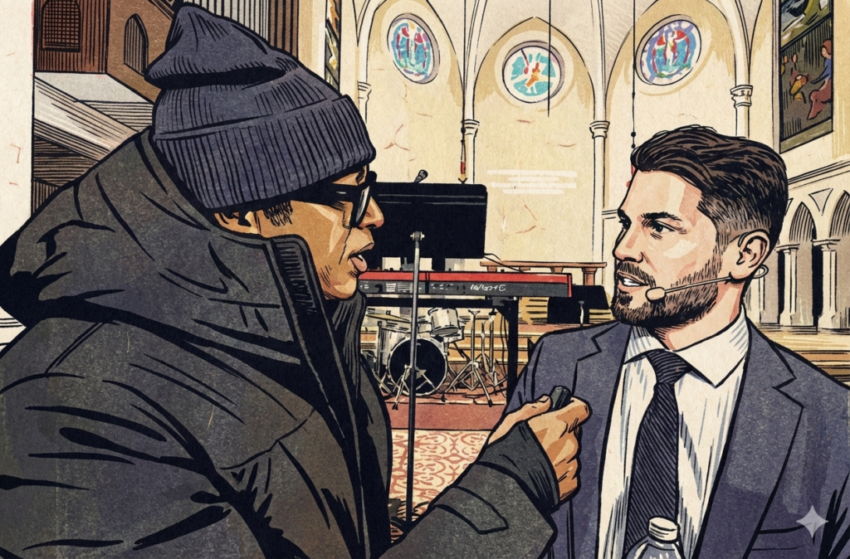
Former CNN host Don Lemon likened his recent participation in the disruption of a Minnesota church service to Jesus Christ overturning the tables in the temple and implied during a podcast earlier this week that the outraged congregants were white supremacists.
“Jesus turned the tables over in the temple, right? He flipped the tables because He was tired of them not doing what they’re supposed to do in His Father’s house, and not living up to the tenets of Christianity,” Lemon said during a glitchy interview on the liberal “I’ve Had It” podcast Monday.
Lemon has since attempted to distance himself from the organizing protesters, though some have noted he had been with organizer Nakima Levy Armstrong before the incident and provided her crew with coffee and donuts.
During his podcast with Welch, Lemon suggested ICE agents and the congregants of Cities Church are racist.
“I think people who are in religious groups like that — it’s not the type of Christianity that I practice — but I think that they’re entitled, and that entitlement comes from a supremacy, a white supremacy, and they think that this country was built for them,” Lemon said. He added that such people believe the U.S. “is a Christian country, when actually, we left England because we wanted religious freedom.”
“It’s religious freedom, but only if you’re a Christian and only if you’re a white male, pretty much,” he claimed.
Introduction
On January 18, 2026, former CNN anchor Don Lemon participated in the disruption of a Sunday worship service at Cities Church, a Southern Baptist congregation in St. Paul, Minnesota. In subsequent media appearances, Lemon attempted to justify this action by invoking the biblical account of Jesus cleansing the temple, stating: “Jesus turned the tables over in the temple, right? He flipped the tables because He was tired of them not doing what they’re supposed to do in His Father’s house, and not living up to the tenets of Christianity.”
This comparison reveals a profound misunderstanding of biblical theology, the nature of Christ’s authority, the purpose of His temple action, and the fundamental distinctions between the Jerusalem temple and the Christian church. As a scholar who has spent decades examining the New Testament in its original languages and historical context, I must address this comparison directly, for it represents not merely a misreading of Scripture but a fundamental category error that, if left unchallenged, could legitimize religious persecution under the guise of prophetic action.
The Temple Cleansing in Its Proper Context
The account of Jesus cleansing the temple appears in all four Gospels (Matthew 21:12-17; Mark 11:15-19; Luke 19:45-48; John 2:13-22), though John places the event early in Jesus’ ministry while the Synoptics place it during Passion Week. In each account, Jesus enters the Court of the Gentiles—the outer court of the Jerusalem temple complex—and overturns the tables of the money changers and those selling sacrificial animals.
To understand this action, we must recognize several crucial factors that Lemon’s comparison entirely ignores.
First, Jesus acted as the divine Son with unique messianic authority over the temple. When Jesus cleansed the temple, He was not acting as a political activist, a social reformer, or even as a prophet in the ordinary sense. He was exercising His unique authority as the Son of God over His Father’s house. In John’s account, Jesus explicitly states, “Take these things away; stop making my Father’s house a place of business” (John 2:16, NASB). The possessive pronoun is crucial: Jesus claims a filial relationship with God that gives Him authority over the temple that no other human being could possess. When the Jewish leaders demand a sign justifying His actions, Jesus responds with a reference to His own death and resurrection: “Destroy this temple, and in three days I will raise it up” (John 2:19). The temple cleansing is thus inseparable from Jesus’ identity as the incarnate Son of God and His redemptive mission.
Don Lemon possesses no such authority. He is neither the Messiah nor a prophet. He cannot claim any divine commission to enter a house of worship and disrupt its services. To claim the mantle of Christ’s temple action without Christ’s identity is not prophetic boldness—it is presumption of the highest order.
Second, Jesus acted against commercial corruption of sacred space, not against worshipers. The Court of the Gentiles had become what Mark’s Gospel describes as a “den of robbers” (Mark 11:17)—a phrase drawn from Jeremiah 7:11. The money changers were charging exorbitant exchange rates to convert Roman currency into the Tyrian shekels required for temple offerings. The animal sellers were exploiting pilgrims who had traveled long distances and could not bring their own sacrificial animals. Moreover, this commercial activity had overtaken the Court of the Gentiles—the only space where non-Jews could come to pray to the God of Israel.
Jesus was not disrupting worship; He was restoring the conditions necessary for true worship. His quotation of Isaiah 56:7—“My house shall be called a house of prayer for all the nations”—emphasizes that the Gentiles’ place of prayer had been compromised. Far from terrorizing worshipers, Jesus was acting on their behalf.
The scene at Cities Church could not be more different. The protesters did not target commercial corruption; they targeted a congregation engaged in the worship of Jesus Christ. Video footage shows families fleeing with frightened children as protesters shouted and accosted congregants. The protesters were not restoring worship—they were preventing it.
Third, Jesus’ action was prophetic judgment on an institution that had failed its divine purpose. The temple cleansing, particularly in Mark’s Gospel, is sandwiched between the cursing and withering of the fig tree (Mark 11:12-14, 20-21)—a symbolic act indicating that the temple, like the fruitless tree, had failed to produce the spiritual fruit God required. Jesus was pronouncing divine judgment on an institution that would soon be destroyed (as He predicts in Mark 13). This was not a model for political activism but a unique prophetic sign-act by the One who alone had authority to judge the temple and announce its coming destruction.
Cities Church is not the Jerusalem temple, and Don Lemon is not authorized to pronounce divine judgment on any congregation. The comparison fails at the most fundamental level.
The Fundamental Category Error
Lemon’s comparison commits what philosophers call a category error—treating something belonging to one category as if it belonged to another. The Jerusalem temple was a unique institution in redemptive history: the singular place where God had caused His name to dwell, where the sacrificial system operated, and where Israel’s covenant relationship with Yahweh was centered. There has never been, nor will there ever be, another institution precisely like it.
The Christian church, while certainly sacred and set apart for the worship of God, is not the temple in the same sense. The New Testament teaches that believers themselves—both individually and corporately—constitute the temple of the Holy Spirit (1 Corinthians 3:16-17; 6:19; 2 Corinthians 6:16; Ephesians 2:21-22). The physical church building is a meeting place, not a dwelling place of God in the Old Testament sense.
More importantly, even if we granted some analogical relationship between the Jerusalem temple and the Christian church, Jesus’ temple action would still provide no warrant for Lemon’s behavior. Jesus acted against those who were preventing proper worship; Lemon and his fellow protesters themselves prevented proper worship. If anything, the protesters more closely resemble the money changers than Jesus—they are the ones who disrupted the worship of God’s people.
The Question of Authority
Throughout the Gospels, Jesus’ authority is a central theme. After the temple cleansing, the Jewish leaders immediately challenge Jesus: “By what authority are You doing these things, or who gave You this authority to do these things?” (Mark 11:28). This is the right question. Authority matters.
Jesus possessed unique divine authority as the incarnate Son of God, the Messiah prophesied throughout the Hebrew Scriptures, the one to whom all authority in heaven and on earth would be given (Matthew 28:18). No human being since—and no human being until His return—possesses comparable authority.
By what authority did Don Lemon enter Cities Church to disrupt their worship? By his own self-appointed authority? By his political convictions? By his interpretation of what Christianity “is supposed to be about”? None of these constitutes the kind of authority Jesus possessed. Indeed, Lemon has acknowledged that he does not share the theological convictions of Cities Church, stating that their Christianity “is not the type of Christianity that I practice.” By what standard, then, does he presume to judge them?
The Accusation of “Entitlement” and “White Supremacy”
Lemon’s subsequent commentary adds further offense to his actions. He described the churchgoers as “entitled,” claiming that “that entitlement comes from a supremacy, a white supremacy.” He accused them of believing that America “is a Christian country, when actually, we left England because we wanted religious freedom.”
The irony here is staggering. Lemon invokes religious freedom while participating in the disruption of a religious service. The Freedom of Access to Clinic Entrances (FACE) Act of 1994, under which the Department of Justice is reportedly investigating the protesters, explicitly protects individuals “seeking to exercise the First Amendment right of religious freedom at a place of religious worship.” Religious freedom means the freedom to worship without intimidation—precisely the freedom that was violated at Cities Church.
Moreover, the accusation of white supremacy against an entire congregation based on their political views represents exactly the kind of broad-brush condemnation that thoughtful people should reject. The gospel of Jesus Christ transcends racial and ethnic boundaries (Galatians 3:28; Colossians 3:11). To accuse Christians of racism simply because they attend a particular church or hold particular views about immigration policy is to bear false witness against one’s neighbor.
The Pastoral and Theological Response
In stark contrast to the chaos introduced by the protesters, Pastor Jonathan Parnell’s response exemplified Christian grace under pressure. He calmly called the disruption “shameful” and asked the protesters to leave. In the days following, he quoted from the Heidelberg Catechism: “I trust God so much that I do not doubt he will provide whatever I need for body and soul, and will turn to my good whatever adversity he sends upon me in this vale of tears.”
The elders of Cities Church issued a statement affirming that “Jesus is real” and condemning the protesters’ behavior as “shameful, unlawful, and will not be tolerated.” They noted that “invading a church service to disrupt the worship of Jesus—or any other act of worship—is protected by neither the Christian Scriptures nor the laws of this nation.”
This is the proper Christian response: firm, truthful, gracious, and grounded in the conviction that God remains sovereign over all circumstances.
Conclusion: The Danger of Weaponizing Scripture
Don Lemon’s invocation of Jesus’ temple cleansing represents a dangerous misappropriation of Scripture to justify political activism that violates both civil law and the sanctity of Christian worship. The comparison fails on every level:
- Jesus acted with unique divine authority as the Son of God; Lemon has no such authority.
- Jesus acted to restore worship by removing commercial corruption; Lemon acted to prevent worship by introducing disruption.
- Jesus acted in the singular Jerusalem temple as a sign of coming judgment; Lemon stormed a local Baptist church to make a political statement.
- Jesus protected worshipers, especially Gentiles who had no other place to pray; Lemon terrified worshipers, including children.
- Jesus fulfilled prophetic Scripture; Lemon violated federal law protecting religious worship.
When public figures misappropriate Scripture to justify actions that actually contradict biblical principles, theologians and pastors have a responsibility to speak clearly. The temple cleansing was a unique Christological event, not a template for political disruption of Christian worship. To suggest otherwise is to commit eisegesis of the worst kind—reading one’s own agenda into the biblical text while ignoring what the text actually teaches.
The church of Jesus Christ has faced persecution throughout its history, and it will continue to face persecution until the Lord returns. What happened at Cities Church was a small foretaste of what many believers around the world experience regularly. The appropriate Christian response is the one demonstrated by Pastor Parnell and the Cities Church elders: trust in God’s sovereignty, commitment to truth, and grace toward those who persecute us.
But trust in God’s sovereignty does not mean silence in the face of scriptural distortion. When someone claims the authority of Jesus while acting in ways that contradict Jesus’ example and teaching, we must speak. Don Lemon’s comparison is not merely historically and theologically ignorant—it is a dangerous precedent that, if accepted, could justify any act of religious intimidation under the guise of prophetic righteousness.
The temple cleansing was about Jesus being who He is—the divine Son with authority over the temple, the Messiah who would soon offer Himself as the final sacrifice, the one who would establish a new covenant in His blood. It was not about political protesters having the right to invade churches because they disagree with a congregant’s occupation. To confuse the two is to misunderstand almost everything that matters in Christian theology.
Soli Deo Gloria.
Update – Redstate: The Don Lemon Church Incursion Could Serve As a Tipping Point for the Direction of the Country.
There has been extensive excitement, in both directions, over the activist stunt that took place in St. Paul this weekend involving disgraced former CNN journalist Don Lemon. That is to say, social media has been all over his participation, but the conventional media apparatus has been notably muted in addressing what went on Sunday. This event could turn out to be a crucial fulcrum in the way the nation is headed.
After initially posting giddy segments where he proclaimed what would transpire, Lemon pledged to film the activities live on his account stream. He joined the mob in the church and even conducted a hectoring interview with a pastor on the scene. It has been a typical practice by this man in a desperate lurch for relevancy, hoping to spark viral interest and resuscitate his flagging career. But very quickly, Don began massaging his narrative.
What makes Sunday’s “protest” consequential going forward is that it was possibly the commission of a federal crime, and the severity of it requires full accountability. Now, Assistant Attorney General for Civil Rights Harmeet Dhillon and the DOJ are looking to take swift action on this group, including Mr. Lemon, and potentially bring charges. Assuming they are justified under the law in question, this is needed because if we see lax enforcement, it promises to encourage more lawlessness. That is not hyperbolic hand-wringing. We see the foundations of potentially severe legal problems in what took place on Sunday.
Now we see lawmakers coming forward to deny the existence of legislation and possibly participating in the violations of the statutes. If this is not addressed swiftly, then a cattle stampede of mob rule is likely to surge through that barn door. These miscreants and Don Lemon need to be held accountable in a very public fashion.