
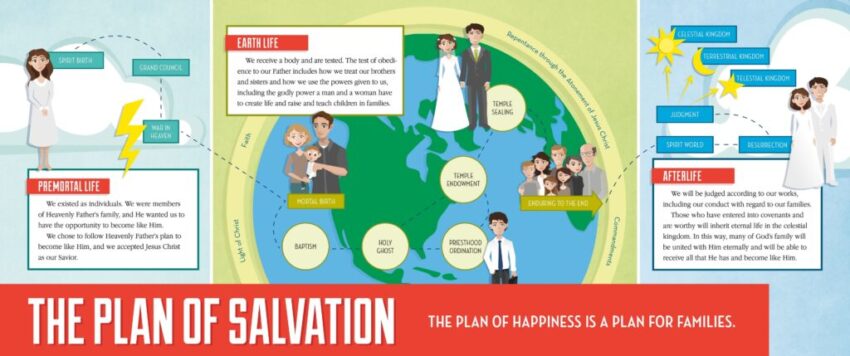
Photo: An LDS infographic illustrating the plan of salvation.
A Comparative Theological Analysis:
“Are Mormons Christian?” Series
Introduction to Latter-day Saint Theology on Salvation
The doctrine of salvation stands as the central pillar of Christian theology, addressing humanity’s most fundamental questions: How can sinful human beings be reconciled to a holy God? What is required for eternal fellowship with the Creator? Throughout two millennia of Christian reflection, the church has consistently affirmed that salvation is accomplished entirely by God’s grace, received through faith in Christ alone. This understanding, crystallized in the Reformation’s cry of sola gratia and sola fide, represents not an innovation but an articulation of what Scripture has always taught and what the Church Fathers affirmed against Pelagian heresies.
The Church of Jesus Christ of Latter-day Saints, while adopting Christian terminology, presents a soteriological framework that fundamentally diverges from the historic Christian understanding. This divergence is not merely a matter of emphasis or nuance; it represents a different understanding of grace, works, human nature, and eternal destiny. The present article examines these differences with scholarly rigor, demonstrating that the LDS soteriology, despite its surface similarities, constitutes a departure from the biblical gospel sufficient to place it outside the boundaries of orthodox Christian faith.
Central to LDS soteriology is the teaching expressed in 2 Nephi 25:23: “For we labor diligently… to persuade our children, and also our brethren, to believe in Christ, and to be reconciled to God; for we know that it is by grace that we are saved, after all we can do.” This formulation, appearing to affirm grace while conditioning it upon human effort, establishes the distinctive LDS understanding of salvation.
Overview of Orthodox Christian Doctrine of Salvation
Orthodox Christianity, drawing from Scripture and affirmed across Catholic, Eastern Orthodox, and Protestant traditions, teaches that salvation is entirely a work of divine grace. The Apostle Paul’s declaration in Ephesians 2:8-9 (ESV) provides the foundational statement: “For by grace you have been saved through faith. And this is not your own doing; it is the gift of God, not a result of works, so that no one may boast.”
This passage contains several crucial elements that define the Christian understanding of salvation. First, salvation is “by grace”—it is God’s unmerited favor bestowed upon those who deserve only condemnation. As noted by scholars at Bible Study Tools, “Grace is God’s undeserved favor, his kindness and power given to those who don’t deserve it… Grace is both the undeserved gift of salvation and divine strength to live the divine life.” This grace is not earned through any human effort; otherwise, as Paul explicitly states, it could not be called grace at all (Romans 11:6).
Second, salvation comes “through faith”—not faith as a meritorious work but faith as the divinely appointed instrument by which grace is received. As the writer to the Hebrews declares: “Now faith is the assurance of things hoped for, the conviction of things not seen.” (Hebrews 11:1, ESV). Faith is trust in God’s promises, particularly the promise of salvation through Christ’s atoning work. Critically, even faith itself is described as a gift of God (Ephesians 2:8), ensuring that humans cannot boast in their spiritual discernment or decision-making capacity.
Third, salvation is “not a result of works.” This negation explicitly excludes human effort from the ground of justification. While affirming that genuine faith inevitably produces good works (James 2:17), the Christian tradition has consistently maintained that works are the fruit, not the root, of salvation. As the theologians of the Reformation articulated, we are saved by faith alone, but not by a faith that is alone. Good works demonstrate the reality of saving faith without contributing to its saving efficacy.
The biblical teaching on salvation by grace through faith addresses the fundamental human condition as described in Romans 5:12 (ESV): “Therefore, just as sin came into the world through one man, and death through sin, and so death spread to all men because all sinned.” Every human being inherits Adam’s fallen nature and stands guilty before a holy God. This universal sinfulness renders all human efforts at self-redemption futile. As Romans 3:20 (ESV) declares: “By works of the law no human being will be justified in his sight.”
Comparative Analysis: Grace “After All We Can Do”
The LDS Position
The phrase “after all we can do” from 2 Nephi 25:23 represents a defining characteristic of LDS soteriology. Recent attempts by some LDS apologists to reinterpret this phrase as meaning “in spite of all we can do” or “regardless of all we can do” have not found support in official LDS teaching or historical interpretation. As researchers at Mormonism Research Ministry have documented, this reinterpretation conflicts with the historical understanding of LDS leadership.
Thirteenth President Ezra Taft Benson provided an authoritative explanation of “after all we can do”: “‘After all we can do’ includes extending our best effort. ‘After all we can do’ includes living His commandments. ‘After all we can do’ includes loving our fellowmen and praying for those who regard us as their adversary. ‘After all we can do’ means clothing the naked, feeding the hungry, visiting the sick… ‘After all we can do’ means leading chaste, clean, pure lives, being scrupulously honest in all our dealings.”
James Faust, a member of the First Presidency, explicitly contrasted this with evangelical teaching: “Many people think they need only confess that Jesus is the Christ and then they are saved by grace alone. We cannot be saved by grace alone, ‘for we know that it is by grace that we are saved after all we can do.'” This statement directly contradicts the biblical gospel and demonstrates the fundamental incompatibility between LDS soteriology and orthodox Christianity.
Apostle Boyd K. Packer agreed with “after” as referencing a preposition of time, saying, “Even that grace of God promised in the scriptures comes only ‘after all we can do’” (“The Brilliant Morning of Forgiveness,” Ensign, November 1995 (Conference Edition), p. 19). And a church manual states, “The phrase ‘after all we can do’ teaches that effort is required on our part to receive the fulness of the Lord’s grace and be made worthy to dwell with him.” (True to the Faith: A Gospel Reference, 2004, p. 77).
Another general authority, Seventy Theodore M. Burton, cited 2 Nephi 25:23 and explained, “The true value of the sacrifice of Christ means much more than this general salvation which comes to all mankind. There is an additional salvation that God has planned for his children. This additional salvation is an individual salvation and is conditioned not only upon grace, but also upon obedience to gospel law.” (“Salvation and Exaltation,” Ensign, July 1972, p. 78).
The official LDS manual True to the Faith confirms: “The phrase ‘after all we can do’ teaches that effort is required on our part to receive the fullness of the Lord’s grace and be made worthy to dwell with him.” This represents a fundamental departure from the biblical gospel, which teaches that Christ’s righteousness alone makes believers worthy to dwell with God.
This Mormon doctrine of the “after all we can do” attainment of God’s grace is clearly understood – and explained — by other Mormon scholars as well: “Indeed, it is only after a person has so performed a lifetime of works and faithfulness – only after he has come to deny himself of all ungodliness and every worldly lust – that the grace of God, that spiritual increment of power, is efficacious.” (Joseph Fielding McConkie and Robert L. Millet, Doctrinal Commentary on the Book of Mormon 1:295)
The Orthodox Christian Response
The LDS formulation inverts the biblical relationship between grace and works. In Scripture, grace precedes and enables good works rather than being conditioned upon them. Ephesians 2:10 (ESV) clarifies this sequence: “For we are his workmanship, created in Christ Jesus for good works, which God prepared beforehand, that we should walk in them.“ Notice that believers are first “created in Christ Jesus”—regenerated and justified by grace through faith—and then enabled to walk in the good works God has prepared. The works follow salvation; they do not precede or contribute to it.
The Apostle Paul’s teaching in Romans 4:4-5 (ESV) directly addresses and refutes the LDS position: “Now to the one who works, his wages are not counted as a gift but as his due. And to the one who does not work but believes in him who justifies the ungodly, his faith is counted as righteousness.” This passage establishes an absolute dichotomy: either salvation is earned through works (in which case it is wages, not a gift) or it is received through faith apart from works (in which case it is truly grace). There is no middle ground where grace is somehow conditioned upon human effort.
Comparative Analysis: Eternal Destiny
LDS Eschatology: Three Degrees of Glory
LDS doctrine teaches a graduated afterlife consisting of three “kingdoms of glory“—the Celestial, Terrestrial, and Telestial kingdoms—with varying rewards based on faithfulness and temple ordinances (Doctrine and Covenants 76). Only “sons of perdition,” defined as those with full knowledge who utterly reject God, face “outer darkness.” This system results in what amounts to near-universal salvation, with virtually everyone receiving some degree of eternal glory.
The requirements for the highest level of the Celestial Kingdom include temple endowment ceremonies and celestial marriage. Without temple sealing, families are not united eternally. This system introduces secret ceremonies and additional requirements beyond faith in Christ, fundamentally altering the accessibility of the gospel.
Orthodox Christianity: The Final Judgment
Orthodox Christianity has consistently taught a binary final judgment: eternal life with God or eternal separation from Him. Jesus Himself presented this distinction in Matthew 25:31-46 (ESV), describing the final separation of “sheep” and “goats”: “And these will go away into eternal punishment, but the righteous into eternal life.” The same Greek word (aionios) modifies both punishment and life, indicating parallel duration.
The Apostle John provides the definitive statement in Revelation 20:11-15 (ESV), describing the Great White Throne judgment: “And if anyone’s name was not found written in the book of life, he was thrown into the lake of fire.” There are no intermediate categories, no graduated levels of glory for the unrepentant. As scholar Paul R. Williamson notes in his essay on the Final Judgment for The Gospel Coalition: “The Bible clearly teaches both God’s absolute sovereignty and human genuine responsibility… final destinies are heaven or hell, not graduated levels of glory.”
Regarding rewards in heaven, biblical Christianity does teach varying degrees of reward for believers based on faithful service (1 Corinthians 3:14; 2 Corinthians 5:10). However, these rewards are given to those already saved by grace, not earned as passage into different levels of heaven. As noted by biblical scholars, “The rewards we gain in heaven are not like the rewards we earn here on earth… any rewards or honor we gain in heaven will be precious to us because they carry the weight and meaning of our relationship with God.”
Comparative Analysis: Baptism and Salvation
LDS Baptism: A Prerequisite for Salvation
The Church of Jesus Christ of Latter-day Saints teaches that water baptism is not merely an act of obedience or public declaration of faith, but an absolute requirement for entering the celestial kingdom. The Third Article of Faith states: “We believe that through the Atonement of Christ, all mankind may be saved, by obedience to the laws and ordinances of the Gospel,”—with baptism explicitly identified as the first of these essential ordinances. The Gospel Principles manual is unambiguous: “We Must Be Baptized for the Remission of Our Sins. When we place our faith in Jesus Christ, repent, and are baptized, our sins are forgiven through the Atonement of Jesus Christ.” Unlike the Protestant understanding of baptism as an outward sign of an inward grace already received, LDS doctrine positions baptism as a salvific mechanism without which exaltation remains impossible. This creates an immediate theological problem: What of the billions who died without LDS baptism? Rather than reconsidering whether baptism is truly essential, the LDS Church developed an elaborate solution that would become one of its most distinctive—and controversial—practices.
LDS Practice: Baptism for the Dead
A distinctive feature of LDS soteriology is the practice of vicarious baptism for the deceased. This practice, based on Doctrine and Covenants 128, involves living members being baptized by proxy for those who died without receiving LDS baptism. This necessitates extensive genealogical work and temple rituals, with LDS members described as “saviors” to their deceased relatives.
President Joseph Fielding Smith wrote: “If we wilfully neglect the salvation of our dead, then also we shall stand rejected of the Lord… But the greatest and grandest duty of all is to labor for the dead… we cannot be saved without them.” This teaching makes the salvation of living Mormons contingent upon their work for the dead, further removing salvation from grace alone.
Orthodox Christianity: Baptism as Public Profession
Orthodox Christianity has rejected proxy baptism as inconsistent with biblical teaching. Hebrews 9:27 (ESV) states clearly: “It is appointed for man to die once, and after that comes judgment.” The moment of death seals one’s eternal destiny; there is no post-mortem opportunity for salvation through vicarious rituals.
While 1 Corinthians 15:29 mentions “baptism for the dead,” scholars note that Paul uses the third person (“they”) to distance himself from this practice, suggesting it was not something the apostles endorsed. As biblical commentators observe, “There is no historical support for the idea that the brazen sea or the laver were ever used for baptisms of any sort” in the Jerusalem temple, contrary to LDS claims about ancient practices.
Christian baptism, properly understood, is the means by which believers make a public profession of faith and discipleship. As Romans 6:4 (ESV) explains: “We were buried therefore with him through baptism into death, in order that, just as Christ was raised from the dead by the glory of the Father, we too might walk in newness of life.” Baptism symbolizes the believer’s identification with Christ’s death and resurrection; it is “an outward testimony of the inward change” already accomplished by grace through faith.
Implications for Faith and Practice
The soteriological differences between LDS theology and orthodox Christianity are not minor theological disputes but fundamental disagreements about the nature of salvation itself. These differences carry profound implications for faith and practice:
- The Nature of Grace: In orthodox Christianity, grace is purely unmerited favor received through faith. In LDS theology, grace is conditioned upon human effort and comes “after all we can do.”
- The Basis of Assurance: Christians can have confident assurance of salvation based on Christ’s finished work. The LDS system, conditioning salvation on continued obedience and temple ordinances, undermines such assurance.
- The Exclusivity of Christ: Orthodox Christianity teaches that salvation comes through faith in Christ alone (Acts 4:12; John 14:6). LDS theology adds temple rituals, secret ceremonies, and proxy work as additional requirements.
- The Finality of Death: Scripture teaches that death is followed by judgment with no second chances. LDS doctrine posits post-mortem opportunities for salvation through proxy ordinances.
- The Accessibility of Salvation: The biblical gospel is freely available to all through faith in Christ. LDS salvation in its fullest sense requires access to temple ordinances available only to worthy members.
Conclusion
The comparative analysis presented in this article demonstrates that the soteriology of the Church of Jesus Christ of Latter-day Saints represents a fundamental departure from orthodox Christian teaching. While LDS theology employs Christian terminology—grace, salvation, faith, atonement—it fills these terms with distinctly different content. The difference is not merely one of emphasis but of essence.
The biblical gospel declares that salvation is by grace alone, through faith alone, in Christ alone. Human works, however noble and sincere, contribute nothing to justification before God. As Paul wrote to the Galatians regarding those who would add works to grace: “I do not nullify the grace of God, for if righteousness were through the law, then Christ died for no purpose.” (Galatians 2:21, ESV).
The LDS teaching that grace comes “after all we can do” inverts this biblical order, conditioning divine grace upon human performance. The addition of temple ordinances, proxy baptisms, and graduated heavenly kingdoms further removes LDS soteriology from the biblical framework. These are not secondary matters but go to the heart of what the gospel is.
This analysis does not question the sincerity of LDS believers nor their misguided desire to follow God as they understand Him. However, theological sincerity does not guarantee theological accuracy. The Apostle Paul addressed sincere but mistaken religious people in Romans 10:2-3 (ESV): “I bear them witness that they have a zeal for God, but not according to knowledge. For, being ignorant of the righteousness of God, and seeking to establish their own, they did not submit to God’s righteousness.”
The stakes in soteriological questions are eternal. A “gospel” that conditions salvation upon human effort is, in Paul’s words, “a different gospel—not that there is another one, but there are some who trouble you and want to distort the gospel of Christ.” (Galatians 1:6-7, ESV). The biblical response to such distortion is clear: it must be identified, examined in light of Scripture, and rejected where it contradicts the apostolic witness.
May this analysis serve the cause of truth and the glory of God, who alone is the Author and Finisher of our salvation. For it is in Christ alone that we find the assurance of eternal life, not through our striving but through His sufficient grace. As Paul declared: “For I am not ashamed of the gospel, for it is the power of God for salvation to everyone who believes.” (Romans 1:16, ESV). This gospel—salvation by grace through faith, apart from works—remains the unchanging truth upon which the Christian church has stood for two thousand years and will stand until Christ returns.
References and Further Reading
For additional resources on this topic, consult the following:
- Mormonism Research Ministry: https://mrm.org/2nephi2523
- Truth in Love Ministry: https://tilm.org/mormonisms-explanation-of-2-nephi-25-23/
- GotQuestions.org – Salvation by Grace through Faith: https://www.gotquestions.org/by-grace-through-faith.html
- Bible Study Tools – Saved by Grace through Faith: https://www.biblestudytools.com/bible-study/topical-studies/how-exactly-are-we-saved-by-grace-through-faith.html
- The Gospel Coalition – The Final Judgment: https://www.thegospelcoalition.org/essay/the-final-judgment
- GotQuestions.org – Rewards in Heaven: https://www.gotquestions.org/rewards-in-heaven.html
- Mormonism Research Ministry – Baptism for the Dead: https://mrm.org/historical-baptism-dead
- Mormonism Research Ministry – Outer Darkness: https://mrm.org/outer-darkness-sons-of-perdition
- East Valley International Church Sunday School Notes: https://novus2.com/righteouscause/2025/11/16/e-v-i-c-sunday-school-notes-fundamentals-of-the-faith-free-will-predestination-and-salvation/