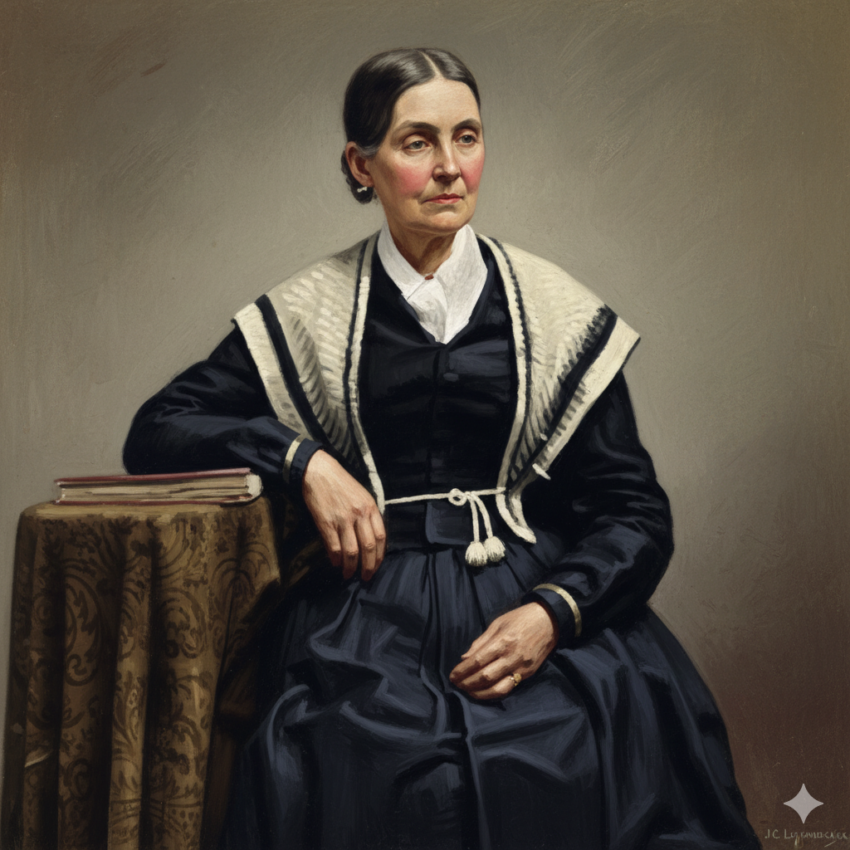
Grief-stricken widow Emma Smith, 41 with infant son, David Hyrum, watched Nauvoo’s exodus from Mansion House—alone with four other children after Joseph’s assassination.
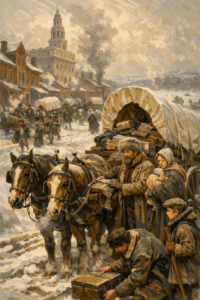
The winter of 1846 descended upon Nauvoo, Illinois, with a bitter cold that matched the chill settling over what had once been the largest city in the state. Along the frozen streets that led to the Mississippi River, wagons creaked under the weight of household goods, farm implements, and the accumulated possessions of families preparing to abandon everything they had built. The great exodus had begun.
From the windows of the Mansion House—the substantial brick home she had shared with her husband Joseph until his violent death eighteen months prior—Emma Smith watched the procession with emotions that historians have struggled to fully reconstruct. She was forty-one years old, a widow with five children, including an infant son, David Hyrum, born five months after his father’s assassination at Carthage Jail. She was pregnant during the mob attack that killed her husband and his brother Hyrum on June 27, 1844.
The families filing past her home were following Brigham Young, president of the Quorum of the Twelve Apostles, who had emerged from the succession crisis as the leader most of the Saints would follow. Young was leading them westward, away from the persecution that had hounded the Latter-day Saints from New York to Ohio to Missouri and now from Illinois. The destination was uncertain—somewhere in the Rocky Mountains, beyond the reach of their enemies, beyond the borders of the United States itself.
Emma was not going with them.
Approximately 3,000 Latter-day Saints accompanied Brigham Young when they left Nauvoo in the initial winter exodus that began in early February 1846. This group, which Young organized into the “Camp of Israel,” included about 500 wagons according to various sources.
The departure from Nauvoo occurred in three distinct phases. The winter exodus led by Brigham Young in February 1846 included approximately 3,000 Saints who crossed the frozen Mississippi River. The spring exodus brought more than 10,000 additional Saints who abandoned Nauvoo in three large waves of refugees. The fall exodus involved about 700 Saints who were forced from the city at gunpoint.
Over the eight months following the initial departure, between 12,000 and 15,000 Latter-day Saints ultimately left Nauvoo and its surrounding settlements. The broader Mormon pioneer migration to the Salt Lake Valley continued from 1846 to 1868 and ultimately involved approximately 70,000 people. By the time the Saints were encamped by the Missouri River a month after the February departure, their population had reached 10,000—with only a fourth being those who had left with Brigham Young in February and three-fourths being spring travelers.
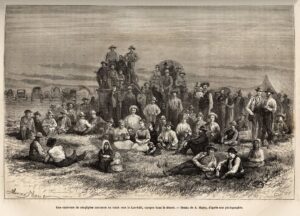
An engraving published in Le Tour du Monde in 1874, based on an 1868 drawing of Mormon pioneers by Adrien-Emmanuel Marie. Via Wikipedia.
The Mormon pioneers faced severe challenges crossing Iowa’s approximately 310 miles between the Mississippi and Missouri rivers in 1846. What Brigham Young originally estimated would take four to six weeks actually required 16 weeks—nearly three times longer than planned.
Heavy rains transformed the rolling plains of southern Iowa into a quagmire of axle-deep mud that reached axle-deep levels. The pioneers departed in early February 1846, exposing them to brutal winter conditions including freezing weather, snow, and rain. The spring weather proved particularly treacherous, miring down wagons for days or even weeks at certain camping spots.
Iowa presented unique infrastructure challenges since there were no established roads, ferries, or bridges within the territory. The pioneers had to follow primitive territorial roads and Native American trails. Rivers proved especially difficult to cross, with swollen waterways creating dangerous conditions that could tip wagons and drown people, oxen, and valuable supplies.
Few people carried adequate provisions for the journey. The general unpreparedness, combined with lack of experience in moving such a large group of people and the much longer duration than anticipated, all contributed to the difficulties they endured. The native landscape, wildlife, and bacteria familiar to indigenous peoples often proved deadly to white settlers unfamiliar with these conditions.
To cope with these challenges, the Mormons established several semi-permanent camps along the route, including Garden Grove and Mount Pisgah, where they planted crops and built facilities to assist later emigrants.
Emma’s decision—to remain in the emptying city while thousands of her fellow believers trudged toward an unknown future—would define Emma’s legacy for generations. To the Utah Saints, she became a cautionary tale, the wife of the Prophet who fell away, who denied the truths her husband had taught, who chose worldly comfort over covenant faithfulness. To the Reorganized Church of Jesus Christ of Latter-day Saints (now Community of Christ), she became a heroine, the faithful widow who refused to follow false prophets and false doctrines.
Both narratives contain elements of truth and elements of mythology. The reality, as with most human stories, was far more complex.
What was she thinking as she watched the exodus? What had she seen and experienced that made her unwilling to follow the man her husband had supposedly designated as the path to continued revelation? What did she know that others did not—or what did she refuse to accept that others had come to believe?
To understand Emma’s choice, we must first understand Emma herself: the woman she was before she met Joseph Smith, the transformation she underwent as his wife, and the impossible position in which his death and the subsequent power struggles left her. Her story illuminates not only the personal tragedy of a woman caught between loyalty and conscience but also the theological fault lines that continue to divide the various branches of the Restoration movement to this day.
II. Who Was Emma Hale?
The Susquehanna Valley and Methodist Roots
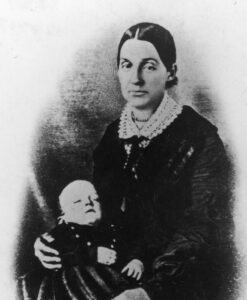
Emma Hale Smith, circa 1845, with David Hyrum Smith; image is at least 181 years old. Via Wikipedia, among the RLDS Archives. Unknown author. Public Domain.
Emma Hale was born on July 10, 1804, in Harmony Township, Susquehanna County, Pennsylvania, the seventh of nine children born to Isaac Hale and Elizabeth Lewis Hale. Her birthplace was a log cabin on ninety acres of farmland in the wooded valleys carved by the swift Susquehanna River—a landscape that would prove formative to her character and pivotal to the early events of the Restoration.
The Hale family was relatively prosperous and deeply rooted in the region. Isaac and Elizabeth had arrived in Susquehanna County in 1791, purchasing land and becoming among the first permanent settlers. Isaac supported his family through hunting, trapping, and shipping meat and merchandise down the river to Philadelphia and Baltimore. Elizabeth hosted lodgers and boarders. The family was known in the community for being honest, hardworking, and generous to their neighbors.
Emma’s religious formation came primarily through Methodism. Her uncle Nathaniel Lewis was an influential Methodist preacher in the area, and Emma attended Methodist camp meetings and Sunday sermons from the age of seven or eight. The religious fervor of the Second Great Awakening swept through the region during her childhood, and Emma absorbed its emphasis on personal religious experience, emotional worship, and moral earnestness.
According to family tradition, Emma’s father, Isaac, went through a period of religious skepticism, becoming a Deist who believed God had created the world but remained distant from human affairs. During this period, he reportedly forbade his family from praying in the home. The young Emma responded by taking her prayers outdoors, going to the woods or the barn to commune privately with her Heavenly Father.
One day, according to this tradition, when Emma was about eight years old, Isaac was hunting in the woods and overheard his daughter praying aloud—praying specifically for him, that he would return to faith. The experience reportedly moved Isaac so deeply that he rejected Deism, converted to Christianity, and allowed his family to pray in the home again.
Whether historically accurate in every detail or not, this family tradition reveals something important about how Emma was remembered and understood: as a woman of faith from her earliest years, one who would go to the woods to pray when circumstances prevented her from praying at home. The parallel to Joseph Smith’s experience in the Sacred Grove—another young person seeking God alone among the trees—would not have been lost on those who told and retold this story.
Education and Character
Unlike Joseph Smith, who had minimal formal education and struggled with spelling and grammar throughout his life, Emma received substantial schooling for a woman of her era. She attended a girls’ school for at least a year and was known for her intelligence and learning. After completing her education, she taught school in Harmony—an indicator of both her educational attainment and her respectable social standing.
Her education would prove essential to Joseph’s work. Emma could read, write, and spell with facility. She knew the Bible well, having read it repeatedly from childhood. When she later served as a scribe during the translation of the Book of Mormon, she could handle the manuscript with competence that Joseph himself could not have matched at that time.
Contemporary descriptions portray Emma as tall (about five feet nine inches), with dark hair and hazel eyes. She was described as a brilliant conversationalist with a quick wit. One account recalls a man teasing her about fishing for a compliment, to which she reportedly retorted, “I never fish in that shallow of water.” She was known for both her kindness and her strong will—traits that would serve her well during the hardships ahead but would also bring her into conflict with those who expected unquestioning deference.
Meeting Joseph Smith
In October 1825, a twenty-one-year-old Emma first encountered a nineteen-year-old young man named Joseph Smith. Joseph had traveled from Palmyra, New York, to the Susquehanna Valley as part of a company employed by Josiah Stowell to search for a legendary lost Spanish silver mine on the Hale family property. Joseph’s reputation as someone with unusual spiritual gifts—specifically, the ability to locate hidden things using a seer stone—had led Stowell to seek him out.
Isaac Hale was skeptical of the venture from the beginning, and his opinion of Joseph Smith was not improved by the young man’s involvement in what he considered foolish treasure-digging. When the mining operation failed, and Joseph turned his attention to courting Emma, Isaac refused to give his blessing to the match. According to one hostile account, Isaac declared he would rather follow Emma to the grave than see her marry the likes of Joseph Smith.
But Emma was drawn to the young man from New York. Despite his lack of education and resources, she was impressed by his character and morals. They courted secretly, meeting at the home of a family friend when Joseph was working as a farmhand in the area. Joseph visited the Hales twice to ask formally for Emma’s hand and was refused both times.
On January 17, 1827, Emma made her choice. With Joseph Knight Sr. providing new clothes for Joseph and lending him his horse and sleigh, Emma and Joseph traveled to South Bainbridge, New York, where they were married the following day by the local justice of the peace. Emma left her parents’ home—according to one account, with only the clothes on her back—to begin her life with a man who would become the most controversial religious figure of nineteenth-century America.
Why Did She Believe?
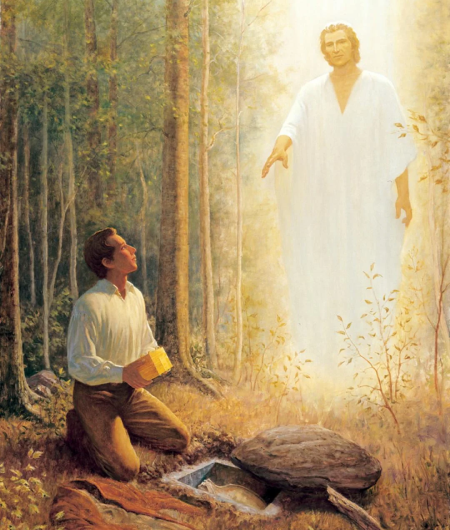
Joseph Smith, the first Mormon Prophet, claimed he was divinely guided to a set of gold plates that were buried near his home in the state of New York. After taking possession of these plates, according to the official LDS account, Joseph translated the ancient writing they contained, which resulted in the Book of Mormon.
This question haunts the Emma Smith story and demands serious consideration. Emma was not an uneducated backwoods girl, easily swayed by religious enthusiasm. She was literate, biblically knowledgeable, and raised in a respectable Methodist tradition that would have provided theological categories for evaluating Joseph’s claims. Her father was openly skeptical of Joseph. Why did she accept what her husband told her about golden plates and angelic visitations?
Part of the answer may lie in what Emma experienced directly. On September 22, 1827, Emma accompanied Joseph to the Hill Cumorah in her riding dress and bonnet. She waited at the base of the hill while Joseph went to retrieve the golden plates from the angel Moroni. According to Martin Harris, Emma was kneeling in prayer during this time. When Joseph returned with a heavy object wrapped in his coat, Emma became part of the unfolding drama.
Emma never claimed to have seen the plates directly; Joseph kept them covered, as he said he was commanded to do. But she testified to their physical reality in multiple ways. She traced their outline through the cloth that covered them. She heard the metallic sound as she moved the pages. She felt their substantial weight when she moved them during housework. In her last recorded interview, given to her sons shortly before she died in 1879, she stated: “In writing for your father I frequently wrote day after day, often sitting at the table close by him, he sitting with his face buried in his hat, with the stone in it, and dictating hour after hour with nothing between us.”
Emma was also impressed by the manner of the translation itself. As one who had worked as Joseph’s scribe, she testified to what she considered miraculous about the process: “When returning after meals, or after interruptions, he would at once begin where he had left off, without either seeing the manuscript or having any portion of it read to him.” For a woman who knew her Bible and understood the difficulty of maintaining consistency in a long narrative, this was remarkable. “It would have been improbable that a learned man could do this,” she observed, “and, for so ignorant and unlearned as he was, it was simply impossible.”
Yet Emma’s belief, whatever its basis, was never simple acceptance of everything Joseph did or taught. From the beginning, her faith existed in tension with her questions, her objections, and her own moral compass. This tension would intensify dramatically as the years passed and as plural marriage entered their relationship.
The Ladies’ Relief Society
On March 17, 1842, Emma Smith was elected by her peers as the first president of the Ladies’ Relief Society of Nauvoo—an organization that continues today as the Relief Society of The Church of Jesus Christ of Latter-day Saints. Joseph Smith attended the founding meeting and declared that “the Church was never perfectly organized until the women were thus organized.”
Under Emma’s leadership, the Relief Society became a significant force in Nauvoo. Its stated purposes included caring for the poor, assisting new immigrants, and “correcting the morals of the community.” Emma took the moral reform aspect of her charge seriously, with all the frankness of the Methodist tradition in which she had been raised. She called the women of Nauvoo to repentance and warned them against “a great evil creeping into the church.”
The irony of Emma’s anti-immorality campaign would become apparent only gradually. The “great evil” she was warning against turned out to be practices that her own husband was secretly introducing. In the summer of 1842, Emma authorized and was the main signatory of a petition with over a thousand female signatures, denying that Joseph Smith was connected with polygamy. She published a certificate in the Relief Society’s name denouncing the practice.
Emma apparently believed, at this point, that the rumors stemmed from the “spiritual wifery” practices of John C. Bennett, a former church leader who had been excommunicated for sexual misconduct. She did not yet know—or did not yet accept—that Joseph himself was secretly practicing plural marriage.
III. The Succession Crisis
Carthage and Its Aftermath
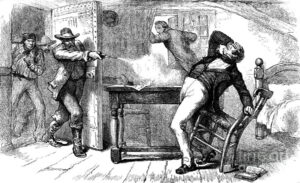
Murder of Joseph and Hyrum Smith, 1844 (c1880). A print from Cassell’s History of the United States, by Edmund Ollier, Volume III, Cassell, Petter and Galpin, London, c1880. (Photo by The Print Collector/Print Collector/Getty Images)
On June 27, 1844, Joseph and Hyrum Smith were killed by a mob at Carthage Jail. The circumstances leading to their imprisonment involved the destruction of the Nauvoo Expositor, a newspaper published by disaffected former members that had threatened to expose Joseph’s practice of plural marriage. Joseph, as mayor and member of the Nauvoo city council, had ordered the press destroyed as a public nuisance. This action gave his enemies the pretext they needed to arrest him.
Emma was at home in Nauvoo, pregnant with David Hyrum, when word came of the killings. According to one witness, when she saw Joseph’s body, she spoke softly to him: “Oh, Joseph, Joseph! My husband, my husband! Have they taken you from me at last!”
The death of the Prophet created an immediate crisis of succession. Joseph had not left unambiguous instructions about who should lead the church after him. Various factions put forward competing claims:
Sidney Rigdon, Joseph’s first counselor in the First Presidency, argued that he should serve as “guardian” of the church until Joseph’s young sons came of age. At the critical August 8, 1844, conference in Nauvoo, Rigdon presented himself not as Joseph’s replacement, but as a “guardian” who would preserve church leadership. According to contemporary accounts, Rigdon taught “that nobody could replace Joseph Smith” but that he should become the Church’s “guardian,” arguing “this Church must be built up to Joseph, and that all the blessings we receive must come through him.”To support his claim, Rigdon cited his long relationship with Joseph Smith and his status as the only surviving member of the First Presidency. He argued that Smith had sent him to Pennsylvania specifically to prevent the entire presidency from being killed in the ongoing conflict with anti-Mormon forces.
Brigham Youngand the Quorum of the Twelve Apostles claimed that Joseph had transferred the “keys of the kingdom” to the Twelve shortly before his death, making them the legitimate successors. The LDS Church points to revelations received through Joseph Smith establishing the Twelve’s authority. In January 1841, a revelation stated: “I give unto you my servant Brigham Young to be a president over the Twelve traveling council; Which Twelve hold the keys to open up the authority of my kingdom upon the four corners of the earth” (D&C 124:127-28).
James J. Strangproduced a letter, purportedly from Joseph Smith, designating him as successor and directing the Saints to gather in Wisconsin.
According to Miles Harvey’s The King of Confidence, James Strang was a lawyer and atheist who disappeared from New York in 1843, only to resurface on the frontier as a Mormon convert. After Joseph Smith’s assassination, Strang presented a letter allegedly designating him as successor and led followers to a Lake Michigan island where he crowned himself king. From this base, he controlled significant portions of Michigan, engaged in polygamy, and orchestrated various criminal enterprises including piracy and fraud. His reign attracted powerful adversaries, culminating in his assassination—a nationally reported event. Harvey’s book examines Strang’s twelve-year rise and fall as an archetype of the American confidence man during the turbulent antebellum period.
William Smith,Joseph’s surviving brother, claimed the right of succession based on family lineage. After Joseph and Hyrum Smith’s deaths in June 1844 (followed by their brother Samuel’s death in July 1844), William Smith became the sole surviving male member of the Smith family. William succeeded Hyrum as Church Patriarch, and the Twelve Apostles confirmed him in this hereditary office in May 1845. He energetically fulfilled this calling, bestowing over three hundred patriarchal blessings during the summer of 1845.
By August 1845, William began asserting that lineal succession should govern church leadership. In a letter dated August 20, 1845, William complained about “a severe influence working against me and the Smith family” and referred to “little Joseph” (Joseph Smith III) as “his father’s successor, although some people would fain make us believe that the Twelve are to be perpetual heads of this church to the exclusion of the Smith family.”
William became the most vocal advocate for lineal succession after Joseph’s death, arguing that “the mantle of Prophet can only be held by a member of the Smith family, meaning himself.” The doctrine of lineal succession had roots in Joseph Smith’s own revelations, including an 1835 revelation stating: “The order of this priesthood was confirmed to be handed down from father to son, and rightly belongs to the literal descendants of the chosen see, to whom the promises were made.”
From Brigham Young’s perspective, William was “a problem,” but William believed he was being excluded and “denied the rights of presidency held by the two preceding Smith patriarchs.” Parley Pratt publicly accused William of being “an aspiring man; that he aspires to uproot and undermine the legal Presidency of the church, that he may occupy the place himself.” William was excommunicated during the October 1845 general conference.
At a critical meeting on August 8, 1844, both Rigdon and Young presented their claims to the gathered Saints. According to later accounts from many present, Young appeared to take on the appearance and voice of Joseph Smith himself during his address. Whether or not this “transfiguration” occurred as later remembered, Young’s argument proved more persuasive to the majority. The Quorum of the Twelve, with Young at its head, assumed leadership of the main body of the church.
No known contemporary record describes an explicit supernatural transfiguration on August 8, 1844. Apostles Brigham Young, Heber C. Kimball, Willard Richards, and Wilford Woodruff all made diary entries on August 8, 1844, but none reference such an event. Wilford Woodruff’s extensive diary entry of nearly 2,200 words makes no mention of anything miraculous. Young himself confirmed during his afternoon address that “for the first in the kingdom of God in the 19th century,” they were “without a Prophet at our head” and were “called to walk by faith, not by sight.”
Emma and Brigham: The Growing Rift
Emma’s relationship with Brigham Young deteriorated rapidly after Joseph’s death. The conflict centered on several issues, but property and plural marriage were paramount.
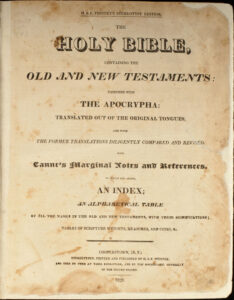
Cooperstown Bible. (The Holy Bible: containing the Old and New Testaments). Cooperstown, NY: H. & E. Phinney, 1828. This Bible is a copy from the same edition that Joseph Smith revised and corrected between 1830 and 1833. Oliver Cowdery purchased Joseph’s copy at E. B. Grandin’s shop in Palmyra, New York, in October 1829, during the time Grandin was printing the first edition of the Book of Mormon.
The property questions were complex. Joseph had served as trustee-in-trust for the church, and the line between his personal property and church property was often blurred. Joseph had also died deeply in debt. As his widow, Emma had legal claims to certain properties, but disentangling her interests from those of the church proved contentious. Emma felt the church leaders were trying to deprive her children of their rightful inheritance. Brigham and the Twelve felt Emma was trying to claim church assets for herself.
Emma also possessed items the church leadership wanted, including Joseph’s translation of the Bible (what became known as the Inspired Version) and the Egyptian papyri from which the Book of Abraham had been translated. Emma refused to surrender these, considering them her husband’s personal effects and part of her children’s patrimony. Brigham reportedly offered to trade certain properties for the Bible translation; Emma agreed but then refused to hand over the manuscript when asked. The Bible manuscript remained with Emma and was eventually published by the RLDS Church.
But the deepest source of conflict was plural marriage. Emma opposed the practice before Joseph’s death and opposed it even more vehemently afterward. Brigham and the other church leaders practiced plural marriage and considered it a sacred principle. From their perspective, Emma’s refusal to accept the doctrine was a rejection of divine revelation. From Emma’s perspective, plural marriage was an innovation that contradicted both Scripture and Joseph’s public teachings.
The hostility between Emma and Brigham became openly expressed. Brigham, speaking in a conference address in 1866, made extraordinary accusations against Emma:
“To my certain knowledge, Emma Smith is one of the damnedest liars I know of on this earth; yet there is no good thing I would refuse to do for her, if she would only be a righteous woman; but she will continue in her wickedness. Not six months before the death of Joseph, he called his wife Emma into a secret council, and there he told her the truth, and called upon her to deny it if she could. He told her forthwith if she did not repent. He told her of the time she undertook to poison him, and he told her that she was a child of hell, and literally the most wicked woman on this earth, that there was not one more wicked than she. He told her where she got the poison, and how she put it in a cup of coffee; said he, ‘You got that poison from so and so, and I drank it, but you could not kill me.’ When it entered his stomach he went to the door and threw it off. He spoke to her in that council in a very severe manner, and she never said one word in reply. I have witnesses of this scene all around, who can testify that I am now telling the truth. Twice she undertook to kill him.”
This is an extraordinary accusation—that Emma Smith twice attempted to poison her husband. What are we to make of it?
The evidence is complicated. Joseph’s diary does record a severe illness in November 1843, during which he vomited blood and believed he had been poisoned. However, medical historians note that the symptoms could have been caused by ulcers, gallstones, or other conditions exacerbated by stress, and Joseph was certainly under enormous stress at this time. Moreover, the poisons available in 1843 that could cause such rapid hemorrhaging would not have allowed the victim to recover sufficiently to attend a meeting that same evening, as Joseph did.
What seems most likely is that Joseph, in a moment of illness and perhaps paranoia amid his conflicts with Emma over plural marriage, accused that he may have later reconsidered. The diary entry for the following morning notes only that Joseph attended to “domestic concerns.” Emma continued to nurse Joseph through later illnesses. Whatever Joseph may have said in anger or confusion during that November 1843 episode, his subsequent actions do not suggest he genuinely believed his wife was trying to murder him.
Brigham Young’s repetition of this accusation two decades later, when Emma was not present to defend herself, tells us more about the bitterness between Emma and the Utah church leadership than about what actually happened in 1843.
IV. Emma’s Reasons: Why She Refused to Follow
What did Emma really think of Brigham Young? We have few direct statements from her, but her actions speak clearly. She refused to follow him. She refused to surrender documents and properties she considered hers by right. She eventually affiliated with a church organization that explicitly rejected plural marriage and the authority of the Utah church.
When Emma spoke of her reasons for remaining in Nauvoo, she often emphasized practical considerations. “You may think I was not a very good Saint not to go West,” she told visitors from Utah in her later years, “but I had a home here and did not know what I should have done there.” She was a widow with young children, including an infant. She owned property in Nauvoo. She had no guarantee of what awaited in the wilderness of the Great Basin.
But reducing Emma’s decision to mere pragmatism misses the theological dimensions. Emma had theological objections to plural marriage that she never abandoned. She also questioned whether Brigham Young had the authority he claimed. She saw William Marks, president of the Nauvoo stake and a fellow opponent of plural marriage, as the most legitimate successor to the church presidency. (Marks himself supported Sidney Rigdon’s claim.)
Emma also wanted to protect the bodies of Joseph and Hyrum. In the immediate aftermath of the martyrdom, there were threats that the bodies would be stolen or desecrated. Emma supervised the secret burial of the remains in a location she kept confidential for years. She remained near their graves for the rest of her life. One historian has suggested that Emma may have interpreted the Lord’s command in Doctrine and Covenants 25 to “go with [Joseph] at the time of his going” as a charge to stay near his body.
Additionally, Emma took responsibility for caring for Lucy Mack Smith, her mother-in-law. Lucy was in poor health and unable to travel west. Lucy chose to remain with Emma rather than with her surviving son, William, or her daughters. Lucy spoke tenderly of Emma’s devotion: “For five nights Emma never left me; but stood at my bedside all the night long.”
Marriage to Lewis Bidamon
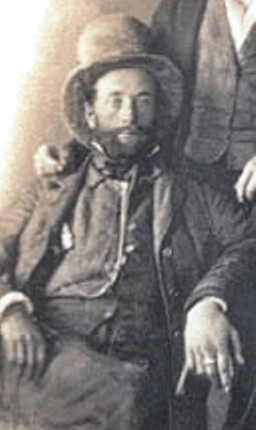
Lewis Crum Bidamon (January 16, 1806 – February 11, 1891) was a leader in the Illinois militia who assisted Latter Day Saints in the 1846 “Battle of Nauvoo”. Second husband of Emma Smith. Via Wikipedia, Public Domain.
Nearly two years after the Saints’ departure, on December 23, 1847—notably, Joseph Smith’s birthday—Emma married Lewis C. Bidamon, a non-Mormon resident of Nauvoo. A Methodist minister performed the ceremony.
The choice of husband signals much about Emma’s state of mind. Bidamon was not a Latter-day Saint of any variety. He had a reputation as a drinker and a gambler. He was also, according to accounts, charming, affectionate, and protective of Emma. He moved into the Mansion House and became a surrogate father to Emma’s children.
For church members in Utah, Emma’s marriage to a non-Mormon confirmed their worst suspicions about her faithfulness. Almon Babbitt, a church leader left in Nauvoo to manage church interests, confronted Emma about her decision to marry outside the faith. Emma was unmoved by his criticism.
Bidamon proved to be a complicated choice. Later in their marriage, he had an affair with a young woman named Nancy Abercrombie, who bore him a son named Charles. Emma’s previous experience with Joseph’s polygamous practices and secret marriages had likely shaped her capacity to respond with unusual forbearance to Lewis’s infidelity. When Nancy found herself unable to support the child alone, she brought him to Emma. In a remarkable act of grace that perhaps reflected her own painful history with marital betrayal, Emma agreed to take in both Nancy and Charles. She and Lewis supported them, and one of Emma’s final requests was that Lewis marry Nancy after Emma’s death to give Charles his proper name. Lewis did so.
Emma and Lewis attempted to operate a store and hotel in Nauvoo after the Mormon exodus, but the town’s population had collapsed, and neither venture was profitable. Emma and her family remained “rich in real estate but poor in capital.”
V. The Polygamy Factor
What Emma Knew
The question of Emma’s knowledge of and involvement in plural marriage is central to understanding her story and its implications for Latter-day Saint truth claims. The historical evidence presents a picture far more complicated than either the traditional LDS narrative (Emma temporarily accepted but then rebelliously rejected a divine revelation) or the RLDS narrative (plural marriage was an invention of Brigham Young, never taught or practiced by Joseph Smith) allows.
According to the detailed research compiled by Linda King Newell and Valeen Tippetts Avery in their groundbreaking biography Mormon Enigma: Emma Hale Smith, Emma’s first confrontation with Joseph’s departure from monogamy came not in Nauvoo but in Kirtland, Ohio, in the mid-1830s. A young hired girl named Fanny Alger lived with the Smith family, and Joseph took her as his first known plural wife. According to William McLellin, then a member of the Twelve, Emma discovered the relationship when she went looking for Joseph and Fanny and, peering through a crack in a barn door, witnessed what McLellin called “the sealing.”
Emma apparently treated this as a one-time incident, but it must have planted seeds of suspicion that would later sprout into bitter conflict.
By 1842, Joseph had secretly married numerous women without Emma’s knowledge. When rumors began circulating, Emma initially believed they stemmed from John C. Bennett’s misconduct and publicly campaigned against “spiritual wifery” without realizing she was preaching against her own husband’s practices. The moment of realization must have been devastating: not only had Joseph deceived her, but her trusted friend Eliza R. Snow—who lived with the Smiths, taught their children, and served as Emma’s Relief Society secretary—had become Joseph’s plural wife.
According to Mormon folk tradition, Emma’s response was physical: she pushed Eliza down a flight of stairs. Some versions claim this caused Eliza to miscarry a pregnancy by Joseph. While the details cannot be confirmed from contemporary sources, some kind of confrontation clearly occurred that ended Eliza’s residence in the Smith home.
Brief Acceptance and Swift Rejection
In May 1843, Emma apparently reached a temporary accommodation with plural marriage. She agreed to let Joseph take additional wives if she could choose them. She selected two sets of sisters who were already living in the Smith household: Emily and Eliza Partridge, and Sarah and Maria Lawrence. What Emma did not know was that Joseph had already secretly married the Partridge sisters two months earlier.
Joseph married the Partridge sisters a second time, with Emma present and giving consent. But Emma’s capitulation was momentary. Emily Partridge later wrote that “Emma seemed to feel well until the ceremony was over, when almost before she could draw a second breath, she turned and was more bitter in her feelings than ever before, if possible, and before the day was over she turned around or repented what she had done and kept Joseph up till very late in the night talking to him.”
From this point forward, Emma fought against plural marriage with every weapon at her disposal. She demanded that the plural wives leave her home. She argued with Joseph constantly. She threatened divorce. In July 1843, when Hyrum Smith tried to convince Emma to accept a written revelation on plural marriage (what became D&C 132), she responded with what William Clayton described as “a more severe talking to” than Hyrum had ever received in his life.
What happened to the original manuscript of D&C 132 remains disputed. According to some accounts, Emma burned it; according to others, Joseph burned it himself with Emma’s encouragement. Emma later denied burning “the revelation” but may have been distinguishing between the specific document she burned and the text preserved by copies that had already been made.
The Public Denials
Throughout her life, Emma publicly denied that Joseph had practiced plural marriage. In her 1879 interview with her sons, she stated: “No such thing as polygamy, or spiritual wifery, was taught, publicly or privately, before my husband’s death, that I have now, or ever had any knowledge of. … He had no other wife but me; nor did he to my knowledge ever have.”
This denial contradicts overwhelming historical evidence from multiple independent sources, including affidavits from women who married Joseph and testimony from reliable witnesses who documented the marriages at the time. The Utah church would later publish these affidavits specifically to counter Emma’s denials.
Why did Emma deny what she clearly knew? Historians have proposed various motivations. Some suggest she was protecting her family’s reputation and her sons’ inheritance. Others argue that she had made temple covenants involving strict secrecy about sacred matters and extended that secrecy to cover plural marriage. Still others propose that denial was simply how Emma coped with painful memories she could not bear to confront. Perhaps most charitably, Emma may have genuinely believed that what Joseph did in secret, under pressure and with her active resistance, did not constitute legitimate “teaching” of plural marriage.
Whatever her reasoning, Emma’s denials created an impossible dilemma that persists to this day. Either the person closest to Joseph Smith was lying about one of the most important and controversial aspects of his ministry, or the extensive documentation of his plural marriages was somehow fabricated or misunderstood. Neither conclusion is comfortable for those seeking to defend Joseph’s prophetic claims.
VI. Two Churches, Two Legacies
The Reorganization
Unlike some members of the Smith family who temporarily affiliated with James Strang or William Smith, Emma and her children lived as unaffiliated Latter Day Saints for more than a decade after Joseph’s death. Many Saints who rejected Brigham Young’s leadership believed that Joseph Smith III, Emma’s eldest surviving son, would one day be called to lead a restored church.
In 1860, Joseph III reported receiving a divine call to lead a “New Organization” of the Latter Day Saint church. Emma supported his decision. On April 6, 1860—the thirtieth anniversary of the church’s founding—Joseph III was sustained as president of the Reorganized Church of Jesus Christ of Latter Day Saints (RLDS) at a conference in Amboy, Illinois. Emma became a member without rebaptism, her original 1830 baptism being recognized as valid. This moment vindicated Emma’s long-held belief that leadership should remain with Joseph Smith’s biological descendants rather than passing to Brigham Young and the Twelve Apostles.
Theological Distinctions from the Utah Church
The RLDS Church (renamed Community of Christ in 2001) developed in conscious opposition to the Utah church on multiple points. It rejected plural marriage as an apostasy introduced by Brigham Young rather than Joseph Smith, aligning with Emma’s lifelong denial that her husband had practiced polygamy. It rejected the doctrine of God as an exalted man who had once been mortal, returning instead to more traditional Christian concepts of deity. It practiced more conventional Protestant forms of worship and organization, including allowing women to participate more fully in church governance. The RLDS Church also rejected temple ceremonies, including endowments and sealings, as practiced in Utah. And it claimed lineal descent from Joseph Smith through his sons as the basis for prophetic succession, establishing a hereditary presidency that would distinguish it from the Utah church’s pattern of succession through apostolic seniority.
Emma’s Final Years with the RLDS Church
Emma remained actively involved with the RLDS Church for the remainder of her life, though she never publicly acknowledged Joseph’s plural marriages. She provided crucial testimony and historical documents to support the church’s positions, particularly its rejection of polygamy. Her presence lent legitimacy to the reorganization and connected it directly to the church’s founding generation.
The Lineal Succession Pattern
Joseph III served as president of the RLDS Church from 1860 until he died in 1914, a fifty-four-year tenure. His brother, Alexander Hale Smith, served as a counselor and Presiding Patriarch, keeping leadership within the family as William Smith had once advocated. The pattern of lineal succession continued for generations, with Joseph’s descendants leading the church until 1996, when Wallace B. Smith—Joseph III’s great-grandson—became the last prophet-president from the Smith family line. The church transitioned to a new selection process and ultimately called W. Grant McMurray, the first president without direct lineage to Joseph Smith, marking the end of the hereditary succession that had defined the RLDS/Community of Christ identity for 136 years.
Claiming Joseph’s Legacy
Both the LDS and RLDS churches claimed to be the true continuation of Joseph Smith’s work, and both constructed narratives that supported their claims while marginalizing the other.
The Utah church emphasized Joseph’s later Nauvoo teachings, including temple ordinances, celestial marriage, and the plurality of gods. It portrayed Emma as someone who had known the truth but rejected it out of jealousy or weakness. For generations, Emma was essentially written out of official church history or treated as a cautionary example.
The RLDS church emphasized Joseph’s earlier teachings and public statements, which rejected polygamy and taught a more conventional understanding of God. It portrayed Brigham Young as an usurper who had corrupted Joseph’s legacy with innovations Joseph never authorized. Emma was honored as the faithful widow who saw through the false claims of the Utah leaders.
Both narratives required selective reading of the historical evidence. The Utah narrative had to explain away Emma’s persistent opposition and denial. The RLDS narrative had to explain away the extensive contemporary documentation of Joseph’s plural marriages. Neither church could fully account for all the evidence without acknowledging uncomfortable truths about their founding prophet or his wife.
The Descendants Today
A remarkable development in recent decades has been the reunification of some of Joseph and Emma’s descendants with the LDS Church. For 128 years, not a single descendant of Emma Smith held the Melchizedek Priesthood in the Utah church. In 1972, Michael Kennedy, a third-great-grandson of Joseph and Emma, joined The Church of Jesus Christ of Latter-day Saints—the first descendant to do so and receive the priesthood.
Kennedy has worked to heal the rift between the two branches of the family. In 2007, representatives of the Brigham Young Family Association presented what they called “The Healing Document” to the Joseph Smith Jr. Family Organization. The document acknowledged the painful history between the two groups and expressed desire to “rebuild that bridge of friendship between our two families that existed not so long ago.”
This healing process has required confronting longstanding prejudices on both sides. Some Smith descendants had been raised to believe that Brigham Young was involved in a conspiracy to kill Joseph. Some Young descendants had been raised to view Emma as an apostate who tried to poison the Prophet. Neither tradition served truth or reconciliation.
VII. The Sanitized Emma: Official Narratives Reconsidered
In recent decades, the LDS Church has worked to rehabilitate Emma Smith’s reputation. The 2015 Gospel Topics essay on “Plural Marriage in Kirtland and Nauvoo” acknowledges Joseph’s practice of plural marriage and Emma’s complex relationship with it. Jennifer Reeder’s 2021 book First: The Life and Faith of Emma Smith, published by Deseret Book, presents a sympathetic portrait of Emma as a faithful woman who struggled heroically with impossible circumstances.
This rehabilitation is welcome in many respects. Emma deserves to be remembered for her genuine contributions and her real suffering, not caricatured as a villain. But the rehabilitated Emma also raises new questions about how LDS writers handle historical complexity.
Consider, for example, the interpretation of Emma’s final words. According to her son, Alexander, when Emma was on her deathbed, she called out “Joseph, Joseph, Joseph,” extended her left arm as if reaching for someone, said “Yes, I am coming,” and died. A few days earlier, a nurse had recorded a dream Emma reported, in which Joseph came to her, showed her a beautiful mansion with a nursery containing her son Don Carlos, who had died as a toddler, and promised her she would have all her children.
LDS Living magazine quotes historian Jennifer Reeder interpreting these events: “The last words that she uttered before she died were, ‘Joseph, Joseph, Joseph.’ And I think that that insinuates that he had come for her and that they continued to share this beautiful relationship, despite its troubles and its feelings of betrayal or misunderstanding or lack of communication. That they forgave each other and that they loved each other so much.”
This is a beautiful interpretation, and it may even be true. But it is also an interpretation that puts specific theological content into Emma’s experience—content that supports a particular narrative about the eternal nature of her marriage to Joseph and the ultimate reconciliation of their conflicts over plural marriage. LDS writers are fond of such interpretive moves, reading their theological assumptions into the minds and experiences of historical figures in ways that stretch factual evidence into devotional certainty.
What we actually know is that a dying woman called out her first husband’s name—a husband she had loved deeply, whatever their conflicts. That is moving and human. The theological conclusions drawn from it are something else entirely.
Similarly, the parallel drawn by some LDS writers between Emma and Eve is theologically loaded. Jenny Reeder at FAIR Conference 2021 drew extended comparisons between Emma as the “elect lady” and Eve as the “mother of all living,” portraying both as essential figures in their respective dispensations. This is creative theologizing, but it assumes the very prophetic framework that Emma’s story might reasonably cause one to question.
VIII. The Smith Children: Aftermath and Fates
Emma’s children with Joseph had varied fates, several marked by tragedy that seemed to echo their parents’ suffering.
Joseph Smith III(1832-1914) led the RLDS Church for over fifty years. He married three times (his first two wives died) and had numerous children. He worked tirelessly to clear his father’s name of the polygamy charge, though the historical evidence ultimately contradicted his efforts. Frederick Granger Williams Smith (1836-1862) died young, possibly during the Civil War. He struggled with health problems throughout his short life. Alexander Hale Smith(1838-1909) served as a counselor to his brother Joseph III in the RLDS Church and as a missionary. He visited Salt Lake City in 1869 as an RLDS missionary, where he was shown affidavits documenting his father’s plural marriages—a confrontation with evidence that must have been painful for someone raised to believe his father never practiced polygamy. David Hyrum Smith(1844-1904), Emma’s last child, was born five months after Joseph’s death. He showed artistic and poetic talent but developed severe mental illness in adulthood. He spent the last decades of his life in an asylum. Some historians have speculated that the trauma Emma experienced during her pregnancy—the murder of her husband, the uncertainty about her future, the stress of the succession crisis—may have affected David’s development. David’s tragic end added another layer of sorrow to Emma’s story. Julia Murdock Smith(1831-1880), Emma’s adopted daughter (one of the twins adopted after Emma’s own twins died at birth), lived a quiet life. Her twin brother Joseph Murdock Smith died as an infant following the mob attack on Joseph Smith in Hiram, Ohio, in 1832.
Emma outlived most of her children who survived infancy. Of the eleven children she bore, only four lived to adulthood, and only three outlived her. The grief of these losses, combined with the other sufferings of her life, shaped a woman who, according to one granddaughter, “smiled with her face but not her eyes.”
IX. What Emma’s Story Reveals: A Theological Analysis
For Christians evaluating the truth claims of the Latter-day Saint movement, Emma Smith’s story provides a crucial window into the founding generation. Here was the person who knew Joseph Smith most intimately—who shared his bed, bore his children, transcribed his revelations, and witnessed his ministry from beginning to end. What does her testimony reveal?
The Succession Problem
If Joseph Smith was a true prophet restoring Christ’s original church, why was the succession after his death so contested and ugly? The LDS Church claims apostolic authority through priesthood lineage, yet the transition from Joseph to Brigham was marked by competing visions, political maneuvering, personal animosities, and bitter accusations of corruption. Multiple factions emerged, each claiming to be the true continuation of Joseph’s work: the Brighamites heading west, the Strangites in Wisconsin, the Rigdonites in Pennsylvania, the eventual Reorganization under Joseph III, the Temple Lot group in Independence, and others.
Compare this to apostolic succession in the New Testament. When Judas fell, the apostles prayerfully selected Matthias to take his place (Acts 1:15-26). When the early church faced the question of Gentile inclusion, the apostles and elders came together in council and reached a unified decision guided by the Holy Spirit (Acts 15). There was a clear, orderly, Spirit-confirmed succession.
The Mormon succession crisis looks far more like what happens when a charismatic founder dies without establishing clear institutional succession—a pattern seen repeatedly in new religious movements throughout history. The fragmentation suggests human institutional dynamics rather than divine guidance.
There are numerous 20th-century examples of new religious movements fragmenting after their charismatic founder’s death, demonstrating a recurring pattern in religious history.
Jehovah’s Witnesses (1916)
When Charles Taze Russell, founder of what became the Jehovah’s Witnesses, died in 1916, the movement faced a succession crisis. Joseph Rutherford succeeded Russell, but his presidency caused significant changes and divisions within the movement. The transition required transforming a “sectarian movement centered on a single charismatic individual” into a more institutionalized organization with loyalty to the movement itself rather than to one person.
International Society for Krishna Consciousness (ISKCON)
When A.C. Bhaktivedanta Swami Prabhupada, founder of the Hare Krishna movement, died in 1977, ISKCON experienced severe fragmentation and succession disputes. Multiple gurus claimed authority, leading to competing factions and allegations of misconduct. The movement struggled for decades to establish stable leadership structures after losing its charismatic founder.
Unification Church
After Sun Myung Moon died in 2012, the Unification Church experienced internal conflicts and competing claims to succession. His widow, Hak Ja Han, and several of his children established rival organizations, fragmenting the movement that had been unified under Moon’s charismatic authority.
Groups That Collapsed
Some movements failed to survive their founder’s death at all. The People’s Temple (Jonestown) collapsed after Jim Jones died in 1978 during the mass suicide tragedy. Heaven’s Gate ended with the mass suicide of its followers in 1997. The Branch Davidians, after David Koresh died in 1993, survived only as a small, isolated faction without a substantial presence. The Spirit Fruit Society self-destructed after its founder’s death, making it one of the few complete failures among studied cases.
Scholarly Consensus
Religious scholars note that “the death of the founder is a crisis in any religious movement.” Research shows that when new religious movements die, “it is from lack of response of the public to the founder’s ideas or the incompetence of the founder in organizing the followers into a strong group” rather than simply the founder’s death. Most movements either “die out, fragment into multiple groups, consolidate [their] position, or change [their] nature to become something quite different from what its founder intended.” The charismatic leadership model itself is “problematic because it is a less stable, noninstitutionalized form in which the personal volatility of the prophet or messiah can have a substantial impact on a group.”
The Polygamy Dilemma
Emma’s resistance to plural marriage puts her in an impossible position within LDS theology. Either she was rebelliously rejecting a divine commandment (the traditional LDS explanation), or she recognized plural marriage as an innovation that contradicted both Scripture and Joseph’s public teachings.
Consider what Emma witnessed: a husband who publicly denied practicing polygamy while secretly marrying dozens of women; a revelation (D&C 132) that threatened her with destruction if she did not accept additional wives for her husband; marriages conducted behind her back with women she trusted; her own moments of capitulation followed by swift regret.
From a traditional Christian perspective, Emma’s moral instincts appear sound. Plural marriage as practiced in Nauvoo violated the New Testament standard of monogamous marriage (1 Timothy 3:2, 12; Titus 1:6). The secrecy and deception involved violated basic ethical principles. The power dynamics—an authoritative religious leader taking young women as wives, sometimes in their teens, sometimes already married to other men—raise serious questions about coercion and exploitation.
Emma’s resistance to plural marriage does not look like faithlessness. It looks like moral courage.
Emma as Unwitting Witness
Emma’s persistent public denial of Joseph’s polygamy, maintained until her death, creates a fundamental credibility problem for any account of early Mormon history. The person who knew Joseph best either lied consistently for decades about one of the most important aspects of his ministry, or the extensive documentation of his plural marriages is somehow unreliable.
Neither option is comfortable for those defending Joseph’s prophetic claims. If Emma was lying, why should we trust her other testimonies about Joseph’s character and revelations? If Emma was telling the truth as she understood it, what does that say about Joseph’s honesty and the reliability of the historical record his followers compiled?
Emma becomes an unwitting witness against the very movement her husband founded. Her denials expose the deception that surrounded plural marriage. Her resistance reveals that even those closest to Joseph questioned the divine origin of some of his most significant teachings. Her refusal to follow Brigham Young demonstrates that reasonable, faithful people could look at the available evidence and reach very different conclusions about who held legitimate authority.
The Fracturing Pattern
The fragmentation of Mormonism after Joseph’s death follows a pattern common to new religious movements lacking a genuine apostolic foundation. When the charismatic founder dies, no one has the same authority or personal connection to the divine, and the movement splinters as various factions claim competing legitimacy.
The LDS Church, the Community of Christ, the Church of Christ (Temple Lot), the Strangite church, and numerous other bodies all trace their origins to Joseph Smith. Each claims to be the true continuation of his work. The fact that they cannot agree on fundamental questions—Who has authority? Was plural marriage divinely commanded? What is the nature of God? How are temples to be used?—suggests that Joseph left no clear, Spirit-confirmed answer to these questions.
This contrasts sharply with the church Jesus Christ actually founded, which maintained essential unity for centuries despite internal disputes and external persecution. The gates of hell did not prevail against it (Matthew 16:18). The Mormon movement, by contrast, shattered into competing fragments within months of its founder’s death.
X. Conclusion: The Tragic Figure and the Inadvertent Witness
Emma Hale Smith Bidamon died in Nauvoo on April 30, 1879, at the age of seventy-four. According to her family, her final words were “Joseph, Joseph, Joseph.” Whether this represented a vision of reunion with her first husband, a dying woman’s memories of her youth, or simply the name most deeply inscribed on her heart, we cannot know with certainty.
What we do know is that Emma spent more than half her life without Joseph, much of it in the town they had built together, but that emptied after his death. She raised her children, cared for her mother-in-law, managed her properties, supported her son’s leadership of the Reorganized Church, and maintained her testimony that the Book of Mormon was divinely translated while simultaneously denying that her husband had ever practiced plural marriage.
Emma was in many ways a victim of the movement her husband created. She sacrificed her family of origin to marry him. She endured poverty, displacement, mob violence, and imprisonment. She buried her children. She was nearby when her husband was killed. She faced public humiliation over his secret polygamy. And then she watched others claim his legacy while portraying her as faithless or deceived.
For Christian readers, Emma’s story illustrates what happens when people build on foundations other than Christ. The tragedy was not merely personal; it was theological. A movement that claimed to restore primitive Christianity could not manage an orderly succession. A prophet who claimed direct revelation from God practiced marriage patterns that contradicted both biblical ethics and his own public teaching. The woman who knew the founder best refused to follow where the movement led after his death.
Emma deserves compassion. She was a woman of sincerity and courage who found herself in an impossible situation. She deserves honesty. Her story cannot be reduced to either the villain of traditional LDS memory or the unblemished heroine of RLDS hagiography. She was a complicated human being who made complicated choices in complicated circumstances.
But Emma’s story also deserves serious theological engagement. Her experience raises questions about Joseph Smith’s prophetic claims that sympathetic biographies cannot simply explain away. The wife who stayed behind, who refused to follow Brigham Young west, who denied that her husband practiced what we now know he practiced—she stands as an inadvertent witness to the fractures at the heart of the Restoration movement.
Her testimony, in all its complexity and contradiction, continues to speak to those willing to listen.
Sources Consulted
Newell, Linda King, and Valeen Tippetts Avery. Mormon Enigma: Emma Hale Smith. 2nd ed. Urbana: University of Illinois Press, 1994.
Reeder, Jennifer. First: The Life and Faith of Emma Smith. Salt Lake City: Deseret Book, 2021.
Bushman, Richard Lyman. Joseph Smith: Rough Stone Rolling. New York: Alfred A. Knopf, 2005.
Brodie, Fawn M. No Man Knows My History: The Life of Joseph Smith. 2nd ed. New York: Alfred A. Knopf, 1971.
The Joseph Smith Papers. josephsmithpapers.org.
“Emma Hale Smith.” Church History Topics. The Church of Jesus Christ of Latter-day Saints.
Newell, Linda King. “The Emma Smith Lore Reconsidered.” Dialogue: A Journal of Mormon Thought 17, no. 3 (1984): 89-100.
“Why Did Emma Smith Remain in Nauvoo after the Death of Joseph Smith?” Doctrine and Covenants Central.
Woodger, Mary Jane. “Emma Hale Smith: First Woman of Faith of the Restoration.” Religious Educator 26, no. 3 (2025): 69-86.
Reeder, Jenny. “First: The Life and Faith of Emma Smith.” FAIR Conference, August 2021.
“Healing the Rift Between Brigham and Emma.” Joseph Smith Jr. and Emma Hale Smith Historical Society.
Brigham Young. Conference Address, October 7, 1866. Brigham Young Collection, LDS Church Archives.