
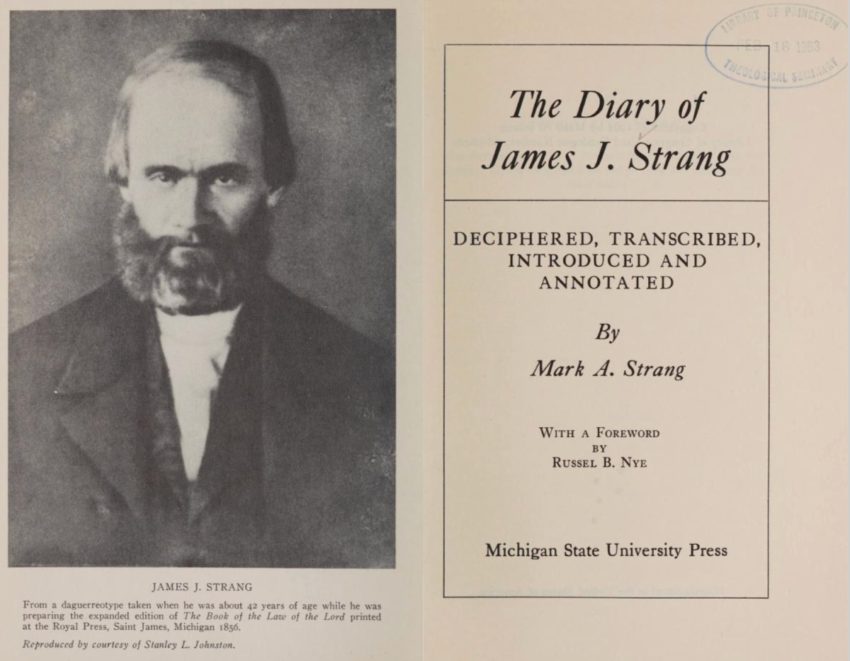
Photo: From the diary of James Strang (see attached PDF). Via Archive.org. Publisher: Michigan State University Press. Copyright review: Public domain according to HathiTrust rights database.
The Mormon King Nobody Remembers:
James Jesse Strang and His Island Empire of Fraud
The Blood of a Prophet and the Ambitions of a Pretender
In the spring of 1844, the air in Nauvoo, Illinois, was thick with a foreboding no theology could fully explain. The mud streets along the Mississippi teemed with believers, skeptics, whiskey peddlers, and land speculators—all of them sensing, with the particular animal instinct of people living at the edge of a continent and an era, that something enormous was about to break. The city of Nauvoo had swelled to rival Chicago in population. Its prophet, Joseph Smith, had declared himself a candidate for the presidency of the United States. And the enemies who had always pressed against the margins of the Mormon world were closing in.
On the evening of June 27, 1844, a mob stormed Carthage Jail and murdered Joseph Smith. The shots that killed the founder of the Latter-day Saint movement did not merely end one man’s life—they opened a chasm of succession that would swallow the ambitions of a dozen men and reshape American religion, politics, and mythology for generations to come.
Among the men who heard the news and immediately calculated its possibilities was a short, balding, sharp-eyed lawyer from upstate New York named James Jesse Strang. He had been a Mormon for barely a year. He had never held a position of authority in the church. By most accounts, he was physically unremarkable—the kind of man who could stand in any crowd and disappear. And yet, within weeks of the prophet’s assassination, Strang would produce a letter—allegedly postmarked before Smith’s death—naming himself the rightful heir to the entire Latter-day Saint movement.
What followed was one of the most audacious, violent, and ultimately tragic confidence schemes in the history of the American republic. To understand how it was possible, you must first reckon with the spiritual atmosphere of the 1840s — an era of profound, aching hunger that no political platform, no economic theory, and no frontier homestead could satisfy. Americans were not merely poor or anxious in this period; they were cosmically unsettled. The old Calvinist certainties had crumbled. The established churches felt cold and distant. The demokratizing promise of the young republic had produced not a paradise but a brutal economic collapse, a widening gulf between the wealthy and the desperate, and a nagging, unanswerable question that haunted the campfire meetings and revival tents of the frontier: Has God forgotten us?
Into that silence came voices — preachers, prophets, visionaries, and outright charlatans — all offering the same essential commodity: the certainty that heaven was near, that God was still speaking, and that this man, in this place, at this moment in history, had been chosen to deliver the divine message. Angels were not metaphors in the 1840s. They were expected visitors. Sacred texts buried in the American earth were not absurdities — they were the fulfillment of a deeply felt conviction that the New World was itself a holy land, that God had been saving His greatest revelation for this continent and this people. It was a hunger so vast and so genuine that even the most transparent frauds could feed it, at least for a while.
It was into this world — starving for miracles, primed for prophets, and profoundly suspicious of the institutions that had already failed it — that James Jesse Strang arrived. And as journalist and scholar Miles Harvey writes in his meticulously researched 2020 book, The King of Confidence, Strang’s story is at once a frontier adventure, a religious thriller, and a parable about the peculiar hungers that have always defined American life — the hunger for certainty in uncertain times, for charisma when institutions have failed, for transcendence when the material world has offered only disappointment, and for a king in a republic that was never supposed to have one.
The Burned-Over District and the Making of a Confidence Man
To fully understand James Jesse Strang, we must first dig into the soil from which he sprang. He was born in 1813 in Cayuga County, western New York — a region that had been swept so many times by the fires of religious revival that historians gave it a permanent name: the Burned-Over District. It was the birthplace of Mormonism, the Millerite movement, the Fox sisters’ Spiritualism, and dozens of other religious experiments that flourished in the anxious air of early nineteenth-century America.
This was not an accident of geography. The young United States was a country in profound, disorienting flux. The Panic of 1837 had obliterated the savings of thousands of ordinary families. Rapid industrialization was upending agricultural life. The telegraph, the railroad, and the steam engine were compressing time and distance in ways that felt almost supernatural. The old certainties — about community, about the future, about God — were dissolving.
This was the same territory that had produced Joseph Smith himself, the Fox sisters and their spirit rappings, the utopian commune at Oneida, and an entire ecosystem of prophets, visionaries, and millennial schemers. The Panic of 1837 had devastated the regional economy. Banks had collapsed, farms had been foreclosed, and ordinary men who had followed the rules found themselves ruined while fast-talking speculators seemed to flourish. Into this crisis, religion poured like water into a cracked earth, offering explanations and promises that the market economy conspicuously failed to provide.
As Miles Harvey writes in his vivid account of the life and times of this American sect leader, “The King of Confidence:”
“Confidence was black magic, good fortune and hard cash combined. Confidence could turn worthless paper into glittering gold, cow towns into cities, empty lots into bustling businesses, losers into winners, paupers into millionaires. Confidence was a charm deployed by bankers, merchants, philosophers, politicians, clergymen and card sharps alike. Confidence was the soul of trade in the words of one leading financial publication. Without it, added Herman Melville, commerce between man and man, as between country and country, would, like a watch, run down and stop.”
In an America where “confidence” was literally described as the national currency, the man who could radiate absolute certainty — about land, about fortune, about God — needed nothing else. No armies, no title, no inheritance. Certainty alone was power enough. The young James Jesse Strang understood this better than almost anyone alive. And he was watching very carefully indeed.
Young Strang moved restlessly through this landscape, working as a lecturer, postmaster, newspaper editor, and self-trained lawyer. He was, by his own private confession, a skeptic of the deepest dye. In journals he kept as a young man—journals that survive and that Harvey draws upon extensively—Strang recorded with startling candor that he could speak about God to audiences in ways that visibly moved them, while privately believing none of it. “On the one hand,” Harvey observes of these journals, “he’s a very idealistic guy. On the other hand, he realizes and talks about how he can talk about God to people in a way that really moves them, but that he doesn’t believe in at all.”
Strang had been a shuffler long before he became a prophet. The word meant something specific in the 1840s — a man who kept his debts, his obligations, and his very identity in perpetual motion, always one step ahead of accountability. The Panic of 1837 had given him his first major test: heavy land investments, spectacular bankruptcy, creditors in multiple states, and the slow construction of an elaborate personal mythology of excuses, missing payments, and misdirected correspondence designed to buy time indefinitely. When a warrant for his arrest finally caught up with him in upstate New York, Strang simply closed one chapter and opened another. He headed west — toward the frontier, toward Nauvoo, toward Joseph Smith, and toward the greatest confidence scheme of his extraordinary career.
He arrived in Nauvoo, Illinois, in the early 1840s, a declared atheist stepping into the capital city of the most dynamic new religion in America. What happened next remains, even to careful historians, something of a mystery. Strang converted to Mormonism and was baptized by Joseph Smith himself. Whether his conversion was genuine—whether some authentic spiritual crisis accompanied his entry into the faith—or whether it was simply the most spectacular long-game confidence scheme of his career, Harvey leaves wisely open.
He’s a guy who was a, you know, an obscure farm boy from western New York who kind of failed at everything he did. He was a self-trained lawyer, a newspaperman, and a postmaster general. And then he left New York in a scandal and moved out to what was then called the West, now the Midwest, and remade himself.
— Miles Harvey, NPR Interview, “The King of Confidence”
What is certain is that Strang possessed one physical quality that everyone who met him remarked upon: his eyes. In a man who was otherwise short, bald, and unimpressive in bearing, those close-set, piercing eyes seemed to look directly through whoever stood before him. In an era when phrenology was a respected science and the visible body was believed to express the invisible soul, Strang’s eyes became the single most persuasive argument for his authority. People who doubted his theology often found, to their own bewilderment, that they believed his eyes.
From his teenage journals, historians can observe the peculiar duality that would define his entire life. He was idealistic and cynical in almost equal measure. He wrote passionately about justice, about destiny, about the human capacity for greatness. He also wrote, with remarkable self-awareness, about his ability to move people emotionally with talk of God — despite believing in none of it himself.
As Harvey noted in his NPR interview with Scott Simon:
“In those journals, you see this idealism and cynicism side by side. On the one hand, he’s a very idealistic guy. On the other hand, he realizes and talks about how he is able to talk about God to people in a way that really moves them, but that he doesn’t believe in at all. But he’s not going to tell him.”
This was the engine of Strang’s entire career: a man who understood the hunger of believers with the cold precision of a predator, and who never once felt bound by the moral obligations of faith.
He kicked around western New York for years — working as a lecturer, an editor, a postmaster, a self-trained lawyer. He married. He accumulated debts. He made promises he did not keep. He was, in the language of his era, a shuffler — someone who kept moving just fast enough to stay ahead of his creditors and his conscience.
Then, in the summer of 1843, he vanished from New York entirely, fleeing a warrant. He headed west. And in Nauvoo, Illinois — the teeming capital of the Mormon world on the eastern bank of the Mississippi — James Jesse Strang began the greatest con of his life.
The Letter and the Plates: A Succession Forged in Confidence
Nauvoo in 1843 was extraordinary by any measure. Joseph Smith had transformed a malarial swamp into a city of fifteen thousand people in just four years, fueled by converts streaming in from across America and from England, Scandinavia, and Wales. The city had its own militia, its own municipal government, its own theological architecture — a faith built on continuous revelation, angelic visitation, sacred texts, and the promise that God was still speaking directly to His people.
For an opportunist like Strang, it must have looked like a treasure chest with the lock already broken.
He presented himself to Joseph Smith in February 1844. Within days, he was baptized into the faith. Whether any part of this conversion was genuine remains an open and tantalizing question. Harvey explored it with characteristic nuance:
“Whether the conversion was real, I don’t know. But anyway, shortly thereafter, Joseph Smith was murdered by a mob. And this guy, James Jesse Strang, claimed that Smith had sent him a letter just before he died saying, you know, son, the church is yours.”
The murder of Joseph Smith on June 27, 1844, produced an immediate crisis of authority within the Latter-day Saint movement. Smith had never formally designated a successor—or, more precisely, the question of succession had been left in a state of productive ambiguity that served Smith’s purposes while he lived and became catastrophic the moment he died.
Into this vacuum stepped Brigham Young, president of the Quorum of the Twelve Apostles, who moved with organizational brilliance to consolidate the loyalty of the majority of Saints and begin planning the great western exodus that would eventually deposit the Mormon community on the shores of the Great Salt Lake. Young’s claim rested on ecclesiastical structure and the weight of institutional authority.
What happened next was breathtaking in its audacity.
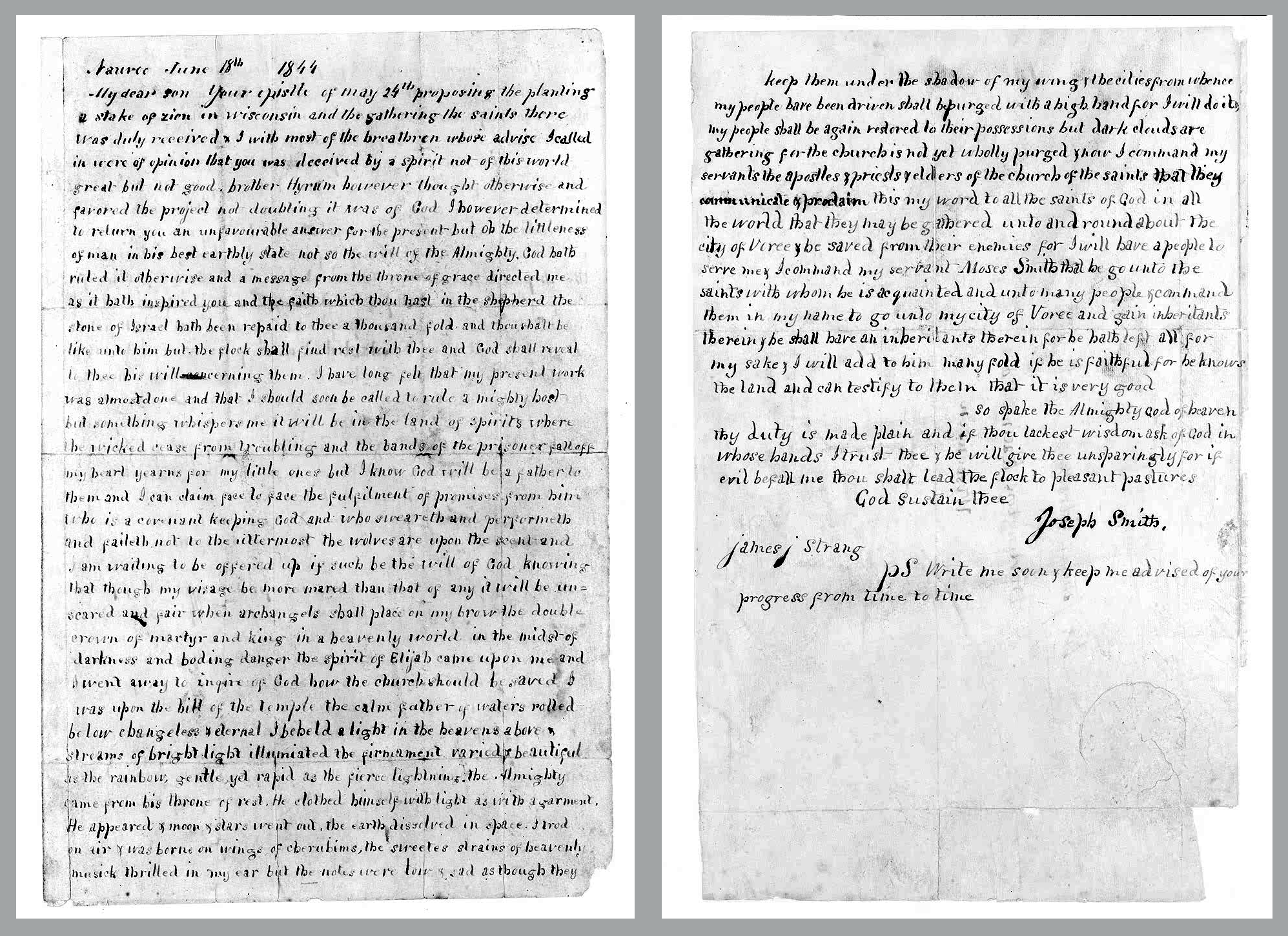
Shortly after Smith’s death, Strang produced a document he claimed had been mailed to him by the prophet just before his imprisonment at Carthage Jail — a letter postmarked from before Smith’s death and naming Strang as his anointed successor. The audacity of the claim was matched only by its apparent plausibility.
Consider what Strang understood about his audience. These were people who had already accepted that an angel had appeared to a young farm boy in upstate New York, that God had directed that boy to a hillside where golden plates lay buried, and that those plates — written in a language no living scholar could read — had been translated by divine power through sacred seer stones. They had staked their homes, their families, their entire earthly lives on the premise that God communicated directly with chosen men through miraculous signs and physical artifacts. A letter from a prophet was not, in this framework, a remarkable thing. It was entirely expected. It was, in fact, exactly the kind of evidence they had been trained to accept.
Strang had studied this framework with a lawyer’s precision and a postmaster’s eye for detail. He had spent years handling official correspondence, learning what authentic documents looked like — the correct postmarks, the proper seals, the weight and texture of official paper, the spacing of a credible signature. He understood, better than most, that forgery is not merely a technical act. It is a psychological one. The forger does not need to fool an expert. He needs only to give believers permission to believe what they already want to believe.
Modern forensic experts who have examined the letter consider it almost certainly a forgery. The handwriting does not match Smith’s known hand, nor the hands of his established scribes. The signatures appear inconsistent with authenticated examples. The phrasing, some scholars have argued, sounds more like Strang than Smith. But in the summer of 1844 — in a community of grieving believers who had just watched their prophet murdered by a mob, who were leaderless and terrified and spiritually unmoored — the letter did not need to be perfect. It needed only to arrive at the right moment, carrying the right words, in the hands of a man whose piercing eyes suggested he had nothing to hide.
It was persuasive enough to attract several hundred followers. And for James Jesse Strang, several hundred followers was all he needed to begin building a kingdom.
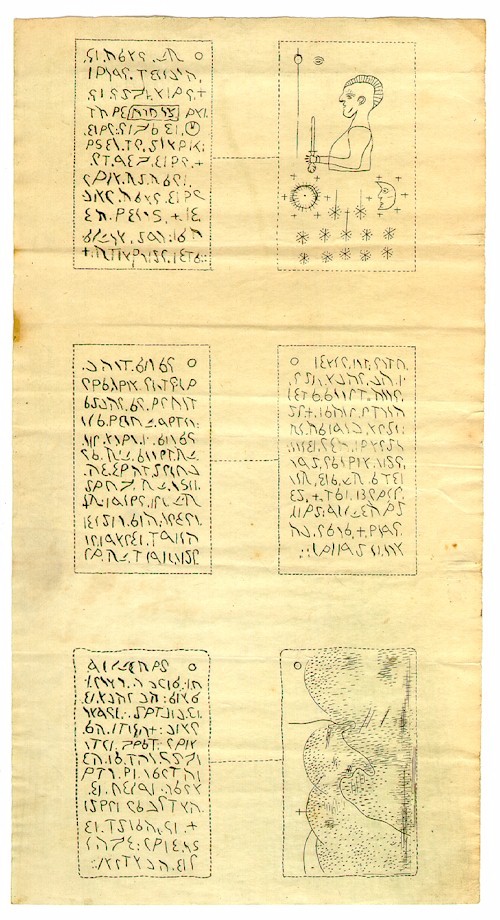
It wasn’t enough for Strang to produce one miraculous artifact, however. He had studied Joseph Smith carefully enough to know that the Mormon faith was built on a foundation of tangible sacred objects — the golden plates, the seer stones, the Urim and Thummim. Strang needed his own relics. And so, in the late summer of 1845, Strang led a group of his followers to a spot near Burlington, Wisconsin—a little settlement he had named Voree—and directed them to dig at the base of a specific tree, at a location revealed to him, he said, in a vision.
The men dug. And there, buried beneath the roots of the tree, they found three small brass plates engraved with an indecipherable script. The plates bore a text attributed to one “Rajah Manchou of Vorito,” the leader of an ancient vanished civilization—conveniently analogous to the lost peoples described in the Book of Mormon. Using a pair of “seer stones” loaned to him by an angel, Strang translated the inscription. It read, in essence: a mighty prophet shall rule after the forerunner’s death. The forerunner was Smith. The mighty prophet was Strang.
Unlike the golden plates that Smith had produced for the Book of Mormon—plates that only a select group of witnesses claimed to have seen, and which subsequently vanished—Strang’s brass plates were available for his followers to hold, examine, and pass among themselves. They were tangible. They were real. And in a religious culture that had been trained to accept buried ancient scriptures as perfectly ordinary, they were, to the hundreds of believers who crowded around them, utterly convincing.
This performance, this blending of frontier religious tradition with calculated stage magic, was Strang’s signature method. And it was working. He was gathering followers in Wisconsin, preaching with the feverish intensity of a man who had memorized what genuine belief looked like.
In his book, Harvey offers a critical observation about this moment: Strang had an ally in all of this — a man named Benjamin Wright, an itinerant actor who helped Strang dramatize his revelations and who understood, with a theater professional’s eye, how spectacle could override skepticism. With Wright’s help, Strang was not just a prophet — he was a production.
The brass plates of Voree were James Strang’s masterstroke. Whatever their true origin, they accomplished what the forged letter alone could not: they made his followers’ faith a matter not of trust but of evidence.
Beaver Island: The Kingdom at the Edge of the World
The community Strang built at Voree in Wisconsin was never entirely secure. He had enemies among the Latter-day Saints who considered his claims fraudulent. Non-Mormon neighbors were suspicious of the tight-knit colony he was assembling. And Brigham Young, consolidating authority from the east with formidable organizational power, represented a constant gravitational pull on the loyalties of the faithful.
He needed a fresh stage.
In the late 1840s, Strang received what he described as a divine revelation directing his people northward, to a remote wooded island in the northern reaches of Lake Michigan. Beaver Island—the largest island in the Great Lakes, lying some thirty miles off the coast of Michigan’s Lower Peninsula—had been inhabited by Anishinaabe peoples and a small community of Irish immigrant fishermen. It was isolated, heavily forested, positioned along the steamboat lanes that carried commerce across the Great Lakes, and largely beyond the practical reach of state or federal law enforcement.
It was, in short, a perfect kingdom.
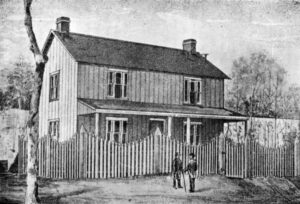
Strang arrived on Beaver Island in 1848 with a small company of followers and immediately set about transforming it. He established a newspaper. He built a tabernacle. He organized a theocratic government in which his divine revelations served as the effective constitution. He dispatched missionaries to the mainland. And he began, with quiet ruthlessness, forcing out or subjugating those who would not submit to his authority—including the Irish fishermen who had been on the island long before his arrival.
The outside world found this equal parts hilarious and alarming. Newspaper editors across the country printed and reprinted stories about “King Strang” with gleeful, mocking fascination — and Strang, who understood the power of publicity as well as any showman of his era, did absolutely nothing to discourage the coverage.
The community that took shape on Beaver Island in the early 1850s was simultaneously a genuine religious settlement and, by any objective assessment, a pirate colony. Strang’s followers launched raids on neighboring communities along the Lake Michigan shoreline, stealing timber, fishing boats, and horses. They operated what amounted to a protection racket for the island’s fishing and lumber trade. As Harvey documents through meticulous archival research, outsiders were entirely correct in their suspicion that the island harbored counterfeiters, land pirates, and timber poachers operating under the protection of Strang’s religious authority.
In 1855, newspapers from Michigan to New York began to run stories about “a gang of marauders” or “pirates” plaguing Lake Michigan. The gang burned sawmills and stole goods, which they displayed on their ships. They carried out “their operations with a boldness, coolness and desperation rarely equalled in the records of highwaysmen,” according to an 1855 article from The Hillsdale Standard, published in southern Michigan.
“There seems to be no question as to the identity of robbers, or their hailing place,” the story continued. “They are emissaries from King Strang’s realms.”
More tales followed. Strang and his followers were settled with responsibility for luring ships ashore to board and plunder, stealing horses, and destroying nets in areas where fishing was big business.
Many of these tales of Strangite piracy have been dismissed over the years, and they’re a little part of the lore told on the island today. Cynthia Prior, a historian for the local lighthouses on Beaver Island, says she’s never heard of that side of Strang. “That’s all folklore,” says the Mormon historian Hajicek. He says it was a twisting of real events, when a ship washed ashore and the Mormons salvaged the wheat aboard.
– Atlas Obscura: The Rise and Fall of the Mormon King of Beaver Island
The Coronation: King of Heaven and Earth
On July 8, 1850, James Jesse Strang staged one of the most extraordinary theatrical productions in American history. Before a crowd of several hundred followers assembled in the tabernacle on Beaver Island, dressed in costumes that had been hand-sewn for the occasion and presiding from a throne constructed of moss and forest timber, Strang was crowned King of Heaven and Earth.
It is tempting to dismiss the coronation as a farce. The costumes were homemade. The throne was mossy wood. The kingdom being proclaimed was a remote island in a cold northern lake. But as Harvey is careful to insist, the federal government of the United States did not find it funny at all. President Millard Fillmore was sufficiently alarmed by the existence of what amounted to a quasi-independent monarchy on American soil that he dispatched the U.S. Navy’s first iron-hulled warship to Beaver Island to arrest Strang and his leadership.
It’s easy to take this stuff sort of like as a joke, but I’ve got to say, the federal government didn’t take it as a joke. President Millard Fillmore, about a year after Strang crowned himself king, was so worried about this quasi-independent kingdom on U.S. soil that he sent in the U.S. Navy’s first iron-hulled warship to invade the island and bring Strang to justice.
— Miles Harvey, Michigan Radio Interview
The warship arrived. Strang and his council were arrested and transported to Detroit for trial. And then something happened that revealed, more clearly than any sermon or tablet, the genuine nature of Strang’s power over his followers: he walked free. The jury, apparently swayed by the charisma of the defendant and the passionate testimony of his community, acquitted Strang and his co-defendants on all charges.
He returned to Beaver Island in triumph. The kingdom was stronger than it had been before the federal government had tried to destroy it.
In the years that followed, Strang pressed his political ambitions beyond the island’s shores. He ran for the Michigan state legislature and won—twice—through a combination of his followers’ bloc votes, strategic alliances, and what the historical record suggests was straightforward ballot stuffing. He lobbied President Franklin Pierce to appoint him governor of the Utah Territory, then being organized as the new center of Mormon settlement. He styled himself, in the newspaper he printed on Beaver Island, as a figure of continental political significance. And by the early 1850s, he had achieved precisely what he had coveted since adolescence: genuine celebrity.
Newspaper editors across the country—who found in Strang an inexhaustible source of the lurid and the improbable—printed and reprinted stories about the King of Beaver Island. As Harvey observes, without that press coverage, Strang’s story would likely have dissolved into a footnote in the chaotic early history of Mormonism. Instead, he became, in Harvey’s precise formulation, a “bona fide celebrity.”
The Theology of Power and the Gospel of Confidence
To understand why Strang succeeded—why hundreds of otherwise sensible men and women abandoned their homes, followed him to a remote island, and defended him against the United States Navy—one must understand the peculiar spiritual economy of antebellum America.
The 1840s and 1850s were a period of what Harvey, drawing on Herman Melville, calls the age of confidence. This was not confidence in the modern psychological sense—not optimism or self-assurance—but something more material and more desperate. In an era before the federal government printed standardized paper currency, the entire economy ran on privately issued banknotes: glorified IOUs that were only as good as the trust that backed them. Confidence was, quite literally, the medium of exchange.
Confidence was black magic, good fortune and hard cash combined. Confidence could turn worthless paper into glittering gold, cow towns into cities, empty lots into bustling businesses, losers into winners, paupers into millionaires.
— Miles Harvey, “The King of Confidence” (read on NPR)
In such an economy, the man who could command trust—who could make others believe in the reality of things not yet seen—possessed a form of social power as real as land or gold. Joseph Smith had understood this intuitively. So had P.T. Barnum, who was building his circus empire during the same years Strang was building his island kingdom. So had a dozen lesser figures who populated the carnival of American religious and commercial life in the decades before the Civil War.
What made Strang distinctive was the precision with which he exploited this economy. He gave his followers not merely faith but evidence: the brass plates they could touch, the coronation they could witness, the newspaper they could read, the political victories they could celebrate. He made his community’s investment in his reality an ongoing and participatory act, requiring their continued involvement to sustain. The more they had sacrificed for the kingdom—their homes, their previous communities, their relationships with skeptical family members—the more the kingdom’s reality became a psychological necessity.
He also held genuinely contradictory views that gave him a kind of intellectual credibility among followers who might otherwise have dismissed him as simply a scoundrel. He was an abolitionist who published essays by Frederick Douglass in his Beaver Island newspaper. He held what were, for his era, progressive views on women’s rights—at least in principle. He was capable of sophisticated political analysis and genuine rhetorical brilliance. As Harvey notes, Strang was simultaneously an idealist and a cynic, a visionary and a thief, a prophet and a scoundrel, and it was precisely this contradictory richness that made him so difficult to dismiss and so dangerous to follow.
The World Strang Inhabited: Melville, Barnum, and the Age of the Confidence Man
One of Harvey’s most important achievements in The King of Confidence is his insistence that Strang cannot be understood in isolation. He was a creature of his era — which is to say, he was the logical product of a particular American moment that produced a whole ecosystem of operators like him.
This was the age of P.T. Barnum, who was building his own empire of spectacle and willful deception in New York City at the same time Strang was building his kingdom on Beaver Island. It was the age of the Fox sisters, who convinced millions of Americans that they could communicate with the dead through mysterious rappings in an upstate New York farmhouse. It was the age of utopian communities — Oneida, Amana, New Harmony — in which idealistic Americans pooled their resources and submitted to charismatic leaders in pursuit of perfection.
And it was the age in which the phrase “confidence man“ entered the American language.
The term originated in 1849, in a New York newspaper story about a single criminal named William Thompson who had perfected a technique of approaching strangers on the street and asking — with complete self-assurance — whether they had confidence enough in him to lend him their watch. Astonishingly, people said yes. The newspaper coined the term “confidence man” to describe him, and within weeks the phrase had spread across the country with the speed of the new telegraph technology.
The reason it spread so fast was that everyone immediately recognized the type. America was full of them.
Harvey draws explicit connections between Strang’s world and the literary figures who were trying to make sense of it. Herman Melville, Nathaniel Hawthorne, Walt Whitman, and Mark Twain were all wrestling, in their fiction, with the question of confidence and deception — with the peculiar American tendency to reward the bold liar over the cautious truth-teller. Melville’s final novel, published during his lifetime, The Confidence-Man, released in 1857 — just months after Strang’s assassination — depicts a swindler who moves through American society exploiting the religious hunger of people in utopian communities. Some scholars believe Melville drew direct inspiration from the well-publicized saga of Strang and Beaver Island.
As Harvey observed to Scott Simon during their NPR interview:
“Strang comes out of this period where things are just changing really fast. There’s been an economic collapse. Technology was just in a massive change. This is the era of the telegraph, the photograph, and the railroad. Everything is shifting. The United States is suddenly a mobile society. And Strang was able to offer people simple solutions to the complex problems of their time.”
This is the pattern that recurs throughout American history with disturbing regularity. In periods of rapid economic and technological disruption — when the old social structures are dissolving, and people cannot see where they are going — a certain kind of leader emerges. Not always a criminal in the legal sense. Not always dangerous in the physical sense. But always someone who offers certainty in exchange for trust, who turns the hunger for meaning into a mechanism of control.
One reviewer, writing about Harvey’s book, noted the contemporary resonance with unmistakable clarity:
“Despite the frontier setting, there is something eerily contemporary about Harvey’s portrait of a real estate huckster with monarchic ambitions, a creative relationship to debt and a genius for mass media.”
It is a description that fits 1850 and feels uncomfortably familiar in 2026.
The Kingdom Unravels: Tyranny, Rebellion, and Assassination
Power, when not checked by institutions or law, has a tendency to metastasize. In the early years of his Beaver Island kingdom, Strang had been content to exercise his authority through persuasion, revelation, and the careful management of his followers’ loyalties. But as the 1850s wore on, the revelations became increasingly coercive, and the punishments for disobedience increasingly brutal.
It looked, by all accounts, like many cult communities have looked throughout history: tightly controlled, internally coherent, deeply satisfying to those who accepted its premises, and quietly terrifying to those who did not.
Strang imposed an increasingly elaborate set of behavioral codes on his followers. He regulated dress, diet, work, and worship. He required women to wear bloomers — a reform dress garment of the era — while simultaneously practicing a version of plural marriage that gave him personal power over the women in his community. He ultimately abandoned his first wife and took four additional wives.
There was a distinctive psychology of Strang’s kingdom. He had not merely persuaded people to follow rules — he had persuaded them that he was, in some literal sense, divine. The rules served the faith, and the faith served the king.
But Strang was also, beneath the prophetic posturing, a pragmatic criminal. Beaver Island’s primary natural resource was timber, and the island sat along the major steamboat routes of Lake Michigan. Strang saw both as revenue streams. He established what one reviewer bluntly described as “a pirate colony” — launching raids on neighboring settlements, stealing horses, hijacking timber and fishing equipment, and running a network of theft and fraud across the upper Great Lakes.
Men who questioned Strang’s authority risked public flogging. The island’s small non-Mormon community—the Irish fishermen who had preceded the Saints—were systematically dispossessed and driven away. A skeptic within the community once wrote, in terms that captured the fundamental absurdity of Strang’s enterprise:
No man can serve two masters. You cannot serve a temporal king and a republican government at the same time. The thing is preposterous.
— Contemporary critic of James Strang, cited in biographies of the period
And yet, under Strang, such a system survived on Beaver Island for six years. What ultimately ended it was not federal prosecution, not the opposition of Brigham Young’s more powerful movement, and not the skepticism of outsiders. What ended it was the accumulated resentments of his own followers.
Outsiders who encountered Beaver Island during this period consistently described it as a refuge for counterfeiters, land pirates, horse thieves, and timber poachers. The Mormon faithful who lived there experienced something quite different — a tight-knit, purposeful community that gave their lives meaning and structure. Both descriptions were true simultaneously, which is precisely what made Strang so difficult to prosecute and so fascinating to observe.
Strang had, by this point, stretched himself to the breaking point. He was simultaneously a king, a prophet, a state legislator, a pirate chief, a newspaper editor, and the patriarch of a polygamous household. The contradictions within his kingdom were multiplying. The demands he placed on his followers were growing. And the resentments were deepening.
By the spring of 1856, two men named Thomas Bedford and Alexander Wentworth had reached the limit of their endurance. Bedford had been publicly flogged by Strang’s enforcers — the exact offense varies by account, with sources citing adultery, a domestic dispute, or Bedford’s knowledge of Strang’s criminal activity. Wentworth harbored grievances of his own. On the evening of June 16, 1856, after Strang had been summoned to the St. James dock by the captain of the USS Michigan, the two men appeared behind him and opened fire. He was shot three times and pistol-whipped as he lay on the ground. Bedford and Wentworth immediately fled aboard the Navy vessel, where they claimed its protection.
Strang did not die immediately. He lingered for three weeks, badly wounded, transported eventually to the mainland while his kingdom dissolved around him. The followers who had built their entire lives around his reality now faced the unthinkable task of rebuilding existence outside it. His wife, Elvira, one of the five women he had taken as plural wives, demonstrated the terrible depth of his followers’ investment when she said, upon hearing that he might not recover:
I just thought he would be raised from the dead. I had that faith.
— Elvira Strang, wife, cited in “The King of Confidence” by Miles Harvey
He was not raised from the dead. James Jesse Strang died on July 9, 1856—twelve years, almost to the day, after the murder of Joseph Smith had first opened the door of succession through which he had so audaciously walked.
A Christian Apologist’s Reflection: False Prophets and the Test of Succession
For Christian apologists and students of comparative religion, the Strang episode is more than a historical curiosity. It is a diagnostic instrument. The very features that made Strang’s claims plausible to his followers—the forged letter of succession, the buried and subsequently translated ancient plates, the claimed angelic visitations, the theocratic authority claimed over followers’ domestic lives—were not inventions of Strang’s peculiar genius. They were features borrowed directly from the founding narrative of Mormonism itself.
This raises a question that Strang himself, with characteristic cunning, understood perfectly: if one accepts the founding mechanisms of Mormonism as authentic—angelic visits, buried scriptures, divinely authorized succession—on what grounds does one distinguish between Joseph Smith’s claims and James Strang’s? Strang’s followers, who had accepted Smith’s founding miracles on faith, found themselves unable to answer that question convincingly. Strang had reproduced the founding conditions of their faith with sufficient fidelity that their existing epistemological commitments left them defenseless.
The LDS Church’s official response to Strang—that he was a fraud, that his plates were forgeries, that his letter was a fabrication—was almost certainly correct. But it relied on the same standards of evidence—the testimony of authorized witnesses, the authority of institutional succession—that Strang had successfully mimicked. The Strangite episode reveals, with uncomfortable clarity, the epistemological vulnerability of a religious tradition whose founding events are not susceptible to ordinary historical verification.
The New Testament standard for evaluating prophetic claims is unambiguous. In Matthew 7:15–20, Jesus warns his followers against false prophets who come in sheep’s clothing and instructs them to know them by their fruits. By that standard, Strang’s fruits were evident: violence, theft, coercion, broken families, and a community whose members were ultimately shot, dispersed, and left to rebuild their lives in the ruins of his kingdom.
But it is worth asking, soberly, whether the followers who built their lives around Strang’s reality were uniquely gullible. They were not. They were people living through a period of economic catastrophe and institutional collapse, hungry for certainty, they were offered a leader with piercing eyes and a confident claim to divine authority. The historian’s task—and the apologist’s—is to understand them, not merely to judge them.
The King Never Really Dies: Strang and the Eternal American Con
James Jesse Strang was shot on a dock on Beaver Island in June 1856. He died in July. His kingdom dissolved within weeks. His followers dispersed across the Midwest, most of them returning to ordinary life with an experience they rarely discussed in later years. The island was resettled by the Irish fishermen who had preceded the Saints, and the tabernacle rotted quietly into the Michigan forest.
Within a generation, Strang was largely forgotten. His name appeared in footnotes to the history of early Mormonism, in occasional newspaper retrospectives, in the local memory of Beaver Island’s surviving residents. The vast engine of American publicity that had made him famous moved on to other celebrities, other scandals, other confidence men.
But Miles Harvey’s great point—the point that gives The King of Confidence its genuine urgency—is that Strang’s disappearance from popular memory is itself a kind of illusion. The conditions that produced him never disappeared. The hunger for certainty in uncertain times, the willingness to follow a confident voice when institutions have failed, the particular susceptibility of communities under economic stress to leaders who offer simple answers to complex questions: these are permanent features of the American landscape, not historical curiosities.
Eventually, the facts of his life faded into obscurity. But people like James Strang never really vanish. When the time is right, they reappear, wearing a new guise, exploiting new fears, offering new dreams of salvation. Americans are fixated on such figures, especially in periods of profound social and economic upheaval.
— Miles Harvey, “The King of Confidence”
Harvey’s warning finds an echo in the words of Mark Twain, who observed that “history never repeats itself but does often rhyme.” The specific details of Strang’s kingdom—the brass plates, the moss throne, the Lake Michigan island—belong to the particular strangeness of the 1850s. But the underlying pattern—the charismatic outsider claiming divine succession, the manufactured evidence, the community bound together by its own investment in a shared reality, the gradual slide from spiritual authority to coercion—that pattern is not bounded by any century.
For students of Mormon history, the Strang episode is an essential case study. For Christian apologists, it is a reminder of why the biblical test of prophecy—fruits, not credentials—remains the most reliable instrument available. For historians and general readers, it is simply one of the most extraordinary stories America has produced: the tale of a short, balding, sharp-eyed lawyer who decided, in the chaos following a prophet’s murder, that the easiest thing in the world was to become a king.
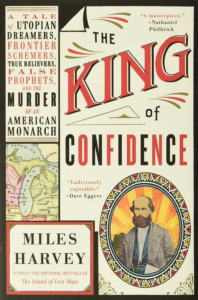
―National Book Review
What is remarkable, in retrospect, is not how many people believed him — but how the mechanics of his deception illuminate the mechanics of religious authority more broadly. The letter, the plates, the angelic visitations: these were not invented from nothing. They were carefully constructed imitations of the authenticating devices that Joseph Smith himself had used to establish Mormon credibility. Strang was running a con, but he was running it with intimate knowledge of his marks’ specific belief architecture. He knew exactly which miracles they were primed to accept, because they had already accepted them once before.
The Book: Miles Harvey’s The King of Confidence
For readers who want to go deeper into this extraordinary story, Miles Harvey’s The King of Confidence is the essential text.
Harvey is a professor at DePaul University in Chicago and the author of two previous works of narrative nonfiction — The Island of Lost Maps (2000), a true crime story about cartographic theft that became a bestseller, and Painter in a Savage Land (2008), about the first European artist in North America. Both books established Harvey as what one reviewer called “a remarkable sleuth, a writer with a passion for maps and islands and the patience to tell a complicated story.”
The King of Confidence, published in 2020, brings Harvey’s research skills and narrative instincts to the Strang story with impressive results. He has tracked the story through archives, special collections, and newspaper databases — turning up, as one reviewer noted, “even minuscule traces of a man like Strang.”
The book is not merely a biography of Strang. It is a portrait of an era — one in which Marx and Darwin, Charlotte Brontë and John Brown, Abraham Lincoln and P.T. Barnum, and even a proto-Freudian psychological analysis all have roles to play. Harvey shows how Strang’s story intersects with virtually every major theme of antebellum America: the confidence economy, the religious revivals of the Second Great Awakening, the crisis over slavery, the promise and failure of utopian communities, and the birth of celebrity culture through the penny press.
One reviewer, writing in a literary journal, captured Harvey’s achievement precisely:
“Strang’s nasty story with its thievery, theatricality, and deceptions, lures us into those writers who tried so hard to wrestle with the contradictions of America’s past. Harvey shows us just how Melville, Hawthorne, Whitman, and Twain shared Strang’s imagined world. They turned confidence schemes into art. Maybe we should try to do that again.”
Sources and Further Reading
• Miles Harvey, The King of Confidence: A Tale of Utopian Dreamers, Frontier Schemers, True Believers, False Prophets, and the Murder of an American Monarch (Little, Brown and Company, 2020)
• NPR Weekend Edition interview with Miles Harvey, “The King of Confidence,” Scott Simon, host
• Michigan Radio interview with Miles Harvey on James Strang and Beaver Island
• Wikipedia: James Strang — https://en.wikipedia.org/wiki/James_Strang
• Atlas Obscura, “Dark History of an Island King” — https://www.atlasobscura.com/articles/dark-history-of-an-island-king
• Saints Unscripted, “Who Was James Strang?” — https://saintsunscripted.com/faith-and-beliefs/living-the-gospel/who-was-james-strang/
• FAIR Latter-day Saints, James Strang movement — https://www.fairlatterdaysaints.org/answers/James_Strang_movement
• BYU Studies, “King of Beaver Island” — https://byustudies.byu.edu/article/king-of-beaver-island-the-life-and-assassination-of-james-jesse-strang
• Northern Michigan History, Strang’s Assassination — https://northernmichiganhistory.com/james-strangs-assassination/