
There is a particular kind of professional — rare, but recognizable — who doesn’t merely survive technological disruption. He sees it coming, steps onto it like a wave, and rides it into the next era. Dennis Robbins is that professional. His career, now spanning five decades, reads less like a résumé and more like a guided tour of every major revolution in modern communication technology.
It began in 1976, in the darkened prepress rooms of commercial graphic arts. The craft Robbins entered was genuinely ancient by industrial standards — a world of large-format process cameras, colored optical filters, orthochromatic film, and the peculiar artistry of film stripping. Producing a full-color printed piece meant photographing original artwork through red, green, and blue filters to isolate each color channel, developing four separate film negatives, aligning them with pin-registration systems to sub-millimeter tolerance, and hand-stripping them onto goldenrod masking paper under a light table. A skilled camera operator was part chemist, part optician, part craftsman. Robbins was that operator.
This was not a transitional skill set. It was a complete professional ecosystem — one that would be largely extinct within a decade. What separated those who merely worked in graphic arts from those who shaped its future was the capacity to recognize, early, that the craft was not the point. Communication was the point. The tools were always temporary.
Robbins recognized it early.
The Digital Rupture
The late 1970s and early 1980s brought the first wave of electronic prepress — high-end drum scanner systems from Scitex and Crosfield that digitized what the process camera had done optically. These were million-dollar systems confined to major commercial shops, but they signaled the direction: the analog darkroom was mortal. Robbins tracked the shift with the same investigative instinct that would later define his writing career. He understood what the technology meant before the industry consensus had caught up.
Then came the desktop publishing revolution. Adobe PageMaker in 1985. QuarkXPress in 1987. PostScript. The Macintosh. The Linotronic imagesetter. In rapid succession, the entire prepress workflow that had employed armies of specialists was compressed into a single workstation operated by a single designer. The camera room, the stat room, the stripping table, the film processor — all of it collapsed into software. Many professionals of Robbins’s generation were simply left behind, their specialized knowledge made obsolete overnight.
Robbins moved forward. He understood PostScript not as a curiosity but as the lingua franca of a new print economy, one that democratized production and shifted creative power toward the individual. He navigated the transition from analog craft to digital workflow with the pragmatic adaptability of someone who had always understood that the underlying goal — getting a message from mind to printed page with accuracy and impact — remained constant even as every tool for achieving it changed.
Content, Platform, and the Ministry Turn
The desktop publishing era did more than change production workflows. It changed who could publish, what they could publish, and at what cost. Robbins, already formed by a career in law enforcement and deepening Christian conviction, grasped what that meant for ministry and apologetics. If the barriers to professional publishing had effectively disappeared, then serious theological content no longer required institutional gatekeepers. A committed individual with a rigorous mind and command of the tools could reach readers directly.
That insight shaped the next chapter of his career entirely. Operating through The Righteous Cause at novus2.com, Robbins has built what amounts to an independent scholarly publishing enterprise, producing long-form apologetics that combine the analytical discipline of his law enforcement background with a layman’s PhD-level theological research. His primary focus — LDS-Christian comparative theology — demands exacting engagement with primary sources: the Joseph Smith Papers, the Journal of Discourses, the Gospel Topics Essays. His catalog of nearly 50 Kindle titles represents an intense, sustained intellectual labor, each piece subject to a systematic production workflow refined through the same attention to process that once governed film registration.
The tools have changed again. Where the 1980s designer learned PageMaker and PostScript, Robbins now commands AI image generation platforms — Grok, Gemini, ChatGPT’s image engine — to produce the visual assets that accompany his essays. Where the 1970s camera operator calibrated light exposure and filter density, Robbins now crafts prompts with enough precision to generate photo-realistic montages that illustrate complex theological arguments. Same underlying discipline. New toolbox.
The AI Frontier
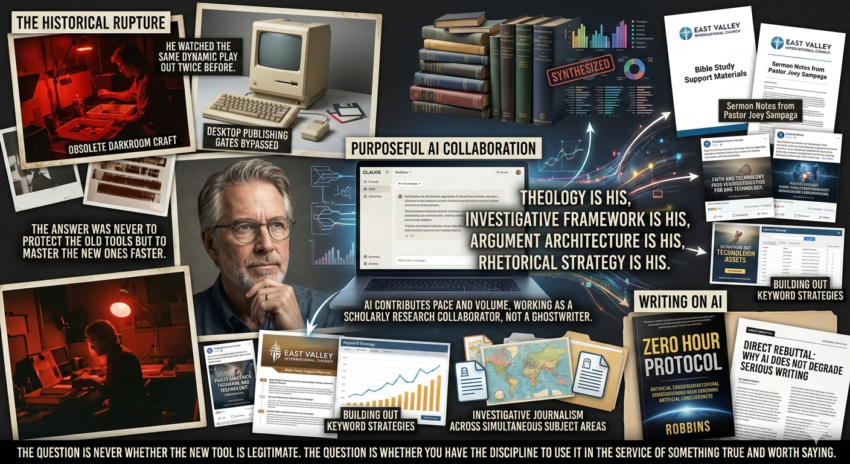
The current era represents the most significant rupture since desktop publishing — arguably more significant, because what AI threatens to disrupt is not merely the production of content but the intellectual labor of creating it. Robbins arrived at this moment with an unusual advantage: he had watched the same dynamic play out twice before. He had seen specialized craft knowledge made obsolete in the darkroom. He had seen editorial gatekeeping bypassed by desktop publishing. He knew, from experience rather than theory, that the answer was never to protect the old tools but to master the new ones faster than the field did.
His use of AI is characteristically purposeful. He employs Claude as a scholarly research collaborator — not a ghostwriter. The theology is his. The investigative framework is his. The argument architecture, the rhetorical strategy, the pastoral application — all his. What AI contributes is the capacity to work at a pace and volume that would otherwise be impossible for a solo operator: synthesizing primary sources, generating derivative marketing assets, building out keyword strategies, producing Bible study support materials for East Valley International Church, drafting sermon notes from Pastor Joey Sampaga’s weekly messages, writing Facebook content series, researching investigative journalism pieces across a half-dozen simultaneous subject areas.
He has also written on AI itself — examining the question of artificial consciousness in the context of his novel Zero Hour Protocol, and publishing a direct rebuttal to critics who argue AI degrades serious writing. His view is consistent with his career arc: the question is never whether the new tool is legitimate. The question is whether you have the discipline to use it in the service of something true and worth saying.
What Fifty Years Prove
Dennis Robbins entered the graphic arts in 1976 as a craftsman who understood light, chemistry, and precision. He exits the first quarter of the twenty-first century as a theologian, apologist, author, street evangelist, and AI-fluent content strategist. The through-line is not the tools. It is the commitment to communication as a serious, craft-level undertaking — one that demands both technical mastery and intellectual honesty.
He has worked with process cameras, waxers, Linotronics, and laser imagesetters. He has mastered PageMaker, Photoshop, and InDesign. He has published on Kindle, podcasted on YouTube, and generated imagery with large language models. At each inflection point, when the wave broke and the industry scrambled, Dennis was already paddling toward the next one.
That is not luck. That is a disposition — the disposition of someone who understood, from the darkroom forward, that the message always outlasts the medium.
Dennis Robbins is a Christian layperson apologist, street evangelist, and author based in Gilbert, Arizona. He is affiliated with East Valley International Church and publishes through The Righteous Cause at novus2.com/righteouscause.