
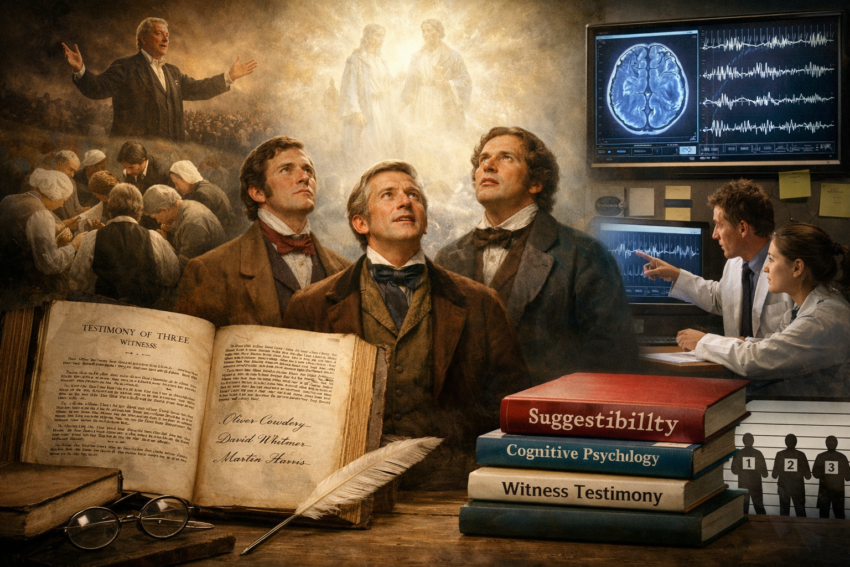
Image: An AI-generated image imagines LDS apologists spending two centuries defending the Book of Mormon witnesses on historical grounds — arguing they never formally recanted, that their testimonies remained consistent, and that their post-Church affiliations don’t disqualify them. The images transition bypasses that battlefield entirely. The more devastating critique is not historical but psychological: the conditions under which the witness testimonies were formed — charismatic authority, communal expectation, visionary rather than physical experience, and high-commitment group dynamics — are precisely the conditions that modern cognitive psychology and witness reliability research identify as most likely to produce sincere, confident, and entirely unreliable testimony. The witnesses believed what they said. That is exactly the problem.
THE PSYCHOLOGY OF WITNESSES
Why the Eleven Don’t Settle the Question
Introduction: The Witness Argument and Its Limits
Every edition of the Book of Mormon — from the first printing in 1830 to the most recent — opens with two sets of formal declarations. The first is the Testimony of Three Witnesses: Oliver Cowdery, Martin Harris, and David Whitmer, who declared that an angel of God came down from heaven and showed them the engraved plates from which Joseph Smith translated his scripture. The second is the Testimony of Eight Witnesses, who claimed they had seen and hefted the physical record. These eleven testimonies form one of the most frequently cited evidential pillars of Latter-day Saint truth claims. Generations of missionaries have repeated the argument in living rooms and doorways across the world: eleven men saw the gold plates; none of them ever formally recanted; people do not die for lies.
On the surface, this argument has intuitive force. We live in a culture that instinctively values eyewitness testimony. When eleven people independently claim to have experienced the same remarkable event, the impulse is to treat that convergence as significant. LDS apologists have cultivated this intuition carefully, and the witness argument remains a staple of popular Mormon apologetics precisely because it is so emotionally compelling.
But intuition is not science, and the history of criminal justice in America has taught us, at incalculable human cost, that eyewitness testimony — even sincere, emotionally committed, unwavering eyewitness testimony — can be catastrophically wrong. The question is not whether the Book of Mormon witnesses were honest men. Most of the evidence suggests they were. The question is whether the conditions under which their testimonies were formed can support the evidential weight LDS apologetics places upon them. A careful application of modern cognitive psychology, social psychology, and forensic witness reliability research produces a sobering answer: they cannot.
This essay does not attempt to prove that Joseph Smith was a fraud. It does not need to. It attempts something more precise and, in some ways, more challenging: to demonstrate that eleven sincere men, operating in good faith, under exactly the psychological and social conditions that prevailed in upstate New York in 1829, could be expected to produce exactly the testimonies they produced — regardless of whether the gold plates existed. That is the argument that LDS apologetics has never adequately addressed. And it begins not with the witnesses’ character, but with how human minds work.
How Critics Have Responded — and Why It Hasn’t Been Enough
The standard critical responses to the witness argument are well-rehearsed and, in many respects, well-founded. All three of the principal witnesses — Cowdery, Harris, and Whitmer — eventually broke with Joseph Smith and were excommunicated or departed from his organization. Cowdery later affiliated briefly with Methodism. Harris drifted through Shakerism and several other religious movements. Whitmer spent his later years in Richmond, Missouri, loudly condemning the direction Brigham Young’s church had taken while continuing to insist that his original testimony of the Book of Mormon was true.
LDS apologists seize upon this complexity with considerable energy. The critics’ emphasis on apostasy is turned against them: the witnesses left the LDS institution, yet did not recant their foundational testimony. Doesn’t this separation actually strengthen the argument? If they had invented their testimony to benefit Smith’s movement, why would they preserve it after falling out with him?
This is a real rhetorical challenge, and critics have struggled to answer it cleanly on historical grounds. The back-and-forth over whether Harris’s later statements about seeing with the ‘eyes of faith’ constitute a de facto recantation, or whether Whitmer’s criticism of LDS leadership undermines his credibility, produces no clear resolution. The debate is genuinely inconclusive, and that inconclusiveness benefits the apologist, who needs only to generate reasonable doubt.
The fundamental problem with the historical approach to the witness debate is that it plays on terrain the apologists have spent generations fortifying. The relevant question is not whether the witnesses formally recanted — it is whether the conditions under which their testimonies were formed can sustain the theological claims built upon them. That question belongs not to the historian alone, but to the cognitive scientist, the social psychologist, and the forensic researcher. And on that terrain, the apologetic position is far more exposed.
The Psychological Reframe
What follows in this essay is not a historical argument. It is a psychological one. The claim is not that the witnesses lied. The claim is that eleven men operating within a specific set of social, cognitive, and spiritual conditions can be reliably expected to form, maintain, and report sincere experiences that do not correspond to objective physical reality — and that the conditions present in June 1829 at the Whitmer farm in Fayette, New York, were precisely those conditions.
This reframe is not merely rhetorical. It is grounded in decades of empirical research across multiple disciplines: the psychology of memory, the sociology of religious movements, the forensics of eyewitness testimony, and the social psychology of conformity and authority. These fields do not pronounce on whether God exists or whether revelation is possible. They pronounce on what human minds do under known conditions. And their findings, when applied to the Book of Mormon witness situation, are illuminating.
Visionary Versus Physical Experience: What Did They Actually See?
The LDS witness argument depends on a particular reading of what the testimonies claim. In their standard apologetic deployment, the testimonies are presented as accounts of physical perception: eleven men touched, hefted, and examined tangible golden plates. But a careful examination of the primary sources — including the accounts recorded in Joseph Smith’s own history, Lucy Mack Smith’s biography, and the later statements of the witnesses themselves — reveals a far more ambiguous picture.
The Critical Distinction in the Testimonies Themselves
The Testimony of the Three Witnesses, as it has been printed in every edition of the Book of Mormon, declares that the witnesses have seen and hefted, and know of a surety that the said Smith has got the plates. But the circumstances surrounding the Three Witnesses’ experience tell a different story. The History of the Church records that all four men — Smith, Cowdery, Whitmer, and Harris — withdrew to the woods to pray in hopes of receiving the promised manifestation. After multiple rounds of prayer produced no result, Harris withdrew, believing his presence was hindering the experience. Only after his departure did Cowdery and Whitmer, along with Smith, reportedly behold an angel and the plates. Smith then sought out Harris separately, and the History of the Church records that ‘the same vision was opened to our view’ — a significant phrase, given that Smith had not carried the plates to the location where he found Harris.
I never saw the golden plates, only in a visionary or entranced state… When the time came for the three witnesses to see the plates, Joseph Smith, myself, David Whitmer and Oliver Cowdery, went into the woods to pray. When they had engaged in prayer, they failed at the time to see the plates or the angel who should have been on hand to exhibit them. They all believed it was because I was not good enough, or in other words, not sufficiently sanctified… In about three days I went into the woods to pray that I might see the plates. While praying I passed into a state of entrancement, and in that state I saw the angel and the plates.
— Martin Harris, as reported by Anthony Metcalf, Ten Years Before the Mast (microfilm copy, p. 70-71); see also Dan Vogel, Early Mormon Documents 2:346-347
This account, published by skeptic Anthony Metcalf based on an interview with Harris conducted around 1873-1874, is among the most significant primary sources in the entire witness literature. Harris explicitly describes his experience as a ‘state of entrancement,’ a visionary state rather than ordinary physical perception. This is not an account of seeing a physical object in ordinary daylight with the naked eyes. This is an altered state of consciousness.
David Whitmer’s later accounts introduce similarly complex language. In his 1887 pamphlet, An Address to All Believers in Christ, Whitmer described the experience in terms of supernatural manifestation: ‘they were shown to me by a supernatural power.’ He drew a consistent distinction throughout his later writings between the kind of spiritual perception involved in his testimony and ordinary physical observation. The Mormonism Research Ministry has documented this distinction extensively, noting that Whitmer used the same sort of visionary language employed by the Three Witnesses in multiple later statements.
In 1838, nearly eight years after joining the Mormon Church, early member Stephen Burnett described a public statement by Harris that sent shockwaves through the nascent LDS community:
I have reflected long and deliberately upon the history of this church and weighed the evidence for and against it, loth to give it up — but when I came to hear Martin Harris state in public that he never saw the plates with his natural eyes only in vision or imagination, neither Oliver [Cowdery] nor David [Whitmer], and that the eight witnesses never saw them and hesitated to sign that instrument for that reason, but were persuaded to do it, the last pedestal gave way, in my view our foundations were sapped.
— Stephen Burnett, letter, 1838, cited in Sharon Lindbloom, ‘Two Sets of Official Book of Mormon Witnesses,’ Mormonism Research Ministry, mrm.org
This letter, written by a committed early Latter-day Saint for an audience of believers, is not the product of an anti-Mormon polemicist. It is the anguished account of a man whose faith was shattered by what he heard Harris say in public. The credibility of the account is difficult to dismiss.
The LDS Church’s Own Gospel Topics Essay Complicates This
In 2015, The Church of Jesus Christ of Latter‑day Saints published a Gospel Topics Essay on the Book of Mormon translation process—one of a series of carefully constructed essays addressing difficult historical questions. The essay, while not abandoning the traditional narrative, incorporates what critics have long argued: that the experience of the witnesses may have involved a visionary or revelatory mode of perception rather than straightforward physical observation. The essay notes that Doctrine and Covenants 17:2 conditions the witnesses’ view of the plates upon their faith, a detail that complicates any claim to purely empirical observation.
The significance of this nuance is considerable. The Church has not publicly emphasized it in standard member‑facing contexts; the average Latter‑day Saint encountering the witness argument in a missionary discussion or Sunday School lesson will likely hear the eleven witnesses presented as straightforward empirical observers of the plates, without the clarifying frame that their seeing was conditioned on faith and framed as a spiritual manifestation.
What Cognitive Psychology Says About Visionary Experience
Modern cognitive science offers a precise account of why visionary experience carries no evidential weight for the objective existence of the thing seen. The human brain is an anticipatory organ: it does not passively receive sensory input but actively constructs experience based on prior knowledge, expectation, and emotional state. Under conditions of heightened arousal, intense prayer, social expectation, and spiritual preparation — precisely the conditions present at the Whitmer farm in June 1829 — the brain’s construction of experience can produce vivid, coherent, emotionally compelling perceptions that bear no relationship to external physical reality.
Daniel Schacter’s landmark work, The Seven Sins of Memory (2001), identifies misattribution as one of the central ways memory fails: the mind assigns a vivid and emotionally resonant internal experience to an external source. A person who has prayed intensely, been prepared by a trusted spiritual authority to expect an angelic visitation, and exists within a social context that will confirm and reward the experience is not a reliable reporter of whether that experience was generated internally or externally. Schacter’s framework, combined with Elizabeth Loftus’s foundational research on memory malleability, predicts exactly what the Book of Mormon witnesses reported.
Loftus’s work on the misinformation effect — the well-documented phenomenon by which post-event information becomes seamlessly incorporated into the original memory — is particularly relevant here. The witnesses were embedded for months and years after their experiences within a community that continuously retold, celebrated, and theologically interpreted those experiences. Each retelling, each communal affirmation, each missionary deployment of the testimony deepened and clarified the memory — not in the direction of greater accuracy, but in the direction of greater conformity to the community’s expectations.
Research on hypnagogic and hypnopompic states, religious ecstasy, and altered consciousness has consistently demonstrated that the mind’s capacity to generate ‘seeing’ without external optical input is robust and well-documented. Grief visions, in which bereaved individuals report vivid sensory encounters with deceased loved ones, are experienced by a significant minority of bereaved people and are typically described as indistinguishable from ordinary perception. Sensory deprivation research produces similar phenomena. Prayer states associated with intense devotional practice can generate visual and auditory experiences that the experiencer describes as physically real. None of this proves that such experiences are pathological or dishonest. It proves that they can be entirely sincere and entirely disconnected from external physical reality.
The critical epistemological point is straightforward: a sincere report of a visionary experience tells us about the experiencer’s mental state. It tells us nothing reliable about the objective existence of the thing seen.
The Charismatic Authority Problem: Testimony Under Joseph Smith
The evidential weight of any witness testimony depends substantially on the conditions under which that testimony was formed. The more that a witness was prepared, directed, or shaped by an authority figure prior to the experience being reported, the less independently probative the resulting testimony is. By this standard, the Book of Mormon witness situation is among the most compromised in the history of religious claims.
Defining Charismatic Authority
The sociologist Max Weber identified three ideal types of legitimate authority: traditional authority, grounded in custom and precedent; rational-legal authority, grounded in established rules and procedures; and charismatic authority, grounded in the perceived extraordinary personal qualities of an individual leader. Weber’s charismatic authority is not synonymous with personal charm or manipulativeness; the charismatic leader genuinely believes in their own calling, and followers genuinely respond to what they perceive as an extraordinary gift.
The psychological dynamics of charismatic authority are well-documented in the social science literature. Followers of charismatic leaders characteristically display heightened suggestibility, reduced critical analysis of the leader’s claims, intensified in-group loyalty, and a tendency to interpret ambiguous experiences in the direction the leader expects. None of these dynamics requires dishonesty on anyone’s part. They are normal features of normal human psychology operating in the presence of a perceived extraordinary authority.
Joseph Smith’s Specific Charismatic Profile
Joseph Smith was twenty-three years old when he orchestrated the witness experiences in June 1829. He had already spent five years building a track record of supernatural claims — treasure-seeing with a seer stone, visitations from the angel Moroni, divine selection as the restorer of Christ’s church. By the time Oliver Cowdery, Martin Harris, and David Whitmer prepared themselves to receive their testimony, they had been living within Joseph Smith’s prophetic framework for months or years. They had been told what to expect. They had been told that the experience would depend on their faith. They had been told that doubt might prevent them from seeing what God intended them to see.
Joseph Smith’s History of the Church records the witness experience with a telling directness: the men ‘agreed to retire into the woods, and try to obtain, by fervent and humble prayer, the fulfilment of the promises given in the above revelation.’ They were not encountering the plates for the first time in neutral conditions. They were attempting to experience something they had been specifically prepared to experience, under the direction of a man whose authority derived from his claimed capacity to mediate between heaven and earth. The experience was, from the outset, shaped by a profoundly directive context.
When Martin Harris’s doubt was identified as a potential obstacle to the experience, he was invited to withdraw — and the experience promptly occurred for the others. Harris’s subsequent separate vision occurred only after he had fasted and prayed specifically for the promised manifestation. The narrative’s structure at every point reflects the dynamics of charismatic authority: the prophet prepares the recipients, identifies the conditions of reception, explains failures, and directs the experience toward its anticipated conclusion.
What Research Shows About Testimony Under Charismatic Authority
Solomon Asch’s landmark conformity experiments, conducted at Swarthmore College in the early 1950s, demonstrated with unusual clarity what happens to perception under group pressure. In Asch’s design, a subject was placed in a group of confederates who consistently reported an obviously incorrect answer to a simple visual comparison task. A remarkable 75 percent of subjects conformed to the group consensus on at least one trial, and many reported afterward that they had genuinely come to see the incorrect answer as correct. They were not lying. They were conforming, and their perception had been genuinely altered.
The Book of Mormon witness situation presented substantially more intense social pressure than Asch’s laboratory setting. The witnesses were not simply facing a group of strangers with a competing perception; they were embedded in a tight social network under the direction of a figure they believed was God’s chosen prophet. The stakes were not an abstract visual judgment but eternal salvation, divine approval, and communal belonging. Under these conditions, the probability of sincere conformity to the expected experience was not reduced from Asch’s laboratory baseline. It was elevated.
Stanley Milgram’s obedience studies, conducted at Yale University in the early 1960s, demonstrated that ordinary people will follow authority figures into extraordinary behaviors when the authority context is sufficiently compelling. Milgram’s most disturbing finding was not the percentage of subjects who obeyed — though that was disturbing enough — but the degree to which subjects’ internal narratives during the experiment reflected genuine compliance rather than reluctant coercion. They found reasons to continue. They constructed justifications.
The most directly applicable research to the Book of Mormon witness situation, however, is Leon Festinger’s landmark study published under the title When Prophecy Fails (1956). Festinger and his colleagues infiltrated a small doomsday cult whose leader had prophesied the imminent destruction of the world and the rescue of true believers by extraterrestrial visitors. When the prophecy failed to materialize, the researchers expected to observe disconfirmation and dissolution. What they observed was the opposite: the group intensified its commitment, increased its proselytizing activity, and generated new interpretations of the experience that preserved the core belief framework.
A man with a conviction is a hard man to change. Tell him you disagree and he turns away. Show him facts or figures and he questions your sources. Appeal to logic and he fails to see your point… But man’s resourcefulness goes beyond simply protecting a belief. Suppose that the belief involves a prediction about something. Suppose that prediction is a little ahead of time. What happens? The individual will frequently emerge, not only unshaken, but even more convinced of the truth of his beliefs than before.
— Leon Festinger, Henry Riecken, and Stanley Schachter, When Prophecy Fails (1956), p. 3
Festinger’s insight is directly applicable to the standard LDS apologetic argument: the fact that the Book of Mormon witnesses did not formally recant their testimonies after leaving the LDS institutional church is precisely what Festinger’s model predicts. The witnesses had invested enormously — socially, spiritually, personally — in the truth of their experience. Cognitive dissonance theory predicts that the greater the investment, the stronger the post-hoc rationalization. The witnesses’ persistent maintenance of their formal testimony, even after estrangement from Smith’s movement, is not evidence of the experience’s objective reality. It is the expected psychological response to massive personal investment in a belief system.
Group Dynamics and Shared Supernatural Belief
Perhaps the single most persistent misrepresentation in popular LDS apologetics about the witnesses is the implicit suggestion that eleven independent observers produced independent corroboration. The word ‘independent’ is doing enormous work here — work it cannot do when examined against the social reality of who the witnesses were and how they were related.
The Witnesses Were Not Independent
The Three Witnesses — Cowdery, Harris, and Whitmer — were not strangers who converged on a shared experience. They were Joseph Smith’s closest associates, sharing his religious framework, his social world, and his theological expectations. Oliver Cowdery was Smith’s primary scribe, the man who had spent months recording the Book of Mormon dictation. David Whitmer had hosted the translation process in his family’s home. Martin Harris had mortgaged his farm to finance the book’s printing. Their investment in the truth of Smith’s claims was not incidental — it was total.
The Eight Witnesses exhibit an even more concentrated social reality. As the Wikipedia entry on the Book of Mormon witnesses notes, all eight were members of either the Whitmer family or the Smith family:
All eight had close personal ties to Joseph Smith’s family — four were David Whitmer’s brothers, a fifth was married to a Whitmer sister, and Joseph’s father and two brothers made up the remaining three.
— Joel B. Groat, ‘Facts on the Book of Mormon Witnesses, Part 1,’ Institute for Religious Research, mit.irr.org
Mark Twain observed this social reality with his characteristic dryness: ‘I could not feel more satisfied and at rest if the entire Whitmer family had testified.’ His wit cuts to the core of the independence problem. When six of eleven witnesses are Whitmers or Smiths, and the remaining five are intimate associates of the same social circle, the claim to independent corroboration is not simply weakened — it is eliminated.
The grant of independence that is essential to the evidential force of multiple-witness claims requires that each witness’s account be formed in isolation from the others, with no common directing authority, and with no shared prior expectation of what will be experienced. None of these conditions was met at the Whitmer farm in June 1829.
The Social Psychology of Shared Religious Experience
William James’s The Varieties of Religious Experience (1902) remains the foundational taxonomy of religious phenomenology in the English language. James was neither a skeptic nor a defender of any particular theological tradition; he was a rigorous psychologist who sought to describe the characteristics of religious experience with scientific precision. His central finding — that subjective certainty is not a reliable indicator of objective reality — is directly relevant here. James documented case after case of individuals who experienced vivid, coherent, emotionally compelling religious encounters that were wholly incompatible with the experiences of other individuals in the same tradition.
The French sociologist Emile Durkheim identified the phenomenon he called collective effervescence — the heightened emotional state generated by intense communal religious practice — as one of the primary mechanisms by which religious experience is produced and sustained. Collective effervescence is not a fraudulent experience; participants genuinely feel transported, unified, and in contact with something beyond themselves. But the mechanism is social and psychological rather than supernatural. It is reliably reproduced wherever communities engage in intense communal ritual under the direction of a charismatic authority.
The Fatima apparitions of 1917 provide a useful comparative case. On October 13 of that year, tens of thousands of people gathered in rural Portugal and reported witnessing an extraordinary solar phenomenon — what became known as the Miracle of the Sun. The accounts differ significantly in what exactly was perceived, but the convergence of thousands of witnesses on some shared visual anomaly is a matter of historical record. Subsequent analysis has generated numerous naturalistic hypotheses, including optical effects, mass suggestion, and retinal afterimages from staring at the sun. What the Fatima event demonstrates is that thousands of people can share a genuine perceptual experience while interpreting it through the theological framework they already inhabit — and that the volume of witness testimony tells us far less about the event’s supernatural character than the apologetics of any tradition would suggest.
The Magical Worldview Context
To evaluate the Book of Mormon witnesses fairly, one must situate them in their actual historical context. As the CES Letter documents in its section on witnesses, the early nineteenth century in western and central New York was what historians call the ‘burned-over district’ — a region saturated with revivalism, supernatural expectation, and what Grant H. Palmer has called a ‘nineteenth-century magical mindset.’ Within this cultural framework, the distinction between physical perception and spiritual sight was far less clearly drawn than it is in a twenty-first century epistemological context.
In order to truly understand the Book of Mormon witnesses and the issues with their claims, one must understand the magical worldview of many people in early 19th century New England. These are people who believed in folk magic, divining rods, visions, second sight, peep stones in hats, treasure hunting, and so on… It would not have been unusual during this time for a neighbor, friend, or even a stranger to come up to you and say, ‘I received a vision of the Lord!’ and for you to respond, in all seriousness, ‘Well, what did the Lord say?’
— CES Letter, ‘Witnesses’ section, read.cesletter.org
Oliver Cowdery himself used a divining rod—a “rod of nature,” as the original Book of Commandments described it—as a mechanism for seeking spiritual guidance. This is not a peripheral biographical detail. It reflects the epistemological world the witnesses inhabited: one in which the boundaries between physical and spiritual perception were routinely blurred, in which “seeing” something with spiritual eyes was a recognized and valued category of experience, and in which the credibility of a claimed supernatural encounter was assessed not by its conformity to modern empirical standards but by its spiritual resonance and the authority of those who confirmed it.
Within this worldview, the experiences reported by the Book of Mormon witnesses were not extraordinary claims. They were culturally expected experiences sought through culturally approved mechanisms. The witnesses were not departing from their world’s norms when they reported angelic visions and spiritual perceptions; they were conforming to them—even as some of them also insisted that they saw and handled the plates with their natural eyes and hands.
The Recantation Non-Event
LDS apologists argue with considerable confidence that the witnesses never recanted their formal testimonies — and this is largely true, particularly of the published statements that appear in the Book of Mormon. But this fact requires interpretation, not just citation. What would recantation require, psychologically, in the actual conditions these men faced?
To formally recant a testimony that had been the foundation of one’s spiritual identity, the justification for years of sacrificial investment, and the basis of family and community relationships, would involve far more than intellectual doubt. It would require a profound re‑ordering of one’s narrative self. The social psychology literature on exit from high‑demand religious groups is consistent on this point: the exit costs are enormous, and formal recantation—which entails acknowledging not merely that one was wrong, but that one had deceived others and wasted their investment—represents a particularly high personal and social cost.
Several witnesses did leave the LDS institutional church. They criticized its leadership. They joined competing movements. Yet they did not formally recant the published testimony. This is not evidence that the testimony was true. It is the predicted behavior of individuals who retain the core belief while rejecting the institutional structure built upon it—a psychologically coherent position that requires no explicit re‑evaluation of the testimony’s objective foundations.
The relevant question is not “did they recant?” but “under what conditions would recantation be expected?” The best evidence suggests that those conditions—psychological safety, social acceptance, and reduced reputational or relational cost—were never present in ways that would make recantation a plausible or low‑cost option. Since that threshold was not met, the absence of formal recantation tells us little about the objective reality of the experience.
What Wrongful Conviction Research Tells Us About Sincere False Testimony
The twentieth century’s most significant contribution to our understanding of human testimony may not have come from academic psychology at all. It came from DNA. Beginning in the mid-1990s, the Innocence Project — a legal advocacy organization founded by attorneys Barry Scheck and Peter Neufeld — began using newly available DNA evidence to re-examine criminal convictions. What they found was systematically disturbing: a significant proportion of the wrongfully convicted had been condemned based on eyewitness testimony that was sincere, confident, and catastrophically wrong.
The Wrongful Conviction Parallel
As of 2023, more than 375 people in the United States have been exonerated by DNA evidence after conviction. The Innocence Project’s data reveals that eyewitness misidentification was a contributing factor in approximately 69 percent of these wrongful convictions — making it the single most common contributing cause of wrongful conviction. These were not cases of deliberate perjury. The witnesses genuinely believed they had seen what they said they had seen. They were confident. They were consistent. They were wrong.
The forensic psychology literature developed to understand this phenomenon maps with uncomfortable precision onto the Book of Mormon witness situation. Researchers have identified two categories of variables that affect eyewitness accuracy: estimator variables, which are present at the time of the original experience and affect the quality of perception; and system variables, which affect how testimony is subsequently gathered and recorded. The Book of Mormon witness situation exhibits problematic conditions in both categories.
Key Findings From Eyewitness Reliability Research
Elizabeth Loftus, whose foundational research on the misinformation effect began in the 1970s and has continued for half a century, has demonstrated with extensive experimental evidence that post-event information is seamlessly incorporated into memory, becoming subjectively indistinguishable from the original perception. Subjects who witness an event and are subsequently given incorrect information about that event will recall the incorrect information as part of their original experience — not as a subsequent addition. The memory has been rewritten, and the person reporting it cannot detect the rewrite.
The witnesses to the Book of Mormon were not tested in controlled conditions and then sealed from all subsequent influence. They spent years after their experiences retelling them in community settings, having them affirmed by fellow believers, deploying them in missionary contexts, and defending them against challenge. Each of these contexts constituted a post-event information environment that could and almost certainly did shape the memory in the direction of greater clarity, coherence, and conformity to the community’s theological narrative.
Gary Wells’s distinction between estimator and system variables provides a useful framework for evaluating the witness situation. Among the system variables Wells identifies as most problematic are: the use of a suggestive questioning context; the presence of a directing authority figure during the experience; the absence of contemporaneous documentation; and the repeated retelling of the testimony in community settings before formal recording. Every one of these factors is present in the Book of Mormon witness situation.
Perhaps most significant is what forensic psychologists call the confidence-accuracy gap. Witnesses who are most confident in their testimony are not significantly more accurate than less confident witnesses — yet confidence is the primary factor in jury and public assessment of credibility. The Book of Mormon witnesses were extraordinarily confident. They maintained their formal testimony with conviction for decades. Within a naïve understanding of testimony, this confidence is evidence of reliability. Within the forensic psychology framework, it is evidence of nothing more than the depth of the witnesses’ commitment, which was never in doubt.
Conditions That Elevate False Memory Risk
Forensic psychology has identified a specific cluster of conditions that dramatically elevate the probability of sincere false testimony. The Book of Mormon witness situation exhibits nearly all of them:
High emotional and spiritual arousal at the time of the experience. The witnesses were engaged in intense prayer, fasting, and religious ecstasy. Lucy Mack Smith’s Biographical Sketches records that after the Three Witnesses’ experience, the men ‘became pale as death’ and fell to the ground. This is not the description of calm, dispassionate observation. It is the description of an altered-state experience under extreme emotional arousal.
Strong prior expectation of what would be seen. The witnesses had been prepared for their experience by months of immersion in Smith’s prophetic framework. They knew what the plates were supposed to look like. They had heard descriptions of the angel Moroni. They had been given a specific revelation (Doctrine and Covenants 17) telling them what they would experience. There was no blank slate here.
A trusted authority figure directing the experience. Joseph Smith was physically present with the Three Witnesses during their experience. He directed the prayer, guided the interpretation, and subsequently confirmed what they had experienced. For Harris, Smith was present at the separate vision experience as well, joining him in prayer and later confirming that ‘the same vision’ had been opened.
Group reinforcement of the interpretation immediately after the experience. The witnesses did not depart from the experience and independently recorded their testimony. They were immediately embedded in a community that affirmed, celebrated, and theologically interpreted what they had experienced.
High personal stakes in the truthfulness of the experience. Cowdery had invested his identity as scribe and eventual co-founder of the LDS movement. Harris had invested in his farm. Whitmer had invested in his family’s home and hospitality. These were not disinterested observers.
No independent, contemporaneous verification. There were no independent witnesses present. There is no contemporaneous record of the experience produced by an outside party.
An extended delay between experience and formally recorded testimony. The formal Testimony of the Three Witnesses was composed and published approximately a year after the claimed experience, and subsequent retelling continued for decades. Memory reconstruction had ample opportunity and ample social incentive to operate.
The Sincerity Argument Cuts Both Ways
LDS apologists frequently deploy the sincerity argument in a form that concedes the wrong premise. The argument is posed as: ‘Why would they lie?’ But as the forensic psychology literature makes absolutely clear, the relevant question is not whether they lied. The question is whether sincere testimony formed under these conditions constitutes reliable evidence. And the evidence from wrongful conviction research, memory science, and cognitive psychology is unambiguous: it does not.
Sincerely mistaken people die for mistaken beliefs with some regularity throughout human history. Martyrdom is not evidence of the objective truth of the belief for which one dies. The history of Christianity itself includes martyrs for doctrinal positions later deemed heretical by the same church tradition. The depth of commitment to a belief tells us about the believer’s inner life. It tells us nothing reliable about whether the belief corresponds to external reality.
Confirmation Bias and the Believing Community
Confirmation bias — the universal human tendency to seek, interpret, and remember information in ways that confirm pre-existing beliefs — is not a character flaw. It is a feature of cognitive architecture. Every human being is subject to it. Research consistently demonstrates that it is especially pronounced in contexts where beliefs carry high personal significance and where social identity is bound up with the truth of those beliefs. The Book of Mormon witness context was precisely such an environment.
The Pre-Loaded Expectation Environment
The witnesses entered their experiences already embedded in Joseph Smith’s prophetic framework. They had heard detailed descriptions of the plates, the angel Moroni, and the anticipated experience. They had been given a specific revelation predicting what they would see. They had been told that the experience would validate months of sacrificial devotion. The theological framework interpreted the experience in advance: this is what God’s messenger looks like; these are the plates from which the Nephites recorded their history; this is what you will experience.
In this context, every ambiguous element of the experience — every flash of light, every emotional sensation, every moment of inner conviction — was pre-interpreted for them by the framework they inhabited. The confirmatory framework was not applied to the experience after the fact. It was applied before the fact, during the fact, and continuously after the fact by the community that sustained both the experience and its interpretation.
How Confirmation Bias Shapes Memory Consolidation
The brain does not record memories like a digital storage device. It reconstructs them. Each retrieval of a memory is an act of reconstruction, shaped by the current emotional state, the community’s expectations, and the purposes for which the memory is being retrieved. Research on memory consolidation consistently demonstrates that memories become more coherent, more internally consistent, and more conformant to narrative expectations over time — and that this process feels, from the inside, like the gradual clarification of an already-existing record.
The witnesses retold their experiences continuously for decades: in missionary settings, in community gatherings, in personal correspondence, in interviews with journalists and investigators. Each retelling was an act of memory reconstruction in a strongly confirmatory social context. The result was not the preservation of an original experience but the progressive crystallization of a community-shaped narrative that the witnesses experienced as their deepest personal truth.
The Moroni’s Promise Trap
The Book of Mormon’s own epistemological framework, encoded in Moroni 10:3–5, instructs the reader to approach the text with a sincere heart, a real intent to act on the testimony received, and to pray with faith to receive a spiritual confirmation. This framework is not merely circular reasoning; it is a confirmation‑bias mechanism of unusual sophistication. It pre‑defines what the confirming experience will feel like—often described in Latter‑day‑Saint teaching as a “burning in the bosom,” a sense of peace, or an impression of truth—pre‑authorizes that feeling as divine communication, and explicitly instructs the reader that doubt about the feeling reflects insufficient faith rather than appropriate epistemic caution.
What is especially powerful is that this promised “witness” is not an open‑ended spiritual test but a directional ritual: the reader is told in advance what to ask for (a manifestation that the Book of Mormon is true) and how to interpret it (as a sign from God). Contemporary research on emotion and spirituality shows that people can reliably experience warm, uplifting sensations in the chest or a sense of “rightness” when engaging with narratives they already find appealing, and these feelings are easily interpreted as “spiritual confirmation” when the community has already told them what to look for.
The witnesses were embedded in this framework years before their experience occurred. They had been taught that God communicates through inner impressions, visionary experiences, and the “power of the Holy Ghost,” and that such experiences count as valid evidence of supernatural reality. This epistemology guaranteed that any compelling inner experience—whether a vision, dream, trance‑like state, or intense emotional surge—would be interpreted as divine confirmation, not as a psychological or cultural artifact.
Crucially, the framework rules out naturalistic explanations in advance. If the confirmatory experience is by definition divine, and doubt about it is by definition a failure of faith, then alternative accounts—such as suggestion, expectation, hypervigilance, or culturally conditioned imagery—never get a fair hearing in the internal logic of the system. The question of whether the experience might have a naturalistic explanation is effectively ruled out of court before the experience even begins, because the reader or witness has already been taught to treat strong internal conviction as synonymous with divine revelation.
For the witnesses, this meant that whatever they felt or saw—whether with “natural eyes” or “spiritual eyes,” as later accounts sometimes distinguish—was already interpreted as a theologically required confirmation. Their epistemology did not invite them to ask, “Could this be imagination, suggestion, or cultural conditioning?” It invited them to ask, “Do I feel this to be true with sufficient faith?”—a question that is structured to generate confirmation rather than open‑ended doubt.
So the Book of Mormon’s epistemology does more than provide a test for readers; it shapes the very criteria by which experiences are deemed real or unreal. Within that framework, the witnesses’ experiences were not anomalies; they were exactly the kind of thing the system was designed to produce. That does not automatically negate the sincerity of the experience, but it does show that the absence of doubt in the witnesses cannot be taken as evidence of objective supernatural reality; it may simply be the expected outcome of a highly sophisticated confirmation‑bias machine.
What Genuine Witness Evidence Would Require
It is worth pausing to consider what standard we actually apply to witness testimony in other domains. We do not accept eyewitness reports uncritically in courtrooms, in scientific research, or in historical investigation. We ask about the conditions of observation, the independence of the witnesses, the availability of corroboration, and the mechanisms by which testimony was gathered and recorded. These standards exist because we have learned, through centuries of hard experience, that without them, sincere testimony can be catastrophically unreliable. The Book of Mormon witnesses have never been subjected to these standards — primarily because the primary audience for the argument has been people already committed to the conclusion.
What Genuine Corroboration Would Look Like
For the witness testimony to carry the evidential weight LDS apologetics assigns it, genuine independent corroboration would require several conditions that the actual witness situation does not meet. Independent witnesses with no prior social or theological connection to Joseph Smith would need to have encountered the same evidence under conditions not prepared and directed by Smith himself. Physical evidence — the plates themselves — would need to be available for independent examination and testing. Testimony would need to have been taken contemporaneously and under conditions designed to prevent conformity pressure. Multiple witnesses would ideally have been selected in circumstances designed to minimize group dynamics.
None of these conditions was present. The witnesses were not independent. The physical evidence was never made available for independent examination (the plates, by the narrative’s account, were returned to the angel Moroni before publication). The testimony was not taken contemporaneously under cross-examination. The witnesses were not selected to minimize social pressure; they were selected from the innermost circle of Smith’s community.
The Analyzing Mormonism resource notes additional structural problems with the formal witness statements themselves: ‘In both of the witness statements, there was no date given, or time of day, or a location for the event. Each of the witnesses signed an already-written statement. None of them ever gave a personal recounting of this event (i.e., no personal journals, firsthand publications, etc.).’ The witnesses did not compose their own testimonies. They signed a document prepared for them. This is a forensic red flag of the first order.
The Strang Parallel: When the Same Witnesses Testified Again
Perhaps the most significant fact in the entire witness literature is this: several of the Book of Mormon witnesses subsequently accepted the claims of James Strang, a competing prophet who also produced buried metal plates and a small company of witnesses to authenticate them. After Joseph Smith’s death, Strang claimed divine appointment as Smith’s successor and produced what he called the Voree plates—small engraved metal plates unearthed from a buried stone box, accompanied by the testimony of multiple witnesses.
After Smith’s death, James Strang, claiming to be Smith’s chosen successor, also produced buried plates and the testimony of eleven witnesses to their authenticity. All living witnesses to the Book of Mormon (except possibly Cowdery) — three of the Whitmers, Martin Harris, and Hiram Page — accepted at least briefly Strang’s ‘leadership, angelic call, metal plates, and his translation of these plates as authentic.’
— Wikipedia, ‘Book of Mormon Witnesses,’ en.wikipedia.org
At least temporarily, this included former Book of Mormon witnesses such as Martin Harris, three of the Whitmer brothers, and Hiram Page, who expressed belief in Strang’s prophetic call, his plates, and his translation of them. This is not to say that they permanently abandoned their earlier testimony or that Strang’s movement gained lasting traction; rather, it shows that several of the same men who had once grounded their lives on Joseph Smith’s revelatory claims were willing, for a time, to accept a parallel set of supernatural claims just a few years later.
The significance of this parallel cannot be overstated for apologetic purposes. The LDS argument often treats the willingness of the Book of Mormon witnesses to maintain their testimony as evidence of its truth. But several of those same witnesses were subsequently willing to authenticate a competing set of plates and a competing prophet, each validated by its own set of witnesses. The Strang episode does not, by itself, prove that Smith’s or Strang’s plates were false; what it does reveal is the witnesses’ susceptibility to the dynamics of charismatic authority, communal expectation, and prior commitment that this essay has described.
They were witnesses whose testimony reflects the psychology of high‑commitment religious experience, not the epistemology of independent empirical observation. Their behavior is what we would expect from individuals deeply embedded in a revelatory worldview, where intense inner conviction and communal affirmation count as evidence—regardless of which prophet, which set of plates, or which group of eleven witnesses happens to provide it.
For readers interested in exploring the Strang episode in greater depth, you can find our earlier post on James Strang and his movement—which situates the Voree plates and his competing claim to prophetic authority alongside the Book of Mormon witnesses—here: “From Atheist to Angel‑Whisperer: The James Strang Story”.
The Contrast With Biblical Witness
The LDS apologetic sometimes attempts to draw a parallel between the Book of Mormon witnesses and the New Testament witnesses to the resurrection of Jesus Christ, suggesting that the two witness situations are structurally equivalent, and that skepticism about one should produce equivalent skepticism about the other. This parallel deserves careful examination.
The resurrection witnesses, as recorded in the New Testament documents, present a structurally different evidential situation in several important respects. The accounts preserved in the New Testament emerge from multiple independent communities with different theological emphases, different audiences, and different rhetorical purposes—and they frequently conflict in peripheral details in ways that suggest independent origin rather than coordinated composition. The Gospel of Mark’s spare, unadorned resurrection account reflects a different compositional hand and community than Paul’s letters, which in turn differ significantly from the Fourth Gospel.
More significantly, the resurrection claim generated an immediate and hostile investigative response from authorities with powerful institutional motivations to disprove it. The Jewish religious leadership and the Roman occupying power both had strong reasons to produce the body of Jesus and extinguish the resurrection claim in its infancy. The New Testament accounts and subsequent history suggest they were unable to do so. The absence of a counter‑testimony from people in a position to produce one is evidentially significant in a way that the absence of counter‑testimony to the Book of Mormon is not, because no one outside the LDS circle was in a position to examine the plates.
The Book of Mormon witnesses, by contrast, formed their testimonies within a single tightly controlled social network, under the direction of a single authority figure, with no hostile independent investigation of the physical evidence. Their testimonies emerged from a community structured to produce exactly those testimonies: members bound by shared commitments, revelatory epistemology, and communal reinforcement. The structural difference between the two situations is not a matter of theological preference; it is a matter of basic evidential logic.
This observation is not a claim that the resurrection is “scientifically proven” or requires no faith. It is a claim that the two‑witness situations are not structurally equivalent, and that the attempt to equate them confuses the evidential landscape rather than clarifying it. The resurrection case, at its best, rests on a broader cluster of early, partially independent testimonies under hostile scrutiny; the Book of Mormon case rests on a small, tightly bounded group of witnesses whose testimony was framed and preserved within a single revelatory community.
Rebuttals to Key LDS Apologetic Arguments
Any serious engagement with the psychological critique of the Book of Mormon witnesses must anticipate and address the arguments that LDS apologists have developed in response to historical critiques of the witnesses. While some of these arguments have genuine force against historical critiques, they are considerably less effective against the psychological analysis developed in this essay.
‘The Witnesses Never Recanted’
This is the most frequently cited argument in popular LDS apologetics, and it is the one most thoroughly addressed by the psychological framework above. The argument assumes that formal recantation would be the expected behavior of someone who had participated in a deception, and that its absence therefore constitutes evidence of genuine experience. Both assumptions are problematic.
The first assumption ignores the enormous psychological and social costs of recantation in a high-commitment religious community. Festinger’s research, combined with decades of subsequent work on exit from high-demand religious groups, establishes that individuals who have invested their identity, relationships, and eternal welfare in a belief system will resist recantation far beyond the point at which intellectual doubt has set in. The persistence of testimony under these conditions is a predicted outcome of the cognitive architecture of belief, not evidence of objective truth.
The second assumption is directly contradicted by the historical record. Several witnesses did make statements that constitute qualified or partial retraction — Harris’s claim to have seen only in a visionary or entranced state; the Stephen Burnett letter reporting Harris’s public statements about natural versus spiritual sight; Whitmer’s careful distinction throughout his later writings between spiritual and physical perception. LDS apologists dispute the interpretive weight of these statements, but their existence complicates the claim that the witnesses’ testimony was unambiguously and consistently in the direction the apologists require.
‘They Wouldn’t Die for a Lie’
This argument rests on an empirical claim that is simply false: the claim that people do not maintain false beliefs under mortal pressure. The history of human experience is full of individuals who died for beliefs that were, in fact, objectively mistaken—whether in religious movements, political revolutions, or ideological crusades. The relevant psychological question is not whether the witnesses were willing to die for their testimony, but whether the conditions under which their testimony was formed were likely to produce sincere false experience.
As this essay has documented, those conditions were highly favorable to sincere false experience. A witness who experienced a vivid visionary state under intense emotional arousal, directed by a trusted charismatic authority, within a group that immediately confirmed and celebrated the experience, and who subsequently retold that experience hundreds of times in community settings—not as a private memory but as a public, identity‑defining narrative—does not need to be a liar to produce unreliable testimony. They need only be human.
Under such conditions, memory consolidates around the meaning the community gives to the experience, repetition reinforces the story, and doubt is reinterpreted as a failure of faith. The result is not deception so much as sincere conviction built on a self‑reinforcing feedback loop. That is fully compatible with people sincerely refusing to recant even under threat of suffering or death—without thereby proving that the experience was objectively supernatural.
‘This Psychologizes Away All Religious Experience’
This is perhaps the most intellectually serious objection to the psychological critique, and it deserves a precise response. The claim of this essay is not that religious experience is invalid, that visionary states are inherently pathological, or that encounters with the divine can be fully reduced to cognitive mechanisms. Christians affirm the reality of the Holy Spirit’s work in human minds and hearts, and that affirmation is fully compatible with the recognition that human cognition—attention, memory, imagination, suggestion, and expectation—operates in predictable, empirically observable ways. Acknowledging the psychology of religious experience does not erase the reality of the Spirit; it simply clarifies the medium through which the experience is processed and interpreted.
The claim here is narrower and more specific: witness testimony about a particular physical object—gold plates with visible engravings—cannot legitimately rest on a visionary experience. A sincere report of a visionary encounter tells us about the subjective significance of the experience: about the depth of conviction, the emotional impact, and the spiritual meaning the witness attaches to what they saw or felt. It tells us about the experiencer’s inner life. It does not, however, provide reliable information about whether the object described in the vision was objectively present in the physical world as a material artifact.
These are two distinct claims, and the evidence required to support them is fundamentally different.
The claim, “I experienced something profound in a visionary state,” is a spiritual testimony about internal transformation and perceived divine encounter.
The claim, “I saw, with ordinary physical perception, a specific physical object in the external world,” is an empirical claim about the existence and nature of a concrete, public object.
The distinction is not a philosophical nicety; it is the difference between a spiritual testimony and an evidential assertion. LDS apologetics, in arguing that the Book of Mormon rests on solid historical‑material evidence, needs the latter kind of testimony: clear, grounded, public‑facing evidence of the plates as physical objects. On careful examination, the primary sources provide, at best, the former—rich descriptions of visionary, revelatory, and spiritually charged experiences—while leaving the empirical claim unresolved.
In short, this essay does not dispute the reality or sincerity of the witnesses’ spiritual experiences; it disputes the inferential leap from those experiences to the conclusion that a specific set of buried metal plates plainly existed in the physical world as described. That leap requires more than inner conviction; it requires a kind of evidence that the sources, given their structure and content, do not, in fact, deliver.
‘The Eight Witnesses Physically Handled the Plates’
The Eight Witnesses’ testimony is the strongest physical claim in the witness literature, and LDS apologists rightly focus on it. Their formal statement claims they ‘saw the engravings’ and ‘hefted’ the plates with their hands. Unlike the Three Witnesses’ visionary encounter in the woods, this appears to describe direct physical handling.
But Thomas Ford’s account in his History of Illinois (1854), based on interviews with individuals who were close to the early LDS movement, offers a description of the Eight Witnesses’ experience that resonates uncomfortably with the dynamics described in this essay. Ford recounts that Smith produced a box he said contained the plates; that when the witnesses looked inside and saw nothing, Smith directed them to prolonged prayer; and that after more than two hours of intense devotional exercise, ‘they were now persuaded that they saw the plates.’ This is not the confident physical examination of a tangible object. This is the gradual persuasion of minds under intense social and spiritual pressure.
Joseph, Jr., answered them, ‘O ye of little faith! how long will God bear with this wicked and perverse generation? Down on your knees, brethren, every one of you, and pray God for the forgiveness of your sins, and for a holy and living faith which cometh down from heaven.’ The disciples dropped to their knees and began to pray in the fervency of their spirit, supplicating God for more than two hours with fanatical earnestness; at the end of which time, looking again into the box, they were now persuaded that they saw the plates.
— Governor Thomas Ford, A History of Illinois (1854), p. 177-178, cited in Mormonism Research Ministry
John Whitmer, one of the Eight Witnesses, himself later used visionary language to describe his experience, saying that the plates were shown to him by ‘a supernatural power’ — language identical to the Three Witnesses’ accounts. The social conditions of the Eight Witnesses’ experience — all family members or intimate associates of Smith, operating under the direction of their prophet, in a context saturated with theological expectation — are precisely the conditions that elevate false memory risk to its maximum.
Conclusion: Sincere Is Not the Same as Reliable
The witnesses to the Book of Mormon were sincere men. The historical record offers no compelling reason to doubt that. Martin Harris mortgaged his farm. Oliver Cowdery dedicated years of his life. David Whitmer maintained his testimony through decades of estrangement from the institutional church he had helped found. These were not casual commitments casually maintained. They were the commitments of men who genuinely believed.
And that belief — sincere, deep, sustained — is precisely the problem.
The cognitive psychology of witness formation is unambiguous: the conditions most likely to produce sincere false memory are conditions of high emotional arousal, strong prior expectation, directive authority, group reinforcement, and high personal stakes. The Book of Mormon witness situation was not characterized by these conditions. It was comprehensively characterized by them, at every stage, from the preparation of the witnesses through the experience itself to the decades of community retelling that followed.
The social psychology of charismatic religious communities is equally clear: under the direction of a charismatic authority figure, within a tight-knit community of shared theological investment, sincere witnesses do not simply report what they observe. They report what their framework has prepared them to experience, what their authority figure has directed them toward, and what their community needs them to have seen. This is not a statement about dishonesty. It is a statement about the universal dynamics of human perception, memory, and social identity.
The forensic evidence from wrongful conviction research drives the point home with statistical force. Approximately 69 percent of DNA-exoneration cases involved sincere eyewitness misidentification as a contributing factor. These were not liars. They were witnesses whose sincere, confident, consistent testimony sent innocent people to prison — because sincere testimony formed under the wrong conditions is not evidence of objective reality, regardless of how deeply the witness believes it.
When LDS apologetics presents the eleven witnesses as probative evidence for the divine origin of the Book of Mormon, it presents an argument that depends entirely on a naïve understanding of human testimony — one that was already being questioned in 1890, that the Innocence Project demolished in the 1990s, and that modern forensic psychology has comprehensively documented over the past half century. The argument was never as strong as it looked. Applied to the conditions of the 1829 Whitmer farm, it is not strong at all.
The most honest question the apologist can ask is not ‘Did the eleven witnesses recant?’ The most honest question is: ‘Given everything we know about how human minds work under exactly these conditions, what would eleven sincere men have been expected to report?’ The answer to that question requires no fraud, no conspiracy, and no malice. It requires only an accurate account of human cognitive architecture.
That is a harder argument to meet than the historical one. Not because it is cleverer or more rhetorically aggressive, but because it grounds itself in what we have actually learned, at great cost, about the relationship between sincere testimony and objective truth. The witnesses believed. That belief was real. And it is precisely because it was real — because it was formed and sustained by all the mechanisms that make belief deeply and durably real in the human mind — that it cannot serve as evidence for what the apologist needs it to prove.
The gold plates may have existed. The angel Moroni may have appeared. These are matters of faith, and faith is not within this essay’s scope to adjudicate. But the testimony of eleven men, formed in the specific conditions of June 1829, does not settle those questions. It never could. Human minds, operating under the conditions documented in this essay, simply cannot be relied upon to tell us whether a specific physical object was objectively present in the world.
That is not an indictment of the witnesses. It is a description of their humanity. And it is a description that the LDS apologetic has never adequately addressed — because to address it honestly would require acknowledging that the argument from witnesses was never as certain as generations of missionaries have claimed. It would require admitting that sincerity, consistency, and willingness to die for one’s beliefs are not the same thing as evidence. It would require the harder, humbler admission that human beings — even righteous, sincere, sacrificial human beings — can be wrong about what they saw.
On that terrain, the argument from eleven witnesses collapses. Not into fraud. Not into conspiracy. Into the far more unsettling reality of human cognition operating, as it always does, within the full complexity of its social, emotional, and psychological context.
Selected Bibliography and Source Notes
Primary Sources
• David Whitmer. An Address to All Believers in Christ. Richmond, Missouri: self-published, 1887. Available at various archive repositories.
• Lucy Mack Smith. Biographical Sketches of Joseph Smith the Prophet and His Progenitors for Many Generations. Liverpool: S.W. Richards, 1853.
• Anthony Metcalf. Ten Years Before the Mast (microfilm copy). Harris interview, circa 1873-74. See also Dan Vogel, Early Mormon Documents, Vol. 2, pp. 346-347.
• Stephen Burnett. Letter, 1838. Cited in Sharon Lindbloom, ‘Two Sets of Official Book of Mormon Witnesses,’ Mormonism Research Ministry.
• Thomas Ford. A History of Illinois. Chicago: S.C. Griggs, 1854, pp. 177-178.
• Joseph Smith. History of the Church of Jesus Christ of Latter-day Saints, Vol. 1. Salt Lake City: Deseret News Press, 1902.
Psychological and Scientific Sources
• Schacter, Daniel L. The Seven Sins of Memory: How the Mind Forgets and Remembers. Boston: Houghton Mifflin, 2001.
• Loftus, Elizabeth F. Eyewitness Testimony. Cambridge: Harvard University Press, 1979.
• Loftus, Elizabeth F. The Myth of Repressed Memory. New York: St. Martin’s Press, 1994.
• Festinger, Leon, Henry Riecken and Stanley Schachter. When Prophecy Fails: A Social and Psychological Study of a Modern Group That Predicted the Destruction of the World. Minneapolis: University of Minnesota Press, 1956.
• Asch, Solomon E. ‘Opinions and Social Pressure.’ Scientific American 193, no. 5 (1955): 31-35.
• Milgram, Stanley. Obedience to Authority: An Experimental View. New York: Harper & Row, 1974.
• Cialdini, Robert B. Influence: The Psychology of Persuasion. New York: Harper Business, 1984.
• James, William. The Varieties of Religious Experience: A Study in Human Nature. New York: Longmans, Green and Co., 1902.
• Weber, Max. Economy and Society. Berkeley: University of California Press, 1978. (Originally published 1922.)
• Wells, Gary L., ‘Applied Eyewitness Testimony Research: System Variables and Estimator Variables.’ Journal of Personality and Social Psychology 36, no. 12 (1978): 1546-1557.
• The Innocence Project. Statistical data on wrongful convictions. innocenceproject.org.
Secondary Apologetic and Critical Sources
• Bill McKeever. ‘Did the Eleven Witnesses Actually See the Gold Plates?’ Mormonism Research Ministry. https://mrm.org/eleven-witnesses
• Sharon Lindbloom. ‘Two Sets of Official Book of Mormon Witnesses.’ Mormonism Research Ministry. https://mrm.org/two-sets-of-official-book-of-mormon-witnesses
• Sharon Lindbloom. ‘The Fruit of Fanatical Earnestness: The Testimony of the Eight Witnesses.’ Mormonism Research Ministry. https://mrm.org/the-fruit-of-fanatical-earnestness-the-testimony-of-the-eight-witnesses
• Joel B. Groat. ‘Facts on the Book of Mormon Witnesses, Part 1.’ Institute for Religious Research. https://mit.irr.org/facts-on-book-of-mormon-witnesses-part-1
• Jeremy Runnells. CES Letter, ‘Witnesses’ section. https://read.cesletter.org/witnesses/
• Mormon Stories. ‘Witnesses’ truth claims section. https://www.mormonstories.org/home/truth-claims/the-book-of-mormon/book-of-mormon-witnesses/
• Wikipedia. ‘Book of Mormon Witnesses.’ https://en.wikipedia.org/wiki/Book_of_Mormon_witnesses
• The Church of Jesus Christ of Latter-day Saints. Gospel Topics Essay on Book of Mormon Translation (2015). churchofjesuschrist.org.
• Grant H. Palmer. An Insider’s View of Mormon Origins. Salt Lake City: Signature Books, 2002.
• Dan Vogel. American Apocrypha: Essays on the Book of Mormon. Salt Lake City: Signature Books, 2002.
A Note on Research Methods and Accuracy
This work represents a collaboration among the author’s theological and historical research, primary-source documentation, and the emerging capabilities of artificial intelligence research tools. AI assistance was employed throughout the investigative process—not as a ghostwriter or a substitute for scholarship, but as a rigorous research partner: surfacing sources, cross‑referencing claims, identifying scholarly consensus, and flagging potential errors before they could reach the page.
Every factual claim in this work has been subjected to active verification. Where AI‑generated content was used as a starting point, it was tested against primary sources, peer‑reviewed scholarship, official institutional documentation, and established historical records. Where discrepancies were found—and they were found—corrections were made. The author has made every reasonable effort to ensure that quotations are accurately attributed, historical details are precisely rendered, and theological claims fairly represent the positions they describe or critique.
That said, no work of this scope is immune to error, and the author has no interest in perpetuating inaccuracies in the service of an argument. If you are a reader—whether sympathetic, skeptical, or hostile to the conclusions drawn here—and you identify a factual error, a misattributed source, a misrepresented teaching, or a claim that cannot be substantiated, you are warmly and genuinely invited to say so. Reach out. The goal of this work is not to win a debate but to get the history right. Corrections offered in good faith will be received in the same spirit, and verified corrections will be incorporated into future editions without hesitation.
Truth, after all, has nothing to fear from scrutiny—and neither does this work.