

Exit by exit, the road goes on. This time, there will be a record of the journey.
My dad, Neil Robbins, carried much of his story to the grave. His son has chosen to leave his behind—in words his children will not have to search for, or struggle to reconstruct when there is no one left to ask.
❧ ✦ ❧
Introduction: Seventeen-Thirty Hours, Kerama Retto
At half past five on the afternoon of April 28, 1945, the anchorage at Kerama Retto lay under the long Pacific light. Fifteen miles off the southwest tip of Okinawa, this small ring of islands had been seized a month earlier to serve as a harbor for fuel, ammunition, and repair. By late April, it had become something else entirely: a refuge for the wounded ships of the largest naval battle of attrition in American history. Sailors had a name for it, the kind of name only men under constant threat invent. They called it Busted Ship Bay.
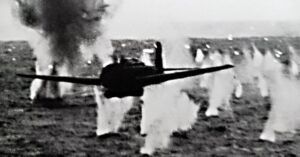
Among the vessels riding at anchor was the USS Pinkney, an evacuation transport serving as the station hospital ship for the fleet. Her wards were full. Her decks carried the evidence of a long campaign — men pulled from Leyte, from Luzon, from the black sand of Iwo Jima, and now from the ridges of Okinawa itself. Somewhere aboard her was a young medical and surgical technician from a small gold-rush town in southern Oregon. His name was Neil Robbins. He was twenty-one years old.
Then the lookouts saw it: a single aircraft, low over the water, closing fast. There was no time for anything but recognition. Seconds later the after-end of the Pinkney’s superstructure vanished behind a sheet of fire. Ammunition began cooking off. Water mains, electrical conduits, and steam lines tore apart. Tugs and landing craft raced alongside to fight the flames, which burned for some three hours. When it was over, the hospital ship was listing heavily to port, and eighteen of her crew were dead. More of Dad’s ship assignment is here.
Neil Robbins came home. He married, raised a family, worked with his hands, and never once — not to his wife’s knowledge, and certainly not to his son’s — told the story of that afternoon. The silence was so complete that his son would not even learn the name of his father’s ship until he was past seventy, piecing it together from records and the patient sifting of the internet.
That son is the subject of this chronicle. His own life would carry him from Willits, California, a lumber town in Mendocino County, to a Christian liberal arts university in South Carolina, from a proposal refused on the Golden Gate Bridge to a proposal accepted in the Berkeley hills, from the darkrooms of Atlanta lithographers to the first Macintosh in a converted garage, from a business sketched on a lunch napkin to the cells of a county detention center, and finally to the Sonoran Desert, where he would bury the woman he had crossed a continent to marry. It is a story of ordinary Americans striving set against extraordinary American change. It is also a story about silence — the silences a family keeps, and what it costs to break them.
❧ ✦ ❧

Part I — A Town Built on Gold
Jacksonville, Oregon: The Long Shadow of 1851
Every family history has a landscape, and the Robbins landscape begins in the Rogue Valley of southern Oregon. Jacksonville was one of the oldest communities in the state, conjured almost overnight out of the discovery of gold in 1851. Like so many mining towns of the American West, it rose on a promise and then settled into the slower rhythms of agriculture and county business once the easy gold was gone. By the early twentieth century, it was a place of brick storefronts and long memories, still the seat of Jackson County, still dignified, but already watching the future pass it by. The railroad had chosen the flatter valley floor, and with it the town of Medford had begun to eclipse its older neighbor.
It was in Medford, because Jacksonville, his parents’ hometown, had no hospital of its own, that Neil Robbins was born in 1923. He was one of nine children — a large family even by the standards of the time — and he grew up in a world of hard work and thin margins. The family was not one to dwell on its past. Of Neil’s parents his son would know almost nothing: a grandfather who died when the boy was two, and a grandmother, Bertha, glimpsed only in the earliest, unrecoverable years of childhood.
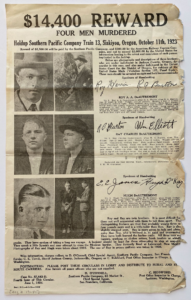
Historical Society 1988.11-8.5, MS 672 (via Smithsonian)
Tunnel 13 and the Last Great Train Robbery
History, however, has a way of arriving uninvited in small places. In October 1923, the same year Neil was born, three brothers named DeAutremont boarded a Southern Pacific express as it passed through Tunnel 13 high in the Siskiyou Mountains. Their plan was to rob the mail car. Instead, they botched the dynamite, murdered four railroad men, and fled empty-handed. The press called it the West’s last great train robbery, and the manhunt that followed became one of the most extensive in the region’s history. You can read more about this event in my post, “A Narrative History of the West’s Last Great Train Robbery.”
It took nearly four years to bring the brothers to justice. In 1927 — when Neil Robbins was four years old — all three stood trial in the Jackson County Courthouse in Jacksonville. It was the old building’s last moment of glory: the final trial held there before the county seat moved to Medford. For a few months the eyes of the nation turned toward the little gold-rush town. Then the reporters left, the courthouse went quiet, and Jacksonville returned to the margins of history.
It is a fitting overture. The Robbins story, too, would be one of quiet places briefly touched by great events — and then left to wonder what, exactly, had passed through.
❧ ✦ ❧
Part II — The Ship of Mercy
A Boy of Eighteen Goes to War
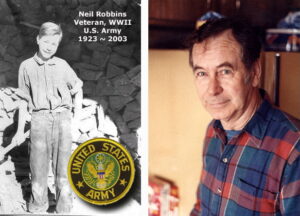
In 1941, shortly after turning eighteen, Neil Robbins enlisted. He had left school after the seventh grade, and the Army offered what Rogue Valley could not: training, purpose, and a place in the great collective effort that was about to engulf the nation. He became a medical and surgical technician, and he was assigned to a ship whose very existence testified to the scale of the coming war.
The USS Pinkney had been laid down as a merchant vessel and converted, in an irony her later crew may never have known, in Oakland, California — the city where Neil’s own son would one day take his first job out of college. Commissioned in November 1942, she was named for Ninian Pinkney, a Navy medical director who had served with distinction during the Civil War. Her mission was not to fight but to carry: combat troops forward to the beaches, and the broken bodies of those same troops back to the rear.
Leyte, Luzon, Iwo Jima, Okinawa
The roll call of the Pinkneys’ campaigns reads like a casualty list of the Pacific War itself. Through 1943 and much of 1944, she worked the South Pacific, ferrying the sick and wounded out of the combat zones. Then came the great drive across the western Pacific: the Palaus, the Battle of Leyte Gulf, the invasion of Luzon, the Philippine campaign, the volcanic hell of Iwo Jima. Each operation fed the ship’s wards. Each one taught the men aboard her something they would carry for the rest of their lives and rarely speak of.
Okinawa was the culmination. The campaign that opened on April 1, 1945, became the bloodiest of the Pacific war, with Allied casualties on the order of fifty thousand. It was also the high tide of the kamikaze. Wave after wave of Japanese aircraft hurled themselves at the fleet, and at Kerama Retto the tension became almost unbearable. The headquarters ship Mount McKinley, flagship of the anchorage, reported that her crew went to general quarters seventy-five times in the month of April alone.
They that go down to the sea in ships, that do business in great waters; these see the works of the LORD, and his wonders in the deep.
— Psalm 107:23–24 (KJV)
Fire at the Stern

The attack of April 28 is recorded in the dry language of naval history: a suicide plane struck the hospital transport Pinkney, serving as station hospital in the anchorage; a supply ship remained alongside the next day to furnish power for pumping out the flooded engine room. Behind those words lies the reality of a medical ship — a ship of the wounded — turned in an instant into a furnace. Rescue parties and damage-control teams formed at once. Men who had spent months treating other men’s burns now fought fires that were creating new ones.
There is one more detail, and it borders on the surreal. At some point the Pinkney took aboard an intact Japanese Shinyo — literally, “sea quake” — a one-man suicide motorboat capable of some thirty knots, built to carry a bow charge of several hundred pounds of explosives into the side of an Allied ship. Kerama Retto had been seized precisely because American planners knew such boats were hidden there. To stand on a deck beside a captured Shinyo was to look directly into the logic of the war in its final, desperate phase.
The Pinkney survived. She came home with six battle stars and without eighteen of her men.
The Architecture of Silence
Historians of the Second World War have long noted that the men who saw the worst often said the least. The generation that came home in 1945 and 1946 was, by and large, a generation that buried its memories with its uniforms. Neil Robbins was no exception. His son never heard a single story of his service — and, being a boy, never thought to ask. Later, as a man, it simply never occurred to him; the past was not a subject the family of four discussed. It would take more than seven decades, and a son’s determined research, for the name of the Pinkney to be spoken aloud in the Robbins family at all.
Dad spent the war among the broken — boys with burns, shattered limbs, and wounds no surgeon could close. He carried them aboard, held what was left of them together, and watched too many slip away. I believe that is why he never told a single story. Some men come home from war with scars you can see. Dad came home with a ward full of faces he could never forget, and he chose to carry them alone.
— Dennis Robbins
❧ ✦ ❧
Part III — The Dispatcher and the Picket Sign
Medford, 1946
Neil returned to Medford in 1946 and found work as a dispatcher for a cab company. It was there, on an otherwise forgettable workday, that the next chapter of the family history walked past his window — carrying a picket sign.
Her name was Millie. She was nineteen, and as family memory has it, she was on the street protesting for higher wages, probably at Pacific Telephone. Neil, with the decisiveness of a man who had seen how short life could be, announced that he was going on break and went outside to introduce himself. Whatever terms he proposed, the young woman with the sign found them acceptable.
Millie had come a long way to be on that sidewalk. Her mother, Florence, had died when Millie was nine, back in Sylvester, Georgia. The reasons for the long journey west remain murky, but in 1947 her sister Irene had invited her to come live in Oregon. Irene’s husband, George Cox, was himself a veteran of the war — complete with the Victory Eagle tattooed across his chest that seemed, in those years, almost a uniform of its own. Southern roots and Western circumstance: it was a very American pairing.
Neil and Millie married. Another war-generation family had begun.
Willits, 1948: A Lumberyard and a Falling-Out
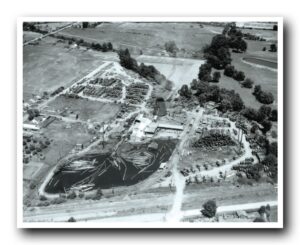
In mid-1948, with Millie already expecting, the couple moved south to Willits, California, a lumber town in the redwood country of Mendocino County. Neil had taken a job in the lumberyard of his brother-in-law, Harold Casteel, husband of his sister Viola. And so it was that Dennis Robbins came to be born not in Oregon, but in California — a fact he would only understand decades later through his own detective work.
The arrangement did not last. Not many months after the baby’s arrival, a “family issue” arose between Neil and Harold, and Neil found himself without a job. The family moved back to Medford. His son has long suspected that this rupture lay at the root of a wider estrangement from several of Neil’s siblings — an estrangement deepened by the fact that one or two of them struggled badly with alcohol. In the Robbins home, by quiet and permanent decree, adult beverages never made an appearance.
There is a postscript of almost novelistic irony. Decades later, sifting through records, Dennis discovered that Uncle Harold — the man whose lumberyard had drawn the family to Willits and whose quarrel had driven it away — had died in 2009 in Mesa, Arizona. Dennis had never met him. He now lives a few miles from where the man died.
The Lost Years
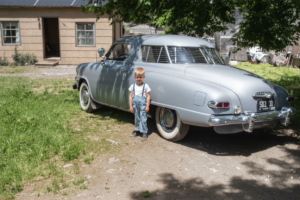
From here the record grows dim. The family seems to have stayed in Medford until about 1951; two old photographs, one with a trailer and another with a used 1947 Studebaker, offer the only reliable evidence. Then, for roughly three years, the narrative goes dark — a gap in the record that its subject, with characteristic humor, has compared to the scene in The X-Files in which Agents Mulder and Scully lose nine unaccounted minutes on a highway in, of course, Oregon.
What does come through the haze is the character of the father. Neil Robbins had no formal training beyond whatever the Army had given him, and no schooling beyond the seventh grade. The GI Bill, which opened the doors of higher education to millions of returning veterans, was of little use to a man who had never finished high school; his son doubts he even knew of it. And yet Neil was a man who taught himself whatever he needed to know. That do-it-yourself instinct — the refusal to wait for permission or credentials — would turn out to be the most valuable inheritance he passed on.
By the mid-1950s, the family had surfaced again, in Shore Acres, California (now known as Baypoint, CA), where Neil’s sister Bonita and her husband, Jeff Tripp, also lived. They were the one branch of the sprawling Robbins clan with whom the family stayed close.
❧ ✦ ❧
Part IV — Greenville, 1969: The Cheerleader and the Unspooled Film
A Westerner Among the Faithful
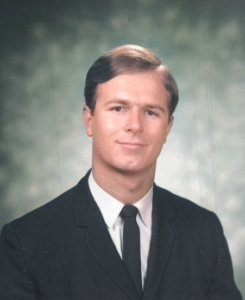
The son of the self-taught dispatcher, whose own schooling had ended at the seventh grade, had a door open to him that his father never had. He had been accepted at the University of California, Berkeley, to study sociology. In the mid-1960s, few places in America stood more squarely at the center of the nation’s upheaval. In the autumn of 1964, the Free Speech Movement had brought the campus to a standstill, and that December some eight hundred students were arrested after a sit-in at Sproul Hall. Teach-ins against the Vietnam War followed, then mass demonstrations, then a counterculture spilling out of nearby Haight-Ashbury. By 1966, Ronald Reagan was running for governor on a promise to “clean up the mess at Berkeley.” For a young man studying sociology, Berkeley offered a front-row seat to the forces remaking American society.
He turned it down. Instead, he went east, to Bob Jones University in Greenville, South Carolina — a world of strict standards, chapel services, and carefully supervised courtship, about as far in spirit from Sproul Plaza as one could travel without a passport. It was the first of many times he would choose the narrower road over the broader one. He studied business management, with English as a minor, and by the autumn of 1969 he was a senior. That spring, 2,500 miles to the west, the National Guard occupied the streets of Berkeley over a vacant lot called People’s Park.
It was then that a young woman named Janice McCall, whom he had dated a couple of times, introduced him to a friend who cheered alongside her for the Lanier Society, one of the campus literary societies. Both girls were striking. But the senior from California felt an immediate and decided preference for the friend. Her name was Deborah Bullock. She was warm, fun, easy company — and, in his own estimation, the most photogenic girl on campus. She also gave him and his buddy Gary Wolfsberger something to argue about.
Thirty Minutes, No Frames

Fate announced its sense of humor early during his senior year. The aspiring sports photographer arranged to meet the University’s entire Lanier cheerleading squad for a photo session. For thirty thoroughly enjoyable minutes, he shot away. Only afterward did he discover that the leader of his 35mm film had never caught the take-up sprocket. Not one frame had been exposed. More than half a century later, the disappointment remains fresh — a small, perfect emblem of the analog age, in which a single mechanical slip could erase an afternoon forever.
Chuck Loving and the Thanksgiving Betrayal
The romance was brief. Debbie seems to have read his interest as the familiar maneuver of a senior hoping to settle matters before graduation scattered the field. He insists he had no such design, but perception has a way of overruling intention. The two agreed to see other people. The final blow came at Thanksgiving: having promised to attend a series of campus events with him, Debbie cancelled when a young man named Chuck Loving asked her instead. How does one remember such a name across half a century? The answer, as its victim notes, is obvious.
Yet there was one consolation, and it would prove decisive. When Debbie’s parents visited campus, she pointed him out to them in a crowd. Her mother took a liking to him — at a distance, at any rate. No one could have known that this single gesture would one day tip the balance of a family decision.
In May 1970 he graduated, having by his own count conducted interviews with some twenty other matrimonial candidates. He went home to West Pittsburg, California — now Bay Point — degree in hand and heart, apparently, unencumbered.
❧ ✦ ❧
Part V — A Photograph on a Bulletin Board
Concord and Oakland
The young graduate went to work for a camper manufacturer in Concord where he had spent his college summers. Through a kind recommendation from the owner, whose father ran an automotive accessory distributorship in Oakland, he moved later in 1970 to that company’s order department. It was steady, unglamorous work. And through it all, pinned to a bulletin board, was a photograph of Debbie Bullock that he had kept for nearly two years.
The Letter Campaign
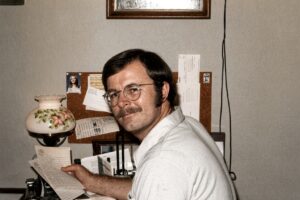
In January 1972, with Valentine’s Day approaching and loneliness pressing in, he looked at that photograph and wondered how she was doing. Without another moment’s thought, he wrote to her. What happened next would later rank among the Great Wonders of the World: she wrote back.
His next move was executed with military precision. On Valentine’s Day, a dozen red roses arrived for Debbie at Bob Jones University, where they became the talk of several dormitories. Letters flowed back and forth through the spring. Then came the bold stroke: would she like to visit him in California after the school year ended? Debbie consulted her parents. Perhaps remembering the young man pointed out in a crowd, they agreed.
None of them had the faintest notion that he had already bought a diamond engagement ring.
The Dramatic Pause
After her last day at Bob Jones, Debbie drove across the country with her close friend Marie Bramblett, who lived in Los Angeles. He drove down to collect her. Three days later, standing on the Golden Gate Bridge with the bay spread out below them, he asked her to marry him.
It was then, as he would later put it, that he came to understand the precise meaning of the phrase dramatic pause. Her answer, as he recalls it, was that she simply wasn’t ready to say yes. Option One had failed. But — and this he noted with the optimism of a man who had already bought the ring — she was still on the bridge.
The View Over Berkeley
Three nights later, they were still enjoying one another’s company. He had found a breathtaking night view overlooking Berkeley, the lights of the East Bay glittering below. And then, out of nowhere, came the question: did he remember the question he had asked her a few days before?
Somewhere in his head, Al Green began to sing “Let’s Stay Together.” Al Green’s signature and most famous song was “Let’s Stay Together” (1972), a US number-one hit that defined 1970s soul music.
Me: “Yes … will you?” Deb: “Yes.”
— Dennis Robbins, recalling the Berkeley hills, 1972
If you’d like, you can let this continue to play while you read the rest of my story.
They married that summer in his little hometown of West Pittsburg. Debbie never returned to finish at Bob Jones, though she would later earn an education degree from Mercer University in Atlanta. The marriage would last forty-five years and produce three daughters: Brooke, Brianne, and Bethany.
❧ ✦ ❧
Part VI — No Visible Means of Support
The Tycoon Who Wasn’t
Every biography needs its season of folly, and this one arrived on schedule. Not long after the wedding, an old high-school buddy persuaded the newlywed that his fortune lay in real estate. Be your own boss, the pitch went. Make millions. Be recognized in the community as a genuine tycoon. In his own retelling, this is the moment to cue the funeral music.
Even before the year had properly begun, there were warnings that he had chosen an awkward moment to become a mogul. On January 15, 1973, Time magazine published “Housing: At Last, a Slowdown,” reporting that California housing starts had outpaced population growth for two years and that Los Angeles already had an oversupply of apartments. One Houston builder supplied an explanation that did not exactly inspire confidence: “We have been building new apartment projects not because of demand, but because of the money available.” Time still viewed the anticipated slowdown as a cooling-off rather than a collapse, but its verdict for prospective buyers was blunt: “For home buyers, the 1973 outlook is not especially cheerful.”
For this particular newlywed, it was not especially cheerful either. The promised millions remained theoretical, community recognition as a tycoon proved elusive, and being his own boss chiefly meant having no one else to blame. For the entire twelve-month stretch the family would come to call, with affection and some trauma, “1973,” the aspiring mogul did not earn enough to fill the tank of their 1960 Pontiac Catalina convertible.
Can you spell “NO VISIBLE MEANS OF SUPPORT?” Boy, I could!
— Dennis Robbins
Debbie Goes to Work
It was Debbie who held the line. She took a job soldering circuit boards at an electronics firm, alongside women who, her husband reports, cursed like sailors. Then she moved on to a nursing home, where her diligence with bedpans earned her the long-awaited community service award known as a paycheck. It was the first of many occasions on which her quiet competence would carry the family through a storm. Enough, as Tammy Faye Bakker would later insist in song, was enough. Readers wishing to hear Tammy make the case are welcome to listen, provided they first agree to set aside their opinions on musical quality—a small act of faith, though perhaps not a small sacrifice.
❧ ✦ ❧
Part VII — Night Shift on I-75
An Invitation to Tennessee
Rescue came, as it so often does, in the form of in-laws. At Christmas 1973, Debbie’s parents invited the young couple to Oak Ridge, Tennessee — the secret city of the Manhattan Project — and offered to pay the way. That, in his words, got his vote. The visit went well. Not long after returning to California, the couple loaded their belongings into U-Haul’s smallest trailer, hitched it to the Pontiac, and drove east.
In Knoxville, he found work as a night auditor at a motel along Interstate 75 — the man desperate enough to sit up from eleven at night until seven in the morning, checking in weary travelers. It was the loneliest shift in American commerce. It was also, though no one could have guessed it, an apprenticeship of a kind: a young man watching the endless river of interstate traffic, the truckers and families and salesmen who needed a bed, a meal, a tank of gas at the next exit.
The Man in the Camera Department
He stayed just long enough to earn another real estate license — a decision he would later greet with the rhetorical question of whether this fellow simply did not get it. He did sell a few properties, but he never loved the selling routine. His boss, Garrett Bruce Asher, a decent man, saw it, and suggested a position at the local newspaper, The Oak Ridger, where a friend ran the advertising department. Garrett has since passed, but his compassion and friendship will always remain.
The mornings were spent calling on advertisers; the afternoons were spent in the art department, pasting up their ads by hand. And there, in the camera room, he found the mentor who would change the course of his life. The man who ran the newspaper’s camera department took him under his wing and taught him everything he knew about graphics and printing. In an age before screens, this was a craft of chemistry, light, and precision — and the young man from Willits discovered that he had a gift for it.
Historical Footnote: Dick Smyser, 81; His Query Prompted ‘I Am Not a Crook’ Response.
The “I Am Not a Crook” Press Conference (Nov 1973 / 1974 context): While attending the Associated Press Managing Editors Association convention at Disney’s Contemporary Resort, Smyser—representing The Oak Ridger—asked President Richard Nixon about the heavy pressures of the office and how they might relate to the Watergate scandal. Nixon’s famous defensive reply (“People have got to know whether or not their president is a crook. Well, I am not a crook”) became a defining moment of the era.
Nixon resigned Aug. 9, 1974, facing likely impeachment over the cover-up of the break-in of Democratic Party headquarters at the Watergate hotel in Washington.
Smyser, who retired in 1983, was hired as managing editor before the Oak Ridger printed its first edition on Jan. 20, 1949. It was the first newspaper for the “secret city” the federal government created as part of the Manhattan Project to build the atomic bomb.
❧ ✦ ❧
Part VIII — Atlanta: The Age of Lead and Light
Graphics Atlanta, 1975–1988
Once again, the decisive turn came through friendship. On a visit to Atlanta, university friends introduced him to a man from their church who happened to be searching for a general manager for his company, Graphics Atlanta. The newcomer’s graphics experience made him the perfect fit. Early in 1975, the family moved to Atlanta and eventually settled in Lawrenceville, in Gwinnett County.
For the next thirteen years, he worked at Graphics Atlanta, mastering color lithography and printing and ultimately running the firm’s typesetting division. In 1988, he moved to Image South, a Norcross-area firm founded that year by Barry M. Rickert. Rickert, who had relocated to Atlanta in 1981 and built a consulting practice serving petrochemical plants and turbo-machinery clients, had expanded into desktop publishing and high-resolution film output. Image South equipped itself with laser typesetters—including a Linotronic—for PostScript-driven film imaging, serving clients such as magazines, Gold Kist, and Turner Broadcasting while Rickert continued his industrial vibration and machinery work alongside the graphics operation.
These were the years in which the family took its settled shape. Debbie finished her degree at Mercer. Three daughters arrived — Brooke, Brianne, and Bethany. Atlanta itself was transforming from a regional capital into a sprawling Sun Belt metropolis, and the Robbins household grew up alongside it.
The Macintosh in the Garage
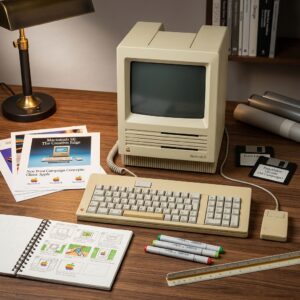
Then, in the mid-1980s, came the revolution. The Apple Macintosh, introduced in 1984, was followed within a year by the laser printer and page-layout software. Together they did something that seemed almost impossible to men who had spent their careers with process cameras, film, and hot type: they put the entire apparatus of publishing on a desktop. Seasoned professionals scoffed. Typesetting houses that had prospered for decades would, within a few short years, simply cease to exist.
Dennis Robbins did not scoff. Around 1987, sensing which way the wind was blowing, he bought his own Macintosh and the equipment to go with it, converted his garage into an office, and set about learning the technology that was about to turn his industry upside down.
Here, perhaps, the father’s legacy shows most clearly. Neil Robbins had taught himself whatever his life required. His son, at nearly forty, did the same — and in doing so made the leap that so many of his contemporaries in the graphic arts could not.
Coda: The Same County, Twenty Years On
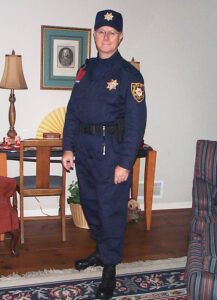 Gwinnett County would remain the family’s home base for more than four decades, and it would set the stage for two of the stranger turns in its story. In 2005, long after the Graphics Atlanta years and the rise and fall of the company he would go on to build, he joined the Gwinnett County Sheriff’s Department in Lawrenceville. The assignment was short-lived but anything but soft: he was placed in charge of one of the inmate housing units at the Detention Center. It was a world of headcounts, locked doors, and rigid procedure, where the measure of a shift was whether it ended quietly. The man who had spent his career managing type, film, and deadlines now managed human beings at their most difficult. He did the job, and then concluded that it was not, in the end, where he belonged.
He went back to what he knew. The Gwinnett Daily Post, the hometown paper of Lawrenceville, hired him to design advertising — a return, after three decades, to the work he had first learned pasting up ads in an Oak Ridge, Tennessee newspaper’s art department. For a time it seemed the circle had closed neatly. Then the paper did what so many American newspapers were doing in those years of shrinking revenue: it shut down its graphic design department and shipped the work overseas. And where did that work go? Wait for it — the Philippines.
History, it seems, has a weakness for rhymes. Sixty years earlier, Neil Robbins had sailed into the Philippines aboard a hospital ship to carry home the wounded of Leyte and Luzon. Now his son’s drawing board had been carried off to the same islands, not by war but by corporate downsizing. The forces that had once lifted him — cheaper machines, faster networks, a world shrinking by the year — were the very forces that now sent his job across the Pacific. It was the Zenrin story in miniature, and it was not the last time the tide of technology would wash out what he had built.
The badge was brief, but it is revealing. It speaks of a restlessness, a willingness to test himself against the unfamiliar, that had marked his life from the real estate misadventures of 1973 onward. It also gave him something every later chapter would draw upon: firsthand knowledge of the law, of institutions, and of the people who end up on the wrong side of both.
Meanwhile, Debbie had built a career of her own in human resources at Nationwide Insurance. Once again, as in the lean days of 1973, she was the steady keel.
❧ ✦ ❧
Part IX — A Napkin and a Nation of Exits
Lunch with a Harvard Man
In the middle of 1990, an acquaintance — a Harvard graduate — approached him with an idea his uncle believed would make a great published product. Over lunch, the man sketched it out on a napkin. With some seed capital, a two-person office, and the graphic design skills of the converted lithographer, they founded a company called Interstate America. They were, in a phrase of the day, off to the races.
The Harvard man was Russell P. Reach, who became not only a business partner but a friend. Russell died on November 11, 2007, at just forty-nine. His family remembered his wit, generosity, love of words, and gift for seeing possibilities in people and their ideas — qualities that lend a special poignancy now to the memory of that lunch and the venture that began on a napkin.
The Exit Authority

The idea was as simple as it was ambitious. The Interstate Highway System, launched in the Eisenhower years, had remade American travel, but no single resource told a driver what lay at each exit. Interstate America would. Its flagship product, The Exit Authority, was a comprehensive directory of travel-related businesses and services at every exit on the national interstate system: truck stops and gas stations, motels and restaurants, RV service and diesel repair, ATMs and emergency medical facilities, pharmacies and supermarkets, rest areas and post offices, coin laundries and propane stations, veterinarians and State Patrol posts, national parks and tourist attractions, outlet malls and car washes — exit by exit, from coast to coast.
The first edition was built exclusively for commercial truck drivers, the men and women who lived on those highways. Then the RV travelers discovered it, and they loved it. One cannot help but recall the young night auditor in Knoxville, watching the traffic of I-75 roll past in the dark. Seventeen years later, he was charting every exit in the nation.
Sold to Zenrin
By the late 1990s, the information age had caught up with the printed atlas. In 1999, the business was sold to Zenrin USA, the American arm of a Japanese mapping company that supplied in-vehicle navigation systems to automakers such as Toyota and Nissan. The interstate data seemed a natural fit for the dashboard screens of the coming century. Yet for reasons never fully explained, Zenrin closed the company in 2001. The paper directory gave way to the satellite and the screen — the same technological wave that had once lifted the desktop publisher now swept away the thing he had built.
❧ ✦ ❧
Part X — The Desert and the Valley of the Shadow
A Family Divided by Two Thousand Miles
In 2015, Nationwide announced that it would close Debbie’s division in the Atlanta area. The company offered to relocate her to Phoenix, where her sister and family already lived, and the couple decided to accept. But two of their daughters were still living at home and attending college in Atlanta. So they made a plan: Debbie would go ahead to Arizona; Dennis would stay behind until the girls graduated, then sell the house and follow. It was a sensible arrangement, the kind of practical compromise long marriages are made of. It meant two years apart.
June to September, 2017
He arrived in Arizona in June 2017. By then Debbie had been diagnosed with ovarian cancer. The disease moved with terrible speed. In September of that year — barely three months after the long separation ended — she was gone.
There is little a chronicler can add to such a sentence, and it would be presumptuous to try. Forty-five years earlier he had crossed a continent and stood on a bridge to ask for her hand, and she had made him wait three days. Now he had crossed a continent again, and been given three months. His own account of what followed is spare and unadorned, in the manner of his father’s generation: it had been, he wrote, a rough couple of years.
Yea, though I walk through the valley of the shadow of death, I will fear no evil: for thou art with me.
— Psalm 23:4 (KJV)
❧ ✦ ❧
Epilogue — What Ancestry Cannot Tell
A New Life in the Sonoran Desert
Widowhood in a new state might have become a long retreat. It did not. In his newfound retirement, he threw himself into a cluster of interests that, taken together, sketch the portrait of a man still very much engaged with the world: collecting antiques, the shooting sports, and the rugged adventures the Arizona desert offers anyone willing to leave the pavement. There are grandchildren, too — a granddaughter, Tyler, and a grandson, Braxton.
And there was something more. The lifelong craftsman of other people’s words and images turned, at last, to his own. He became an author and apologist, publishing more than 130 books on Amazon and launching this blog, The Righteous Cause, a long-form publication devoted to Christian apologetics and commentary. The man who had spent half a century laying out pages for others had, finally, found his own subject.
Breaking the Silence
It was in these years, too, that he went looking for his father. Neil Robbins had never told his story, and his son had never thought to ask. Now, with the patience of a lithographer registering four colors to a hair’s breadth, he began piecing it together: the birth certificate from Medford, the reason for Willits, the lumberyard, the uncle who died in Mesa. Only about a year before he wrote his own account did he finally discover the name of the ship — the Pinkney — and with it, the explanation for a lifetime of silence.
It’s nice … but it doesn’t tell any stories.
— Dennis Robbins, on his Ancestry.com family tree
That is the paradox at the heart of every family history in the digital age: the records have never been richer, yet the silences remain. Documents once buried in county courthouses are now a keystroke away. They can tell us that a man served on a hospital ship, that he married a girl with a picket sign, that a family moved to Willits and later moved away. But they cannot tell us what he saw at Kerama Retto. They cannot explain why he never spoke of it, or what he felt when his son came home with a university degree.
For those things, we need people willing to remember—and willing to speak while there is still time.
This chronicle, then, is more than an account of one man’s life: the lithographer, the entrepreneur, the deputy, the husband, the father, the widower, the writer. It is an attempt to keep another life from slipping beyond the reach of those who come after. Not to fill every silence in his father’s story, but to leave fewer silences in his own.
Neil Robbins carried much of his story to the grave. His son has chosen to leave his behind—in words his children will not have to search for, or struggle to reconstruct when there is no one left to ask.
Exit by exit, the road goes on. This time, there will be a record of the journey.
❧ ✦ ❧
Photographic Colophon
This chronicle would not be complete without one photograph.
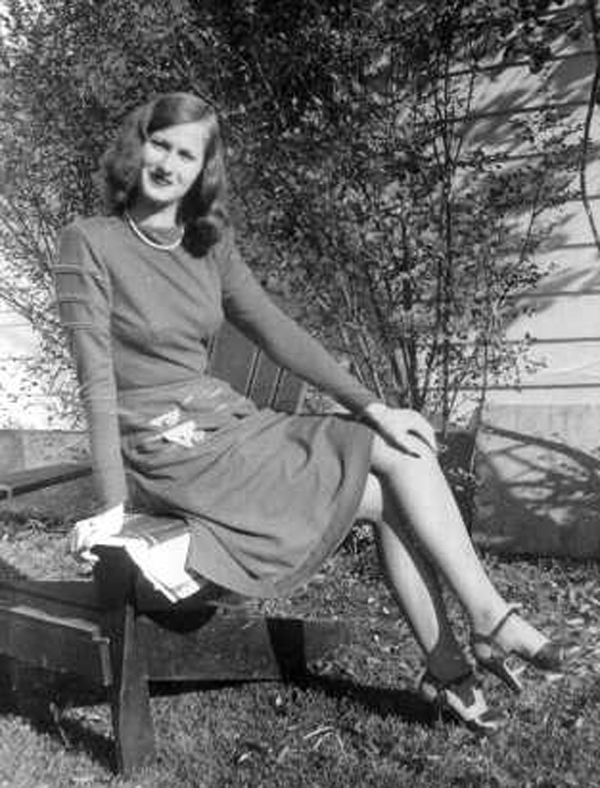
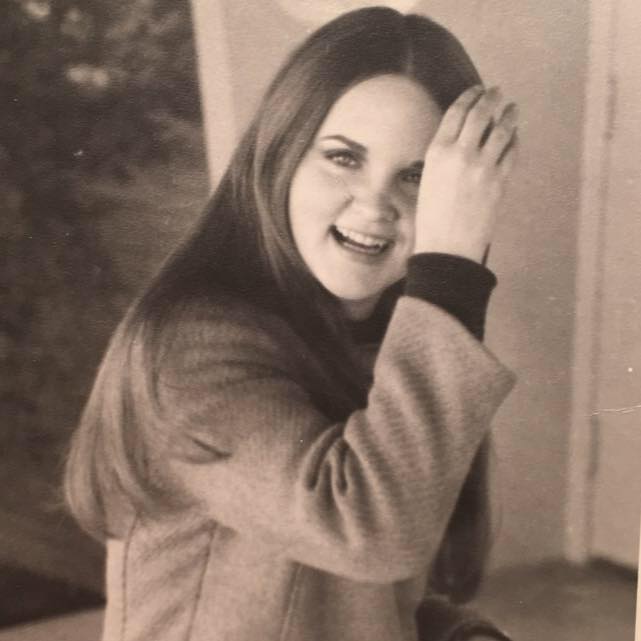
It is the very first picture I ever took of Debbie, made just after our first date at Bob Jones University in the autumn of 1969. Readers will remember that my career as a campus photographer got off to an inglorious start. Thirty minutes with the Lanier cheerleaders, and not a single frame caught on the sprocket. But this time the film advanced. The shutter opened, the light came through, and a young woman I barely knew was fixed in silver for good.
I had no idea then what I was holding. I didn’t know that a different picture of her would one day hang on my bulletin board for two long years and send me reaching for pen and paper. I didn’t know that a letter and a dozen roses would follow, or that we would stand together on a bridge, and later on a hillside above Berkeley, and later still in hospice care in my bedroom in Arizona. A photograph only captures a moment. It is God who writes the story that comes after it.
Forty-five years of marriage, three daughters, and a lifetime later, I look at this first image and my heart is full.
She really was the most photogenic girl on campus.
Sources
Robbins, Dennis. “Robbins Historical Details.” Unpublished family memoir notes, n.d.
Robbins, Dennis. “The Story of Neil.” Blog post. https://bit.ly/Story-of-Neil.
“USS Pinkney.” Wikipedia. https://en.wikipedia.org/wiki/USS_Pinkney.
Naval Historical Center. “USS Pinkney (APH-2), 1942–1957.” Online Library of Selected Images. https://ibiblio.org/hyperwar/OnlineLibrary/photos/sh-usn/usnsh-p/aph2.htm.
Carter, Worrall Reed. Beans, Bullets, and Black Oil: The Story of Fleet Logistics Afloat in the Pacific During World War II. Ch. 27, “Logistics at Kerama Retto for the Okinawa Operation.” https://www.ibiblio.org/hyperwar/USN/BBBO/BBBO-27.html.
Naval History and Heritage Command. “H-048-2: The Naval Battle of Okinawa (Continued), 11 May–5 June 1945.” https://history.navy.mil/about-us/leadership/director/directors-corner/h-grams/h-gram-048/h-048-2.html.
“DeAutremont Brothers Train Hold-Up at Tunnel 13.” The Oregon Encyclopedia. https://www.oregonencyclopedia.org/articles/deautremont-brothers-train-hold-up-at-tunnel-13/.
Historic Jacksonville, Inc. “Trial of the DeAutremont Brothers.” https://historicjacksonville.org/?p=6419.
The Holy Bible, King James Version. Psalm 23:4; Psalm 107:23–24.