Unlike a Typical Megachurch Sermon, Jesus’ Words Were Astonishing
❧ ✦ ❧
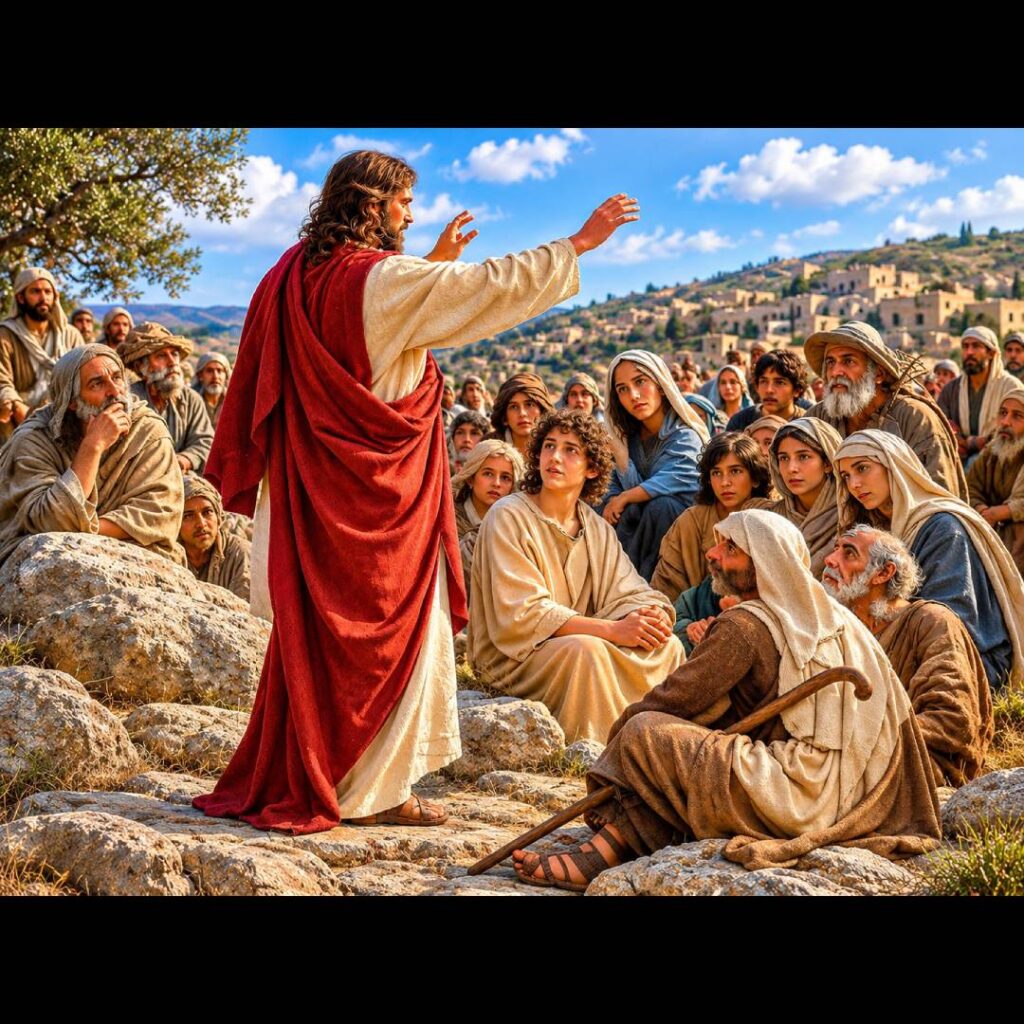
The sun had climbed high over the hills above Capernaum by the time the voice fell silent. For a long moment, no one moved. Fishermen who had come hoping to see a miracle-worker stood with their questions forgotten. Mothers who had spent the morning hushing restless children realized the children had long since gone quiet on their own. And somewhere near the back of the crowd, a man who had sat under synagogue teaching every Sabbath of his adult life noticed that his hands were trembling.
He had heard sermons before—hundreds of them. He knew the cadence of the scribes, the careful citations, the measured appeals to the great teachers of the past. But this was something else entirely. This carpenter from Nazareth had not quoted a single rabbi. He had simply opened His mouth and spoken, and the words had gone through the listener like a blade.
Matthew, the converted tax collector, records the moment in two short sentences:
“And when Jesus finished these sayings, the crowds were astonished at his teaching, for he was teaching them as one who had authority, and not as their scribes.” (Matthew 7:28–29, ESV)
When the Sermon Ended
These verses are the closing curtain on the Sermon on the Mount, the great discourse on the kingdom of heaven that fills Matthew chapters 5, 6, and 7. It opened with blessing on the poor in spirit and closed with a storm—two houses, two foundations, and one devastating outcome:
“And everyone who hears these words of mine and does not do them will be like a foolish man who built his house on the sand. And the rain fell, and the floods came, and the winds blew and beat against that house, and it fell, and great was the fall of it.” (Matthew 7:26–27, ESV)
Then the voice stopped. Matthew says the crowds were astonished—in Greek, ekplēssō, to be struck out of one’s senses, overwhelmed, knocked off balance. The verb is in the imperfect tense, suggesting an amazement that did not pass in an instant but lingered. People walked down that hillside unable to shake what they had heard.
Not as Their Scribes
To understand why, we must remember what Sabbath teaching normally sounded like. The scribes were the trained custodians of the Law, and their authority was borrowed. A teacher’s credibility rested on his chain of transmission back through honored names. The tractate of the Mishnah known as Pirkei Avot opens by tracing exactly that chain:
Moses received the Torah at Sinai and transmitted it to Joshua, Joshua to the elders, and the elders to the prophets, and the prophets to the men of the Great Synagogue.
— Mishnah, Pirkei Avot 1:1; text via Wabash Center, wabashcenter.wabash.edu
A scribe’s lesson was a pedigree: Rabbi Hillel said, or Rabbi Shammai taught. He was a caretaker of consensus, never a source. Jesus broke that pattern so completely that the eighteenth-century Baptist scholar John Gill, who knew the rabbinic literature intimately, summed up the difference in a single line:
He spoke as a lawgiver, as one that had authority from heaven, and not from men.
— John Gill, Exposition of the Entire Bible, on Matthew 7:29 (biblestudytools.com)
A Command, Not a Citation
Again and again in Matthew 5, Jesus set what the people had heard alongside His own word:
“You have heard that it was said to those of old, ‘You shall not murder; and whoever murders will be liable to judgment.’ But I say to you that everyone who is angry with his brother will be liable to judgment.” (Matthew 5:21–22, ESV)
No footnotes. No precedents. Only “But I say to you.” A scribe who spoke that way would have been dismissed as a fraud or charged with blasphemy. Jesus spoke that way because He was not a commentator on the Law. He was its Author. The same Lord who thundered from Sinai now sat on a Galilean hillside, explaining what He had meant all along.
The Heart, Not the Checklist
The scribes had built elaborate fences of tradition—how far one could walk on the Sabbath, how cups and hands must be washed. Albert Barnes observed that they “taught chiefly the sentiments of their Rabbis, and the traditions which had been delivered.” Jesus walked straight past the fences and went for the heart:
“You have heard that it was said, ‘You shall not commit adultery.’ But I say to you that everyone who looks at a woman with lustful intent has already committed adultery with her in his heart.” (Matthew 5:27–28, ESV)
That kind of preaching unsettles anyone who has been keeping score. You can count your Sabbath steps. You cannot count a lustful glance or a secret grudge. Jesus pulled away the ladder people were using to climb up to God and showed them they needed a Savior to come down to them.
The Hillside, Not the Lecture Hall
And He did it with birds and flowers:
“Look at the birds of the air: they neither sow nor reap nor gather into barns, and yet your heavenly Father feeds them. Are you not of more value than they?” (Matthew 6:26, ESV)
Seed and soil, salt and light, gates and trees—common people understood every image, yet every homely picture carried the weight of eternity.
The consciousness of divine authority, as Lawgiver, Expounder and Judge, so beamed through His teaching, that the scribes teaching could not but appear drivelling in such a light.
— Jamieson, Fausset, and Brown, Commentary Critical and Explanatory, on Matthew 7:29 (bibletools.org)
Unlike a Typical Sermon Today
It would be comfortable to treat all this as an ancient contrast with no modern application. But every generation develops its own version of scribal preaching. Ours rarely cites rabbis, yet it often leans on something borrowed—the latest leadership book, the trending psychology, the survey data on what audiences want to hear. A twenty-minute talk on “Five Keys to Your Best Week” may be pleasant. It will not leave anyone trembling.
The cure is not louder preaching or slicker production. The cure is the same voice the crowds heard on that hill. On another mountain, the Father Himself gave the only instruction we need: “This is my beloved Son, with whom I am well pleased; listen to him” (Matthew 17:5, ESV).
Every word proves its Author to be Divine.
— Matthew, Commentary on Matthew 7:21–29 (christianity.com)
When a preacher simply opens the text and lets Christ speak, the astonishment returns—not because the preacher is gifted, but because the words still carry their Author’s authority. “Heaven and earth will pass away, but my words will not pass away” (Matthew 24:35, ESV).
Building on the Rock
Here is the encouragement, and it is enormous. The authority that astonished the crowds is not an authority that crushes. The scribes, Jesus said, “tie up heavy burdens, hard to bear, and lay them on people’s shoulders” (Matthew 23:4, ESV). His own authority does the opposite:
“Come to me, all who labor and are heavy laden, and I will give you rest. Take my yoke upon you, and learn from me, for I am gentle and lowly in heart, and you will find rest for your souls.” (Matthew 11:28–29, ESV)
The One who has the right to command is the One who carries the load. So the question that faced the crowd is the question that faces us: will we merely be astonished, or will we build? Astonishment that ends on the hillside is not faith.
“Everyone then who hears these words of mine and does them will be like a wise man who built his house on the rock. And the rain fell, and the floods came, and the winds blew and beat on that house, but it did not fall, because it had been founded on the rock.” (Matthew 7:24–25, ESV)
Whatever storm is beating against your house tonight—grief, illness, a wayward child, the slow erosion of strength—the Rock has not moved. The voice that spoke on that hillside now speaks as the risen Lord: “All authority in heaven and on earth has been given to me” (Matthew 28:18, ESV). That authority has not been handed to a committee or diluted by time. It belongs to Him, and He has pledged it to the good of everyone who builds on Him.
A Closing Prayer
Lord Jesus, forgive us for being content with borrowed words when You have spoken with Your own. Astonish us again. Tear down the fences we have built to measure our own righteousness, and teach us not merely to hear You but to obey You. Be the Rock beneath our house when the storms come. In Your name we pray, Amen.
❧ ✦ ❧
Works Cited
Barnes, Albert. Notes on the New Testament: Matthew 7. BibleTools.org, https://www.bibletools.org/index.cfm/fuseaction/Bible.show/sVerseID/23345/eVerseID/23346/RTD/barnes
Gill, John. Exposition of the Entire Bible: Matthew 7:29. Bible Study Tools, https://www.biblestudytools.com/kjv/matthew/7-29.html
Henry, Matthew. Commentary on Matthew 7:21–29. Christianity.com, https://www.christianity.com/bible/kjv/matthew/7-29
Jamieson, Robert, A. R. Fausset, and David Brown. Commentary Critical and Explanatory: Matthew 7:29. bibletools.org, https://www.bibletools.org/index.cfm/fuseaction/Bible.show/sVerseID/23346/eVerseID/23346/RTD/jfb
Mishnah, Pirkei Avot 1. Wabash Center, https://www.wabashcenter.wabash.edu/syllabi/r/reed/1JM8T-Rel212/avot.html
The Holy Bible, English Standard Version. Wheaton, IL: Crossway, 2001.
Colophon: Researched and drafted with the assistance of Claude (Anthropic) as a scholarly research collaborator. The author retains full editorial authority over the final text.