
Going Global While Growing Distant: The LDS Church’s Shifting Charitable Focus
Introduction: The Question Jesus Asked First
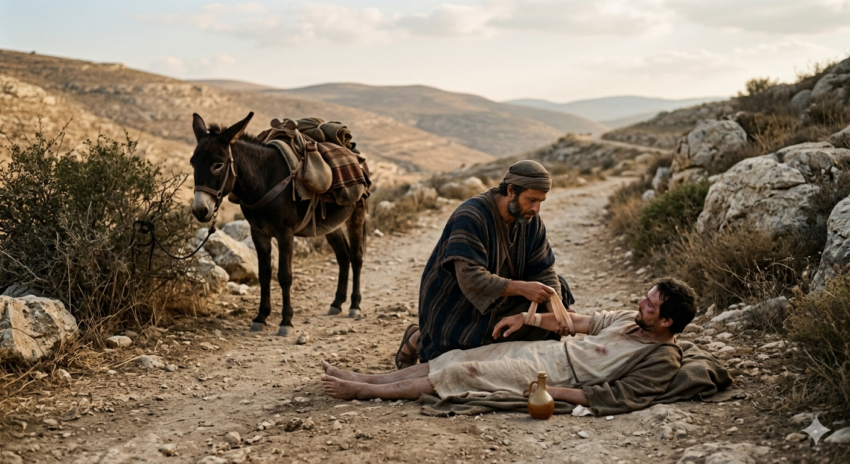
A lawyer once asked Jesus, “And who is my neighbor?” It was a reasonable question, and Jesus answered it with a story about a man who crossed racial, religious, and social barriers to help a stranger left bleeding in a ditch. The Parable of the Good Samaritan (Luke 10:25–37) did not merely define charity. It defined the geography of charity — it happens close to home, among people we actually see.
The Church of Jesus Christ of Latter-day Saints makes extraordinary claims about its own charitable mission. In March 2026, it reported spending $1.58 billion in welfare and humanitarian aid during 2025, dispatching volunteers to 196 countries, facilitating nearly 38,600 service projects, and maintaining 121 bishops’ storehouses distributing over 37 million pounds of food. These are genuinely impressive statistics, and they deserve fair analysis.
An AI image generated by Google Gemini.
But impressive statistics prompt equally serious questions. For an institution that collects an estimated $5.5 to $6.5 billion annually in tithing alone — and whose investment portfolio has been independently estimated at more than $200 billion — how does charitable outlay compare to institutional wealth? Are the charitable stories told in official reports genuine reflections of LDS values, or are they carefully managed narratives designed to burnish a global brand? Are rank-and-file LDS members in American neighborhoods truly impacting the lives of the poor and marginalized who live around them, or are their service hours overwhelmingly directed inward — toward their own congregational callings, their own families, and their own pursuit of celestial exaltation?
These are not hostile questions. They are the questions Jesus asked.
This analysis at The Righteous Cause blog examines the LDS Church’s charitable footprint across six dimensions, drawing on current church reports, independent financial analysis, peer-reviewed social science research, and a comparison with the Scientology Volunteer Ministers program. The goal is not to dismiss real acts of genuine service — of which there are many — but to ask whether the institutional architecture of the LDS Church ultimately produces the kind of neighbor-love that Jesus described, or something considerably more complicated.
Section 1: Local Impact vs. Global Outreach — Are U.S. LDS Members Reaching Their Own Neighbors?
The 2025 Numbers: Impressive in Scope, Vague in Geography
The Church of Jesus Christ of Latter-day Saints released its Caring for Those in Need: 2025 Report on March 10, 2026 — the most current data available at the time of writing. KSL News (Salt Lake City) reported the headline figures:
The Church of Jesus Christ spent $1.58 billion on welfare efforts, emergency relief and humanitarian aid in 2025 … Members of The Church of Jesus Christ of Latter-day Saints participated in 3,514 humanitarian projects, spending 7.4 million hours of service in 196 countries and territories last year.
— KSL.com, March 10, 2026
The Church’s JustServe platform — a volunteer coordination website and app — surpassed one million registered users in 2025, with 38,597 new service projects created through the platform that year. Emergency responses encompassed 569 projects addressing earthquakes in Myanmar and Vanuatu, wildfires in California, and floods in Argentina. The numbers are real, and the geographic breadth is genuinely remarkable.
What the 2025 report does not tell us — a significant omission — is how those 7.4 million service hours are distributed between the United States and the rest of the world, or how they are distributed between service to LDS members and service to the general public. This is not a trivial distinction.
The Penn Study: Where LDS Service Hours Actually Go
The most rigorous independent academic study of LDS volunteering behavior was conducted by researchers at the University of Pennsylvania and Indiana University-Purdue University Indianapolis. Published in 2012 and based on surveys of 2,644 active Latter-day Saints across five sampling areas — southeastern Pennsylvania, New Jersey, Michigan, Utah, and California — “Called to Serve: The Prosocial Behavior of Active Latter-day Saints“ remains the definitive peer-reviewed benchmark on this question.
The findings were striking on two levels. Active LDS members are extraordinarily generous with their time, contributing approximately 430 hours of volunteer labor per year — roughly seven times the national average. Lead researcher Ram Cnaan, an expert in faith-based social services at Penn’s School of Social Policy and Practice, observed:
Regardless of where they live, they are very generous with their time and money. Through a theology of obedience and sacrifice and a strong commitment to tithing and service, Latter-day Saints are model citizens.
— Professor Ram Cnaan, University of Pennsylvania, “Called to Serve” Study, 2012
However, the study’s distributional breakdown reveals a critical structural tension:
- 57% of LDS volunteer time is spent on internal religious purposes — performing “callings,” leading youth groups, maintaining church facilities, and participating in ward-level religious programs.
- 22% is spent on social services within the ward — helping fellow LDS members move, providing meals to sick ward members, and leading LDS-affiliated Boy Scout troops.
- Only 8% of total LDS volunteer time is directed toward non-LDS community members — what the researchers termed “social volunteering outside of the church.”
This 8% figure is telling. As the Penn researchers acknowledged, even this modest fraction equals the national volunteering average for all Americans, which speaks to how uncommonly high total LDS volunteerism actually is. But it also means that of those 430 annual hours, only about 34 hours per year, on average, are directed toward the broader community outside church walls.
The LDS Church actively promotes community engagement through platforms like JustServe, which surpassed one million registered users in 2025. But the institutional demand structure of Latter-day Saint life works against broad outward engagement. A member serving a calling, attending Sunday services, fulfilling temple recommend standards, participating in family home evening on Monday nights, attending mid-week activities, and completing home and visiting ministry assignments faces a schedule that is, structurally speaking, oriented primarily inward — a reality the “Called to Serve” data confirms in precise numerical terms.
Callings, Temple Covenants, and the Inward Pull
The LDS system of lay “callings” is both its greatest organizational strength and one of the primary reasons that community-facing service is structurally constrained. When 86% of active respondents in the Penn study report currently fulfilling a calling — with the most common activities being cleaning the church building, leading youth programs, or serving as ward leaders — the labor of those hours is directed entirely toward maintaining the institutional structure of the church itself.
This is not to suggest such work is without value. Organizational maintenance is necessary for any institution that wishes to sustain charitable output. But it does complicate the narrative that LDS members are broadly “serving their neighbors.” The vast majority of institutional service investment sustains the church as an institution first, and the broader community second.
The theological stakes intensify this inward orientation. LDS soteriology ties access to the “Celestial Kingdom” — the highest degree of exaltation — to participation in temple ordinances, which require both a current temple recommend (verified full compliance with church standards, including full tithing) and the investment of significant time in temple work. For observant LDS members, time spent in the temple or in temple-qualifying behavior is not merely desirable. It is salvifically necessary. Against this backdrop, time spent serving a homeless shelter in one’s neighborhood carries no explicit celestial credit — while the same hours spent on a calling carry institutional weight and salvific meaning.
This is a structural observation, not a condemnation of individual LDS members, some of whom likely serve their neighbors with genuine and unstinting generosity. The point is that the institutional architecture of the LDS Church creates powerful centripetal forces that pull service inward, and the 2025 annual report — for all its impressive aggregate numbers — does little to demonstrate that these forces have been overcome.
Presiding Bishop Waddell’s Notable Acknowledgment
In a statement that may be more candid than the church intended, Bishop W. Christopher Waddell, the presiding bishop, noted in the 2025 report that “most of the meaningful service has been within members’ own communities.” This framing is ambiguous by design: “communities” could mean LDS wards, or it could mean the broader public. But the use of the word “within” — rather than “for” or “toward” — subtly reinforces the inward orientation that the Penn data documents empirically.
Data Sources
KSL News — 2025 Caring Report: https://www.ksl.com/article/51459905/church-of-jesus-christ-reports-158-billion-and-74-million-hours-in-service-last-year
Penn Study — “Called to Serve”: https://penntoday.upenn.edu/news/penn-research-shows-mormons-are-generous-and-active-helping-others
LDS Friend and Neighbor Program: https://www.churchofjesuschrist.org/serve/share/friend-and-neighbor?lang=eng
Section 2: The Financial Comparison — Does the LDS Church Tithe Its Own Billions?
What the Church Collects
The LDS Church does not publish audited financial statements, and its single internal “Church Auditing Department Report,” presented annually at the General Conference, provides no line-item financial data. Independent analysis has therefore been necessary to estimate the scale of church finances.
To appreciate the full weight of this opacity, it is worth reading the Church Auditing Department Report in its entirety — because its entirety is 158 words. Presented each April at General Conference by Managing Director Jared B. Larson, the April 2025 report confirms that contributions received, expenditures made, and assets of the Church “have been recorded and administered in accordance with Church-approved budgets, accounting practices, and policies.” That is the complete substance of the disclosure. No total tithing receipts. No expenditure categories. No asset valuation. No comparison to prior years. The auditors are not attesting that the Church’s finances are transparent — they are attesting that the Church followed its own internal rules, rules that the Church itself wrote, enforced by auditors who report to the institution they are auditing. The report closes with a note that the Church “follows the practices taught to its members of living within a budget, avoiding debt, and saving against a time of need” — a statement that, read against independent estimates of $265 billion in accumulated reserves, carries an unintentional irony that the report’s authors almost certainly did not intend.
For an institution managing one of the largest private financial portfolios on earth, this is the annual shareholder meeting: 158 words, no figures, no questions taken.
The most thorough independent analysis comes from a research project called The Widow’s Mite Report, which cross-references publicly available data sources including Ensign Peak’s SEC-mandated Form 13F filings (the investment portfolio disclosure required after Ensign Peak’s 2023 SEC settlement), international church filings in countries requiring religious financial disclosure (UK, Canada, Australia, New Zealand, the Netherlands), and court filings that have disclosed church financial data in litigation.
Their current best estimates, as of 2024–2025:
• Annual tithing income: approximately $5.5–6.5 billion
• Total annual church spending: approximately $6 billion (drawing on investment returns to supplement tithing)
• Total net worth (investment portfolio plus real estate): independently estimated at $293 billion as of 2024, of which approximately $206 billion is held in the Ensign Peak investment portfolio
• Investment portfolio earnings capacity: sufficient at current rates to fund all expected church costs for the next 30 years — or, with interest-only disbursements, to fund operations in perpetuity
An independent analysis in 2024 estimated the church’s net worth at approximately $293 billion, of which $206 billion is held in its investment portfolio, intended as a reserve or “rainy-day” fund. The analysis estimated that those investments could directly pay for all expected church costs for the next 30 years.
— Wikipedia: Finances of the Church of Jesus Christ of Latter-day Saints, citing Widow’s Mite Report analysis
The 10% Standard: Members vs. Institution
The LDS Church strongly requires — as a formal condition of temple recommend eligibility — that members declare themselves full tithe-payers, contributing 10% of their income. Without a current temple recommend, members cannot access the highest ordinances the Church offers, including endowments, sealings, and celestial marriage. The Penn study confirmed that 88% of active LDS respondents reported paying a full tithe, with another 6% reporting partial tithing. Professor Cnaan observed that full tithing compliance at this scale is essentially unique in American religious life:
There is probably no other religious group in which tithing is taken so seriously as in the LDS Church. In America, it’s rarely practiced.
— Professor Ram Cnaan, University of Pennsylvania, “Called to Serve” Study, 2012
The question that arises naturally from this institutional mandate is: Does the Church itself meet the 10% standard it imposes on members?
The answer requires careful framing. In 2025, the Church reported $1.58 billion in total welfare and humanitarian expenditures. The prior year’s figure was $1.45 billion. The independent Widow’s Mite Report distinguishes between member welfare (fast offerings, bishops’ orders, Deseret Industries services — which primarily benefit LDS members) and external humanitarian aid directed at the general public — a distinction the Church’s own reporting does not make explicit.
Against the Church’s financial scale, the $1.58 billion figure looks modest rather than generous:
• Ensign Peak Advisors’ publicly disclosed equity holdings stand at approximately $56–58 billion based on recent SEC 13F filings. Total estimated Church institutional wealth — including non-equity holdings, real estate, and other assets — is estimated by the Widow’s Mite Report at roughly $265 billion.
• The Salt Lake Tribune noted that $1.58 billion equals approximately 2.8% of Ensign Peak’s disclosed portfolio value alone.
• Total estimated Church income is approximately $31 billion annually, of which tithing constitutes the primary share — though the Church does not disclose a tithing-only figure. Against that total income figure, $1.58 billion represents roughly 5% — still below the 10% standard the Church requires of members.
• When measured against the total estimated institutional wealth of $265 billion, $1.58 billion represents just 0.6% — well below any meaningful tithing equivalent applied to accumulated assets.
The definitional question matters enormously. The LDS Church includes member welfare — fast offering distributions, bishops’ orders for food and goods, Deseret Industries employment training — within its charitable expenditure total. These programs are genuine and help real people. But they primarily serve LDS members, raising the question of whether intra-community mutual aid constitutes the kind of neighbor-love that a tithe standard implies.
A further financial complication involves the Church’s investment reserves. If Ensign Peak’s portfolio generates returns at even a conservative 5% annually, that yields roughly $2.8–3 billion per year in investment income alone — returns that fund Church operations without any tithe-equivalent disbursement from accumulated wealth. The Widow’s Mite Report observes that for every dollar directed toward global humanitarian efforts in recent years, the Church has allocated roughly three dollars to member welfare and approximately fifty-nine dollars to investments. The Church’s total wealth is larger than the GDP of most countries — and the gap between what it asks of members and what it gives proportionally from its reserves is a question the 2025 Caring Report does not address.
The Transparency Problem
The Church’s financial opacity is itself a matter of legitimate public inquiry — and it stands in pointed contrast to the financial transparency the institution demands of its own members.
The LDS Church is one of the largest religious institutions in the world that does not publish audited financial statements. The Church Auditing Department Report — the sole official financial disclosure presented to members — consists of a few sentences affirming that tithing funds were spent “in accordance with revealed principles.” No figures are provided. No categorical breakdown is offered. No independent audit is made available to the public.
There is one jurisdiction where the LDS Church’s financial opacity is interrupted by the force of law — and the contrast is instructive. The Church of Jesus Christ of Latter-day Saints (Great Britain), registered with the UK Charity Commission as charity number 242451, is required by English charity law to file fully audited financial statements annually, and it does so, on time, every year. The 2023 accounts — independently audited, publicly available, and running to more than forty pages including a consolidated balance sheet, statement of financial activities, and cash flow statement — show total UK income of £66.2 million, total expenditure of £71.1 million, and total assets of approximately £260 million, held almost entirely in property.
This filing is useful not primarily for what it reveals about the UK operation — which is a relatively modest regional subsidiary — but for what it demonstrates about the institution’s relationship with transparency itself. When English law requires a full independent audit, the Church produces one. When U.S. law does not require one, the Church produces 158 words. The transparency is not a value the institution applies consistently; it is a compliance threshold the institution meets precisely and no further. The UK accounts also reveal the mechanism by which the parent Church funds regional operations: in 2023, “donations from related parties” — transfers from the Church’s U.S. holding company — increased to £23.7 million, covering the UK operation’s £4.7 million deficit and then some. The investment reserves that generate these transfers are held at the U.S. parent level, entirely outside any public disclosure requirement. The window the UK filing opens is real — but it looks into a single room of a very large house whose other doors remain locked.
This opacity became a legal matter of public record in 2023, detailed in our post, “The LDS Church: Heavenly Father’s Wealthiest Subsidiary,” when the SEC settled charges against both Ensign Peak Advisors and the Church of Jesus Christ of Latter-day Saints itself for systematic violations of federal securities law spanning 1999 through 2019. The SEC found that Ensign Peak had filed Form 13F disclosures under a network of shell LLCs specifically to conceal the true scale of the investment portfolio from public view. Ensign Peak paid a $4 million penalty; the Church paid an additional $1 million, for a combined $5 million settlement. Neither party admitted wrongdoing, as is standard in SEC settlements. The enforcement action confirmed what critics had long suspected: the concealment of financial holdings was not incidental but deliberate and sustained across two decades.
The Widow’s Mite Report has further noted that a 2025 independent analysis found strong evidence of systematic tax avoidance — not a colloquial term but a legal one, distinct from evasion — involving Ensign Peak’s structure from approximately 2003 to 2017. Whether such arrangements crossed the line into illegal tax evasion remains a matter of ongoing scrutiny rather than a settled legal finding, and the distinction matters. What is not in dispute is that the Church’s financial architecture has been specifically engineered, over a long period of time, to minimize disclosure and public accountability.
The structural double standard here is stark and worth naming directly. The LDS Church requires annual tithing settlement interviews, in which individual members declare their compliance to a bishop, a lay leader with ecclesiastical authority over their temple recommend status. Full financial transparency is, for members, a condition of spiritual standing. The institution that administers that requirement publishes no equivalent accounting of its own finances, has been penalized by federal regulators for concealing its investment holdings, and declines to submit to any independent audit for its American operations. The asymmetry is not incidental. It is the operating model.
Data Sources
LDS Philanthropies — Humanitarian Services: https://philanthropies.churchofjesuschrist.org/humanitarian-services/
Widow’s Mite Report (Independent Financial Analysis): https://thewidowsmite.org/
Wikipedia — LDS Church Finances: https://en.wikipedia.org/wiki/Finances_of_the_Church_of_Jesus_Christ_of_Latter-day_Saints
Section 3: The Communications Analysis — Authentic Charity or Strategic PR?
The 2025 Caring Report: What It Says and What It Omits
The church’s “Caring for Those in Need 2025 Report” is professionally produced, visually polished, and available in 17 languages. The KSL News story reporting its release is accompanied by photographs of smiling recipients in Peru and food donation events in Michigan. The First Presidency’s accompanying statement is warm and Christ-centered:
Every meal shared, every shelter built, every kindness offered becomes part of the Lord’s work. As we serve others, we are truly serving him. In this way, each of us is answering his call to be a light to the world and to follow the Savior’s pattern of loving our neighbor.
— First Presidency statement, LDS 2025 Caring Report — KSL.com, March 10, 2026
The statement is doctrinally appropriate and humanly sincere. But a sociological reading of the full report raises patterns that are worth examining.
Narrative Patterns in the Annual Reports
The annual report consistently leads with dramatic, globe-spanning vignettes — volunteer Charles Adebayo in Nigeria, the Tabernacle Choir touring Brazil, a child nutrition event in Peru. These stories serve an important purpose: they make the aggregate statistics humanly legible. But they also systematically foreground the international and photogenic over the local and mundane.
The Helping Hands program page on the LDS Newsroom — the closest the church comes to a formal account of U.S. community service — is notably undated. The topical article reads as a timeless organizational overview rather than a current report. The linked press releases span from 2005 to 2014, with no updates since. This is not a small omission. For a church that produced a 2025 annual report available in 17 languages with an interactive global map, the absence of current, dated, local U.S. service data on the Newsroom is conspicuous.
The LDS Newsroom serves dual functions: it is the official press office for a global institution, and it functions as the primary public-facing communication channel for a church whose members are told that the institution is God’s restored church on earth. This dual function creates an inherent tension between public relations and prophetic accountability. The former incentivizes polished storytelling; the latter demands honest reckoning.
Aggregation Without Verification
The LDS 2025 Caring Report presents its numbers without the kind of third-party verification that would be standard for any charitable organization subject to an independent audit. The Church’s own leadership has acknowledged this framing explicitly. In his October 2022 General Conference address “Helping the Poor and Distressed,” Church President Dallin H. Oaks stated — in language that has accompanied each subsequent Caring Report — that such figures represent “an incomplete report of our giving and helping,” implying the true totals are larger. This may be accurate. But a claim that the real numbers are even larger, offered without independent verification, cannot be confirmed.
Consider how a major secular charity operates by comparison. The American Red Cross publishes audited financial statements, IRS Form 990 filings accessible to the public, overhead ratios, program efficiency metrics, and third-party evaluation ratings from organizations like Charity Navigator. The LDS Church and its humanitarian arm, Latter-day Saint Charities, provide none of these. This is not simply a matter of institutional choice about transparency — it is a matter of law that the Church has actively worked to preserve. As a recognized church under the Internal Revenue Code, the LDS Church is legally exempt from filing Form 990, the same exemption that prevents Charity Navigator from rating the Salvation Army. That exemption exists because Congress extended it; the Church has benefited from and defended it. The result is that one of the wealthiest religious institutions on earth is subject to less public financial accountability than a small community food bank.
This opacity has already produced documented legal consequences. The 2023 SEC enforcement action established that Ensign Peak filed deliberately falsified disclosures for two decades. A separate 2025 watchdog analysis identified a more specific potential violation: Ensign Peak appears to have invested in publicly traded partnerships generating Unrelated Business Taxable Income — income legally subject to taxation for nonprofit entities — filed the required Form 990-T disclosures, but did not pay the taxes owed, potentially leaving approximately $90 million unpaid to the IRS. These are not abstract concerns about transparency. They are documented patterns of an institution managing its finances in ways specifically designed to minimize external scrutiny.
This is not evidence of fraud in the humanitarian reporting — the service projects described in the 2025 Caring Report are documented and real. But the absence of independent verification means readers must accept the figures entirely on institutional faith, which is an uncomfortable epistemological position for any charitable analysis. It is a particularly striking one for an institution whose entire theological system is built on the authority of institutional testimony — the same authority that asks members to declare their finances annually to a bishop as a condition of their spiritual standing, while the institution itself answers to no equivalent external accounting.
An Honest Assessment
To be fair, the LDS Church’s annual Caring Reports are not pure propaganda. They document genuine programs with genuine impact — clean water projects, vision care, wheelchair distribution, earthquake relief, and employment training through Deseret Industries. Deseret Industries operates 46 locations offering structured on-the-job training, job coaching, and career counseling to help individuals facing employment barriers. The JustServe platform represents a real and functioning infrastructure investment in volunteer coordination, open to members and nonmembers alike, now connecting over one million registered users with community service opportunities. These are not phantom programs. People are helped.
But the overall communications architecture is optimized for institutional image-building in ways that should not be allowed to foreclose legitimate accountability questions. An independent academic analysis from the Yale Review of International Studies put it plainly: LDS Charities “is not accountable to taxpayers, governments, or the vast majority of its donors,” and there is “no public record of any sort of review of results or outcomes from projects.” The Caring Reports announce totals. They do not explain methodologies. They document activity. They do not measure outcomes. They celebrate geographic breadth. They do not evaluate the depth of impact. And they never ask — let alone answer — the obvious comparative question the data invites.
It is also worth noting what the Caring Reports do not say about the programs they celebrate. Deseret Industries, for instance, operates primarily through bishop referrals and serves LDS members and their networks first — it is not a general community resource open to walk-ins in the way a secular job-training center would be. The LDS Philanthropies office channels donor funds to named programs and provides some degree of donor-directed giving, but donor direction is not the same as independent accountability; it is the same institution deciding how its money is spent, with no external audit of results.
The unanswered questions at the heart of this analysis are institutional, not personal. Individual LDS members are, by peer-reviewed evidence, among the most generous volunteers and tithers in American religious life. The concern is structural: whether an institution managing an estimated $265 billion in total wealth — deploying sophisticated financial instruments, benefiting from federal tax exemptions unavailable to secular nonprofits, and having already paid SEC penalties for concealing its portfolio — is directing its resources in a manner proportionate to its means, its theological claims, and the standard it imposes on its own members.
The closing line of the Church’s official PRNewswire press release for the 2025 Caring Report deserves to be read slowly: “The Church’s humanitarian efforts are funded primarily by the voluntary contributions of its members and friends.” It is a sentence engineered to land in a particular emotional register — evoking the widow’s mite, the faithful tithe-payer, the Relief Society sister who fasts so that others might eat. It is not technically false. But it is strategically incomplete in a way that amounts to a subtle institutional sleight of hand.
The LDS Church holds an estimated $265 billion in total institutional assets. Its investment arm, Ensign Peak Advisors, manages a publicly disclosed equity portfolio of $56–58 billion and generates investment returns estimated in the billions annually. The Church’s total annual income — tithing, fast offerings, investment returns, and other sources combined — is estimated by independent analysts at approximately $31 billion. Against that backdrop, attributing $1.58 billion in humanitarian expenditure primarily to “voluntary contributions” obscures the degree to which decades of accumulated tithing, now generating compounding investment returns far exceeding annual member contributions, is what actually funds institutional operations. The members gave the seed money — generations of them, faithfully, under temple recommend obligation. The institution has been harvesting the returns ever since. Crediting the harvest to the farmers is not dishonest, exactly. But it is not the whole story either.
Bishop Waddell’s accompanying quote — that “much of this meaningful service happens within our communities” — is similarly layered. It is true, in the sense that ward-level mutual aid, fast offering distributions, and JustServe projects do occur in local neighborhoods. But as the Penn study’s distributional data makes clear, 79% of LDS volunteer time is directed inward — toward callings, internal religious programming, and fellow ward members. “Our communities,” in institutional LDS usage, most naturally means the ward community. The press release deploys the phrase to evoke civic neighbor-love. The data suggests the reality is more circumscribed. That gap — between the language the Church uses to describe its charitable identity and the structural reality of where member time and institutional resources actually flow — is precisely what the 2025 Caring Report is designed to paper over, one professionally produced headline figure at a time.
Data Sources
LDS Newsroom — Helping Hands (undated): https://newsroom.churchofjesuschrist.org/article/helping-hands
KSL — 2025 Caring Report: https://www.ksl.com/article/51459905
LDS Philanthropies — Humanitarian Services: https://philanthropies.churchofjesuschrist.org/humanitarian-services/
Section 4: Global Growth and the Liahona Pivot — Following the Flock or Feeding the World?
The Demographic Reality
The LDS Church reports a total global membership of approximately 17.5 million, but independent analysis consistently suggests the active membership figure is considerably lower — the Widow’s Mite Report estimates between 3.8 and 5.4 million active members in 2024, of whom approximately half reside in the United States. The critical demographic trend, however, is directional: U.S. LDS membership growth has stagnated or declined relative to international growth, particularly in Latin America, Africa, and the Pacific.
The Church’s own 2024 statistical report reflects this with unusual clarity. New ward and branch units — the basic organizational building blocks of LDS community life — are being created in the global south at rates that dwarf domestic U.S. growth. The Church’s temple-building program, which ended 2025 with 383 total temples dedicated, under construction, or announced, is now disproportionately concentrated outside the United States, with the Africa, Philippines, and Latin America regions leading announced construction. North America, which accounts for 56% of total membership, holds 65% of operational temples — a ratio that is declining as international construction accelerates.
The missionary deployment picture is equally revealing — and, characteristically, incompletely disclosed. As of 2024, the Church fields 74,127 full-time teaching missionaries across 450 missions worldwide, the highest totals in Church history. The Church does not publish a breakdown of where missionaries originate versus where they serve — a gap that mirrors its broader financial opacity. What independent analysis does confirm is that the Intermountain West — Utah, Idaho, Arizona, California — continues to supply the majority of the missionary force, while the Philippines and Democratic Republic of Congo are emerging as significant new missionary-sending regions, with Filipino missionaries alone accounting for an estimated 2,000+ of the recent year-over-year surge. The structural pattern is significant: U.S. members, whose tithing funds the global institutional infrastructure, are subsidizing a missionary enterprise increasingly staffed and directed toward the global south — the same regions receiving the most concentrated humanitarian investment and generating the fastest membership growth.
This convergence — tithing flowing from a stagnating U.S. base, missionaries increasingly deployed to and from the global south, temples announced in Tanzania and the Philippines, humanitarian programs concentrated in the fastest-growth corridors — is not coincidental institutional drift. It is a coherent, if unannounced, strategy for managing the most significant demographic transition in the Church’s 195-year history: the shift from a religion of the American West to a genuinely global institution whose future membership, financial base, and institutional identity will be written in Portuguese, Tagalog, Swahili, and French — not in English.
The Ensign to Liahona Transition
The retirement of the Ensign magazine at the end of 2020 and its replacement by the Liahona as the universal adult publication for LDS members worldwide is one of the clearest institutional signals of the Church’s demographic shift. The Ensign had been the flagship American publication since January 1971. The Newsroom announcement on December 3, 2020, was direct about the purpose:
Starting in January of 2021, the Ensign will be retired and the Liahona will become the Church’s magazine for all adult members around the world.
— LDS Newsroom, December 3, 2020
The Church’s own farewell editorial in the final Ensign issue was frank about the trade-off involved: by accepting fewer printed pages in English, the Church could provide international members — some of whom had been receiving only one magazine per year — with monthly or bi-monthly content. The American audience was, in a real sense, asked to make room.
Relief Society General President Jean B. Bingham commented in the August 2020 announcement: “I am excited to think about the impact these magazines can have on individuals who will know better how to focus their lives on Jesus Christ and His gifts.” This is a genuine pastoral priority — but it is also, functionally, member retention and faith formation: exactly the priorities of an institution managing explosive membership growth in regions where retention and doctrinal grounding remain serious challenges.
The demographic data make the institutional logic unmistakable. As of December 31, 2024, the Church reported a total worldwide membership of 17,509,781, with 308,682 convert baptisms in 2024 alone. The growth is not evenly distributed. Africa is the defining story: Tanzania grew by 275% in reported membership over the prior baseline period, Malawi by 207%, Cameroon by 122%, and every country in the Africa Central Area reported at least 8% annual growth in 2024. Angola grew by 24.1% — its highest rate since 2009. Rwanda’s membership more than doubled in two years. By contrast, the United States and Canada, the historic core of the Church, report growth in the low single digits.
The Ensign‘s retirement was presented as an act of global inclusion. It was also a legible institutional acknowledgment that the center of gravity of Latter-day Saint life has moved — and is continuing to move — decisively southward and away from the American heartland that shaped the Church’s self-image for its first 150 years. The 2025 Caring Report’s emphasis on 196 countries and 569 emergency responses is not merely humanitarian messaging; it is ecclesiological positioning for a Church whose future membership, and whose future tithing base, increasingly lives in the developing world.
But the question of why membership is growing in those regions deserves closer examination than the institutional communications offer — because the answer is more complicated, and in some respects more troubling, than the headline numbers suggest.
The sociological literature on LDS international growth is unambiguous on one point: missionary volume is the primary driver of baptismal rates. A 2025 Dialogue Journal analysis of Latin American LDS growth concluded that “the correlation between growth and number of missionaries is almost always direct.” The 2024 record of 74,127 full-time missionaries deployed across 450 missions — the highest in Church history — correlates precisely with the record convert baptisms that followed. When the Church floods a region with missionaries, baptisms follow. This is not a criticism of missionary sincerity; it is a documented structural relationship between institutional investment and measurable output.
The Global Charity Question
The geographic concentration of LDS humanitarian activity raises a question that institutional communications are not designed to answer directly: Is the Church’s global charitable focus genuinely motivated by Christ-like concern for the world’s poorest populations, or is it strategically aligned with the countries where membership is growing fastest?
The honest answer is almost certainly: both, and the institutional architecture makes it very difficult to separate the two.
The LDS Church’s humanitarian programs officially operate without membership requirements, and aid is explicitly stated to be given “regardless of race, gender, nationality, or religious affiliation.” The Church’s relationship with the American Red Cross is a genuine case of domestic generosity: in August 2025, it donated $5.1 million specifically to support blood donation programs and sickle cell disease treatment, following a $7.35 million donation in 2024 and an $8.7 million donation in 2023. LDS members also constitute the largest single source of blood donations to the American Red Cross, contributing approximately 97,000 units annually through 37,000 drives over three decades. These are real contributions that require real coordination and genuine sacrifice — and they deserve acknowledgment precisely because honest analysis requires distinguishing what the Church does well from the structural questions it prefers not to answer.
But the pattern of institutional investment tells a different and more pointed story. The 2025 Caring Report documents humanitarian activity in 196 countries and territories — a footprint that tracks almost exactly with the Church’s missionary and temple-building activity. This is not coincidental. Temple announcements under Church President Russell M. Nelson have been disproportionately concentrated in the regions of fastest membership growth: in April 2025 alone, of 15 new temples announced, the majority were in Latin America, Africa, and the Philippines — the three regions leading global LDS membership expansion. Nigeria now has more than 250,000 members in nearly 850 congregations, with a seventh temple announced for Uyo. West Africa is described by the Church’s own Newsroom as “one of the fastest growing areas of the Church in the world.” Africa dominated the global list of fastest-growing LDS regions in both 2022 and 2024, with Tanzania, Malawi, Zambia, and the Democratic Republic of Congo leading in congregational growth rates.
The Gospel Coalition — a theologically conservative Christian watchdog that monitors LDS expansion in Africa — has noted directly that the Church’s humanitarian initiatives “appear benevolent” but “serve a deeper purpose: establishing credibility and fostering goodwill to facilitate conversions,” concluding that the strategy “is working.” This is not a fringe observation. It reflects a pattern well-documented in the sociology of religion and the history of Christian missions more broadly: humanitarian investment serves simultaneously as genuine aid and as institutional bridge-building in communities targeted for growth.
It is worth being precise about what this does and does not mean. Providing clean water to a Tanzanian village is not cynical because it also happens to open doors for missionaries. Both things can be true simultaneously. The LDS Church does not need to be accused of bad faith for the overlap between its charitable footprint and its growth footprint to be a meaningful analytical data point. What the 2025 Caring Report obscures — structurally, not through explicit deception — is this entanglement. It presents $1.58 billion as a straightforward act of neighbor-love, without disclosing how much of that investment flows to communities that are also active missionary targets, how much is directed toward member retention versus community aid, or how humanitarian investment correlates with subsequent membership growth trajectories.
The Church is a missionary institution. Its founding charter is to expand. There is no theological or organizational reason to be surprised that its charitable resources are deployed in ways that serve that expansion. But there is every reason to name it — because the 2025 Caring Report presents itself as a report on generosity, when it is more precisely a report on institutional investment. The distinction matters.
Data Sources
LDS Newsroom — Liahona Announcement: https://newsroom.churchofjesuschrist.org/article/liahona-to-provide-universal-messages-for-a-global-church
LDS Philanthropies — Humanitarian Services: https://philanthropies.churchofjesuschrist.org/humanitarian-services/
Section 5: The Comparative Analysis — LDS Helping Hands vs. Scientology Volunteer Ministers
Why This Comparison Matters
Comparing the LDS Church’s humanitarian communications with those of the Church of Scientology’s Volunteer Ministers program is instructive not because the two organizations are equivalent in scale or intent — they emphatically are not — but because the comparison illuminates what genuine charitable activity documentation looks like versus what manufactured humanitarian PR looks like. The contrast is, ultimately, clarifying. Note also that I’m not the first one to observe a similarity.
Scientology’s Volunteer Ministers: The Anatomy of PR-as-Charity
The Scientology Volunteer Ministers program claims to send trained volunteers to disaster zones worldwide. Its website features reports of activity in Dorset, England; Baton Rouge, Louisiana; Valencia, Spain; Uganda; and elsewhere. These reports are professionally produced and carry the visual language of humanitarian outreach — yellow shirts, yellow tents, smiling recipients, engaged volunteers.
A 2024 investigation published at The Righteous Cause documented the structural problem with the Volunteer Ministers’ media presence:
The fact remains that the Volunteer Ministers’ world influence never makes its appearance on any mainstream media news sites … it is purely manufactured as ‘Public Relations’ like everything else created within the world of Scientology.
— “Scientology Volunteer Ministers: Faux Humanitarian Aid Promoted by Their Own Press Releases,” The Righteous Cause, 2024
The investigation found that Scientology disaster relief stories exist almost exclusively within the Scientology media ecosystem and on paid press release distribution services such as Send2Press and EIN Presswire — platforms where organizations pay for distribution rather than earning coverage through editorial interest. Independent coverage from major news organizations is effectively absent. Wikipedia’s article on Volunteer Ministers notes that critics have long argued the program is primarily used “to gain positive media attention and recruit new members” — a conclusion consistent with Scientology’s historically aggressive management of its public image, including its documented attempts to manipulate Wikipedia entries on its own behalf.
The most striking episode documented in the Righteous Cause analysis was a 2017 Volunteer Ministers social media post featuring a photograph of a U.S. Coast Guard MH-60T Jayhawk helicopter — appropriated from the Coast Guard’s own website — in a context that implied the aircraft was part of the Scientology relief effort. It was, of course, a government rescue asset with no connection to the Church.
The late Mike Rinder — who died January 5, 2025, from metastatic esophageal cancer at 69 — spent 25 years as head of Scientology’s Office of Special Affairs, the Church’s intelligence and legal arm, before his 2007 departure. In his 2022 memoir A Billion Years and across thousands of posts on his blog, Rinder documented how Scientology front groups use charity as a fundraising and propaganda vehicle:
I have noted many times that the ‘good work’ does not happen if it cannot be documented by a video team who then use the video to fundraise and for propaganda pieces about the great things they are doing around the world.
— Mike Rinder, mikerindersblog.org, cited in The Righteous Cause, 2024
It is also noteworthy that when the Volunteer Ministers’ news page was examined in 2025, it had been updated — but with content that still generated no coverage from independent news organizations. The absence of third-party verification remains the defining characteristic of Scientology’s humanitarian claims, and it is a useful contrast for the LDS analysis above: the LDS Church’s figures may lack independent audit, but they are reported upon, cited by secular news organizations, and at least subject to external scrutiny. Scientology’s Volunteer Ministers exist almost entirely in a media ecosystem the Church itself controls, which is a different and deeper epistemological problem altogether.
LDS Helping Hands: A Different Tier, But Similar Questions
The LDS Helping Hands program belongs in a fundamentally different category from Scientology’s Volunteer Ministers. Established in 1998 — beginning with an annual day of service organized across Argentina, Paraguay, Uruguay, and Chile — Helping Hands has since mobilized hundreds of thousands of volunteers in response to natural disasters worldwide, including Hurricanes Katrina and Sandy, Typhoon Haiyan in the Philippines, and California wildfires. These events generated independent media coverage from outlets with no institutional relationship to the LDS Church. The volunteers in yellow shirts are genuinely there. That is not a small thing.
However, the LDS Newsroom’s Helping Hands overview page shares one characteristic with the Scientology Volunteer Ministers site that deserves comment: it is notably undated in its overview text, and its linked press releases stop in 2012–2014. For an institution that publishes its 2025 annual Caring Report in 17 languages, the absence of current institutional documentation of its most visually recognizable domestic service program is a notable gap. It is compounded by the fact that the Church has increasingly subsumed the Helping Hands brand into the broader “Caring for Those in Need” framework and JustServe platform — a rebranding that may reflect genuine program evolution, but has the practical effect of making the program’s current scale and activity harder to trace independently.
The distinction between the two organizations ultimately comes down to scale, verifiability, and demonstrated real-world presence. LDS Helping Hands represents genuine service backed by real logistical resources — bishops’ storehouses, welfare missionaries, institutional coordination — and independently documented activity across three decades. Scientology Volunteer Ministers represents a PR operation with minimal verified real-world impact, structurally dependent on self-generated press releases and a media footprint it manufactures for itself.
That comparison serves a precise analytical purpose here: it establishes what purely institutional, PR-driven charity looks like at its functional extreme. Against that baseline, LDS charitable communications represent something categorically more substantive. The question this analysis has been posing is not whether LDS charity is real — it is — but whether it is proportionate to institutional wealth, adequately transparent in its accounting, genuinely neighbor-centered in the way Jesus described in the parable of the Good Samaritan, and honest about the entanglement between humanitarian investment and missionary strategy. The 2025 Caring Report answers none of those questions. What it does — with considerable professional polish — is make the institution look generous. Those are not the same thing.
Data Sources
The Righteous Cause — Scientology Volunteer Ministers Analysis: https://novus2.com/righteouscause/2024/06/08/scientology-volunteer-ministers-faux-humanitarian-aid-promoted-by-their-own-press-releases/
Scientology Volunteer Ministers News Page: https://www.volunteerministers.org/news/
LDS Newsroom — Helping Hands: https://newsroom.churchofjesuschrist.org/article/helping-hands
Section 6: Updating the Penn Study — What the 2012 Data Looks Like in 2025–2026
The Benchmark and Its Age
The 2012 Penn study remains the definitive peer-reviewed benchmark for understanding LDS individual giving and volunteering behavior. Its sample of 2,644 active members across multiple U.S. states and regions was the largest study of its kind conducted by a non-church-affiliated institution. But it is now 13 years old, and the LDS Church has undergone significant structural changes in that period that would be expected to affect its findings in conflicting — and not easily predictable — directions.
Key Changes Since 2012
The first change cuts toward more outward service. In October 2018, the Church announced that Sunday meetings would be reduced from three hours to two, effective January 2019 — reframing the shift as a move toward a “home-centered church.” This freed approximately one hour per week of member time previously consumed by institutional religious programming, theoretically creating more space for community-facing activity.
The second change also points outward. The JustServe platform, which did not exist during the Penn study period, now connects over one million registered users with community service opportunities and facilitated 38,597 new projects in 2025 alone. JustServe is specifically designed to direct members toward service needs beyond the ward, and its infrastructure represents a genuine institutional investment in outward-facing volunteerism that did not exist when Cnaan and his colleagues conducted their surveys.
The third change cuts in the opposite direction. The LDS Church has dramatically accelerated its temple-building program under President Russell M. Nelson. In 2012, the Church had approximately 140 dedicated temples worldwide. By the end of 2025, the total number of temples — dedicated, under construction, and announced — stood at 383, including 211 dedicated and 62 under construction. Greater temple accessibility increases the soteriological pull of temple attendance: when a temple is two hours away rather than ten, weekly or bi-weekly attendance becomes a realistic expectation rather than an occasional commitment. Temple work is, by definition, an inward institutional activity — time spent on proxy ordinances for the deceased and personal covenant renewal, not on community service.
The fourth change is demographic, and it may be the most analytically significant. U.S. retention data has deteriorated sharply since 2012. A December 2025 Religion News Service analysis confirmed that the LDS Church’s U.S. retention rate dropped from 70% in 2007 to 54% in 2023–24, with millennial and Gen Z departure rates reaching 55% according to the General Social Survey. The members most likely to have left are younger, more educated, and disproportionately concentrated in non-Intermountain West metropolitan areas — precisely the demographic profile of civic engagement and community-facing volunteerism. The members who remain are increasingly concentrated in Utah and Idaho, which now account for approximately 66% of total U.S. LDS membership. The nationally distributed, civically embedded active LDS membership that the Penn study captured in 2012 may look quite different in its current geographic and demographic composition — and the 8% outward-service figure the study documented may have shifted in either direction as a result.
What remains missing — and what no institution, including the LDS Church, has funded or commissioned — is a follow-up study with equivalent methodological rigor. The 2025 Caring Report’s 7.4 million service hours are an aggregate institutional claim. Without a peer-reviewed distributional analysis of where those hours go and who performs them, the Penn study’s 2012 findings remain the best available evidence, aging, but uncontested.
What Would Updated Research Need to Examine?
A 2025–2026 replication of the Penn study would need to address several questions the 2012 study could not:
• Has the introduction of JustServe shifted the distribution of volunteer hours toward non-member community service, or does the 8% external volunteer figure persist?
• Has the two-hour Sunday meeting block freed time for community engagement, or has that time been absorbed by temple attendance, family history work, or other inward institutional activities?
• Has the post-pandemic period and the U.S. membership “great migration” toward Utah and Idaho changed the character of LDS community engagement outside the Mormon Corridor?
• How do tithing compliance rates differ in 2025 from 2012, particularly given reports of elevated member exits among active, higher-income demographics?
The Penn researchers’ most provocative finding — that 57% of LDS volunteer time is directed toward internal religious activities — remains the foundational challenge for any institutional claim that LDS members are primarily engaged in neighbor-facing community service. Until a replication study is conducted, that 13-year-old benchmark remains the most credible available data point.
Data Sources
Penn Study — “Called to Serve” (2012): https://penntoday.upenn.edu/news/penn-research-shows-mormons-are-generous-and-active-helping-others
KSL — 2025 Service Report: https://www.ksl.com/article/51459905
Widow’s Mite — U.S. Membership Trends: https://thewidowsmite.org/
Conclusion: The Ongoing Question of Proportionality
The Church of Jesus Christ of Latter-day Saints is not a fraudulent charity. It is a massive, genuinely active institution with real programs, real volunteers, and real impact on real lives. The 2025 service figures — $1.58 billion, 7.4 million hours, 196 countries — represent genuine institutional output. Individual LDS members, as the Penn study documented, are among the most generous Americans by almost any measure of volunteerism and charitable giving. These facts deserve honest acknowledgment, and this analysis has tried to give them that.
But the questions this analysis was asked to address converge on a single recurring theme: proportionality. The LDS Church is, by independent estimates, among the wealthiest religious institutions on earth, with total assets estimated at approximately $265 billion. Against that figure, even $1.58 billion in charitable expenditure represents a relatively modest commitment — one that, depending on definitional assumptions about what counts as “charitable,” may barely satisfy the 10% standard the Church imposes on individual members as a condition of their spiritual standing.
The communications architecture of the annual Caring Reports, while documenting real activity, is optimized for institutional image-building rather than accountability. It announces aggregate figures without independent verification, leads with international emergency response while leaving domestic service documentation undated, and never asks — let alone answers — the proportionality question. The shift from Ensign to Liahona, the geographic concentration of humanitarian programs in regions of fastest membership growth, and the Church’s documented history of financial concealment — culminating in the 2023 SEC enforcement action — all belong to the same institutional pattern: an organization managing its public presentation with considerable sophistication while resisting the external scrutiny it demands of its own members.
The comparison with Scientology’s Volunteer Ministers is clarifying precisely because it establishes a floor. At its worst, institutional charity is pure theater — manufactured press releases, appropriated government photographs, and a media footprint that exists entirely within proprietary channels, verified by no one outside the institution itself. The LDS Church is not that. But the comparison establishes a spectrum, and honest analysis locates the LDS charitable enterprise somewhere between the theatrical and the genuinely transformative — real in its activity, constrained in its transparency, and not yet proportionate to its resources.
In the tenth chapter of Luke, a lawyer asked Jesus a question intended to justify himself: “And who is my neighbor?” Jesus answered not with a definition but with a story — a man beaten and left in a ditch on the road to Jericho, passed by a priest and a Levite, men of institutional standing and religious obligation, each of whom crossed to the other side. It was a Samaritan — a foreigner, a theological outsider, a man with no institutional standing in Jerusalem’s religious hierarchy — who stopped, knelt in the dirt, bound the wounds, paid the innkeeper, and asked for nothing in return. He filed no press release. He submitted no annual report. He did not calculate whether his expenditure on oil and wine reached the tithe equivalent of his net worth. The need was visible, the command was clear, and he simply acted.
The question “And who is my neighbor?” has a modern answer that the Good Samaritan’s road now stretches to reach: it is the flood survivor in Malawi and the earthquake victim in Myanmar — and it is equally the unhoused veteran outside a Salt Lake City grocery store, the food-insecure family in a Phoenix suburb, the elderly widow two doors down from an LDS ward building whose name never appears on a bishop’s referral list. The neighbor is not sorted by membership status, missionary potential, or geographic drama. The neighbor is whoever is in the ditch — and the ditch is often right outside the chapel doors.
This is where the institutional responsibility becomes personal. The LDS Church has the reach, the resources, the organizational infrastructure, and the theological mandate to do something that few institutions on earth could match: to commission and empower every one of its 17.5 million members to become a genuine ambassador of charity in the specific neighborhood, street, and ZIP code where they actually live. Not as a missionary strategy. Not as a retention tool. Not as content for the next Caring Report. But as the simple, unambiguous fulfillment of the commandment, Jesus called second only to loving God, to love your neighbor as yourself.
The 2025 Caring Report celebrates what the institution does across 196 countries. What it does not yet say — and what genuine biblical humanitarianism demands — is this: go home, look left, look right, and start there. The member in Boise and the member in Birmingham, the family in Fresno, and the congregation in Columbus have neighbors who are hungry, isolated, grieving, and unseen — not because no one has the resources to help, but because the institutional energy flows outward and the local ditch goes unnoticed. An institution with $265 billion in reserve and a theological system built on covenant obligation has both the means and the mandate to change that. The proportionality question — what neighbor-love looks like when you hold that much in reserve — will not be answered by the next Caring Report’s headline figures. It will be answered, or not, in the ordinary Tuesday afternoons of ordinary members in ordinary neighborhoods, equipped and explicitly commissioned by their institution to be exactly what Jesus described: a neighbor, without qualification, to whoever needs one.
A Note on Research Methods and Accuracy
This work represents a collaboration between the author’s own research, primary source documentation, and the emerging capabilities of artificial intelligence research tools. AI assistance was employed throughout the investigative process — not as a ghostwriter or a substitute for scholarship, but as a rigorous research partner: surfacing sources, cross-referencing claims, identifying scholarly consensus, and flagging potential errors before they could reach the page.
Every factual claim in this work has been subjected to active verification. Where AI-generated content was used as a starting point, it was tested against primary sources, peer-reviewed scholarship, official LDS documentation, and established historical records. Where discrepancies were found — and they were found — corrections were made. The author has made every reasonable effort to ensure that quotations are accurately attributed, historical details are precisely rendered, and theological claims fairly represent the positions they describe or critique.
That said, no work of this scope is immune to error, and the author has no interest in perpetuating inaccuracies in the service of an argument. If you are a reader — whether sympathetic, skeptical, or hostile to the conclusions drawn here — and you identify a factual error, a misattributed source, a misrepresented doctrine, or a claim that cannot be substantiated, you are warmly and genuinely invited to say so. Reach out. The goal of this work is not to win a debate but to get the history right. Corrections offered in good faith will be received in the same spirit, and verified corrections will be incorporated into future editions without hesitation.
Truth, after all, has nothing to fear from scrutiny — and neither does this work.