
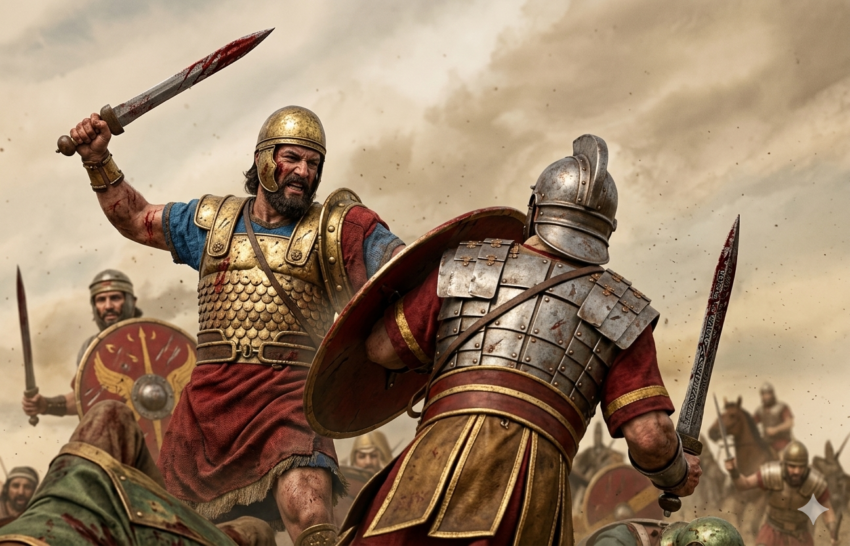
The Convenient Civilization: Why the Jaredites Fit Joseph Smith’s World, Not 2200 BC’s
Introduction: A Battlefield with No Bodies
Imagine a battlefield so vast, so saturated with carnage, that nearly two million people are said to have been slain by the sword—and yet not one archaeologist has ever identified a single bone, weapon, or site that can be credibly tied to that war or to its combatants. Imagine a civilization said to span roughly sixteen centuries, from around the time of the Tower of Babel (about 2200 BC in LDS discourse) down to about 600 BC, encompassing millions of people, cities, metalworking in iron and other ores, extensive agriculture, domesticated elephants, and a written record on gold plates—and yet not one artifact, not one inscription, not one confirmed Jaredite site has ever been excavated or recognized by mainstream scholars. Imagine eight sealed wooden barges, “tight like unto a dish,” loaded with seeds, livestock, honeybees, and families, driven by storms across “the great waters” for 344 days, lit by glowing stones said to have been touched by the finger of God—yet no other culture on earth, no ancient chronicle, no independent text from any civilization, ever mentions their departure or their arrival.
This is the story of the Jaredites.

Described essentially only in the Book of Ether—a relatively small section of the larger Book of Mormon—the Jaredites are presented as a pre‑Lehite civilization: a mighty nation said to have arisen near the Tower of Babel, migrated under divine direction to a “promised land” in the Americas, built up kingdoms for many generations, and finally annihilated itself in a civil war so complete that, of that nation, only a single king, Coriantumr, is said to have survived, along with the prophet‑historian Ether, who recorded their history on twenty‑four gold plates before disappearing from the record.
The narrative is remarkable. It is also under rigorous examination, unsupported by any independent external evidence from archaeology, genetics, linguistics, ancient Near Eastern studies, or comparative historiography. Outside of LDS and pro‑LDS apologetic literature, no recognized archaeologist, historian, or anthropologist has identified a Jaredite site, artifact, or text, nor has any specialist endorsed the Jaredites as a real historical population. This essay examines the Jaredite record with the same investigative discipline one would apply to any historical claim—not out of hostility toward those who revere the text, but with the intellectual seriousness that all truth‑claims should face.
For faithful Latter‑day Saints, the Jaredites are not myth but history, preserved by revelation. For the Christian apologist and the biblical historian, however, the question must be asked directly: does the totality of the evidence—or the conspicuous absence of it—support the conclusion that these people actually existed in space and time? Based on what we currently know, the answer this essay will argue for is, with near 100% certainty, no.
A note on approach: This essay draws on LDS apologetic resources, critical scholarship, archaeological consensus, and the Book of Ether’s own internal text. Where LDS and apologist sources make arguments for Jaredite historicity, those arguments are represented fairly and then subjected to critical analysis. The goal is not to mock or dismiss sincere faith, but to demonstrate that the historical and evidentiary case for the Jaredites’ existence does not meet the minimum standards of historical plausibility.
The Narrative — What the Book of Ether Tells Us
The Story of the Jaredites
The Book of Ether, contained in the Book of Mormon, presents itself as an abridgment by the prophet Moroni of twenty‑four gold plates written by Ether, the last Jaredite prophet. Ether, in turn, is said to have compiled the records of the Jaredite royal lineage from its beginnings at the Tower of Babel down to the civilization’s final destruction. The story opens with Jared, his brother, and their families (along with “some others and their families”) leaving “the great tower” at the time when the Lord confounds human language and scatters the peoples over the face of the earth (Ether 1:33, paraphrased).
Jared and his brother—whose personal name, Mahonri Moriancumer, is not given in the Book of Mormon itself but is attributed to Joseph Smith in a later LDS account of a baby blessing—petition God to preserve the language of their families and friends from the confusion at Babel. God grants the request and promises to lead them to a “choice land above all other lands.” The group gathers an extraordinary collection of provisions: flocks and herds, seeds of every kind, a vessel to carry “the fish of the waters,” and notably, honeybees (called “deseret,” meaning honeybee in the text). They travel through the wilderness for many years, crossing “many waters” in barges, before finally reaching a great sea that “divideth the lands.”
There they camp for four years—during which, the narrative says, the Lord appears and chastens the brother of Jared for having forgotten to call upon Him—and then receive instructions to build eight barges for the ocean crossing. The specifications are unusual: the barges are to be “tight like unto a dish,” without windows, peaked at both ends, with a hole in the top and another in the bottom that can be unplugged for air, and sealed so completely that they remain watertight even when submerged. The problem of light is solved when God touches sixteen small stones with His finger, causing them to glow and illuminate the darkness inside the sealed vessels.
The party then crosses the ocean—for 344 days according to the text—driven by “furious winds” and great waves until they land in a “promised land” in the Americas, the same covenant land later occupied by Nephites and Lamanites. There, they are said to establish a civilization that endures for well over a millennium (often estimated in LDS timelines at roughly 1,500 years) before destroying itself in a catastrophic civil war.
The Civilization They Built
According to the Book of Ether, the Jaredites become a large, populous, technologically sophisticated nation. The text credits them with:
• Advanced metallurgy: “working in all manner of ore, both of gold, and of silver, and of iron, and of copper, and of brass, and of steel” (Ether 10:23), and making “swords out of steel” (Ether 7:9)—an anachronism absent from pre-Columbian Americas, where iron smelting and steel production did not exist until Europeans arrived, with Native metallurgy limited to cold‑hammered copper and rare meteoric iron artifacts.
• Large‑scale agriculture and livestock: “all manner of grain” and lands “covered with flocks and herds,” including “elephants, and cureloms, and cumoms; all of which were useful unto man” (Ether 9:18–19).
• Urban construction: “many mighty cities” and “many great cities” built across the land built across the land (e.g., Ether 10:4–12)—civilizations that, one might think, leave more than a whisper in the archaeological record, like scattered slag heaps or stubborn foundations that refuse to stay buried. Ether tantalizes with “mighty cities” but frustratingly omits blueprints—did they use Mesopotamian mudbrick, American wood, or divine Legos? We wouldn’t know from the text…or the dirt.
• A preserved language: their language “not confounded” at the Tower of Babel, so that Jared, his brother, and their friends could still understand one another and carry their written record with them to the promised land (Ether 1:34–37; 3:24). The preserved language is the original, pre‑Babel language spoken by all humanity at that time, which LDS tradition widely identifies as the “Adamic language” (the pure language of Adam). Like other Book of Mormon records (e.g., Nephite large plates of Nephi), preserved records of the Jaredites are consistently described as gold plates—thin sheets of precious metal bound together, engraved with their unconfounded pre-Babel language (preserved Adamic tongue).
• A population numbered, at its peak, in the millions: Moroni reports that “there had been slain by the sword already nearly two millions of [Coriantumr’s] people, … two millions of mighty men, and also their wives and their children,” implying a multi‑million population before the final collapse (Ether 15:2).
• Silk and fine‑twined linen: “they did have silks, and fine‑twined linen” (Ether 10:24).
The civilization’s collapse is attributed to a recurring cycle of righteousness and wickedness, the rise of “secret combinations” (secret oaths for power, robbery, and murder), and ultimately a catastrophic civil war between the forces of King Coriantumr and his rival Shiz (Ether 8–15). Ether 15 depicts the final phase in harrowing detail: after nearly two million of Coriantumr’s people have already been slain, both sides gather with their “wives and their children—both men, women and children being armed with weapons of war” and fight repeated day-long battles, sleeping on their swords at night, until all combatants have fallen by the sword except Coriantumr and Shiz, while the prophet Ether observes from hiding in a cave (Ether 15:2, 15–24, 29–33). Coriantumr, himself grievously wounded, finally beheads the prostrate Shiz—who briefly struggles headless before dying—and then collapses, but survives the battle; later, he is said to be discovered by the people of Zarahemla (descendants of Mulek), among whom he dwells “for the space of nine moons” (Ether 15:30–32; Omni 1:21).
The Textual Transmission Chain
Before evaluating the historicity of this account, it is essential to understand how the text reaches the reader. The chain of transmission is as follows:
1. Original Jaredite records, supposedly maintained across roughly 1,500 years
2. Written by Ether on 24 gold plates near the civilization’s end
3. Discovered by a Nephite expedition and brought to King Mosiah
4. Translated by Mosiah using the “two stones” (interpreters)
5. Abridged by Moroni into the current Book of Ether
6. Translated by Joseph Smith from gold plates using a seer stone in a hat, in upstate New York, in 1829
This is, by any standard of historiography, a complex and unverifiable transmission chain. Each step introduces potential for alteration, editorial interpretation, or simply confabulation. The text itself explicitly acknowledges it is an “abridgment of an abridgment” (cf. Andersen and Smith, Book of Mormon Central, 2011), which by definition means original materials have been condensed and filtered through multiple editorial hands over millennia.
It is important to note that the Book of Ether is an abridgement of an abridgement and thus may explain what can be considered as limited geographic descriptions within the account as compared to the rest of the Book of Mormon.
— Joe V. Andersen and Natasha Smith, “The Geography of the Jaredites,” Book of Mormon Central / BMAF, 2011
REBUTTAL: The “abridgment of an abridgment” defense is a double-edged sword. While apologists use it to explain sparse geographic details, it also means that no reader — including Joseph Smith — had access to source documents. Every claim about Jaredite geography, population, and technology rests solely on this severely compressed summary. This is not a weakness that can be rehabilitated by pointing to textual brevity; it is a foundational problem of verifiability.
The Archaeological Silence
What a Real Civilization Leaves Behind
One of the most powerful arguments against the historicity of the Jaredites is simply the absence of any archaeological evidence for their existence. This requires some context about what ancient civilizations actually leave behind.
A civilization spanning 1,500 years — from approximately 2200 BC to 700 BC — with a population that the text implies numbered in the millions, engaged in metallurgy, urban construction, agriculture, and written language, would leave an unmistakable archaeological footprint. The civilizations of comparable age and scope in the Old World — Mesopotamia, Egypt, the Indus Valley, and Shang China — have left thousands of excavated sites, hundreds of thousands of artifacts, confirmed inscriptions, identified languages, and extensive material remains.
The Olmec civilization, which occupied Mesoamerica roughly between 1500 BC and 400 BC, is the most commonly proposed archaeological counterpart to the Jaredites. It is the earliest major Mesoamerican culture, and its temporal overlap with the proposed Jaredite period has made it an attractive candidate for LDS apologists. As the Book of Mormon Resources blog notes:
Sorenson correlates the Jaredites with the Olmec who had influence from Central Mexico to the Caribbean and from the Gulf of Mexico to the Pacific.
— Book of Mormon Resources, “Tracking the Jaredites,” January 18, 2017
The Olmec connection is frequently cited because the Olmec were indeed a sophisticated, populous Mesoamerican people who built cities (such as San Lorenzo and La Venta), created monumental stone sculptures, and appear to have had an early writing system. On the surface, this seems like a reasonable correlation. But correlation is not identification, and the problems with the Olmec-Jaredite hypothesis are severe.
Why the Olmec Are Not the Jaredites

First, the Olmec have a well-documented origin in Mesoamerica itself. Archaeological and genetic evidence indicate that the peoples of Mesoamerica descended from the same Asian migrations that populated the rest of the pre-Columbian Americas — migrants who crossed the Bering land bridge over thousands of years beginning around 15,000–20,000 years ago. There is no archaeological signature of a Middle Eastern or Near Eastern founding population entering Mesoamerica circa 2200 BC.
Second, the specific material culture the Book of Ether attributes to the Jaredites does not match the Olmec archaeological record. The text credits the Jaredites with steel swords (Ether 7:9), silk (Ether 10:24), and iron working (Ether 10:23). None of these are attested in pre-Columbian Mesoamerica. Specifically:
• Steel: Pre-Columbian Mesoamerica had no steel industry. The Olmec did not produce steel.
• Iron working: Iron smelting is not attested archaeologically in pre-Columbian America. The Olmec worked with stone and jade, not smelted iron.
• Silk: Silk production (Bombyx mori silkworm) is a Chinese technology. It was not present in pre-Columbian Mesoamerica.
• Elephants: The American mastodon and mammoth were extinct long before 2200 BC in Mesoamerica (most died out 10,000–12,000 years ago). The Book of Ether mentions elephants as part of the Jaredite economy (Ether 9:19).
Third, the Book of Ether describes a civilization that ends in a catastrophic multi-million-casualty civil war at the site known as “Hill Ramah,” identified in LDS tradition as the same Hill Cumorah in upstate New York. The Andersen and Smith paper from Book of Mormon Central acknowledges:
The Jaredite hill Ramah and the Nephite hill Cumorah were the same hill (Ether 15:11).
— Joe V. Andersen and Natasha Smith, “The Geography of the Jaredites,” 2011
Extensive archaeological surveys of the Hill Cumorah area in upstate New York have produced no evidence of massive ancient battles, no pre-Columbian metal weapons in the quantities the text implies, and no signs of the kind of industrial civilization the Jaredites are said to have built.
REBUTTAL: LDS apologists respond by proposing “limited geography” models — placing Jaredite events in a restricted part of Mesoamerica rather than the whole hemisphere, and arguing that Hill Ramah/Cumorah may be a different location than the New York hill. While this flexibility is intellectually honest, it also means that no specific geographic claim in the text can be falsified. A theory that can be relocated at will, to wherever evidence is least contradictory, is not historical — it is a matching exercise. The proliferation of competing geographic models (Pacific crossing, Atlantic crossing, Mesoamerica, North American heartland, Oaxaca, Veracruz) itself demonstrates that the text’s geographic data is insufficient to anchor the story in any real place.
Archeological Update
No formal, academically recognized archaeological excavations have been conducted directly on or around the Hill Cumorah itself by LDS organizations, in part because the Church treats it as a sacred historic site rather than a dig site. Mainstream archaeology of upstate New York has found no evidence of massive pre‑Columbian battles, metal weapons, or industrial civilizations there—just Hopewell and Adena mound‑builder artifacts from 2000–400 BCE, with no swords, armor, or battle mass graves.
LDS “Heartland” model attempts (non‑academic):
Wayne May and Rod Meldrum’s “Heartland Research Group“ (ongoing since ~2010s): Private, faith‑driven digs and ground‑penetrating radar (GPR) surveys in western New York and Midwest sites (e.g., Illinois mounds, Michigan). They claim artifacts like arrowheads, tablets, and “human bone dust” on Sampson Farm near Cumorah (1930s farmer story, Cornell analysis), but these are anecdotal, unpeer‑reviewed, and focus on general “ancient American” items rather than explicitly Book of Mormon ones. No metal weapons or Cumorah battle evidence reported.
Glen Ellis/Sampson Farm anecdotes (1930s–1940s, promoted 2018+): Farmers allegedly plowed up “white dust” later identified as ancient human bone by Cornell University; tied to Talmage’s 1920s soil analysis claiming calcium/phosphate from decayed bodies. No bones, weapons, or publications; dismissed by mainstream as unverified folklore.
Church position and site management:
The Church owns Hill Cumorah (since 1928) and rededicated it in September 2025 after refurbishing the Visitors’ Center and reforesting (removing pageant infrastructure). No digs mentioned; emphasis is on Joseph Smith’s history, not Book of Mormon battles.
Official stance (via FAIR): No professional excavations have ever been done at Cumorah, and the Church discourages them to preserve the site. Most LDS scholars reject NY Cumorah as the battle site, favoring Mesoamerica.
Heartland proponents continue private surveys, but nothing has yielded verifiable Book of Mormon artifacts like steel swords or mass battle remains. Claims remain speculative and confined to fringe LDS circles.
Critics argue that the Church avoids excavations because the hill is archaeologically “clean”—no metal weapons, mass graves, or battle evidence from the Book of Mormon’s claimed millions of dead—which would confirm the narrative’s fictional status if nothing turns up.
Historical digs (e.g., 1950s–60s construction, farmer plowing) yielded only a few modern arrowheads, no pre‑Columbian swords or bones, and the Church has never sponsored professional surveys despite owning the site since 1928.
In short, the “sacred site” rationale is plausible but convenient; avoiding a high‑stakes test that could embarrass the historicity claim makes strategic sense for an institution balancing faith promotion and damage control.
The Tower of Babel Problem
The Jaredite narrative is explicitly anchored to the Tower of Babel. This creates a second layer of historical difficulty, because the Tower of Babel, as described in Genesis 11, is itself a text whose literal historicity is contested among biblical scholars and archaeologists.
The LDS apologist Jerry D. Grover, in his detailed scholarly treatment of the Jaredite travel route published by Book of Mormon Central, attempts to locate the Valley of Nimrod, the departure point of the Jaredites, near a volcano called Nemrut Dagı in southeastern Turkey:
There is only one volcano that shows activity at that time in Mesopotamia, and it is located at the northern extent of ancient Assyria. The name of the volcano is Nemret Dagi, and it is located on the southern end of Lake Van… The name of the volcano, ironically, means Mount Nimrod.
— Jerry D. Grover, Jr., “Travel Path of the Jaredites,” The Swords of Shule, Challex Scientific Publishing, 2018
This is genuinely creative scholarship, and Grover’s work represents a serious attempt to ground the narrative in real geography. However, the exercise reveals the fundamental problem: Grover must postulate a specific volcanic pillar of cloud, a specific departure point, a specific route through Central Asia or across the Mediterranean, and a specific landing point in Mesoamerica — all from a text that provides none of these details explicitly. Every geographic identification requires a speculative inference. The result is a plausible-sounding reconstruction, not a confirmed route.
Moreover, the Book of Mormon Resources blog documents the profound disagreement among LDS scholars about the most basic geographic questions — did the Jaredites cross the Pacific or Atlantic? Did they land in Veracruz or on the west coast of Mexico? Did they travel through Central Asia or straight to the Mediterranean? Major LDS Mesoamerican scholar John L. Sorenson changed his own conclusion between 1985 and 2013:
John L. Sorenson in 1985 suggested they traveled east to the Pacific and landed on the west coast of Mexico. In 2013 Sorenson changed his mind and postulated an Atlantic crossing disembarking in Veracruz.
— Book of Mormon Resources, “Tracking the Jaredites,” January 18, 2017
The fact that the leading LDS scholar of Book of Mormon geography reversed his position on something as fundamental as which ocean the Jaredites crossed is not a minor footnote. It is a diagnostic indicator of the evidentiary weakness underlying all geographic reconstructions.
The Vessels — Engineering, Navigation, and the 344-Day Voyage
What the Text Describes
The Jaredite ocean crossing presents one of the most detailed — and most physically problematic — elements of the narrative. The Book of Ether describes eight barges built to specific divine specifications: sealed at both top and bottom, peaked at both ends, “tight like unto a dish,” with airhole plugs, and illuminated by glowing stones touched by God’s finger. They carried humans, animals, seeds, and food for a voyage described as 344 days.
The Times and Seasons blog, in a detailed 2017 examination by Clark Goble, attempts a sympathetic reading of the vessel description:
The key phrase in verse 17 is ‘the length thereof was the length of a tree.’ We don’t know the size of the trees they used, but it suggests… a hollowed out log. That would explain why it was tight – because there were no seams.
— Clark Goble, “Some Thoughts on Jaredite Barges,” Times and Seasons, February 1, 2017
Goble’s analysis is refreshingly candid. He admits that “traversing the Pacific would be extremely dangerous. Doubly so for a group with no experience.” He also notes that the assumption of a submarine-like vessel is unlikely, and that the church’s own artistic depictions are probably misleading.
The 344-Day Voyage: Apologist Calculations and Their Problems
The Ask Gramps website, an LDS apologetics Q&A resource, addresses the 344-day voyage duration with a calculation based on Pacific Ocean currents:
Famed LDS Scholar, religious historian, and apologist John W. Welch explains… it takes just about that time for a floating mass to come from Asia to Mexico. This can be proven by taking the average velocity of currents (somewhere in the neighborhood of 12 to 18 nautical miles/day) along the path of the current.
— Ask Gramps, “Why Did It Take the Jaredites 344 Days to Reach the New World?” AskGramps.org
The Ask Gramps response actually calculates that at average current speeds, the trip would take 466 days, not 344. It then argues that slight wind assistance could reduce this to 344 days, which it describes as “entirely achievable.” This is an interesting attempt at scientific plausibility, but it compounds rather than resolves the problem.
REBUTTAL: The apologist calculation requires: (1) that wooden hollowed‑log submarines survived 344 continuous days at sea, including, per Ether 6:6–8, being “tossed upon the waves” by repeated storms, buried under the sea, and driven by “furious winds”; (2) that livestock, honeybees, fish in vessels, and humans survived 344 days in sealed, lightless chambers with only intermittent air from unplugged holes; (3) that provisions fit in ~11 m³ total cargo space across 8 barges (~1.4 m³ each); (4) that eight identical vessels all arrived at the same destination. None of these is physically credible for wooden hollow logs of ancient manufacture.
The apologist calculation requires: (1) that wooden hollowed-log submarines survived 344 continuous days at sea…; (4) that eight identical, unsteerable vessels—dispersed by storms and currents over ~2,000+ miles—all arrived at the same destination (odds ~1 in 5–200 million by conservative drift models). None of these is physically credible … Nail in coffin: Even “furious winds” can’t synchronize 8 passive logs precisely. Apologists ignore physics for faith.
Added: Provisions math – ~40 humans + 10 cattle + 20 sheep/goats need 371 m³ food/water for 344 days (conservative: 4L water/person/day, 50L/cow, 2kg food equivalents). Available: ~11 m³. Shortfall: 361 m³ (~33x overcapacity). No room for “flocks, herds, seeds, fish, deseret” (Ether 2:1–3).
The calculation succeeds in demonstrating rough temporal plausibility for the voyage duration while ignoring the physical impossibility of the vessels and their cargo surviving such a journey. By comparison, the earliest confirmed Pacific Ocean crossing by humans—by Polynesian voyagers in sophisticated outrigger canoes designed specifically for ocean travel—took place thousands of years after the proposed Jaredite voyage (~1000–1200 AD), with long legs averaging 2–6 weeks using vessels far superior to sealed hollow logs.
Even ‘deseret’ honeybees die without cleansing flights, stable cluster temps (18–35°C), and foraging—facts unknown to Joseph Smith but fatal to the story of a 344‑day barge voyage.
The Light Problem
The Book of Ether’s solution to the darkness problem inside sealed, windowless barges — sixteen transparent stones made to glow by God’s touch — is a miraculous claim by definition. The apologetic literature does not attempt to naturalize this element, as there is no natural analog. What is notable is that two of these stones reportedly became part of Joseph Smith’s “interpreters” or Urim and Thummim, used to translate the Book of Mormon. This creates a literary circularity: the translated text describes miracle stones that later became the instrument of its own translation.
The Genetic Wall — What DNA Tells Us About the Americas
The Population Genetics Consensus
Perhaps the most powerful modern argument against the historicity of the Jaredites—and of Book of Mormon peoples generally—is the overwhelming consensus of population genetics. The human genetic record of the Americas is now one of the most extensively studied in science, and it tells a clear story.
The indigenous peoples of the Americas descended from ancient migrations from northeastern Asia across the Bering land bridge (Beringia), beginning approximately 20,000 years ago and continuing in multiple waves. This has been confirmed by mitochondrial DNA (mtDNA) analysis, Y‑chromosome studies, autosomal genome‑wide studies, and ancient DNA recovered from archaeological sites across the continent. The haplogroups characteristic of Native American populations—primarily A2, B2, C1, D1, and X2a on the mtDNA side—all trace to Asian origins.
A Jaredite founding population from ancient Mesopotamia—the Fertile Crescent, roughly corresponding to modern Iraq and Syria—would carry genetic haplogroups associated with the ancient Near East: primarily H, J, K, T, U (mtDNA) and E, G, I, J, R1b (Y‑chromosome). None of these is native to the pre‑Columbian Americas at any statistically significant frequency.
The Church of Jesus Christ of Latter‑day Saints itself acknowledged this problem in a Gospel Topics Essay on “Book of Mormon and DNA Studies,” which states that the ancestors of the American Indians “came from Asia,” not the Near East. This essay quietly shifted the official position from the “principal ancestor” language of the 1981 Book of Mormon introduction (added by Bruce R. McConkie), which was changed in 2007 to “among the ancestors.”
What This Means for the Jaredites
The Jaredite founding population is presented as beginning with a small group: Jared had 12 children (4 named sons + 8 others); his brother had 22 children; plus “about twenty and two souls” (friends and families) who also had children before landing (Ether 6:14–20). That’s roughly 34 named individuals + unspecified friends, totaling perhaps 100 or fewer upon arrival around 2200 BC. Even accounting for rapid population growth over ~1,600 years (to ~600 BC), such a founding population arriving in a sparsely populated continent would leave a detectable Near Eastern genetic signature in modern Native American populations—unless, as LDS apologists argue, they were “swamped” by pre‑existing populations.
Using conservative pre‑modern growth rates (0.85% annual), that initial ~100 could grow to ~33 million by the final wars; at 1.5%, over 500 million. Either way, total extinction (per the text) means zero descendants; survival means a massive genetic footprint. Yet no Near Eastern haplogroups appear.
While Beringian migrations continued post‑2200 BC, the Americas were far from empty: Clovis culture (~13,000 BP) and pre‑Clovis sites indicate established populations by Jaredite times, but not dense enough to fully swamp a multi‑million influx over 1,600 years without traces.
The swamping hypothesis has two problems. First, the Book of Ether does not describe the Jaredites intermarrying with or being absorbed by any pre‑existing population; it portrays them as a self‑contained civilization with a distinct royal lineage from Jared to Coriantumr (Ether 1–15). Second, the civilization is described as ending in total destruction, not absorption: Ether 15 claims “they had all fallen by the sword” except Coriantumr and Shiz, with Ether hiding separately (Ether 15:29–34). If all Jaredites were killed, there would be no descendants to contribute to any gene pool. LDS apologists like FAIR admit: “the Jaredites were then utterly and completely destroyed…leaving no genetic contribution.”
The Jaredite DNA problem is therefore absolute: the text claims a Near Eastern founding population that either left no descendants (total destruction) or should have left genetic traces (size, duration, isolation). Neither possibility is visible in the genetic record, which shows unbroken Asian ancestry.
The Destruction That Could Not Have Happened
What the Text Claims
Ether 15 is one of the most dramatic passages in the Book of Mormon. It describes the final phase of the Jaredite civil war between Coriantumr and Shiz with extraordinary specificity: armies of millions, total mobilization of men, women, and children, continuous combat over multiple days, and a final stand in which every single combatant on both sides is killed. The prophet Ether, watching from a cave, records:
And it came to pass that when they had all fallen by the sword, save it were Coriantumr and Shiz, behold Shiz had fainted with the loss of blood. And it came to pass that when Coriantumr had leaned upon his sword, that he rested a little, he smote off the head of Shiz. (Ether 15:29–30)
— Book of Ether, Book of Mormon, Chapter 15
The text explicitly states that Coriantumr and Shiz were “the last two warriors” and that every other person on both sides had been killed, including women and children! Ether, the sole observer, then “wrote the remainder of these things” and hid himself. This is the last we hear of anyone from the Jaredite civilization except Coriantumr, whom the Mulekites later find.
The Military History Problem
The scenario described in Ether 15 — a civil war in which literally every combatant on both sides is killed — is not merely unlikely. It is, by the standards of military history, operationally and statistically impossible at the scale described.
Does it seem incredible that the Jaredites would have employed women and children on both sides in their final civil war battle? Military historians have studied thousands of wars, battles, and genocides across human history. The empirical record is unambiguous: no war in recorded history has resulted in the complete biological extermination of a combatant population of millions. Even the most catastrophic defeats—Carthage razed by Rome (~150 BC, ~50,000 survivors fled), Mongol sack of Baghdad (1258, tens of thousands survived), Rwanda genocide (1994, ~300–400k Tutsi survivors from ~1M targeted)—left substantial remnants. Studies of civil wars consistently show they end in military defeat and the collapse of one side, not in the biological extinction of every participant.
The Jaredite destruction narrative demands not merely the death of millions of combatants, but the death of every non‑combatant as well—“men, women, and children” per Ether 15:15. No pandemic, no famine, no genocide in human history—not even the Holocaust (~6M Jews, millions survived)—has achieved this outcome for a population numbered in the millions across an entire continent.
REBUTTAL: LDS apologists sometimes suggest that the “two million” figure refers only to Coriantumr’s casualties in one phase of the war, not the total population, or that the geographic scope was limited. But this reading requires importing into the text assumptions that are not present. The text says Ether saw that “every soul had been destroyed save it were Coriantumr” (Ether 15:29). The plain reading allows no survivor except Coriantumr himself. If the civilization was geographically limited, why does no trace of its catastrophic end appear archaeologically anywhere in the Americas?
The Coriantumr Problem
The narrative creates an additional logical difficulty. Coriantumr, the sole Jaredite survivor, is said to have lived among the Mulekites (the people of Zarahemla) for “the space of nine moons” before his death (Omni 1:21). If he was healthy enough to survive the final battle and live for nine months, why was there no attempt to record his testimony, recover Jaredite history from him directly, or document his language? The Mulekites reportedly “had not brought any records with them” (Omni 1:17), and their language had become corrupted. Coriantumr, a living witness, is mentioned only in passing and apparently contributes nothing to the historical record.
The text also describes Ether as hiding in a cave while writing the final plates, then going out “to survey the destruction of his people” (Ether 15:33). He then disappears from the narrative with a cryptic final note: “whether the Lord will that I be translated, or that I suffer the will of the Lord in the flesh, it mattereth not.” This leaves the disposition of the 24 plates unresolved: how did they end up in a location discoverable by a Nephite expedition centuries later if Ether was hiding in a cave in a land whose entire population was dead?
Internal Textual Anachronisms and Inconsistencies
Anachronistic Technologies
The Book of Ether credits the Jaredites with several technologies that are historically anachronistic for the period and region attributed to them.
Steel swords (Ether 7:9): The earliest known steel production dates to approximately 1800 BC in Anatolia (modern Turkey) and does not appear in Mesoamerica at any pre-Columbian period. The Jaredites are said to have had steel circa 2000 BC at the latest, and their steel-making is attributed to a single individual (Shule) working from a hill. This does not correspond to any known metallurgical development.
Elephants (Ether 9:19): The text mentions the Jaredites keeping “elephants” as useful animals. The American megafauna, including mammoth and mastodon species that could be called “elephants,” went extinct in the Americas approximately 10,000–12,000 years ago. No elephants existed in the Americas during the proposed Jaredite period of 2200–600 BC. LDS apologists have proposed that isolated populations survived later in restricted areas, but no archaeological evidence supports this.
Silk (Ether 10:24): Silk production from Bombyx mori silkworms is a Chinese technology dating to approximately 3000 BC and was not present in pre-Columbian America. LDS apologists have suggested “silk” refers to a different fiber, perhaps a plant-based material. This is a retroactive redefinition that departs from the plain meaning of the text.
Honeybees (Ether 2:3): The European honeybee (Apis mellifera) was introduced to the Americas only after European contact in the 16th century AD. No native American bee species produces honey in the way the text implies.
The 24 Gold Plates
The Jaredite history is said to have been recorded by Ether on 24 gold plates. The transmission of these plates presents multiple difficulties. Ether reportedly wrote them at the end of the civilization’s existence, while in hiding, while witnessing the final destruction. He then concealed them, and they were subsequently discovered by a Nephite expedition — centuries later — in or near “the hill Ramah.”
The logistics of this preservation are unclear. More significantly, King Mosiah is said to have translated the plates using divine instruments (the interpreters), producing an account that Moroni later abridged into the current Book of Ether. The account Moroni produces, by his own admission, covers only a fraction of the original record. This means the primary source for Jaredite history has never been independently examined by any modern scholar.
Joseph Smith’s 19th-Century Context
Critical scholars have long noted that the Jaredite narrative contains numerous elements that reflect the intellectual and cultural world of early 19th-century America rather than ancient Mesopotamia or pre-Columbian America.
The Tower of Babel setting was a matter of popular theological speculation in Joseph Smith’s era, as Americans debated the origins of Native Americans. Theories that connected indigenous Americans to Old World civilizations—including the “Mound Builder” hypothesis, which attributed the earthworks of the Ohio and Mississippi valleys to a vanished, superior civilization distinct from living Native Americans—were widely circulated in upstate New York in the 1820s. Ethan Smith’s “View of the Hebrews” (1823 and 1825), published in Poultney, Vermont, where Oliver Cowdery’s stepmother and half‑sisters had been baptized years earlier (1818), though no direct record confirms Oliver’s attendance during Smith’s pastorate (1821–26), explicitly proposed that Native Americans descended from the lost tribes of Israel and that they had once possessed a high civilization subsequently destroyed by wars.
The Jaredite narrative — a great civilization, utterly destroyed by civil war, leaving no trace except for buried records discovered by later arrivals — fits this cultural template with remarkable precision. This does not prove Joseph Smith borrowed from “View of the Hebrews,” but it demonstrates that the Jaredite story addresses the exact questions 1820s Americans were asking about ancient America, with answers that 1820s Americans would have found plausible.
LDS Apologist Arguments and Their Evaluation
The Olmec Correlation
As noted above, LDS apologists frequently correlate the Jaredites with the Olmec civilization. The Supporting Evidence website summarizes the geographic arguments for placing the Jaredite civilization in Mesoamerica, emphasizing that the Book of Mormon’s internal geography can be mapped onto real Mesoamerican terrain:
The Olmec correlation has intuitive appeal: the Olmec were the earliest major Mesoamerican civilization, their timeline partially overlaps with the proposed Jaredite period, and their geography fits some internal Book of Mormon descriptions. However, as established in Part II, the specific technological and biological markers attributed to the Jaredites (steel, silk, elephants, honeybees) are absent from the Olmec record. The Olmec were a sophisticated culture, but they were not Near Eastern migrants.
REBUTTAL: The Olmec correlation is a correlation without confirmation. It works by finding temporal and geographic overlap, then assuming identity. By the same logic, any ancient Mesoamerican culture from the proposed timeframe could be called “Jaredite.” The absence of distinctive markers — Near Eastern genetic signatures, Mesopotamian linguistic loan-words, steel metallurgy, silkworm cultivation — means the Olmec-Jaredite identification is not a conclusion supported by evidence but a hypothesis kept alive by the absence of disconfirming evidence specific enough to have been tested.
The Appearance Question
The Latter-day Saint Magazine posed the question of what the Jaredites might have looked like — a question that reveals the speculative nature of the entire enterprise:
Are There Ideas About What the Jaredites Might Look Like?
— Latter-day Saint Magazine (Meridian Magazine)
The fact that this is an open question — that LDS scholarship cannot agree on whether the Jaredites were Semitic, Hamitic, East Asian, or something else in appearance — reflects the evidentiary vacuum at the heart of Jaredite studies. The apologist literature by David Stewart (“Jaredites: The First Americans,” Plates of Mormon) argues that the Jaredites descended from Ham, citing Olmec statuary showing “Negroid” features. Other scholars place them in East Asian or Polynesian contexts. The Ask Gramps author places their Pacific crossing route near Hong Kong. The Book of Mormon Resources blogger prefers a landing on the west coast of Mexico. Grover places the departure from southeastern Turkey. These are not minor disagreements about details; they reflect fundamental uncertainty about who the Jaredites were, where they came from, and where they went.
The “Who Are the Jaredites?” Baseline
The Jaredite Stories website, a devotional LDS resource, provides a straightforward summary of the mainstream LDS understanding of the Jaredites:
The Jaredites are a group of people who left the middle east area at the time of the Tower of Babel… They were here in the American continent from approximately 2100 BC to 600 BC, about 1500 years. During that time, they may have spread out in both continents, right now, no one really knows.
— Jaredite Stories, “Who Are the Jaredites?” JarediteStories.com
The frank admission that “no one really knows” where the Jaredites lived, where they landed, and whether they spread to one or both continents is telling. A people who lived on at least one, possibly two continents, for 1,500 years, with a civilization the text claims was highly advanced and populous, should have left abundant and identifiable traces. The absence of those traces is not a minor puzzle to be solved by future archaeology. It is a sustained and total silence.
The Broader Context — Book of Mormon Historicity and Shifting LDS Positions
The Retreat from Principal Ancestors
The Jaredite question cannot be separated from the broader question of Book of Mormon historicity, which has been significantly reshaped by modern science. The Church of Jesus Christ of Latter-day Saints once taught, through its official publication materials, that the Lamanites were “the principal ancestors of the American Indians.” This language appeared in the Book of Mormon’s own introduction, added in 1981.
That language was changed in 2006–2007 to read “among the ancestors,” a significant qualification driven by the accumulation of genetic evidence showing that Native American populations are overwhelmingly of Asian origin. As the document in the uploaded source material notes:
The shift from “principal ancestors” to “among the ancestors” represents an institutional retreat from a historical claim that could not survive scientific scrutiny. The Jaredite narrative is subject to the same pressure. If the Lamanites are merely “among” the ancestors of Native Americans rather than their principal progenitors, the Jaredites face an even more severe problem: they are claimed to have been totally destroyed, leaving no biological descendants at all. They cannot be “among” anyone’s ancestors because the text explicitly says they were all killed.
The “Limited Geography” Escape Hatch
Modern LDS apologetics has increasingly relied on the “limited geography” model to insulate the Book of Mormon from archaeological and genetic falsification. Under this model, all Book of Mormon events, including the Jaredite civilization, took place in a small region of Mesoamerica, surrounded by large populations not described in the text. Any absence of evidence in one area can be explained by pointing to another.
The problem is that “limited geography” is a methodological retreat, not an advance. It works by continuously narrowing the scope of testable claims. A civilization originally said to have produced the principal ancestors of all Native Americans, then reduced to “among the ancestors,” then reduced to a small Mesoamerican region, then reduced to events that left no distinctive archaeological signature, is a historical claim that has progressively surrendered its empirical content.
A historical claim that cannot be falsified by any evidence is not a historical claim. It is a theological assertion dressed in geographic vocabulary.
A Protestant Theological Perspective
Scripture, History, and the Burden of Proof
From a Protestant Christian perspective, the Jaredite question has significance beyond academic historiography. The Book of Mormon is presented not merely as an inspiring narrative but as divine scripture, the keystone of LDS theology, and, as Joseph Smith described it, “the most correct of any book on earth.” If the Jaredites did not exist, this is not a minor inaccuracy in a peripheral text. It is a fundamental problem for the truth claims of the entire LDS restoration.
The biblical standard for evaluating prophetic claims is straightforward: Does the prophet speak the truth? (Deuteronomy 18:22 –“When a prophet speaketh in the name of the Lord, if the thing follow not, nor come to pass, that is the thing which the Lord hath not spoken, but the prophet hath spoken it presumptuously: thou shalt not be afraid of him.”). The historical claims embedded in the Book of Ether — a specific civilization, at a specific time, in a specific relationship to the Tower of Babel, crossing a specific ocean in specific vessels, establishing a specific civilization, and being destroyed in a specific way — are historical claims, not merely theological ones. They are falsifiable. And they have been tested by the disciplines of archaeology, genetics, linguistics, and comparative history. They have not survived that testing.
This is not an argument for dismissing the spiritual sincerity of LDS believers. Many devout and thoughtful Latter-day Saints hold their faith with depth and integrity, much as sincere Muslims revere the Quran, JWs treasure the Watchtower, or Scientologists commit to L. Ron Hubbard’s writings. Sincerity is the common currency of faith across traditions—it testifies to human longing for truth and transcendence. But sincerity does not establish historicity. The Christian apologist is advised to engage with the truth claims of the LDS restoration with both charity and clarity: charity toward the people, clarity about the evidence—or lack thereof—that separates conviction from verifiable reality.
The Tower of Babel, Genesis, and Corroboration
It is worth noting that the Jaredite narrative is not merely unsupported by external evidence; it is in tension with the biblical account it claims to extend. Genesis 11 describes the Tower of Babel as an event of divine language confusion and human scattering. The Jaredite narrative claims that a specific group was exempted from this confusion, preserving an Adamic or pre‑Babel language intact across 1,500 years and an ocean crossing (Ether 1:33–37).
No biblical text corroborates this exemption. No extra‑biblical ancient source—Mesopotamian ziggurat texts (e.g., Enmerkar and the Lord of Aratta), Josephus (Antiquities 1.4.3), or Jubilees—describes a group preserved from the Babel confusion. No linguistic study has identified a pre‑Babel language substrate in any Native American language family; comparative linguistics traces Amerindian languages to Siberian/Asian roots (e.g., Na‑Dene linked to Yeniseian via Ket), with no Semitic or Mesopotamian ties. The Jaredite language claim is not merely unverified; it is scientifically incoherent given what we know about the actual history of human language development.
Contemporary scholars like John Walton (The Lost World of Genesis One) and Tremper Longman III view Genesis 11 as etiological mytho‑history: a theological etiology explaining linguistic diversity and human hubris, not literal global history. It parallels Sumerian ziggurat myths but polemicizes against them, with no room for “exempted” groups. Evangelical critics like Michael Heiser (The Unseen Realm) note Babel as divine council judgment (Deut 32:8–9), apportioning nations to “sons of God”—a framework incompatible with Jaredites as a preserved covenant people predating Abraham.
The narrative serves identifiable literary and theological functions that would be fully explained by fictional authorship in the 19th century. The presence of these functions does not prove the story is non-historical, but it does demonstrate that historicity is not required to explain why the text exists or what it accomplishes.
Conclusion: The Case for Non-Existence
The question posed at the outset of this essay was not whether the Jaredites are a spiritually meaningful narrative within LDS theology, but whether the evidence supports the conclusion that they actually existed as a historical people. After examining the textual, archaeological, genetic, linguistic, and military-historical evidence, the answer must be: almost certainly not.
The cumulative case against Jaredite historicity rests on the following points:
1. Total absence of archaeological evidence: No excavated site, artifact, inscription, language, or material culture has been identified with the Jaredites. A civilization of the size and duration described should have left abundant physical remains.
2. Genetic impossibility: The genetic record of Native Americans shows Asian, not Near Eastern, ancestry. A founding population from Mesopotamia circa 2200 BC, living in the Americas for 1,500 years, should have left detectable genetic traces. None have been found.
3. Technological anachronisms: The text attributes steel, silk, iron, and honeybees to the Jaredites in a pre-Columbian context where none of these existed.
4. Biological impossibility: The elephant population required by Ether 9:19 did not exist in the Americas during the proposed Jaredite period.
5. Military-historical impossibility: The total extermination of both sides in the civil war is unprecedented in all of human military history at any scale.
6. Navigational implausibility: Eight sealed, hollow-log vessels carrying humans, livestock, and supplies for 344 days in open ocean could not have survived such a voyage under any credible interpretation of ancient shipbuilding.
7. Internal scholarly disagreement: LDS scholars cannot agree on which ocean the Jaredites crossed, where they landed, where their civilization was located, or what they looked like. This is not a sign of a robust historical tradition; it is the fingerprint of a narrative with insufficient historical anchoring.
8. 19th-century cultural fit: The Jaredite narrative addresses the exact questions of 1820s American theological and intellectual culture, with answers that fit that cultural moment better than they fit the ancient Near East or pre-Columbian America.
None of these points, individually, constitutes an absolute logical refutation. It is always possible to postulate unknown archaeological evidence, to imagine genetic swamping scenarios, to redefine “steel” and “silk” and “elephants,” to propose miraculous preservation of ancient vessels. But the cumulative weight of the evidence is not balanced. It points decisively in one direction.
The Jaredites are, in all probability, a literary creation of the early 19th century, embedded within the Book of Mormon as part of its broader narrative architecture. They serve theological purposes admirably. They do not appear to have walked the earth.
For the Christian apologist, this conclusion is not a cause for triumphalism but for charitable engagement. The LDS men and women who have believed in the Jaredites have done so because they trusted in the divine origin of the Book of Mormon. That trust, and the sincere faith it represents, deserves a certain level of respect even as the historical claims it rests upon deserve honest evaluation.
The bones of the Jaredites have never been found. Based on everything we know, they never will be.
A Final Observation
You know what’s especially interesting—purely as a coincidence, of course—is how closely the Jaredite extinction story in Ether tracks with the Nephite–Lamanite apocalypse at Cumorah.
Both civilizations, we are told, end in a final, all‑or‑nothing war of annihilation centered on the same hill. The Jaredites call it Ramah; the Nephites later call it Cumorah, and the text explicitly identifies the two as the same place. In each case, vast armies gather there for a last stand, fight through successive days of escalating slaughter, and are reduced to a handful and then to almost nobody at all. One hill, two peoples, two separate “last battles,” both of which somehow manage to exterminate an entire nation at that exact spot.
The narrative symmetry doesn’t stop with geography. Each doomed civilization has its own prophet‑historian standing on the sidelines, warning that destruction is coming and then living long enough to document the fulfillment of his own prophecy. For the Jaredites, it is Ether; for the Nephites, it is Mormon and then his son Moroni. Both sets of prophets deliver the same sermon: secret combinations, societal corruption, and rejection of God will bring total ruin on a “promised land.” Both are ignored. Both then become the theological narrators of their nations’ downfall.
And in each story, when the dust finally settles on the hill, there is essentially one man left to tell the tale. Among the Jaredites, Coriantumr survives the genocidal civil war and wanders as a broken remnant; among the Nephites, Moroni ends up alone with the records, hiding from the victorious Lamanites. Two civilizations, same land, same hill, same pattern: prophetic warnings, secret combinations, spiraling violence, and a lone survivor attached to a stack of metal plates.
LDS scholars devoted to defending the Book of Mormon have actually leaned into these parallels, publishing charts and articles with titles like “The Two Final Battles” and “Ether and Mormon: Parallel Prophets of Warning and Witness,” explicitly arguing that the Nephites are retracing the Jaredite pattern at the same sacred site. Authors like Dale LeBaron embellish the tone and scale of these events—calling the Jaredite war “perhaps the bloodiest ever fought on the American continents”—while treating sparse textual details as evidence of divine orchestration. For apologists, this is intentional typology—a divinely structured repetition designed to drive home the covenant-land message of pride, secret combinations, and inevitable destruction.
For others, it may look less like providential typology and more like literary recycling: the same story beats, the same setting, the same theological moral, simply run twice with different labels.
However one reads it, the destruction of the Jaredites and the destruction of the Nephites line up so neatly that calling it an “interesting coincidence” almost feels like an understatement—almost as if Joseph Smith had heard the story around a campfire from Indiana Jones himself: snakes, gold plates, and all.
Sources and Further Reading
Primary LDS and Apologetic Sources
Jaredite Stories. “Who Are the Jaredites?” JarediteStories.com.
Latter-day Saint Magazine (Meridian Magazine). “Are There Ideas About What the Jaredites Might Look Like?”
Ask Gramps. “Why Did It Take the Jaredites 344 Days to Reach the New World?”
Grover, Jerry D., Jr. “Travel Path of the Jaredites.” Chapter 9 in The Swords of Shule. Challex Scientific Publishing, 2018. Archived at Book of Mormon Central.
Andersen, Joe V., and Natasha Smith. “The Geography of the Jaredites.” Book of Mormon Archaeological Forum / Book of Mormon Central, 2011.
Goble, Clark. “Some Thoughts on Jaredite Barges.” Times and Seasons, February 1, 2017.
Book of Mormon Resources Blog. “Tracking the Jaredites.” January 18, 2017.
Stewart, David. “Jaredites: The First Americans.” Plates of Mormon Blog.
Supporting Evidence. “The Geographical Location of the Jaredites.”
Critical and Academic Sources
Murphy, Thomas F. “Lamanite Genesis, Genealogy, and Genetics.” American Apocrypha, 2002.
Southerton, Simon. Losing a Lost Tribe: Native Americans, DNA, and the Mormon Church. Salt Lake City: Signature Books, 2004.
Smith, Ethan. View of the Hebrews. Poultney, VT: Smith & Shute, 1823 (2nd ed. 1825).
Church of Jesus Christ of Latter-day Saints. “Book of Mormon and DNA Studies.” Gospel Topics Essays.
LDS Discussions. “DNA and the Book of Mormon.”
A Note on Research Methods and Accuracy
This work represents a collaboration between the author’s own theological research, primary source documentation, and the emerging capabilities of artificial intelligence research tools. AI assistance was employed throughout the investigative process — not as a ghostwriter or a substitute for scholarship, but as a rigorous research partner: surfacing sources, cross-referencing claims, identifying scholarly consensus, and flagging potential errors before they could reach the page.
Every factual claim in this work has been subjected to active verification. Where AI-generated content was used as a starting point, it was tested against primary sources, peer-reviewed scholarship, official LDS documentation, and established historical records. Where discrepancies were found — and they were found — corrections were made. The author has made every reasonable effort to ensure that quotations are accurately attributed, historical details are precisely rendered, and theological claims fairly represent the positions they describe or critique.
That said, no work of this scope is immune to error, and the author has no interest in perpetuating inaccuracies in the service of an argument. If you are a reader — whether sympathetic, skeptical, or hostile to the conclusions drawn here — and you identify a factual error, a misattributed source, a misrepresented doctrine, or a claim that cannot be substantiated, you are warmly and genuinely invited to say so. Reach out. The goal of this work is not to win a debate but to get the history right. Corrections offered in good faith will be received in the same spirit, and verified corrections will be incorporated into future editions without hesitation.
Truth, after all, has nothing to fear from scrutiny — and neither does this work.