
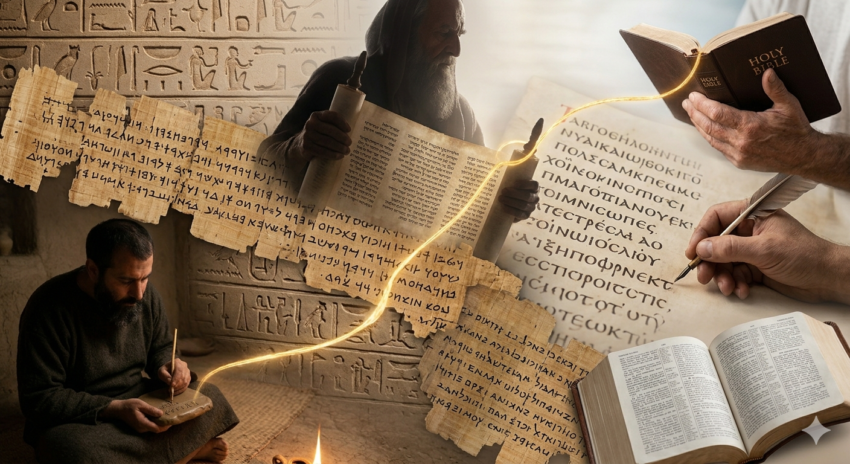
Image: An AI-generated image of an oil lamp flickering, illuminating a Sumerian scribe pressing the first cuneiform wedges into damp clay, as the written word embarked on a millennia-long journey. This obscure act birthed a legacy that flowed through Egyptian priests painting hieroglyphs on papyrus and Hebrew prophets tracing sacred texts onto rough vellum scrolls. As Greek scribes meticulously copied gospels into early bound codices, these scattered fragments of human history and divine revelation converged. Through centuries of careful preservation, discernment, and compilation by countless hands, this vast web of ancient traditions culminated in the unified Biblical canon we hold today.
Chiseled by God’s Providence: How Ancient Alphabets Converged to Preserve His Word
Introduction: The Miracle Hidden in Plain Sight
Before printing presses and touchscreens, before scrolls and codices, there was clay. Wet, pliable, unremarkable clay. And in the hands of a Sumerian scribe crouched in a lamplit room somewhere near the banks of the Euphrates around 3200 BC, that clay became something the world had never seen before: writing. A wedge-shaped reed pressed again and again into a soft tablet, leaving behind a pattern of marks that could outlast the memory of any living person — marks that, pressed in the right sequence, meant grain or sheep or debt or prayer.

That moment, obscure and unheroic as it must have seemed, set in motion one of the most consequential chains of events in human history. Five millennia later, you are holding the product of that chain in your hand every Sunday morning. The Bible — the sacred text of the Christian faith, the most printed and most translated book in human history — did not fall out of the sky already lettered and bound. It emerged from a vast and intricate web of writing traditions that stretched across continents and millennia, passing through the hands of Sumerian accountants, Egyptian priests, Phoenician traders, Hebrew prophets, and Greek apostles. To understand how the Bible came to be is to enter one of the great stories of human and divine history: the story of how the written word was born, refined, sanctified, and ultimately entrusted with the revelation of God Himself.
This essay traces that story from its most ancient origins to its culmination in the Biblical record. We will follow the evolution of writing from the clay tablets of Sumer through the monumental inscriptions of Egypt, from the proto-Sinaitic scratches of Canaanite miners to the squared Hebrew script of the rabbis, and from the fluid columns of Greek papyri to the New Testament documents that announced the Good News to the Greco-Roman world. Along the way, we will meet the people who made this history: the nameless scribes who memorized thousands of signs, the priestly archivists who guarded sacred texts, the prophets who dictated the words of the Lord, and the apostolic authors who bore witness to the risen Christ.
From a traditional Christian perspective, this history is not merely academic. Providence stands behind it. The God who spoke the cosmos into existence is also the God who orchestrated the development of human writing with the evident purpose of preserving, transmitting, and proclaiming His Word to every generation. The same sovereign hand that guided Abraham out of cuneiform-literate Ur of the Chaldees guided Moses through a Nile Delta saturated with hieroglyphic tradition, guided Ezra through the Aramaic scribal corridors of Babylon, and guided Paul through a Greek-speaking world perfectly prepared to receive the gospel. Writing was not an accident. It was a gift — and the Bible is its greatest treasure.
The First Marks: Why Humans Began to Write
Before Writing: The World of Tokens and Memory
For tens of thousands of years, human beings managed their affairs without writing. Agreements were sealed with handshakes, histories were carried in the memories of elders, and accounts were kept through physical objects — knotted strings, notched bones, or small clay shapes. The world of preliterate human society was not primitive in any pejorative sense; its oral traditions could be extraordinarily sophisticated, preserving genealogies, laws, and cosmologies across generations with remarkable fidelity. But it had limits. A community of any significant size dealing in any significant volume of goods needed something more reliable than human memory.
The answer, as archaeologist Denise Schmandt-Besserat of the University of Texas has convincingly demonstrated, was tokens. Small clay objects of various shapes — spheres, cones, discs, cylinders — were used across the ancient Near East from at least the eighth millennium BC to represent discrete quantities of specific commodities. A cone might represent a small measure of grain; a cylinder, a jar of oil; a sphere, a specific animal. These tokens were the accounting system of prehistoric economies, the precursors to all the written record-keeping that would follow.
Writing — a system of graphic marks representing the units of a specific language — has been invented independently in the Near East, China and Mesoamerica. The cuneiform script, created in Mesopotamia, present-day Iraq, ca. 3200 BC, was first. It is also the only writing system which can be traced to its earliest prehistoric origin. This antecedent of the cuneiform script was a system of counting and recording goods with clay tokens.
— Denise Schmandt-Besserat, “The Evolution of Writing,” International Encyclopedia of Social and Behavioral Sciences, Elsevier, 2014
The transition from tokens to writing was not sudden. As trade networks expanded and Sumerian cities grew into genuine urban centers with populations in the tens of thousands, the old system of storing tokens in clay envelopes (bullae) became cumbersome. A critical insight emerged: you could press the token against the outside of the envelope to leave an impression of its shape, and then you did not need the token inside at all. The two-dimensional impression on the clay surface contained all the information needed. From impression to inscription was a short step, and cuneiform was born.
The Invention of Cuneiform: Writing for the Ages
The earliest cuneiform tablets, dating to approximately 3200 BC and discovered at Uruk in present-day Iraq, are fundamentally economic documents: lists of commodities, records of temple storehouses, receipts of transactions. They are not literature, not religion, not law — they are receipts. This fact is theologically interesting in itself. Writing began not as a vehicle for divine communication but as a pragmatic tool for human commerce. And yet the God of all wisdom would, in time, transform this human invention into the medium of His own self-disclosure.
The word “cuneiform” comes from the Latin cuneus, meaning “wedge,” referring to the characteristic wedge-shaped impressions made by pressing a triangular-tipped reed stylus into moist clay. The beauty of this technology was its durability. Clay tablets, when baked — either deliberately or by the fires that frequently destroyed ancient cities — could survive for thousands of years. Vast archives of cuneiform tablets have been recovered from sites like Nineveh, Nippur, Ebla, and Mari, giving scholars an extraordinarily detailed window into the administrative, diplomatic, literary, and religious lives of ancient Mesopotamian civilizations.
Cuneiform began as a logographic and ideographic system — each sign representing a word or concept — and then evolved over centuries into a mixed logographic-syllabic system capable of representing the full range of human speech. By the third millennium BC, the Sumerians were using cuneiform not only for accounts but for hymns, lamentations, royal inscriptions, legal codes, and mythological narratives. The great Epic of Gilgamesh, the world’s oldest surviving literary work, was committed to cuneiform tablets. The Code of Hammurabi — the most famous ancient law code — was engraved in cuneiform on a seven-foot diorite stele. Cuneiform became the lingua franca of ancient Near Eastern diplomacy: the Amarna letters, a cache of correspondence between Egyptian pharaohs and Canaanite city-kings, were written in cuneiform Akkadian even though both parties had their own native scripts.
For the student of the Bible, cuneiform is not merely interesting background material — it is immediate context. Abraham came from Ur of the Chaldees, one of the most sophisticated cuneiform cities of the ancient world. The civilization that produced Abraham was literate, legally sophisticated, and theologically complex. The creation and flood narratives preserved in Mesopotamian cuneiform literature — the Enuma Elish, the Atrahasis Epic, the flood tablet of Gilgamesh — share unmistakable structural parallels with Genesis, not because Moses borrowed from Mesopotamian mythology, but because both the Mesopotamian traditions and the Genesis account are responding to the same deep cultural memory of primordial events, with Genesis offering the theologically corrective, monotheistic interpretation of those events under divine inspiration.
The Language of the Gods: Egyptian Hieroglyphs and Their World
Hieroglyphs: Sacred Carvings and Scribal Arts
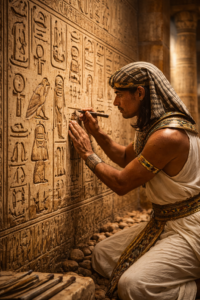
While Sumerian scribes were pressing wedges into clay by the Euphrates, another great writing tradition was flowering along the Nile. Egyptian hieroglyphic writing, which emerged around 3100 BC — roughly contemporary with the earliest cuneiform — is in many ways the most visually magnificent writing system ever devised. Its name comes from the Greek hieroglyphika grammata, meaning “sacred carved letters,” a phrase that reflects the classical world’s sense that this ornate pictorial script was something divine, something set apart from ordinary human commerce.
Unlike cuneiform, which fairly quickly shed its pictorial origins in favor of abstract wedge-clusters, Egyptian hieroglyphs retained their pictographic character throughout their entire history. A hieroglyph of an owl really looked like an owl; a hieroglyph of a seated man really looked like a man. This visual richness made hieroglyphic writing uniquely suited to its most prominent application: the decoration of temples and tomb walls with texts that were intended to be experienced as images as much as to be read as words. The great ritual texts carved into the walls of Egyptian temples — the Pyramid Texts, the Coffin Texts, the Book of the Dead — were not merely inscribed; they were illustrated with the sacred signs of the gods, making the text and the image inseparable dimensions of a single religious act.
The Egyptian scribal system was, in fact, tripartite. Hieroglyphs were the formal, monumental script used for religious and royal inscriptions. Hieratic was a cursive, simplified version of hieroglyphs developed for writing on papyrus with a brush or rush pen; it was the script of administrative documents, medical texts, literary works, and priestly records. Demotic, which emerged around 650 BC, was an even more abbreviated script used for everyday legal and commercial purposes. These three scripts coexisted for centuries, each occupying a distinct functional niche in the complex scribal culture of Egypt.
The Scribal Class and the Materials of Egyptian Writing
The Egyptian scribe — the sesh — occupied a privileged and highly respected place in ancient society. In Egypt, literacy was power: it opened the way to administration, temple service, recordkeeping, taxation, legal authority, and statecraft. A famous Middle Kingdom work, the Satire of the Trades, functions almost like a literary recruiting manifesto for the scribal profession, contrasting the comparatively comfortable and honorable life of the scribe with the exhausting, hazardous labor of farmers, metalworkers, potters, builders, and stonecutters. Scribes were trained in institutions often associated with the House of Life (Per Ankh), temple-based centers that served as archives, scriptoria, schools, and repositories of sacred and practical learning. There, students learned to copy texts, preserve traditions, and master the painstaking discipline required by Egyptian writing systems.
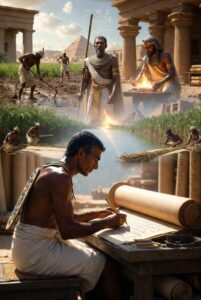
Egypt itself was uniquely important in the ancient world because it combined extraordinary administrative sophistication with deep religious and literary continuity. The Nile valley produced one of the earliest and most enduring civilizations, with writing attested as early as the late fourth millennium BC. Its script evolved through several forms — hieroglyphic, hieratic, and later demotic — each serving different social and practical functions. The papyrus plant, which grew abundantly in the Nile Delta and marshlands, provided the world with one of its first great writing materials. Prepared from strips of pith pressed together and dried into smooth sheets, papyrus became the equivalent of paper for the ancient Mediterranean world. It allowed texts to be copied, transported, archived, and assembled into long scrolls, making literary and bureaucratic culture far more portable than inscriptions carved in stone.
The significance of Egypt for biblical history cannot be overstated. The people of Israel spent centuries in Egypt, living within the orbit of one of the most literate and administratively advanced societies of the ancient Near East. Whether one dates the exodus early or later, the biblical memory of Israel’s sojourn in Egypt preserves the fact that Egypt was not a cultural backwater but the dominant civilization of its region. Moses, described in Acts 7:22 as being “trained in all the wisdom of the Egyptians,” would almost certainly have been exposed to scribal education and courtly administration. That means he was not encountering writing as a novelty when God commanded him to record events and statutes; he was being commissioned to use an established cultural skill for a covenantal and theological purpose. In that sense, divine revelation did not bypass scribal culture — it appropriated it.
The interface between Egyptian writing and the rise of Israelite literacy goes even deeper. The earliest alphabetic inscriptions yet discovered, usually associated with Proto-Sinaitic or early Proto-Canaanite writing, were found in the early twentieth century by Sir Flinders Petrie at Serabit el-Khadim, the turquoise mines in the Sinai Peninsula worked by Semitic laborers under Egyptian control. These inscriptions appear to represent a revolutionary simplification of writing: instead of mastering hundreds of signs, scribes selected a relatively small number of Egyptian hieroglyphic symbols and adapted them using the acrophonic principle, taking the first sound of the pictured object as the value of the sign. In this way, an ox-head could become aleph, a house could become beth, and a hook or nail could become waw. What emerged from this process was the alphabet — a writing system dramatically simpler, more adaptable, and more widely usable than either hieroglyphic or cuneiform systems.
That development mattered profoundly. The alphabet eventually made written communication more accessible beyond elite scribal classes and helped shape the literary culture of the Levant, including the Hebrew tradition. In a real historical sense, the Bible’s written world stands at the intersection of Egyptian scribal prestige, Semitic adaptation, and the gradual democratization of writing. The result was not merely a new technique of inscription, but a medium capable of carrying covenant, law, history, prophecy, and worship across generations. The alphabet was born in the shadow of Egypt, but it would become one of the most consequential inventions in human history.
In 1905, pioneering archaeologists Flinders and Hilda Petrie explored the Egyptian turquoise mines and Hathor temple at Serabit el-Khadim in the Sinai Peninsula. Among many Egyptian hieroglyphic and hieratic inscriptions there, they also recorded a few dozen unusual pictographic carvings — their signs were similar to certain hieroglyphs, but the inscriptions could not be read as Egyptian. A few years later, Egyptologist Alan Gardiner realized that these were the pictographic prototypes for the linear Phoenician alphabet!
— Virginia Herrmann and Adam Smith, “The Alphabet: A Remarkable Journey from Sinai to Beijing,” Expedition Magazine, Penn Museum, Vol. 64, No. 3
The Great Simplification: From Pictographs to Alphabet
Proto-Sinaitic to Phoenician: The Birth of the Alphabet
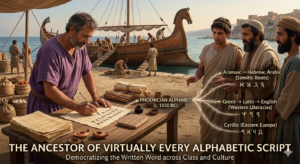
The Proto-Sinaitic inscriptions remained a largely local curiosity for centuries. The great flowering of alphabetic writing came with the Phoenicians, the seafaring merchant people of the Levantine coast whose trading networks spanned the ancient Mediterranean world. By approximately 1050 BC, Phoenician merchants had developed a streamlined, twenty-two-letter consonantal alphabet that could represent the sounds of the Northwest Semitic languages with remarkable efficiency. No vowels were written — Semitic languages, with their characteristic consonantal roots, could generally be read without them — and the resulting script was compact, learnable, and extraordinarily portable.
The Phoenician alphabet was the ancestor of virtually every alphabetic script used in the world today: Hebrew, Aramaic, Arabic, Greek, Latin, Cyrillic, and all their descendants. This is not a minor footnote in the history of writing. It is one of the most consequential inventions in human history, enabling widespread literacy across classes and cultures that would never have been able to master the thousands of signs required by cuneiform or hieroglyphics. The alphabet democratized the written word.
In comparison with the earliest writing systems, the Penn Museum scholars Herrmann and Smith observe that an alphabet has far fewer signs and takes less time to learn. Instead of hundreds of signs, students of alphabetic writing only need to learn twenty to thirty letters to spell out the basic sounds of their spoken language. The theological implications of this democratization were profound. A writing system accessible to common fishermen, farmers, and tentmakers was a writing system through which God could speak to all people, not merely to the scribal elite.
The Gezer Calendar and Early Israelite Writing
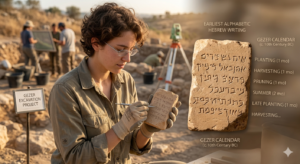
Among the earliest surviving specimens of alphabetic Hebrew writing is the Gezer Calendar, a small limestone tablet dated to the tenth century BC, discovered at the ancient Canaanite city of Gezer in 1908. The inscription lists the agricultural seasons of the year — planting, harvesting, pruning — in a form that suggests a scribal exercise or a practical farming almanac. Simple as it is, the Gezer Calendar establishes that alphabetic writing was in use in ancient Israel during the period of the early monarchy — the time of David and Solomon.
Other early Hebrew inscriptions include the Siloam Tunnel Inscription (eighth century BC), which commemorates the completion of King Hezekiah’s water tunnel in Jerusalem; the Mesha Stele (also ninth century BC), a Moabite royal inscription that actually mentions the “house of David”; and the Lachish Ostraca (early sixth century BC), military correspondence written during the Babylonian siege of Judah. These inscriptions confirm that alphabetic Hebrew writing was a living, functioning scribal tradition throughout the period of the monarchy and the prophets, providing the material substrate upon which the Biblical literature was composed and transmitted.
The PBS scholar William Schniedewind, whose landmark work How the Bible Became a Book traces the textualization of Israelite culture, has noted that in ancient Palestine, writing was initially a restricted and expensive technology controlled by government and priestly elites. Writing was seen, in the ancient Near Eastern context, as a gift from the gods — a technology of power and sacred authority.
In ancient Palestine, writing was a restricted and expensive technology. Writing was controlled by the government and manipulated by the priests. Writing was seen as a gift from the gods. It was not used to canonize religious practice, but rather to engender religious awe. Writing was magical. It was powerful. It was the guarded knowledge of political and religious elites.
— William Schniedewind, “Origins of the Written Bible,” NOVA/PBS
And yet the trajectory of Biblical history moves in exactly the opposite direction: toward the democratization of the sacred text. The very invention of the alphabet served this purpose. The Torah commanded literacy not as an elite privilege but as a spiritual necessity: “You shall teach them diligently to your children, and shall talk of them when you sit in your house, and when you walk by the way, and when you lie down, and when you rise” (Deuteronomy 6:7, ESV). A God who commands that His Word be on every parent’s lips requires a writing system accessible to every person.
The Language of Covenant: Hebrew Script and the Old Testament
Paleo-Hebrew and the Monarchy Period
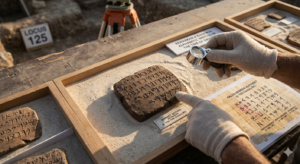
The script in which the earliest layers of the Hebrew Bible were written is known as the Paleo-Hebrew alphabet — essentially the Canaanite-Phoenician alphabetic script adapted to the Hebrew language. This script, with its angular, somewhat pictographic character, was used throughout the period of the monarchy and is attested in the inscriptions mentioned above as well as on coins, seals, and ostraca from across the pre-exilic period.
According to Wikipedia’s article on Ancient Hebrew Writings, the earliest known precursor to Hebrew, an inscription in the Paleo-Hebrew alphabet, is the Khirbet Qeiyafa ostracon (eleventh to tenth century BC), if it can be considered Hebrew at that early stage. This inscription, discovered at a site in the Judean foothills, provides remarkable evidence that alphabetic writing was in use in the heartland of ancient Israel during the period associated with the reigns of Saul and David.
The Hebrew language itself belongs to the Northwest Semitic family of languages — the same family as Phoenician, Aramaic, Moabite, Ugaritic, and Ammonite. It is one of the Canaanite languages, as Wikipedia notes, which, along with Aramaic, constitute the Northwest Semitic group. The close linguistic relationship between Hebrew and the other languages of ancient Canaan is actually theologically illuminating: the God of Israel chose to speak in a language that was native to the land He had promised to His people, and that was intelligible — at least in part — to the surrounding nations.
The Aramaic Revolution: Script in Exile
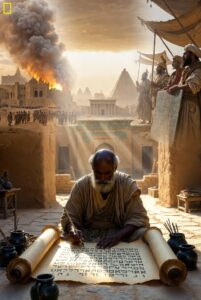
The single most dramatic transformation in the history of Hebrew script came as a direct result of one of Israel’s greatest national catastrophes: the Babylonian exile. When Nebuchadnezzar destroyed Jerusalem in 586 BC and carried the Judean elite into exile in Babylonia, the Jewish community was immersed in a world dominated by Aramaic — the diplomatic and commercial lingua franca of the ancient Near East from roughly the eighth century BC onward.
The Imperial Aramaic script, a descendant of the Phoenician alphabet like Paleo-Hebrew, gradually displaced the older Paleo-Hebrew writing among the Jewish people. Scholars debate the precise timeline and mechanism of this transition, but by the time the Persian-era scribes Ezra and Nehemiah were active in the fifth century BC, the “square” Aramaic-derived Hebrew script — the one still used in printed Hebrew Bibles and Torah scrolls today — was becoming the standard script for Jewish religious texts. The Paleo-Hebrew script was retained for certain special purposes — some Dead Sea Scroll manuscripts write the divine name YHWH in Paleo-Hebrew even within otherwise square-script texts — but its general use gave way to the new Aramaic-derived form.
The Torah.com article by scholar Aaron Koller traces this transformation with scholarly precision. The shift from Paleo-Hebrew to what we now call the “Assyrian” or “Aramaic” script represented not merely a calligraphic preference but a profound cultural negotiation: how does a people in exile maintain its identity while participating in the scribal culture of its captors? The answer, at least in part, was to adopt the external form of the dominant script while filling it with distinctively Israelite content.
The Scribal Tradition and the Formation of the Hebrew Bible
The transmission of the Hebrew Bible was the work of generations of dedicated scribes whose professional standards were nothing less than extraordinary by any measure in the ancient world. The scribal tradition of ancient Israel was not a casual affair but a rigorous, disciplined vocation with deep theological roots. Scribes — the soferim — were not merely copyists; they were interpreters, teachers, and guardians of the sacred text.
The Bible Odyssey scholars note that the scribal tradition shaped the Hebrew Bible at every level, from the selection and arrangement of texts to the preservation of linguistic features that might otherwise have been updated or standardized. Scribes were responsible not only for copying texts but for editing, compiling, and annotating them — activities that were understood, within the framework of the scribal tradition, as acts of fidelity to the sacred material rather than acts of creative invention.
The materials available to these scribes varied by period and context. In the early period, writing was done on clay, stone, wood, and bone — durable surfaces suited to important inscriptions. Papyrus was used for scrolls, which were the standard vehicle for literary and religious texts throughout the Biblical period. Parchment — prepared animal skin — became increasingly important in the Second Temple period and eventually replaced papyrus as the preferred writing surface for sacred texts among the rabbis, who taught that a Torah scroll written on anything other than parchment was invalid.
Before the invention of the printing press, the only way to duplicate a manuscript was to spend hours (weeks? months? years?) laboriously copying it by hand. Note: It took one modern scribe four years, of writing up to 14 hours a day with fine-tipped markers, to handwrite a copy of the Bible!
— Sightline Ministry, “Materials Scribes Used to Write the Bible”
The Masoretes: Guardians of the Vowels
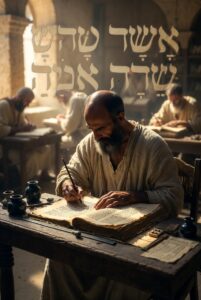
The most remarkable chapter in the history of Hebrew textual transmission belongs to the Masoretes, a school of Jewish scholars who flourished between approximately AD 700 and AD 1000. Working primarily in Tiberias, Babylon, and Palestine, the Masoretes undertook a systematic project to stabilize and standardize the text of the Hebrew Bible in a way that had never before been attempted.
The challenge they faced was formidable — and the stakes could not have been higher. Hebrew, like Aramaic and other Semitic languages, was written as a purely consonantal text; the vowels were carried in the reader’s memory and transmitted through the living oral tradition of synagogue reading. Generation after generation, the sound of the text was passed from rabbi to student, from father to son, from cantor to congregation. The written letters were, in a sense, a skeleton; the spoken tradition was its breath.
But breath is fragile. As the Jewish community dispersed further from its linguistic homeland following the catastrophes of 70 and 135 A.D. — the destruction of the Temple and the crushing of the Bar Kokhba revolt — Hebrew ceased to be a living vernacular for the vast majority of the Jewish world. Aramaic dominated daily speech in the east; Greek and Latin pressed in from the west. With each passing generation, the danger grew: a community losing its mother tongue is a community losing its memory, and a community losing its memory is a community losing its text. Mispronunciation could shade into misinterpretation. Misinterpretation could corrupt meaning. And corrupted meaning, however unintentionally, could silence the voice of God.
It was into this crisis that the Masoretes stepped — and they stepped with a reverence bordering on terror. These were men who took seriously what Jesus himself had declared: “For truly I say to you, until heaven and earth pass away, not the smallest letter or stroke shall pass from the Law until all is accomplished” (Matthew 5:18). The Hebrew word for that smallest letter — the yod, no larger than an apostrophe — and the stroke, or tittle, the tiny serif distinguishing one letter from another, represented for the Masoretes not typographical trivia but the sacred architecture of divine revelation. If even the yod mattered to God, then every vowel mattered, every syllable mattered, every pause and cadence mattered.
Their solution was as elegant as it was meticulous. Working primarily between the sixth and tenth centuries A.D. in Tiberias, Babylon, and Palestine, the Masoretes invented a sophisticated system of diacritical markings — dots and dashes placed above, below, and within the consonantal letters — to indicate the correct vowel pronunciation with precision. These nikudot, or vowel points, were not guesswork. They encoded centuries of received oral tradition, the accumulated memory of a people who had read, chanted, and prayed these texts across millennia. The markings were carefully positioned so as never to alter or obscure the sacred consonantal text itself — the Masoretes would sooner have cut off their hands than change a single received letter. What they gave the world was not a revision but a rescue: the living voice of the Hebrew Bible, pinned to the page so that it could never again be lost.
As the St. Paul Center notes, the Masoretes also introduced various quality control measures for the reproduction of manuscripts: they tabulated the number of words and letters in each biblical book, and subsequent scribes were expected to match these counts exactly. The resulting Masoretic Text is the standard Hebrew form of the books of the Jewish Bible, the form used for chant and proclamation in traditional Jewish synagogues to this day. The oldest complete manuscript of the Masoretic Text, the Codex Leningradensis, was written in Galilee around AD 1000 and is held in what is now the Russian National Library in St. Petersburg.
The Language of the World: Greek and the New Testament
The Greek Alphabet and Its Phoenician Roots
The Greek alphabet stands at the fountainhead of Western civilization’s entire literary tradition. From Homer to Plato, from Thucydides to the Apostle Paul, from the tragedians to the theologians, the Greek alphabet has carried the most important intellectual and spiritual heritage of the Western world. And like every other alphabetic script in history, its ultimate ancestry traces back to those Proto-Sinaitic scratches in the Sinai Peninsula and their Phoenician descendants.
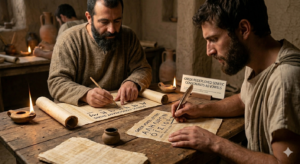
The Penn Museum scholars confirm what the ancient historian Herodotus already recorded: the Phoenicians taught the alphabet to the Greeks. The earliest known Greek alphabetic inscriptions date to the 700s BCE, when Phoenician ships sailed the Mediterranean. The adaptation of Phoenician to Greek involved one crucial innovation: the Greek language had more vowel sounds than could be adequately conveyed by the purely consonantal Semitic alphabet, so the Greeks repurposed certain Semitic letters that represented sounds absent in Greek — the aspirates and pharyngeals of Semitic phonology — as vowel letters. Alpha, epsilon, iota, omicron, upsilon: these were originally Semitic consonant signs (aleph, he, yod, ayin, waw) that Greek ingeniously redeployed as the world’s first written vowels.
This innovation made the Greek alphabet the most phonetically complete writing system ever devised up to that time. It could represent the full range of spoken Greek with a precision that no previous writing system had achieved, which in turn made it a uniquely powerful vehicle for the kinds of philosophical and theological precision that Greek thought prized. When the Apostle John needed to articulate the most philosophically ambitious sentence in the entire New Testament — “In the beginning was the Word, and the Word was with God, and the Word was God” — he had at his disposal a language and a script perfectly engineered for that level of precision.
Koine Greek: The Language of the New Testament

The specific form of Greek in which the New Testament was written is known as Koine Greek — the “common” Greek that emerged as the lingua franca of the eastern Mediterranean world following the conquests of Alexander the Great in the fourth century BC. Alexander’s military campaigns spread Greek language and culture from Greece to Egypt, from Palestine to Persia, creating what historians call the Hellenistic world: a cultural zone in which Greek served as the common tongue of trade, philosophy, diplomacy, and literature.
The providence of this development for the spread of the Christian gospel is almost impossible to overstate. When the early church began its missionary expansion following the resurrection of Christ, it moved into a world in which one language — Koine Greek — could be understood in Alexandria, Antioch, Athens, Corinth, Rome, and everywhere in between. The New Testament authors did not need to commission translations into dozens of local languages (though those translations would come soon enough); they could write in a single language confident that their message would be understood across the entire known world.
Bible Gateway’s resource on the original languages of the Bible notes that the New Testament was written entirely in Greek, reflecting the Hellenistic cultural environment in which early Christianity was born and spread. Even the Old Testament had been translated into Greek — in the translation known as the Septuagint (abbreviated LXX), produced in Alexandria, Egypt, beginning around 250 BC — making the Hebrew scriptures accessible to the vast Jewish diaspora communities who had lost fluency in Hebrew. The New Testament authors quote from the Septuagint far more often than from the Hebrew text, reflecting the Greek-language environment in which they lived and wrote.
The Bible was originally written in the ancient languages of Hebrew, Aramaic, and Greek over a period of many centuries. Although sometimes referred to as “dead” languages (because they are not commonly spoken in the modern world), all three of these languages are very much alive.
— Jacob Edson, “What Language Was the Bible Written In?” Bible Gateway
Papyrus, Parchment, and Codex: The Material History of the New Testament
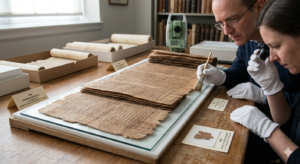
The New Testament documents were almost certainly first written on papyrus — the same versatile material that had served Egyptian scribes for nearly three millennia, from the Old Kingdom onward. Harvested from the pith of the Cyperus papyrus plant in the Nile Delta marshes, papyrus was processed into thin, smooth sheets by soaking, pressing, and drying strips laid crosswise, then trimmed and joined edge-to-edge with paste or stitching. This created a lightweight, flexible surface ideal for ink-based writing with reed pens and carbon-black inks. Papyrus was abundant and relatively inexpensive in the Roman Mediterranean world (despite Egypt’s state-controlled export monopoly), making it perfect for the kinds of letters, gospels, and short narratives that formed the earliest Christian writings. The epistles of Paul — the earliest datable New Testament texts, composed in the 40s and 50s AD during his missionary journeys — were almost certainly drafted and dispatched as papyrus letters (epistolas), rolled into portable scrolls for delivery by trusted couriers like Timothy or Tychicus.
As the Christian movement expanded rapidly across the empire — from Jerusalem to Rome, Antioch, Ephesus, and beyond — its burgeoning literature demanded more efficient formats. Here, another material and technological innovation proved pivotal: the codex. Unlike the traditional volumen (scroll), which required sequential unrolling and was limited to about 20-35 feet of text, the codex consisted of multiple papyrus sheets folded and stitched along one edge into a stack, forming “leaves” or pages bound between wooden or leather covers. This format emerged in the first century AD among Roman bureaucrats and wax-tablet users but was embraced by Christians with astonishing speed, becoming dominant for sacred texts by the early second century.
The reasons are still debated by papyrologists: some point to theological symbolism (the codex as an “eternal” book mirroring divine completeness); others to practical superiority. A codex could hold vastly more content — up to four Gospels or Paul’s collected letters in one volume — without excessive bulk; it allowed random access to any page; it was compact for travel, durable for repeated use, and harder to alter (enhancing textual integrity amid heresy debates). By the time of the great uncial codices like Vaticanus and Sinaiticus (fourth century), Christians had not only standardized the codex but influenced its adoption empire-wide, giving humanity the physical ancestor of the modern book.
Not all manuscripts are created equal. Among the papyrus discoveries of the twentieth century, a handful rise above the rest by virtue of their age, their scope, and their capacity to illuminate the transmission history of the New Testament text. Papyrus 66 is one of them.
UASVbible.org: Papyrus 66 and Its Witness to the Johannine Text
Papyrus 66, commonly designated P66 and sometimes named Bodmer Papyrus II, is one of the most substantial and strategically important early witnesses to the Gospel of John. Unlike the tiny scrap of Papyrus 52, P66 preserves almost the entire Gospel in a single codex, including large continuous sections from the opening prologue through the resurrection appearances. Its combination of early date, extensive content, and clear textual character makes it indispensable for understanding how the Johannine text was transmitted from the second century onward.
P66 stands within the Alexandrian textual tradition, though its scribe exhibits more freedom and more visible corrections than the scribes of Papyrus 75 (P75) or Codex Vaticanus (B). The papyrus shows both the strength and the humanity of early Christian copying activity. On the one hand, its overall agreement with other Alexandrian witnesses demonstrates that the text of John was already stable in the second century. On the other hand, its observable slips, corrections, and occasional idiosyncratic readings reveal how individual scribes interacted with their exemplars.
The importance of Papyrus 66 lies not merely in what it contains but in what it demonstrates. It shows that by the early second century the Gospel of John was copied in codex form; that it circulated in a textual shape closely aligned with the later Alexandrian tradition; that scribes treated it with seriousness, correcting their work to conform to exemplars; and that the Johannine proclamation of Jesus’ identity and work was not the product of late doctrinal revision, but a message preserved with remarkable fidelity from the beginning.
This scribal evolution underscores Christianity’s unique portability: papyrus scrolls carried apostolic witness to the provinces, while codices preserved and multiplied it for house churches and public reading. What began as pragmatic choices became the vessel for the Word’s global transmission.
The Bridge of Translation: The Septuagint and Scribal Providence
Alexandria and the Making of the Greek Old Testament
Few events in the history of the Biblical text were as consequential as the translation of the Hebrew Scriptures into Greek in Alexandria, Egypt, beginning around 250 BC. The story of this translation, embellished in the Letter of Aristeas, tells of seventy-two Jewish scholars brought from Jerusalem to Alexandria at the request of Pharaoh Ptolemy II, translating the Torah in seventy-two days and producing, miraculously, seventy-two identical translations. The legend gives the Septuagint its name (from the Latin septuaginta, “seventy”) and its aura of divine authority.
The historical reality is probably less dramatic but no less significant. The large and growing Jewish community of Alexandria and other Greek-speaking cities had, over generations, lost fluency in Hebrew and Aramaic. They needed their sacred scriptures in the language they actually lived in — Greek. The Septuagint answered that need, and in doing so became one of the most important translations in human history. Not only did it make the Hebrew scriptures accessible to the Greek-speaking diaspora, but it also gave the early church its Bible. When the New Testament authors quote “the scripture,” they are overwhelmingly quoting the Septuagint. The theological vocabulary of the New Testament — words like ekklesia (church), diatheke (covenant), hagios (holy), and countless others — was shaped by the Greek of the Septuagint.
On LXX Shaping NT Language & Theology:
“The Septuagint is in many respects a theologically outstanding version of the Old Testament, amplifying the religious traditions of Judaism and defining the meaning of the Jewish Bible in the centuries around the birth of Jesus.”
— Peter Müller, via Themelios journal
The Septuagint also accomplished something subtler and more remarkable: it demonstrated that the word of God was not bound to any single human language. The same revelation that had been spoken in Hebrew by the prophets could be spoken in Greek by the apostles. The message was not the medium; the message transcended the medium. This is, in a sense, the theological lesson of the entire history of ancient writing: God’s Word has always been larger than any single script or language, capable of moving through cuneiform and hieroglyphs and Phoenician scratches and square Hebrew script and Greek uncials toward its ultimate destination — the hearts and minds of human beings made in His image.
On Divine Authority Across Translations:
“The words of Jesus are spirit and life… The Bible is not just a book of devotional thoughts or moral teachings, but the very words of God, breathed out for our guidance and salvation.”
— Kevin DeYoung, in Taking God at His Word
Faithful to the Fire: Manuscripts, Scrolls, and Textual Preservation
The Dead Sea Scrolls and the Miracle of Textual Stability
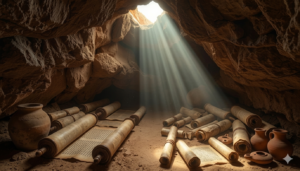
No discovery in the history of Biblical archaeology has more dramatically confirmed the fidelity of the scribal tradition than the Dead Sea Scrolls. Discovered between 1947 and 1956 in the caves of Qumran near the Dead Sea, the Scrolls constitute the largest and oldest collection of Biblical manuscripts ever found, including manuscripts of every book of the Hebrew Bible except Esther. The most famous of the Biblical scrolls, the Great Isaiah Scroll (1QIsa-a), is a complete copy of the book of Isaiah, dated to approximately 125 BC — a full millennium older than the Masoretic manuscripts that had previously been the oldest known copies of the Hebrew Bible.
When scholars compared the Great Isaiah Scroll with the Masoretic Text of Isaiah, the result was extraordinary: despite a thousand years of copying by hand, the two texts were in remarkable agreement, with differences consisting primarily of minor spelling variations and occasional scribal corrections. The scribal tradition had transmitted the text of Isaiah across a millennium with astonishing accuracy. As the St. Paul Center records, the oldest partial copies of the text of any biblical book are to be found among the Dead Sea Scrolls, while the oldest complete manuscript of the Hebrew protocanonical books is the Codex Leningradensis, written around AD 1000.
This textual stability was not accidental. It was the product of the rigorous scribal protocols that the Masoretes and their predecessors had developed and enforced over centuries. A copy that failed to match the letter and word counts of its exemplar was not a valid copy; it was destroyed, and the process began again. The very scribal culture that the ancient Near East had developed over three millennia of writing tradition had, in the hands of Jewish scribes consecrated to the God of Israel, become a system of textual preservation unparalleled in the ancient world.
The Significance of Writing Materials
Throughout the Biblical period, scribes worked with a remarkable variety of materials suited to different purposes and contexts. Stone, as the Sightline Ministry resource notes, was used for permanent inscriptions — the Ten Commandments were written on stone tablets (Exodus 31:18), and boundary markers, commemorative stelae, and public legal inscriptions were carved in stone across the ancient Near East. Clay tablets, the medium of cuneiform, were used for administrative records, legal documents, and literary texts throughout Mesopotamia.
Papyrus, the great Egyptian contribution to writing technology, was the standard medium for scrolls throughout the biblical period and the Hellenistic and Roman eras. The preparation of papyrus writing surfaces was a skilled craft: the pith of the papyrus plant was cut into strips, laid in perpendicular layers, pressed and dried, and then polished smooth. The resulting sheets could be joined into scrolls of considerable length — the longest surviving papyrus scroll, the Great Harris Papyrus from Egypt, is over forty meters long.
Parchment — vellum made from the prepared skins of sheep, goats, or calves — gradually supplanted papyrus as the preferred writing material for sacred texts in the rabbinic period. The Talmud mandates that Torah scrolls be written on parchment (klaf), and this requirement has been maintained in Jewish tradition to the present day. The superior durability of parchment over papyrus is one reason that so many medieval Biblical manuscripts have survived, while far fewer ancient papyrus documents remain.
Modern Biblical Apologist Commentary
These material choices weren’t random—they reflect divine wisdom in preservation. As Daniel B. Wallace (Director of the Center for the Study of New Testament Manuscripts) notes on New Testament papyri and parchment: “Manuscripts of the New Testament are written on one of three different materials: papyrus, parchment, or paper. Each material is unique in its production and utility… parchment manuscripts… provide valuable insight into the text of the New Testament and how it developed over time.”
Eric Lyons of Apologetics Press affirms on stone: “Writing on stone was a way to ensure that the words were preserved for many generations,” underscoring the Ten Commandments’ enduring medium.
And CSNTM (a leading manuscript preservation group) explains parchment’s edge: “Parchment manuscripts are of great significance… offering scholars the opportunity to study the textual history of the New Testament,” with many surviving due to its durability over fragile papyrus.
These quotes from contemporary apologists highlight how scribal technology ensured the Bible’s reliability across millennia.
The Providential Convergence: How All Roads Led to the Bible
A Web of Writing Traditions
Standing back from the full sweep of this history, we can perceive a pattern that is, from a Christian perspective, breathtaking in its coherence. The Bible did not emerge in a writing vacuum. It emerged from the most text-rich environment the ancient world had ever produced: a Fertile Crescent saturated with five thousand years of cuneiform tradition, bordering an Egypt whose scribal culture was three millennia old, connected by trade routes to a Phoenician commercial civilization that had spread alphabetic literacy across the Mediterranean, and shaped by a Hellenistic world in which a single language carried the knowledge and culture of the known world.
Every one of these writing traditions made a specific and necessary contribution to the Biblical record. Cuneiform gave the ancient Near East a vocabulary of legal, diplomatic, and narrative genres that shaped the very forms in which the Biblical authors thought and wrote. Egyptian hieroglyphic and scribal culture trained the hands and minds of the people of Israel during their four centuries of sojourn, and contributed — through the Proto-Sinaitic inscriptions of Canaanite workers in Egyptian mines — to the very invention of the alphabet in which the Hebrew Bible was eventually written. The Phoenician alphabet gave that invention its mature, transmissible form, spreading literacy across the Levant and the Mediterranean. Aramaic carried the Hebrew scribal tradition through the crisis of the exile and gave the square Hebrew script that Torah scrolls still use today. And Greek, the great synthesizing language of the Hellenistic world, became the medium in which the Old Testament was translated for the diaspora and in which the New Testament was proclaimed to the nations.
Cross Bible’s article on the history of the Biblical languages captures something of this depth when it notes the way language change and cultural exchange shaped the transmission of Scripture across centuries. The Bible’s linguistic history is not a story of isolated development but of creative adaptation — a text that moved through the scribal cultures of the ancient world, absorbing their best technical achievements while maintaining its theological distinctiveness.
From Oral Tradition to Written Word: The Textualization of Israel
The transition from oral culture to written culture in ancient Israel — what William Schniedewind calls the “textualization” of ancient Israelite society — was not simply a technological development. It was a theological revolution. When the written word supplanted the living voice of the teacher as the primary vehicle of religious authority, a fundamental shift occurred in how a community related to its sacred traditions. The text became an anchor — stable, portable, reproducible, and capable of transcending the limitations of any single teacher’s memory or any single community’s geographic location.
This was, in retrospect, precisely what was needed. The people of Israel were a people who would spend centuries in exile, dispersion, and diaspora. They needed a sacred text that could travel with them — that could be carried in a scroll to Babylon, that could be translated into Greek in Alexandria, that could be copied in the caves of Qumran, that could be read in synagogues from Antioch to Rome. The written Torah was not merely a convenience; it was a theological necessity for a people whose God was not tied to any temple or any land but was Lord of all the earth.
And then, in the fullness of time — that charged phrase from Galatians 4:4 that Paul uses to describe the moment of Christ’s coming — the final stage of the Biblical writing tradition unfolded. The apostles and evangelists of the first century AD took up pen and papyrus in a Greek-speaking world perfectly prepared to receive their message and wrote the documents that would form the New Testament. These were not learned academics writing for a scholarly audience; they were fishermen, tax collectors, physicians, and tentmakers writing because they had witnessed something so astonishing — the death and resurrection of the Son of God — that silence was not an option.
The Scribal Hand and the Divine Author
There is a profound theological paradox at the heart of the history of Biblical writing. On one hand, the Bible is a thoroughly human document: written in specific human languages, shaped by specific human cultures, transmitted through the hands of specific human scribes, and bearing the marks of specific historical contexts. On the other hand, Christians confess that the Bible is the Word of God — that its human authors were moved by the Holy Spirit (2 Peter 1:21) in a way that makes their words genuinely and entirely the words of God.
The history of writing does not resolve this paradox; it illuminates it. Every stage in the development of ancient writing — from the clay tokens of Mesopotamia to the papyrus scrolls of the New Testament — was a human achievement, the product of human ingenuity, labor, and creativity. And yet, surveying the whole, the Christian cannot help but perceive a providential design. The specific writing systems that developed, in the specific regions that developed them, at the specific times that they developed, created a precisely configured environment in which the Word of God could be reliably inscribed, accurately transmitted, and universally proclaimed.
The God who spoke the world into existence at creation also spoke His saving word into a world that — through five thousand years of scribal development — had been prepared to receive it. This is not naivety; it is theological insight. The same sovereignty that guided Abraham out of Ur, Moses through Egypt, Israel through exile, and Paul through the Mediterranean world also guided the development of the very writing systems through which their stories were told and their words preserved.
Conclusion: The Living Word in Dead Scripts
We began with clay — wet, ordinary, unremarkable. We end with the Bible — the most extraordinary book in human history, the living Word of the eternal God, carried across five millennia on the wings of scripts that most people will never learn to read. Cuneiform sleeps in the museums of London, Berlin, and Baghdad, its wedge-shaped marks deciphered by only a handful of scholars worldwide. Egyptian hieroglyphs adorn the walls of temples that tourists visit, but few can read. Paleo-Hebrew is the province of specialists. And yet the message that these ancient scripts helped transmit has refused every attempt to contain it.
Today, at least some portion of the Bible has been translated into 4,007 languages — more than half of the 7,396 known languages on earth, including sign languages. Pause with that number for a moment. The scribes of Mesopotamia pressed their reeds into clay to preserve the records of kings and grain harvests. The scholars of Alexandria labored to produce a Greek Old Testament for a Jewish diaspora that had forgotten its Hebrew. Jerome bent over his manuscripts in Bethlehem to give Latin Christianity a Bible it could read. Wycliffe, Tyndale, and Luther cracked the text open for the common people of medieval Europe. And the work has never stopped. Today, thousands of Bible translators — many of them working in jungles, deserts, and remote island communities — continue reducing unwritten languages to text for the singular purpose of placing the Word of God into hands that have never held it.
The ancient scripts are silent now. Cuneiform has not been a living writing system for two thousand years. Hieroglyphs died with the last trained temple priests of Egypt. Even the classical Hebrew of the Torah required the centuries-long labor of the Masoretes to preserve it against the erosion of exile and dispersion. But the message those scripts carried forward did not die with them. It leapt from medium to medium, language to language, century to century, losing nothing of its power in the transfer. The good news of a God who creates, loves, redeems, and restores is proclaimed today in more languages, to more people, across more of the earth’s surface than at any previous moment in human history — and the translation work is not finished yet.
The scribes of ancient Mesopotamia who first pressed reed to clay were not thinking about the Bible. The Canaanite miners who scratched their experimental alphabet on Sinai stone were not thinking about the Torah. The Alexandrian scholars who bent over their papyrus, translating the Septuagint, were not thinking about the New Testament. And yet, in the economy of a sovereign God, all of their work contributed to a single, magnificent, and utterly improbable outcome: the written preservation of the revelation of God for all people, in all times, in all languages.
The Apostle Paul, writing in the most sophisticated literary Greek of any New Testament author, put it simply: “All Scripture is breathed out by God and profitable for teaching, for reproof, for correction, and for training in righteousness” (2 Timothy 3:16, ESV). “All Scripture” — not merely the words, but the very writing, the very text, the very letters pressed into clay and papyrus and parchment across five thousand years of human scribal history. God breathed through all of it.
The history of writing is, for those who have eyes to see, a love story: the story of a God who refused to be silent, who pursued His wayward creation with words, who entrusted His most precious self-disclosure to the marks of a reed on clay, a brush on papyrus, a chisel on stone — and who, by His own sovereign grace, ensured that those marks survived, were copied, were translated, were transmitted, and were placed in your hands.
Pick up the Bible. You are holding five thousand years of human ingenuity and divine faithfulness in your hands. Handle it accordingly.
Primary Sources Consulted
The following online resources were consulted in the research and writing of this essay:
Writing and the Biblical Tradition
• “How Did Early Writing Influence the Transmission and Preservation of the Bible?” — uasvbible.org/2024/11/18/how-did-early-writing-influence-the-transmission-and-preservation-of-the-bible/
• “Materials Scribes Used to Write the Bible” — sightlineministry.org/materials-scribes-used-bible/
• “The Origins of the Written Bible,” William Schniedewind — pbs.org/wgbh/nova/article/origins-written-bible/
• “How the Bible Became a Book: The Textualization of Ancient Israel” — christiancentury.org/reviews/2004-08/how-bible-became-book-textualization-ancient-israel
• “Crash Course in Bible History” — baptistnews.com
• “How Was the Bible Written?” — spokenpast.com
• “Writing” — Encyclopedia of the Bible, Bible Gateway — biblegateway.com/resources/encyclopedia-of-the-bible/Writing
• “What Language Was the Bible Written In?” — biblegateway.com/learn/bible-101/about-the-bible/original-language-of-the-bible/
• “Old Testament Manuscripts” — St. Paul Center — stpaulcenter.com/posts/old-testament-manuscripts
• “Biblical Manuscripts” — Dunham Bible Museum, Houston Christian University — hc.edu/museums/dunham-bible-museum/
• “Ancient Materials and Manuscripts” — predikuesi.wordpress.com/ancient-materials-and-manuscripts/
• “Ancient Inscriptions and the Bible” — bibelanguages.blogspot.com/2017/07/ancient-inscriptions-and-bible.html
• “How Did Scribes and the Scribal Tradition Shape the Hebrew Bible?” — bibleodyssey.org
Writing Systems and Language History
• Schmandt-Besserat, Denise. “The Evolution of Writing.” International Encyclopedia of Social and Behavioral Sciences, Elsevier, 2014 — sites.utexas.edu/dsb/tokens/the-evolution-of-writing/
• “The Earliest Scriptures” — Smithsonian Institution, Asia Archive — asia-archive.si.edu/exhibition/the-earliest-scriptures/
• “The First Four Millennia of Writing” — History World — historyworld.net/history/Writing/166
• Herrmann, Virginia R. and Adam Smith. “The Alphabet: A Remarkable Journey from Sinai to Beijing.” Expedition Magazine, Vol. 64, No. 3. Penn Museum — Penn.museum/sites/expedition/the-alphabet/
• “Stages of Ancient Egyptian Writing” — Medium/@dahliasaadedin
• “Egyptian Writing” — EgiptoExclusivo — egiptoexclusivo.com/en/culture/ancient-egypt/egyptian-writing/
Hebrew and Greek Language Resources
• Koller, Aaron. “The Transformation of Hebrew Script: From Paleo-Hebrew to Aramaic” — thetorah.com/article/the-transformation-of-hebrew-script-from-paleo-hebrew-to-aramaic
• “Hebrew Language” — Britannica — britannica.com/topic/Hebrew-language
• “Ancient Hebrew Writings” — Wikipedia — en.wikipedia.org/wiki/Ancient_Hebrew_writings
• “An Introduction to the Biblical Greek Alphabet” — Zondervan Academic — zondervanacademic.com/blog/biblical-greek-alphabet
• Nelson, Stephen. “Greek vs Hebrew: A History of the Biblical Languages and Lexicography” — crossbible.com/blog/greek-vs-hebrew-a-history-of-the-biblical-languages-and-lexicography
A Note on Research Methods and Accuracy
In recent years, some have voiced concern that artificial intelligence may distort facts or introduce inaccuracies into serious research. That criticism deserves acknowledgment. However, AI has now evolved into the most powerful research instrument available to any dedicated scholar—capable of analyzing vast datasets, cross‑referencing historical records, and surfacing overlooked connections across sources. This work represents a collaboration between the author’s theological and historical inquiry, verified primary documentation, and the advanced analytic capabilities of AI research tools. Here, AI was not used as a ghostwriter or a shortcut for scholarship, but as a disciplined research partner devoted to rigor, accuracy, and transparency.
Every factual claim in this work has been subjected to active verification. Where AI‑generated content was used as a starting point, it was tested against primary sources, peer‑reviewed scholarship, official institutional documentation, and established historical records. Where discrepancies were found—and they were found—corrections were made. The author has made every reasonable effort to ensure that quotations are accurately attributed, historical details are precisely rendered, and theological claims fairly represent the positions they describe or critique.
That said, no work of this scope is immune to error, and the author has no interest in perpetuating inaccuracies in the service of an argument. If you are a reader—whether sympathetic, skeptical, or hostile to the conclusions drawn here—and you identify a factual error, a misattributed source, a misrepresented teaching, or a claim that cannot be substantiated, you are warmly and genuinely invited to say so. Reach out. The goal of this work is not to win a debate but to get the history right. Corrections offered in good faith will be received in the same spirit, and verified corrections will be incorporated into future editions without hesitation.
Truth, after all, has nothing to fear from scrutiny—and neither does this work.