
Island of Broken Math: Why Alcatraz Makes Zero Fiscal Sense
A Policy Analysis
Introduction: The Rock Is Back — Whether You Like It or Not
Imagine spending $2 billion to house fewer than 300 inmates on a crumbling, salt-corroded island with no running water, no functioning sewage system, and no operational heating — where every gallon of fresh water and every ham sandwich has to be shipped in by boat. Then imagine calling it a “state-of-the-art secure prison facility.”
Welcome to Trump’s Alcatraz.
On May 4, 2025, President Donald Trump fired off a Truth Social post that had the internet simultaneously gasping and laughing: he was directing the Bureau of Prisons, the Department of Justice, the FBI, and Homeland Security to reopen the legendary island penitentiary in San Francisco Bay. Not just reopen it — substantially enlarge and rebuild it, to house “America’s most ruthless and violent Offenders.” The announcement, by most accounts, came on a Sunday morning when the president’s local Palm Beach PBS affiliate happened to be airing Clint Eastwood’s Escape from Alcatraz.
“I am directing the Bureau of Prisons, together with the Department of Justice, FBI, and Homeland Security, to reopen a substantially enlarged and rebuilt ALCATRAZ, to house America’s most ruthless and violent Offenders. The reopening of ALCATRAZ will serve as a symbol of Law, Order, and JUSTICE.”
— President Donald Trump, Truth Social, May 4, 2025 — thehill.com/homenews/administration/5815432-trump-seeks-funds-alcatraz-reopening-budget/
Most observers assumed the post was bluster — a political attention-getter with no more shelf life than a campaign rally applause line. They were wrong. Nearly eleven months later, Trump’s Fiscal Year 2027 budget, released April 3, 2026, contains a line item: $152 million to cover “the first year of project costs” for rebuilding Alcatraz. The administration is now on record, in writing, committed to the plan. The question is no longer whether Trump is serious. The question is whether Congress, the courts, and common sense will stop him.
This essay examines the full scope of what reopening Alcatraz would actually require: the staggering financial costs (current estimates reach $2 billion before a single inmate sets foot on the island), the logistical impossibilities, the legal and regulatory minefield, the loss of one of the most lucrative tourist attractions in the American West, and the frank assessment of whether there is any rational policy justification for the project at all. The conclusion, as you will see, writes itself.
A Brief History of The Rock
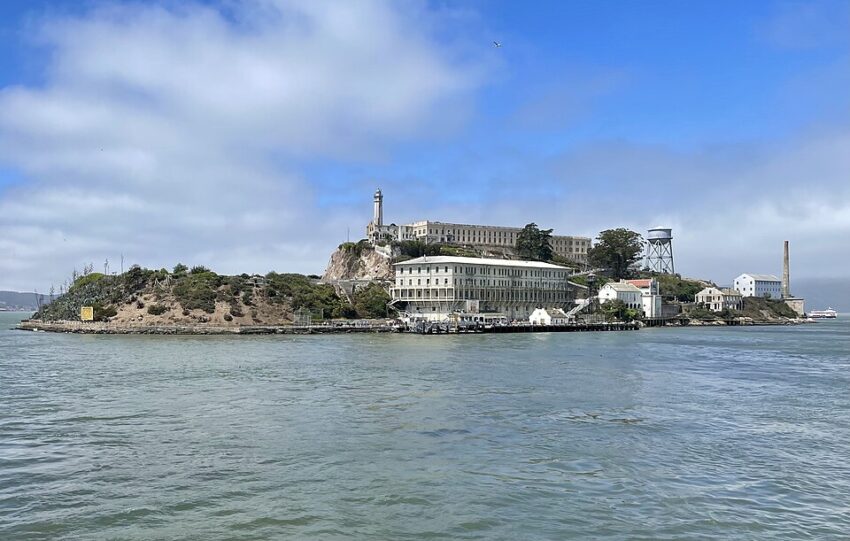
Alcatraz Island sits in the middle of San Francisco Bay, approximately 1.5 miles from shore, surrounded by frigid, churning Pacific waters. It first served as a military installation in the 1850s, then transitioned to a military prison. In 1934, the federal government converted it into a maximum-security civilian penitentiary — the most escape-proof facility in the country, not because of extraordinary technology but because of the bay itself. The water temperature rarely rises above 55 degrees Fahrenheit; the currents are brutal. No prisoner ever successfully escaped, though five are officially listed as “missing and presumed drowned.”
At its operational peak, Alcatraz housed between 260 and 275 inmates — less than one percent of the total federal prison population. Among its most famous residents: Chicago mob boss Al Capone, bank robber George “Machine Gun” Kelly, and James “Whitey” Bulger. The facility operated for just under 29 years before the federal government made a straightforward cost-benefit calculation and shut it down in March 1963.
“Alcatraz was nearly three times more expensive to operate than any other Federal prison. The major expense was caused by the physical isolation of the island. For example, the island had no source of fresh water, so nearly one million gallons of water had to be barged to the island each week. The Federal Government found it was more cost-effective to build a new institution than to keep Alcatraz open.”
— Bureau of Prisons website — bop.gov
That was 1963. The infrastructure has been decaying ever since. In 1972, Congress established Alcatraz Island as part of the Golden Gate National Recreation Area. In 1986, it was designated a National Historic Landmark. Since 1973, it has operated as one of the most popular tourist attractions in America, drawing approximately 1.4 million visitors annually and generating, according to the National Park Service, roughly $60 million per year in revenue.
That is the baseline reality against which Trump’s proposal must be measured.
From Truth Social to Budget Line Item
When Trump’s May 2025 Truth Social post appeared, it was greeted with a mixture of derision and dismissal. Former House Speaker Nancy Pelosi, whose congressional district includes Alcatraz, set the tone for Democratic opposition immediately.
“The planned announcement to reopen Alcatraz as a federal penitentiary is the Trump administration’s stupidest initiative yet. It should concern us all that clearly the only intellectual resources the administration has drawn upon for this foolish notion are decades-old, fictional Hollywood movies.”
— Former Speaker Nancy Pelosi — Source: axios.com/2025/07/18/trump-alcatraz-prison-cost-2-billion
But the administration pressed forward. Bureau of Prisons Director William K. Marshall III responded that his agency would “pursue all avenues” to implement the president’s directive. In July 2025, then-Attorney General Pam Bondi and Interior Secretary Doug Burgum flew to San Francisco for a personal tour of the island. Bondi emerged from the dilapidated facility and described it, memorably, as a “terrific facility” — a characterization that must have puzzled structural engineers and hazmat specialists alike.
The administration commissioned feasibility studies. Axios reported in July 2025 that internal administration sources had placed preliminary cost estimates at $2 billion. The White House did not dispute that figure. San Francisco Mayor Daniel Lurie, unconvinced, posted on X that summer: “There is no realistic plan for Alcatraz to host anyone other than visitors.”
Then, on April 3, 2026, the FY2027 budget dropped. Buried on page 44 of the White House’s 92-page spending proposal was this language:
“The Budget affirms the President’s commitment to rebuild Alcatraz as a state-of-the-art secure prison facility, providing $152 million to cover the first year of project costs.”
— White House FY2027 Budget Proposal, p. 44, April 3, 2026 — thehill.com/homenews/administration/5815432-trump-seeks-funds-alcatraz-reopening-budget/
No further breakdown of how the $152 million would be spent was provided. The White House, asked for clarification, referred reporters to Trump’s 2025 Truth Social post. The Department of Justice and the Department of the Interior did not respond to press inquiries. The Bureau of Prisons, when asked by CNN for total restoration costs, offered only: “As an agency, we are moving forward, evaluating, and formulating the actions necessary to reopen and operate USP Alcatraz.”
The feasibility study began in 2025 and has not yet been completed.
The True Price Tag — What Reopening Alcatraz Would Actually Cost
The $152 million figure in the budget is not a total renovation cost. It is described as covering “the first year” only. Every independent estimate of the full renovation project dwarfs that number.
Upfront Capital Costs
My original 2025 analysis estimated total upfront renovation costs in the range of $235 million to $370 million, scaling from the NPS’s $63.6 million hospital wing project. That estimate, however, appears to have been significantly conservative. By mid-2025, administration sources themselves were acknowledging a figure of approximately $2 billion for full renovation and reconstruction. California State Senator Scott Wiener’s office cited the same figure. The SF Standard, KQED, ABC7, and multiple other outlets all reported the $2 billion estimate as the prevailing consensus by the time the FY2027 budget was released.
Why the dramatic gap between my earlier estimate and the $2 billion figure? The answer lies in the scope of what “rebuilding” actually means for a facility that has been crumbling in a saltwater environment for over six decades:
• The island has no source of fresh water. One million gallons per week had to be barged in during original operations. A modern desalination facility would require significant capital investment, ongoing maintenance, and redundant backup systems.
• There is no functioning sanitation system. All waste infrastructure would need to be built from scratch.
• There is no operational heating. The island’s fog-drenched, wind-blasted environment requires serious HVAC infrastructure.
• The main cellhouse, built between 1909 and 1912, suffers from severe spalling concrete, rusted steel reinforcements, and weather damage. Seismic retrofitting alone for a structure of this age and condition is extraordinarily expensive.
• Asbestos and lead paint removal — standard in any historic building of this era — adds tens of millions more.
• Every pound of building material, every tool, every piece of equipment must arrive by boat. Island logistics inflate construction costs by a factor the mainland never encounters.
• The NPS’s partial rehabilitation of just the hospital wing — a single building on the island — cost $63.6 million and took from 2021 to 2027 to complete. Extrapolating that to the entire facility, including new utilities, security systems, staff housing, dining, and expanded cell capacity, makes the $2 billion estimate credible and possibly still optimistic.
Annual Operating Costs
The BOP’s own website acknowledges that Alcatraz was “nearly three times more expensive to operate than any other Federal prison” when it closed in 1963. That structural disadvantage has not changed; if anything, modern regulatory requirements for prisoner welfare, mental health services, and staffing ratios have made it worse.
My 2025 analysis estimated annual operating costs in the range of $24.5 to $60 million for 250 to 300 inmates. For context, a mainland federal prison housing 3,000 inmates typically costs $93 to $210 million annually — meaning Alcatraz would spend three to four times more per inmate than any equivalent facility.
At 300 inmates and $60 million in annual operating costs, the per-inmate annual cost approaches $200,000 — compared to approximately $40,000 to $50,000 at a standard federal facility. There is no security rationale, no rehabilitative rationale, and no deterrence rationale that justifies a 400% cost premium per prisoner.
The Opportunity Cost: $60 Million in Annual Tourism Revenue Lost
There is another number that rarely gets sufficient attention in the Alcatraz debate: $60 million. That is the annual revenue the National Park Service currently generates from Alcatraz Island as a tourist attraction, according to NPS data cited by ABC7 San Francisco. Alcatraz draws approximately 1.4 million visitors each year — tourists from Spain, from Japan, from Australia, from every corner of the United States — who come to walk the cell blocks, listen to the audio tour, and stand at the edge of San Francisco Bay. That revenue goes to the federal government.
Converting Alcatraz to a prison eliminates that revenue stream permanently. So the true annual fiscal calculus is not merely $60 million in operating costs; it is $60 million in operating costs plus $60 million in lost tourism revenue: $120 million per year in net federal fiscal impact, for a prison that holds fewer than 300 inmates.
“If the federal government has billions of dollars to spend in San Francisco, we could use that funding to keep our streets safe and clean and help our economy recover.”
— San Francisco Mayor Daniel Lurie, July 2025 — Source: sfstandard.com/2026/04/03/trump-budget-alcatraz-reopen-federal-prison-152-million/
The Logistical and Regulatory Mountain
The Infrastructure Challenge
To understand the logistical challenge of reopening Alcatraz, consider a single fact: during its original operation, every gallon of fresh water consumed on the island — by inmates, staff, and their families — had to be transported by barge from the mainland. Nearly one million gallons per week. Every week. That water infrastructure challenge has not improved in sixty years. It has gotten worse because the existing infrastructure has continued to decay.
The Artvoice analysis published April 4, 2026, summarized the baseline infrastructure situation bluntly: “The infrastructure on the island has no running water, no functioning sanitation system, and no operational heating, and all of it would need to be built from scratch or comprehensively rebuilt.” This is not a renovation. This is construction on an island, which means every cubic yard of concrete, every foot of pipe, every electrical panel, and every roll of cable has to be loaded onto a boat, transported across 1.5 miles of open bay, unloaded at a deteriorating dock, and transported up a steep island terrain to the worksite.
The NPS’s rehabilitation of the hospital wing — again, one building, a partial job — required six years. The full project timeline for a complete rebuild, by most expert estimates, would run four to six years minimum, and that assumes no significant regulatory delays. Given everything else discussed below, that assumption is heroic.
The Legal Labyrinth: Congress Owns This Island
Here is a detail the Trump administration appears to find inconvenient: Alcatraz Island is not federal prison property. It is a federally recognized national park, established by Congress in the Golden Gate National Recreation Area Act of 1972. The island is currently under the jurisdiction of the Department of the Interior, managed by the National Park Service, not the Bureau of Prisons.
Transferring Alcatraz from the National Park Service to the Bureau of Prisons requires an Act of Congress. The executive branch cannot unilaterally reassign a congressional national park. This is not a bureaucratic obstacle that can be resolved by executive order; it is a constitutional one. The same Congress that would need to approve the $152 million budget request would also need to pass separate legislation stripping Alcatraz of its national park status and transferring it to DOJ control.
Additionally, the National Historic Landmark designation, conferred in 1986, adds another layer of preservation requirements. Any construction or significant alteration to a National Historic Landmark must comply with the National Historic Preservation Act, which mandates consultation with the Advisory Council on Historic Preservation and can trigger years of review.
The KQED analysis noted that the island’s current legal status “includes Alcatraz, Muir Woods in Marin County and the Presidio in San Francisco” as part of the same recreational area, making the legislative disentanglement even more complex than it might appear.
Environmental Compliance: The Whales Are Watching
San Francisco Bay is not a dead waterway. It supports significant marine life, including whale populations that use the bay seasonally. Large-scale construction on Alcatraz — involving constant boat traffic, pile driving, material delivery, and waste removal over multiple years — would require comprehensive environmental impact assessments under the National Environmental Policy Act (NEPA). These assessments alone can take years, and that is before litigation from environmental groups, which in California is functionally guaranteed.
The Axios reporting noted that “Some in the administration also have noted that there’s a healthy population of whales in the bay and there are worries that the boat traffic required for a large-scale construction project on Alcatraz would interfere with them.” When an administration’s own advisers are flagging whale disruption as a project concern, the logistical picture is perhaps more complicated than a Truth Social post conveys.
Personnel: 130 to 165 Staff for Fewer Than 300 Inmates
Alcatraz historically operated with a staff-to-inmate ratio of approximately 1:3, significantly higher than standard federal facilities, due to the facility’s high-security classification. For 250 to 300 inmates, modern operational requirements would demand approximately 130 to 165 total personnel: correctional officers in three shifts, administrative staff, medical and mental health professionals, kitchen and maintenance workers, and boat operators for supply runs.
All of those staff members, and their equipment, supplies, and personal effects, must commute to an island. Daily. In all weather. The operational complexity of running a 24/7 prison on a bay island is not merely logistical — it is a perpetual constraint on everything from emergency medical response to contraband interdiction to simple employee retention. Would correctional officers — already in short supply across the BOP system — accept island assignments? At what pay premium?
The Political Firestorm — Who Is Saying What
Opposition to the Alcatraz proposal has been bipartisan in California, even if it has tracked partisan lines in Washington. The most pointed objections have come from those who know the island best.
“Trump’s idiotic quest to sink $2 billion into ruining a globally popular tourist attraction is the epitome of waste, fraud, and abuse.”
— California State Senator Scott Wiener — Source: sfstandard.com/2026/04/03/trump-budget-alcatraz-reopen-federal-prison-152-million/
“This project is stupid and a waste of taxpayer money. In California, we are proud to meaningfully improve public safety.”
— Diana Crofts-Pelayo, spokesperson for Gov. Gavin Newsom — Source: sfstandard.com/2026/04/03/trump-budget-alcatraz-reopen-federal-prison-152-million/
Even those sympathetic to the Trump administration’s law-and-order messaging have struggled to articulate a policy justification that goes beyond symbolism. The Axios reporting, drawing on administration sources, was unusually candid about the president’s motivation:
“Trump’s interest in Alcatraz is motivated more by symbolism than necessity. Alcatraz, featured in many movies, has a space in the cultural consciousness as a tough place, and the president likes that. ‘He likes it because it’s tough,’ one adviser said.”
— Axios, July 18, 2025 — axios.com/2025/07/18/trump-alcatraz-prison-cost-2-billion
Symbolism. That is the honest answer. Two billion dollars, and the acknowledged rationale is that the president “likes it because it’s tough.”
What $2 Billion Could Actually Buy?
The conversation about Alcatraz cannot be complete without asking the obvious counter-question: if the administration genuinely wants to expand capacity for violent federal offenders, what does $2 billion buy on the mainland?
A great deal more than 300 inmate beds.
A new federal maximum-security facility on the mainland, built from scratch on purchased land, typically costs between $150 million and $250 million for a facility housing 1,000 to 1,500 inmates. For $2 billion, the federal government could build six to eight such facilities, adding 6,000 to 12,000 high-security beds to the federal system — compared to the approximately 300 beds that Alcatraz could ever hold at its absolute maximum. Annual operating costs at those facilities would run at standard BOP rates, roughly $40,000 to $50,000 per inmate, rather than the $200,000 per inmate that Alcatraz would demand.
Furthermore, the BOP’s own acknowledged problem is not a lack of dramatic island prisons. It is a correctional officer shortage and aging infrastructure across dozens of mainland facilities. The $1.7 billion broader BOP funding request in Trump’s budget — targeting staff pay and working conditions — actually addresses a real systemic problem. The $152 million Alcatraz line item does not.
There is also the matter of the existing supermax option. The United States Penitentiary Administrative Maximum Facility in Florence, Colorado — ADX Florence, known informally as the “Florestone” or “Alcatraz of the Rockies” — already houses the federal system’s most dangerous inmates in conditions of extreme isolation. It operates on the mainland, at a fraction of the per-inmate cost that Alcatraz would demand, without requiring boat logistics, desalination plants, or the dismantling of a national park.
Conclusion: A Symbol in Search of a Strategy
The case for reopening Alcatraz as a federal prison does not fail on a single point. It fails on every point simultaneously.
The cost is prohibitive: $2 billion in upfront renovation for a facility that could never house more than 300 inmates, at a per-inmate operating cost three to four times higher than any comparable mainland facility. The legal obstacles are substantial: transferring a congressionally established national park requires an act of Congress, and the National Historic Preservation Act adds years of compliance review. The logistics are uniquely punishing: every gallon of water, every meal, every building material, and every employee must travel by boat across 1.5 miles of open bay in one of the nation’s most seismically active regions. The environmental review process could alone add years of delay. And the opportunity cost is real: $60 million per year in tourism revenue that currently flows to the federal treasury would simply cease.
Meanwhile, the stated justification — from the president’s own advisers, on the record — is that the president “likes it because it’s tough.” Not because it solves a capacity problem (it does not — the federal prison population has been declining). Not because it is cost-effective (it demonstrably is not, as the BOP itself has acknowledged for sixty years). Not because no other high-security option exists (ADX Florence is right there, in Colorado, operational and proven).
The $152 million in the FY2027 budget is not the beginning of a solution to a criminal justice problem. It is the down payment on a very expensive symbol — and as the BOP’s own institutional memory makes clear, the last time America tried to run a prison on that island, the federal government decided it would be cheaper to walk away and build something new. That was in 1963 dollars. The lesson, apparently, has not landed.
“Trump’s pipe dream to reopen Alcatraz as a federal prison entered a new phase Friday as the White House called for $152 million in next year’s budget for the project. Estimates suggest it would cost far more to accomplish that goal.”
— SF Standard, April 3, 2026 — sfstandard.com/2026/04/03/trump-budget-alcatraz-reopen-federal-prison-152-million/
If the administration is serious about law and order — about genuinely protecting the American public from violent and repeat offenders — then the path forward is not a deteriorating island that the federal government already abandoned once for cost reasons. The path forward is investing in the existing federal prison system: addressing the correctional officer shortage, modernizing aging mainland facilities, and expanding capacity where it can be expanded efficiently.
Alcatraz is many things. It is a stunning piece of American history. It is a world-class tourist attraction. It is an iconic symbol of the consequences of criminal behavior. What it is not, and what no amount of Truth Social bravado or budget line items can make it, is a practical solution to anything.
Some rocks are better left unturned.
Sources and References
The following sources were consulted in the preparation of this essay:
-
The Hill — “Donald Trump requests $152M in fiscal 2027 budget to rebuild Alcatraz” — thehill.com/homenews/administration/5815432-trump-seeks-funds-alcatraz-reopening-budget/
-
CNN Politics — “Trump wants $152 million to rebuild and reopen Alcatraz as a secure prison” — cnn.com/2026/04/03/politics/alcatraz-reopen-trump-white-house-budget
-
Axios — “Scoop: Trump’s new Alcatraz prison could cost $2 billion” (July 18, 2025) — axios.com/2025/07/18/trump-alcatraz-prison-cost-2-billion
-
SF Standard — “Trump proposed to put Alcatraz in the budget. Year one alone: $152 million.” — sfstandard.com/2026/04/03/trump-budget-alcatraz-reopen-federal-prison-152-million/
-
KQED — “Trump Asks Congress for $152 Million to Reopen Alcatraz” — kqed.org/news/12078717/trump-asks-congress-for-152-million-to-reopen-alcatraz
-
ABC7 San Francisco — “Trump seeking $152 million from Congress to reopen Alcatraz as a federal prison” — abc7news.com/post/trump-seeking-152-million-congress-reopen-alcatraz-federal-prison/18835847/
-
Artvoice — “Alcatraz Is Getting $152 Million In Trump’s Budget And Nobody Can Agree On It” — artvoice.com/2026/04/04/
-
Fox News — “Alcatraz could reopen as a state-of-the-art secure prison under Trump’s $152M budget request” — foxnews.com/politics/alcatraz-could-reopen-state-art-secure-prison-trumps-152m-budget-request
-
NBC News Live Blog — FY2027 Budget Coverage — nbcnews.com
-
Bureau of Prisons — Official institutional history of Alcatraz — bop.gov
-
National Park Service — Structural Upgrades for Alcatraz Prison Hospital Wing — nps.gov
A Note on Research Methods and Accuracy
In recent years, some have voiced concern that artificial intelligence may distort facts or introduce inaccuracies into serious research. That criticism deserves acknowledgment. However, AI has now evolved into the most powerful research instrument available to any dedicated scholar—capable of analyzing vast datasets, cross‑referencing historical records, and surfacing overlooked connections across sources. This work represents a collaboration between the author’s research inquiry, verified primary documentation, and the advanced analytic capabilities of AI research tools. Here, AI was not used as a ghostwriter or a shortcut for scholarship, but as a disciplined research partner devoted to rigor, accuracy, and transparency.
Every factual claim in this work has been subjected to active verification. Where AI‑generated content was used as a starting point, it was tested against primary sources, peer‑reviewed scholarship, official institutional documentation, and established historical records. Where discrepancies were found—and they were found—corrections were made. The author has made every reasonable effort to ensure that quotations are accurately attributed, historical details are precisely rendered, and claims fairly represent the positions they describe or critique.
That said, no work of this scope is immune to error, and the author has no interest in perpetuating inaccuracies in the service of an argument. If you are a reader—whether sympathetic, skeptical, or hostile to the conclusions drawn here—and you identify a factual error, a misattributed source, a misrepresented teaching, or a claim that cannot be substantiated, you are warmly and genuinely invited to say so. Reach out. The goal of this work is not to win a debate but to get the history right. Corrections offered in good faith will be received in the same spirit, and verified corrections will be incorporated into future editions without hesitation.
Truth, after all, has nothing to fear from scrutiny—and neither does this work.