
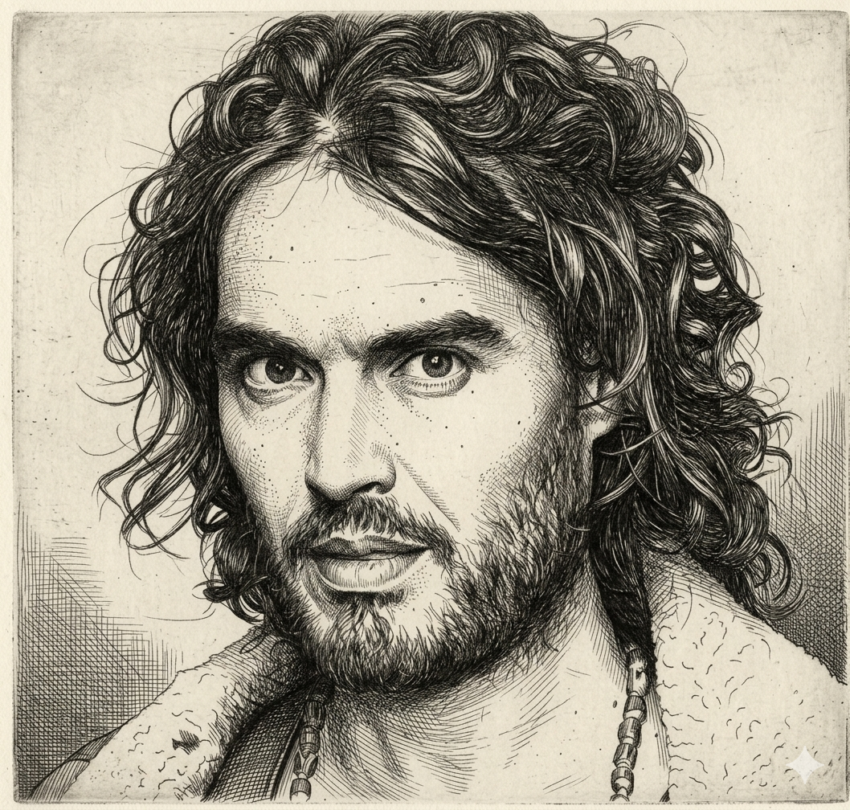
From the Thames to the Throne Room
Evaluating the Christian Conversion of Russell Brand
On the final Sunday of April 2024, a man with a long history of provocation, promiscuity, and public spectacle waded into the River Thames in white linen and was lowered backward beneath the cold English water. Bear Grylls, the celebrated television survivalist and outspoken evangelical, stood at his side. So did a friend named Joe, a fellow traveler in twelve-step recovery. The man rose from the river coughing, sputtering, and weeping. The man was Russell Brand. The cameras were rolling. The internet was watching. And nearly two years later, the question still hovers over his name: was that a conversion, or a costume?
This essay does not presume to answer that question. Scripture reserves the verdict on the human heart for the One who searches it (1 Samuel 16:7; Jeremiah 17:10), and Christian charity counsels us to receive a profession of faith with hope rather than suspicion. Yet Brand’s case raises serious and substantive questions that deserve careful, biblical, and pastoral examination—questions about the nature of repentance, the meaning of baptism, the marks of genuine faith, and the responsibility of the watching church to disciple, not merely applaud, those who claim the name of Christ. What follows is an attempt to walk that narrow road: neither cynical dismissal nor uncritical celebration, but a sober, scripturally grounded reflection on a high-profile profession of faith and what it can teach all of us about the gospel of grace.
Who Is Russell Brand?
Russell Edward Brand was born on June 4, 1975, in Grays, Essex—an unremarkable English town whose very name, as he wryly observes, is a forecast of its weather. His parents separated when he was six months old, and he was raised by his mother, who battled uterine and breast cancer while he was still a boy. By his own account, he developed bulimia at fourteen, left home at sixteen, and tumbled headlong into cannabis, amphetamines, LSD, ecstasy, and eventually heroin. He has spoken openly about being sexually abused as a teenager by an acting tutor.
He clawed his way out of obscurity through stand-up comedy and brash television presenting in the early 2000s, becoming, for a season, one of Britain’s most polarizing celebrities. American audiences came to know him through Forgetting Sarah Marshall (2008), Get Him to the Greek (2010), and the ill-fated Arthur remake (2011). He hosted MTV’s Video Music Awards twice. He was briefly married to pop singer Katy Perry. He flirted publicly with Hare Krishna devotion, transcendental meditation, Buddhist practice, and what he called “Christ consciousness.” In 2012, the Dalai Lama personally selected him to host a Buddhist youth event in Manchester.
Then came political reinvention. After guest-editing the New Statesman in 2013, Brand recast himself as a counter-cultural prophet of revolution, denouncing corporate capitalism, urging non-voting, and writing the bestseller Revolution (2014). The COVID-19 pandemic accelerated a rightward drift. By 2022, his YouTube channel had become a clearing house for skepticism about vaccines, the World Economic Forum, and what he persistently described as “globalist” power. When YouTube began demonetizing his content, he migrated his daily livestream to Rumble.
In September 2023, a joint investigation by The Times, The Sunday Times, and Channel 4’s Dispatches aired explosive allegations of rape, sexual assault, and emotional abuse from multiple women, spanning 2006 to 2013. Brand denied them all, framing the accusations as a coordinated establishment hit-piece. In April 2025, the Crown Prosecution Service formally charged him with one count of rape, one count of oral rape, one count of indecent assault, and two counts of sexual assault, relating to alleged offenses between 1999 and 2005. Brand has pleaded not guilty; the trial is currently set for June 2026, with additional charges authorized in December 2025.
It is against this backdrop—spiritual restlessness, public scandal, looming criminal trial, and a vast online following—that Russell Brand stepped down into the Thames.
The Spiritual Trajectory Before the Thames
Brand has never been a settled atheist. From his earliest sobriety, dating to 2003, he was, in his own description, a seeker. Twelve-step recovery introduced him to the language of a “Higher Power.” Hindu and Buddhist forms beckoned. He famously had a crucifix tattooed on his arm—alongside Krishna, Hindu Sanskrit, a Masonic emblem, and Ganesha, the Hindu elephant god. In 2024, the year of his baptism, he was simultaneously promoting an amulet he claimed could shield wearers from “evil energies” and harmful Wi-Fi signals.
This tangled spiritual genealogy is essential for understanding what came next. Brand’s instinct, repeatedly demonstrated, has been syncretism—the additive blending of incompatible spiritualities—not exclusive devotion. CBN’s David Hoffman, who has researched Brand’s output extensively, summarizes the pattern with care:
“His belief system is one of universalism and syncretism, the idea that multiple religions and spiritualities are different roads leading to the same source.”
— David Hoffman, CBN News, May 1, 2024
The Apostle Paul confronted precisely this kind of cafeteria spirituality when he preached on Mars Hill (Acts 17:22–31). The Athenians were religious in every direction; what they lacked was not piety but particularity—the exclusive, crucified, risen, returning Christ. Genuine Christian conversion is not the addition of Jesus to a shelf of admired teachers; it is, as Paul thunders in 1 Thessalonians 1:9, the act of turning “to God from idols, to serve the living and true God.”
Brand himself, in his most extended public testimony to date—a long-form interview on the Apologetics Canada Podcast with Andy Steiger and Wes Huff—describes his pre-conversion state with unusual self-awareness:
“I came to Christ in crisis. I came to Christ in pain. I came to Christ in brokenness, not because I didn’t believe Christ was real, but somehow I weren’t willing to be dislodged from the altar of the present myself. I wanted to sort of stay there somehow. I wanted it to still be about me.”
— Russell Brand, Apologetics Canada Podcast #535
That is, in the abstract, a deeply Augustinian confession—one Saint Augustine himself might have written. Whether Brand has, in fact, been dislodged from the altar of self is the question on which all subsequent evaluation must turn.
The Voices That Drew Him In
Several figures have publicly accompanied Brand on his stated journey toward Christ. The most visible is Bear Grylls, the British adventurer and well-known evangelical believer who performed the Thames baptism. In a January 2025 interview with The Telegraph, summarized by Newsweek, Grylls offered this defense:
“It was for him a real moment of humility and repentance and genuine heart-felt finding of quite a faith in his life.”
— Bear Grylls, quoted in Newsweek, January 12, 2025
Grylls is associated with the Alpha Course, the introductory Christianity curriculum developed at Holy Trinity Brompton in London by Anglican vicar Nicky Gumbel. While emotionally powerful, the Gospel presentation is sometimes viewed by critics as not sufficiently emphasizing God’s judgment or the full meaning of the cross. Brand has confirmed that his early biblical instruction came almost exclusively from Gumbel’s devotional, The Bible in One Year—not, by his own admission, from sustained reading of Scripture itself.
Beyond Grylls, Brand has interacted publicly with Canadian apologist Wesley Huff (whose January 2025 appearance on The Joe Rogan Experience helped catalyze a wave of conversion testimonies), with the controversial public intellectual Jordan Peterson, and with assorted American evangelical pastors who have welcomed him into their pulpits and platforms—most notably Oceans Church in Destin, Florida, which Brand now identifies as his home congregation.
Of particular interest to this essay is the post I wrote about Jordan Peterson, “Is Jordan Peterson more enamored by his own religious philosophical concepts than he is convinced of traditional doctrines of Christianity?”
Peterson’s Philosophical Approach:
Symbolism Over Doctrine: Peterson often speaks about Christianity in terms of its psychological and symbolic significance rather than its literal or doctrinal aspects. He delves into the stories of the Bible, particularly the Old Testament, as repositories of human psychological truths and archetypes. His lectures and discussions tend to focus on what these narratives can teach us about human behavior, morality, and the structure of reality rather than advocating for adherence to traditional Christian doctrine.
Metaphorical Interpretation: Peterson has famously argued that the Bible can be seen as a profound psychological document. He interprets biblical stories through the lens of Jungian psychology, where myths and religious stories serve as metaphors for the human condition, personal development, and the battle between order and chaos.
Personal Beliefs: Peterson has been ambiguous about his personal faith. While he has stated he believes in God in some capacity, he often speaks in terms that suggest a belief in the utility and truth of religious narratives for living a meaningful life rather than a strict adherence to Christian theology or practice. His discussions on faith often revolve around the necessity of belief for existential stability and moral guidance rather than traditional worship or doctrinal fidelity.
The pastoral question pressing in upon all of these relationships is whether Brand is being meaningfully discipled or merely platformed. Genuine spiritual fathers do more than affirm; they correct, instruct, restrain, and, when necessary, withhold the microphone. The Apostle Paul reminded a young pastor that an overseer must “hold firm to the trustworthy word as taught, so that he may be able to give instruction in sound doctrine and also to rebuke those who contradict it” (Titus 1:9, ESV). The biblical pattern of discipleship is Priscilla and Aquila quietly pulling Apollos aside and explaining “the way of God more accurately” (Acts 18:26)—not handing him a livestream.
A Biblical Examination of Brand’s Public Testimony
Russell Brand has not been silent about his faith. He livestreams daily on Rumble, posts constantly on social media, has published How to Become a Christian in Seven Days through Tucker Carlson’s new imprint, and gave an extended testimony on the Apologetics Canada Podcast. The book has sparked sharply divided reviews. Fans celebrate its raw, honest depiction of his spiritual transformation, while critics dismiss the work as stylistically chaotic, theologically shallow, and a superficial embrace of faith tinged with self-promotion.
What Sounds Genuinely Christian
Several elements of Brand’s articulated testimony resonate strongly with historic Christian conversion. He locates his turning at the foot of the cross. He confesses to prior idolatry of fame, sex, and self. He acknowledges the inadequacy of his own resources to save him. In the Apologetics Canada interview, he speaks movingly of the moment Christ’s suffering finally broke through:
“Somehow when his body breaks, somehow that broke me…. After the false idols lay broken, a fallen temple of themselves, as I stood among the shards and ashes… there was the crucifix. There he was.”
— Russell Brand, Apologetics Canada Podcast #535
He also speaks the historic vocabulary of evangelical faith—substitutionary atonement (“by his stripes I am saved”), the Spirit’s indwelling, the finished work of Christ (“it is done; it is finished”), and the believer’s union with Christ. This is not the language of New Age vagueness, and it would be uncharitable to pretend otherwise.
Lutheran writer Donavon Riley, writing for 1517.org, captures the appropriate posture of Christian generosity:
“How can we know for sure that Brand is sincere about his conversion? We can’t. The proof is not in our doing, but God’s enduring.”
— Donavon Riley, 1517.org, May 13, 2024
Riley is right. We do not see the heart. The thief on the cross had no time for catechesis, baptism, or sanctification, and yet Christ welcomed him into paradise that very afternoon (Luke 23:43). God is gloriously free to save whom He pleases when He pleases.
What Warrants Pastoral Concern
That generous reception, however, does not require us to suspend discernment. Several features of Brand’s public testimony invite, even demand, biblical scrutiny.
1. The Persistent Centrality of the Self
Despite his stated repentance from self-worship, Brand’s prose remains relentlessly autobiographical. UnHerd columnist Kathleen Stock, reviewing his new book How to Become a Christian in Seven Days, observes—with sharper edges than this essay would adopt, but not unfairly—that the project amounts to:
“a desultory pretext for what Brand has always liked best — talking about himself.”
— Kathleen Stock, UnHerd, April 2026
The Apostle Paul, by contrast, after his Damascus encounter, withdrew into Arabia for an extended period of obscurity (Galatians 1:17). John the Baptist insisted, “He must increase, but I must decrease” (John 3:30, ESV). Brand’s public ministry, by his own admission, began within weeks of his baptism—an inversion of the biblical pattern of mature seasoning before public teaching (1 Timothy 3:6).
2. The Lingering Pull of Syncretism
On April 29, 2024—the day after his baptism—Brand posted a video on social media holding a tarot card and discussing its meaning, asking his followers their views on “synchronizing other spiritual practices with Christianity” and joking about “meddling in the occult arts.”
Scripture is uncompromising on this point. Deuteronomy 18:10–12 places divination on the same condemned list as child sacrifice. Leviticus 19:31 and 20:6 forbid consulting mediums and “wizards.” In Acts 19:18-19, the Ephesian converts who had practiced sorcery brought their occult books and burned them publicly, to the value of fifty thousand pieces of silver. Genuine repentance issues, as John the Baptist demanded, in “fruit in keeping with repentance” (Matthew 3:8). David Hoffman writes:
“It is truly shocking to see a video of Russell Brand sharing about getting baptized and then the next day to see him promoting tarot cards.”
— David Hoffman, The Christian Post, May 2, 2024
3. The David and Bathsheba Self-Comparison
In his recent book, as Stock notes, Brand identifies most closely with the biblical David—and specifically with David’s “adulterous, exploitative, wrong, but consensual seduction of Bathsheba.” This framing is theologically alarming. The biblical narrative of 2 Samuel 11–12 emphatically does not present David’s actions as “consensual seduction.” David sees Bathsheba bathing, summons her by royal command, sleeps with her, attempts to deceive her husband, and ultimately orchestrates Uriah’s death. The prophet Nathan’s rebuke (“You are the man!” — 2 Samuel 12:7) treats David’s sin as predatory abuse of power, not as a romantic encounter requiring nuance.
Brand stands accused of multiple counts of rape and sexual assault. To reach for the David narrative as personal analogy—and to misread that narrative in the direction of softening culpability—is exactly the sort of move that fuels concern about whether genuine repentance has occurred. Psalm 51, David’s authentic post-Nathan confession, contains no language of self-justification. It pleads only for mercy: “Against you, you only, have I sinned and done what is evil in your sight” (Psalm 51:4, ESV).
4. The Question of Restitution
Zacchaeus, the converted tax collector, did not need to be told what repentance required. He volunteered immediately: “Behold, Lord, the half of my goods I give to the poor. And if I have defrauded anyone of anything, I restore it fourfold” (Luke 19:8, ESV). Jesus’ response was immediate: “Today salvation has come to this house” (v. 9). True conversion produces an instinctive movement toward restitution toward those one has wronged.
This is not to demand that Brand confess to crimes he denies committing—the courts will adjudicate that question. But it is to note, with pastoral concern, that he has shown little public movement of contrition or restitution toward the women in his past life whom he has acknowledged using promiscuously and without regard for their dignity. “If you own an orchard,” he writes, “you don’t steal apples”—a metaphor that treats women as fruit and dismisses moral concern with a quip. The Christian gospel reframes every such relationship under the imago Dei (Genesis 1:27): every woman he has known is a divine image-bearer, not produce.
The Skeptical Reception
Skepticism toward Brand’s baptism has come from across the cultural and theological spectrum. Some of it is legitimate; some of it is reflexively cynical; all of it deserves engagement.
From the secular left, Theo Hobson of The Spectator articulates what many feel:
“It looks like a man addicted to adulation has found a new way to impress large crowds and seem like a figure of rare spiritual insight.”
— Theo Hobson, The Spectator, October 9, 2024
From within evangelicalism, British pastor Stephen Kneale has offered three concrete reasons why Brand should not, at present, be conducting baptisms—as he has been doing in white underpants in the Thames, and reportedly even in a zoo penguin enclosure. Kneale’s reasoning is biblical, charitable, and worth weighing:
“I make no claim to know whether Russell Brand is a genuine Christian or not. I am not his pastor, I’ve not heard his testimony and I can’t see his life up close…. Nevertheless, as much as it may be the case that Brand has converted, I cannot see any credible reason why he should be conducting baptisms.”
— Stephen Kneale, Building Jerusalem, November 18, 2025
Kneale’s three concerns are: (1) baptism is properly an act of the local church, not a freelance individual; (2) baptism without church membership leaves new converts with no discipleship scaffolding; and (3) public ministry while serious criminal charges remain unresolved “fundamentally brings the gospel into disrepute.” Each concern is rooted in Scripture’s vision of the church as the body into which baptism initiates the believer (1 Corinthians 12:13; Acts 2:41–42).
Craig Nash of Good Faith Media takes a different angle, less concerned with the sincerity of Brand’s personal conversion than with the brand of Christianity Brand is advancing—one shaped by online masculine grievance and adjacent to political reactionism. He writes:
“I am primarily concerned with the evangelicals, particularly pastors, who allow him to do so.”
— Craig Nash, Good Faith Media, January 15, 2025
Whatever one’s political instincts, the underlying observation deserves attention: a celebrity convert without serious discipleship can become a vector for distortion, however unintentionally.
Reddit threads, comment sections, and skeptical journalism have piled on with predictable cynicism—some of it warranted, much of it merely sneering. Christians ought not to take their cues from cultural mockery. But neither should they dismiss every concern as worldly opposition. “The simple believes everything,” says Proverbs 14:15, “but the prudent gives thought to his steps” (ESV).
Voices Offering Support
Set against the chorus of skepticism are voices urging patience and grace. They, too, deserve a hearing.
Donavon Riley’s 1517.org piece, quoted earlier, frames Brand’s baptism in the rich Lutheran theology of the Holy Spirit as the active agent of conversion:
“God chose Russell Brand, chose to defy his fast-escaping life and drink up all his swift-running sin in the River Thames.”
— Donavon Riley, 1517.org, May 13, 2024
Bear Grylls, in his Telegraph interview, takes a similar line: “You can’t only stand beside people who have had perfect journeys.” That is gospel truth. Christ ate with tax collectors and sinners precisely because the well do not need a physician (Mark 2:17). The presence of sin in a convert’s past, even sin of the gravest kind, is not evidence against conversion—it is the universal condition of every redeemed sinner.
The most pastorally important contribution from supportive voices is the reminder that no convert—celebrity or otherwise—arrives at the baptismal waters fully sanctified. Sanctification is a lifelong work (Philippians 1:6). New believers are babes in Christ, fed on milk before solid food (1 Corinthians 3:1–2; 1 Peter 2:2). Even the great Apostle Peter, after Pentecost, required public correction from Paul on a matter of gospel integrity (Galatians 2:11–14). To demand sinless maturity from a man baptized two years ago is to misunderstand both grace and growth.
“It Might Seem a Bit Soon”: Brand as Baptizer
Within three months of his own baptism, Russell Brand was himself performing immersions, in white underpants, before the cameras. “It might seem a bit soon to be baptizing people,” he quipped, “but the Apostles did it on day one, so here we are.”
The quip deserves a careful response. The apostles did indeed baptize converts on the day of Pentecost (Acts 2:41), but they did so as commissioned eyewitnesses of the resurrection, having spent three years under the direct teaching of Christ and ten days in prayerful preparation in the upper room. They had received specific commission (Matthew 28:19–20), specific empowerment (Acts 2:1–4), and were operating within the gathered fellowship of the church (Acts 2:42). Brand’s freelance baptisms in the Thames—and reportedly in a zoo penguin pool—share none of these features.
The Christian Post’s David Hoffman writes:
“No one expects perfection out of a new Christian. However, becoming a Christian is more than taking the plunge of baptism.”
— David Hoffman, The Christian Post, May 2, 2024
Stephen Kneale’s ecclesiological argument bears repeating: baptism, in the New Testament pattern, is not merely a private declaration. It is the church’s public affirmation of a credible profession of faith and the believer’s public union with Christ’s body, the church (Romans 6:3–4; 1 Corinthians 12:13). Detached from a local congregation, baptism becomes, as Kneale memorably puts it, “just being dunked.”
None of this denies the real authority of every believer to bear witness to Christ. But the authority to administer the sacrament of baptism on behalf of Christ’s church is something Scripture treats with weight (Acts 8:14–17; Acts 10:47–48). A man two months removed from his own baptism, awaiting trial on grave criminal charges, performing immersions before a livestream audience, has not earned that weight. He may yet do so. Christian charity hopes he will. But the present pattern is, as Kneale argues, both “missionally unwise” and “personally unwise.”
Repentance, Faith, and Baptism in the Path of Redemption
To evaluate Brand’s testimony rightly, we must return to first principles. What does the Bible actually teach about repentance, faith, and baptism—and how do these relate to the redemption Christ accomplished?
Repentance: Metanoia, Not Merely Regret
The New Testament word for repentance, metanoia, denotes a change of mind so radical that it produces a corresponding change of life. John the Baptist demanded “fruit in keeping with repentance” (Matthew 3:8). Jesus opened His public ministry with the call: “The time is fulfilled, and the kingdom of God is at hand; repent and believe in the gospel” (Mark 1:15, ESV). Peter, on Pentecost, replied to those cut to the heart: “Repent and be baptized every one of you in the name of Jesus Christ for the forgiveness of your sins, and you will receive the gift of the Holy Spirit” (Acts 2:38, ESV).
Genuine repentance, biblically, has at least four marks: (1) intellectual recognition of sin as offense against a holy God; (2) emotional grief over that sin (2 Corinthians 7:10—“godly grief produces a repentance that leads to salvation”); (3) decisive turning from the sin; and (4) where possible, restitution toward those wronged. The Heidelberg Catechism (Q. 88–90) summarizes the historic Reformation understanding under two heads: “the dying-away of the old self, and the coming-to-life of the new.”
Faith: Trust in a Person, Not Assent to a Proposition
Saving faith is not merely intellectual agreement that certain facts about Jesus are true—the demons believe and tremble (James 2:19). Saving faith is personal trust, the casting of the soul’s entire weight upon the crucified and risen Christ for forgiveness, righteousness, and eternal life. Ephesians 2:8–9 establishes the foundational principle for all Christian soteriology:
“For by grace you have been saved through faith. And this is not your own doing; it is the gift of God, not a result of works, so that no one may boast.”
— Ephesians 2:8–9, ESV
The Reformation summarized this glorious truth in five Latin phrases: sola gratia (grace alone), sola fide (faith alone), solus Christus (Christ alone), sola Scriptura (Scripture alone), soli Deo gloria (to God alone be glory). No work—not baptism, not church membership, not moral reformation, not religious zeal—can add anything to the finished work of Christ on the cross.
Baptism: Sign and Seal, Not Saving Work
Here, careful theology matters most. Brand’s public emphasis has fallen heavily on his baptism—the moment in the Thames, the white shirt, the dove imagery, the celebrity celebrant. While baptism is a beautiful, commanded, and theologically rich ordinance, biblical Christianity has consistently denied that the act of being immersed in water saves a soul.
Randy Alcorn of Eternal Perspective Ministries treats this question with characteristic clarity:
“Baptism is wonderful…. I just want us to believe all that Scripture says instead of clinging to just a portion of it out of context, when doing so could distort the nature of salvation.”
— Randy Alcorn, Eternal Perspective Ministries, March 24, 2021
Several Scriptures make this clear beyond reasonable dispute:
• The thief on the cross was assured of paradise without ever being baptized (Luke 23:42–43).
• The household of Cornelius received the Holy Spirit before they were baptized (Acts 10:44–48)—the order is decisive.
• Paul explicitly distinguishes baptism from the gospel: “Christ did not send me to baptize but to preach the gospel” (1 Corinthians 1:17, ESV).
• >Salvation is by grace through faith, “not a result of works” (Ephesians 2:8–9), and baptism, as something we receive, is an act in which we participate.
S. Michael Houdmann of Got Questions notes the persistent confusion across Christian traditions on baptism’s mode and meaning, but lands clearly:
“Salvation by grace alone, through faith alone, in Christ alone, is so clearly communicated throughout the entirety of Scripture, the verses that appear to teach that baptism is necessary for salvation must be interpreted differently.”
— S. Michael Houdmann, Got Questions
Baptism, then, is the outward sign of an inward grace already received—the public picture of the believer’s union with Christ in His death, burial, and resurrection (Romans 6:3–5). It is, as the Westminster Confession describes the sacraments, a “sign and seal”—not the saving thing itself, but the visible portrait of the saving thing.
The pastoral concern with Brand’s testimony is not that he has placed too much value on baptism, but that his stated emphasis sometimes seems to invest baptism with the weight that belongs to faith and repentance alone. If “I got baptized” becomes the load-bearing wall of one’s assurance, the structure is built on sand. If “I have placed my entire trust in the crucified, risen, returning Christ for forgiveness and eternal life” is the foundation, baptism becomes its proper, joyful, public expression.
The Arc of Redemption
Scripture’s redemptive arc may be traced through four great movements: creation, fall, redemption, and consummation. Humanity, made in the image of God (Genesis 1:27), fell into sin through the rebellion of our first parents (Genesis 3). Sin produced both guilt before a holy God and bondage within human nature itself (Romans 5:12; Ephesians 2:1–3). Into this ruin God sent His Son, born of a virgin, fully God and fully man, to live a perfectly righteous life, die a substitutionary death on the cross, and rise bodily on the third day (1 Corinthians 15:3–4). To all who repent and believe, the merits of His finished work are imputed; their sins are forgiven, their nature renewed by the indwelling Spirit, and their final destiny secured (Romans 8:28–39). Baptism is the public seal of this transaction. Christ Himself will return to consummate the kingdom (Revelation 21–22).
In this great arc, where does Russell Brand stand? Only God knows with certainty. What we can say is that the gospel’s offer remains fully open to him, as it does to every penitent sinner: “whoever comes to me I will never cast out” (John 6:37, ESV).
What This Story Asks of the Watching Church
Russell Brand’s baptism is a mirror as much as a moment. It reflects back to the watching church several questions worth pondering, regardless of the final verdict on his particular profession.
First, do we celebrate celebrity conversions on terms different from those we apply to ordinary converts in our own pews? When a stranger walks into the back of the sanctuary, broken and seeking, do we platform them within weeks? The honest answer is no, and rightly so. The same wisdom should govern how we receive—and how we hand microphones to—public figures who profess faith. “He must not be a recent convert,” Paul writes of any candidate for spiritual leadership, “or he may become puffed up with conceit and fall into the condemnation of the devil” (1 Timothy 3:6, ESV). This is not legalism; it is mercy. New believers need years of seasoning, not seasons of spotlight.
Second, are we as committed to the unsexy work of discipleship as we are excited about the dramatic moment of profession? The angels in heaven rejoice over one sinner who repents (Luke 15:10), and so should we. But the rejoicing of heaven anticipates the long obedience of earth. Discipleship—being taught to observe all that Christ has commanded (Matthew 28:20)—is the indispensable second half of the Great Commission. Without it, professions wither (Mark 4:16–17).
Third, are we willing to extend the same grace to other notorious sinners we instinctively extend to celebrities, and the same scrutiny to celebrities we routinely apply to others? Bear Grylls is right that we cannot only stand beside those with perfect journeys. Stephen Kneale is also right that public criminal charges of grave seriousness rightly slow us down. Both can be true. Both must be.
Fourth, do we remember that the gospel is offered to actual abusers? It is. And it is also offered to actual victims, who often need to hear, more than anything else, that Christ sees them, knows their suffering, and will execute perfect justice on the last day (Romans 12:19; Revelation 21:4). A church that races to celebrate the alleged abuser without first weeping with the alleged victims has misunderstood the gospel’s shape. Compassion runs in both directions, but it runs first to the wounded.
Conclusion: The Verdict We Cannot Give
Russell Brand stood in the River Thames in April 2024 and declared his desire to follow Jesus Christ. He has, since that day, spoken publicly and frequently of his faith. He has also continued to display patterns of behavior—flirtation with the occult, freelance baptizing, public ministry while under serious criminal charges, ongoing self-promotion—that warrant pastoral concern. He awaits trial on charges of rape, oral rape, indecent assault, and sexual assault, charges he denies, and a court will adjudicate.
The verdict on his soul is not ours to render. It belongs to the Lord who searches hearts (1 Samuel 16:7), who sees what no camera can capture, who knows the difference between Saul of Tarsus on the road to Damascus and Simon Magus reaching for spiritual power he cannot purchase (Acts 8:9–24). What we can say is this: the gospel of Jesus Christ is wide enough to save Russell Brand. It saved Saul, who held the coats while Stephen was stoned. It saved David, the man of blood. It saved Mary Magdalene, from whom seven demons had been cast out. It saved Manasseh, the most wicked king Judah ever knew. It saved John Newton, the slave-trader who gave us “Amazing Grace.” It saved a thief two hours from death. There is no sinner so deep that Christ’s arms cannot reach. There is no past so dark that the cross does not eclipse it.
And the same gospel, which is wide enough to save Russell Brand, is wide enough to save you. The same Jesus who waded into the Jordan with John still meets penitent sinners in every river, every kitchen, every prison cell, every hospital bed. Repent. Believe. Be baptized into the fellowship of His church. Walk the long road of discipleship in the company of His people. The water in the Thames was not magic; the man who waded into it was not a savior. But the One whose name was invoked over those waters is, and He still calls.
“Behold,” He says, “I am making all things new” (Revelation 21:5, ESV). May He do so for Russell Brand. May He do so for every reader. And may the watching world, when it sees the result—whether in him, or in us—see not the spectacle of self-promotion but the long, quiet, costly, beautiful obedience that is the unmistakable signature of grace.
Primary Sources Consulted
• Stock, Kathleen. “Russell Brand: Spray-On Christian.” UnHerd, April 2026. https://unherd.com/2026/04/russell-brand-spray-on-christian/
• Steiger, Andy and Wesley Huff. Apologetics Canada Podcast #535: Russell Brand Interview. Apologetics Canada.
• Nash, Craig. “Russell Brand’s Brand of Christianity.” Good Faith Media, January 15, 2025. https://goodfaithmedia.org/russell-brands-brand-of-christianity/
• Hobson, Theo. “The Unlikely Christian Conversion of Russell Brand.” The Spectator, October 9, 2024. https://spectator.com/article/the-unlikely-christian-conversion-of-russell-brand/
• Riley, Donavon. “The Day Russell Brand Was Filled with the Holy Breath.” 1517.org, May 13, 2024. https://www.1517.org/articles/the-day-russell-brand-was-filled-with-the-holy-breath
• Hoffman, David. “ANALYSIS: Only God Knows Russell Brand’s Heart, but Baptism and Syncretism Aren’t Compatible.” CBN News, May 1, 2024. https://cbn.com/news/entertainment/analysis-only-god-knows-russell-brands-heart-baptism-and-syncretism-arent
• Hoffman, David. “Russell Brand Just Got Baptized. But What Does It Mean?” The Christian Post, May 2, 2024. https://www.christianpost.com/voices/russell-brand-just-got-baptized-but-what-does-it-mean.html
• Houdmann, S. Michael. “What Is the Biblical Understanding of Baptism?” Got Questions Blog. https://www.gotquestions.blog/biblical-baptism.html
• Alcorn, Randy. “Does Scripture Say Baptism Is Necessary to Be Saved?” Eternal Perspective Ministries, March 24, 2021. https://www.epm.org/resources/2021/Mar/24/baptism-necessary-saved/
• Kneale, Stephen. “Three Reasons Russell Brand Should Not Be Baptising Anybody.” Building Jerusalem, November 18, 2025. https://buildingjerusalem.blog/2025/11/18/three-reasons-russell-brand-should-not-be-baptising-anybody/
• Wikipedia contributors. “Russell Brand.” Wikipedia, the Free Encyclopedia. https://en.wikipedia.org/wiki/Russell_Brand
• Venegas, Natalie. “Russell Brand Christianity: Bear Grylls Weighs in on Comedian’s Conversion.” Newsweek, January 12, 2025. https://www.newsweek.com/russell-brands-christianity-bear-grylls-weighs-comedians-conversion-2013650
• Mouser, Jessica. “Russell Brand Asks Followers Where He Should Go to Church.” ChurchLeaders, March 20, 2024. https://churchleaders.com/news/473714-russell-brand-asks-church-baptism.html
A Note on Research Methods and Accuracy
In recent years, some have voiced concern that artificial intelligence may distort facts or introduce inaccuracies into serious research. That criticism deserves acknowledgment. However, AI has now evolved into the most powerful research instrument available to any dedicated scholar—capable of analyzing vast datasets, cross‑referencing historical records, and surfacing overlooked connections across sources. This work represents a collaboration between the author’s investigative inquiry, verified primary documentation, and the advanced analytic capabilities of AI research tools. Here, AI was not used as a ghostwriter or a shortcut for scholarship, but as a disciplined research partner devoted to rigor, accuracy, and transparency.
Every factual claim in this work has been subjected to active verification. Where AI‑generated content was used as a starting point, it was tested against primary sources, peer‑reviewed scholarship, official institutional documentation, and established historical records. Where discrepancies were found—and they were found—corrections were made. The author has made every reasonable effort to ensure that quotations are accurately attributed, historical details are precisely rendered, and theological claims fairly represent the positions they describe or critique.
That said, no work of this scope is immune to error, and the author has no interest in perpetuating inaccuracies in the service of an argument. If you are a reader—whether sympathetic, skeptical, or hostile to the conclusions drawn here—and you identify a factual error, a misattributed source, a misrepresented teaching, or a claim that cannot be substantiated, you are warmly and genuinely invited to say so. Reach out. The goal of this work is not to win a debate but to get the history right. Corrections offered in good faith will be received in the same spirit, and verified corrections will be incorporated into future editions without hesitation.
Truth, after all, has nothing to fear from scrutiny—and neither does this work.