
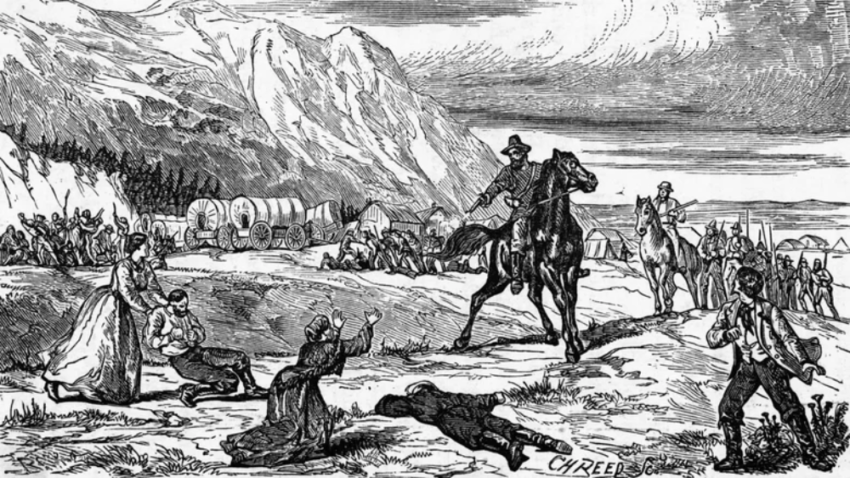
This is one of the darkest chapters in Mormon history—the Mountain Meadows Massacre. This isn’t a surface-level retelling. We walk through what led up to it, how it unfolded, and what happened afterward… and we let the historical record speak for itself. We examine the environment in southern Utah at the time—heightened fear, isolation, and rhetoric that blurred the line between obedience to leaders and loyalty to God. We talk about the Baker–Fancher wagon train, why they were targeted, and how a situation that could have ended peacefully turned into something far worse. We break down the massacre itself—how the militia gained the trust of the emigrants, what happened when they were escorted out under a white flag, and how the attack was carried out. We also cover what followed: the children who were spared and placed into Mormon homes, the removal and redistribution of property, and the long effort to control the narrative. We dig into the aftermath—the oath-like silence described by participants, the blaming of Native Americans, and the later statements by leaders that don’t quite line up with what we now know. We’ll also talk about the monument, its destruction, and the unsettling details surrounding that. This episode isn’t about sensationalism. It’s about understanding how something like this happens—inside a system that believes it is acting under divine authority.
In this episode:
* The climate in Utah leading up to 1857
* Brigham Young’s rhetoric and its impact
* The Baker–Fancher party and why they were targeted
* How the massacre unfolded
* The fate of the child survivors
* The cover-up and shifting of blame
* The role of John D. Lee and others
* The long road to accountability
Before you dive into the summary below, I want to point you to where this story truly comes alive — in the voices of the men who walked the ground and opened the documents. On Wednesday evening, April 22, Bill Reel and Radio Free Mormon devoted a full three-hour episode of Mormonism Live to the Mountain Meadows Massacre, and the recording is the finest accessible treatment of this history I have encountered in one sitting. Reel had just returned from walking the meadow himself that very day, camera in hand, and RFM brought his seasoned prosecutorial eye to every document they put on screen. What follows is a condensed narrative summary, but it is no substitute for the real thing. Watch the two of them build the case sermon by sermon, letter by letter, plaque by plaque — and see the photographs Bill took at the overlook, the execution site, and the gravesite cairn. You can stream the full discussion on the Mormon Discussions Podcast YouTube channel here: https://www.youtube.com/live/Kt7-xLnuJWQ?si=x7AzUHbn-tb3Lp1r. Subscribe while you are there — this kind of rigorous, source-driven historical work deserves a wide audience, and channels like theirs only grow when we bring people to them.
This review also serves as a natural companion to my earlier post, Blood, Bigotry, and False Prophecy: Why Brigham Young Cannot Be Called a Man of God — an in-depth study examining Young’s racism, his polygamy, his false prophecies, his theology, his culture of violence, and the ongoing institutional effort to sanitize his legacy. What Reel and Radio Free Mormon document in their three-hour discussion of the Mountain Meadows Massacre is not an anomaly in Young’s tenure but a logical extension of the doctrines, rhetoric, and authoritarian structures explored there. Readers who want the fuller case against Young’s prophetic credentials will find that essay a useful next step.
The following is a synopsis of this podcast:
The Mountain Meadows Massacre:
A Mormon Discussions Podcast Review.
The First 9/11
A Deep Dive into the Mountain Meadows Massacre
Summary of Mormonism Live, aired Wednesday, April 22
Hosted by Bill Reel with co-host Radio Free Mormon
Introduction: A Meadow Drenched in Blood
On a September morning in 1857, a wagon train of roughly 120 men, women, and children from Arkansas rolled into a grassy valley in southern Utah, paused to rest their livestock, and never rolled out again. Over five days — September 7 through September 11 — the Baker-Fancher Party was besieged, deceived under a white flag, and slaughtered in one of the most coldly orchestrated acts of religious violence in American history. Only seventeen children, all deemed too young to remember, were spared.
On the April 22 episode of Mormonism Live, host Bill Reel — fresh from a personal visit to the Mountain Meadows site — joined co-host Radio Free Mormon (RFM) for a source-driven reexamination of what happened, why it happened, and how the cover-up has stretched from 1857 into the present day. Drawing on primary documents — the congressional special report by Brevet Major J. H. Carleton, the findings of Indian Affairs Dr. Jacob Forney, John D. Lee’s confessions, Juanita Brooks’s seminal history, and Will Bagley’s Blood of the Prophets — the hosts refused both apologetic extremes: the claim that a few rogue Saints went off-script, or the claim that Brigham Young personally barked the order. The truth, they argue, is darker than either caricature.
Setting the Stage: A Theology of Sanctified Violence
Reel opens not with the massacre, but with the sermons that made it thinkable. In 1856 — a single year before Mountain Meadows — Brigham Young repeatedly preached blood atonement, the idea that certain sins were so severe that the blood of Christ could not cleanse them, and the sinner’s own blood had to be spilled to make amends. It was not an obscure footnote. It was a pulpit theme.
The Javelin Sermon (March 16, 1856)
In one of the more chilling addresses of the era, Young offered a grim hypothetical about catching his own wife in adultery — he would be justified, he said, in piercing both her and her partner through the heart with a javelin, and would do it “with clean hands.”
“There is not a man or woman who violates the covenants made with their God that will not be required to pay the debt. The blood of Christ will never wipe that out. Your own blood must atone for it.”
— Brigham Young, March 16, 1856
RFM observed that this was not ambiguous. A public leader, speaking from a position of theocratic authority, was telling his followers that killing could be a form of moral repair. Such rhetoric gives followers “license to enact the violence that they already may be contemplating.”
The September 1856 Sermon: Killing as Favor
Six months later, Young doubled down. There were sins, he preached, for which the sinner would — if enlightened — be willing to have his own blood spilled as an offering. Critics of “strong doctrine,” he added, should understand the killing was meant to save, not destroy, the soul.
“I know when you hear my brethren telling about cutting people off from the earth, that you consider it strong doctrine; but it is to save them, not to destroy them.”
— Brigham Young, September 21, 1856
Reel drew the obvious throughline: if a prophet insists that murder can be mercy, and if obedience is preached as “the first law of heaven,” the remaining barrier to mass violence is not conscience. It is coordination.
A Theocracy with No Brakes
Compounding the rhetoric was the structure of early Utah itself. The same men who served as bishops and stake presidents also served as mayors, judges, and militia officers. Church, state, and military flowed through a single pipeline of authority. Dissent was not merely unpopular — it was administratively impossible. Add the Danites, the endowment’s vengeance oath, the scriptural veneration of Nephi killing Laban and Abraham binding Isaac, and the cultural command to obey priesthood authority even against one’s own conscience, and the conditions were not merely permissive. They were generative.
The Baker-Fancher Party: Who They Actually Were
Departing near Harrison, Arkansas in April 1857, the company of roughly 120 to 150 people consolidated along the trail into what would become known as the Baker-Fancher Party. They were bound for California with wagons, tents, cattle, and families. Not a war party. Not fugitives. Families. Brevet Major J. H. Carleton’s subsequent investigation, built on testimony from places the party had passed through, painted a clear picture of their character.
“The company was respectable, quiet, and comparatively well-equipped… with multiple wagons, tents, women, and many children.”
— Brevet Major J. H. Carleton, Special Report of the Mountain Meadow Massacre
This reality matters because two Mormon-originated rumors were later seeded to justify what happened: that the party boasted of killing Joseph Smith, and that they poisoned a spring at Corn Creek, sickening Paiutes. RFM drilled into the incoherence of these claims. If the Mormons denied any role, why fabricate motives for themselves? The alibis betrayed the crime. Dr. Jacob Forney, who began his investigation assuming Paiute guilt, concluded the poisoning story was “too improbable to be true” and that “bad white men magnified” it to inflame Indian hostility. Even the tribe named — the Pahvants — lived a hundred miles away and had no difficulty with the company.
A Perfect Storm: The Utah War Climate
The emigrants arrived in a territory on a war footing. The United States Army, roughly 850 men with freight trains strung behind, was marching toward Utah to install a new federal governor in place of Brigham Young. Martial law was effectively in force. Young had instructed the Saints to hoard supplies and deny trade to passing emigrant trains. The Baker-Fancher Party, depleted by months on the trail, arrived at the precise moment when Mormon settlements had been ordered to treat outsiders as adversaries. Messages ran south along the route ahead of them. By the time they reached Mountain Meadows, they were walking into a prepared climate of suspicion, scarcity, and theological rage.
The Attack: A Five-Day Siege
On Monday, September 7, 1857, the first shots rang out as the emigrants camped at a spring in Mountain Meadows — a broad valley ringed by mountains. Reel, who walked the ground the day of the podcast, described the geography: a meadow sitting in a shallow depression, with ridgelines offering attackers both concealment and elevation. The immigrants responded with the discipline of experienced trail travelers. They circled their wagons and reinforced the corral with earth shoveled up to the wagon beds, creating a makeshift fort. For several days they traded fire with their attackers, suffering some killed and wounded. Per Forney’s report:
“White men were present and directed the Indians.”
— Dr. Jacob Forney, Indian Affairs
The wagon fort held. Daily exchanges of fire “did not accomplish much.” By day five, the Baker-Fancher Party was out of water, short on ammunition, and had no reason to believe rescue was coming. They were ripe for the next, more insidious phase of the plan.
Deception-Based Annihilation: The White Flag
On September 11 — the first 9/11, as Reel pointedly frames it — a group of local Latter-day Saint militiamen, recognizable as such to the besieged emigrants, approached under a white flag. Led by John D. Lee, they negotiated a deal: surrender your weapons, and you will be escorted safely from the valley. The emigrants, exhausted and without options, agreed. The militia then separated the company. The wounded, women, and children were placed in wagons and sent ahead. The adult men and older boys were marched in single file behind them, each escorted by one armed Mormon militiaman. The two groups moved several hundred yards apart along the road. Then, at a prearranged signal — testimony from the trials suggests the shouted word “halt” — the killing commenced.
“Signal: ‘The work of death commenced.’”
— Brevet Major Carleton, Special Report
Each militiaman turned and shot the man walking beside him. Simultaneously, other attackers — some militia, some Paiute allies — fell upon the women and older children in the wagons. Within minutes, roughly 120 men, women, and older children lay dead. RFM noted, in a revealing aside, that the phrase “the work of death” occurs three times in the Book of Mormon — a 19th-century turn of phrase embedded in a text that purports to be ancient. Reel emphasized the coordination: this was not a spontaneous atrocity. Signals, stations, cues, and roles were all pre-assigned. This was planned.
The Seventeen: Children Spared, Then Used
Only seventeen children survived, ranging from two months to seven years old. The Mormons made the grim calculation that only children too young to bear witness could be allowed to live. Reel noted that plaques at the memorial list victims as young as nine, ten, and eleven — children old enough to remember were deemed old enough to kill. The survivors were taken to Jacob Hamblin’s ranch house on the northern slope of the meadow, then distributed among Mormon families in Cedar City, Santa Clara, and elsewhere. Forney would later find them “in better condition than children generally in the settlements” — a detail RFM noted speaks to Forney’s credibility precisely because it cuts against his larger conclusion. But the care was not innocence. It was cover. And it was also, in its most cynical form, commerce.
The Audacity of the Claim
The Mormons told federal investigators that the children had been stolen by the Paiutes, who had then sold them to the Mormons in exchange for rifles, blankets, and goods. On this fiction, they then filed claims for reimbursement — $200 to $400 per child — from the federal government for the costs of feeding, clothing, and doctoring the survivors.
“Murderers of the parents and despoilers of their property, these Mormons, rather these relentless incarnate fiends, dared even to come forward and claim payment for having kept these little ones barely alive… Has there ever been an act which at all equaled this devilish hardihood? Never but one. And even then the price was but thirty pieces of silver.”
— Brevet Major Carleton, Special Report to the 57th Congress
The Loot
Forney was equally blunt about motive. The emigrants had traveled with a large quantity of property — wagons, cattle, tools, clothes — “not one particle of which has been satisfactorily accounted for.” Carleton documented that cattle taken from the company could be traced into Mormon hands and resold. Reel added a chilling detail: reports that survivors later saw Mormon neighbors wearing the clothes of their murdered parents.
The Brigham Young Letter: Alibi or Authentic?
No artifact in this story has been more litigated than the letter Brigham Young sent in response to Isaac C. Haight’s September 7 inquiry asking what to do about the Baker-Fancher Party. Young’s reply is dated September 10, 1857 — one day before the massacre.
“In regard to the emigration trains passing through our settlements, we must not interfere with them until they are first notified to keep away. You must not meddle with them. The Indians we expect will do as they please, but you should try and preserve good feelings with them. If those that are there will leave, let them go in peace.”
— Brigham Young to Isaac C. Haight, September 10, 1857
The letter, on its face, appears exculpatory. Juanita Brooks, the pioneering Mormon historian whose book The Mountain Meadows Massacre broke the silence in the mid-20th century, concluded that Young had not ordered the killing but had created the conditions that made it possible.
“While Brigham Young and other church authorities did not specifically order the massacre, they did preach sermons and set up social conditions that made it possible.”
— Juanita Brooks, The Mountain Meadows Massacre
But Reel and RFM pressed harder. First, the letter’s pristine condition raises questions. Is it dated September 10, or was it written September 10? In a religious tradition with a long history of documentary obfuscation, the hosts noted it would not be surprising if the letter had been composed after the fact as a cover document. Second, the letter’s content betrays the cover story. If the massacre was purely the work of Native Americans, why were Haight and others writing urgently to Salt Lake asking permission to act? Why would Young’s reply tell his people not to meddle with the emigrants? The very existence of the question reveals the falseness of the eventual alibi. Third, Will Bagley, in Blood of the Prophets, argued that Young often embedded coded instructions in otherwise innocuous letters — broad generalizations up front, with the operative message in a terse phrase buried in the middle. And then there is the postscript — scrawled on the same letter — that haunts the entire record:
“P.S. Vengeance is mine, saith the Lord, and I have taken a little.”
— Brigham Young, postscript to the September 10, 1857 letter
The Cover-Up: Oaths, Scapegoats, and a Convenient War
The Oath of Silence and the Reimbursement Letter
John D. Lee’s posthumous confessions record that the militia at Mountain Meadows was sworn to secrecy. Trial testimony decades later confirmed it — witnesses recalled Klingensmith and Haight telling them “to keep silent, that it would be best to keep silent.” On November 20, 1857, Lee wrote to Brigham Young in Young’s capacity as Superintendent of Indian Affairs — a dual role that conveniently let the same man receive, process, and launder the claim. Lee framed the massacre as an Indian depredation and attached an itemized account of livestock, wagons, and goods attributed to specific tribal bands, positioning the event for federal reimbursement. The paperwork was the cover story put in writing.
The Sermon of 1863
Most damning, RFM argued, is Brigham Young’s March 8, 1863, sermon — delivered years after Young unquestionably knew what had happened — in which he publicly told his flock that the Arkansas emigrants had been “destroyed by the Indians,” framing continued federal inaction as proof of Mormon innocence:
“To this day they have not touched the matter, for fear the Mormons would be acquitted from the charge of having any hand in it, and our enemies would thus be deprived of a favorite topic to talk about.”
— Brigham Young, Sermon of March 8, 1863
RFM offered an alternative explanation for the federal silence that required no supernatural vindication: the Civil War. With the nation consumed by four years of war and then Reconstruction, the Mountain Meadows investigation fell off the front page. Prosecutions that might otherwise have come in the early 1860s did not arrive until the mid-1870s.
The Scapegoat
When justice finally came, it came for one man. A grand jury indicted nine. Only John D. Lee was tried. His first trial in 1875 ended in a hung jury before a largely Mormon panel. His second trial in 1876 produced a conviction, on the strength of testimony from fellow participants who somehow remembered Lee’s every action while forgetting their own. On March 23, 1877, Lee was taken to Mountain Meadows, seated on his own coffin at the edge of the meadow where the massacre had occurred, and executed by firing squad.
“I am a victim. I am sacrificed in a cowardly, dastardly manner.”
— John D. Lee, final statement before execution
Lee was excommunicated in 1870, four years before his arrest. Isaac Haight was also excommunicated. No other participant was ever criminally prosecuted. RFM noted the grim theological irony: in a church that taught blood atonement, Lee’s execution fulfilled the doctrine. One man’s blood was shed to redeem the community.
Walking the Ground: Reel’s Visit to the Site
Reel interspersed the podcast with photographs from his visit and RFM’s earlier visit in snowy February 2023. The site consists of several markers spread across a wide meadow ringed by mountains — an Overlook with panoramic plaques, memorials for the Women and Children and for the Men and Boys, a monument at the execution site where John D. Lee died, and the principal Gravesite Memorial surrounded by an iron fence and inscribed plaques bearing victims’ names and ages. Reel noted the somber average age of those named: low to mid-twenties, with many teenagers and younger children. He commented on one architectural curiosity: the road to the main Gravesite Memorial is paved, while the roads to the other markers remain dirt — a subtle signal, he suggested, that the Church wants visitors to see one particular, more sterile site and not linger at the others. A 1999 excavation accidentally unearthed additional remains, triggering a forensic anthropology study that reported findings consistent with close-range gunfire on men’s skulls and blunt-force trauma on many women and children, with no evidence of arrow trauma — further undermining the myth of primarily Native American perpetration.
Regret vs. Apology: The Carefully Crafted Non-Apology
In 2007, on the 150th anniversary, Elder Henry B. Eyring traveled to Mountain Meadows and delivered a statement on behalf of the First Presidency. He called the massacre “a terrible and inexcusable departure from Christian teaching.” The Church’s 2007 statement acknowledged that “a separate expression of regret is owed to the Paiute people,” who had “unjustly borne the principal blame.” Reel zeroed in on the chosen word: regret. In a church famously precise with language, the choice is telling.
“Regret says something bad happened and we feel sad about it. An apology says something bad happened and we take responsibility for it. Those are two very different moral positions.”
— Bill Reel, Mormonism Live
The Church’s present-day topic page attributes the massacre to “tragic decisions by local church leaders,” while omitting any reference to Brigham Young’s violent rhetoric, the doctrine of blood atonement, or his continued public blaming of Native Americans as late as 1863. Signage at the site describes violence committed “by Mormon militia” — a distancing formulation that obscures that those same militiamen were also the stake president, the bishop, the mayor, and the judge. They were, Reel insisted, the Church in that time and place.
Broader Patterns: Why This Matters
In a concluding stretch, the hosts zoomed out to the psychological and doctrinal scaffolding that produced Mountain Meadows and, they argued, continues to produce religiously motivated violence in the Mormon orbit — from the Lafferty brothers to Jeffrey Lundgren to Chad Daybell and Lori Vallow. The essential ingredients are durable: obedience elevated to the first law of heaven; a leader’s voice treated as equivalent to God’s; scriptural models (Nephi and Laban, Abraham and Isaac) in which divine command overrides moral intuition; rhetoric that frames dissenters as existential threats; and a doctrine that sacralizes violence as restorative. When these elements are present, Reel argued, atrocity becomes not aberration but predictable output.
“When you teach obedience is the first law of heaven and you encourage dishonesty, manipulation, obfuscation, and violence, what do you expect will happen? It’s almost mathematical in its predictability.”
— Bill Reel
A Personal Reckoning
Toward the end of the episode, Radio Free Mormon shared the story that shaped his own understanding of this history. Around age forty, having heard whispers in Mormon hallways about a massacre blamed on Indians, he finally sat down with Juanita Brooks’s book. He had expected a siege and a running gun battle. He was not prepared for the white flag, the march, the prearranged signal, the militiaman walking beside each emigrant man. He could not sleep that night. The next morning was Tuesday, September 11, 2001. He woke to the news that the World Trade Center had fallen.
“Before there was 9/11, there was 9/11. Because nothing is more dangerous than a person who is religious and knows they’re right.”
— Radio Free Mormon
Conclusion: The Meadow Still Speaks
The Mountain Meadows Massacre was not, as apologists suggest, the tragic improvisation of a few overzealous frontiersmen. Nor was it, as some critics insist, an operation ordered in so many words by Brigham Young. It was something more troubling: the predictable harvest of a theology that preached blood atonement, a culture that enshrined obedience, a polity that fused church and state and militia into one unreviewable hand, and a leadership that cultivated rhetoric of violence and then professed shock when that rhetoric was taken at its word.
The cover-up that followed — the invented Paiute villains, the reimbursement claim, the twenty years of foot-dragging, the scapegoating of John D. Lee, the dismantling of the memorial, the late-arriving “regret” that will not quite say “sorry” — compounded the original crime. As Reel observed in closing, every ward should spend at least two Sundays a year teaching what happens when religious fanaticism goes too far. The lesson is simple:
“It’s okay to lie for the church, but don’t kill for the church.”
— Bill Reel, summarizing the ethical floor the tradition has not yet reached
Until that lesson is taught — not with regret, but with repentance — the meadow will keep speaking. And thoughtful men like Bill Reel and RFM will keep turning up, microphones in hand, to make sure it is heard.
— End of Summary —