
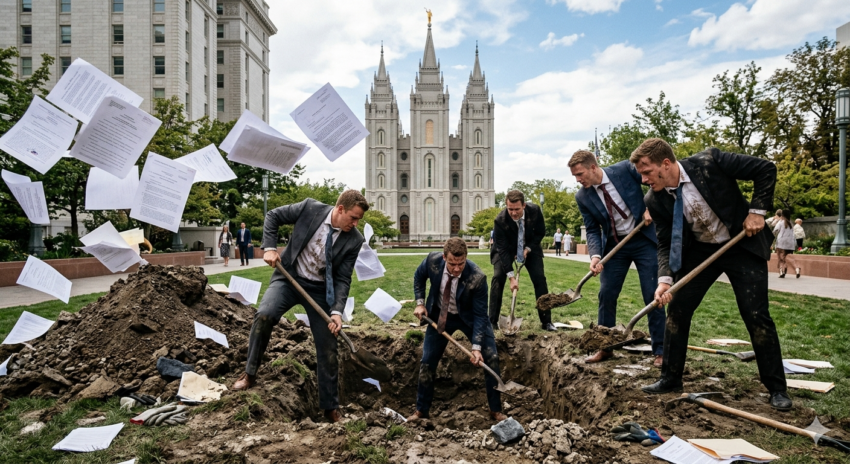
Image: An AI-generated image imagines a group of handsomely dressed lawyers frantically digging a hole near an LDS temple to find archeological evidence against brand infringement.
Trademark, Tribe, and Trial
A Semi-Legal Analysis of the LDS Church’s Lawsuit Against
John Dehlin and the “Mormon Stories” Podcast
1. Introduction: A Suit Born of a Word
On April 17, 2026, a federal complaint landed in the United States District Court for the District of Utah that may, before it concludes, redraw the working boundary between religious self-identification and registered trademark. The Church of Jesus Christ of Latter-day Saints, joined by its intellectual property arm Intellectual Reserve, Inc., sued podcaster John Dehlin and his nonprofit Open Stories Foundation, alleging trademark infringement, unfair competition, and copyright infringement arising from the branding of the long-running “Mormon Stories” podcast. The complaint asks the federal court to permanently enjoin Dehlin and his organization from using marks, names, or designs “confusingly similar” to those of the Church, and from reproducing or publicly displaying any of the Church’s copyrighted images in connection with the podcast’s promotional and editorial activity.
The factual posture is unusual. The plaintiff is the largest religious organization in the Mountain West and has amassed a large portfolio of marks containing the word “Mormon,” even as its own top leaders have spent years urging the public to stop using that very term. John Dehlin has used the phrase “Mormon Stories” continuously since 2005, and he was excommunicated from the plaintiff’s membership rolls. The legal point is sharper still: the Church’s trademark campaign is now being handled by Pirkey Barber in Texas, while Kirton McConkie remains the Church’s broader longtime institutional counsel in other contexts. That makes the case less a simple dispute over ownership and more a revealing clash between a public rebranding effort and a legal strategy designed to preserve exclusive control over the language the institution itself has tried to retire.
This analysis proceeds from the assumption that both sides are entitled to a fair, evidence-driven adjudication. Reasonable people of good faith may disagree about where the line falls between brand confusion and protected expressive use; the goal here is not to score points but to weigh the legal merits with the same rigor a trial court will eventually be obliged to apply. The discussion that follows examines the Church’s use of the doctrinal pillars of “intent” and “confusion,” the institutional record of distancing the Church from the very term in question, the patchwork enforcement history surrounding the word “Mormon,” the latent conflict-of-interest concerns surrounding plaintiff’s counsel, the high but not insurmountable bar of malicious prosecution doctrine, the equitable consequences of more than two decades of non-enforcement against the defendant, and a count-by-count rebuttal to the complaint.
2. Analysis of “Intent” and “Confusion” in the Complaint
Two doctrinal terms carry the bulk of the complaint’s argumentative weight: intent and confusion. The Church alleges that Dehlin “willfully and knowingly created confusion” by adopting logos, color palettes, fonts, and imagery similar to the Church’s official visual identity. Each word in that allegation must be unpacked, because each carries a distinct legal load.
2.1 Intent in Civil Trademark Litigation
In American civil litigation, intent is rarely a strict-liability proxy. As Cove Law summarizes the doctrine, “intent is not necessarily a required element” in many civil claims, and even where it is alleged, the burden is the relatively modest “preponderance of the evidence,” not the criminal standard of proof beyond a reasonable doubt. The Hofstra Law Review’s treatment of intent in civil cases adds that intent is almost always proved circumstantially — inferred from conduct, communications, and pattern — because direct admissions are rare.
Source: https://covelaw.com/the-role-of-intent-in-civil-criminal-cases/
Source: https://law.hofstra.edu/pdf/academics/journals/lawreview/lrv_issues_v38n04_cc1_crump_final.pdf
In trademark infringement under the Lanham Act, intent is one of several factors in the multi-factor confusion test (variously the Polaroid, Sleekcraft, or AMF v. Sleekcraft factors, depending on circuit), but it is not dispositive. Bad-faith intent to capitalize on another’s goodwill can be a thumb on the scale; its absence does not, by itself, defeat liability, and its presence does not, by itself, establish liability. The Church’s repeated use of “willfully and knowingly” in the complaint is best understood as a pleading strategy aimed at unlocking enhanced statutory damages and attorney’s fees under 15 U.S.C. § 1117 in the event of victory — not as an indispensable element.
Dehlin’s position is that the brand existed in essentially the same form for nearly two decades before the alleged confusion arose, that the December 2022 logo color shift to blue was an aesthetic choice common to thousands of media brands, and that further changes were made promptly upon receipt of the Church’s November 2025 letter. A defense rooted in good-faith belief, prior use, prompt remediation, and reliance on counsel — the four classic pillars of a no-bad-intent defense in commercial litigation — is plainly available.
2.2 Confusion: The Heart of the Lanham Act Inquiry
Under 15 U.S.C. § 1114, the operative question is not whether anyone could ever be confused, but whether there is a likelihood of confusion among an appreciable segment of relevant consumers as to source, sponsorship, or affiliation. Courts assess this through fact-intensive multi-factor balancing, weighing the strength of the senior mark, the similarity of the marks, the similarity of goods or services, evidence of actual confusion, the defendant’s intent, the marketing channels used, the degree of consumer care, and the likelihood of bridging the gap between the parties’ markets.
The complaint marshals anecdotal Facebook and YouTube comments — “is this channel run by Mormons? Or ex-Mormons?” and “I subscribed to his channel immediately thinking it was church-affiliated” — as evidence of actual confusion. Such comments are admissible but, standing alone, are notoriously thin proof of likelihood of confusion. Federal courts routinely discount unverified, self-selecting online comments unless they reflect a representative consumer survey or systematic data. The Tenth Circuit, which will govern any appeal from the District of Utah, has emphasized that anecdotal evidence of confusion must be weighed against the broader market reality.
“Trademark law should not be used to deprive commercial speakers of the ordinary utility of descriptive words.”
— U.S. Supreme Court, KP Permanent Make-Up, Inc. v. Lasting Impression I, Inc., 543 U.S. 111 (2004), as quoted by the Electronic Frontier Foundation
https://www.eff.org/deeplinks/2016/02/not-mormonr-still-mormon
That principle is particularly forceful where, as here, the contested term is also the popular name of a 196-year-old religious tradition encompassing multiple denominations — the LDS Church, the Community of Christ, fundamentalist groups, and the Bickertonite and Strangite branches — and where the United States Patent and Trademark Office has previously rejected an application by the Church to register “Mormon” for religious services on grounds that the word is generic in that context, comparable to “Presbyterian” or “Methodist.”
3. The Church’s Public Repudiation of the Term “Mormon.”
Few documents are more legally awkward for the plaintiff than the plaintiff’s own published style guide. The Church’s Newsroom directs the public, the media, and members alike to refrain from the very word it now seeks to enforce against a third party:
“While the term “Mormon Church” has long been publicly applied to the Church as a nickname, it is not an authorized title, and the Church discourages its use. Thus, please avoid using the abbreviation “LDS” or the nickname “Mormon” as substitutes for the name of the Church, as in “Mormon Church,” “LDS Church,” or “Church of the Latter-day Saints.””
— Church Newsroom Style Guide, The Church of Jesus Christ of Latter-day Saints
https://newsroom.churchofjesuschrist.org/style-guide
This passage is, in a single paragraph, both a public-relations directive and a potential evidentiary admission. The Church frames “Mormon” as a “nickname,” not an authorized title, and “discourages its use.” Trademark law turns on the proposition that a mark functions as a source identifier in the marketplace; a mark whose owner publicly tells the world to stop using it has a credibility problem the moment it walks into court asking that the same word be policed.
Counsel for the defense will almost certainly seek admission of this style guide — along with the 2018 directives by President Russell M. Nelson urging the public to drop “Mormon” and “LDS” — as evidence under Federal Rule of Evidence 801(d)(2) as a party-opponent admission. Such evidence does not, by itself, constitute abandonment of the trademark; under American doctrine, abandonment requires non-use “with intent not to resume” for three consecutive years. But the style guide goes directly to the strength-of-mark and likelihood-of-confusion analyses. If the senior user has spent eight years telling the world the term should not be applied to its Church, an ordinary consumer encountering “Mormon Stories” may have less, not more, reason to assume official affiliation.
“We have to be careful to protect the name ‘Mormon.’ The media will think that we are tossing it out. We aren’t. We just want to be accurate.”
— President Russell M. Nelson, address to Latter-day Saints in Canada, August 2018, as reported by Tad Walch in the Deseret News
https://www.deseret.com/2018/8/19/20651519/we-re-correcting-a-name-president-russell-m-nelson-tells-latter-day-saints-in-canada/
The Nelson statement is the Church’s strongest counter to its own style guide — a sworn intent to protect, not abandon. Reasonable jurists will read the Newsroom guide and the Nelson address together and conclude that the Church’s posture is one of selective retention: dropping “Mormon” as a self-designation while preserving the legal right to police others’ use of it. Whether this two-track strategy is coherent under trademark doctrine is precisely the question the District of Utah must now resolve.
4. Historical Context of the Church’s Branding Efforts
To assess the present action, one must understand the long arc. The word “Mormon” was originally a slur applied by outsiders, drawn from the Book of Mormon and used in 1831 newspaper coverage to dismiss “that infamous imposter” Joseph Smith and his followers. By the 1840s, the term had been reappropriated by adherents themselves, and by the late nineteenth century, it had become the standard global shorthand for the movement. President Gordon B. Hinckley’s celebrated 1990 General Conference address, “Mormon Should Mean ‘More Good,’” embraced the term explicitly, conceding that the Church might “never convert the world” to using its full name and urging members to wear the nickname with pride.
Source: https://en.wikipedia.org/wiki/Mormon_(word)
From roughly 2010 through 2018, the Church invested heavily in monetizing the very word it now disclaims. The “I’m a Mormon” advertising campaign aired internationally; the 2014 feature film Meet the Mormons was distributed in commercial theaters; mormon.org served as the public-facing missionary domain; and the Mormon Tabernacle Choir toured under that brand. These efforts established commercial use, fixed the term in the public mind, and built the trademark portfolio Intellectual Reserve now seeks to enforce.
The pivot came in August 2018, when President Russell M. Nelson declared in General Conference that the use of nicknames for the Church represented a “major victory for Satan” and announced an institution-wide rebranding. Mormon.org and lds.org were redirected to ChurchofJesusChrist.org. The Mormon Tabernacle Choir was renamed the Tabernacle Choir at Temple Square. Deseret Book began phasing out titles containing “Mormon.” An updated style guide instructed the public, the media, and members to use the full name on first reference and “the Church,” “the Church of Jesus Christ,” or “the restored Church of Jesus Christ” thereafter.
The historical record matters legally because trademark rights flow from use in commerce. A mark grows or shrinks with how the public perceives it. When the Church spent a decade saturating the marketplace with “Mormon” as a primary identifier, then spent the next eight years actively dismantling that very identification, it created exactly the conditions under which questions of mark dilution, abandonment, naked licensing, and selective enforcement become legally salient. The Dehlin litigation thus arrives at a doctrinally awkward moment in the Church’s own branding history.
5. Trademark Issues and the Selective History of Enforcement
Intellectual Reserve’s trademark portfolio is real, registered, and substantial. The complaint itemizes a non-exhaustive list: “Mormon,” “Book of Mormon,” “Book of Mormon Stories,” “Mormon Messages,” “Mormon Channel,” “Mormon Tabernacle Choir,” “Book of Mormon Videos,” “Mormon Battalion,” and “Mormon Handicraft.” Each registration is presumptively valid under 15 U.S.C. § 1057(b). But registration is the floor of a trademark inquiry, not the ceiling. Three structural problems confront the plaintiff.
5.1 The USPTO Has Already Refused “Mormon” for Religious Services
In a fact rarely surfaced in the Church’s public statements, the United States Patent and Trademark Office rejected an application by the Church to register the bare word “Mormon” for religious services. The 2005 office action concluded that the term was generic in that context — “popularly understood as referring to a particular kind of church, similar to Presbyterian or Methodist, rather than a service mark.” The application was abandoned in August 2007. This federal administrative determination is not res judicata in the present action, but it is highly persuasive authority for the proposition that “Mormon”, used to describe a religious community or its discourse, may operate as a generic descriptor rather than a protectable source-identifier.
Source: https://en.wikipedia.org/wiki/Mormon_(word)
5.2 Selective and Inconsistent Enforcement
Trademark rights erode under selective enforcement. Courts in the Tenth Circuit and elsewhere have long held that a mark holder who tolerates widespread third-party use weakens the mark. The record reveals a striking pattern. The Church has, since 2014, sent cease-and-desist letters to or pursued opposition proceedings against “Mormon Match” (a dating site), “Bad Mormon” (a 2023 trademark application by Heather Gay of The Real Housewives of Salt Lake City), “Mormon Mental Health Association” (a 501(c)(3) clinical organization), “Mormons for the Devil,” and several smaller entities.
Yet during the same period, dozens of academic, journalistic, and commercial uses have proceeded entirely unchallenged: the Journal of Mormon History, the Mormon Studies Review, the Howard W. Hunter Chair of Mormon Studies at Utah State University, the Mormonish Podcast, Mormon Land (a Salt Lake Tribune podcast), Mormon Coffee (an evangelical apologetics blog), and indeed “Mormon Stories” itself for two full decades. The Electronic Frontier Foundation, representing the Mormon Mental Health Association in 2016, framed the broader concern bluntly: “Trademark law does not give one company the right to control language.”
Source: https://www.eff.org/deeplinks/2016/02/not-mormonr-still-mormon
Source: https://mrm.org/mormon-term
5.3 The Equitable Defenses That Selective Enforcement Unlocks
Three equitable doctrines flow from selective enforcement: laches, acquiescence, and estoppel. Laches bars relief where the plaintiff has unreasonably delayed asserting a known right and the defendant has been prejudiced. Acquiescence — stronger still — bars relief where the plaintiff has affirmatively, though perhaps implicitly, indicated it will not enforce. Estoppel bars the plaintiff who has misled the defendant by conduct into believing that enforcement would not follow. Each is fact-intensive; each will be fully briefed at the summary-judgment stage; and each is significantly strengthened by the Church’s own “discourages its use” Newsroom guide.
6. Conflict-of-Interest Considerations: The Counsel Question
The trademark suit against John Dehlin is being handled by Pirkey Barber in Texas, a major trademark firm whose involvement signals that the Church is treating this as a serious intellectual-property case rather than a casual dispute. That distinction matters because it keeps the immediate litigation question separate from the Church’s broader, long-running relationship with Kirton McConkie.
Kirton McConkie remains the Church’s longtime outside counsel and has been closely identified with LDS institutional matters for decades. The firm’s City Creek Center offices were dedicated by Elder Dallin H. Oaks, and the Church’s general counsel, Lance B. Wickman, said at that dedication that the firm was not simply representing “another client,” but “the church of Jesus Christ himself.” That language is not, by itself, evidence of a technical conflict under Utah’s ethics rules, but it does show a level of institutional identification that goes well beyond ordinary lawyer-client distance.
As a matter of professional responsibility, that close relationship does not automatically disqualify either firm. The Church may hire Pirkey Barber for a trademark dispute while still relying on Kirton McConkie as its broader institutional counsel, and there is no inherent rule violation in that arrangement absent a specific concurrent conflict. Still, the optics are hard to ignore: one firm is pushing a branding-enforcement case, while the other carries the Church’s long memory as a legal institution embedded in LDS life.
The public backdrop also matters. The Associated Press reported in 2022 that Kirton McConkie operated the Church’s abuse helpline and that critics alleged the system often prioritized legal exposure over reporting abuse to law enforcement; the Church disputed those allegations, but the controversy remains part of the public record. Even though that controversy is separate from the Dehlin trademark case, it inevitably shapes how observers interpret the Church’s legal posture and its appetite for aggressive institutional protection.
For the court, however, the analysis remains narrower. Counsel’s closeness to the client does not change trademark law. A meritorious claim is not weakened because it is brought by an experienced firm, and a weak claim is not strengthened by institutional familiarity. The more relevant issue is whether the Church’s long pattern of selective trademark use reflects a coherent policy or a late-stage effort to police language after years of publicly discouraging the very term it now seeks to enforce.
7. The Doctrine of Malicious Prosecution in Civil Cases
The complaint has prompted some commentators to invoke the principle of malicious prosecution. The doctrine is real but exceptionally narrow, and it is important to be precise about what it does and does not allow.
As Beresford Booth’s analysis of civil malicious prosecution notes, the modern American framework, traceable through Clark v. Baines, 150 Wash.2d 905 (2004), requires a defendant turned counterclaimant to prove seven elements: (1) that a civil claim was filed; (2) that the claim lacked probable cause; (3) that the plaintiff was motivated by malice; (4) that the plaintiff failed to prove the claim; (5) that the defendant suffered injury; (6) that the claim resulted in arrest of the defendant or seizure of the defendant’s property; and (7) that the resulting injury was “special” — that is, distinct from the ordinary burdens of being sued. Most jurisdictions follow analogous frameworks, and the doctrine is similarly narrow in Utah federal practice.
Source: https://beresfordlaw.com/malicious-prosecution-in-civil-cases/
The sixth element — arrest or seizure of property — is a near-fatal hurdle in ordinary civil cases. Trademark suits do not normally produce either, although a successful preliminary injunction granted to the plaintiff could, depending on its scope, freeze the defendant’s assets, domain registrations, or sponsorship revenues, raising potential “special injury” arguments. Even so, the realistic legal posture is that any malicious-prosecution counterclaim by Dehlin against the Church would be exceptionally difficult to sustain unless and until the present trademark suit collapses entirely on the merits.
That said, the practical doctrines that more frequently constrain overreaching plaintiffs in trademark litigation are not malicious prosecution but rather (a) Federal Rule of Civil Procedure 11 sanctions for filings that lack a reasonable factual or legal basis; (b) the Lanham Act’s own attorney’s-fees provision, 15 U.S.C. § 1117(a), which allows the prevailing defendant in “exceptional cases” to recover fees — a standard interpreted broadly after Octane Fitness v. ICON Health (2014); and (c) anti-SLAPP statutes in jurisdictions where the suit might be characterized as targeting protected speech. Section 1117(a) is the most realistic vehicle for redress if the case is dismissed; courts have awarded fees against trademark plaintiffs whose enforcement appeared to target speech rather than commerce, particularly where prior tolerance of the same use undercuts the asserted likelihood-of-confusion claim.
8. Twenty Years of Silence: The Laches and Acquiescence Problem
Mormon Stories was launched in 2005. It has used the name “Mormon Stories” continuously for more than twenty years. By Dehlin’s account, repeated as recently as April 2026, the Church raised no formal trademark concern about the name itself until the Church’s November 2025 letter from the Intellectual Property Office. That is a delay of roughly two decades.
Laches in federal trademark practice typically borrows the analogous state limitations period as a presumptive trigger. Utah’s general statute of limitations for fraud and analogous trademark torts is four years; for written contracts, six. After roughly six years of inaction in the face of open, notorious, and commercially active use, the laches presumption shifts in the defendant’s favor. After twenty years, the presumption is overwhelming. The Church’s rejoinder — articulated in the April 23 Deseret News analysis by attorney Brittany Ratelle — is that the post-2022 logo redesign and the alleged appropriation of the Christus statue imagery created a new, materially different infringement that resets the laches clock. That argument has facial merit; whether it survives depends on whether the trier of fact concludes the alleged infringement is genuinely new, or merely an incremental evolution of pre-existing branding the Church previously tolerated.
Source: https://www.deseret.com/opinion/2026/04/23/mormon-stories-lawsuit/
Acquiescence is the harder doctrine for the plaintiff. Where the senior user has affirmatively communicated tolerance — by, for example, declining to act on prior complaints, by appearing as guests on the defendant’s platform, or by failing to respond to public branding decisions — acquiescence converts mere delay into something closer to consent. Discovery will reveal whether the Church or its agents ever, in twenty years, communicated approval, neutrality, or de facto consent to the “Mormon Stories” brand. That evidentiary record will be decisive.
9. Legal Rebuttals to Each Count of the Filing
The complaint advances three principal categories of claim: (i) trademark infringement and unfair competition under the Lanham Act, (ii) common-law and federal copyright infringement based on the use of Church-owned photographs, and (iii) requests for permanent injunctive relief. Each merits a discrete rebuttal.
9.1 Rebuttal to the Trademark Infringement and Unfair Competition Claims
First, descriptive fair use under 15 U.S.C. § 1115(b)(4) may apply. “Mormon Stories” arguably uses “Mormon” in its descriptive sense — stories about Mormons — not as a source-identifying brand. Where a term has been publicly disavowed by the senior user as an authorized title, the descriptive-fair-use defense is materially strengthened.
Second, nominative fair use under New Kids on the Block v. News America Publishing, 971 F.2d 302 (9th Cir. 1992), permits use of another’s mark when the product or service cannot be readily identified without it, when only so much of the mark as is reasonably necessary is used, and when nothing in the use suggests sponsorship or endorsement. A podcast that critically examines the Church of Jesus Christ of Latter-day Saints can hardly do so without naming it; the question is whether the visual presentation crosses the line from referential to suggestive of affiliation.
Third, the genericness defense under Park ’N Fly, Inc. v. Dollar Park & Fly, Inc., 469 U.S. 189 (1985), may attach to “Mormon” as applied to communities, discourse, and stories about the religious tradition — a defense materially supported by the USPTO’s 2007 abandonment determination.
Fourth, the equitable defenses of laches, acquiescence, and estoppel apply for the reasons set out in Section 8 above.
Fifth, the absence of competition between the parties cuts against confusion. The Church does not produce excommunicant-led oral-history podcasting; “Mormon Stories” does not produce official sacrament meeting curricula. Where the parties’ services do not overlap, the likelihood-of-confusion factors lean in the defendant’s way.
9.2 Rebuttal to the Copyright Infringement Claim
The complaint’s copyright count is meaningfully stronger than its trademark count. Photographs of the First Presidency and other officially commissioned imagery are clearly within the scope of the Church’s copyright registrations. Use of those images in commercial podcast thumbnails, banners, and social-media promotion is a textbook prima facie case for infringement.
Defendant’s likely defense is fair use under 17 U.S.C. § 107, weighing (i) purpose and character of the use, including transformativeness and commerciality; (ii) nature of the copyrighted work; (iii) amount and substantiality of the portion used; and (iv) effect on the potential market. Mormon Stories will argue that its use is transformative — commentary, criticism, journalism, and education concerning the very institution depicted. The countervailing factors are that the use is commercial (the podcast generates revenue), that the photographs are creative rather than purely factual, and that the use of entire images, not excerpts, weighs against fair use.
In favor of the defense: the Brigham Young University Religious Studies Center’s own scholarship, published as “‘We Believe in Being Honest’: Using Church Copyrighted Materials,” acknowledges substantial latitude under fair use for educational and critical commentary on the Church’s own materials. Dehlin has also represented that Mormon Stories has, in response to the complaint, removed the contested images and committed not to use copyrighted Church photographs prospectively. Such remediation, undertaken in good faith, is relevant to both the equitable balance and to any award of statutory damages or fees.
Source: https://web.archive.org/web/20240422201108/https://rsc.byu.edu/vol-6-no-3-2005/we-believe-being-honest-using-church-copyrighted-materials
9.3 Rebuttal to the Demand for Permanent Injunction
Permanent injunctive relief in federal court requires the four-factor test of eBay Inc. v. MercExchange, L.L.C., 547 U.S. 388 (2006): irreparable injury, inadequacy of legal remedies, balance of hardships favoring the plaintiff, and the public interest. In a religious discourse context, the public-interest factor weighs unusually heavily. An injunction enjoining a critical podcast from using a generic religious descriptor approaches the territory of prior restraint on speech. Federal courts have, in Lanham Act cases involving commentary, repeatedly tailored injunctions narrowly to address the specific source-confusing element — typically a logo or mark, not the underlying critical activity — rather than issuing the broad relief the present complaint requests.
10. Conclusion: Likelihood of Success on the Merits
The honest answer to the question “will the Church win?” is: it depends on the count, the relief, and the doctrinal lens applied. A clear-eyed forecast looks roughly as follows.
On the copyright count, the Church’s position is strong. Direct use of registered, copyrighted imagery in commercial promotional materials is difficult to defend as fair use, particularly where the defendant has admitted that the use was, at a minimum, careless. A modest damages award and a narrowly tailored injunction prohibiting future use of identified images is plausible.
On the trademark count, the Church’s position is materially weaker. The combination of its own published style guide discouraging “Mormon,” the USPTO’s prior refusal to register the bare term for religious services, twenty years of non-enforcement against the defendant, the broad academic and journalistic use of the term that the Church has tolerated, and the descriptive and nominative fair-use defenses available to a critical podcast all weigh against a finding of liability based purely on the use of “Mormon” in the name. The Church’s strongest trademark argument is narrower: that specific design elements introduced after 2022 — the blue color palette, the light-rays motif, and the Christus imagery — do approach the line of source confusion when stacked together. A negotiated outcome in which the defendant adopts a clearly differentiated logo and color scheme, a verbal disclaimer at the start of episodes, and a commitment not to use copyrighted Church photographs is the most legally plausible resting point for this dispute.
On the broader cultural and equitable considerations, two truths sit in tension. The first is that the Church holds presumptively valid registered marks and has both the legal right and, under the “use it or lose it” logic of trademark doctrine, an institutional obligation to police them. The second is that twenty years of public tolerance, an explicit rebrand away from the contested term, and the prior administrative determination that “Mormon” is generic for religious services together create real headwinds. The District of Utah will be asked to resolve a genuinely difficult question of doctrine — not a slam-dunk for either side.
Whatever the eventual outcome, the case underscores a principle that has organized American trademark jurisprudence for more than a century: the law protects marks insofar as they identify sources, not insofar as they preserve institutional control over the vocabulary of a religious tradition. Where those two goals diverge, courts have historically sided with the public’s ability to speak about a tradition in the language the public actually uses. That principle, paired with the equitable consequences of the Church’s own twenty-five-year vacillation on the very word at issue, suggests this litigation will refine, rather than redraw, the boundaries of religious trademark enforcement in the United States.
Update, April 29, 2026:
Salon: Mormons will regret suing an ex-member
The Church of Jesus Christ of Latter-day Saints can’t seem to leave John Dehlin alone. Church leadership excommunicated this former graduate of Brigham Young University in 2015, charging him with apostasy for allegedly claiming the Book of Mormon is “fraudulent” and a work “of fiction.” Dehlin believes his support of same-sex marriage and women’s equality in the church was also a major factor in the decision, a position the church disputes. In 2017, a major leak of internal church documents showed that LDS leadership shared a PowerPoint presentation accusing multiple people and organizations of “leading people away from the gospel.” Dehlin, who also has a doctorate in psychology from Utah State University, was on the list.
Now the LDS church is suing Dehlin and his popular “Mormon Stories” podcast using a surprising legal argument: that the show, which he launched during the early days of podcasting in 2005 and is openly critical of the church, is violating the church’s trademark rights. The podcast’s name and marketing materials, the plaintiffs argue, will “cause individuals to be confused” and believe the podcast “comes from or is affiliated with or endorsed by the Church.” The lawsuit takes special issue with the use of the word “Mormon,” though it also includes complaints that the font and colors used in the show’s logo, as well as images of Jesus and holy light, will cause audiences to mistake the podcast for an official LDS production.
The church denies that the aim of the lawsuit is to silence a popular maverick whose content is widely disseminated by critics of Mormonism. They claim their goal is only to prevent “ongoing confusion about whether ‘Mormon Stories’ is official Church content.” But they can’t be surprised by the widespread public scoffing at the denial, especially in light of the institution’s longstanding hostility to Dehlin.
While the levels of confusion do matter legally, from a big picture standpoint the church just sounds paranoid. If a Mormon were to click on an episode of “Mormon Stories,” the worst that could happen is exposure to arguments and evidence that question and challenge their beliefs. As long as they’re not being forced to continue listening, their rights aren’t being violated. Is the church suggesting their own beliefs are so fragile that even minimum exposure to skepticism is a threat? If so, too bad. In a free society, there is no right to be shielded from information that might cause pangs of doubt.
It’s hard to say what will happen with this lawsuit. The church could very well prevail on the narrow claim that “Mormon Stories” has violated its intellectual property rights. But on the matter of public reputation, it is sure to lose. The lawsuit makes the church look like they have something to hide. That’s bad enough for any institution, but it is much worse when an organization, like the Church of Latter-day Saints, has a long reputation of secrecy and pressuring members to conceal their true selves to present idyllic images to the public.
Editorial Note
This analysis is offered in the spirit of scholarly apologetics and public-interest legal commentary. It is not legal advice. The Church of Jesus Christ of Latter-day Saints holds and exercises legitimate intellectual-property interests; John Dehlin and the Open Stories Foundation retain the right to defend their work and their branding. The District of Utah, in due course, will resolve the questions outlined here on a full factual record. Until then, the issues deserve patient, evenhanded examination — which is what the foregoing has attempted to provide.
— The Righteous Cause
A Note on Research Methods and Accuracy
In recent years, some have voiced concern that artificial intelligence may distort facts or introduce inaccuracies into serious research. That criticism deserves acknowledgment. However, AI has now evolved into the most powerful research instrument available to any dedicated scholar—capable of analyzing vast datasets, cross‑referencing historical records, and surfacing overlooked connections across sources. This work represents a collaboration between the author’s investigative inquiry, verified primary documentation, and the advanced analytic capabilities of AI research tools. Here, AI was not used as a ghostwriter or a shortcut for scholarship, but as a disciplined research partner devoted to rigor, accuracy, and transparency.
Every factual claim in this work has been subjected to active verification. Where AI‑generated content was used as a starting point, it was tested against primary sources, peer‑reviewed scholarship, official institutional documentation, and established historical records. Where discrepancies were found—and they were found—corrections were made. The author has made every reasonable effort to ensure that quotations are accurately attributed, historical details are precisely rendered, and theological claims fairly represent the positions they describe or critique.
That said, no work of this scope is immune to error, and the author has no interest in perpetuating inaccuracies in the service of an argument. If you are a reader—whether sympathetic, skeptical, or hostile to the conclusions drawn here—and you identify a factual error, a misattributed source, a misrepresented teaching, or a claim that cannot be substantiated, you are warmly and genuinely invited to say so. Reach out. The goal of this work is not to win a debate but to get the history right. Corrections offered in good faith will be received in the same spirit, and verified corrections will be incorporated into future editions without hesitation.
Truth, after all, has nothing to fear from scrutiny—and neither does this work.
Kirton & McConkie are not representing the church in this case. They are represented by Pirkey Barber out of Texas
Noted. Revised. Thanks a bunch.
Very helpful. Thanks.