
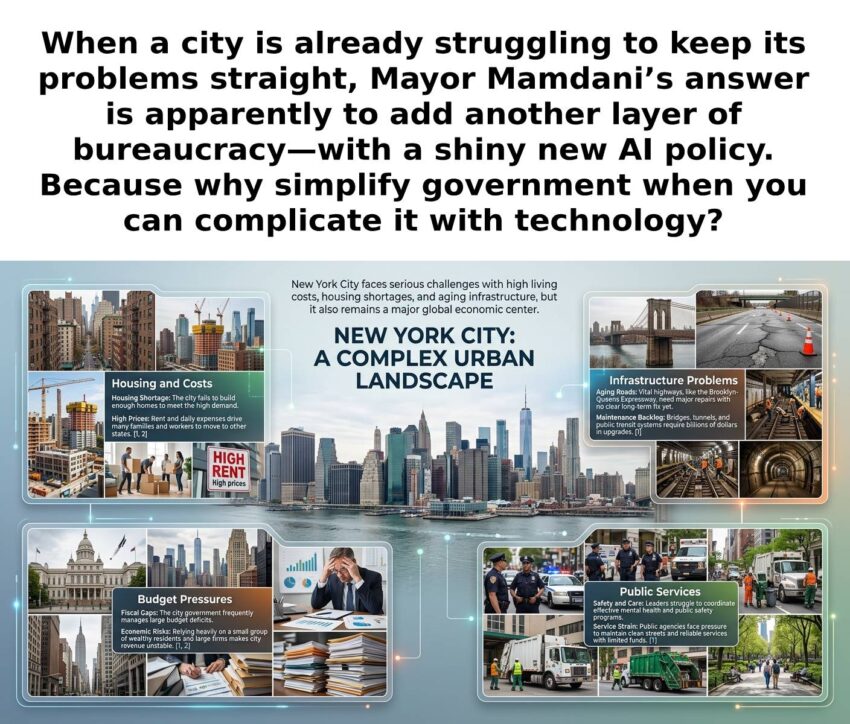
A critique of the Mamdani administration’s 2026–27 generative artificial intelligence policy for New York City Public Schools, written from the standpoint of a career in technology education and integrative STEM.
◆ ◆ ◆
I. A Policy Announced Eight Days Before the Bell
On September 2, 2026 — eight days before the first day of classes — Mayor Zohran Mamdani and Schools Chancellor Kamar H. Samuels announced what City Hall billed as the nation’s broadest moratorium on student-facing generative artificial intelligence in public schools. The policy suspends student-facing generative AI for children in 2-K through eighth grade for the 2026–27 school year, prohibits companion chatbots at every grade level, requires two 45-minute AI literacy modules annually for all high school students, authorizes five tightly metered high school pilots, and recommends daily screen-time caps for elementary and middle grades. City Hall put the number of students affected at nearly 600,000, roughly two-thirds of system enrollment.
The announcement was, by the standards of American school technology policy, unusually specific. It named the five permitted pilot products and the minutes each may consume. It drew a defensible line between assistive technology, which is exempted, and open-ended generative tools, which are not. It committed the Education Department to convene a Technology in Schools Coalition of students, educators, parents, union partners, and outside experts to study the moratorium and publish recommendations. Chancellor Samuels framed the underlying conviction plainly: “innovation does not mean more technology”.
The evidence base for generative AI in K–12 instruction is thin relative to the enthusiasm surrounding it. A pause is a defensible response to that asymmetry. The argument of this essay is not that New York City should have embraced classroom AI, nor that AI instruction has no place in the upper grades of public education. It plainly does. The argument is narrower and, I think, more troubling: the policy as announced is modest in the student minutes it governs and immodest in the adult labor it requires, and New York City is not currently staffed or funded to supply that labor.
Three practical weaknesses follow. First, the policy depends on specialist expertise — in AI evaluation, education technology procurement, data governance, and instructional design — that municipal government has great difficulty recruiting and retaining. Second, it depends on classroom teachers, particularly in the upper grades, whom the city has already conceded it cannot hire in sufficient numbers. Third, its true cost lies almost entirely outside the software licenses, in a fiscal environment where recurring spending already outpaces recurring revenue. Each of these is a human-resource problem wearing a technology costume.
◆ ◆ ◆
II. What the Policy Actually Requires
It is worth restating the policy with some precision, because two details are widely misreported and both bear on the analysis.
The first concerns the scale of the high school pilots. The mayor’s office describes the 50,000-student cap as approximately five percent of the public-school student body, which is accurate against a total enrollment that stood at 906,248 in 2024–25. Chalkbeat, measuring against the population actually eligible, put the same figure at roughly 17 percent of all high school students. Both numbers are correct; they answer different questions. For an administrator deciding how many trained supervisors a building needs, 17 percent is the operative figure, and it is more than three times as demanding as the headline suggests.
The second concerns teacher use. Summaries of the policy generally note that teachers may continue using compliant AI tools for planning and operations. That is true as far as it goes. But according to the Education Department’s own summary, teachers may not use AI tools to grade student work, monitor student behavior, develop special education plans, or assist with student mental health challenges. These are not marginal exclusions. Grading and individualized education program drafting are precisely the labor-intensive tasks for which teachers had begun adopting these tools — Bowdoin’s Hastings Initiative found that among early adopters, roughly a fifth had used AI to grade tests in 2023–24, and teacher adoption overall climbed from 46 percent to 60 percent in a single year. The policy therefore does not merely pause a student behavior; it reverses an adult workflow that had already taken hold, and reversal has a cost.
Beyond the classroom rules, the policy commits the system to an administrative program of considerable size:
- An exhaustive review of every technology tool used in the district, assessed for vendor accountability on safety and transparency, ethics, evidence of learning design and instructional impact, prior research, and continuous collection of user feedback — with tools barred if their functionality is deemed not mission-critical to learning.
- The disabling of AI features in 38 existing citywide education technology contracts, with products removed outright where the features cannot be switched off. Officials have not published the list. Two named examples — the reading tutor Amira, in use at 222 schools, and the digital Houghton Mifflin Harcourt reading curriculum — indicate the reach into core literacy instruction.
- A new review layer, run by the Education Department’s information technology, legal, and contracts teams, applied even to ed tech purchases under $25,000. This follows a purchasing freeze of nearly two months. The deputy chancellor who briefed principals warned the reviews would take time.
- Two 45-minute literacy modules delivered annually to every high school student across 573 high schools.
- Five supervised pilots, each under the direct supervision of a trained educator, capped at five classes per high school.
- A year-long coalition process producing recommendations for subsequent school years.
None of this is unreasonable in isolation. Taken together it constitutes a substantial new standing workload, distributed across a central office, the district superintendencies, and roughly 1,600 schools. And the department began this work without a baseline: officials acknowledged they have little hard data on how much AI is actually in use across the system, and declined to release the results of a survey they had conducted asking schools that very question.
That last point deserves emphasis. A moratorium whose administrators cannot say what they are suspending, in which buildings, at what current volume, is a policy without a denominator. Every subsequent estimate of enforcement effort, replacement cost, and instructional disruption inherits that uncertainty.
◆ ◆ ◆
III. The First Weakness: Recruiting Specialists a City Cannot Pay
Consider what the tool review actually demands. To evaluate a product against safety, transparency, ethics, evidence of learning design, instructional impact, prior research, and continuous user feedback is to require, at minimum, a reviewer competent in machine learning behavior, a reviewer competent in learning sciences and research methods, a privacy and contracts attorney fluent in student-data law, and someone able to reconcile the three. Multiply by an inventory of unknown size that must be re-reviewed whenever a vendor ships an update. Generative features are not stable properties of a product; they are added, altered, rebranded, and bundled continuously. A one-time approval is a snapshot of a moving object.
This is the kind of function that state and local government finds hardest to staff. Industry recruiters place the public-private compensation differential for AI and data science roles in the range of 30 to 50 percent, and note that competitive civil service hiring for specialized information technology positions commonly runs six months to a year — a timeline fundamentally out of step with a policy that must be operating within days. New York City is in an especially unfavorable position here, because it is competing for this talent in the same labor market that is currently generating the city’s tax revenue. The Center for New York City Affairs observed that Wall Street’s 2025 profits, potentially a record $60 billion, were substantially connected to artificial intelligence. The city is trying to hire AI expertise away from the sector whose AI-driven earnings are underwriting its budget, at a discount of a third to a half, into a job whose principal deliverable is telling schools what they may not use.
There is an irony worth naming. The Center’s outlook also flagged that this same concentration exposes the city to boom-and-bust dynamics: a collapse in AI-linked income and investment on Wall Street would flow directly into city services and programs. New York is thus simultaneously fiscally dependent on the AI economy and institutionally committed to keeping it out of two-thirds of its classrooms. That is not necessarily incoherent — a city may reasonably tax an industry it declines to admit to its elementary schools — but it does mean the revenue that would fund careful implementation is correlated with the phenomenon the policy exists to restrain.
The administration’s answer to the expertise problem appears to be the Technology in Schools Coalition. But a coalition of students, parents, educators, union representatives, elected officials, and volunteer experts is a legitimacy mechanism, not a capacity mechanism. Advisory bodies convene, deliberate, and publish. They do not review 38 vendor contracts for residual generative functionality, audit whether a disabled feature has quietly returned in a point release, or answer a principal’s Tuesday-afternoon question about whether a $4,000 purchase clears the new threshold. Substituting an advisory body for staff capacity is among the most durable errors in education technology governance, and I have watched it recur for four decades.
The field I spent my career in offers a direct precedent. The conversion of industrial arts into technology education in the 1980s and 1990s was, on paper, a curricular decision. In practice it foundered wherever the supply of appropriately prepared teacher educators and district specialists failed to keep pace with the ambition of the standards documents. Programs that had the specialists made the transition; programs that had only the standards renamed their shops and continued as before. The lesson generalizes: in this field, policy documents are cheap and qualified personnel are the binding constraint. Stanford’s Susan Athey put the contemporary version of the problem succinctly at the 2026 AI+Education Summit, observing that the bottleneck is “too many pilots actually, and still not enough implementations that are actually effective”.
◆ ◆ ◆
IV. The Second Weakness: A Teacher Pipeline Already Conceded
If the specialist problem is acute, the teacher problem is systemic — and here the city has, in effect, already admitted defeat in writing.
Begin with the arithmetic of the literacy mandate. If 50,000 students represent roughly 17 percent of high school enrollment, the high school population is on the order of 294,000. Every one of those students is to receive two 45-minute modules per year. Across 573 high schools, that averages about 513 students per building. At 30 students per session, a typical high school must deliver roughly 34 module sessions annually — something on the order of 25 instructional hours per building, or about 14,600 hours citywide, before counting preparation, materials development, or training the people who deliver them.
Those hours must come from somewhere. There is no AI literacy certification area, no line in the master schedule, no course code, and no funded position. The modules will be absorbed by existing staff during existing periods — which means they will displace instruction in a tested subject, colonize an advisory block if the school has one, or be delivered by whoever is available rather than whoever is prepared. In a year when the city must raise class-size compliance to 70 percent, that scheduling flexibility is precisely what buildings do not have.
Set against this is the state of the pipeline. The number of candidates completing traditional college teacher preparation programs in New York fell from more than 22,000 in 2012 to under 15,000 a decade later. High school mathematics and science, special education, and bilingual instruction remain chronically understaffed. The Independent Budget Office has noted that the city faces filling roughly 7,500 existing vacancies on top of creating new positions for class-size compliance, and that competitive salaries relative to suburban districts are the decisive variable. In 2025, the Education Department was aiming to hire between 7,000 and 9,000 new teachers in a single year to reach 60 percent class-size compliance, against a baseline near 46 percent.
Then came the retreat. Mayor Mamdani’s February 2026 preliminary budget carried $543 million, anticipating roughly 6,000 new teachers. By the executive budget in May, that had been reduced to $122 million for 1,000 educators, on the expectation that Albany would grant relief. Albany did. The June 2026 agreement pushed full class-size compliance from 2027–28 to 2029–30, with interim benchmarks of 70, 80, and 90 percent, and delivered roughly $500 million in near-term budget relief. Crucially, the deal institutionalized “hard-to-staff” and space exemptions, paired with a negotiated differential of up to $8,500 in 2026–27 and $9,500 in 2027–28 for teachers whose classes remain oversized under those exemptions.
The United Federation of Teachers described the situation with a candor that city officials have avoided. Noting that other districts had been recruiting since February while New York had no recruitment or capital plan in place, the union stated that “it may not be possible to hire all the staff that schools need”.
That sentence is the load-bearing fact of this entire critique. A school system that has just negotiated a two-year extension, an exemption regime, and a compensation differential specifically because it cannot staff its classrooms to legal minimums is now also committing to deliver universal AI literacy instruction and to supervise five metered pilots under the direct supervision of trained educators. The trained educator supervising the Intel AI-Ready Schools project for one period each week is not a new hire. She is the same mathematics or science teacher the city cannot replace, in the same building that qualified for a hard-to-staff exemption, holding a class larger than the law permits and drawing a differential as compensation for that fact.
Enforcement compounds the problem, because the policy locates it almost entirely in the classroom. Officials did not specify a compliance mechanism. The mayor conceded that much of the enforcement will happen at the school and classroom level and expressed confidence that teachers, principals, and superintendents would carry it. The UFT president objected that the burden falls on “school communities or individual educators to figure out after the fact” whether what their school uses complies. Both statements describe the same arrangement; they differ only on whether it is acceptable. From a workforce standpoint, the arrangement is a straightforward unfunded assignment of technical compliance work to instructional staff who are already the system’s scarcest resource.
National data suggest what to expect. Bowdoin’s Hastings Initiative found that while 31 percent of schools had AI policies, 60 percent of educators reported the policies were not clear to them or their students; that 67 percent of schools reported offering AI training while 68 percent of teachers reported not engaging with any institution-provided training; and that only 14 percent of schools taught students about ethical and appropriate AI use. New York City is not exempt from that pattern. It is a larger version of it.
◆ ◆ ◆
V. Is Ninety Minutes a Year an Education?
A separate question deserves its own hearing: even if the city delivers everything it has promised, is the instructional dose adequate to the stated goal?
Two 45-minute modules per year is 90 minutes. Over four years of high school, a student receives six hours of formal AI instruction, in which the city proposes to cover what AI is and is not, bias, risks, ethical considerations, careers, and future skills. Compare that with the curricular progression Stanford’s Mehran Sahami sketched at the same summit: introduce what AI is; teach hallucinations and bias; demonstrate how to verify outputs; then teach advanced techniques such as prompting and agentic workflows. That is a sequenced course with practice, feedback, and assessment. It is not a pair of assemblies. Sahami’s warning was that without a structured approach, students teach themselves, and that the large majority do so in ways that short-circuit rather than support learning.
The comparison is not merely unflattering; it exposes a category error that this field has committed before. Ninety minutes of exposure is an awareness intervention. Competence with a general-purpose reasoning technology is a discipline. Technology education learned this distinction painfully during the computer literacy movement of the 1980s, when a single required semester of keyboarding and BASIC was widely mistaken for preparation and was obsolete before most cohorts graduated. The instinct to satisfy a curricular obligation with a universal short module is understandable in a system under staffing pressure. It is also how a system produces documented coverage and undocumented incompetence.
There is a further pedagogical hazard specific to a one-year pause followed by possible reintroduction. Guilherme Lichand’s work with middle school students in Brazil, presented at the Stanford summit, found that students who lost access to AI assistance after having it performed dramatically worse on a subsequent creative task — roughly four times worse than their initial advantage — and had come to believe the machine was more creative than they were. Whatever one concludes about the moratorium itself, the finding argues strongly against governing access through abrupt on-and-off policy cycles. If the Technology in Schools Coalition recommends reopening in 2027–28, the transition design will matter as much as the decision.
◆ ◆ ◆
VI. The Third Weakness: The Costs That Are Not Licenses
The five pilots are cheap. That is the trap.
Instructional AI pricing spans several orders of magnitude. A generative assistant a teacher uses for lesson planning may run twenty-five dollars a month. A full adaptive learning platform can reach the tens of thousands of dollars, before implementation, and before the recurring costs of maintenance, updates, and staff training that follow every such system into a district budget. Underserved schools have never been able to absorb the upper end of that range, which is exactly why cost discipline in this domain is an equity question rather than an accounting one.
But license price is not the principal cost driver here, and EdSurge’s June 2026 analysis explains why. Traditional education software becomes cheaper to distribute as it scales. Generative AI does not: it incurs inference costs each time a user engages it, which makes multi-year forecasting genuinely difficult for districts accustomed to predictable licensing. Layer on the data-privacy response — private deployments, district-controlled systems, locally hosted models — and the costs migrate into storage, cybersecurity, hardware, networking, and technical staff. With federal pandemic relief funds expired, there is no longer a cushion absorbing that migration. The publication’s central observation is that few districts have any real example of what universal access would cost.
For New York City in 2026–27, however, the dominant costs are those of the prohibition, not the permission. Disabling generative features across 38 contracts requires legal review of each agreement, technical verification that the feature is genuinely off, and a replacement plan for any product that cannot comply. Amira alone is in 222 schools; the digital Houghton Mifflin Harcourt reading program is the most widely used of the three mandated NYC Reads literacy curricula. Removing or degrading a mandated literacy tool mid-year is not a software decision. It is a curriculum decision with professional development, materials, and assessment consequences, and it lands in a system that is simultaneously implementing curriculum mandates and class-size compliance.
Add the review layer for purchases under $25,000, imposed after a two-month freeze, on a contracting process that was already slow. Add the training required so that supervision by a “trained educator” means something, which requires either paid time outside the school day, coverage during it, or the diversion of the professional development calendar. Add evaluation, without which the year of study produces impressions rather than evidence. None of these appear as a line item labeled artificial intelligence. All of them consume the same central and school-level capacity that class-size compliance is consuming.
The fiscal setting makes this more than an inconvenience. The Citizens Budget Commission’s analysis of the city’s structural position documented chronic underbudgeting exceeding $4 billion a year and estimated class-size compliance alone at $450 million, then $900 million, then $1.4 billion annually as it phased in. The Comptroller’s review of the adopted fiscal 2027 budget — $125.84 billion — found that the administration relied on $6.07 billion in temporary measures to close the fiscal 2026 and 2027 gaps, and that the underlying problem, recurring spending outpacing recurring revenue, remains unresolved; his office restated the fiscal 2028 gap at $8.8 billion. Three of the four agencies rating the city’s general obligation bonds moved their outlooks to negative during the budget cycle.
In June 2026, the city’s cash position deteriorated to the point that projections under review at City Hall showed the balance going negative in November, prompting the administration to consider deferring roughly $3.5 billion in contractually required advances to social service nonprofits. Comptroller Mark Levine, declining to fault the current administration for the underlying condition, attributed it to “a direct result of the structural imbalance in our City’s budget”. The Center for New York City Affairs, writing in January, projected slow growth or contraction for 2026 and a $520 million city revenue loss from federal business tax changes absent state decoupling.
Against that backdrop, a small pilot that creates permanent support expectations is a genuine fiscal hazard. This is the pattern by which education technology initiatives become structural costs: a pilot is funded with temporary money, teachers and families come to depend on it, and the subscription, the help desk, the coaching position, and the evaluation contract become recurring obligations that no one ever voted to make permanent.
It should also be said that the department is not spending into a lean system. As the Manhattan Institute’s John Ketcham documented in his account of what he called the city’s “resource curse”, the Department of Education’s budget has grown by nearly $10 billion since fiscal 2020 while enrollment fell by more than 100,000 students, producing a per-pupil figure around $42,000 — the highest in the nation — with outcomes at or below the national average. One need not accept the Manhattan Institute’s policy conclusions to take the arithmetic seriously. A system spending that much per student and unable to staff its classrooms or its central technology review functions has a resource allocation problem, not merely a resource problem. That distinction matters, because it means the constraint on this policy is not only how much money the city has but how much of its existing capacity is already committed.
◆ ◆ ◆
VII. Ambition, Announcement, and the Unglamorous Prerequisite
The deepest criticism of this policy is not that it does too much or too little. It is that it addresses the wrong layer of the problem first.
Comprehensive technology policy is the visible, announceable, nationally reportable act. Recruitment, certification, professional development capacity, procurement staffing, and evaluation infrastructure are none of those things. They are the unglamorous prerequisites, and they are what determines whether any classroom policy survives contact with 1,600 buildings. The administration has produced a document of genuine sophistication and has proposed to implement it with a workforce it has formally acknowledged it cannot assemble.
The predictable consequence is not failure but divergence. Wendy Kopp’s observation at the Stanford summit was that AI amplifies whatever educational foundation already exists: in schools with strong pedagogy and clear guidelines it becomes a useful instrument, and in schools without them it becomes a distraction. Miriam Rivera drew the sharper version — in well-resourced schools students learn to create with technology, while in less-resourced schools they merely consume it. A uniform citywide rule administered through radically uneven building-level capacity does not produce uniform practice. It produces a system in which the schools that already employ a technology coordinator run careful pilots and document them, while the schools managing vacancies, coverage, attendance, and special education compliance apply the rules inconsistently or, more likely, avoid the permitted tools entirely to reduce risk.
Overcompliance is the underdiscussed failure mode here. When definitions are imprecise and enforcement is delegated to individuals who bear personal exposure for getting it wrong, the rational response is to avoid the entire category. Teachers uncertain whether an embedded feature counts as student-facing generative AI will simply stop using the software. That outcome would satisfy the letter of the moratorium while degrading instruction the policy never intended to touch, and it would fall hardest on exactly the buildings with the least capacity to seek clarification.
One more asymmetry deserves mention. The policy sets screen-time recommendations for grades three through eight but offers no guideline for high school, where the pilots and the literacy modules actually live. The grades receiving the least prescriptive attention on screen time are the grades receiving the most new technology obligation. That is not a contradiction, but it does suggest the policy was designed primarily as a protection instrument for younger children and only secondarily as an instructional program for older ones. The younger-grade protections require a decision. The older-grade instruction requires a workforce.
◆ ◆ ◆
VIII. What Would Make the Year Worth Something
A skeptical reading is not a counsel of despair. The moratorium buys a year, and a year is worth having if it is spent building the capacity the policy presupposes. Six measures would materially improve the odds.
- Publish the register. The 38 affected products, the criteria applied, the disposition of each, and a named contact should be public before the first marking period closes. A prohibition whose scope is unpublished cannot be complied with in good faith, and every principal who guesses wrong generates an incident the central office will eventually have to adjudicate.
- Staff the review function rather than deputizing it. A small, permanent, adequately compensated unit combining machine learning, learning sciences, and student-data law is the minimum viable structure. Where civil service compensation cannot reach the market, term appointments, university partnerships, and shared arrangements with other large districts are more honest instruments than assigning the work to a volunteer coalition.
- Convert the modules into a course. Ninety minutes a year satisfies a mandate; a sequenced elective or a required half-credit unit, with a defined certification pathway for the adults who teach it, produces competence. If the city cannot fund a course this year, it should say so and treat the modules as an interim awareness measure rather than as AI literacy.
- Supply the materials centrally. Model lessons, parent communications, academic integrity language, student instructions, and rubrics developed once at the center cost a fraction of the same work repeated across 573 high schools, and they are the single most effective lever against uneven implementation.
- Budget the implementation transparently. Licensing, training, coverage, technical support, legal and privacy review, evaluation, and administration should be identified separately. A pilot that appears free because its licenses are discounted is a pilot no one can evaluate on cost-effectiveness.
- Set evidence thresholds before expansion. Participation, minutes actually used, teacher workload, technical failures, accessibility outcomes, integrity incidents, cost per student, and learning results against comparable non-pilot classrooms should be specified now, not reconstructed later. Otherwise, the coalition will deliberate in 2027 on the same evidentiary basis available in 2026, and the decision will be made on politics and vendor enthusiasm.
Underlying all six is a sequencing principle that this field keeps relearning: staffing capacity should govern the pace of policy, not the reverse. Expansion of the pilots should wait until the city can demonstrate that it is meeting its class-size obligations, supporting schools equitably, and processing procurement reviews without delaying essential instructional purchases. If those conditions are not met, the correct response is not to expand and hope, but to hold the program small and say why.
◆ ◆ ◆
IX. Conclusion
New York City has done something most large districts have avoided: it has taken a clear position on generative AI and children, and it has accepted the political cost of saying no. That deserves acknowledgment, and the pause may well prove to have been the right instinct. But a policy is a promise about adult behavior, and this one promises a volume of expert and instructional labor that the same administration has formally acknowledged, in a negotiated agreement with its own teachers’ union, that it cannot currently supply.
The five named products and their metered minutes will not determine whether this works. What will determine it is whether the city can hire people who can tell a disabled feature from a dormant one, whether it can put a prepared adult in front of every high school student for more than ninety minutes a year, and whether it can pay for the training, oversight, and evaluation that transform a moratorium into knowledge. Those are personnel and budget questions. They were personnel and budget questions before artificial intelligence arrived, and they will remain so after the Technology in Schools Coalition reports.
The hardest problems in this policy are not even AI-related. That is precisely the point.
SOURCES
All sources retrieved and verified September 4, 2026.
• City of New York, Office of the Mayor. “Mayor Mamdani and Chancellor Samuels Put Students First with Nation’s Broadest Generative AI Moratorium in Schools.” September 2, 2026.
https://www.nyc.gov/mayors-office/news/2026/09/mayor-mamdani-and-chancellor-samuels-put-students-first-with-nat
• Elsen-Rooney, Michael, and Alex Zimmerman. “NYC’s New School AI Ban Explained: What’s Changing? What’s Still Murky?” Chalkbeat New York, September 2, 2026.
https://www.chalkbeat.org/newyork/2026/09/02/what-to-know-about-nyc-public-schools-generative-ai-ban-screen-time-limits/
• Citizens Budget Commission. “Running on Empty: Precarious NYC Budget Not Prepared for Looming Risks.” March 10, 2025.
https://cbcny.org/research/running-empty
• Ketcham, John. “New York’s Resource Curse.” City Journal, Summer 2026.
https://www.city-journal.org/article/new-york-city-revenue-spending-budget
• Russo, Melissa. “Mamdani, NYC Comptroller Teams Working Through Weekend on City Cash Crunch.” NBC New York, June 13, 2026.
https://www.nbcnewyork.com/news/politics/mamdani-comptroller-working-through-weekend-on-city-cash-crunch/6512858/
• Center for New York City Affairs. “New York City’s 2026 Economic & Budget Outlook: Making Affordability a Reality Amidst Inequality and Fiscal Constraints.” January 5, 2026.
https://www.centernyc.org/reports-briefs/new-york-citys-2026-economic-budget-outlook-making-affordability-a-reality-amidst-inequality-and-fiscal-constraints
• Center for New York City Affairs. “2026 Economic & Budget Outlook — Executive Summary” (PDF). January 2026.
https://static1.squarespace.com/static/53ee4f0be4b015b9c3690d84/t/695a13c0fc67c57df34eac3a/1767510976996/Outlook-summary.pdf
• Aniefuna, Mi. “Can Schools Afford an AI-First Future?” EdSurge, June 10, 2026.
https://www.edsurge.com/news/can-schools-afford-an-ai-first-future
• Hastings Initiative for AI and Humanity, Bowdoin College. “AI in High School Education: Trends, Challenges, and Opportunities.” August 2025.
https://www.bowdoin.edu/hastings-ai-initiative/resources/initiative-created-resources/ai-in-high-schools-report.html
• Lynch, Shana. “AI Challenges Core Assumptions in Education.” Stanford Institute for Human-Centered Artificial Intelligence, February 19, 2026.
https://hai.stanford.edu/news/ai-challenges-core-assumptions-in-education
• Office of the New York City Comptroller. “Comments on New York City’s Fiscal Year 2027 Adopted Budget.” 2026.
• Zimmerman, Alex. “NYC Schools to Get 2 More Years to Shrink Class Sizes Under Albany Deal.” Chalkbeat New York, June 1, 2026.
https://www.chalkbeat.org/newyork/2026/06/01/nyc-class-size-law-delay-albany-uft-deal/
• United Federation of Teachers. “UFT on 2026 Class Size Agreement.” June 1, 2026.
https://www.uft.org/news/press-releases/uft-on-2026-class-size-agreement
• Elsen-Rooney, Michael. “NYC Schools Prepare for Hiring Spree to Reduce Class Sizes.” Chalkbeat New York, April 1, 2025.
https://www.chalkbeat.org/newyork/2025/04/01/schools-prepare-for-hiring-spree-to-reduce-class-sizes/
• Zimmerman, Alex. “Mamdani Slashes NYC Class Size Hiring Plan, Betting on Albany to Ease Mandate.” Chalkbeat New York, May 12, 2026.
https://www.chalkbeat.org/newyork/2026/05/12/nyc-mamdani-executive-budget-class-size-delay-teacher-hiring/
• New York City Public Schools. “NYCPS Data at a Glance.” 2024–25.
https://www.schools.nyc.gov/about-us/reports/nycps-data-at-a-glance
• New York City Public Schools. “Guidance on Artificial Intelligence and Screen Time.” September 2026.
https://www.schools.nyc.gov/about-us/policies/guidance-on-artificial-intelligence
◆ ◆ ◆
COLOPHON
Research assistance, source retrieval, and drafting support for this article were provided by Claude, an AI assistant developed by Anthropic, working under the author’s direction. All primary sources were fetched and read in full; every figure cited was checked against its originating document. Editorial judgment, argument, and final authority rest with the author.