
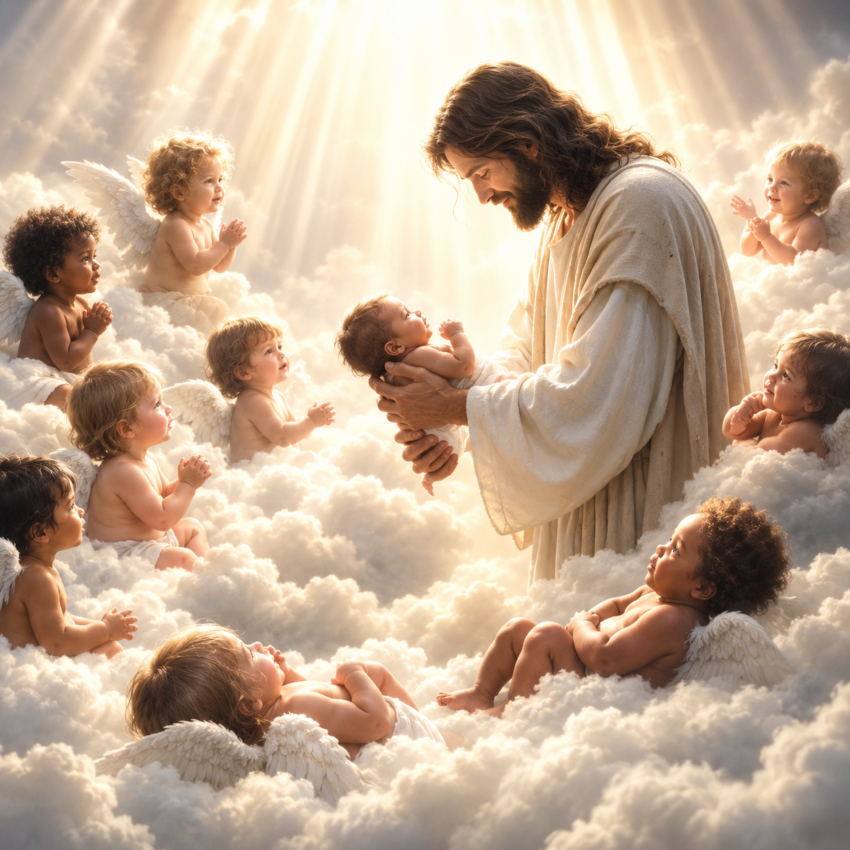
The Nursery and the Decree: What Predestination Does With the Children Who Never Grew Up
I. A Question Asked From the Graveside
John Owen, the greatest theological mind England produced in the seventeenth century, fathered eleven children. Derek Thomas, recalling the fact in a Ligonier interview, notes that ten of them died in infancy — and that this was not remarkable. It was ordinary. In Owen’s century, burying children was simply what parenthood involved for most of the population most of the time.
This matters for how we read the theology. When the Westminster Assembly convened in the 1640s, and when the Synod of Dort met at Dordrecht in 1618, the question of what becomes of a child who dies before it can speak was not an abstract puzzle posed by a seminarian with a fondness for hard cases. It was the standing condition of the pews. Every congregation contained parents who had walked behind a very small coffin. Whatever the divines wrote on this subject, they wrote knowing that it would be read aloud at gravesides.
The question presses hardest against Reformed theology precisely because Reformed theology refuses the two easiest exits. It will not say that infants are innocent, because it holds that guilt in Adam is inherited and real. And it will not say that salvation can be earned or occasioned by anything in the creature, because it holds that the ground of salvation is God’s eternal and unconditional election. A system holding both commitments simultaneously must answer a hard question: on what basis is anyone saved who dies before conscious understanding — and is everyone in that condition saved?
What follows is an attempt to lay out, fairly and without polemic, how that tradition has actually answered. The answer is not one answer. It is at least eight, arranged into three broad families, and the differences among them are not trivial. Some of the most confident modern assurances on this subject would have been unrecognizable to the theologians whose confessions those assurances are said to rest upon. That is worth knowing, whatever one finally concludes.
❦ ⁂ ❦
II. The Structural Problem: Two Commitments in Collision
The First Commitment: No One Is Innocent
Reformed anthropology begins with a claim that modern sentiment finds nearly unbearable when applied to infants: there is no such thing as a morally neutral human being. The Westminster Confession states that every sin, original and actual, brings guilt upon the sinner and binds him over to the wrath of God. Original sin is not merely a defect or a tendency; it is culpable. Psalm 51:5, Job 14:4, Romans 5:12–21, 1 Corinthians 15:22, and Ephesians 2:3 are the standing proof-texts, and the tradition reads them as establishing that condemnation in Adam precedes and does not depend upon personal transgression.
R.C. Sproul put the inversion memorably: we are not sinners because we sin, but sin because we are sinners. Applied to an infant, this yields the conclusion that Reformed writers have consistently refused to soften. Loraine Boettner, whose 1932 chapter on the subject remains the standard popular-level statement of the position, wrote:
Calvinists, of course, hold that the doctrine of original sin applies to infants as well as to adults. Like all other sons of Adam, infants are truly culpable because of race sin and might be justly punished for it. Their “salvation” is real. It is possible only through the grace of Christ and is as truly unmerited as is that of adults.
Loraine Boettner, The Reformed Doctrine of Predestination (1932), ch. IV.3.11
Boettner then presses the point that most distinguishes the Reformed treatment from the popular evangelical one. If original sin is not genuinely damning, then the deliverance of infants is deliverance from something small, and the mercy shown them is correspondingly small. It is the seriousness of the guilt that makes the salvation worth calling salvation at all.
The Second Commitment: Salvation Comes Through Christ Alone, Applied by the Spirit
The second commitment is that no one is saved apart from the merits of Christ applied to the individual soul. There is no natural innocence that qualifies a person for heaven and no meritorious act that secures it. Faith is the ordinary instrument by which the elect lay hold of Christ. But an infant cannot exercise faith in any sense we ordinarily recognize.
Hold both commitments and the problem states itself. The infant is guilty and therefore needs salvation. The infant cannot believe and therefore cannot receive salvation by the ordinary means. Either there is an extraordinary means, or the infant is lost.
The Reformed Resolution: The Order of Salvation
The escape route the tradition takes is structural rather than exegetical, and it is worth understanding on its own terms before evaluating it. In Reformed soteriology, regeneration precedes and produces faith rather than following it. The Spirit gives new life; the new life expresses itself in believing. Faith is therefore the ordinary means by which elect persons who reach maturity come to Christ, but it is not the ground of their salvation. The ground is election, the atonement, and the monergistic work of the Spirit.
This is why the Westminster divines could address infant salvation without treating it as a special exception to the system. If regeneration is the Spirit’s sovereign act, and if the Spirit is not bound by the ordinary means, then an infant can be regenerated. Westminster Confession 10.3, situated deliberately within the chapter on effectual calling, states:
Elect infants, dying in infancy, are regenerated, and saved by Christ, through the Spirit, who worketh when, and where, and how he pleaseth: so also are all other elect persons who are incapable of being outwardly called by the ministry of the Word.
Westminster Confession of Faith, 10.3
The Orthodox Presbyterian Church, in a published Question and Answer on precisely this subject, calls that language precise and carefully chosen — which it is, and which is exactly the source of three centuries of argument about what it was carefully chosen to say. The OPC respondent notes that the Confession clearly entertains that at least some who die in infancy are elect, and that Luke 1:39–44, with John the Baptist filled with the Spirit before birth, demonstrates that prenatal regeneration is possible. What the Confession does not say, on the OPC’s reading, is that all such infants are saved.
That distinction — between establishing that infant regeneration is possible and establishing that it is universal — is the hinge on which the entire debate turns. Every position surveyed below can be located by where it stands on that single question.
❦ ⁂ ❦
III. What the Confessions Actually Say
Westminster 10.3 and the Fight Over Two Words
The controversy over “elect infants” is genuinely old and genuinely unresolved. Critics — Lutheran, Roman Catholic, Arminian, and Baptist alike — have read the qualifier as implying a complementary class of non-elect infants who die in infancy and are lost. Defenders have insisted the contrast intended was different.
Boettner records the defense offered by S.G. Craig, writing in Christianity Today in January 1931. Craig argued that the historical contrast implied by the phrase was not between elect infants dying in infancy and non-elect infants dying in infancy, but between elect infants who die in infancy and elect infants who live to grow up. On this reading, the qualifier is doing no work of exclusion at all; it is simply distinguishing the class under discussion from the ordinary case of elect persons who are called through the preaching of the Word.
Derek Thomas, in the Ligonier interview, makes a related observation with unusual candor: theologically, the word “elect” in that clause is doing nothing, since by definition the elect are saved whether they are infants or adults. He notes that the Belgic Confession does not use the qualifier at all, and states his understanding that all or most of the Westminster delegates believed that all who die in infancy go to heaven.
Against this stands a serious body of historical scholarship arguing the opposite. Reformed Books Online, surveying the primary literature at length, states the historic position bluntly: while the Confession’s wording technically permits the view that all dying infants are elect, the dominant viewpoint among the Westminster divines themselves was that not all dying infants — and not all dying infants within the visible church — are elect. Philip Schaff, no polemicist against the Reformed tradition, summarized the continental Calvinists as having followed Calvin in confining salvation to elect infants and excluding non-elect infants, baptized or not.
The Presbyterian Church in the United States of America eventually found the ambiguity intolerable. In 1903 it adopted a Declaratory Statement that resolved the matter by fiat:
With reference to Chapter X, Section 3, of the Confession of Faith, that it is not to be regarded as teaching that any who die in infancy are lost. We believe that all dying in infancy are included in the election of grace, and are regenerated and saved by Christ through the Spirit, who works when and where and how He pleases.
Presbyterian Church U.S.A., Declaratory Statement (1903)
Craig himself conceded what this cost. The Declaratory Statement, he acknowledged, goes beyond what Chapter X, Section 3 actually teaches, because it makes a positive affirmation the Confession had declined to make. Some, he noted, hold that it also goes beyond Scripture. His defense of it was pragmatic rather than exegetical: whatever else it did, it accused that Presbyterians teach the damnation of dying infants impossible to sustain.
That is an honest account of what happened, and it is worth stating plainly. The most confident modern Presbyterian assurance on this subject is not an interpretation of the Confession. It is an amendment to it.
The Canons of Dort I.17 — and What It Was Written to Do
The Canons of Dort are frequently cited as offering warmer and firmer comfort than Westminster. The article reads:
Since we are to judge of the will of God from his Word, which testifies that the children of believers are holy, not by nature, but in virtue of the covenant of grace, in which they, together with the parents, are comprehended, godly parents have no reason to doubt of the election and salvation of their children, whom it pleases God to call out of this life in their infancy.
Canons of Dort, First Head of Doctrine, Article 17 (1619)
Read cold, this appears to promise a great deal. Read in its polemical context, it promises considerably less than it first appears — and the historical record on this point is unusually well documented.
At the Synod’s thirty-first session in December 1619, the thirteen Remonstrant divines submitted their own sentences on predestination. Their ninth article declared that all children of the faithful are sanctified in Christ so that not one dying before the use of reason perishes, and that none of them are to be counted among the reprobate. Their tenth article extended the same to baptized covenant children. At the thirty-fourth session they went further and challenged the Synod directly to state whether it acknowledged as its own doctrine the reprobation of infants born of believing parents.
Article 17 was the Synod’s answer. And it is conspicuously not the Arminian statement. Where the Remonstrants asserted flatly that not one such child perishes, the Synod said that godly parents ought not to doubt. That is a statement about the parents’ posture, not a declaration about the children’s eternal status.
Marinus Schipper, writing in The Standard Bearer in 1959, put the interpretive question with useful directness: did the fathers at Dort make an objective statement of fact about the salvation of covenant children dying in infancy, or were they instructing grieving parents to rest in the promises of the covenant without asserting anything objective at all? His judgment, resting on the history of the Synod’s deliberations, was the latter. Article 17 was offered, in his phrase, as a judgment of love.
Two further pieces of evidence sharpen the point. Francis Gomarus, the lead opponent of Arminius and one of the most consequential figures at the Synod, submitted his own evaluation, which conditions the promise on the parents being in God’s covenant through Christ and true believers. Melchior Leydekker, writing later at Utrecht, was more explicit still:
That divine promise has a common truth, though God reserve to Himself, according to His own power and liberty, the exclusion of some infants. Faith… performs its office when it lays hold of the promise as it is given, and reverently leaves to God liberty of application.
Melchior Leydekker, Commentary on the Palatinate Catechism (1694), Lord’s Day 27
The word “godly” in Article 17, on this reading, is not decorative. It marks a narrower category than “professing,” and the Reformed writers who used it knew the difference. The Swiss delegation at Dort, asked for their judgment, said of covenant children dying before the years of discretion that they hoped the best of them. That is warm. It is not the same as a guarantee.
The Confessional Map, Briefly
-
Westminster Confession 10.3 (1646): elect infants dying in infancy are regenerated and saved; the number and identity of that class is not specified. The 1689 London Baptist Confession reproduces the language substantially unchanged.
-
Canons of Dort I.17 (1619): godly parents ought not to doubt the election and salvation of covenant children God takes in infancy. Silent regarding infants outside the covenant.
-
Belgic Confession: addresses the children of believers without the “elect” qualifier, which Derek Thomas treats as significant.
-
PCUSA Declaratory Statement (1903): all dying in infancy are included in the election of grace. A denominational addition, acknowledged at the time as going beyond the Confession.
-
Anglican Book of Common Prayer, post-1662 rubric: baptized children dying before actual sin are undoubtedly saved. Richard Baxter and the Savoy nonconformists objected specifically to being required to assent to this as certain by the Word of God, cataloguing at least a dozen competing opinions on the question.
❦ ⁂ ❦
IV. How Many Views Are There? A Taxonomy
Popular treatments of this subject usually present two options: babies go to heaven, or Calvinists are monsters. The actual field is considerably more crowded. Sorting the historical and contemporary literature yields at least eight distinct positions, which fall into three families according to what they take to be the operative principle — the sacrament, the covenant, or the incapacity of the subject.
Family One: The Sacrament Decides
-
Baptismal exclusivism. Unbaptized infants do not enter heaven. Myron Houghton notes that Roman Catholic theology has no formal dogma here, but that the weight of tradition placed such infants in limbus infantum — a state of natural happiness without the beatific vision. Thomas Aquinas grounded this in the distinction between the penalty of loss and the penalty of sense: original sin involves aversion from God without conversion to the creature, and therefore incurs deprivation rather than active suffering. The Reformed rejected this on two grounds, stated crisply by William Hendriksen: Scripture nowhere attaches that weight to the omission of baptism, and nowhere teaches a limbo.
-
Sacramental ambiguity. Houghton’s survey of Lutheran materials finds no official position but four operative commitments: infants are born in original sin, faith is necessary, infants are capable of faith, and faith can be created through the Word, baptism, or the Supper. Johann Gerhard, in the seventeenth century, declined to condemn infants dying before baptism and hoped they were received into favor through the prayers of godly parents or of the church.
Family Two: The Covenant Decides
-
Covenantal certainty. The children of believers who die in infancy are saved, on the ground of the covenant promise of Genesis 17:7 and Acts 2:39 and the declaration of 1 Corinthians 7:14 that such children are holy. R. Scott Clark, quoted on the Puritan Board, frames the structure sharply: covenant, not accountability, is the biblical category for thinking about this, and the ground of comfort is not the infancy of the deceased but the promise administered through the covenant of grace. Sproul locates his own denomination here, holding that the children of believers dying in infancy go to heaven by God’s special grace while the children of unbelievers are left to mystery.
-
Covenantal hope, or the judgment of charity. The same covenantal frame, but with the certainty withdrawn. Peter Martyr Vermigli, Beza, David Pareus, Gomarus, Leydekker, and Witsius all belong here, as do Bavinck and Berkhof in the modern era. Pareus stated the position for his generation with unusual clarity, denying that Zwingli, Calvin, or any of their circle placed all infants dying without baptism in heaven indiscriminately, and saying the judgment was pronounced by the law of charity concerning covenant children alone, without prejudice to God’s election. Bavinck, as quoted by Hendriksen, held that covenant children entering heaven is what we may say, and that regarding the rest so little is revealed that refraining from positive judgment is best.
Family Three: The Incapacity of the Subject Decides
-
Universal infant salvation on Calvinistic grounds. All who die in infancy are elect and saved — not because they are innocent, but because God has sovereignly chosen to save them, and the fact of dying in infancy is itself the providential mark of that choice. Hodge, Shedd, Warfield, Boettner, Spurgeon, and in the modern period, MacArthur and Piper. This is the dominant contemporary view and the one most often assumed to be simply “the Christian position.”
-
Universal infant salvation on grounds of incapacity. The same conclusion by an incompatible route. GotQuestions, working from John 9:39–41 and Isaiah 7:16, argues that God does not condemn people for what they are unable to do, and that infants and the mentally disabled are therefore not held accountable for unbelief. Robert Lightner’s Heaven for Those Who Can’t Believe is the fundamentalist standard. Houghton adds the argument from Revelation 20:12–13: the great white throne judgment turns on personal works; infants have none, and therefore they are not present at it.
-
Reverent agnosticism. Scripture does not answer the question, and neither should we. E.J. Young, the Westminster Old Testament scholar, made the case from Deuteronomy 29:29 — the secret things belong to the Lord — and warned against the temptation to press past the plain teaching of the text, while allowing that the nature of the covenant creates every presumption in favor of the children of Christian parents. Mark Jones declares himself agnostic specifically about the infants of unbelievers, holding that we can say neither that they will definitely be lost nor that they will definitely be saved. William Twisse, prolocutor of the Westminster Assembly, wrote that it is better to doubt about secret things than to wrangle about uncertain ones.
-
Historic restrictionism. Some who die in infancy are not elect and do not enter heaven. Charles Krauth’s 1874 review documented this as the mainstream position of Reformed orthodoxy before the nineteenth century, and Schaff’s summary agrees. Twisse pressed Arminian opponents on precisely this point, asking whether they would say no infant perishes in original sin. Herman Hoeksema could not affirm Dort I.17 in the sense usually given it, holding that there are among the children of the elect those who are reprobate.
Two further positions appear at the fringes and are worth noting because they mark the boundaries of the debate rather than occupying it. Barthold Holtzfus, writing in 1712, records one author who preferred to believe that the souls of the infants of the nations are annihilated. And Boettner argued that an Arminian system, which suspends salvation on a personal act of rational choice, is logically driven either to a postmortem probation or to annihilation, since a mere opportunity for salvation avails an infant nothing.
That last argument is the most aggressive move in the entire Reformed literature, and it deserves to be stated in its author’s own words.
❦ ⁂ ❦
V. Are All Infants Elect? The Case in Favor
Warfield’s Argument: Only Calvinism Can Secure It
B.B. Warfield’s 1897 study, The Development of the Doctrine of Infant Salvation, remains the classic treatment, and its argument is not defensive but offensive. Warfield contends that universal infant salvation is not a difficulty for Calvinism but a doctrine that only Calvinism can coherently hold:
Their destiny is determined irrespective of their choice, by an unconditional decree of God, suspended for its execution on no act of their own; and their salvation is wrought by an unconditional application of the grace of Christ to their souls, through the immediate and irresistible operation of the Holy Spirit prior to and apart from any action of their own proper wills…
If only a single infant dying in irresponsible infancy be saved, the whole Arminian principle is traversed. If all infants dying such are saved, not only the majority of the saved, but doubtless the majority of the human race hitherto, have entered into life by a non-Arminian pathway.
B.B. Warfield, Two Studies in the History of Doctrine (1897), p. 230
The logic is worth following, because it is genuinely strong. Any soteriology that makes salvation contingent on a conscious human response faces a dilemma when confronted with a subject incapable of response. It must either exclude such subjects, invent an exception for them, or posit an opportunity after death. Calvinism faces no such dilemma, because it never located the decisive act in the creature to begin with. Warfield adds the providential observation: if death in infancy falls under God’s providence, then it is God who selects this vast multitude for unconditional salvation — which is simply to say that they are predestined to life from the foundation of the world.
Hodge’s Argument From the Adamic Analogy
Charles Hodge argued the case from Romans 5:18–19. E.J. Young summarizes the structure fairly even while declining to accept it: all descendants of Adam are saved unless Scripture expressly reveals otherwise; Scripture contains no express revelation excluding those who die in infancy, as it does exclude, for instance, adulterers and drunkards; therefore all such children are saved. Hodge reinforced this from the character of God, who would rather bless than curse, and from Christ’s posture toward children. Hendriksen quotes Hodge’s summary claim that Scripture nowhere excludes any class of infants — baptized or unbaptized, of Christian or heathen lands, of believing or unbelieving parents — from the benefits of redemption.
Spurgeon and the Prevailing Nineteenth-Century Consensus
Charles Spurgeon held the position with characteristic force. Preaching on 2 Kings 4:26, he said that among modern Calvinists he knew of no exception — all hoped and believed that those dying in infancy are elect. In his Expositions of the Doctrines of Grace, he went further, saying he had never met anyone who claimed there were infants in hell, and that the salvation of those dying in infancy might be a chief means by which the number of the saved comes to exceed the number of the lost.
The Modern Statement: Piper, MacArthur, and the Argument From Revelation
John Piper grounds his position on Romans 1:19–20 rather than on any claim of innocence, and is explicit that infants participate in original sin. His reading turns on the “therefore” at the end of verse 20: humanity is without excuse because it has perceived what God has made plain. An infant incapable of processing general revelation would, on that logic, fall into the category of still having an excuse. Piper adds a further construction that his critics regard as the weak point of the account — that at the judgment such children will be covered by Christ’s blood and will come to faith, either immediately in heaven or later at the resurrection.
John MacArthur’s Safe in the Arms of God is the popular-level version of the universalist case, and Tim Counts, writing for The Master’s Seminary, sets out its main lines. God claims ownership of the children, even of idolatrous Israel, in Ezekiel 16:21. Jonah 4:11 extends divine compassion explicitly to a pagan city on the ground that its inhabitants cannot tell right hand from left. Isaiah 7:15–16 speaks of those not yet knowing enough to refuse evil and choose good. Christ blesses infants in Mark 10 and Luke 18, and there is no other instance in the Gospels of Jesus blessing persons destined for perdition. And the great white throne judgment of Revelation 20:12–13 proceeds according to works, which infants do not have.
Counts also supplies a datum frequently overlooked in this debate: Calvin himself, commenting on the Gospel harmony, wrote that it would be too cruel to exclude that age from the grace of redemption. Whatever Calvin’s systematic commitments, that is not the sentiment of a man consigning infants to perdition.
The Arithmetic
One consequence of the universalist position deserves emphasis, since it is frequently stated by its proponents and rarely noticed by its critics. Given historical rates of infant and prenatal mortality, if all who die in infancy are saved, then the redeemed are not a remnant. Boettner states the conclusion directly: more than half the human race to the present would be numbered among the elect. Hendriksen, opening his own treatment, framed the same demographic fact as the reason the question matters at all — what are we to say about the souls of that surprisingly large proportion of everyone who has ever lived, who lived only a few years, months, or minutes?
This is a striking inversion of the popular caricature of Calvinism as the theology of the narrow gate. On the universalist reading, the doctrine of election is the mechanism by which the majority of humanity is saved.
❦ ⁂ ❦
VI. Are All Infants Elect? The Case Against
The objections fall into four categories: exegetical, systematic, historical, and methodological. Taken together, they do not establish that infants dying in infancy are lost. They establish something narrower and, for the purposes of honest assessment, more important — that the confident universal affirmation is not as well grounded as its popularity suggests.
The Exegetical Objection: The Texts Do Not Say It
E.J. Young, examining Hodge’s argument, asked whether the reasoning was actually conclusive and answered that there is always a temptation to go beyond the plain teaching of the Bible, comparing the impulse to attempts at explaining the Trinity or reconciling predestination with human agency. His governing text was Deuteronomy 29:29. It is unwise, he concluded, to make dogmatic pronouncements on a subject about which Scripture is silent — while allowing that the covenant creates every presumption in favor of the children of Christian parents.
Hendriksen conceded the same point from the other direction, in a passage his Protestant Reformed critic Schipper thought insufficiently emphasized: Scripture nowhere explicitly teaches that some or all of the children of unbelievers dying in infancy are saved, and while a person may feel strongly inclined toward that position on other grounds, he can never say that Scripture positively declares it.
The Systematic Objection: Perseverance
Adi Schlebusch raises the sharpest structural objection in the recent literature, and it deserves to be taken seriously because it operates entirely within Reformed premises. If all who die in infancy are saved, and if the perseverance of the saints is true — that those who have received saving grace can never be lost — then the position generates an absurdity: the implication would be that the majority of people forfeit salvation simply by growing up.
There are available replies. One may distinguish between the decree and its temporal application, holding that dying in infancy is a providential index of election rather than a cause of it, so that no one who grows up was ever in the saved class to begin with. But that reply concedes something important, which the next section takes up.
The Historical Objection: This Was Not the Reformed Position
Reformed Books Online, marshalling primary sources from Musculus, Vermigli, Beza, Ursinus, Zanchi, Pareus, Bucan, Twisse, Rutherford, Dickson, Momma, Heidegger, Leydekker, Witsius, and others, argues that the historic Reformed consensus held that not all dying infants — and not all dying infants within the church — are elect. Schaff’s summary agrees. Beza, disputing with the Lutheran Jacob Andrea, said that of infants born within the church and divinely elected he had little difficulty concluding based on the divine promise that they are engrafted into Christ from birth — but he prefaced it with the caution that we must not rashly conclude every such infant to be of that character.
One Puritan Board contributor makes the historical point without qualification, observing that Reformed theologians began teaching universal infant salvation especially from the nineteenth century onward and that Scripture never says any such thing. Whether or not one accepts the conclusion, the chronology is accurate. The confident universal affirmation is a modern development, and its confidence outpaces its pedigree.
The Methodological Objection: Attributes Are Not Arguments
Mark Jones, writing at Reformation21, raises the objection that cuts deepest. Many appeal to the goodness or love of God as the chief reason all infants dying in infancy go to heaven. Jones responds that this truth about God’s nature cannot be turned into a wax nose, shaped to whatever makes us comfortable, and points out that structurally identical arguments have been deployed for universalism and annihilationism — a loving God would never do this, would never disapprove of that. He then directs the reader to the account of the flood, and to what it necessarily meant for the young children engulfed in the waters of judgment, along with the destruction commanded in Deuteronomy 20, Joshua 6, and 1 Samuel 15.
Jones also insists on a distinction the universalist position must collapse: that Scripture distinguishes the infants of believers from the infants of unbelievers, in both Testaments, the former called holy and the latter unclean in 1 Corinthians 7:14. Anyone denying a covenantal difference, he argues, must maintain that there is no difference whatever between the child of a Muslim parent and the child of a Christian parent — a position he finds appealing in several respects while doubting it enjoys the biblical support it requires.
One commenter beneath the Sproul excerpt put the methodological worry in a single sentence worth preserving: we should guard against forming doctrine after our emotions rather than after the revealed Word. That is a caution both sides of this debate can accept, and it is one both sides have occasionally failed.
❦ ⁂ ❦
VII. If an Infant Is Not Among the Elect, What Becomes of That Soul?
This is the question the tradition is least willing to answer and most often accused of answering badly. The honest report is that Reformed theology has three distinct responses to it, and that they are not fully compatible with one another.
First Answer: The Question Is Malformed
The dominant modern reply is that the category is empty — that no non-elect infants are dying in infancy, and therefore nothing to describe. This is the position of the 1903 Declaratory Statement, of Hodge, Warfield, Boettner, Spurgeon, and MacArthur. On this account the question has the same status as asking what becomes of a square circle.
Second Answer: Calvin’s Own Logic Forecloses It
The most ingenious argument in the literature comes from R.A. Webb, summarized by Boettner, and it deserves wider notice than it receives. Webb grants that Calvin taught reprobation as eternal, and therefore that there are reprobate infants in the sense that some persons come into the world reprobate. But Calvin also consistently taught that the reprobate procure their own destruction through personal and conscious acts of impiety, wickedness, and rebellion. An infant, while an infant, cannot procure destruction in that manner. Webb’s conclusion follows:
While, therefore, Calvin teaches that there are reprobate infants, and that these will be finally lost, he nowhere teaches that they will be lost as infants, and while they are infants… Consequently, his own reasoning compels him to hold (to be consistent with himself), that no reprobate child can die in infancy; but all such must live to the age of moral accountability, and translate original sin into actual sin.
R.A. Webb, summarized in Calvin Memorial Addresses, p. 112
If Webb is right, Calvin’s system generates universal infant salvation as an internal consequence, without any appeal to sentiment, innocence, or the goodness of God as a free-floating premise. Boettner adds the flat historical claim that nowhere in Calvin’s writings does he say, directly or by good and necessary inference, that any dying in infancy is lost, and that the passages usually cited against him are assertions of original sin lifted from controversial contexts.
Third Answer: The Category Is Not Empty, and We Are Not Told What Follows
The restrictionist tradition allows the category and declines to describe its contents. Krauth documented that the Reformed, with exceptions, generally argued against the Roman position that such infants suffer only the penalty of loss, holding instead that they suffer penalties of sense for original sin. That is the harshest reading available within the tradition, and it was a real position held by real theologians. It is also, notably, not the position of any confession.
One exchange on the Puritan Board illuminates the conceptual difficulty better than most published treatments. Asked whether a perishing infant would be in hell without the capacity to understand why, a moderator replied that the question assumes a person frozen at the age and intellect at which judgment was imposed, and that this removes growth from personhood — noting that we do not suppose an infant entering heaven remains forever incapable of understanding its blessing. Another contributor observed that the infant is perhaps the least knowable of all human beings, unreachable to us and unreachable to its own later self.
These are not evasions. They are an acknowledgment that our intuitions about this case are constructed from a picture — a permanently infantile soul in a place of torment — that no theologian on any side of the debate actually holds.
❦ ⁂ ❦
VIII. Where Is the Cutoff? The Boundary Problem
The user of any position on this subject eventually runs into the boundary. If infants dying in infancy are saved, when does infancy end? A child of two? Five? Nine? The question is not pedantic; it determines whether the position describes a category with edges or a category with none.
The Reformed Rejection of the Age of Accountability
The first thing to say is that the Reformed tradition rejects the framework in which the question is usually asked. The “age of accountability” — the notion that children become guilty of sin at some developmental threshold — grounds infant salvation in innocence, and Reformed theology denies that innocence. Mark Jones states the consequence directly: because of original sin, there really is no age of accountability, and asking when a child first sins or becomes accountable misses the point.
Derek Thomas locates the origin of the framework sociologically rather than exegetically. The question of accountability arises, he argues, in churches where the primary commitment is the freedom of the will; since one cannot speak of a two-week-old exercising free will, accountability becomes a dogma of necessity in those systems. He notes that a cognitive, rational expression of will might be located somewhere around eighteen months to four years — and the vagueness of that range is itself instructive.
MacArthur’s refinement is to speak of a condition of accountability rather than an age of it, extending the category to include the mentally disabled. The OPC respondent, addressing that formulation, judged that it comes down to the same basic concept and rests on the mistaken idea that up to a certain point of development children are not held accountable by God for their sin. The OPC’s counter is that infants are not innocent but cannot merely express their sin nature noticeably.
Which Positions Need a Cutoff and Which Do Not
This is the analytically decisive point, and it is rarely made. The boundary problem is fatal to one family of positions and irrelevant to another.
-
Positions grounded in incapacity require a cutoff and cannot supply one. If salvation attaches to the inability to comprehend the gospel or process general revelation, then the class of the saved has a boundary defined by cognitive development — a boundary that varies by individual, admits of degrees, and is invisible to any observer. Piper’s Romans 1 argument, the Revelation 20 works argument, and the popular age-of-accountability framework all inherit this problem.
-
Positions grounded in the covenant require no cutoff at all. If the ground is the promise to believers and their seed, the child of a believer is in the covenant at conception, at two years, and at twelve. Nothing turns on locating a developmental threshold. The covenantal view pays for this coherence with a different cost: it says nothing about children outside the covenant.
-
Positions grounded in sovereign election require no cutoff either, but for a different reason. If dying in infancy is the providential mark of election, then the boundary is wherever God has in fact drawn it, and our inability to locate it is a limitation on our knowledge rather than a defect in the doctrine. Warfield’s formulation — that God in providence selects this multitude — makes the boundary a matter of divine decree, not human definition.
The Unborn
Extending the discussion prenatally is uncontroversial within the tradition for one reason: the personhood of the unborn is not in dispute. Psalm 139 and Jeremiah 1:5 establish it, and Luke 1:39–44 supplies the demonstration that the Spirit can work before birth. Sproul framed the connection precisely: since the classical view is that life begins at conception, the question of infant death and prenatal death receive the same answer.
Schlebusch adds a layer most treatments omit, arguing that the question of ensoulment underlies the entire discussion. He surveys the three historic options — preexistence, creationism, and traducianism — and argues for traducianism on the ground that it alone ties ensoulment intrinsically to conception, appealing to Psalm 51:5 and to Christ’s language in John 3:6. Whether or not one follows him, the observation is sound: any position on prenatal salvation presupposes a position on when there is a soul to be saved.
❦ ⁂ ❦
IX. The Theological Problems With Universal Infant Election
Suppose the claim is that every human being who dies before conscious understanding — in the womb, at birth, in the nursery — is among the elect and is saved. Six difficulties attend that claim. None is decisive on its own. Together they explain why the tradition has never quite been able to settle.
1. The Asymmetry Problem
The universalist argument rests on divine freedom: God is not bound by ordinary means and may regenerate whom he pleases, when and where and how he pleases. Granted. But that freedom is unconstrained with respect to adults as well. If God’s liberty is sufficient warrant for concluding that he elects every infant who dies, it is difficult to explain why the same liberty does not warrant concluding that he elects every adult who dies. The appeal to divine freedom appears to do a great deal of work in one direction and none at all in the other, and no principled reason for the asymmetry is usually offered.
The available reply is that Scripture explicitly excludes certain classes of adults — Hodge’s adulterers and drunkards — and explicitly excludes no class of infants. That is a real disanalogy. But it converts the argument from one about divine freedom into one about the silence of Scripture, and arguments from silence carry only the weight the surrounding evidence permits.
2. The Perseverance Problem
Schlebusch’s objection, stated above, is that universal infant salvation coupled with the perseverance of the saints implies that people lose salvation by growing up. The standard reply distinguishes the decree from its application. But note what that reply commits one to: dying in infancy cannot be what makes a person elect; it can only be a sign of an election already determined. Which leads directly to the next problem.
3. The Providence-as-Revelation Problem
Warfield’s argument, and Houghton’s more explicit version of it, treats the fact of dying in infancy as evidence of election — Houghton states outright that dying in infancy is outward proof that one is chosen. This is an unusual epistemological move for a tradition that is otherwise emphatic that providence does not disclose the decree. Reformed theology ordinarily insists that we cannot read election off circumstances: prosperity is not evidence of favor, and calamity is not evidence of reprobation. Making early death the one providential fact that reliably discloses election requires a justification the literature does not generally supply.
4. The Felix Culpa Problem
Mark Jones names this one directly, and it is the objection with the sharpest practical edge. If every infant dying in infancy is saved regardless of parentage, an attitude becomes available that Jones labels a kind of happy guilt — abortion is terrible, but at least they all go to heaven. He argues the opposite conclusion follows from a covenantal framework: the true horror of abortion is that it robs a child of the opportunity to hear the gospel, and because the stakes are unknown, they are correspondingly high.
A Puritan Board contributor states the reductio more starkly still, arguing that if being aborted secures a child’s entry into heaven, abortion functions as a quasi-means of grace alongside the preaching of the Word, prayer, and the sacraments. That formulation is deliberately provocative, and defenders of universal infant salvation will object that a wrong act can have a merciful outcome without being a means of grace. But the objection has purchase, because the universalist position genuinely does imply that a prenatal death guarantees an eternal outcome that survival does not.
5. The Postmortem Faith Problem
Piper’s formulation — that infants who die will be covered by Christ’s blood and will come to faith either immediately in heaven or later at the resurrection — is the point at which his critics press hardest. Boettner had argued that a system suspending salvation on rational choice would be driven to postulate a postmortem probation, and offered that as a reason to prefer Calvinism. If a Calvinist account of infant salvation itself requires postmortem faith to complete the transaction, the advantage Boettner claimed is diminished. Whether Piper’s construction genuinely amounts to postmortem conversion, or merely to the eschatological maturation of an already-regenerate soul, is a question worth pressing rather than assuming.
6. The Route Problem
Reformed writers who affirm universal infant salvation arrive at the same practical conclusion as most evangelicals — babies who die go to heaven — by a route incompatible with the reasoning most evangelicals actually use. The evangelical route runs through innocence and the age of accountability. The Reformed route runs through guilt, election, and monergistic regeneration. The conclusions coincide; the systems do not.
This creates a peculiar situation in which the same sentence means very different things in different mouths, and in which Reformed pastors offering comfort must decide whether to correct the grieving parent’s reasoning or accept the shared conclusion and leave the reasoning alone. It is not a trivial pastoral question, and it is one reason the debate persists inside a tradition that appears from outside to have reached consensus.
❦ ⁂ ❦
X. Is the Controversy Devoid of Scriptural Support?
The final question in the brief is the most important one, and it deserves a direct answer: is there enough in Scripture to establish any conclusion beyond “we do not know”? The way to answer it is to audit the texts one at a time and ask what each actually establishes.
2 Samuel 12:23 — “I Shall Go to Him”
This is the load-bearing text for nearly every popular treatment, and it will not bear the weight placed on it without help. David’s statement is capable of two readings: that he expects to be reunited with his son in the presence of God, or simply that he will one day join his son in death. Nothing in the grammar decides between them.
Three considerations are offered in favor of the stronger reading. Derek Thomas concedes the surface reading is available but observes that most interpreters take David to be saying something more, suggesting a linkage of faith. Sproul calls the reunion reading more likely while acknowledging it could refer merely to David’s eventual death. Myron Houghton supplies the strongest argument — and it is genuinely strong — by contrasting David’s response here with his response to the death of Absalom in 2 Samuel 18:33. When his adult son died, David did not speak of going to him; he cried out in anguish. The difference in response is the evidence.
Against all of this stands one observation the covenantal writers press: the child in question was David’s. He was a covenant child. Whatever the verse establishes, it establishes it about a child inside the covenant, which is precisely the class about which the covenantal position was already confident. It supplies no information about anyone else.
Jonah 4:11 — Those Who Cannot Discern Right From Left
This is the text most often deployed to extend the argument beyond the covenant, since Nineveh was emphatically pagan. Hendriksen used it to show that God’s heart is concerned with the children of unbelievers as well as believers, and Counts uses it the same way. The limitation is that the verse concerns God’s reason for sparing a city from temporal judgment. It establishes divine compassion toward those lacking moral discernment. It does not address the eternal state of anyone, and reading it as a soteriological statement requires an inference the text does not make.
Matthew 19:14, Mark 10:13–16, Luke 18:15–17
The strength of these passages is real. Luke’s term in verse 15 indicates nursing infants, and Jesus says the kingdom belongs to such as these. The OPC respondent treats this as showing that the Confession is right to entertain that some infants are among the elect. Counts adds the observation that there is no other instance in Scripture of Jesus specifically blessing persons destined for perdition.
The weakness is the phrase “such as these.” Whether Christ means these particular children, or those who resemble children in dependence and receptivity, has been contested since the patristic period, and the immediate context in Matthew 18 — where the same imagery is applied to disciples who humble themselves — supports the second reading at least in part. Sproul’s assessment is candid: the saying gives consolation but does not offer a categorical promise of infant salvation.
Luke 1:15 and 1:39–44 — John in the Womb
This text does exactly one thing, and does it decisively: it establishes that the Spirit can work in a person before birth. Every party to the debate accepts this. The OPC calls it an instance of infant regeneration; Schlebusch reads it as demonstrating prenatal saving faith. What it cannot establish is universality. John is presented as an exceptional case, prophesied in advance and set apart for a unique office. An exceptional case proves possibility, not rule.
Romans 1:19–20 — Piper’s Text
The argument is that condemnation is tied to suppression of a revelation that has been received, and that an infant has received none. Mark Jones rejects this move directly, holding that appeals to Romans 1:20 do not really solve much in the debate, since on the Reformed account those who perish do so not merely for what they did but for what they are — sinners not covered by the blood of Christ, whose identity remains in Adam. The disagreement is not about the exegesis of Romans 1 but about whether actual transgression is required for condemnation. That question is settled elsewhere, and Romans 1 does not settle it.
Revelation 20:12–15 — The Argument From Works
Houghton and Counts both argue that the great white throne judgment proceeds according to works, that infants have none, and that they are therefore absent from it and numbered among the redeemed. Houghton develops the point further, suggesting that the purpose of judging by works is to display God’s righteousness, and that this requires memory and conscience, which an infant lacks.
The difficulty is verse 15, which states that the lost are cast into the lake of fire because their names are not found written in the book of life. If that verse names the criterion, then the books of works serve to establish the degree or the justice of the sentence rather than the fact of it, and the absence of works does not entail absence from the judgment. Houghton is aware of this and addresses it, but the argument at that point is inferential rather than plain.
1 Corinthians 7:14 — The Covenantal Distinction
The text says the children of a believing parent are holy rather than unclean. Mark Jones treats this as decisive for distinguishing the two classes and continuous with the Old Testament distinction between Israelite children and those of surrounding nations. Universalists respond that the holiness in view is federal and external — as Wendelin put it, a covenantal and outward sanctity rather than an internal one — and that it therefore establishes church membership rather than eternal destiny. Both readings are defensible; the verse does not adjudicate between them.
The Verdict of the Audit
The result is consistent across every text. Each passage is capable of supporting the universalist reading. Not one of them requires it. And no passage in Scripture directly addresses the eternal state of those who die before conscious understanding — a fact conceded, in nearly identical language, by writers on every side. The OPC, Young, Hendriksen, Sproul, Jones, Schipper, and even GotQuestions all acknowledge the absence of an explicit answer.
Is the controversy therefore devoid of scriptural support? No — but the support is of a particular kind, and being clear about the kind is what intellectual honesty requires here. There are three things Scripture does establish:
-
That infants are guilty in Adam. This is taught plainly and repeatedly, and it rules out any position grounded in infant innocence.
-
That the Spirit can regenerate before conscious understanding. Luke 1:15 establishes this, and it rules out any position claiming infants cannot be saved.
-
That God has covenanted with believers and their seed. Genesis 17:7, Acts 2:39, and 1 Corinthians 7:14 establish a real distinction, and they ground a real hope for a specific class of children.
What Scripture does not establish is the universal proposition. Between “some infants dying in infancy are certainly saved” and “all infants dying in infancy are certainly saved” lies a gap that no text closes, and the tradition has crossed it, when it has crossed it, on the strength of inference from the divine character rather than on the strength of exegesis. That is not nothing. Inference from God’s revealed character is a legitimate theological operation. But it is a different operation from exegesis, and it yields a different grade of certainty, and the difference should be stated rather than blurred.
The most defensible conclusion, then, is neither the confident universal affirmation nor a shrug. It is graduated: certainty for covenant children on the strength of the covenant promise; genuine and substantial hope for all others on the strength of what we know of God’s mercy, Christ’s posture toward children, and the absence of any text excluding them; and an honest confession that hope is not the same as knowledge.
❦ ⁂ ❦
XI. What Can Be Said at the Graveside
Every writer surveyed here, whatever his position, is finally writing for a particular reader: a parent who has lost a child and wants to know where that child is. It would be a failure of the whole exercise to end without addressing that reader directly.
Tim Counts writes from inside the experience. He and his wife had bought books for the grandparents and were planning the announcement when the miscarriage came. He describes going home after praying with a couple whose conjoined twins died in their mother’s arms, and reading MacArthur’s book straight through that night, because he needed to be more biblically certain of where those babies had gone. His conviction is that God does not want believers to be agnostics on this question, and that Scripture would not leave unanswered something affecting so many.
Mark Jones, who reaches a more restrained conclusion, is equally clear about what he can say and to whom. Pastors, he writes, have grounds for offering real comfort to Christians who have lost an infant, resting on the covenantal promise — and he says candidly that he cannot offer that same comfort to an unbeliever, not because the unbeliever’s child cannot be elect, but because he lacks covenantal grounds for the assurance. That is a hard sentence, and it is an honest one.
The Protestant Reformed tradition, at the most restrictive end of the spectrum, still finds something to say. Herman Hoeksema closed his treatment with a prayer he put in the mouth of a bereaved covenant parent:
Lord, in Thy name I have brought forth a child. I have consecrated it to Thee, in order that it should be a child for Thy covenant. And now Thou hast taken the child away from me. In that same faith wherein I consecrated him to Thee, I leave him with Thee, without being filled with anxious doubt concerning the salvation and election of this child…
Herman Hoeksema, Believers and Their Seed, pp. 165–166
E.J. Young, declining to make dogmatic pronouncements, still ended his answer with the question that carries the pastoral weight: when God in his wisdom sees fit to take one of these little ones, may not parents who sincerely plead his promises have every reason to believe he has taken that child to himself?
And one Puritan Board contributor made an observation that cuts across the entire debate and is worth sitting with regardless of one’s position. Our hope, he wrote, must rest in God’s perfect justice and mercy rather than in a particular outcome; no one should have his heavenly hope rooted in a reunion. The point is not that reunion does not matter. It is that a theology built primarily to secure a desired outcome will eventually be asked to secure others, and the request will not stop.
❦ ⁂ ❦
XII. Conclusion: An Honest Accounting
Return to the question as originally posed: how do advocates of predestination and election deal with the death of unborn babies, infants, and toddlers?
The first answer is that they deal with it far better than the caricature suggests. The doctrine of election does not create this problem; it supplies the only mechanism by which the problem is soluble at all. Warfield’s point stands: a system requiring conscious human response has no coherent account of a subject incapable of response, while a system grounding salvation in unconditional election and monergistic regeneration has one immediately available. Infant salvation requires no exception to Calvinism. It is Calvinism operating exactly as designed.
The second answer is that the tradition is considerably less unified than its confident modern spokesmen imply. The universal affirmation is a genuine position with serious defenders, but it is a nineteenth-century development, not the historic consensus; it was written into American Presbyterianism by a declaratory statement whose own defenders conceded it exceeded the Confession; and it sits uneasily beside perseverance, beside the ordinary Reformed refusal to read the decree off providence, and beside the covenantal distinction of 1 Corinthians 7:14 that the tradition otherwise insists upon.
The third answer is that the covenantal position, whether or not one finds it sufficient, is the one that actually rests on stated promises rather than on inference. Genesis 17:7 and Acts 2:39 are explicit. Whatever else is uncertain, a believing parent has a word from God about his own children, and that word is not a deduction from the divine attributes but a covenant.
The fourth answer is that on the largest question — the children of the nations, the children of unbelievers, the billions who have died before drawing breath — Scripture is silent, and the tradition’s best minds have said so. Young said it. Hendriksen said it. Sproul said it. Jones said it. Even the confident universalists concede that no text states their conclusion and argue instead from analogy, from divine character, and from the absence of exclusion.
There is a way of holding a conviction that acknowledges its own grade. One may believe, with Calvin, that it would be too cruel to exclude that age from the grace of redemption, and hold that belief warmly, and preach it as hope — while declining to dress it as certainty and while resisting the temptation to accuse those who decline the extra step of hardness or bad faith. The Reformed writers who refused to make the universal affirmation were not withholding comfort out of severity. They were declining to promise on God’s behalf what God had not promised.
Both instincts — the impulse to comfort and the refusal to overstate — are answerable to the same authority, and the debate has been most fruitful when each side has credited the other with honoring it. Abraham’s question at Sodom remains the place where the argument finally rests, and Mark Jones is right that it is where everyone can stand regardless of where they came out: shall not the Judge of all the earth do right?
❦ ⁂ ❦
SOURCES CONSULTED
All URLs below were retrieved and read in full during preparation of this essay.
Primary Reformed and Confessional Sources
Boettner, Loraine. “Infant Salvation,” The Reformed Doctrine of Predestination (1932), ch. IV.3.11. Christian Classics Ethereal Library.
https://ccel.org/ccel/boettner/predest/predest.iv.iii.xi.html
Hicks, Tom. “‘Infant Salvation’ by Loraine Boettner.” Founders Ministries.
https://founders.org/articles/infant-salvation-by-loraine-boettner/
“On the Salvation of Infants in & without the Church.” Reformed Books Online. Primary-source survey including the Remonstrant sentences at Dort, Gomarus, Leydekker, Beza, Vermigli, Pareus, Twisse, Rutherford, Witsius, Krauth, and Schaff.
https://reformedbooksonline.com/on-the-salvation-of-infants-in-without-the-church/
Schipper, Marinus. “Are All Who Die In Infancy Saved?” The Standard Bearer, vol. 35, no. 10 (15 February 1959). Reformed Free Publishing Association. Includes William Hendriksen’s outline with quotations from Hodge, Warfield, Boettner, Bavinck, and Berkhof, and the 1903 PCUSA Declaratory Statement.
https://sb.rfpa.org/are-all-who-die-in-infancy-saved/
Schipper, Marinus. “Are All Who Die In Infancy Saved?” Protestant Reformed Churches in America resource listing.
https://www.prca.org/resources/articles/all-who-die-infancy-saved
Young, E.J. “Are All Covenant Children Dying in Infancy Regenerated?” Westminster Media, Westminster Theological Seminary.
https://wm.wts.edu/read/are-all-covenant-children-dying-in-infancy-regenerated
Confessional Interpretation and Denominational Statements
“Salvation of Infants Who Die.” Question & Answer, The Orthodox Presbyterian Church, 29 February 2004.
https://opc.org/qa.html?question_id=83
Jones, Mark. “The Loss of Infants: What is their Destiny?” Reformation21, Alliance of Confessing Evangelicals, 28 July 2015.
https://reformation21.org/infants-dying-in-infancy-what-php/
“Salvation of infants who die at a young age.” Discussion thread, The Puritan Board, 29–30 August 2025. Includes R. Scott Clark on the covenantal frame and Herman Hoeksema on Dort I.17.
https://puritanboard.com/threads/salvation-of-infants-who-die-at-a-young-age.116729/
Contemporary Advocates and Critics
Piper, John. “Why Do You Believe That Infants Who Die Go to Heaven?” Desiring God, 30 January 2008.
https://www.desiringgod.org/interviews/why-do-you-believe-that-infants-who-die-go-to-heaven
Bingham, Nathan W., and Derek Thomas. “Is There an Age of Accountability?” Ask Ligonier, Ligonier Ministries, 15 April 2021.
https://learn.ligonier.org/podcasts/ask-ligonier/is-there-an-age-of-accountability
Sproul, R.C. “Where Do Babies Go When They Die?” Adapted from Surprised by Suffering: The Role of Pain and Death in the Christian Life (Reformation Trust). Reproduced at LifeCoach4God, 26 August 2012.
https://lifecoach4god.life/2012/08/26/dr-r-c-sproul-on-where-do-babies-go-when-they-die/
Counts, Tim. “‘Is My Baby In Heaven?’ Why I Believe God’s Word Assures Us We Can Say, ‘Yes.’” The Master’s Seminary Blog, 12 June 2018. Summarizes John MacArthur’s Safe in the Arms of God and quotes Spurgeon’s Expositions of the Doctrines of Grace.
https://blog.tms.edu/is-my-baby-in-heaven
Schlebusch, Adi. “On the Salvation of Children who Die as Infants or Pre-Born Babies.” Knowing Scripture, 7 December 2021. Includes the ensoulment survey and the perseverance objection.
https://knowingscripture.com/articles/on-the-salvation-of-children-who-die-as-infants
Comparative and Non-Reformed Treatments
Houghton, Myron J. “The Destiny of Those Who Die in Infancy.” Faith Pulpit, Faith Baptist Theological Seminary, 5 May 1999. Surveys the Roman Catholic, Lutheran, Calvinist, and fundamentalist positions.
https://faith.edu/faith-pulpit/posts/the-destiny-of-those-who-die-in-infancy/
“Do babies and children go to heaven when they die?” GotQuestions.org.
https://www.gotquestions.org/do-babies-go-to-heaven.html
Works Cited Within the Sources Above
- Warfield, B.B. Two Studies in the History of Doctrine, containing “The Development of the Doctrine of Infant Salvation” (1897), p. 230.
- Hodge, Charles. Systematic Theology, vol. I, p. 26.
- Boettner, Loraine. The Reformed Doctrine of Predestination (Grand Rapids: Eerdmans, 1932), pp. 143–145.
- Craig, S.G. Christianity Today, January 1931, p. 14.
- Webb, R.A., summarized in Calvin Memorial Addresses, p. 112; and The Theology of Infant Salvation.
- Bavinck, Herman. Gereformeerde Dogmatiek, 3rd ed., vol. IV, p. 711.
- Berkhof, Louis. Systematic Theology, pp. 638, 693.
- Krauth, Charles P. Infant Baptism and Infant Salvation in the Calvinistic System: A Review of Dr. Hodge’s Theology (Philadelphia: Lutheran Books Store, 1874).
- Venema, Cornelius P. “The Election and Salvation of the Children of Believers who Die in Infancy: A Study of Article I/17 of the Canons of Dort,” Mid-America Journal of Theology 17 (2006), pp. 57–100.
- Hoeksema, Herman. Believers and Their Seed, pp. 165–166.
- Lightner, Robert P. Heaven for Those Who Can’t Believe (Schaumburg, IL: Regular Baptist Press, 1977).
- MacArthur, John. Safe in the Arms of God.
- Schaff, Philip. Creed Revision in the Presbyterian Churches (New York: Charles Scribner’s Sons, 1890), p. 18.
❦ ⁂ ❦
A Note on Method
This essay was researched and drafted with AI assistance under the author’s direction and editorial control. Every source listed above was retrieved and read in full during preparation. Confessional texts and quotations from Boettner, Warfield, Hodge, Spurgeon, Leydekker, Webb, and Hoeksema are reproduced from the sources cited. Characterizations of the views of living writers — Piper, Thomas, Jones, Schlebusch, Counts, and the Puritan Board contributors — are summarized in the author’s own words from their published statements, and readers are encouraged to consult the linked originals directly. Interpretive judgments, the taxonomy of positions, the assessment of the scriptural audit, and the conclusions drawn are the author’s own.