
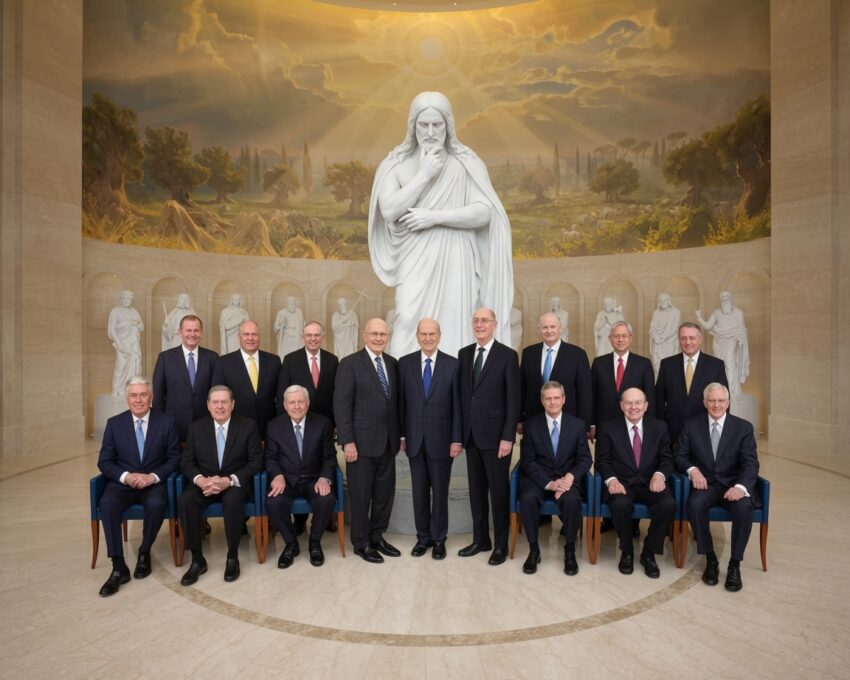
Image: A profound AI revision of the original image displayed in the Salt Lake Tribune: “Even carved in immutable white marble, a moment of divine second-guessing over the current lineup is unmistakably etched into the Savior’s posture.”
Called by Whom? The Latter-day Saint Apostleship Measured Against the Twelve Christ Chose
❦ ❖ ❦
I. Introduction: Thirteen Figures in Carrara Marble
Visitors to the Rome, Italy Temple Visitors’ Center of The Church of Jesus Christ of Latter-day Saints encounter, in a bright oval room, thirteen figures carved from Carrara marble. They are replicas of the celebrated Christus and apostle statues executed by the Danish sculptor Bertel Thorvaldsen in the early nineteenth century for the Church of Our Lady in Copenhagen. The Church’s own Philippines-area website describes them as physical testimonies to the faith and commitment of the ancient apostles, and adds that the living apostles of today are represented by those same statues in their work of leading the Church.
That sentence deserves a moment’s reflection, because it contains, in miniature, the entire question this essay proposes to examine. Thirteen figures stand in the Roman light. Twelve of them are men who walked the roads of Galilee, ate fish on the shore of Tiberias, watched their Teacher die, and — according to their own testimony — saw Him alive again. The thirteenth is the Lord Himself. And the claim, gently made and easily missed, is that fifteen men presently living in Salt Lake City stand in a relation of genuine continuity with the twelve figures in the marble.
Is that claim true? Not “Is it sincerely held?” — it plainly is. Not “Are the men who make it good men?” — by every ordinary human measure, most of them appear to be. The question is narrower and harder: does the office presently held by fifteen Latter-day Saints in Utah stand in the same relation to Jesus Christ that the office held by Peter, James, John, and their nine colleagues stood in? And if it does not, what exactly is it?
The question is not academic, and it is not stale. Between September 2025 and February 2026, the Latter-day Saint apostleship passed through one of the most compressed periods of transition in its modern history. President Russell M. Nelson died on 27 September 2025 at the age of 101. On 14 October, Dallin H. Oaks — then ninety-three years old, a former Utah Supreme Court justice, and the senior apostle by ordination date — was ordained and set apart as the eighteenth President of the Church. Jeffrey R. Holland succeeded Oaks as President of the Quorum of the Twelve and died on 27 December 2025. Gérald Caussé, the Presiding Bishop, was called to the Quorum on 6 November 2025; Clark G. Gilbert, a General Authority Seventy, was called on 12 February 2026. Henry B. Eyring became President of the Quorum, and Dieter F. Uchtdorf was named Acting President on 8 January 2026.
In five months, then, a global church of some seventeen million members lost its prophet and one of its most beloved apostles, seated a ninety-three-year-old successor without contest or crisis, and filled two vacancies through a process the Church describes as inspiration and outside observers describe as institutional. Nothing about this was scandalous. Everything about it was orderly. And that orderliness is precisely what invites the comparison this essay undertakes — because whatever else may be said of the calling of the original Twelve, orderly is not the word for it.
This essay measures the modern Latter-day Saint apostleship against the biblical original, using as its principal instrument John MacArthur’s Twelve Ordinary Men: How the Master Shaped His Disciples for Greatness, and What He Wants to Do with You, published by W Publishing Group in 2002. MacArthur’s book was not written about Mormonism. It contains, so far as I can determine, not a single reference to the Latter-day Saints. It is a pastoral and expositional character study, grown out of a sermon series on the Gospel of Matthew, aimed at ordinary Christians who might be encouraged to learn that the men Christ chose were, by any worldly reckoning, unremarkable.
That is exactly what makes it useful. A measuring instrument constructed for another purpose is less likely to have been calibrated to produce a desired result. MacArthur was not building a case against Salt Lake City. He was building a portrait of twelve men. If that portrait, honestly drawn from the biblical text, turns out not to fit the fifteen men in Salt Lake City, the misfit is a finding rather than a foregone conclusion.
A word about method and about tone. This essay is written from within traditional, historic Christianity, and it does not pretend otherwise. It proceeds from the conviction that the sixty-six books of the Old and New Testaments constitute a completed and sufficient revelation, and that this conviction is itself a claim requiring argument rather than assertion. Latter-day Saints who read these pages will disagree with that starting premise, and the disagreement is honest and substantial. What I have tried to avoid is the polemical register — the sneer, the caricature, the cheap point — that has disfigured too much writing in this field, and that persuades no one who is not already persuaded.
I have therefore drawn heavily on Latter-day Saint sources, including official ones, and I have quoted them at length and in context. Where Latter-day Saint writers make an argument, I have tried to state it in the form its best defenders would recognize before responding to it. Where the evidence cuts against the traditional Christian position, I have said so. And where the honest answer is that we cannot know, I have said that too.
The reader will judge whether I have succeeded.
❦ ❖ ❦
II. The Instrument: What MacArthur Actually Argues
Before Twelve Ordinary Men can serve as a measuring rod, its argument has to be stated accurately. MacArthur’s thesis is easily misremembered as a piece of democratic sentiment — God uses ordinary people, so be encouraged. That is in the book, but it is the application rather than the argument.
The argument runs the other way. MacArthur’s point is that the ordinariness of the Twelve is theologically load-bearing precisely because their office was not ordinary at all. He is emphatic on this. The men were common; the calling was uncommon; and the disproportion between the two is the entire point, because it locates the explanatory weight in Christ rather than in them.
MacArthur begins by insisting on the humanity of the Twelve against centuries of hagiographic accretion. He argues that readers need to recover them as actual men rather than as exalted figures in a pantheon of religious ritualism — a phrase worth holding onto, because it will matter later. Halos, stained glass, and pious legend have made them unrecognizable. The biblical record, by contrast, is unsparing. They were slow to understand. They quarreled about status. They misread plain statements. Peter, the leader, is characterized by MacArthur with a memorable phrase about a foot-shaped mouth. They were, in MacArthur’s reading, prone to mistakes, misstatements, wrong attitudes, lapses of faith, and bitter failure.
They were also socially and politically incoherent as a group. One was a former Zealot — a member of a movement committed to violent resistance against Rome. Another was a tax collector, a man who had made his living collaborating with the occupying power. In any ordinary human organization these two men would have been at each other’s throats. MacArthur notes that they spanned the political spectrum, and that the establishment of Jesus’ day regarded the whole company as outsiders.
Having established their ordinariness, MacArthur then catalogues what made their office extraordinary. Drawing this from his first chapter, “Common Men, Uncommon Calling,” the marks are these:
• They received truth by direct divine revelation. MacArthur grounds this in Ephesians 3:5, where Paul says the mystery of Christ has now been revealed by the Spirit to God’s holy apostles and prophets. Their message was not a human message; it came to them immediately from God.
• They were the source of all true church doctrine. Before the New Testament existed, the apostles’ teaching was the only standard — which is why Acts 2:42 describes the first believers as continuing steadfastly in the apostles’ doctrine. MacArthur makes the further point that the written New Testament is nothing other than the Spirit-inspired inscripturation of that apostolic teaching.
• They were given for the edifying of the church. Ephesians 4:11–12 names them among the gifts Christ gave for equipping the saints. Their teaching, as recorded in the New Testament, remains the rule by which sound doctrine is tested.
• They were examples of virtue. Ephesians 3:5 calls them holy apostles. They set the standard for all subsequent church leadership.
• They possessed unique power to work miracles that confirmed their message. MacArthur is careful here: the New Testament indicates that only the apostles and those closely associated with them worked such miracles, which is why 2 Corinthians 12:12 can call them the signs of an apostle.
• Their role was foundational. Ephesians 2:20 places them, with the prophets, as the foundation of the church, Jesus Christ Himself being the chief cornerstone.
To these six, MacArthur adds a seventh consideration that emerges throughout the book rather than in a single list: the eschatological permanence of their number. Revelation 21:14 describes the wall of the New Jerusalem as having twelve foundations, and in them the names of the twelve apostles of the Lamb. MacArthur returns to this repeatedly — when discussing Andrew, when summing up the whole company — observing that their names will be permanently etched into the foundation of that city. Whatever else this image conveys, it does not suggest an office through which an indefinite series of officeholders will rotate. Twelve names are inscribed, not twelve chairs.
MacArthur also treats, briefly, the two cases that complicate any tidy account: Matthias and Paul. On Matthias, he simply reports Acts 1 without editorializing: the office vacated by Judas was filled, the qualification stated by Peter was that the man had accompanied the company from John’s baptism to the Ascension, and Matthias — of whom Scripture tells us nothing else whatever — was chosen and numbered with the eleven. MacArthur’s summary is that one more perfectly ordinary man was raised to an extraordinary calling.
On Paul, MacArthur is more expansive but declines to make him the book’s subject. Paul, he notes, was called to a distinct apostolic office — apostle to the Gentiles — and possessed the same authority and privileges as the Twelve. But Paul was not one of them. He was, in his own phrase from 1 Corinthians 15:8, born out of due time. He had not shared Jesus’ public ministry. His apostleship rested on a direct encounter with the risen Christ on the Damascus road, which is precisely why he defends it in 1 Corinthians 9:1 with a question rather than a credential: have I not seen Jesus our Lord?
This is the instrument. Seven marks, drawn by a writer with no interest in Utah, from a book whose stated purpose was to encourage ordinary believers. The question now is what happens when the instrument is applied.
❦ ❖ ❦
III. The Convergence: Boyd K. Packer and the Ordinariness of the Twelve
The first result of the comparison is a surprise, and it is a surprise in the Latter-day Saints’ favor. On MacArthur’s central descriptive claim — that the apostles were ordinary men — senior Latter-day Saint leaders have said the same thing, sometimes in almost the same words.
The present Twelve are very ordinary people. They are not, as the original Twelve were not, spectacular individually, but collectively the Twelve are a power.
— Boyd K. Packer, quoted at MormonBeliefs.org
That is a remarkable convergence. Packer, who served in the Quorum of the Twelve for more than half a century, states MacArthur’s thesis without prompting and without apology. He goes on, in the same body of material, to describe the professional variety of his colleagues — scientists, lawyers, teachers, a pioneering heart surgeon, several military men — and to say that almost to a man the Twelve come from humble beginnings, as it was when the Lord was here. The fishing-net imagery is explicit: when the call came, each put down his nets and followed.
Nor is this an isolated formulation. Elder Dale G. Renlund, in his October 2015 conference address given shortly after his own call, cited the Doctrine and Covenants language about the fullness of the gospel being proclaimed by the weak and the simple, and identified himself as one of the weak and simple. Elder Neil L. Andersen, interviewed for the Church’s July 2019 Ensign feature on the modern apostleship, described a quorum without factions, without lobbying, without power centers, and — in his phrase — without egos. President Dieter F. Uchtdorf, in the same feature, insisted that the recognizability the calling brings is not about the men who hold it.
A critic who ignores this convergence is not arguing honestly. Latter-day Saint leaders do not, as a rule, claim personal spectacularity. The rhetoric of the modern Quorum is a rhetoric of humility, and there is no reason to believe it insincere. When Elder Ronald A. Rasband says that the deference members show is directed at the office rather than at the man, he is saying something a Reformed pastor could say about the pulpit.
But the convergence, examined closely, turns out to conceal a divergence — and the divergence is the hinge of this entire essay. MacArthur and Packer are not describing the same kind of ordinariness.
Two Kinds of Ordinary
The ordinariness MacArthur describes is social and institutional. The Twelve were outsiders. They held no religious office. They had no rabbinic training, no synagogue appointment, no standing in the Sanhedrin, no letters of commendation from Jerusalem. MacArthur makes the point with some force: when Jesus chose them, the religious elite of Israel were symbolically set aside. The Twelve did not rise through an existing hierarchy; they replaced one. When Peter and John stood before the Sanhedrin in Acts 4, the council perceived them to be unlearned and ignorant men, and marveled.
The ordinariness Packer describes is professional and biographical. The modern apostles were not born to eminence; they came from modest homes; they had ordinary careers before they were called. All of that is true and creditable. But it is a different proposition, because by the time a Latter-day Saint is called to the Quorum of the Twelve he is not, in the relevant sense, an outsider at all. He is very nearly the definition of an insider.
Consider the record. Dallin H. Oaks was president of Brigham Young University and a justice of the Utah Supreme Court when he was called. Russell M. Nelson was an internationally known cardiac surgeon. Jeffrey R. Holland had been president of Brigham Young University and a member of the First Quorum of the Seventy. David A. Bednar was the final president of Ricks College and the first president of Brigham Young University–Idaho. Gary E. Stevenson and Gérald Caussé were each serving as Presiding Bishop of the Church. Clark G. Gilbert, called in February 2026, had been a General Authority Seventy since 2021 and, before that, a figure in the Church Educational System. Dieter F. Uchtdorf came to the Quorum from the Presidency of the Seventy after a career as a senior airline executive.
Wikipedia’s summary of the process is dry and accurate: any Melchizedek priesthood holder is technically eligible, but new apostles generally have considerable experience in church government, having served as bishops, stake presidents, mission presidents, or Seventies. The same article records that apostles are ordinarily asked to leave their professional careers for full-time Church service, and that some receive assignments to the boards of Church-owned for-profit corporations and to the trusteeship of the Church’s educational institutions.
This is not a criticism of the men. It is a description of a structure. And the structure is the opposite of the one described in the Gospels. The Twelve were called out of the fishing trade and the customs house into an office that had not existed before and for which no career path existed. The Fifteen are called out of the upper reaches of an existing ecclesiastical and institutional apparatus into its highest office, along a path so well-defined that outside observers can and do handicap the field.
Wikipedia’s article on the Quorum notes, citing Richard and Joan Ostling’s Mormon America, that the body bears some general similarity to the College of Cardinals, the differences arising chiefly from life tenure — which can produce an elderly or infirm president but also provides considerable training of apostles to become the president. The comparison is not hostile; it is structural, and Latter-day Saints have made it themselves. But it is worth sitting with. No one has ever compared the company that followed Jesus around the Galilee to the College of Cardinals, and the reason is not that the Twelve were holier. It is that they were differently constituted.
Peter did not spend eleven years as a stake president. Matthew did not chair a subcommittee. Simon the Zealot was not vetted. The ordinariness of the New Testament Twelve was the ordinariness of men who had no business being where they were. The ordinariness of the modern Fifteen is the ordinariness of accomplished men who rose through an institution that trained them for exactly the place they now occupy.
Both may be humble. Only one is unaccountable in worldly terms.
❦ ❖ ❦
IV. Called by Whom?
We come now to the question that gives this essay its spine. The Church of Jesus Christ of Latter-day Saints teaches that its apostles are called of God. The claim is stated on the Church’s official website in language that invites direct comparison: Jesus Christ calls Apostles to represent Him in our day just as He did in the Bible. Elder Rasband, describing his own call in the October 2015 general conference, reported that President Thomas S. Monson told him the call came from the Lord Jesus Christ, and said he was shaken to his core by the words.
There is no reason to doubt that Rasband experienced exactly what he describes. The question is not about his sincerity. The question is about the structure of the transaction — and specifically about how many hands the call passed through on its way to him.
The Gospel Pattern
Luke is precise about how the Twelve were chosen:
And it came to pass in those days, that he went out into a mountain to pray, and continued all night in prayer to God. And when it was day, he called unto him his disciples: and of them he chose twelve, whom also he named apostles.
— Luke 6:12–13, KJV
The grammar admits of no intermediary. Jesus prayed. Jesus called. Jesus chose. Jesus named. In John 15:16, He tells them plainly that they did not choose Him but that He chose them. Mark 3:13 says He called unto Him whom He would, and they came. There is no committee, no sustaining vote, no pool of qualified candidates, no seniority, and — conspicuously — no prior officeholder acting as the conduit of the call.
Paul, the one apostle called after the Ascension, defends his office in exactly these terms, and the emphasis of his opening line to the Galatians is unmistakable in the King James rendering:
Paul, an apostle, (not of men, neither by man, but by Jesus Christ, and God the Father, who raised him from the dead;)
— Galatians 1:1, KJV
The parenthesis is a denial of mediation, and Paul evidently thought it worth putting first. He returns to it in the same chapter, insisting that the gospel he preached was not received from man, nor taught to him by man, but came by revelation of Jesus Christ, and noting almost pointedly that after his conversion he did not immediately go up to Jerusalem to those who were apostles before him. Whatever else Paul is doing in Galatians 1, he is refusing to let his apostleship be traced through a human chain.
The 1835 Pattern
Against this, set the Church’s own account of how the first Latter-day Saint Quorum of the Twelve was constituted. The Ensign of October 2017 published a short historical piece on the subject, drawn from the Joseph Smith Papers, and its details are not disputed by anyone.
On 8 February 1835, Joseph Smith asked the brothers Brigham and Joseph Young to sing to him, and afterward received a revelation that the time had come for the Twelve to be called. He instructed Brigham Young to announce a conference for the following Saturday and told him that he would be one of the Twelve. Six days later the Saints assembled, and Joseph Smith stated that one of the meeting’s primary purposes was for the Three Witnesses of the Book of Mormon — Oliver Cowdery, David Whitmer, and Martin Harris — to choose twelve men from the church as Apostles. Cowdery and Whitmer had received that assignment in June 1829 and had sought the Lord by fasting and prayer to identify the Twelve, but the time had not then been right. Now, Joseph said, it had come.
The twelve chosen, in the order presented, were Lyman Johnson, aged twenty-three; Brigham Young, thirty-three; Heber C. Kimball, thirty-three; Orson Hyde, thirty; David W. Patten, thirty-five; Luke Johnson, twenty-seven; William E. McLellin, twenty-nine; John F. Boynton, twenty-three; Orson Pratt, twenty-three; William Smith, twenty-three; Thomas B. Marsh, thirty-four; and Parley P. Pratt, twenty-seven. All had previously served missions. Eight had marched with Joseph Smith in Zion’s Camp the previous summer.
Three observations follow, and none of them requires hostility to make.
First, the selecting agents were three men. Not Christ directly, in the Lukan manner, but Cowdery, Whitmer, and Harris, acting under an assignment given six years earlier and under Joseph Smith’s direction on the day. Latter-day Saints will reply that the Three Witnesses acted by revelation, and that revelation through authorized servants is precisely how God has always worked. That reply is coherent within Latter-day Saint premises. But it concedes the structural point rather than answering it: the call was mediated, and the New Testament calls were not conspicuously mediated.
Second, the pool was small and known. Eight of the twelve had been in Zion’s Camp with Joseph Smith. All had served missions. These were, in other words, the movement’s proven and available young men. That is a perfectly reasonable way to staff an organization. It is not obviously the way described in Luke 6, where the sorting criterion is invisible to the observer and where the resulting company includes a Zealot and a tax collector who had every social reason to despise one another.
Third, and most consequentially, the subsequent history of that original Quorum is not the history of the New Testament Twelve. Within a few years, Lyman Johnson, Luke Johnson, John F. Boynton, William E. McLellin, and Thomas B. Marsh — five of the twelve, including the Quorum’s first president — had left the Church or been excommunicated. William Smith’s relationship with the Church ended in estrangement. Orson Pratt was excommunicated in 1842, reinstated in 1843, publicly condemned by his own quorum in 1865, and demoted in seniority in 1875 to prevent his succession to the presidency. That last history I have examined at length elsewhere and will not rehearse here, except to note the arithmetic: of the original Latter-day Saint Twelve, roughly half did not finish.
Among the New Testament Twelve, the corresponding figure is one — and the New Testament treats that one as a matter of prophetic necessity and unrelieved tragedy, devoting to Judas an entire chapter of MacArthur’s book and considerable space in all four Gospels. A defection rate of one in twelve is a scandal that Scripture labors to explain. A defection rate approaching one in two is a different kind of fact, and it sits uneasily beside the claim that the modern office is the ancient office restored.
The Modern Pattern
The present-day procedure is described consistently across official and semi-official sources. When a vacancy arises, the Twelve and the counselors in the First Presidency counsel and pray together and recommend a name to the President of the Church. The final decision rests with the President. The name is then formally voted on by the Twelve and the counselors, presented to the general membership for a sustaining vote, and the man is ordained by the laying on of hands.
The Encyclopedia of Mormonism, quoted by Truth in Love Ministry, states the definition compactly: an apostle is an ordained leader in the Melchizedek Priesthood, chosen through inspiration by the President of the Church, sustained by the general membership, and ordained by the First Presidency and the Quorum of the Twelve by the laying on of hands.
Set that sequence beside Luke 6:13, and the difference is not one of emphasis. In Luke, one agent acts. In the modern procedure, the chain runs: deliberation among the Fifteen, inspiration to the President, decision by the President, ratification by vote, sustaining by the membership, ordination by the body. Every link in that chain is defensible as ecclesiastical practice. Together they constitute something that would have been unrecognizable to Peter — not because it is corrupt, but because it is a procedure, and the calling of the Twelve was not.
The question in the title of this section is therefore not rhetorical mischief. It is the plain question the comparison generates. When Elder Rasband was told that the call came from the Lord Jesus Christ, the words were spoken by President Monson. When Elder Gilbert was called in February 2026, the call came through President Oaks. In no case does the modern claim rest on what Paul’s claim rested on — a personal, unmediated, verifiable-in-principle encounter with the risen Christ, appealed to in public as the ground of the office.
Latter-day Saints have an answer to this, and it deserves a full hearing. It is the doctrine of priesthood keys and delegated authority: that Christ governs His Church through servants He has authorized, that the authority conferred by the laying on of hands is genuinely His, and that mediation is not dilution. On its own premises, this is internally consistent, and it is the same logic by which Catholic and Orthodox Christians defend episcopal succession.
But the Latter-day Saint case cannot rest there, because the Church’s foundational narrative is that precisely this kind of mediated succession failed. The Great Apostasy doctrine holds that priesthood authority was lost when the apostles died, and that the resulting chain of merely institutional succession produced centuries of error. If mediated authority is sufficient to preserve the apostolate, the Great Apostasy is unnecessary. If mediated authority is insufficient — as the Restoration narrative requires — then the modern Quorum, which is constituted by mediated authority, has a problem it cannot solve by pointing to the same mediation.
This is not a gotcha. It is a genuine tension in the position, and thoughtful Latter-day Saints have noticed it. The usual resolution is to say that the difference lies in the restoration of keys by Peter, James, and John to Joseph Smith and Oliver Cowdery in 1829 — that the chain was broken and then divinely re-forged, and that everything since flows from that re-forging. Whether one finds that resolution persuasive will depend almost entirely on what one concludes about the 1829 event itself, which is a separate inquiry. What can be said here is narrower: the modern process of calling an apostle does not resemble the New Testament process of calling an apostle, and the resemblance cannot be recovered by appeal to a doctrine whose own premise is that resemblance of that kind is insufficient.
We deal extensively with the restoration claims in another essay, “The Gates Did Not Prevail: A Biblical and Historical Case Against the LDS Great Apostasy Doctrine.”
The Mormon claims of total apostasy and exclusive restoration rest not on historical evidence but on the credibility of Joseph Smith’s private revelations. When tested against Scripture, history, and contemporary scholarship, these claims are found wanting. The supposed “restoration” of Christianity by Joseph Smith was unnecessary because authentic Christianity was never lost.
❦ ❖ ❦
V. Special Witnesses of What?
Every Latter-day Saint apostle is set apart, in the language of Doctrine and Covenants 107:23, as a special witness of the name of Christ in all the world. Elder Rasband reported that his own ordination included the phrase at all times and in every circumstance. Elder Bednar, in the July 2019 Ensign feature on the modern apostleship, put the priority sharply: first and foremost, he said, the apostles are witnesses of the living reality of the Lord Jesus Christ, and — in a formulation worth noting for a later section — they are ministers rather than administrators.
The word witness is doing enormous work in these sentences, and the question this section asks is what it means. A witness, in ordinary usage and in every legal system I am aware of, is someone who testifies to what he has himself perceived. The New Testament uses the word in exactly that way. When Peter stands at Pentecost and says of the resurrection that we all are witnesses, he is not reporting a conviction. He is reporting a sighting.
The Acts 1 qualification makes this explicit, and it is worth quoting in full:
Wherefore of these men which have companied with us all the time that the Lord Jesus went in and out among us, beginning from the baptism of John, unto that same day that he was taken up from us, must one be ordained to be a witness with us of his resurrection.
— Acts 1:21–22, KJV
Peter is not describing a desirable qualification. He is describing the only qualification. The candidate must have been physically present for the whole span of the public ministry, and the purpose of his ordination is stated in a single clause: to be a witness with us of his resurrection.
Modern Latter-day Saint apostles do not claim to meet this standard, and no honest critic should pretend that they do. The question is what they claim instead — and here the historical record is more interesting, and more uncomfortable, than either side’s usual summary allows.
The Standard the Restoration Set for Itself
On 21 February 1835, a week after the Twelve were designated, Oliver Cowdery delivered a charge to the newly ordained apostles. The text survives in the Kirtland Council Minutes and is reproduced in full on the Latter-day Saint group blog Times & Seasons, in a 2022 essay by Chad Nielsen titled “Do All Prophets and Apostles See God?” Because the document is a nineteenth-century record in the public domain, it can be quoted at length — and it should be, because it is the single most important text in this entire discussion.
You have been indebted to other men in the first instance for evidence [of God’s existence, and] on that you have acted. But it is necessary that you receive a testimony from Heaven for yourselves, so that you can bear testimony to the truth of the Book of Mormon. And that you have seen the face of God; that is more than the testimony of an Angel. When the proper time arrives you shall be able to bear this testimony to the world. When you bear testimony that you have seen God. This testimony God will never suffer to fall, but will bear you out. Although many will not give heed, yet others will. You will, therefore see the necessity of getting this testimony from heaven. Never cease striving until you have seen God, face to face. Strengthen your faith, cast off your doubts, your sins and all your unbelief and nothing can prevent you from coming to God. Your ordination is not full and complete till God has laid his hand upon you. We require as much to qualify us as did those who have gone before us. God is the same. If the Saviour in former days laid his hands upon his deciples. Why not in the latter Days.
— Oliver Cowdery, charge to the Twelve, Kirtland Council Minutes, 21 February 1835
Read that again slowly, because almost every element of the biblical apostolic standard is present in it — and present because Cowdery put it there deliberately.
He acknowledges that the new apostles have so far been dependent on the testimony of others. He declares that secondhand evidence is insufficient for the office. He specifies the required evidence: not an angel, but the face of God. He promises that the day will come when they can bear that testimony publicly. He commands them not to stop until they have seen God face to face. And then he says the sentence that ought to be engraved over every discussion of this subject: your ordination is not complete till God has laid his hand upon you.
Cowdery, in other words, understood what the New Testament required of an apostle, and he set that requirement before the men of 1835 as a standard to be met. He grounded it explicitly in continuity: we require as much to qualify us as did those who have gone before us. God is the same.
The traditional Christian critic and the nineteenth-century Latter-day Saint are therefore in agreement about the standard. The disagreement concerns whether it has been met.
The Historical Record
Nielsen’s Times & Seasons essay is the fairest inventory of the evidence I have found, and it is written from inside the tradition by a believing Latter-day Saint who is manifestly not trying to embarrass anyone. His conclusion, stated without polemic, is that some but not all of the apostles have seen Christ.
On the affirmative side, he assembles a genuine list. Wilford Woodruff reported that the Savior appeared after the Salt Lake Temple dedication to accept the temple. Lorenzo Snow was said to have met the Savior in the Salt Lake Temple following Woodruff’s death. George Q. Cannon declared publicly in 1896 that he knew Jesus lived because he had seen Him — which Nielsen rightly identifies as the straightforward case. Orson F. Whitney described a dream-vision in which he saw and spoke with Christ. Melvin J. Ballard had an experience while presiding over a mission. Hugh B. Brown told a nephew that the Lord had appeared to him informally. David B. Haight had an extended vision during a serious illness. Boyd K. Packer said on at least two occasions that he knew the Lord. Jeffrey R. Holland once testified with what he called the conviction Peter described as the more sure word of prophecy.
That is a substantial body of claimed experience, and a critic who waves it away is not dealing with the evidence. But the negative side of Nielsen’s ledger is what makes the essay valuable, because it consists of statements by presidents of the Church.
Joseph Fielding Smith, after nearly forty years in the apostleship, told his son plainly that he had not lived in the days of the Savior, that Christ had not come to him in person, and that he had not beheld Him. He added that he did not consider this necessary, having felt Christ’s presence and received the witness of the Spirit.
David O. McKay, asked directly by a reporter some years into his presidency whether he had seen Christ, answered that he had not — and then explained, according to the account preserved in Gregory Prince and Wm. Robert Wright’s biography, that he had heard the Lord’s voice many times and felt His presence and influence, and that some evidences are stronger even than sight.
Heber J. Grant’s case is the most poignant. Nielsen recounts that after his call to the Twelve, Grant spent months in deep depression, in part because one of the Brethren had told him that no man could serve in the Quorum who had not had an open vision of Christ — and Grant had not. He felt, he later said, like a liar every time he bore his testimony, because he had never seen Him and did not know. The resolution came in a vision of a council in the spirit world, of which Grant said that he seemed to see rather than saw, and that he was not seeing it with his eyes.
And Boyd K. Packer, who elsewhere said that he knew the Lord, also supplied the formula that has governed public discussion of this question for two generations: that the Brethren do not speak of the sacred interviews which qualify the Lord’s servants to bear special witness of Him, because they have been commanded not to, but that they are obliged to bear the witness itself.
Stating the Difficulty Precisely
It is important to state the difficulty precisely, because it is easy to overstate.
The difficulty is not that Latter-day Saint apostles have lied. There is no basis for that charge, and I do not make it. The difficulty is not even that some of them have not seen Christ; Joseph Fielding Smith’s position — that the witness of the Spirit suffices and sight is unnecessary — is a perfectly respectable theological view, and it is substantially the view every traditional Christian holds about every Christian.
The difficulty is that Joseph Fielding Smith’s position is not Oliver Cowdery’s position, and the office was defined by Cowdery’s.
Cowdery told the Twelve that their ordination was not complete until God had laid His hand upon them, and that they must never cease striving until they had seen God face to face. If a president of the Church can serve four decades in the apostleship and say honestly that he has not beheld the Lord, then either the standard Cowdery set has been quietly abandoned, or the office has been held for long stretches by men whose ordination was, in Cowdery’s own terms, not complete. There is no third possibility that I can construct.
Latter-day Saints may reasonably answer that Cowdery was speaking aspirationally; or that the phrase special witness of the name of Christ in Doctrine and Covenants 107:23 concerns the name rather than requiring sight of the person — a reading one commenter in Nielsen’s thread proposes with some care; or that publicizing such experiences would exert a coercive pressure on faith that the Lord does not desire, which is the argument the same commenter develops at length. Each of these answers has force. But each of them also moves the office further from the thing the New Testament describes, in which the entire point of the testimony was that it was public, evidential, and offered as a ground for belief.
Another commenter in that thread puts the counter-position with unusual directness, and her instinct is the biblical one: a witness who does not testify to what he has witnessed is not functioning as a witness. Peter did not decline to describe the empty tomb on grounds of sacredness. Paul recounted the Damascus road three separate times in the Book of Acts, to three different audiences, including a Roman procurator and a Herodian king. John opened his first epistle by piling up the verbs of perception — heard, seen with our eyes, looked upon, handled — and then stated the purpose: that which we have seen and heard declare we unto you.
The reticence of the modern Quorum is not a moral failing. It may well be the appropriate response of humble men to experiences they find genuinely difficult to articulate, and there is a long and honorable Christian tradition of reserve about private consolations. But it is not apostolic reticence, because apostolic testimony was by definition the opposite of reticent. The apostles were killed for saying out loud, in public, in front of hostile authorities, precisely what they claimed to have seen.
A Standard That Moved
There is one further consideration, and it belongs in the body rather than in a footnote, because it bears directly on the question of authenticity that this essay was asked to examine.
The Latter-day Saint position on apostolic witness has moved. In 1835 the standard was seeing God face to face, stated flatly and publicly by the man charged with delivering the apostolic charge, and reinforced by ordination blessings that — according to Heber C. Kimball’s later recollection in the Times and Seasons of April 1845 — promised the Twelve power to heal the sick, cast out devils, raise the dead, give sight to the blind, and remove mountains. By the mid-twentieth century, the standard had become a sacred interview that must not be described. By the twenty-first, the most common formulation from the pulpit at general conference is that the speaker knows Jesus is the Christ — a testimony indistinguishable in form from the one every faithful member is invited to bear.
Elder Renlund made this democratization explicit in the 2019 Ensign piece when he observed that Barsabas’s testimony of the Savior and His resurrection was equal to that of Matthias, and that the difference between them lay in God’s choosing rather than in the quality of their witness. President Ballard, in the same feature, said that every member of the Church can develop an apostolic-like relationship with the Lord.
That is a warm and pastorally generous thing to say, and I do not doubt that it is meant kindly. But viewed structurally, it is a substantial deflation of the office. If the apostolic witness differs from the ordinary member’s witness in scope and authority but not in kind, then the word apostle has come to designate an administrative rank rather than an evidential category. An administrative rank, however exalted, is not what Peter was describing in Acts 1. Peter was describing a man who had been in the room.
❦ ❖ ❦
VI. The Signs of an Apostle
MacArthur’s fifth mark was miraculous attestation, grounded in Paul’s phrase about the signs of an apostle being wrought in signs and wonders and mighty deeds. This is the mark that Latter-day Saint writers have found it necessary to address most directly, because the absence is conspicuous and members notice it.
The clearest treatment I have found is Kelly Merrill’s at Gospelstudy.us, in an essay titled “Has the Calling of the Apostles Changed?” Merrill reports that someone came to him with a list of scriptural miracles worked by ancient apostles and the observation that we never hear of miracles worked by modern ones. Merrill’s response deserves a full hearing, because it is thoughtful and because it is characteristic.
His argument has four moves. First, priesthood administration changes from dispensation to dispensation while priesthood power does not; the modern arrangement differs from the ancient one as the Mosaic arrangement differed from the patriarchal. Second, the apostolic calling is fundamentally to bear witness of Christ’s divinity and resurrection, and this is done to individuals and families rather than to crowds. Third — and this is the load-bearing claim — the apostles did not do things for public display, either in our day or in the early Church. Fourth, modern apostles do work miracles, but privately, as confirmations of individual faith; Merrill says he has spoken with people who know of those healed by apostolic blessings.
Merrill adds a prudential argument. He asks the reader to imagine what would happen if an apostle worked a public miracle in front of a cell-phone camera today: the viral video, the social-media firestorm, the crowd determined to disprove what they had seen. Miracles, he concludes, exist to confirm faith rather than to convert the determined unbeliever, and there is not the faith today to warrant such public confirmations.
Where the Argument Fails
The prudential argument is unfalsifiable by construction, and Merrill is entitled to it as a theological opinion. But the historical claim is a different matter, because it can be checked against the text — and the text does not support it. The assertion that the New Testament apostles did not work miracles publicly is, with respect, simply mistaken, and the correction requires nothing more than the Book of Acts.
Consider Acts 3. Peter and John heal a man lame from birth at the Beautiful Gate of the temple — the single most public location in Jerusalem, at the hour of prayer. Luke reports that all the people saw him walking and praising God, that they knew it was the man who had sat begging at the gate, and that they were filled with wonder and amazement. A crowd assembles in Solomon’s Porch. Peter preaches to it. The temple authorities arrest them because of it. In Acts 4:16, the Sanhedrin itself concedes the difficulty in the plainest terms: a notable miracle has been done, it is manifest to all who dwell in Jerusalem, and we cannot deny it.
That is not a private confirmation of individual faith. That is a public sign, performed before a hostile establishment, conceded by that establishment, and used as the occasion for evangelistic preaching to thousands.
Consider Acts 5:12–16. Luke reports that many signs and wonders were wrought among the people by the hands of the apostles, that they were all with one accord in Solomon’s Porch, that the people magnified them, and that believers were added in multitudes. He then describes the sick being carried into the streets on beds and couches so that Peter’s shadow might fall on some of them, and a multitude coming out of the surrounding cities bringing the sick and the afflicted, and every one of them being healed. Whatever else this passage is, it is a description of public, mass, reputational miracle-working — so public that people organized street logistics around it.
Consider Acts 9:32–43. Peter heals Aeneas at Lydda, and Luke states the result: all who dwelt at Lydda and Sharon saw him and turned to the Lord. Peter raises Dorcas at Joppa, and Luke states the result: it was known throughout all Joppa, and many believed in the Lord. The miracle is not merely public; its publicity is presented as its evangelistic mechanism.
Consider Acts 19:11–12 at Ephesus, where handkerchiefs and aprons from Paul’s body were carried to the sick. Consider Acts 20:9–12, where Eutychus falls from a third-storey window during a congregational meeting, and Paul restores him in front of the assembled church. Consider Acts 28:8–9 on Malta, where Paul heals the father of Publius and then, Luke says, others on the island who had diseases came and were healed.
The pattern is consistent across the entire book. Apostolic miracles in Acts are public, are witnessed by hostile parties, are conceded by opponents, and function as evidence offered to unbelievers. Merrill’s third premise — the one on which his whole argument rests — inverts the record.
Nor is this a matter of proof-texting a devotional writer. Merrill is representing a widely held Latter-day Saint understanding, and the same claim appears in various forms across Latter-day Saint apologetics. But it cannot survive contact with Acts, and the reason matters. The New Testament presents miraculous attestation as an evidential category — Paul calls such works the signs of an apostle, and Hebrews 2:3–4 says God bore witness to the apostolic message with signs and wonders and various miracles and gifts of the Holy Spirit. Signs are for signifying. A sign that no one is permitted to see is not performing the function the word names.
The 1835 Promise
The point sharpens considerably when we return to Kirtland. The ordination blessings pronounced upon the first Latter-day Saint Twelve did not promise them quiet private confirmations. According to Heber C. Kimball’s recollection, published in the Times and Seasons in 1845 and reprinted by the Church in its own October 2017 Ensign, those blessings predicted that the Twelve would have power to heal the sick, cast out devils, raise the dead, give sight to the blind, and remove mountains, and that all things should be subject to them through the name of Jesus Christ.
This is not a critic’s framing. It is the Church’s own published account of what its first apostles were promised at their ordination. And it is the New Testament standard — the standard of Acts 3 and Acts 5 and Acts 9 — restated in nineteenth-century American idiom.
The Baptist pastor Dave Mallinak, writing from nearly three decades of ministry in Utah, records his own negative observation on this point: that in all his years of listening to general conference and following Church news in the state’s media, he has never once heard of a sign or wonder or mighty deed wrought by a member of the Quorum of the Twelve. Mallinak’s essay is written in a considerably sharper register than this one — he calls the Quorum false apostles without qualification, and his metaphors run to billy goats and paper wads — and I do not adopt either his conclusion’s bluntness or his rhetoric. But the observation itself is an empirical claim about the public record, and it is not difficult to verify. The modern Latter-day Saint apostleship does not present miraculous attestation as evidence for its own authority, and it has not done so within living memory.
A fair-minded reader should notice that this observation cuts at more than one target. Very few Protestant ministries present miraculous attestation as evidence for their authority either, and traditional cessationists like MacArthur would say that this is exactly as it should be, because the signs of an apostle attended the apostolic office and the apostolic office has ended. That is a coherent position, and it is mine. But it is available only to those who are not claiming the apostolic office. The Latter-day Saint Church claims the office. Having claimed it, it inherits the office’s biblical marks — including the one Paul himself named as the seal of his own apostleship.
❦ ❖ ❦
VII. Foundations Are Laid Once
The Latter-day Saint case for a continuing apostolate rests on three pillars, and they should be set out in their strongest form before they are examined.
The first is the Matthias precedent. The eleven filled the vacancy created by Judas, and Latter-day Saints reasonably infer that the office was meant to be maintained at twelve. Bruce R. McConkie stated the argument in Mormon Doctrine, holding that apostolic succession was the Church order in the meridian of time, and that Paul taught in Ephesians 4 that apostles were to continue in the true Church until the millennial era. James E. Talmage, in The Great Apostasy, drew attention to the procedural detail that the whole company of about a hundred and twenty was assembled for the selection and that the qualification Peter named — personal knowledge of the Lord’s ministry — is the distinguishing feature of the apostleship.
The second is Ephesians 4:11–13, where Christ gives apostles, prophets, evangelists, pastors and teachers for the perfecting of the saints, until we all come in the unity of the faith. Since the Church has manifestly not yet arrived at that unity, the argument runs, the gifts named must still be operative — including apostles. Ask Gramps deploys precisely this text, as does virtually every Latter-day Saint treatment of the subject.
The third is the Great Apostasy: that the death of the apostles removed priesthood keys from the earth, that error consequently crept into the Church, and that a restoration was therefore necessary. The Church’s own manual on the Restoration states this plainly, and Ask Gramps develops it with a martyrology of the original Twelve and appeals to Matthew 7:15, Acts 20:29–30, and 2 Thessalonians 2:1–4.
Each argument deserves a specific answer.
On Matthias
The Matthias episode establishes less than it is asked to establish, for a reason that is textual rather than theological. Acts 1 is descriptive. It tells us what the eleven did; it does not tell us what the Church must do in perpetuity.
And the decisive counter-instance is not a matter of inference. In Acts 12:1–2 Herod kills James the brother of John with the sword — the first apostolic martyrdom, the death of a member of the inner three. Luke gives it two verses and moves on. There is no assembly, no casting of lots, no replacement. The Church does not act to maintain the number. If the twelve-member quorum were a standing office requiring perpetual maintenance, Acts 12 is the moment at which we should expect to see the machinery operate, and the machinery is absent.
What distinguishes Judas from James is not that one vacancy required filling and the other did not by oversight. It is that Judas defected. Peter, in Acts 1:20, grounds the replacement in Psalm 109:8 — let another take his office — treating the case as the fulfillment of a specific prophecy about a specific betrayer, not as the institution of a general rule. Judas abandoned a post. James completed one.
It is also worth observing what Matthias’s qualification implies about perpetuity. The criterion Peter states is availability from John’s baptism to the Ascension. That pool was finite in the first century and empty by the second. Peter did not establish an office; he described a category of eyewitnesses, and categories of eyewitnesses close.
MacArthur’s handling of Matthias is instructive here precisely because it is so undramatic. He reports the episode, notes that Scripture tells us nothing whatever about Matthias beyond the two verses in Acts 1 that record his selection, and observes that another perfectly ordinary man was raised to an extraordinary calling. He draws no succession doctrine from it in either direction, because the text does not supply one.
On Ephesians 4
The Ephesians 4 argument is the strongest of the three and should not be waved away. It is genuinely true that Paul lists apostles among gifts given for the building up of the body until a maturity plainly not yet reached.
The traditional Christian answer is that Paul is describing gifts given, not offices perpetually staffed, and that the manner in which a foundational gift continues to build the church is through what it produced. Dave Mallinak states this version well: their instruction is foundational, their persons and their office are not; and the instruction is found in the writings we call the New Testament. Lucky Mogakane, writing for The Gospel Coalition Africa, makes the same point from the other direction — that the modern church must return to the apostolic word rather than running after modern apostles, because the church stands or falls on the word of God.
The controlling text is Ephesians 2:20, two chapters earlier in the same letter, where the household of God is described as built upon the foundation of the apostles and prophets, Jesus Christ Himself being the chief cornerstone. MacArthur returns to this verse throughout Twelve Ordinary Men, calling the apostles the foundation stones of the church. The image is architectural, and architecture is not infinitely repeatable. A foundation is laid once. A builder who is still laying foundation in the third century of construction is not building; he is starting over.
The eschatological image reinforces this. Revelation 21:14 describes the wall of the New Jerusalem as having twelve foundations bearing the names of the twelve apostles of the Lamb. Names, not offices. MacArthur draws this out with evident relish, noting more than once that these men’s names will be permanently etched into the foundation of that city. If the apostolate were a rotating office, the image would be incoherent — which twelve names, out of the hundreds who have since held the title?
There is a further wrinkle that Latter-day Saint sources themselves surface. Doctrine and Covenants 107:22–24 establishes fifteen apostles: three in the First Presidency and twelve in the Quorum. Mormon FAQ states the arrangement flatly — scripture dictates fifteen. The Church’s own institutional practice therefore does not preserve the biblical twelve; it preserves twelve plus three, with the three drawn from among the twelve and the resulting vacancies filled. Whatever the merits of this arrangement, it is not the pattern of Revelation 21:14, and it complicates the claim that the biblical number is being restored.
The Distinction That Clarifies Everything
The most useful contribution to this debate that I encountered in preparing this essay comes not from an anti-Mormon polemicist but from Clarke Morledge, writing at Veracity in 2019. His question is whether the gift of apostleship ceased at the end of the first century, and his answer is a carefully constructed yes and no.
Morledge distinguishes between what he calls capital-A Apostles and lower-case-a apostles. The Greek word apostolos simply means one sent as a messenger, and the New Testament uses it in both a generic and a technical sense. Epaphroditus is called an apostolos in Philippians 2:25, where English versions render it messenger. Barnabas is called an apostle in Acts 14:14. Junia is described in Romans 16:7 as outstanding among the apostles. None of these is plausibly a member of the foundational company.
The capital-A category, Morledge argues, consists of those who saw the risen Christ and were commissioned by Him to articulate the gospel authoritatively for the first-century world — the Twelve, plus Paul, plus arguably James the Lord’s brother. Their distinguishing capacity was that they, or those in their immediate circle, wrote Scripture. That category is closed, and Morledge says so bluntly in connection with Latter-day Saint claims specifically: there is no case for additional revealed books of the Bible beyond what we already have.
The lower-case-a category, by contrast, remains open. Church planters, missionaries, cross-cultural pioneers — people genuinely sent out by Christian communities as messengers of the gospel — exercise a gift the New Testament recognizes. Morledge is relaxed about the terminology; if calling them apostles causes grief, call them something else, but the function persists.
This distinction does real work, and it is more generous to the Latter-day Saint position than the flat cessationism a critic might have expected. It concedes that apostleship in a real sense continues. It concedes that the office of foundation-laying does not. And it locates the disagreement exactly where the disagreement actually lies: not in whether God still sends people, but in whether anyone alive today can add to the canon or speak with the authority Peter and Paul spoke with.
Truth in Love Ministry, whose treatment of this subject is notably free of the acid that characterizes much writing in this field, frames the consequence in terms of stability rather than legitimacy. The organization’s position is that the uniqueness of the first-century apostles matters because a shifting foundation cannot bear the weight of eternal hope, and that if today’s apostles can revise what yesterday’s apostles said, certainty about the truth becomes impossible to secure.
That is, I think, the strongest form of the traditional Christian argument, and it is worth noticing that it is an argument about consequences rather than an accusation about motives.
On the Great Apostasy
The third pillar can be treated briefly, because it is largely a matter of what one does with a single promise. Jesus said in Matthew 16:18 that He would build His church and that the gates of hell should not prevail against it. The traditional Christian reads this as a guarantee of the Church’s continuous existence — not of its purity, not of its faithfulness in every generation, not of its freedom from grievous error, but of its survival.
The Great Apostasy doctrine requires that the promise failed, or that it means something less than continuous existence. Latter-day Saints generally take the second option, arguing that individual believers and much truth remained while the institution with authority did not. The Church’s own Restoration manual puts it this way: good people and much truth remained, but the gospel as Christ established it was lost.
I note only that the apostolic warnings which Latter-day Saint writers cite in support of a total apostasy do not, on inspection, predict one. Paul in Acts 20:29–30 warns the Ephesian elders that wolves will enter in and that men will arise from among themselves speaking perverse things — a warning that presupposes a continuing church to be preyed upon. Peter in 2 Peter 2:1 warns of false teachers among you, and closes the same letter by exhorting his readers to grow in grace and in the knowledge of Christ — counsel that would be strange if the Church were about to cease. First Timothy 4:1 speaks of some departing from the faith, not all.
CARM’s Luke Wayne puts the ecclesiological conclusion compactly: the twelve were twelve specific people appointed by Christ for a specific purpose, and the church is neither meant nor permitted to claim its own continuous line of twelve apostles. One may disagree with that conclusion, but it does not depend on hostility to Mormonism; it depends on a reading of Ephesians 2:20 and Revelation 21:14 that predates Joseph Smith by many centuries.
❦ ❖ ❦
VIII. Ministers or Administrators? The Corporate Form
Elder Bednar told the Ensign in 2019 that the apostles are not administrators but ministers of the gospel of Jesus Christ. Elder Stevenson said in the same feature that the apostleship is not like being a business executive but is a ministerial and pastoral role. These statements are worth examining, not because they are dishonest — I have no doubt the men meant them — but because the surrounding material in the very same article, and in the Church’s own descriptions of the office, describes a great deal of administration.
The same feature reports that Elder Cook oversees a four-year cycle in which every stake, ward, district, and branch in the Church receives a visit from a member of the Twelve for leadership training on prophetic priorities; that the Twelve exercise the keys under which the Church’s seventy thousand full-time missionaries are assigned to their missions; that Elder Uchtdorf chairs the Missionary Executive Council. Wikipedia records that apostles receive assignments to the boards of Church-owned for-profit corporations and to the trusteeships of Church educational institutions. President Nelson, quoted at MormonBeliefs.org, explicitly compared the Quorum’s arrangements to corporate succession planning, describing a system of redundancy, backup, and training such that the work proceeds regardless of who sits in the chairs.
Perhaps the most striking single detail in all the material I reviewed comes from Elder Donald L. Hallstrom of the Seventy, describing how the senior leadership stays informed. He reports that experts come in and make presentations to the Twelve on government, society, culture, and circumstances; that there is a research division that assists Church leadership in gathering information on subjects ranging from young single adults to the workload of bishops; and that this is not a secret. Then comes the sentence: revelation is assisted by good information.
I want to be careful here, because that sentence is easy to weaponize and it does not deserve to be. Hallstrom is making a defensible point about the ordinary means through which providence works, and any Protestant pastor who has ever read a demographic study before planting a church has acted on the same principle. Grace does not despise data.
But the sentence is also, unmistakably, a description of a modern institution. And when it is set beside Acts 15, the difference in kind is difficult to miss. At the Jerusalem Council there was much disputing, then testimony from Peter about Cornelius, then reports from Paul and Barnabas, then a scriptural argument from James out of Amos, then a decision framed in a phrase that has no obvious modern analogue: it seemed good to the Holy Ghost, and to us. No research division. No presentations from experts. No four-year training cycle. A theological crisis, a company of men arguing in a room, and a conclusion attributed jointly to the Spirit and to themselves.
The contrast extends to how disagreement is handled. President Gordon B. Hinckley described the modern process with evident satisfaction: differences of opinion presented in deliberation, a sifting and winnowing of ideas, divergent views coming together under the influence of the Spirit until there is total harmony and full agreement, and only then implementation. He added that he knew of no other governing body of which this could be said. President Packer described the requirement, grounded in Doctrine and Covenants 107, that every decision be made by unanimous voice.
Unanimity is a genuine institutional achievement, and it should be credited as one. But it is not the New Testament pattern either. Paul withstood Peter to his face at Antioch, publicly, and then wrote about it in a letter that became Scripture. MacArthur discusses the episode directly, noting that Peter was their leader and that Paul opposed him anyway. Whatever else that incident shows, it shows an apostolate in which public disagreement between colleagues could occur, be recorded, and be resolved without either man being demoted or condemned — and in which Peter afterward referred to Paul’s letters as Scripture.
The Latter-day Saint record on this point is different, and I have documented it at length elsewhere in the case of Orson Pratt, whose fifty-year apostolic career included excommunication, reinstatement on a procedural technicality, more than twenty years of public theological conflict with Brigham Young over the nature of God, formal condemnation of his published writings by his own quorum in 1865, and a retroactive seniority demotion in 1875 engineered to prevent his succession to the presidency. That history is available in Gary James Bergera’s Conflict in the Quorum and need not be repeated here. Its relevance to the present argument is simply this: the mechanisms by which the modern Quorum achieves its admirable unanimity have a history, and the history is institutional rather than charismatic.
A related structural observation deserves a paragraph. In the biblical pattern, prophets characteristically stood outside and against the religious establishment. Nathan confronted David. Elijah confronted Ahab. Amos, a herdsman with no prophetic pedigree, was told to go home to Judah and prophesy there. Jeremiah was imprisoned by the authorities of his own nation’s temple religion. The prophetic vocation was frequently adversarial to institutional religion, and the Twelve inherited that posture — Peter and John told the Sanhedrin to judge whether it was right to obey men rather than God.
A prophet who presides over the institution cannot occupy that position. This is not a moral failing; it is a structural impossibility. When the prophet and the institution are the same, the prophetic function of calling institutional religion to account has nowhere to stand. Latter-day Saint leaders can and do call individual members to repentance. They cannot, like the case, do what Jeremiah did.
❦ ❖ ❦
IX. Conclusion: The Foundation Already Laid
Return, finally, to the marble.
Thirteen figures stand in the oval room in Rome. Twelve of them were, as MacArthur insists at length and as Boyd K. Packer agreed, entirely ordinary men — slow to understand, quick to quarrel, prone to bitter failure, socially incoherent, institutionally invisible. What made them apostles was nothing in the marble. It was that they had been in the room. They had seen the risen Christ with their eyes, had eaten with Him, had touched Him, and had gone out and said so in public until it killed them.
The thirteenth figure is the reason the other twelve matter. Thorvaldsen’s Christus stands with arms lowered and open, the wounds visible in the hands. Everything the twelve had to say was about Him. Their office existed to deliver a message they had received and could not have invented, and once that message was delivered and written down, the office had done what it was given to do.
This is why the traditional Christian answer to the question with which we began is not that modern apostles are unnecessary because the Church has grown self-sufficient, or because God has stopped speaking, or because revelation is an embarrassment to a modern religion. It is that the foundation has been laid, and that laying it again is not an act of piety but a misunderstanding of what a foundation is.
What, then, is the office presently held by fifteen men in Salt Lake City?
On the evidence assembled here, it is a serious, disciplined, and in many respects admirable ecclesiastical institution: a body of experienced men, unanimity-bound, life-tenured, drawn from the upper levels of a global organization they have served for decades, charged with governing that organization, teaching its members, and testifying of Christ across the world. It is, by the standards applicable to religious institutions, functional and stable. It is not obviously staffed by charlatans.
But it is not what Peter was describing in Acts 1, and it does not meet the standard that Oliver Cowdery himself set for it in the winter of 1835. Its members are not chosen as Luke 6:13 describes. They do not claim, publicly and as the ground of their authority, to have seen the risen Christ. They do not exhibit the signs Paul called the signs of an apostle, nor the specific powers their own founding blessings promised. They govern rather than found, administer as well as minister, and receive their calls through a chain of human mediation that Paul in Galatians 1:1 went out of his way to deny of himself.
The question that gives this essay its spine — called by whom? — therefore admits of an answer, and it is not a cruel one. They are called by the President of the Church, upon the counsel of their colleagues, with the sustaining vote of the membership, and by the laying on of hands. Latter-day Saints believe that Christ stands behind that chain, and they may be right. But the chain is there; it is visible, it is documented in the Church’s own publications, and it is precisely the kind of chain the New Testament apostles declined to stand in.
To Latter-day Saint readers who have come this far: I have tried to state your position as you would state it, to quote your leaders in context, and to concede what honesty required. If I have failed at any of those, the failure is mine, and I would want to know of it. What I have not been able to do is find, in the record you have preserved and published, the thing the New Testament describes.
The invitation of traditional Christianity is not to abandon the search for authority but to look for it where the apostles themselves pointed. They did not point to their successors. They pointed to what they had seen, and then they wrote it down, and then they died. Their names are written on twelve foundation stones of the heavenly city, the New Jerusalem. What remains is not to lay that foundation again but to build on it — which the Church has been doing, imperfectly and unbrokenly, for two thousand years.
Now therefore ye are no more strangers and foreigners, but fellowcitizens with the saints, and of the household of God; And are built upon the foundation of the apostles and prophets, Jesus Christ himself being the chief corner stone.
— Ephesians 2:19–20, KJV
❦ ❖ ❦
PRIMARY RESOURCES AND WORKS CONSULTED
Principal Source
MacArthur, John. Twelve Ordinary Men: How the Master Shaped His Disciples for Greatness, and What He Wants to Do with You. Nashville: W Publishing Group, a division of Thomas Nelson, Inc., 2002. ISBN 0–08499–1773–5. Cited throughout by chapter and argument; quotation kept to a minimum in accordance with fair-use limits, with MacArthur’s positions paraphrased.
Official and Semi-Official Latter-day Saint Sources
• “The 12 Apostles of Jesus Christ: Then and Now.” The Church of Jesus Christ of Latter-day Saints, Philippines Area website.
https://ph.churchofjesuschrist.org/12-apostles-of-jesus
• Weaver, Sarah Jane, and Jason Swensen. “We Are Witnesses: The Twelve Apostles Today.” Ensign, July 2019.
https://www.churchofjesuschrist.org/study/ensign/2019/07/we-are-witnesses-the-twelve-apostles-today?lang=eng
• “The Calling of the Restoration’s Original Apostles.” Ensign, October 2017. Drawn from the Joseph Smith Papers, Documents, Volume 4, and the Kirtland minutes of 14–21 February 1835.
https://www.churchofjesuschrist.org/study/ensign/2017/10/young-adults/five-lessons-for-young-adults-from-young-apostles/the-calling-of-the-restorations-original-apostles?lang=eng
• “Apostles of God: Dedicated Servants of the Lord.” MormonBeliefs.org. Compiles statements by Presidents Packer, Nelson, Hinckley, Monson, Faust, and Elders Holland, Ballard, Bednar, Wirthlin, Stevenson, Renlund, Rasband, and Hallstrom.
https://mormonbeliefs.org/temples-and-prophets/apostles-dedicated-servants-of-the-lord/
• Stewart, Rachel. “All About Apostles in the LDS Church.” MormonFAQ.com, 11 October 2017. Source for the fifteen-apostle structure of Doctrine and Covenants 107:22–24.
https://mormonfaq.com/3086/apostles-lds-church
• Gorton, Clay (“Gramps”). “How are the Apostles of the Mormon Church any different from any other preacher?” AskGramps.org, 14 February 2018.
https://askgramps.org/apostles-mormon-church-different-preacher/
• Merrill, Kelly. “Has the Calling of the Apostles Changed?” Gospelstudy.us, 29 October 2018.
https://gospelstudy.us/has-the-calling-of-the-apostles-changed/
• Nielsen, Chad. “Do All Prophets and Apostles See God?” Times & Seasons, 30 April 2022. The principal source for Oliver Cowdery’s 1835 charge and for the statements of Joseph Fielding Smith, David O. McKay, Heber J. Grant, Boyd K. Packer, Gordon B. Hinckley, and B. H. Roberts.
https://archive.timesandseasons.org/2022/04/do-all-prophets-and-apostles-see-god/index.html
Reference and Historical
• “Quorum of the Twelve Apostles (LDS Church).” Wikipedia. Source for quorum history, succession procedure, current membership, and the Ostlings’ College of Cardinals comparison.
https://en.wikipedia.org/wiki/Quorum_of_the_Twelve_Apostles_(LDS_Church)
• Bergera, Gary James. Conflict in the Quorum: Orson Pratt, Brigham Young, Joseph Smith. Salt Lake City: Signature Books, 2002.
• Prince, Gregory A., and Wm. Robert Wright. David O. McKay and the Rise of Modern Mormonism. Salt Lake • City: University of Utah Press, 2005.
• Ostling, Richard, and Joan Ostling. Mormon America: The Power and the Promise. New York: HarperCollins, 2007.
• Kimball, Heber C. “Extracts from H. C. Kimball’s Journal.” Times and Seasons, 15 April 1845, 868.
Traditional Christian Analysis
• Wayne, Luke. “Must there always be twelve living apostles in the church?” Christian Apologetics and Research Ministry (CARM), 7 February 2018.
https://carm.org/must-there-always-be-twelve-living-apostles-in-the-church
• Mogakane, Lucky. “Apostles Then and Apostles Now: Are They the Same?” The Gospel Coalition Africa, 5 November 2019.
https://africa.thegospelcoalition.org/article/apostles-then-apostles-now/
• Mallinak, Dave. “True Apostles v False Apostles of Mormonism.” The Village Smithy, 9 October 2024. Cited for its four-mark analysis of apostolic qualification; its polemical register is noted and not adopted.
https://davemallinak.com/2024/10/09/true-apostles-v-false-apostles-of-mormonism/
• Morledge, Clarke. “Do We Still Have Apostles Today, in the Church?” Veracity, 19 November 2019. Source for the capital-A / lower-case-a distinction.
https://sharedveracity.net/2019/11/19/do-we-still-have-apostles-today-in-the-church/
• “Apostles.” Are Mormons Christian? digital guide, Truth in Love Ministry. Includes the Encyclopedia of Mormonism 1:59–60 definition.
https://tilm.org/are-mormons-christian/apostles/
Companion Essays at The Righteous Cause
• The Righteous Cause. “The LDS Enigma of Orson Pratt: Did This Much Controversy Surround the NT Apostles?” 11 February 2026.
https://novus2.com/righteouscause/2026/02/11/the-lds-enigma-of-orson-pratt-did-this-much-controversy-surround-the-nt-apostles/
• The Righteous Cause. “Do the LDS Prophets Speak for God?” 1 February 2026.
https://novus2.com/righteouscause/2026/02/01/do-the-lds-prophets-speak-for-god/
• The Righteous Cause. “Examining LDS Prophetic Claims Against Traditional Biblical Standards.” 22 May 2026.
https://novus2.com/righteouscause/2026/05/22/examining-lds-prophetic-claims-against-traditional-biblical-standards/
Sources Requested but Unavailable
Two Reddit discussion threads specified in the research brief — “How do modern apostles compare to the OG disciples?” and “15 apostles vs 12 apostles,” both in r/mormon — could not be retrieved; the platform blocked automated access at the time of writing. Their substantive concerns — the ordinariness comparison and the fifteen-versus-twelve numerical question — are addressed in Sections III and VII respectively, using documentary sources.
https://www.reddit.com/r/mormon/comments/1vh8myj/how_do_modern_apostles_compare_to_the_og_disciples/
https://www.reddit.com/r/mormon/comments/thkbqg/15_apostles_vs_12_apostles/
❦ ❖ ❦
A NOTE ON METHOD
This essay was researched and drafted with the assistance of Claude, an AI system developed by Anthropic, working under the author’s direction as a research collaborator. Every source cited was retrieved and read in full during preparation; the two Reddit threads noted above were the only requested sources that could not be accessed. Editorial judgment, argumentative structure, theological positions, and all conclusions are the author’s own.
Quotation from John MacArthur’s Twelve Ordinary Men has been deliberately minimized in favor of paraphrase, in keeping with fair-use practice for a copyrighted work in current commercial publication. Readers are encouraged to obtain the book. Nineteenth-century documents — the Cowdery charge, the Kirtland minutes, the Kimball journal extract — are in the public domain and are quoted at length. Scripture is quoted from the King James Version.