
Why “Arabia” Is Not an Incidental Detail
A Silence Loud Enough to Preach
There is a hole in the New Testament record roughly the size of a seminary education. Luke, who tracks Paul across two continents and counts the days of his sea voyages, says nothing about it. Paul himself disposes of it in a single clause and moves on. Yet between the blinding light on the Damascus road and the day the converted persecutor finally climbed the road to Jerusalem, three years elapsed — and the man who emerged from them was not merely a forgiven Pharisee. He was the theologian of grace, the apostle to the nations, a man so certain of his message that he was prepared to pronounce an anathema on an angel who contradicted it.
Something happened in Arabia. The traditional answer of the church — echoed by commentators from the Victorian era to the modern evangelical pulpit — is that Saul of Tarsus went into the wilderness and was schooled there by the risen Christ. It is a claim that deserves better than the dismissive shrug it often receives. The evidence for it is not a legend layered onto Scripture. It is an inference drawn from what Paul himself swore under oath.
❖ ❖ ❖
I. The Claim Paul Places Under Oath
The foundation is Galatians 1:11–12, and its wording repays close attention:
But I certify you, brethren, that the gospel which was preached of me is not after man. For I neither received it of man, neither was I taught it, but by the revelation of Jesus Christ.
— Galatians 1:11–12, King James Version
Paul issues a double denial and then a single affirmation. He did not receive the gospel by transmission (he was handed it by no man), and he was not taught it by instruction. The verb he chooses for that second denial is the ordinary word for classroom teaching. Paul is not claiming he never sat under a teacher; he is claiming that the teacher was not a human being. Having ruled out every earthly instructor, he names the source positively: a revelation of Jesus Christ.
Nine verses later he does something Paul seldom does. He swears to it: “Now the things which I write unto you, behold, before God, I lie not” (Galatians 1:20). Men do not take oaths about metaphors. Paul understood that his entire apostolic standing rested on the literal truth of a claim to have been personally instructed by the risen Lord.
II. The Missing Years That Galatians Recovers
Neither went I up to Jerusalem to them which were apostles before me; but I went into Arabia, and returned again unto Damascus. Then after three years I went up to Jerusalem to see Peter, and abode with him fifteen days.
— Galatians 1:17–18, King James Version
This itinerary appears nowhere in Acts. John MacArthur observes that Galatians preserves biographical material Luke omits entirely, including the apostle’s “3-year stay in Nabatean Arabia” and the brief fifteen-day visit with Peter that followed it. The point is not that Luke erred, but that Luke was writing the history of a mission, not the memoir of a soul. What Paul supplies in Galatians is precisely the material Acts leaves out — and he supplies it because his opponents in Galatia were insisting he had been trained in Jerusalem and had garbled the lesson.
Consider what Paul is arguing. His credentials are being attacked. The most natural defense in the world would be to say, “I learned at the feet of Peter and James.” Paul refuses that defense and instead points to an absence: he did not go to Jerusalem; he went to the desert, and three years passed before he shook an apostle’s hand. That is a strange argument to make unless the desert years were themselves the credential.
❖ ❖ ❖
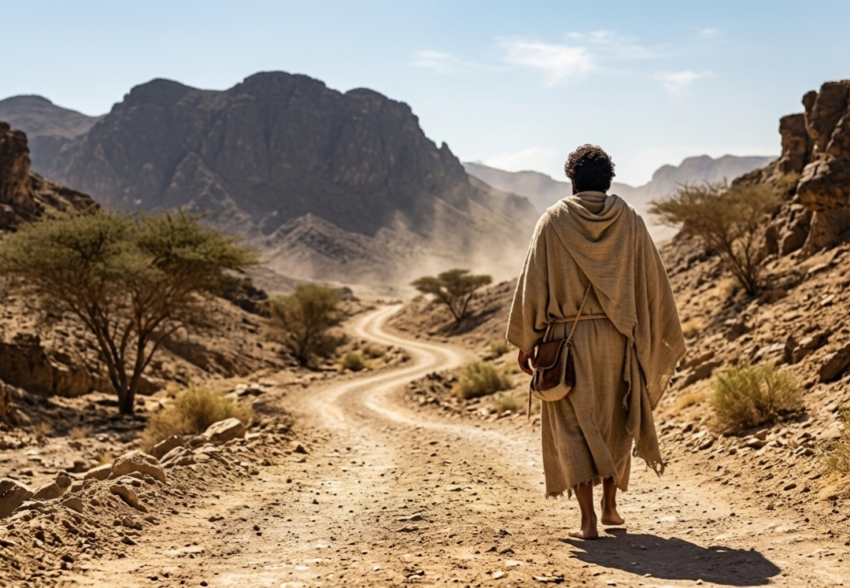
III. Why “Arabia” Is Not an Incidental Detail
Modern readers hear “Arabia” and picture empty sand. Paul’s readers heard something far more specific, and Paul himself tells us what: “for this Agar is mount Sinai in Arabia” (Galatians 4:25). In the geography of Paul’s own epistle, Arabia is the country of the mountain of God.
That single fact reframes the whole question. Sinai is where Moses spent forty days receiving the covenant. Sinai — Horeb — is where Elijah fled in his exhaustion, heard the still small voice, and received his marching orders. And the orders Elijah received were these: “Go, return on thy way to the wilderness of Damascus” (1 Kings 19:15). Paul, in Galatians 1:17, goes away into Arabia and returns to Damascus. The prophet’s route, step for step.
N. T. Wright on the Elijah Pattern
The parallel is close enough that even scholars with no stake in a devotional reading have found it compelling. N. T. Wright argues that the verbal echoes and the shared theme of zeal are too exact to be coincidence, and that Paul made a deliberate pilgrimage to the mountain where the covenant was ratified, in order to present himself to God as Elijah had. Wright puts it plainly in an interview: the transformation took time, “not least his trip to Mount Sinai in Arabia, like Elijah!”
The Older Commentators Saw It First
The place where the Law was first given may have seen its renewal in his mind — not destroyed, but fulfilled in the new law of love. Like Moses, and like Elijah, the great minister of the new dispensation may have here received strength for his work.
— Charles John Ellicott, Commentary for English Readers, Galatians 1:17
Ellicott was a cautious Victorian churchman, not an enthusiast, and he was writing more than a century before Wright. That two such different scholars converge on Sinai suggests the reading is driven by the text rather than by the theology of the reader.
❖ ❖ ❖
IV. Christ Promised Further Appearances
Here is the argument most often overlooked. On the Damascus road itself, Jesus did not merely commission Saul; He scheduled the follow-up. Paul recounts the words to Agrippa:
But rise, and stand upon thy feet: for I have appeared unto thee for this purpose, to make thee a minister and a witness both of these things which thou hast seen, and of those things in the which I will appear unto thee.
— Acts 26:16, King James Version
The tense is future. Christ told Saul, at the very moment of his calling, that there would be further appearances and further content — things not yet seen. Whatever else the Arabian years contained, the risen Lord had already announced that His instruction of this man was not finished. The Damascus road was the enrollment, not the entire curriculum.
Paul’s later letters read exactly as one would expect from a man who received such appearances. He tells the Corinthians that the account of the Lord’s Supper — an event at which he was not present — came to him from the Lord Himself: “For I have received of the Lord that which also I delivered unto you” (1 Corinthians 11:23). Someone described that upper room to Paul in detail, and Paul says the someone was Jesus. He speaks elsewhere of visions and revelations, of being caught up into the third heaven and hearing words he was not permitted to repeat (2 Corinthians 12:1–4). By his own dating, that episode falls squarely within the silent years.
V. Three Years — The Length of an Apostolic Education
The number itself carries an argument. When the Eleven sought a replacement for Judas, they required a man who had accompanied Jesus throughout His ministry, from the baptism of John to the ascension (Acts 1:21–22) — roughly three years of instruction from the Lord in person. Paul was disqualified by that standard on the surface. Unless, of course, he had received the same course of study by another route.
This is precisely how the Reformed devotional tradition reads the passage. Ligonier Ministries notes that Paul clearly implied “he spent three years being taught by Jesus Himself”, and draws the conclusion explicitly: Paul was formed for ministry the same way the Twelve were, over the same span of time, by the same Teacher. His apostleship is therefore not a lesser, derivative office. It is the genuine article, established by the same means.
The symmetry is difficult to dismiss as accident. Three years with Christ qualified Peter. Three years with Christ qualified Paul. The only difference is that one course was taught in Galilee and the other in the wilderness.
❖ ❖ ❖
VI. Answering the Honest Objection
The strongest objection is straightforward: Galatians never says, in so many words, that Jesus appeared to Paul in Arabia and taught him for three years. That is true, and the case should be argued honestly rather than overstated. But four considerations narrow the gap considerably.
1. The inference is short, not speculative
Paul states that he was taught by no man; that he was taught by revelation of Jesus Christ; that he withdrew from all human authority; and that three years passed. Connecting those four statements is not an imaginative leap. It is addition.
2. Silence is exactly what the argument required
Paul is defending his independence, not publishing a journal. Narrating the content of private revelation would have undercut the very point he was making, which is that his gospel came from above rather than from a syllabus.
3. Ananias does not fill the gap
Acts records that Ananias restored Saul’s sight and baptized him (Acts 9:17–18). What Acts never records is Ananias teaching Saul the gospel. And Saul began preaching Christ in the synagogues almost immediately (Acts 9:20) — an implausible feat for a man who had learned the faith from a three-day acquaintance. Grant Richison’s exposition puts the emphasis where the text does: in Arabia, God clarified the doctrine of grace to a man who had spent his life steeped in law, and he did not get his message from human beings.
4. Jerusalem added nothing
The decisive confirmation comes fourteen years later. When Paul finally laid his gospel before the pillars of the Jerusalem church, the verdict was not correction but recognition: “they who seemed to be somewhat in conference added nothing to me” (Galatians 2:6). A self-taught convert working from fragments would have needed a hundred corrections. Paul needed none — because his instruction had already come from the highest possible authority.
❖ ❖ ❖
The School in the Wilderness
Strip away the ornament and the proposition is modest, well attested, and thoroughly evangelical: the risen Christ personally revealed the gospel to Saul of Tarsus and personally commissioned him, and the three-year interval spent in Arabia is the most natural setting Scripture offers for that instruction. Whether the teaching came through appearances, visions, illumination of the Hebrew Scriptures, or all three, the Teacher was the same, and Paul staked his life on saying so.
It has been written on my own heart by the Lord himself.
— C. H. Spurgeon, on Paul’s reception of the gospel, sermon of April 25, 1890
Spurgeon understood what the Galatian troublemakers never grasped. There are truths a man can be handed and truths a man must be given. Paul went into the desert with a shattered theology and came out with a finished one, and the church has been reading his lecture notes for two thousand years.
Sources and Further Reading
Ligonier Ministries, “The Preparation of Paul,” Reformed Bible Studies & Devotionals.
https://learn.ligonier.org/devotionals/the-preparation-of-paul
John MacArthur, “Bible Introductions: Galatians,” Blue Letter Bible.
https://www.blueletterbible.org/Comm/macarthur_john/bible-introductions/galatians-intro.cfm
Charles John Ellicott, Commentary for English Readers, Galatians 1:17.
https://biblehub.com/commentaries/galatians/1-17.htm
N. T. Wright, Paul: A Biography (HarperOne, 2018); interview, The Christian Post.
https://www.christianpost.com/news/nt-wright-apostle-paul-misunderstood-extraordinary-interview.html
Grant Richison, “Galatians 1:17,” Verse by Verse Commentary.
https://versebyversecommentary.com/1999/12/17/galatians-117/
Charlie Garrett, “Galatians 1:17,” The Superior Word.
https://superiorword.org/galatians-1-17/
C. H. Spurgeon, quoted in “Paul’s Education: Galatians 1:16–24,” Berean Bible Church.
https://www.bereanbiblechurch.org/transcripts/galatians/1_16-24.htm
A Note on Research Methods and Accuracy
In recent years, some have voiced concern that artificial intelligence may distort facts or introduce inaccuracies into serious research. That criticism deserves acknowledgment. However, AI has now evolved into the most powerful research instrument available to any dedicated scholar—capable of analyzing vast datasets, cross‑referencing historical records, and surfacing overlooked connections across sources. This work represents a collaboration between the author’s investigative inquiry, verified primary documentation, and the advanced analytic capabilities of AI research tools. Here, AI was not used as a ghostwriter or a shortcut for scholarship, but as a disciplined research partner devoted to rigor, accuracy, and transparency.
Every factual claim in this work has been subjected to active verification. Where AI‑generated content was used as a starting point, it was tested against primary sources, peer‑reviewed scholarship, official institutional documentation, and established historical records. Where discrepancies were found—and they were found—corrections were made. The author has made every reasonable effort to ensure that quotations are accurately attributed, historical details are precisely rendered, and theological claims fairly represent the positions they describe or critique.
That said, no work of this scope is immune to error, and the author has no interest in perpetuating inaccuracies in the service of an argument. If you are a reader—whether sympathetic, skeptical, or hostile to the conclusions drawn here—and you identify a factual error, a misattributed source, a misrepresented teaching, or a claim that cannot be substantiated, you are warmly and genuinely invited to say so. Reach out. The goal of this work is not to win a debate but to get the history right. Corrections offered in good faith will be received in the same spirit, and verified corrections will be incorporated into future editions without hesitation.
Truth, after all, has nothing to fear from scrutiny—and neither does this work.