
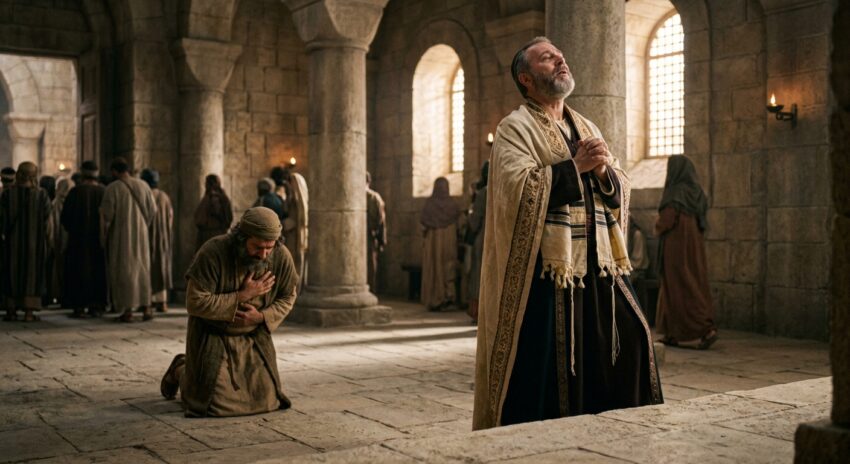
An AI Exposition and Supplemental Bible Study of Luke 18:9-14, as preached by
Pastor Joey Sampaga at East Valley International Church, September 20, 2026.
The Parable of the Pharisee and the Publican
And he spake this parable unto certain which trusted in themselves that they were righteous, and despised others: Two men went up into the temple to pray; the one a Pharisee, and the other a publican. The Pharisee stood and prayed thus with himself, God, I thank thee, that I am not as other men are, extortioners, unjust, adulterers, or even as this publican. I fast twice in the week, I give tithes of all that I possess. And the publican, standing afar off, would not lift up so much as his eyes unto heaven, but smote upon his breast, saying, God be merciful to me a sinner. I tell you, this man went down to his house justified rather than the other: for every one that exalteth himself shall be abased; and he that humbleth himself shall be exalted.
— Luke 18:9–14, Authorized Version
◆ ◆ ◆
I. Two Men, One Verdict
It is the shortest distance in all of Scripture between two human beings and the greatest distance between two destinies. Two men climb the same temple steps on the same morning. They breathe the same incense. They stand perhaps twenty paces apart, within sight of one another, at the same hour of prayer. One of them is, by every measurable standard available to his community, a good man — better than good, a man of disciplined devotion whose life would survive any audit you cared to run on it. The other is a collaborator with the occupying power who has grown wealthy by squeezing his own countrymen. And when our Lord pronounces the verdict in verse 14, the good man goes home condemned, and the traitor goes home justified.
There is no parable of Jesus more offensive to religious people, and none more necessary. It is offensive because it does not work the way we expect a moral tale to work. We are prepared for a story in which the respectable man turns out to be secretly corrupt — the whitewashed tomb, the embezzling deacon, the preacher with a mistress. That story we can absorb, because it leaves our categories intact. But that is not this story. Luke gives us no hint whatever that the Pharisee is lying. Everything he says about himself appears to be true. And it is precisely because it is true that the parable is terrifying.
This is why the subject before us is a delusion and not merely a hypocrisy. A hypocrite knows the gap between his claim and his condition; he is an actor who has chosen his mask. A deluded man has no such knowledge. He holds a false belief with total conviction, and — this is the defining feature — the evidence available to him keeps confirming it. The Pharisee is not play-acting piety. He has examined the record and the record is good. The delusion is not that he is righteous by human reckoning. The delusion is his conclusion about what that record means before God.
This study is a companion to the one preceding it in Luke’s Gospel. In 18:1–8 our Lord taught us how long to pray: a widow with no money and no advocate kept coming back until she got a verdict. Here in 18:9–14, He teaches us how to come: a man with no defense and no excuse stood at a distance and asked to be covered by a sacrifice. Persistence and poverty of spirit; the two parables are a matched pair, and Luke set them side by side on purpose. The widow shows us the posture of the hands. The publican shows us the posture of the heart.
II. Notice Who Is Listening
Luke does something in verse 9 that he has just done in verse 1, and the repetition is deliberate. He tells us the target before he tells us the story: “And he spake this parable unto certain which trusted in themselves that they were righteous, and despised others.”
Read that sentence slowly, because there is an escape hatch in it that most readers take without noticing. Luke does not say that Jesus spoke this parable to the Pharisees. He says He spoke it to certain ones who trusted in themselves. The Pharisee is a character inside the story, not a label on the audience. Which means the door is left wide open, and every generation of readers must walk through it on their own feet. You cannot get out of this parable by protesting that you are not a Pharisee. The qualification for being addressed by it is not membership in a party. It is a state of the heart that is available to any of us on any Sunday morning.
Two clauses describe that state, and they are joined by a hidden logic. The first is pepoithótas eph’ heautois, a perfect participle of the verb for confidence or persuasion — they had persuaded themselves, and the persuasion had settled and hardened. This is not a passing moment of pride. It is a conclusion reached and filed away. The second clause is exouthenountas tous loipoús, literally “counting the rest as nothing.” The verb means to reduce to zero, to treat as beneath consideration; Luke uses the same word when Herod and his soldiers set Christ at nought (23:11).
Now observe why those two clauses always travel together. Self-righteousness is not an absolute measurement; it is a comparative one. No one has ever arrived at a settled confidence in his own goodness by weighing himself against the holiness of God. It cannot be done. The confidence is only available by weighing oneself against other people, which means self-righteousness structurally requires somebody beneath you. Contempt is not an unfortunate side effect of the disease. Contempt is the mechanism by which the disease sustains itself.
And that gives us the only reliable diagnostic test we possess. You cannot detect self-righteousness by examining your theology, because your theology may well be excellent. You cannot detect it by examining your conduct, because your conduct may be exemplary. You detect it by asking whom you despise — which category of person functions in your interior life as the floor you are standing on.
III. Two Men Went Up
“Two men went up into the temple to pray; the one a Pharisee, and the other a publican” (18:10).
A word first about the Pharisee, because two thousand years of Christian preaching have turned the term into a slur, and that is a loss both historically and pastorally. The Pharisees were the reform party of Second Temple Judaism, and their program was admirable on its face. They believed the Scriptures were the word of God and meant to be obeyed in detail. They believed in the resurrection of the dead, in angels, in divine providence, in the world to come. They sought to bring the holiness of the temple into the ordinary Jewish home, so that a kitchen table might be treated with the reverence of an altar. They were not the cynical party; that was the Sadducees. They were the serious party. They were the ones who read commentaries on their afternoons off.
This matters enormously for how we hear the parable. If “Pharisee” means “insincere religious fraud,” then the parable is about somebody else, and we may read it with comfort. But if “Pharisee” means “the most earnest, most biblically literate, most disciplined believer in the congregation,” then the parable is aimed directly at the front pew, and at the people who take notes during the sermon, and at those of us who write about theology for a living. Jesus did not choose a scoundrel to make this point. He chose the best man in the room.
The publican, meanwhile, was not simply a disreputable man; he occupied a position widely regarded as beyond rescue. Tax farmers contracted with the Roman administration for the right to collect duties and tolls, and they profited from whatever they could extract above the contracted sum. They were counted with robbers and prostitutes. And there was a further, crueler dimension to his case that we easily miss: repentance in that world required restitution, and a tax collector who had defrauded hundreds of anonymous travelers over many years had no way on earth to find them all and pay them back. His situation was not merely shameful. It was structurally hopeless. He could not put it right.
One more detail hides in plain sight. The two men have gone up at an hour of prayer, which in temple practice coincided with the morning or afternoon offering — the daily burnt sacrifice, the smoke of atonement going up, the incense rising with it. Both men are praying in the shadow of shed blood offered for the sins of the people. Only one of them appears to notice. We will see in a moment that the publican’s cry is soaked in that imagery, while the Pharisee, standing in a building whose entire purpose is the covering of sin, has evidently not connected the architecture to himself.
IV. The Prayer That Never Left the Room
“The Pharisee stood and prayed thus with himself” (18:11). The Greek phrase — statheis pros heautòn prosēúcheto — is genuinely ambiguous, and the manuscripts show ancient scribes wrestling with it. The words may mean that he took his stand by himself, apart from the crowd, preserving his ritual purity from contamination. Or they may mean that he prayed to himself. Both readings are defensible, and both are devastating. Either he has separated himself from the people he is about to pray about, or his prayer has no addressee outside his own skull. It ascends to the ceiling and comes back down.
Then comes the prayer itself, and its first word is the one nobody expects: “God, I thank thee.” This is not a boast in form. It is a thanksgiving. He gives God the credit for his condition. Whatever else we say about this man, he is not a crude self-made moralist who imagines he built his own virtue from scratch. His formal theology of grace is, on the surface, entirely orthodox — and he is lost anyway. It is possible to attribute your righteousness to God and still be trusting in it rather than in Him. There is such a thing as a doctrinally correct prayer prayed by a damned man.
Count the pronouns. In two verses, the Pharisee refers to himself five times. He thanks, he compares, he fasts, he tithes, he possesses. And then notice what the prayer does not contain, which is the loudest thing about it: there is no petition. He asks God for nothing at all. No confession, no request, no cry for help, no need expressed in any form. This is not an oversight in his devotional method. It is the perfectly logical output of his theology. A man who has concluded that he lacks nothing has nothing to ask for. His prayer is a status report filed with a superior who is expected to initial it and hand it back.
His self-assessment comes in two movements, negative and positive:
-
What he is not — not an extortioner, not unjust, not an adulterer. Three categories of public, chargeable sin; three offenses of which a court could convict a man. He has kept his record clean where records are kept.
-
What he does — he fasts twice in the week and tithes everything he acquires. Both are works of supererogation, going beyond the written requirement. The Law of Moses commanded one fast a year, on the Day of Atonement; the devout Pharisee fasted Mondays and Thursdays. The Law required tithes of the produce of the land; he tithes all his income, including goods on which the tithe may well have been paid already, in case a seller somewhere was careless.
This is the crux of the entire parable, and it must not be softened. The man is not exaggerating. He is not inflating a modest record into a grand one. He is doing more than God asked, and he is doing it consistently, and as far as Luke lets us see, he is doing it honestly. If he came to your church, he would be on the board within a year. If he joined your Bible study, he would be the one who had done the reading.
And when he went down the temple steps that morning, he was not justified.
V. Why the Facts Were No Help
Here we must do the theological work the parable demands, because the natural reading of it is a shallow one. The shallow reading says: the Pharisee’s problem was pride, and if he had performed the same deeds with a humbler attitude, all would have been well. That reading leaves the machinery of self-righteousness entirely intact and simply asks us to run it more quietly.
The deeper problem is one of category. The Pharisee has treated his obedience as a currency with purchasing power at the throne of God, and it has none. Not because obedience is worthless — God commanded it and delights in it — but because the debt in question is not the kind that can be paid in that coin. Isaiah had already said that our righteousnesses are as filthy rags (Isaiah 64:6), and Paul would later put the argument in its final form: by the deeds of the law shall no flesh be justified in His sight, for by the law is the knowledge of sin (Romans 3:20). The law was given to diagnose, not to cure. The Pharisee has taken the thermometer and tried to pay the hospital bill with it.
Which is why self-righteousness is the most dangerous condition a soul can occupy, and I would argue it is deadlier than any of the sins the Pharisee correctly disowned. Consider what makes it so:
-
It is built from the means of grace themselves. Extortion and adultery are constructed out of obvious wickedness. This is constructed out of fasting, tithing, Scripture, and prayer. The materials are holy. That is exactly what makes the structure so hard to see and so hard to tear down.
-
It is self-sealing. Every other sin can be convicted by the conscience. This one recruits the conscience and puts it to work on its own side. The more faithfully you obey, the more evidence accumulates for the very conclusion that is destroying you.
-
It produces contempt as a necessary by-product. Because the confidence is comparative, it cannot survive without a population of inferiors. It will always be manufacturing someone to look down on, and it will always find a scriptural justification for doing so.
-
It feels wonderful. Note that both men went home. The Pharisee presumably went home satisfied, even refreshed. The publican went home wrecked. Our emotional state after prayer is worthless as evidence of our standing before God — a fact that should make us permanently suspicious of measuring our spiritual condition by how our devotions feel.
There is a phrase from the Western tradition that captures the whole diagnosis: the heart incurvatus in se, curved in upon itself. Augustine described the condition, and Luther made the phrase famous. A soul so bent inward can still perform every outward duty. It can attend, tithe, fast, memorize, evangelize, and argue correctly. It simply cannot look up. And it will never know that it cannot look up, because from the inside the view of one’s own excellence is indistinguishable from a view of heaven.
VI. A Man With a Reference Group of One
“And the publican, standing afar off, would not lift up so much as his eyes unto heaven, but smote upon his breast, saying, God be merciful to me a sinner” (18:13). Luke gives us four details, and not one of them is decoration.
-
Standing afar off. The Greek makróthen tells us he kept his distance from the holy place. Nobody stationed him there; he stationed himself. He knew what he was and he knew where he was, and he did not presume upon the proximity.
-
He would not lift up his eyes. The customary posture of Jewish prayer was with eyes and hands raised toward heaven. He refused the ordinary liberty of a worshiper. This is not false modesty; it is a man who cannot bring himself to look at the One he has offended.
-
He smote upon his breast. In that culture this was a violent gesture of grief, and one associated more with women in mourning than with men. Luke records it once more in his Gospel: the crowds who watched the crucifixion went home smiting their breasts (23:48). It is the body doing what words cannot.
-
God be merciful to me a sinner. And here the Greek carries a weight the English cannot hold, which we must take up separately.
But first, notice the contrast Luke has quietly constructed. The Pharisee compared himself with everybody — other men, extortioners, the unjust, adulterers, and that publican over there. The publican compared himself with nobody at all. In fact, the definite article in his prayer makes the point unmistakable: he says tôi hamartōlôi, “the sinner,” not “a sinner.” He is not confessing membership in a broad and crowded category. He has a reference group of one, and he is it. So far as he is concerned, there is a sinner in the temple this morning, and it is him.
This is the thing no amount of moral effort can produce, and no amount of moral failure can guarantee. A man only stops comparing himself with other men when he has caught sight of the holiness of God, and the moment he does, everyone else drops out of the frame entirely. Isaiah in the temple does not say that he is somewhat less unclean than the average Judean. He says he is undone, a man of unclean lips (Isaiah 6:5). Job, who had argued his innocence for thirty-eight chapters and argued it well, abhors himself the moment God actually speaks (Job 42:6). Peter, confronted with a boatload of fish, asks the Lord to leave (Luke 5:8). The pattern is invariable. Where God is genuinely seen, comparison dies.
VII. “Be Propitiated Toward Me”
Now to the word. Our Authorized Version reads “God be merciful to me a sinner,” and there is nothing wrong with the rendering except that it is much too general. The ordinary New Testament word for mercy is eleéō, and that is not the verb here. The publican says hilásthēti moi, an imperative from the family of words built on hilaskómai — the propitiation vocabulary.
The related noun, hilastḗrion, is the term the Greek Old Testament uses for the mercy seat: the gold lid over the ark of the covenant, in the holy of holies, where on the Day of Atonement the high priest sprinkled the blood of the sacrifice. Paul uses that same noun of Christ Himself, whom God set forth to be a propitiation through faith in His blood (Romans 3:25), and Hebrews uses it of the mercy seat directly (Hebrews 9:5). The verbal form appears in Hebrews 2:17, where Christ is made a merciful and faithful high priest to make reconciliation — propitiation — for the sins of the people.
So what the publican is actually praying, standing in the temple courts with the smoke of the morning sacrifice above him, is something closer to this: God, let the atonement be applied to me. Let the blood on the mercy seat count for me. Let Your righteous anger be satisfied and turned away in my case. He is not asking God to be lenient. He is not asking God to overlook anything, or to grade generously, or to take his circumstances into account. He is asking to be covered by a sacrifice that somebody else has provided — which is the only thing a man in his position could ask, since he could not make restitution and had nothing whatever to bring.
There is the whole gospel in a sentence of seven Greek words, spoken by a tax collector who almost certainly could not have explained the doctrine he had just confessed. And there is the answer to a question that troubles thoughtful readers: how could a man be justified before the cross? The same way Abraham was. He looked to a provision he did not make, and it was counted to him for righteousness.
VIII. The Verdict
“I tell you, this man went down to his house justified rather than the other” (18:14).
The word is dedikaiōménos — a perfect passive participle of the great courtroom verb, the very word on which the Reformation would turn. It appears here on the lips of Jesus, in a parable, years before Paul would write a line of Romans, and Luke — Paul’s travelling companion — has preserved it with evident care. Take the grammar seriously, and the doctrine assembles itself:
-
It is forensic. This is a verdict, not a transformation. The man has been declared righteous, his legal standing altered by a decision rendered outside himself.
-
It is passive. He did not justify himself; he was justified. The verb tells us there was an acting party, and it was not the publican.
-
It is perfect in tense — a completed action with a standing result. He did not go home hoping. He went home with the matter settled.
-
It is immediate. He was justified before he had reformed his conduct, resigned his post, made restitution, or joined anything. Same job, same debts, same reputation in the village. New standing before God.
And it is exclusive. “Rather than the other” translates par’ ekeinon, and interpreters have occasionally tried to soften it into a comparison of degree — as if the publican were justified more than the Pharisee, and the Pharisee somewhat justified as well. The sense will not bear it. This one and not that one. The verdict was not delivered on a curve. Two men climbed the steps, and only one of them went down the steps a righteous man, and it was not the one who had earned it.
Jesus then seals the parable with a proverb He has used once before in Luke: “for every one that exalteth himself shall be abased; and he that humbleth himself shall be exalted” (compare 14:11). Both verbs are passive, and in Jewish usage that passive voice normally veils the name of God. This is not a general observation about how life tends to reward modesty. It is a statement about who does the abasing and who does the exalting. The self-exalting man is not merely setting himself up for disappointment. He is being opposed by God — which is exactly what James and Peter would later say in so many words: that God resists the proud and gives grace to the humble.
IX. The Trapdoor
Every honest reader of this parable eventually falls through its floor, and it is better to fall through it deliberately than by accident.
The trap is this. You read about the Pharisee. You see his self-congratulation, his cold comparison, his contempt for the broken man across the courtyard. And you feel a warm and entirely spontaneous gratitude that you are not like that. At which point you have just prayed his prayer, word for word, with only the object of comparison updated. God, I thank Thee that I am not as this Pharisee.
That is not a clever debating trick; it is the parable working as designed. It cannot be escaped by being cleverer than it, because every escape route is itself an exercise in comparison, and comparison is the disease. The only exit is downward. The parable is not asking us to find the right group to belong to. It is asking us to stop looking sideways altogether.
So where does this delusion actually live among us? Rarely in the language of the Pharisee; nobody in a modern congregation prays about fasting twice a week. It lives in the accounting we keep privately, and it has learned to speak our dialect. It sounds like gratitude that we are not as the people whose doctrine is wrong, or as those who have left the faith, or as the compromising churches down the road, or as the family members who voted differently, or as the addict, or as the divorced, or as the young people with their phones. It keeps a ledger of what we have given up and what we have contributed and how long we have been faithful.
And it is an occupational hazard for a particular class of Christian, of whom I am one, and this ought to be said plainly. The person who spends his life defending the truth is uniquely exposed to this disease, because being right is a genuine good and therefore makes excellent building material. Apologists, teachers, writers, polemicists, and pastors deal daily in the currency of correctness. We can demonstrate that our opponents are mistaken. Frequently we can demonstrate it conclusively. And there is no gap in all of Christian experience narrower or more treacherous than the one between this doctrine is false and I am not as that man. The first is a duty. The second is the prayer of a man who went home unjustified.
Luke, for his part, is not finished making the argument. Immediately after this parable he sets two illustrations side by side: infants brought to Jesus, of whom the Lord says the kingdom belongs to such as these and must be received as a little child receives (18:15–17); and then a rich young ruler, who asks what he must do to inherit eternal life and answers his own examination with the words, “All these have I kept from my youth up” (18:21). There is the Pharisee again, walking out of the parable and into the narrative. He goes away sorrowful, and the disciples ask who then can be saved. The answer given is the only answer this whole section of Luke will allow: the things impossible with men are possible with God.
◆ ◆ ◆
X. For Study and Reflection
Observation — What does the text actually say?
-
According to verse 9, to whom was this parable spoken, and what two things were true of them? How are those two things connected to each other?
-
Write out the Pharisee’s prayer and mark every first-person pronoun. What does he thank God for? What does he ask God for?
-
List the four physical details Luke gives us about the publican in verse 13. What does each one communicate?
-
What exactly does Jesus say happened to each man in verse 14, and what does He say did not happen?
Interpretation — What does the text mean?
-
Is there any indication in the text that the Pharisee is lying about his fasting, his tithing, or his conduct? If he is telling the truth, what precisely has gone wrong?
-
Both men are praying during the hour of sacrifice in the temple. How does that setting change the way you hear the publican’s petition — and the Pharisee’s silence about sin?
-
Compare Romans 3:20–26 with this parable. Where does the publican’s prayer appear in Paul’s argument, and where does the Pharisee’s?
-
Read Luke 18:1–8 and 18:9–14 together as a single unit on prayer. What does the widow teach that the publican does not, and what does the publican teach that the widow does not?
-
Read on into Luke 18:15–30. How do the little children and the rich ruler function as living illustrations of the two men in this parable?
Application — What does the text require?
-
Whom do you despise? Not disagree with — despise. Name the category. That answer is a more reliable measure of your spiritual condition than any inventory of your disciplines.
-
When you pray, do you ask God for anything, or do you mostly report? A prayer life with no petitions in it is worth examining closely.
-
Where do you catch yourself saying “at least I never”? Finish the sentence honestly and then ask what that phrase is doing for you.
-
If your obedience were suddenly and permanently invisible to everyone but God — no one to notice, no one to compare with — what portion of it would survive?
-
Could you pray the publican’s prayer this week, in his words, without adding a single qualifier or explanation to it?
One practical caution belongs here. The proper response to this parable is not to begin cultivating an air of humility, which would simply be the same disease wearing a costume, and a more repulsive one. Humility that is worked at as a technique becomes another entry in the ledger — and a man can be quite proud of how low he has learned to bow. The publican was not performing humility. He had simply seen something true about himself and about God, and his posture followed. The cure for this delusion is not a resolution. It is a sight. Ask to see God as He is and yourself as you are, and the comparison with other men will fall away on its own, because there will be no one left in the room to compare yourself to.
◆ ◆ ◆
XI. Going Down to the House
The parable ends with both men walking home, and I find that detail quietly unbearable. Nothing visible has changed for either of them. The Pharisee still fasts twice a week; he will fast again on Thursday, and his fasting is still real, and he is still lost. The publican still has his contract with Rome, still has the money he took, still has neighbors who will cross the street when they see him coming. Nobody in Jerusalem saw anything happen that morning. The verdict was rendered in a court no one could see, and the two men who received it passed each other on the steps.
Which means the question this parable puts to us cannot be answered by looking at our lives from the outside. Both of these men would have shown up in the same census of temple worshipers. Both had prayed. Both went home. The difference between them was not in the record and not in the feeling — it was in what each man was resting on when he opened his mouth.
The Pharisee came to God with a portfolio and asked Him to admire it. The publican came with nothing, stood at a distance, could not lift his eyes, beat his chest, and asked to be covered by blood he had not shed. And the astonishing verdict of the Lord Jesus Christ, who would Himself shortly become the propitiation the publican was asking for, is that the empty-handed man went home a righteous man in the sight of God.
There is no third option in this parable. There are two men on those steps, and one of them is you. If you have been keeping a ledger, the invitation is to close it, and to pray the only prayer in this story that God answered.
God, be propitiated toward me, the sinner.
Colophon
This study was researched and drafted in collaboration with Claude, an AI research assistant developed by Anthropic, operating under the author’s direction and editorial authority. The doctrinal positions expressed in this essay are the author’s own, and the author is ultimately responsible for its contents. Scripture citations are from the KJV and are reproduced in abbreviated form with full references supplied.
A Note on Research Methods and Accuracy
In recent years, some have voiced concern that artificial intelligence may distort facts or introduce inaccuracies into serious research. That criticism deserves acknowledgment. However, AI has now evolved into the most powerful research instrument available to any dedicated scholar—capable of analyzing vast datasets, cross‑referencing historical records, and surfacing overlooked connections across sources. This work represents a collaboration between the author’s investigative inquiry, verified primary documentation, and the advanced analytic capabilities of AI research tools. Here, AI was not used as a ghostwriter or a shortcut for scholarship, but as a disciplined research partner devoted to rigor, accuracy, and transparency.
Every factual claim in this work has been subjected to active verification. Where AI‑generated content was used as a starting point, it was tested against primary sources, peer‑reviewed scholarship, official institutional documentation, and established historical records. Where discrepancies were found—and they were found—corrections were made. The author has made every reasonable effort to ensure that quotations are accurately attributed, historical details are precisely rendered, and theological claims fairly represent the positions they describe or critique.
That said, no work of this scope is immune to error, and the author has no interest in perpetuating inaccuracies in the service of an argument. If you are a reader—whether sympathetic, skeptical, or hostile to the conclusions drawn here—and you identify a factual error, a misattributed source, a misrepresented teaching, or a claim that cannot be substantiated, you are warmly and genuinely invited to say so. Reach out. The goal of this work is not to win a debate but to get the history right. Corrections offered in good faith will be received in the same spirit, and verified corrections will be incorporated into future editions without hesitation.
Truth, after all, has nothing to fear from scrutiny—and neither does this work.