
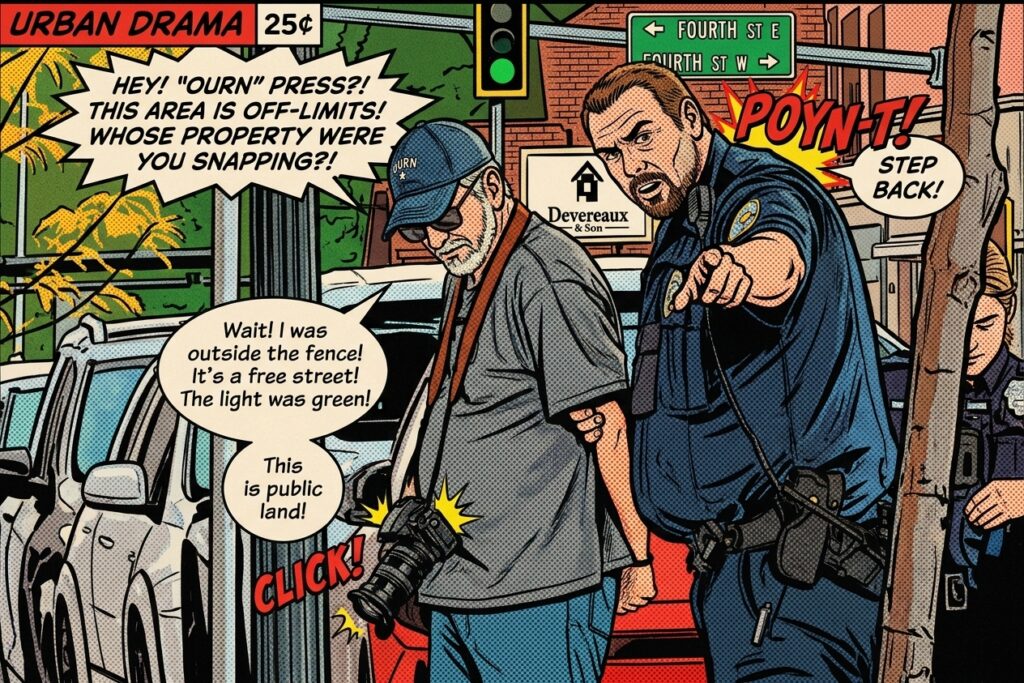
“At this point you’re being detained for disorderly conduct.” — and Other Laws That Don’t Exist
This essay is legal commentary for public education. It is not legal advice, and statutes differ from state to state. Readers facing a specific situation should consult a licensed attorney in their jurisdiction.
❧ ❖ ☙
Introduction: An Illegal Arrest, Made Up On the Spot
On September 30, 2026, Kalispell, Montana police arrested Mike Norton, the creator behind the First Amendment audit channel KULT News, and charged him with disorderly conduct. The incident was captured on video, and the footage is now drawing wide attention for how little the arresting officers appear to understand about the constitutional limits on their own authority. As far as the video shows, Norton’s offense was filming in public and telling an officer exactly what he thought of him, in language the officer did not care for. When the clip began circulating, Officer Jesse Allen of the Kalispell Police Department responded by filing a privacy complaint with YouTube to have it taken down. But an officer’s on-duty conduct in a public place is the public’s business, and a takedown request does not make it private. The law here is not new. In City of Houston v. Hill (1987), the U.S. Supreme Court held that the First Amendment protects a substantial amount of verbal criticism and challenge directed at police. Profanity and insults aimed at an officer, standing alone, are not a crime. An officer who arrests a citizen for hurting his feelings has not enforced the law. He has broken his oath to uphold it.
❧ ❖ ☙
A Man, a Sidewalk, and a Law That Wasn’t There
In October 2018, Keith Massimino stood on a public sidewalk in Waterbury, Connecticut, and pointed a camera at the outside of a police station. He did not enter the building. He did not block a door. He did not threaten anyone. Officers came out and told him that what he was doing was illegal. It was not. When he gave vague answers about his purpose and declined to show identification, they arrested him for obstruction. Prosecutors dropped the misdemeanor roughly two and a half years later. When his civil-rights case finally reached the United States Court of Appeals for the Second Circuit in August 2026, the court confirmed what he had been saying on that sidewalk all along: there is a First Amendment right to record the exterior of a police station from a public sidewalk.
When the government wants to preserve its privacy, it may build a fence or close a door—but not ban speech.
— Judge Myrna Pérez, U.S. Court of Appeals for the Second Circuit, Massimino v. Benoit (2026), as reported by Reason
https://reason.com/2026/08/18/appeals-court-upholds-right-to-film-police-but-grants-immunity-to-cops-who-arrested-a-connecticut-videographer/
And yet Massimino lost his case. The same court held that the right, though real, had not been “clearly established” in Connecticut in 2018, so the officers received qualified immunity. It also concluded that his evasive answers, combined with his refusal to identify himself, supplied enough suspicion to defeat his Fourth Amendment claims. That split result captures the whole problem this essay addresses. The right to record is real. The courts keep confirming it. But officers on the street keep acting as though it does not exist, and the legal system often shields them when they do.
Over the last decade, a loose movement of citizen videographers calling themselves “First Amendment auditors” has made a practice of testing exactly this gap. They film post offices, city halls, police stations, banks, and courthouses from public places, then post the encounters online. An audit “passes” if nothing happens and “fails” if an official confronts, threatens, or removes the person holding the camera. Whatever one thinks of the auditors themselves (and this essay will be candid about their excesses), their videos have produced an enormous and unflattering public record. That record shows a significant number of officers, supervisors, security guards, and private employees who simply do not know the law governing a person with a camera on a public sidewalk.
This essay examines that knowledge gap. It sets out the constitutional framework, the specific legal standards that govern detention and arrest, the real limits of criminal trespass, the recurring mistakes of police, guards, and bank employees, the problem of citizens who assault auditors, the ways auditors forfeit their own protection, and the training every jurisdiction should provide. It closes with a practical set of lawful statements an auditor can use in nearly any encounter.
❧ ❖ ☙
Part One: The Constitutional Framework
The First Amendment: Recording as Part of the Press and Speech Process
The First Amendment forbids government from “abridging the freedom of speech, or of the press.” Through the Fourteenth Amendment, that command binds state and local governments, including every police department and municipal office in the country. Courts have reasoned that the right to publish information would be hollow without a corresponding right to gather it, and that recording is an essential step in gathering it. The First Circuit put it plainly in Glik v. Cunniffe, 655 F.3d 78 (1st Cir. 2011), a case involving a Boston lawyer arrested for filming officers arresting people on Boston Common. The court called the filming of government officials in public spaces:
A basic, vital, and well-established liberty safeguarded by the First Amendment.
— Glik v. Cunniffe, 655 F.3d 78 (1st Cir. 2011), as quoted by Daigle Law Group, “First Amendment ‘Audits’ and the Civilian Right to Film Law Enforcement (Part 1),” March 15, 2022
https://daiglelawgroup.com/first-amendment-audits-and-the-civilian-right-to-film-law-enforcement-part-1/
Glik does not stand alone. The federal courts of appeals have now recognized the right in one form or another across most of the country: the First Circuit (Glik, 2011), the Third Circuit (Fields v. City of Philadelphia, 2017), the Fifth Circuit (Turner v. Driver, 2017), the Seventh Circuit (ACLU of Illinois v. Alvarez, 2012), the Eighth Circuit (Ness v. City of Bloomington, 2021), the Ninth Circuit (Fordyce v. City of Seattle, 1995), the Tenth Circuit (Irizarry v. Yehia, 2022), the Eleventh Circuit (Smith v. City of Cumming, 2000), and now the Second Circuit (Massimino v. Benoit, 2026). The Fourth Circuit, in Sharpe v. Town of Winterville (2023), held that livestreaming a traffic stop is protected First Amendment activity that a police department may not ban outright, though it granted the individual officer immunity. The Supreme Court has not squarely decided the question, but the direction of the federal courts of appeals is clear.
The Fifth Circuit’s decision in Turner v. Driver is particularly instructive because its facts are a classic audit. Phillip Turner stood on a sidewalk in Fort Worth, Texas, filming a police station. Officers demanded identification, handcuffed him, and put him in a patrol car. The court held:
A First Amendment right to record the police does exist, subject only to reasonable time, place, and manner restrictions.
— Turner v. Driver, 848 F.3d 678 (5th Cir. 2017), as quoted on Wikipedia, “Turner v. Driver”
https://en.wikipedia.org/wiki/Turner_v._Driver
Two features of this body of law deserve emphasis. First, the right is not limited to credentialed journalists. As the Hall Booth Smith law firm summarized the case law, the right “goes beyond protection of the press” and “protects the public’s right of access to information about their officials’ public activities.” Second, the right is not absolute. It is subject to reasonable time, place, and manner restrictions that are content-neutral, narrowly tailored to a significant government interest, and leave open alternative channels for recording. An officer may move a person who is physically interfering with an arrest. An officer may not order a person off a public sidewalk because the officer dislikes being filmed.
Forum Analysis: Where You Stand Determines What You May Do
The strength of the right depends heavily on location, and this is where many officers and auditors alike go wrong. Constitutional law sorts government property into categories. Traditional public forums, such as sidewalks, streets, and parks, receive the strongest protection; government restrictions there must be content-neutral and narrowly tailored. Designated or limited public forums are places government has opened for expressive use, sometimes for particular purposes. Nonpublic forums, such as the employee-only areas of a city hall, the secure side of a police lobby, or a records vault, may be restricted so long as the restriction is reasonable and not aimed at suppressing a viewpoint.
UNC School of Government’s Kristi Nickodem summarized the principle this way:
The government generally has greater flexibility to impose restrictions on expressive activity
— Kristi Nickodem, “Responding to First Amendment Audits: Is Filming Protected by the First Amendment?” Coates’ Canons, UNC School of Government, Nov. 14, 2022 (discussing property that is not a traditional or designated public forum)
https://canons.sog.unc.edu/blog/2022/11/14/responding-to-first-amendment-audits-is-filming-protected-by-the-first-amendment/
The public sidewalk outside a business, a bank, or a police station is the paradigm traditional public forum. A person standing there may photograph or film anything plainly visible: the building, the parking lot, the cars, the people walking by, and the interior of the building to the extent it can be seen through a public-facing window. The Washington-based Municipal Research and Services Center made the related point about publicly accessible government spaces:
There is no reasonable expectation of privacy in spaces that are publicly accessible and viewable.
— Harry Boesche, “Q&A: 1st Amendment Audits,” MRSC Insight, Municipal Research and Services Center (2026)
https://mrsc.org/stay-informed/mrsc-insight/february-2026/qa-1st-amendment-audits
The Fourth Amendment: The Limits on Stopping, Searching, and Seizing
The Fourth Amendment protects “the right of the people to be secure in their persons, houses, papers, and effects, against unreasonable searches and seizures.” The federal judiciary’s own educational materials describe its core function succinctly:
The Constitution, through the Fourth Amendment, protects people from unreasonable searches and seizures by the government.
— United States Courts, “What Does the Fourth Amendment Mean?”
https://www.uscourts.gov/about-federal-courts/educational-resources/about-educational-outreach/activity-resources/what-does-fourth-amendment-mean
For the citizen with a camera, the Fourth Amendment does three crucial things. It limits when an officer may detain a person. It limits when an officer may arrest. And it protects the camera and phone themselves from seizure and search. Under Riley v. California, 573 U.S. 373 (2014), officers generally need a warrant to search the contents of a cell phone, even one taken during a lawful arrest. The same body of law that protects the auditor also explains why the auditor is entitled to film: as the Supreme Court said in Katz v. United States, 389 U.S. 347, 351 (1967), “What a person knowingly exposes to the public, even in his own home or office, is not a subject of Fourth Amendment protection.” A business that displays its lobby through plate glass to a public street has knowingly exposed that view.
The Fifth Amendment: The Right to Remain Silent
The Fifth Amendment protects against compelled self-incrimination. Outside of a valid stop-and-identify statute (discussed below), a person approached by police is generally not required to answer questions about who they are, why they are filming, or for whom they are filming. One practical caution, however: in Salinas v. Texas, 570 U.S. 178 (2013), a plurality of the Supreme Court held that a person who is not in custody must expressly invoke the privilege rather than simply stay silent if he wants to rely on it later. The safest course is to say plainly, “I am choosing to remain silent.”
The Fourteenth Amendment: The Bridge to Local Government
None of these protections would bind a city police officer or a county deputy without the Fourteenth Amendment, which applies the core guarantees of the Bill of Rights to the states. It also supplies the vehicle for enforcement. Under 42 U.S.C. § 1983, any person acting “under color of” state law who deprives another of constitutional rights may be sued. That is the statute behind the lawsuits, settlements, and policy changes discussed throughout this essay.
❧ ❖ ☙
Part Two: The Legal Standards That Govern Every Encounter
The most common police failure in audit videos is not hostility. It is confusion about the three levels of police-citizen contact. Getting these right resolves the great majority of audits before they become lawsuits.
Level One: The Consensual Encounter
An officer may approach anyone in a public place and ask questions. No suspicion is required. But the person is free to decline to answer and free to walk away. In United States v. Mendenhall, 446 U.S. 544, 554 (1980), the Supreme Court explained that a person is “seized” only if, “in view of all of the circumstances surrounding the incident, a reasonable person would have believed that he was not free to leave.” Well-trained departments instruct their officers to say so. The Oxnard Police Department’s leadership, writing in Police1, recommended telling auditors directly:
You are not being detained, and are free to leave at any time.
— Commander Kevin Baysinger and Sergeant Michael Thomas, Oxnard Police Department, “You’re on Camera: How Police Should Respond to a First Amendment Audit,” Police1, May 2, 2018
https://www.police1.com/police-training/articles/youre-on-camera-how-police-should-respond-to-a-first-amendment-audit-bxahwGYD4uNsVIZM/
Level Two: The Investigative Detention (Terry Stop)
Reasonable suspicion is a lower standard than probable cause. Under Terry v. Ohio, 392 U.S. 1, 21 (1968), an officer may briefly detain a person only when the officer can point to “specific and articulable facts which, taken together with rational inferences from those facts, reasonably warrant that intrusion.” Courts assess those facts under the totality of the circumstances, asking whether they suggest the person has been, is, or is about to be involved in criminal activity. If the officer also reasonably believes the person is armed and dangerous, the officer may conduct a limited pat-down of outer clothing for weapons. That is all a frisk is. It is not a search for evidence.
Several principles follow, and each is routinely violated in audit videos:
- No suspicion at all means no detention. An officer cannot detain someone on a whim, a hunch, or a caller’s generalized unease. As the Arizona defense firm of James Novak put it, “Reasonable suspicion requires more than a hunch, feeling, or guess,” and “Without reasonable suspicion, the stop is unconstitutional and violates your 4th Amendment rights.”
- Unfounded “suspicion” is not a defense. An officer who says “I find this suspicious” has stated a conclusion, not a fact. The question in court is what specific, objective facts the officer observed. Filming a building from a public sidewalk, by itself, is not one of them. California has written that principle into statute: Penal Code § 148(g) provides that photographing or recording an officer in a public place does not, in and of itself, constitute reasonable suspicion to detain or probable cause to arrest.
- Being told you cannot leave is a detention. If an officer tells you that you cannot walk away, you are legally detained even if you are not in handcuffs, not in a patrol car, and not touched.
- There is a time limit. A detention must be temporary and last only as long as needed to complete the investigation that justified it. In Florida v. Royer, 460 U.S. 491, 500 (1983), the Court said an investigative detention “must be temporary and last no longer than is necessary to effectuate the purpose of the stop.” Rodriguez v. United States, 575 U.S. 348 (2015), reinforced that once the mission of a stop is complete, authority for the seizure ends.
The Fifth Circuit applied exactly that time limit in Turner. Although the court found the initial brief detention arguably justified, it denied immunity to the officers who kept Turner handcuffed in the patrol car, reasoning that they:
Could not prolong an investigative detention without an investigatory purpose.
— Turner v. Driver, 848 F.3d 678 (5th Cir. 2017), as quoted on Wikipedia, “Turner v. Driver”
https://en.wikipedia.org/wiki/Turner_v._Driver
Level Three: Arrest on Probable Cause
Probable cause requires facts sufficient to warrant a prudent person in believing that a specific crime has been committed and that this person committed it. If a temporary detention escalates into a full arrest, officers must eventually inform the person of the reason, ordinarily through the charging process. But a point often misunderstood by citizens deserves careful statement: the legal validity of the arrest does not depend on what the officer said on the sidewalk. Under Devenpeck v. Alford, 543 U.S. 146 (2004), an arrest is lawful if the facts known to the officer supplied probable cause for any offense, even one the officer never mentioned. The converse is equally important. An arrest that lacked probable cause for every possible offense is unlawful no matter how confidently the officer announced a charge.
Stop-and-Identify Laws
Few subjects generate more confrontation in audit videos than “Show me your ID.” The rule is narrower than most officers assume. In Brown v. Texas, 443 U.S. 47 (1979), the Supreme Court held that police may not require a person to identify himself absent reasonable suspicion. In Hiibel v. Sixth Judicial District Court of Nevada, 542 U.S. 177 (2004), the Court upheld a state statute requiring a person to state his name during a valid Terry stop. Put together, you generally must provide your name only if (1) your state has a stop-and-identify law, and (2) the officer has valid reasonable suspicion to detain you. Otherwise, you do not have to answer questions.
Arizona’s statute, A.R.S. § 13-2412, is a model of how narrow these laws typically are. It applies only when a person has been lawfully detained on reasonable suspicion and has been told that refusal is unlawful, and it requires only the person’s true full name. The detained person:
Shall state the person’s true full name, but shall not be compelled to answer any other inquiry of a peace officer.
— Arizona Revised Statutes § 13-2412
https://www.azleg.gov/ars/13/02412.htm
The Hall Booth Smith analysis made the same point for a governmental audience: refusing to identify yourself is criminal only during a valid detention and only where a state statute makes it so. An officer who demands identification from a person filming a building, without articulable suspicion of a crime, is demanding something the law does not give him.
❧ ❖ ☙
Part Three: Laws Made Up on the Spot
The recurring pattern in audit videos is not the officer who correctly applies a hard rule. It is the officer who invents one. These improvised directives tend to fall into recognizable families.
“It Is Illegal to Film a Police Station.”
This was the claim made to Keith Massimino in Waterbury. It was false then and is plainly false now. It was the same theory that led Fort Worth officers to handcuff Phillip Turner. No federal or state statute of general application forbids photographing the outside of a police station from a public place.
“Filming Here Is Suspicious Activity.”
In November 2017, Terrell Clayton filmed marked patrol cars outside a Colorado Springs police substation. Officers took his camera and phone, placed him in a squad car, and cited him for disorderly conduct, saying he was acting suspiciously outside a law enforcement facility. The city later paid $41,000. More significant than the money was the remedy: the department agreed to adopt a General Order stating that recording from a public place does not in itself constitute suspicious activity, and to produce a roll-call training video on the right to record. Clayton’s own summary of his motivation was simple:
A right not exercised is a right lost.
— Terrell Clayton, quoted in KKTV 11 News, “Colorado Springs to pay cameraman $41,000 after First Amendment audit of police,” June 1, 2018
https://www.kktv.com/content/news/Colorado-Springs-to-pay-cameraman-41000-after-First-Amendment-audit-of-police-484291511.html
“You Are Interfering” When No One Is Being Interfered With
Interference, obstruction, and resisting statutes require actual conduct that hinders an officer’s lawful duties. Standing at a distance and recording is not that conduct. Colorado auditor Chris Cordova was arrested in Colorado Springs for interference; a jury found him not guilty, and he has since filed suit alleging retaliation. His attorney, Milo Schwab, framed the issue precisely:
Standing quietly and recording is just a different act, and it’s in some ways less disruptive.
— Milo Schwab, interview with First Amendment Watch, Oct. 6, 2025
https://firstamendmentwatch.org/newsmaker-interviews/attorney-milo-schwab-on-a-first-amendment-auditors-claims-in-colorado/
Schwab’s diagnosis of the underlying motive was more pointed: “It’s more about police officers just not liking to deal with people being around in public.” The Gericke v. Begin decision from the First Circuit sets the correct legal test: an order directed at filming may be imposed only if the officer can reasonably conclude that the filming itself is interfering, or is about to interfere, with the officer’s duties.
The Leon Valley Episode
The most notorious example of improvised enforcement came from Leon Valley, Texas, in June 2018. According to contemporaneous reporting by the Daily Dot, auditors who filmed inside and outside the municipal building were charged with criminal trespass, obstruction, and retaliation; cameras and phones were seized, including from bystanders; and a judge at arraignment refused some charges for lack of evidence. Civil-rights litigation followed. The episode illustrates a recurring dynamic: once officers commit to the premise that filming is a threat, they reach for whatever statute seems closest, and the arrests become harder to justify the further they go. As one of the auditors’ attorneys, Solomon Radner, put it to the Daily Dot: “Filming police is legal. Period.”
Other Familiar Inventions
Audit videos and the professional literature reveal a long list of other directives that have no basis in law when applied to a person lawfully filming from a public place:
- “You need my consent to record me.” Not in a public place where there is no reasonable expectation of privacy.
- “This is federal property, so no photography.” Hall Booth Smith noted that filming federal building exteriors is generally not illegal and that Department of Homeland Security guidance directs federal officers not to detain people for filming facilities absent other indications of criminal activity.
- “Tell me why you are filming.” No law requires a person to explain the purpose of lawful expression.
- “Give me the phone; it is evidence.” Seizing a camera to stop recording, or deleting footage, raises serious First and Fourth Amendment problems. Phones may be searched only with a warrant or a recognized exception, per Riley.
- “Move back across the street” when nothing is happening. A distance order is lawful only when tied to a real safety or interference concern. Arizona’s 2022 eight-foot recording buffer law was blocked in federal court after a challenge by media organizations, a reminder that even legislatures face limits here.
The Police1 article by retired Orlando police master sergeant Leith Harrell distills the right lesson for officers into a single sentence:
What you cannot enforce, do not command.
— Leith Harrell, “Common First Amendment Audit Mistakes Officers Should Avoid,” Police1, May 11, 2026
https://www.police1.com/patrol-issues/common-first-amendment-audit-mistakes-officers-should-avoid
❧ ❖ ☙
Part Four: Criminal Trespass — What It Is and What It Is Not
Trespass is the tool most often invoked to end an audit, and it is the tool most often misused. Statutes vary, but most follow a common structure. Arizona’s third-degree criminal trespass statute, A.R.S. § 13-1502, is typical. In summary, it is committed by knowingly entering or remaining unlawfully on real property after a reasonable request to leave by a law enforcement officer, the owner, or any other person having lawful control over the property, or after reasonable notice prohibiting entry. When an officer requests on the owner’s behalf, it has the same effect as the owner’s request. The offense is a class 3 misdemeanor.
(1) Where Trespass Can Be Invoked
Trespass can be invoked on property where someone has a lawful right to exclude others:
- Private property, including the interior of a business, a bank lobby, a private parking lot, or a shopping center. Even where the public is generally invited, the invitation is a revocable license, and the owner or manager may revoke it for any lawful reason, including a policy against filming.
- Nonpublic areas of government property, such as employee-only workspaces, secured lots, records rooms, and areas behind a counter or locked door. Government may reasonably and consistently close these areas, ideally with signage. The Texas Association of Counties’ County magazine reported that Grayson County responded to an alarming 2023 courthouse incident by marking private work areas and offices; MRSC similarly notes that courts look at whether an agency consistently enforces its policies.
- Areas posted or fenced against entry. Signs, barriers, and locked doors can satisfy the “reasonable notice” element without any verbal request.
(2) The Limitations on a Lawful Trespass Charge
Every element must be present. If any is missing, there is no crime:
- The person giving the order must have lawful control of the property. A bank manager controls the bank lobby. He does not control the city sidewalk in front of it. A security guard controls nothing beyond his client’s property line.
- The person must actually be on the property in question. A person standing on a public sidewalk or easement cannot be “trespassed” from that sidewalk by a neighboring business.
- A request to leave (or reasonable notice) must precede the offense. A person invited into a business who is told to leave and then promptly leaves has committed no crime.
- The person must knowingly remain after the request, with a reasonable opportunity to comply.
- On public property, the exclusion must be constitutionally valid. Government cannot exclude a person from a traditional public forum, or from the public portions of a government building open for business, simply because the person is filming or criticizing officials. An exclusion aimed at the person’s viewpoint, or one that is not grounded in a reasonable, consistently enforced rule, invites First Amendment liability.
(3) Where Trespass Does Not Reach a Lawful Level
Trespass does not reach a lawful level in these common audit scenarios:
- Filming from a public sidewalk into a business’s public-facing windows.
- Filming from a public sidewalk toward a police station, post office, or city hall.
- Standing in the open, public lobby of a government office during business hours, quietly filming what any member of the public can see, without a valid, content-neutral rule against it.
- Leaving promptly when told to leave private property.
- Being ordered off public land by an employee or officer whose only reason is that the person is recording.
(4) Is an Arrest Lawful If the Elements Are Not Met?
No. A warrantless arrest requires probable cause to believe that every element of the offense is present. The Supreme Court held in Atwater v. City of Lago Vista, 532 U.S. 318 (2001), that the Fourth Amendment permits a custodial arrest even for a minor offense, so long as probable cause exists. That is the point: the arrest stands or falls on probable cause. If the person was on a public sidewalk, if no one with lawful control asked him to leave, or if he left when asked, there is no probable cause for trespass, and an arrest for trespass is an unreasonable seizure. The officer may still claim qualified immunity if the law was not clearly established, but immunity is a defense to damages, not a declaration that the arrest was lawful.
❧ ❖ ☙
Part Five: Banks — A Favorite Target and a Predictable Mistake
Banks occupy a special place in audit culture because the reaction is so reliable. Bank employees, trained to think about robbery and fraud, almost invariably respond to a camera on the sidewalk by demanding that it stop. That demand has no legal force when the camera is on public property.
The correct legal analysis has two halves. Outside, on the public sidewalk, the auditor may film the building, the ATMs, the parking lot, and whatever is visible through the glass. The bank cannot stop it, and police cannot enforce a bank manager’s wish to stop it. Inside, the lobby is private property. The bank may adopt a no-filming policy, may tell a person to stop recording, and may ask him to leave. If he refuses to leave, he may be trespassing.
A banking-industry consultancy summarized the line correctly for its clients:
Filming on public sidewalks is legal, but filming inside the bank without permission is not.
— Spring Media Solutions, “Navigating First Amendment Auditors: A Guide for Bankers,” July 18, 2025
https://springmediasolutions.com/navigating-first-amendment-auditors-a-guide-for-bankers/
More precisely, filming inside is something the bank may forbid; the enforcement mechanism is the request to leave followed by trespass, not an independent crime of filming. The same guide advises training managers “not to demand that auditors stop filming or leave public spaces,” and reminds staff that “Employees are not obligated to engage with auditors.” Banks have legitimate obligations to protect customer financial information, but those obligations are met by privacy screens, angled monitors, and blinds, not by confronting someone on a city sidewalk.
The May 2026 arrest of a self-described auditor outside a Cincinnati bank illustrates where the analysis becomes genuinely harder. According to Fox19, a bank employee called 911 after the man, while filming outside, asked employees how many people worked there and where the vault was. Officers detained him on the theory he might be planning a robbery, and he was charged with refusing to identify himself. Cincinnati police opened an internal investigation. Whatever the outcome, the case demonstrates a sound principle. Filming a bank is not suspicious. Asking about staffing levels and the location of the vault is the kind of specific, articulable fact a court could find adds up to reasonable suspicion. The camera does not create suspicion, but neither does it erase it.
❧ ❖ ☙
Part Six: Security Guards — Agents of the Owner, Not Officers of the Law
Private security officers appear in a large share of audit videos, and they frequently misunderstand both the law and their own job. The key principle is simple: a private security guard generally has no more legal authority than any other private citizen, plus whatever authority the property owner has delegated.
That means a guard may:
- Observe and report.
- Communicate the owner’s rules, including a no-filming policy, on the owner’s property.
- Ask a person to leave the owner’s property on the owner’s behalf, which can set up a trespass charge if the person refuses.
- Call police.
- In limited circumstances defined by state law, make a citizen’s arrest. Arizona, for example, permits a private person to arrest for a misdemeanor amounting to a breach of the peace committed in his presence, or for a felony (A.R.S. § 13-3884). These powers are narrow and carry real civil and criminal risk when misused.
A guard may not:
- Order a person off a public sidewalk, street, or easement.
- Detain a person for filming, which is not a crime.
- Grab, block, or knock away a camera. Physical contact of that kind is battery.
- Demand identification. A private guard has no authority to compel it anywhere.
- Seize a phone or demand deletion of footage.
The deeper misunderstanding is about the guard’s mission. A guard’s job is to protect people and property. A person filming from the sidewalk threatens neither. An unprofessional confrontation, by contrast, creates exactly what the auditor hopes to capture and exposes the guard’s employer to liability. The New Jersey water authorities’ trade association offered its members simple advice that applies with equal force to private security: “Avoid physical contact or confrontational behavior.” A guard who simply notes the time, ensures the auditor is not entering restricted areas, and lets the camera run usually ends the encounter. Brazos County, Texas, Chief Deputy Paul Martinez made the point memorably to County magazine: “When they don’t get the confrontation, they don’t stay very long.”
❧ ❖ ☙
Part Seven: When Citizens Commit Battery and Assault Against Auditors
Many audit videos show not police misconduct but private citizens losing their tempers: shoving the person holding the camera, slapping the phone away, grabbing the lens, or throwing objects. Those who do so often believe they are justified because the filming feels intrusive or provocative. The law does not agree.
The Legal Elements
Most states define assault and battery broadly. Arizona’s assault statute, A.R.S. § 13-1203, reaches not only injury but also knowingly touching another person “with the intent to injure, insult or provoke.” The common law has long treated an object closely connected to the body as an extension of the person for these purposes; the Texas Supreme Court’s decision in Fisher v. Carrousel Motor Hotel, 424 S.W.2d 627 (Tex. 1967), finding a battery where a plate was snatched from a guest’s hand, is a classic illustration. Slapping a phone from a person’s hand or yanking a camera is, in most jurisdictions, a battery. Damaging the device can add criminal damage or theft charges.
Why “He Was Filming Me” Is Not a Defense
Self-defense requires a reasonable belief that force is immediately necessary to protect against the other person’s use or attempted use of unlawful force. Filming is not force. Insults are not force. Being followed with a camera may support a harassment complaint in some circumstances, but it does not license a physical response. The remedy for unwanted filming on private property is a request to leave and a call to police, not a hand on the lens.
Recent Examples, and Their Complications
Real cases are rarely tidy, and honest analysis requires acknowledging that. In Catahoula Parish, Louisiana, a local Police Jury member was arrested on active warrants in August 2025 after a confrontation with a self-described auditor outside the parish courthouse was widely viewed online; the Sheriff’s Office did not immediately disclose the charges. In Georgia in March 2026, an auditor alleged that a physician physically removed her from a health department waiting room; the department cited a patient-privacy-based no-filming policy, and the matter illustrates how a legitimate privacy interest can still be pursued through an unlawful method.
The same caution runs the other way. In Mountain View, California, in March 2026, police reported that a shopper pushed away a self-described auditor’s camera after being mocked, and the auditor then chased the shopper’s car and pepper-sprayed him, causing a corneal injury. The investigating officer wrote that “It appears Maza’s actions were not only not a legitimate attempt at self-defense.” The auditor faces felony charges. The lesson for citizens is that putting your hands on someone’s camera is both unlawful and dangerous. The lesson for auditors is that a provoked confrontation does not convert retaliation into self-defense.
❧ ❖ ☙
Part Eight: Where Auditors Cross the Line to Their Own Detriment
Credibility requires candor. The constitutional right to record is not a license to harass, intimidate, trespass, or endanger. The Freedom Forum’s Lata Nott and Alex Morey captured the movement’s central tension:
The more inflamed the interaction, the more views they get and the more money they make.
— Lata Nott and Alex Morey, “First Amendment Audits: Definition, Examples and More,” Freedom Forum (updated June 3, 2026)
https://www.freedomforum.org/first-amendment-audits/
The same article stresses that “First Amendment auditor” is a self-applied term, not a legal status or standardized credential. Calling oneself an auditor confers no greater rights than any other citizen holds. The Fraternal Order of Police made the same point after the Cincinnati bank arrest: being a self-proclaimed auditor “doesn’t insulate you from breaking the law.”
Auditors forfeit legal protection when they:
- Enter restricted or posted areas, or refuse to leave private property or nonpublic government areas when lawfully asked.
- Physically interfere with an active police scene, crowd officers, or ignore a reasonable distance instruction tied to safety. The Santa Barbara Police Department’s bulletin correctly notes that the individual “may not present an undue safety risk to the officers, him/herself or others.”
- Supply the officer with articulable facts. Asking about vaults, staff schedules, alarm systems, or shift changes can convert lawful filming into reasonable suspicion.
- Harass individuals. Following a private person who has asked to be left alone, blocking their path, or repeatedly confronting them can satisfy harassment or disorderly conduct statutes that have nothing to do with the camera.
- Use fighting words or threats. Profane criticism of police is generally protected, but true threats and words likely to provoke an immediate violent reaction are not. The Washington Post reported on a Gilbert, Arizona, cop-watcher who shouted at a sergeant at a stoplight to “eat one of your service rounds,” a statement no defense lawyer wants to explain to a jury.
- Record private conversations unlawfully. States with all-party consent statutes may prohibit secretly recording private conversations, even though they cannot criminalize recording officers performing public duties in public.
- Escalate to violence. In Pierce County, Washington, a self-described auditor was charged with two counts of second-degree assault after allegedly pepper-spraying a couple who asked why he was filming them. In Marine City, Michigan, in January 2026, an auditor was charged with pepper-spraying a business owner during a confrontation over sidewalk filming of businesses.
- Refuse a lawful identification demand. Where a stop-and-identify statute exists, and the officer actually has reasonable suspicion, refusing to give one’s name is a crime. The 2026 Massimino decision shows how courts may treat evasiveness as part of the suspicion calculus.
Arizona auditor Gabriel Bassford’s experience, reported by the Arizona Republic and published in the Arizona Daily Star, shows both sides of this ledger. Of four charges brought against him across several encounters, three were dismissed, but he was found guilty of unlawfully remaining in a Mesa park, and in May 2026 a jury sided with an officer in his retaliation suit. His reflection is worth hearing: “How many times can you get in trouble before it really takes a toll?”
❧ ❖ ☙
Part Nine: The Training Every Jurisdiction Should Provide
The persistence of these errors is ultimately a training failure. The good news is that the model training already exists; it has simply not been universally adopted. The Los Angeles School Police Department’s 2019 bulletin, the Santa Barbara Police Department’s 2021 bulletin, the Colorado Springs General Order adopted after the Clayton settlement, and the practical guidance published in Police1 all point in the same direction.
Core Content of a Sound Training Program
- The law of recording. Officers should learn the controlling circuit precedent for their jurisdiction, the forum categories, and any state statute like California Penal Code § 148(g) that expressly provides that filming alone is not interference and does not create reasonable suspicion or probable cause.
- The three tiers of contact. Every officer should be able to articulate, on camera, which tier an encounter is in and why. The Santa Barbara bulletin directs officers to treat filming and verbal criticism in public as protected activity unless the person actually interferes.
- A neutral opening. The Oxnard authors and the LASPD bulletin both stress that “your first words will often dictate the remainder of the contact.” A greeting, not an accusation.
- Honesty about the reason for contact. If responding to a call, say so; if the activity is not suspicious, say that too. Dispatchers and call-takers must be trained to collect specific facts, not merely relay a caller’s discomfort, so that responding officers do not walk into an unnecessary detention.
- Command discipline. Do not give orders that cannot be lawfully enforced. Harrell warns that “Rushing is where many civil rights violations occur.”
- Arrest as a last resort. The Santa Barbara bulletin instructs that “a custodial arrest should be considered a last resort when other options do not exist or fail.”
- No debates. The same bulletin notes there is no “winning” an argument with an auditor; the objective is a lawful, professional encounter.
- Phones and footage. Never delete footage. Never search a phone without a warrant or recognized exception. Never seize a camera to stop a recording.
- Supervisory response. Supervisors should be available promptly and should be trained to de-escalate, correct a subordinate’s legal error on scene, and end unlawful detentions.
- Civilian staff training. Clerks, receptionists, bank tellers, and security contractors need their own training, signage, and scripts. Thomas Kerss of the Texas Association of Counties summarized the goal: “Preparation is really understanding what their rights are and understanding what their limitations are.”
The Lawful Actions Available to Officers
Training should also be clear about what officers may do. Properly understood, the law gives officers ample tools:
- Initiate a consensual encounter with anyone, at any time, and ask questions, provided the person remains free to decline and leave.
- Conduct a Terry stop when, and only when, the officer can articulate specific, objective facts suggesting criminal activity, and keep it brief and focused.
- Frisk for weapons only when there is reasonable suspicion the person is armed and dangerous.
- Demand a name only during a valid detention, and only where a state stop-and-identify statute authorizes it.
- Arrest on probable cause for a specific offense whose every element is satisfied.
- Issue reasonable, content-neutral time, place, and manner instructions, such as a safe distance from an active arrest or traffic stop, where the filming itself is interfering or is about to interfere with duties.
- Enforce trespass on behalf of a private owner or within a validly closed nonpublic government area, after a proper request to leave.
- Seek a warrant for a phone or footage that has genuine evidentiary value, rather than seizing or searching it on the spot.
- Record the encounter with body-worn cameras, which the Oxnard authors recommend, and document the facts.
Harrell’s closing observation is the right note for any training curriculum: “You may not control the encounter — but you do control the outcome.”
❧ ❖ ☙
Part Ten: A Lawful Script for the Auditor
What follows is a set of calm, lawful statements a citizen videographer can use in almost any encounter with police, security, or members of the public. None of them is magic, and none of them protects conduct that is actually unlawful. Their purpose is to clarify the legal status of the encounter, to invoke rights explicitly, and to create a clear record without escalating.
With Police
- “Good afternoon, officer. I’m recording from a public sidewalk.”
- “Am I being detained, or am I free to go?”
- “If I am being detained, what crime do you suspect me of committing?”
- “I am choosing to remain silent, and I don’t wish to answer questions.”
- “I don’t consent to any searches of my person, my bag, or my phone.”
- “Is there a state law requiring me to identify myself during this stop?” (Where a valid stop-and-identify law applies, give your true name.)
- “If you are ordering me to move, I will comply. Please tell me the distance and the reason so I can continue recording lawfully.”
- “I would like a supervisor to respond, please.”
- “If I am under arrest, I will not resist. I do not consent to the search of my phone, and I would like to speak with a lawyer.”
- “Thank you, officer. Have a good day.”
With Security or Business Staff
- “I’m on the public sidewalk, which isn’t private property.”
- “You’re welcome to call the police. I’ll wait right here.”
- “If you’re asking me to leave your property, I’ll leave now.” (Then leave.)
- “Please don’t touch me or my camera.”
- “I’m not here to bother anyone. I’ll keep my distance.”
With Members of the Public
- “I’m not recording you specifically; I’m filming the building.”
- “I’ll step back to give you some room.”
- “Please don’t touch my camera. If you have a concern, the police can help.”
- “I’m sorry this is upsetting. I’ll move along.”
❧ ❖ ☙
Conclusion: Who Is Really Being Audited?
The phrase “First Amendment audit” suggests that the auditor is the examiner and the officer the examinee. In a deeper sense, the institution being tested is the rule of law itself. The constitutional questions at the heart of these encounters are not novel. Federal courts across the country have answered them consistently: the public may record government officials performing public duties in public places, subject to reasonable and neutral limits. What audit videos expose is not legal uncertainty but institutional ignorance, and occasionally institutional resentment, of a rule that is already settled.
The Supreme Court observed in Houston v. Hill, 482 U.S. 451, 462–63 (1987), that “the freedom of individuals verbally to oppose or challenge police action without thereby risking arrest is one of the principal characteristics by which we distinguish a free nation from a police state.” The same principle protects the person who silently holds up a camera. A department that cannot tolerate being recorded on a public sidewalk has misunderstood the source of its authority.
The remedy is not hostility toward auditors, whose conduct ranges from exemplary to plainly criminal, nor is it reflexive deference to officers, most of whom serve honorably and many of whom handle audits flawlessly. The remedy is knowledge: officers who know the three tiers of contact, guards who know where the property line is, bank managers who know that glass windows face a public street, citizens who keep their hands off other people’s cameras, and auditors who understand that the right they champion carries obligations as well. When every participant knows the law, the audit has nothing left to test.
❧ ❖ ☙
Sources and Bibliography
Reason, “Appeals Court Upholds Right To Film Police but Grants Immunity to Cops Who Arrested a Connecticut Videographer,” Aug. 18, 2026.
https://reason.com/2026/08/18/appeals-court-upholds-right-to-film-police-but-grants-immunity-to-cops-who-arrested-a-connecticut-videographer/
Baysinger, Kevin, and Michael Thomas. “You’re on Camera: How Police Should Respond to a First Amendment Audit.” Police1, May 2, 2018.
https://www.police1.com/police-training/articles/youre-on-camera-how-police-should-respond-to-a-first-amendment-audit-bxahwGYD4uNsVIZM/
Auburn Police Department (CA), “A Message to Our Community Regarding First Amendment Auditors,” Facebook post. (The page blocks automated retrieval; not quoted in this essay.)
https://www.facebook.com/AuburnPoliceCA/posts/a-message-to-our-community-regarding-first-amendment-auditorswe-understand-that-/1379916130914872/
United States Courts, “What Does the Fourth Amendment Mean?”
https://www.uscourts.gov/about-federal-courts/educational-resources/about-educational-outreach/activity-resources/what-does-fourth-amendment-mean
Law Office of James Novak, “What You Need to Know About Reasonable Suspicion to Stop,” Mar. 9, 2017.
https://www.arizonacriminaldefenselawyer.com/blog/need-know-reasonable-suspicion-stop/
Granieri, Susanna. “Attorney Milo Schwab on a First Amendment Auditor’s Claims in Colorado.” First Amendment Watch, Oct. 6, 2025.
https://firstamendmentwatch.org/newsmaker-interviews/attorney-milo-schwab-on-a-first-amendment-auditors-claims-in-colorado/
Gorman, Christopher R., and Daniel K. Noonan. “Advising Clients on First Amendment Audits: Rights and Reactions from Both Views.” DCBA Brief, DuPage County Bar Association.
https://www.dcba.org/mpage/V38-Gorman-Koonan
Harrell, Leith. “Common First Amendment Audit Mistakes Officers Should Avoid.” Police1, May 11, 2026.
https://www.police1.com/patrol-issues/common-first-amendment-audit-mistakes-officers-should-avoid
Daigle Law Group, “First Amendment ‘Audits’ and the Civilian Right to Film Law Enforcement (Part 1),” Mar. 15, 2022.
https://daiglelawgroup.com/first-amendment-audits-and-the-civilian-right-to-film-law-enforcement-part-1/
Wikipedia, “Turner v. Driver.”
https://en.wikipedia.org/wiki/Turner_v._Driver
Santa Barbara Police Department, Training Bulletin Vol. 2021 No. 17, “First Amendment Auditors,” Nov. 9, 2021.
https://santabarbaraca.gov/sites/default/files/2022-06/First%20Amendment%20Auditors%20Training%20Bulletin.pdf
MacLatchie, Scott. “Citizen Video Audits: Know Their Rights and Yours.” Hall Booth Smith, P.C., Jan. 13, 2020.
https://hallboothsmith.com/citizen-video-audits-know-their-rights-and-yours/
KKTV 11 News, “Colorado Springs to Pay Cameraman $41,000 After First Amendment Audit of Police,” June 1, 2018.
https://www.kktv.com/content/news/Colorado-Springs-to-pay-cameraman-41000-after-First-Amendment-audit-of-police-484291511.html
Boesche, Harry. “Q&A: 1st Amendment Audits.” MRSC Insight, Municipal Research and Services Center, 2026.
https://mrsc.org/stay-informed/mrsc-insight/february-2026/qa-1st-amendment-audits
Association of Environmental Authorities of New Jersey, “How Authorities Can Prepare for First Amendment Auditors,” Sept. 29, 2023.
https://www.aeanj.org/how-authorities-can-prepare-for-first-amendment-auditors/
Nott, Lata, and Alex Morey. “First Amendment Audits: Definition, Examples and More.” Freedom Forum, Sept. 28, 2023 (updated June 3, 2026).
https://www.freedomforum.org/first-amendment-audits/
Seely, Taylor. “Arizona Cop-Watcher Faced Arrests, Trial.” Arizona Republic, via Arizona Daily Star, June 16, 2026.
https://tucson.com/article_28caa209-b23f-45b5-bcbf-fff28ca95275.html
Crum, Brooke. “First Amendment Auditors Raise Issues for Counties.” County magazine, Texas Association of Counties, Spring 2024.
https://www.county.org/county-magazine-articles/spring-2024/first-amendment-auditors
The Washington Post, “Cop-Watchers Are Now YouTube Celebrities. They’ve Changed How Police Work.” Aug. 7, 2023.
https://www.washingtonpost.com/national-security/2023/08/07/cop-watchers-auditors-you-tube-police/
Nickodem, Kristi. “Responding to First Amendment Audits: Is Filming Protected by the First Amendment?” Coates’ Canons, UNC School of Government, Nov. 14, 2022.
https://canons.sog.unc.edu/blog/2022/11/14/responding-to-first-amendment-audits-is-filming-protected-by-the-first-amendment/
Los Angeles School Police Department, Training Bulletin BUL-19-04-003, “Responding to ‘First Amendment Audits,’” Apr. 10, 2019.
https://media.edlio.net/26803019/4c9d07e2/79324a35/20145e7d75304688b56cb7f47bbf391d?_=TrainingBulletin_19_04_003_1stAmendment.pdf
“First Amendment Audits: Comparing the Arguments for the Right to Record on the Street to Arguments in Case Law.” ResearchGate. (The page refused automated retrieval; not quoted in this essay.)
https://www.researchgate.net/publication/349901373_First_Amendment_audits_comparing_the_arguments_for_the_right_to_record_on_the_street_to_arguments_in_case_law
Irvine Police Department, “Someone Filming in Public? Before You React, Read This,” Facebook post. (The page blocks automated retrieval; not quoted in this essay.)
https://www.facebook.com/IrvinePD/posts/someone-filming-in-public-before-you-react-read-thisit-might-make-you-uncomforta/1470933281741337/
r/securityguards, “Dealing with First Amendment Auditors (Primer),” Reddit. (Reddit was unreachable from the research environment; not quoted in this essay.)
https://www.reddit.com/r/securityguards/comments/1kxrg1n/dealing_with_first_amendment_auditors_primer/
Quora, “Are First Amendment Auditors Protected by the Constitution, or Are They Considered to Be Illegally Trespassing?” (The page blocks automated retrieval; not quoted in this essay.)
https://www.quora.com/Are-first-amendment-auditors-protected-by-the-Constitution-or-are-they-considered-to-be-illegally-trespassing
Spring Media Solutions, “Navigating First Amendment Auditors: A Guide for Bankers,” July 18, 2025.
https://springmediasolutions.com/navigating-first-amendment-auditors-a-guide-for-bankers/
Supplementary Sources
Arizona Revised Statutes § 13-1502, Criminal Trespass in the Third Degree.
https://azleg.gov/ars/13/01502.htm
Arizona Revised Statutes § 13-2412, Refusing to Provide Truthful Name When Lawfully Detained.
https://www.azleg.gov/ars/13/02412.htm
Daily Dot, “YouTube Auditors and the Leon Valley Police,” Dec. 31, 2018.
https://dailydot.com/youtube-leon-valley
Fox19 NOW, “Cincinnati Police Investigate Arrest of Self-Described ‘First Amendment Auditor,’” May 14, 2026.
https://www.fox19.com/2026/05/14/cincinnati-police-investigate-arrest-self-described-first-amendment-auditor/
KALB/KNOE, “Catahoula Police Jury Member Arrested After ‘First Amendment Audit’ Video Goes Viral,” Aug. 5, 2025.
https://www.kalb.com/2025/08/05/catahoula-police-jury-member-arrested-after-first-amendment-audit-video-goes-viral/
The Almanac, “YouTuber Provoked, Pepper-Sprayed Shopper at Mountain View Costco, Police Say,” Apr. 8, 2026.
https://www.almanacnews.com/police/2026/04/08/youtuber-provoked-pepper-sprayed-shopper-at-mountain-view-costco-police-say/
AOL / The News Tribune, “Pierce County YouTube Activist Charged After Pepper-Spraying Couple.”
https://www.aol.com/articles/pierce-county-youtube-activist-charged-222357863.html
Principal Cases Cited
- Terry v. Ohio, 392 U.S. 1 (1968)
- Katz v. United States, 389 U.S. 347 (1967)
- Brown v. Texas, 443 U.S. 47 (1979)
- United States v. Mendenhall, 446 U.S. 544 (1980)
- Florida v. Royer, 460 U.S. 491 (1983)
- Houston v. Hill, 482 U.S. 451 (1987)
- Atwater v. City of Lago Vista, 532 U.S. 318 (2001)
- Hiibel v. Sixth Judicial District Court of Nevada, 542 U.S. 177 (2004)
- Devenpeck v. Alford, 543 U.S. 146 (2004)
- Salinas v. Texas, 570 U.S. 178 (2013)
- Riley v. California, 573 U.S. 373 (2014)
- Rodriguez v. United States, 575 U.S. 348 (2015)
- Glik v. Cunniffe, 655 F.3d 78 (1st Cir. 2011)
- Gericke v. Begin, 753 F.3d 1 (1st Cir. 2014)
- Fields v. City of Philadelphia, 862 F.3d 353 (3d Cir. 2017)
- Turner v. Driver, 848 F.3d 678 (5th Cir. 2017)
- Sharpe v. Town of Winterville, 59 F.4th 674 (4th Cir. 2023)
- Irizarry v. Yehia, 38 F.4th 1282 (10th Cir. 2022)
- Massimino v. Benoit (2d Cir. 2026)
About This Document
This essay was researched and drafted with the assistance of Claude, an AI model made by Anthropic, working as a research collaborator under the editorial direction of the author, who retains full editorial authority over its content and conclusions. Quotations from web sources were gathered from the cited pages in October 2026. Five of the listed primary sources (two Facebook posts, a Reddit thread, a Quora page, and a ResearchGate listing) could not be retrieved automatically and are listed for reference only; no quotations are attributed to them.