
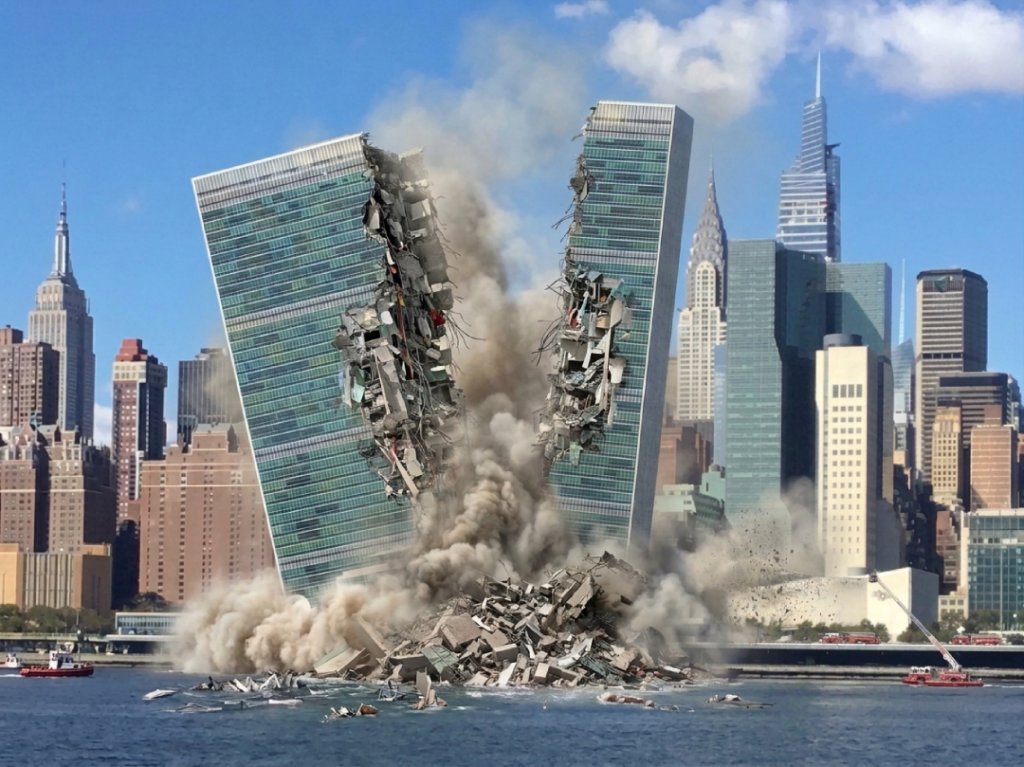
A Geopolitical Assessment on the Eve of the 81st General Assembly | September 2026
❦ ◆ ❦
Introduction: The Empty Chairs of New York
This week, as the eighty-first session of the United Nations General Assembly opens in Manhattan, the world’s premier diplomatic institution convenes beneath nearly every storm its founders pledged to prevent. The Associated Press’s veteran U.N. correspondent Edith M. Lederer lays out the agenda: active wars in Iran, Gaza, Ukraine, Sudan, Congo, and Myanmar; accelerating climate shocks; a global economy strained by blocked shipping lanes; and a new, ungoverned technological force, artificial intelligence, whose own industry leaders have warned it could slip beyond human control. Hanging over all of it, Lederer notes, is a question that has become as ritual as the opening gavel: can the assembled leaders actually do anything to end these wars?
The more revealing story lies in who will not be in the hall. China’s Xi Jinping will be in Washington the same week, yet is sending only a vice president to New York. Vladimir Putin is staying home. India’s Narendra Modi has withdrawn. The leaders of three of the most consequential powers on earth have quietly concluded that the world’s parliament is not the room where their business gets done.
Even sympathetic observers struggle to describe the organization’s condition in hopeful terms. Richard Gowan of the International Crisis Group, among the most respected U.N. watchers alive, told the AP that the organization is no longer in free fall. It is, however,
Stuck in an open-ended or permanent crisis.”
— Richard Gowan, International Crisis Group, quoted by Edith M. Lederer, Associated Press (ABC7 Chicago), September 21, 2026
This essay argues that Gowan’s diagnosis is accurate but incomplete. The crisis is not a passing illness; it is structural and congenital. Across eight decades, the United Nations has functioned as an assembly of national representatives rather than subject-matter authorities, and its collective output has been shaped far less by expertise or shared purpose than by the interests of the governments that dispatch its delegates. The record is long, well documented, and drawn from critics across the political spectrum and across continents. The conclusion it points toward is uncomfortable but difficult to escape: the United Nations must either be fundamentally reconstituted or be allowed to recede while more capable structures take its place.
❦ ◆ ❦
I. A Charter Built on Sand
Three Assumptions That Failed the Test of History
Writing in The Statesman, A. K. Ghosh identifies the three political premises on which the Charter’s architecture rested: that the great powers would act together against any threat to peace, whatever its source; that their combined strength and judgment would suffice to meet such threats without resort to war; and that no such threat would ever arise from among the great powers themselves. Each premise, Ghosh observes, collapsed under the weight of postwar reality. The superpowers could not act in unison whenever their interests diverged, and the gravest menaces to world peace have come precisely from those powers. The gap between constitutional intention and political fact, he concludes, turned the organization into something its architects never intended:
A toothless tiger in the face of a predictable outbreak of wars”
— A. K. Ghosh, “Ineffectual UN,” The Statesman, May 9, 2022
Ghosh adds a subtler point that deserves emphasis. The will of the United Nations is nothing more than the aggregated will of its individual members. There is no independent institutional judgment standing apart from the governments in the room. When the Soviet Union invaded Afghanistan, and when the United States invaded Iraq, each simply routed around the organization. An institution that the powerful may consult or ignore at their convenience is not a guarantor of collective security; it is a venue.
The Non-Falsifiable Institution
Kenneth Anderson of Stanford’s Hoover Institution frames the same problem as a set of contradictions built into the organization’s DNA. The U.N. claims independent authority to govern globally, yet it is merely an instrument of its member states. It professes the sovereign equality of all nations while claiming to enforce universal values that many of those nations reject. Its Secretary-General is at once a humble ministerial servant and something approaching, however weakly, a president of the world. The practical consequence, Anderson argues, is a distinctive paralysis: constant motion that never moves forward. The organization survives this paralysis through a peculiar rhetorical bargain. It is, in his memorable formulation,
A failure today—and a hope for tomorrow”
— Kenneth Anderson, “Why Does the UN Still Exist?” Hoover Institution, July 25, 2012
Anderson calls this posture UN platonism. Whatever the failure, whether persistent hunger, a pandemic, or a regional war, the prescribed remedy is always a deeper commitment to the very institution that failed. An argument that no conceivable evidence could refute is not a reasoned policy judgment. It is a creed, and creeds are poor foundations for the architecture of global security.
❦ ◆ ❦
II. The Veto: Paralysis by Design
One Nation’s Objection Over the World’s Will
The Security Council is where the Charter’s design flaws become operational failures. Five permanent members, the victors of 1945, hold a veto over every substantive action. As the Wikipedia survey of criticism of the United Nations summarizes, a single permanent member’s objection can override a clear majority and freeze any armed or diplomatic response to a crisis. By July 2019, the Soviet Union and its Russian successor had cast 141 vetoes, the United States 83, the United Kingdom 32, France 18, and China 14. The pattern is neither partisan nor regional. Every permanent member has used the veto to shield itself or its clients. In 2014, Russia’s lone veto defeated a resolution condemning its own annexation of Crimea, overriding thirteen votes in favor. Washington has repeatedly vetoed resolutions critical of Israel, and Moscow and Beijing have blocked action on Syria again and again.
Andre Avanessians, writing for George Washington University’s Trachtenberg School of Public Policy, recalls that the Charter’s drafters understood that permanent members would abstain in disputes to which they were party, an expectation the Charter itself codifies only for peaceful-settlement matters and that has long since eroded in practice. The Council designed to police aggression cannot act against an aggressor that holds a permanent seat. Avanessians’s verdict is that the body has become
Nothing more than a battleground for competing agendas”
— Andre Avanessians, “UN Security Council: Global Enforcer or Ineffectual Figurehead?” Policy Perspectives (GWU), March 30, 2016
A Council Frozen in 1945
The retired NYU international-relations professor Alon Ben-Meir adds that the Council’s composition no longer reflects the world it claims to govern. By his reckoning, it represents roughly a quarter of the global population, leaving Africa, Latin America, the Muslim-majority world, and India without a permanent voice. Reform proposals have failed for the most elementary of reasons: the five governments whose ratification any Charter amendment requires are the same five that would surrender privilege. The AP’s pre-Assembly reporting notes that member states have endorsed a broad reform package that includes the Council, yet implementation remains, as ever, somewhere over the horizon. Ben-Meir recalls the question Ukraine’s president put to the Council in 2022, a question that still has no answer:
Where is the security that the Security Council needs to guarantee?”
— Volodymyr Zelensky (2022), quoted by Alon Ben-Meir, “Has the United Nations outlived its usefulness?” Emerging Europe, November 4, 2024
❦ ◆ ❦
III. The Graveyard of Good Intentions
Rwanda, 1994
No episode indicts the Security Council more thoroughly than Rwanda. A 2023 analysis in The Arcadia Quill summarizes the essential facts: the Council delayed reinforcements for roughly two months, the force it eventually fielded lacked the equipment and authority to intervene effectively, and the killing continued for more than three months, claiming an estimated 800,000 Tutsis and moderate Hutus. Critics cited in the Wikipedia survey draw the damning contrast: an oil-rich Kuwait was rescued in 1991, while resource-poor Rwandans were left largely unprotected three years later.
Srebrenica, 1995
Srebrenica was a U.N.-declared “safe area,” guarded by some 400 lightly armed Dutch peacekeepers. In July 1995, Bosnian Serb forces killed roughly 8,000 Muslim men and boys there, the worst mass killing on European soil since the Second World War. TRT World’s compilation of U.N. failures notes that many of the victims had fled to the enclave precisely because the U.N. flag promised protection. The flag, it turned out, was a promise without a guarantor.
Darfur, Syria, Myanmar, and the Long Roll Call
In Darfur, estimates of the dead run from 200,000 to 300,000, and TRT World observes that four years elapsed before the U.N. authorized a large deployment. In Syria, Russia used its veto at least a dozen times to protect the Assad regime while more than six million Syrians fled the country. On the Rohingya, China shielded Myanmar from Council action. Reaching further back, the U.N. continued to seat the Khmer Rouge regime’s representatives even after its genocide, and critics widely regard the 1971 Bangladesh genocide as having been halted by Indian military intervention rather than by any action in New York.
The pattern is consistent across decades, regions, and secretaries-general. When the victims are strategically inconvenient, or when a permanent member has a client to protect, the machinery of collective security does not engage. That is not a series of isolated lapses. It is the system operating exactly as its structure dictates.
❦ ◆ ❦
IV. Peacekeeping Without Peace
Missions Without End
Writing in the American Foreign Service Association’s Foreign Service Journal, former U.S. ambassador Dennis Jett offers perhaps the most sober professional assessment of U.N. peacekeeping available. At the time of his 2019 analysis, fourteen missions employed nearly 100,000 personnel at an annual cost of close to $7 billion, with the United States assessed 28 percent of the bill. More than 3,800 peacekeepers had died on duty, and the toll had risen in every decade. Six of the missions were classical ceasefire operations that together had run for more than three centuries, including observer missions in Jerusalem and Kashmir dating to the organization’s first years, with no prospect of conclusion. Jett’s core finding is almost tautological, and all the more devastating for it:
Peacekeepers are bound to fail if there is no peace to keep”
— Dennis Jett, “Why Peacekeeping Fails,” Foreign Service Journal (AFSA), May 2019
The newest generation of protection-and-stabilization missions, Jett argues, is deployed in countries such as Mali, Sudan, South Sudan, the Central African Republic, and the Democratic Republic of the Congo, whose governments rank among the world’s most corrupt and repressive. Wealthy nations with capable armies decline to send troops, so the most dangerous assignments fall to poorly equipped soldiers from developing countries. In Jett’s blunt phrasing, peacekeeping has become a way for rich countries to send poor countries’ soldiers into conflicts the rich countries do not much care about. Ben-Meir reaches the same conclusion from a different angle, noting that peacekeepers are routinely posted where there is no peace to keep and are neither trained nor authorized for combat.
When the Protectors Do Harm
The record includes harms inflicted by the mission itself. Dominique Lazanski of the University of Pittsburgh recounts how the 2010 cholera epidemic in Haiti, which killed more than 9,000 people, was traced to waste from a U.N. peacekeeping base, while the organization stalled and claimed diplomatic immunity. Six years passed before the Secretary-General acknowledged the U.N.’s role. A 1996 U.N. study led by Graça Machel found that in six of twelve country studies, the arrival of peacekeeping troops coincided with a rapid rise in child prostitution. Anderson notes the recurring cycle of sex-for-food scandals, stern declarations of zero tolerance, and a conspicuous absence of criminal prosecutions. An institution that cannot hold its own personnel to account is poorly positioned to hold nations to account.
❦ ◆ ❦
V. Diplomats, Not Experts
The Representation Problem
At the heart of the U.N.’s ineffectiveness lies a design choice rarely examined directly. Its principal organs are staffed by delegates who speak for governments, not by specialists who answer to evidence. A diplomat’s professional obligation is to advance the instructions of a capital; the question of what a problem actually requires is secondary by design. Critics cited in the Wikipedia survey note that the organization represents the interests of governments rather than the people who live under them, and the world federalist Dieter Heinrich observes that the Charter concentrates legislative, executive, and judicial powers in a single body, the Security Council, without the separation that accountable governance requires.
The consequences are most visible in the human rights machinery. As of 2023, only about 30 percent of the members of the U.N. Human Rights Council were classified as “free” by Freedom House. That same year Iran was chosen to chair the Council’s Social Forum, even as its security forces were killing protesters. In 2025, Saudi Arabia chaired the Commission on the Status of Women, a choice Amnesty International condemned in the strongest terms. The American ambassador Jeane Kirkpatrick captured the atmosphere four decades ago when she wrote that Security Council deliberations
More closely resemble[d] a mugging”
— Jeane Kirkpatrick (1983), as cited in “Criticism of the United Nations,” Wikipedia
Telling Members What They Want to Hear
The internal review of U.N. conduct during the final months of Sri Lanka’s civil war in 2009, led by the former U.N. official Charles Petrie, found that staff were afraid to publicize widespread civilian killings, that headquarters’ communications with member states were shaped by what states wanted to hear rather than what they needed to know, and that the Security Council was deeply ambivalent about even placing the conflict on its agenda. Rights groups estimated up to 40,000 dead. Human Rights Watch called the episode a dereliction of duty. This is precisely the failure mode one would predict from an organization whose incentives reward political accommodation over expert candor.
Outpaced by Those Who Actually Know
Lazanski’s essay in Law & Liberty supplies instructive examples. During the 2014–16 Ebola outbreak, West Africa’s mobile-phone industry built a free text-reporting line that produced a live heat map of new cases, while the U.N. did not become meaningfully involved until late in 2015. Satellite spectrum and orbital allocation, long negotiated among governments at the International Telecommunication Union, now depend on private operators whose data are shared through a multi-stakeholder body outside the U.N. system. The World Health Organization’s inquiry into the origins of COVID-19 stalled when Beijing withheld data. Lazanski’s conclusion is stark:
The UN does not need to exist in today’s world”
— Dominique Lazanski, “The Useless United Nations,” Law & Liberty, December 18, 2023
The artificial-intelligence question now pushing onto this week’s agenda sharpens the point. Janine di Giovanni, writing in The National, reports that Secretary-General Guterres wants multilateral oversight of AI while the United States and European Union prefer to leave it to the private sector. A Security Council that cannot agree on Gaza or Ukraine is being asked to govern a frontier technology whose engineers themselves disagree about its risks. There is little in the organization’s record to suggest it will bring technical mastery, rather than another round of national positioning, to that task.
❦ ◆ ❦
VI. National Interest in Multilateral Clothing
Votes, Aid, and the Price of a Seat
If the U.N. were truly a forum for disinterested global deliberation, one would expect the votes of its members to be insulated from material inducement. The economists Ilyana Kuziemko and Eric Werker found otherwise. Developing countries holding a rotating Security Council seat received on average about 59 percent more U.S. foreign aid, and roughly 170 percent more in years when the Council was handling high-profile crises. UNICEF funding to those same countries rose as well. The aid fell back to prior levels once their terms ended. The researchers could not prove that votes were purchased, but the correlation speaks for itself.
Ben-Meir identifies a still deeper conflict of interest: the permanent members of the Security Council are also among the world’s leading arms exporters. Meanwhile, more than 80 percent of the funding for major agencies such as UNDP and UNICEF now arrives earmarked by donors for specific purposes, and decisions about which agencies survive are driven by politics rather than performance.
Washington’s À La Carte Membership
The largest funder has increasingly treated membership as a menu. During the first Trump administration, the United States left UNESCO, the Human Rights Council, and the World Health Organization; the Biden administration reversed those moves. In July 2025, the State Department announced a second withdrawal from UNESCO, effective at the end of 2026, charging the agency with pursuing
A globalist, ideological agenda for international development”
— Tammy Bruce, Department Spokesperson, U.S. Department of State press statement, July 22, 2025
On January 7, 2026, a presidential executive order directed withdrawal from 66 international organizations, 31 of them affiliated with the U.N., including the Framework Convention on Climate Change and the Population Fund. Secretary of State Marco Rubio explained that these bodies
No longer serve the interests of the United States”
— Marco Rubio, U.S. Secretary of State (January 2026), as quoted in “Proposals for the United States to withdraw from the United Nations,” Wikipedia
One need not endorse Washington’s reasoning to recognize what it reveals. When the organization’s chief financier engages selectively, while Russia and China treat the Council as a shield for their own conduct and that of their clients, the word “united” describes an aspiration, not a fact. Every major member already behaves as though the U.N. is a tool of national policy. The only question is whether the rest of the world will admit it.
❦ ◆ ❦
VII. Money, Management, and Moral Hazard
An Organization That Cannot Count Its Own Staff
Anderson’s Hoover essay turns from grand diplomacy to the internal ledgers, which few experts bother to read. What emerges is a picture of rent-seeking, weak fiscal discipline, and a chief executive who, Anderson writes, has no exact idea how many people work for him. The Oil-for-Food Programme became a multibillion-dollar scandal in which proceeds were diverted to Saddam Hussein’s government and to U.N. officials. A $23 million ceiling mural was installed in the Human Rights Council chamber in Geneva, partly financed from Spain’s development-aid budget. When the American diplomat James Wasserstrom raised corruption concerns in Kosovo, he was dismissed and detained by U.N. police; a U.N. tribunal later ordered compensation for his wrongful dismissal.
The former special representative to Somalia, Mohamed Sahnoun, documented how nongovernmental organizations repeatedly outperformed the U.N. in the field while envoys managed the crisis from desks in Nairobi, and he warned that absent sweeping reform the organization would keep answering emergencies with inept improvisation. Danielle Pletka of the American Enterprise Institute observes that calls to leave the U.N. were once confined to the political fringe, but that it is now reasonable to ask whether membership serves any purpose in what she calls
The most corrupt, compromised, and useless international organization since the League of Nations”
— Danielle Pletka, “Is It Time to Give Up on the United Nations?” The Dispatch, January 23, 2024
The Scorecard in 2026
The present offers little relief. Di Giovanni notes that this year’s official focus is again the Sustainable Development Goals, yet only about a third of the seventeen goals are on track. Development aid is falling at its steepest rate on record, and the Security Council remains unable to act on Gaza or Ukraine. The AP reports that Washington’s unpaid arrears forced cuts to peacekeeping and humanitarian operations, and that a $725 million payment arrived just in time to preserve the U.S. vote in the General Assembly. On the perennial promises of reform, di Giovanni offers a one-line audit:
As far as I can see, nothing has happened.”
— Janine di Giovanni, “Can the UN restore trust in itself?” The National, September 21, 2026
❦ ◆ ❦
VIII. The League’s Long Shadow
History offers a precedent that U.N. defenders prefer not to discuss. The League of Nations was dissolved because it failed to prevent war. Writing for Ohio State University’s Origins in 2006, the historian Dino E. Buenviaje traced the parallels: League sanctions did not deter Japan in Manchuria, and U.N. sanctions did not deter North Korea’s nuclear program; the League abandoned Ethiopia to Italy in 1935, and the U.N. declined to call Darfur a genocide. Having missed so many opportunities to enforce international law, Buenviaje concluded, the U.N. retained
No relevance other than as a debating society”
— Dino E. Buenviaje, “The UN Follows the League’s Long Trail to Impotence,” Origins (Ohio State University), October 2006
One of Buenviaje’s examples requires correction, and the correction strengthens his thesis rather than weakening it. The 1991 coalition that liberated Kuwait was in fact authorized by the Security Council. But it was possible only during a brief post–Cold War moment when Washington and Moscow happened to agree. The Council functions when the great powers already concur, which is to say when it is least needed. When they disagree, which is when a collective-security body earns its keep, it is paralyzed. Charles de Gaulle, who dismissed the organization as le machin, and Richard Nixon, who in 1967 called it obsolete and inadequate for the crises of its day, were early witnesses to a condition that has only hardened since.
❦ ◆ ❦
IX. The Strongest Case for the Defense, and Why It Falls Short
What the Defenders Rightly Point To
Scholarly honesty requires engaging the best counterarguments. A 2005 RAND Corporation study found U.N. peacekeeping successful in two of three cases and reported that seven of eight U.N. nation-building cases it examined were at peace, against four of eight comparable U.S.-led efforts. The 2005 Human Security Report presented circumstantial evidence that international activism, much of it led by the U.N., contributed to the decline in armed conflict after the Cold War. Secretary-General U Thant served as a vital intermediary between Kennedy and Khrushchev during the Cuban Missile Crisis. On the U.N.’s own seventieth anniversary in 2015, General Assembly President Mogens Lykketoft credited the system with containing conflicts, feeding the hungry, and advancing decolonization, even as he conceded that member states had too often given it too little, too late.
Public opinion, too, remains more supportive than critical. Gallup’s September 2025 survey found that 60 percent of Americans consider the U.N. necessary and 79 percent want the United States to remain a member. The Better World Campaign argues that a U.N. without the United States would mean less peacekeeping capacity and weaker enforcement of international law. And Mark Malloch-Brown, a former Deputy Secretary-General, insists that the organization’s real value lies in the field, in the unheralded work of special representatives and resident coordinators, and not in the halls of New York:
A distant club of men in dark suits is doomed to irrelevance”
— Mark Malloch-Brown, “Slow death or new direction for the UN?” UNU-WIDER (via Project Syndicate), November 2020
Why the Defense Ultimately Concedes the Case
Each of these arguments, examined closely, supports reconstitution rather than preservation. First, the successes cluster where great powers already agree, which is the Buenviaje paradox restated. Second, the valuable work is overwhelmingly technical and field-based. Anderson notes that the effective bodies of global coordination share two features: they deal with matters where interests broadly overlap, and they deliberately limit themselves to a defined function. That is an argument for unbundling the U.N.’s useful agencies from its dysfunctional political core, not for protecting the core. Malloch-Brown, among the organization’s most distinguished insiders, effectively concedes that New York is the problem.
Third, the polling cuts both ways. The same Gallup survey found that Americans rate the U.N.’s performance as poor rather than good by 63 percent to 32 percent, and that less than half have given it a positive rating in every reading since March 2003. The share favoring outright withdrawal, 17 percent, ties the highest level in a trend dating to 1951. Respondents’ chief complaints were inaction, ineffectiveness, and a lack of real power. Americans want an international body that works; they do not believe this one does. That is Anderson’s hope for tomorrow in statistical form.
❦ ◆ ❦
X. The Exit Problem
An Institution With No Door Marked “Leave”
Any serious proposal must confront a peculiar legal fact:
The UN Charter contains no provision for withdrawal”
— Better World Campaign, “UN, Explained: Can a Country Quit the UN?”
Article 6 permits expulsion of a member that persistently violates the Charter, but it has never been used. Only one state has ever tried to leave. Indonesia announced its withdrawal in January 1965 in protest over Malaysia’s Security Council seat; after a change of government, it asked to resume full cooperation the following year, and the Assembly quietly treated the episode as though it had never been a withdrawal at all. Under customary international law and the Vienna Convention on the Law of Treaties, a state may generally exit a treaty lacking withdrawal terms only upon a fundamental change of circumstances, and it is unlikely the U.N. would recognize a unilateral departure absent one. The Philippines’ Rodrigo Duterte threatened to leave in 2016 and retracted the threat the next day.
In the United States, the American Sovereignty Restoration Act has been introduced in Congress repeatedly since 1997, and Senator Mike Lee and Representative Chip Roy introduced the DEFUND Act in December 2023, yet each attempt has drawn minimal support. What does bite is money. Under Article 19, a member more than two years in arrears loses its General Assembly vote, a fate Washington narrowly averted in 1998 and again this month. An institution without a practical exit is an institution without market discipline. The realistic paths, then, are internal reconstitution or gradual displacement: squeezing the organization’s political core into irrelevance by building more capable structures around it and shifting resources accordingly.
❦ ◆ ❦
XI. Revamp or Replace: A Road Map
Path One: Radical Reconstitution
The reform literature is extensive, and its most credible proposals share a common logic: reduce the power of any single government to block collective action, and raise the bar for who may sit in judgment of others. Ben-Meir proposes limiting the veto in cases of mass atrocity, requiring a supermajority for a veto to take effect, creating rotating regional seats, and strengthening the General Assembly’s “Uniting for Peace” procedure for moments of Council deadlock. Avanessians go further, proposing that a majority of the Council prevail over permanent-member objections, or that the Council be replaced by regional security councils voting by majority. Amnesty International has proposed that the permanent five surrender the veto on questions of genocide. As far back as 2005, Kofi Annan proposed that Human Rights Council members be approved by a two-thirds vote of the General Assembly precisely to keep abusive regimes off the body.
To these should be added three practical measures drawn from the evidence above. First, sunset clauses for peacekeeping: Jett recommends closing the six endless classical missions or requiring the parties and their patrons to pay for them. Second, functional unbundling: the technical agencies that work should be governed under self-limiting mandates, insulated from Security Council politics, in the manner Anderson describes. Third, competence criteria for membership in expert bodies, so that the chair of a women’s-rights commission is not held by a government that systematically restricts women’s rights.
The obstacle is the same one that has defeated every prior effort. Article 108 requires that Charter amendments be ratified by two-thirds of members, including all five permanent members. The organization’s own constitution guarantees that those with the most to lose hold the key to change. The leadership transition now under way offers one point of leverage: Secretary-General Guterres’s term ends December 31, and member states could condition their support for any successor on a binding reform agenda. In Frontline, the economist Ajay Chhibber argues that the next Secretary-General must pursue far deeper change than the incremental measures of recent years.
Path Two: Displacement by Design
If reconstitution fails, the alternative is not isolation but a deliberate migration of real cooperation to structures that work. Ghosh points out that the Economic Community of West African States proved in the early 1990s that a regional force can succeed where a U.N. force falters, and that regional actors did better in Somalia after U.N. forces withdrew. Lazanski, drawing on Friedrich Hayek’s case for international federations and on Elinor Ostrom’s polycentric governance, argues for issue-specific coalitions of states with shared goals, formed from the bottom up rather than imposed from New York. Commentators across the political spectrum, including a September 2025 opinion column in Allentown’s Morning Call whose headline urged readers to scrap the U.N. and start over, have begun to say openly what diplomats say privately.
Under this second path, the U.N. would not be abolished by fiat. It would be squeezed out of existence by attrition, retaining its technical agencies where they perform, while the work of peace, security, and technology governance migrates to regional bodies, functional compacts, and coalitions of the willing and able. That process, as the empty chairs in New York this week suggest, is already well under way.
❦ ◆ ❦
Conclusion: The House That 1945 Built
The United Nations was built by the victors of a war that ended eighty-one years ago, for a world that no longer exists, on assumptions that failed within its first decade. It has survived not because it succeeds but because, in Anderson’s image, it always promises to succeed tomorrow. Its principal organs are staffed by representatives whose duty is to their capitals rather than to the problems before them; its most powerful body is designed to freeze whenever the stakes are highest; its peacekeepers are sent where there is no peace to keep; and its largest members already treat it as an instrument of national policy.
None of this diminishes the courage of individual peacekeepers, aid workers, or field officers who have given their lives under its flag. It is precisely their sacrifice that makes the institution’s structural failure so difficult to excuse. As the world’s leaders gather this week amid wars, climate shocks, and an ungoverned technological revolution, the honest question is not whether the United Nations can be made to feel relevant for another General Assembly season. It is whether the world is prepared to build something that works, either by rebuilding this house from its foundations or by constructing a better one beside it and letting the old structure fall quiet. The evidence of eight decades suggests that the time for that decision has arrived.
❦ ◆ ❦
Sources Consulted
Lederer, Edith M. “World leaders meet at UN as their planet grapples with war, division, runaway AI and climate shocks.” Associated Press / ABC7 Chicago, September 21, 2026.
https://abc7chicago.com/story/world-leaders-meet-planet-grapples-war-division-runaway-ai-climate-shocks/19854498/
Jones, Jeffrey M. “United Nations Seen as Necessary but Ineffective.” Gallup, September 21, 2025.
https://news.gallup.com/poll/695417/united-nations-seen-necessary-ineffective.aspx
Ghosh, A. K. “Ineffectual UN.” The Statesman, May 9, 2022.
https://www.thestatesman.com/opinion/ineffectual-un-1503069696.html
“Criticism of the United Nations.” Wikipedia.
https://en.wikipedia.org/wiki/Criticism_of_the_United_Nations
Anderson, Kenneth. “Why Does the UN Still Exist?” Hoover Institution, July 25, 2012.
https://www.hoover.org/research/why-does-un-still-exist
Ben-Meir, Alon. “Has the United Nations outlived its usefulness?” Emerging Europe, November 4, 2024.
Buenviaje, Dino E. “The UN Follows the League’s Long Trail to Impotence.” Origins, Ohio State University, October 2006.
https://origins.osu.edu/history-news/un-follows-league-s-long-trail-impotence
Avanessians, Andre. “UN Security Council: Global Enforcer or Ineffectual Figurehead?” Policy Perspectives, George Washington University, March 30, 2016.
UN Security Council: Global Enforcer or Ineffectual Figurehead?
“The UN Security Council is Ineffective.” The Arcadia Quill, April 28, 2023.
Lazanski, Dominique. “The Useless United Nations.” Law & Liberty, December 18, 2023.
Tekingunduz, Alican. “Twelve times the UN has failed the world.” TRT World.
https://www.trtworld.com/article/12710932
Jett, Dennis. “Why Peacekeeping Fails.” Foreign Service Journal, American Foreign Service Association, May 2019.
https://afsa.org/why-peacekeeping-fails
Malloch-Brown, Mark. “Slow death or new direction for the UN?” UNU-WIDER, November 2020.
https://www.wider.unu.edu/publication/slow-death-or-new-direction-un
Better World Campaign. “UN, Explained: Can a Country Quit the UN?”
“Proposals for the United States to withdraw from the United Nations.” Wikipedia.
https://en.wikipedia.org/wiki/Proposals_for_the_United_States_to_withdraw_from_the_United_Nations
Pletka, Danielle. “Is It Time to Give Up on the United Nations?” The Dispatch, January 23, 2024.
Bruce, Tammy. “The United States Withdraws from the United Nations Educational, Scientific and Cultural Organization (UNESCO).” U.S. Department of State, July 22, 2025.
https://www.state.gov/releases/2025/07/the-united-states-withdraws-from-the-united-nations-educational-scientific-and-cultural-organization-unesco
Di Giovanni, Janine. “Can the UN restore trust in itself?” The National, September 21, 2026.
https://www.thenationalnews.com/opinion/comment/2026/09/22/unga-guterres-new-york-diplomacy-iran-ukraine-climate-middle-east/
“Withdrawal from the United Nations.” Wikipedia.
https://en.wikipedia.org/wiki/Withdrawal_from_the_United_Nations
Chhibber, Ajay. “It’s time the UN fixed itself.” Frontline (The Hindu).
https://frontline.thehindu.com/world-affairs/un-reform-global-governance/article71399429.ece
“It’s time to scrap the UN and start over” (opinion). The Morning Call, September 9, 2025.
Lykketoft, Mogens. Statement at the informal session commemorating the 70th Anniversary of the United Nations, October 23, 2015.
Informal session of the General Assembly commemorating the 70th Anniversary of the United Nations
“Kofi Annan Presents Comprehensive Agenda for Reforming the UN.” YaleGlobal, March 21, 2005.
https://archive-yaleglobal.yale.edu/content/kofi-annan-presents-comprehensive-agenda-reforming-un
A Note on Research Methods and Accuracy
In recent years, some have voiced concern that artificial intelligence may distort facts or introduce inaccuracies into serious research. That criticism deserves acknowledgment. However, AI has now evolved into the most powerful research instrument available to any dedicated scholar—capable of analyzing vast datasets, cross‑referencing historical records, and surfacing overlooked connections across sources. This work represents a collaboration between the author’s investigative inquiry, verified primary documentation, and the advanced analytic capabilities of AI research tools. Here, AI was not used as a ghostwriter or a shortcut for scholarship, but as a disciplined research partner devoted to rigor, accuracy, and transparency.
Every factual claim in this work has been subjected to active verification. Where AI‑generated content was used as a starting point, it was tested against primary sources, peer‑reviewed scholarship, official institutional documentation, and established historical records. Where discrepancies were found—and they were found—corrections were made. The author has made every reasonable effort to ensure that quotations are accurately attributed, historical details are precisely rendered, and theological claims fairly represent the positions they describe or critique.
That said, no work of this scope is immune to error, and the author has no interest in perpetuating inaccuracies in the service of an argument. If you are a reader—whether sympathetic, skeptical, or hostile to the conclusions drawn here—and you identify a factual error, a misattributed source, a misrepresented teaching, or a claim that cannot be substantiated, you are warmly and genuinely invited to say so. Reach out. The goal of this work is not to win a debate but to get the history right. Corrections offered in good faith will be received in the same spirit, and verified corrections will be incorporated into future editions without hesitation.
Truth, after all, has nothing to fear from scrutiny—and neither does this work.