
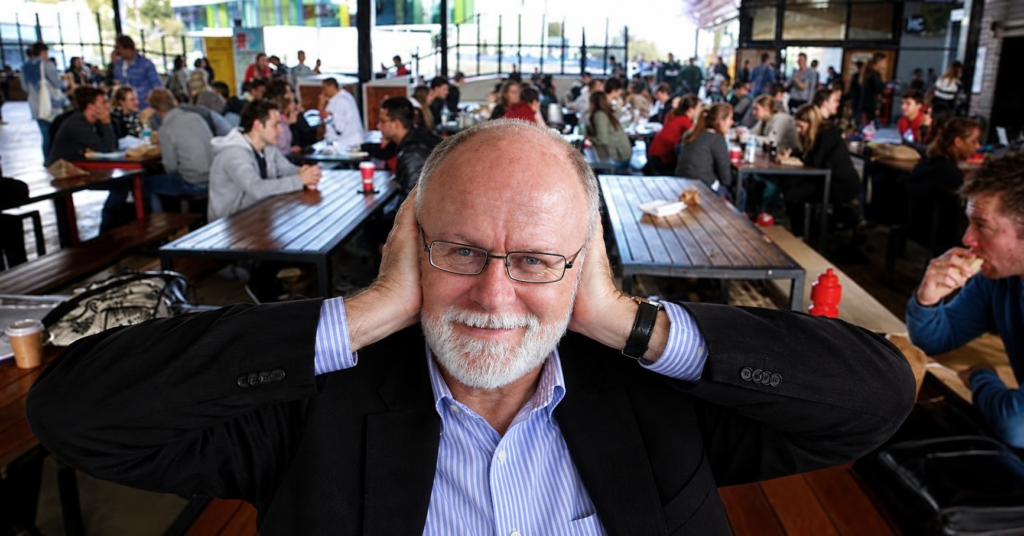
The Tyranny of the Unasked-For Song
A Christian review of John Cassara’s “Loudcasting:
The Tyranny of Unwelcome Music,” and a plea for the recovery of quiet
❧ ✦ ❧
Introduction: The Essay We Should Have Written
Somewhere this evening, a family is trying to say grace over a restaurant meal while a speaker mounted ten feet above the booth pumps out a song none of them chose, at a volume none of them would tolerate at home. The father leans in to hear his daughter. The waiter repeats the specials twice. Nobody complains, because complaining has become a social offense far greater than the noise itself. Then everyone goes home a little more tired than they came.
Every writer knows the peculiar sting of opening a magazine and finding the article he has been meaning to write for ten years, already written, and written well. That was my experience with John Cassara’s recent commentary in Crisis Magazine, “Loudcasting: The Tyranny of Unwelcome Music.” Let it be confessed at the outset: this is the essay The Righteous Cause should have written first. Mr. Cassara beat us to the microphone, and he did it, appropriately, without raising his voice. What follows is a review of his argument, a set of reinforcements from Scripture, from the Christian tradition and from secular observers on both sides of the Atlantic and the Pacific, and finally a confession of one author’s long-suppressed exasperation.
Cassara opens with a series of questions that read like a rap sheet of modern life: the restaurant where conversation is impossible, the Walmart parking lot with music blaring from outdoor speakers, the gas pump that greets you with “loud techno-sounds and ads,” the barber chair in which relaxation is defeated by “grating music.” His summary is blunt:
Unwelcome, overly loud, and intrusive music is now the norm. Some call it “loudcasting.”
— John Cassara, “Loudcasting: The Tyranny of Unwelcome Music,” Crisis Magazine
The word is new, but the problem is old, and the Christian has more to say about it than either the acoustic engineer or the etiquette columnist. Noise is a question of neighbor-love, of the stewardship of shared space, and finally of the soul’s capacity to hear God. That is the ground on which this review stands.
❧ ✦ ❧
Following the Money: Cassara’s First Diagnosis
Music as a Sales Instrument
Cassara’s first suspect is the oldest one in the moral lineup. “Perhaps the number one culprit for the growth of intrusive music,” he writes, “like so many other things that corrupt our society, is money.” He summarizes research showing that background music alters mood, regulates pace, and “manipulat[es] shoppers subconsciously,” and he notes that in restaurants slow-tempo music has been shown to lengthen dining time by nearly 25 percent compared with fast-tempo music, while faster music increases turnover.
The secular literature confirms him in remarkable detail, and it does so without any embarrassment. Writing on Medium, music critic Christopher Coplan summarized the findings of psychologists Adrian North and David Hargreaves in The Social and Applied Psychology of Music: low-tempo music makes shoppers and diners stay longer and buy more; classical music nudges customers toward pricier items (wine stores in the 1990s found it “greatly increased sales and made people buy more expensive items”); and loud music increased customer turnover “by up to 10%, without changing the quantity or volume of purchased goods.” Coplan, who actually likes piped music, is candid about what it is for:
Stores use this piped music as just another tool to get you to open your wallet and buy clothes, books, stereo equipment, a nice venison meal or an over-sized caramel frappe.
— Christopher Coplan, “Pipe Down: Should Music Be Played In Public Places?” Medium (Sing Song Blog Log)
Ted Landphair, writing for the Voice of America, notes that psychologists have a name for the barrage: “audio architecture,” or “musical wallpaper,” which is “designed to put you in the mood to buy more and eat a lot.”
The Muzak Inheritance
Cassara reminds us that this is not a smartphone-era invention. Nearly a century ago, Muzak pioneered pre-recorded music piped directly to subscribing businesses, pitching it as “a scientifically proven means to increase productivity and thus make more money.” Landphair likewise calls Muzak “a pioneer in both ‘background music’ and the psychological possibilities that it presents.” The jokes about elevator music are, as Cassara says, “legion.” But the joke has a sharper edge than we usually admit. A technology deliberately engineered to bypass the conscious will to separate a person from his money is not morally neutral merely because the melodies are pleasant.
The Christian moral tradition has always distinguished between persuasion, which addresses the reason, and manipulation, which goes around it. Scripture commands that commerce be conducted with “a just weight” (Proverbs 11:1). A sound environment engineered to make a meal “feel more high-end” than it is, as Cassara puts it, sits uncomfortably close to a thumb on the scale. The point is not that every restaurant owner who switches on a playlist is a cheat. The point is that the industry selling him the playlist openly advertises it as a way to influence behavior beneath the level of awareness, and Christians ought to notice.
❧ ✦ ❧
The Pocket-Sized Amplifier: Loudcasting Goes Personal
From Sodcasting to Bare Beating
Cassara’s second movement turns from the cash register to the cell phone. He cites Pew’s finding that roughly 91 percent of Americans own a smartphone, up from 35 percent in 2011 (his gloss of “about 325 million Americans” overstates the adult figure Pew actually measures, but the trend is not in dispute). The result is that “nearly everybody has a music generating device that is only six ounces,” and many of them “put their music (and phone conversations) on speakerphone for everybody around them to hear.”
The British have been naming this vice for nearly two decades. In August 2026, Dan Hancox wrote in The Guardian that the practice was first christened “sodcasting” in that newspaper nineteen years ago, and that it has returned in a more corrosive form:
What we are all hearing on buses and trains thanks to sodcasting 2.0 is measurably more antisocial and individualistic: for one thing, 2010’s groups of teen sodcasters weren’t changing songs every 10 seconds… It is maddening behaviour to anyone who has experienced it: like being on a bus or a train with someone who is flicking TV channels, constantly.
— Dan Hancox, “The war on ‘loudcasting’ phones can be won, but it will take some very British nudging,” The Guardian, August 25, 2026
The British have another name for it now: “bare beating.” Ada Wein of Travel Tomorrow explains the joke behind the coinage. Where “rawdogging” a flight meant voluntarily enduring a journey without devices, bare beating “flips the equation: it’s not self-inflicted, but forced upon others.” That single sentence captures the whole moral structure of the problem. The loudcaster does not suffer his own noise. He exports it.
Rebellion, Performance and Bad Manners
Cassara quotes Dr. Rachael Kent’s observation to the BBC that this behavior is “performative… a way to rebel,” a way “to express who you are, what your tastes are.” He answers dryly that “it’s also impolite, immature, and simply bad-mannered.” He is right, and the theologian can add a word the sociologist may hesitate to use: it is proud. To play one’s music aloud in a shared space is to announce that one’s preferences are the public’s business and that everyone else’s preferences are not. The apostle’s description of love is precisely the inverse: charity “doth not behave itself unseemly, seeketh not her own” (1 Corinthians 13:5).
Cassara also notes that researchers found the COVID-19 pandemic “loosened informal social policing and public etiquette,” as habits formed at home migrated back into shared spaces. The Pew data he cites is sobering: nearly half of Americans believe the culture has grown ruder over the last five years, and nearly 60 percent consider loud music in public unacceptable. A clear majority, in other words, is being governed by a noisy minority.
A Dissenting Voice, Fairly Heard
In fairness, not every writer agrees. Hancox himself once wrote “more than 2,000 words in defence of sodcasting,” arguing that teenagers playing music on buses were making “a necessary claiming of public space by people who are often bullied out of it,” and he is suspicious of any city that is “silent, tidy, prim.” A Substack writer identified as Choong, writing from Singapore, offers a narrower defense: delivery riders who play music while cycling on shared paths are, in effect, sounding a continuous bicycle bell, signaling their approach. Yet even Choong concedes the larger point. “I still think one has an obligation not to create noise pollution,” the writer says, adding: “put the damn phone down for once! (Maybe… the boomers were right?)”
These dissents are worth hearing because they clarify the line. No serious person wants a city of mausoleum silence. The objection is not to sound. It is to imposed sound: the amplified, the repetitive, the unchosen and the inescapable.
❧ ✦ ❧
When the Music Is the Weapon
Classical Music as a Repellent
One of the strangest chapters in this story, and one Cassara does not explore, is the use of music not to attract people but to drive them away. Hermione Lai, writing for the Hong Kong classical-music site Interlude, traces the practice back to 1985, when 7-Eleven stores in British Columbia, after consultation with psychologists, began playing classical music in parking lots to discourage loitering teenagers. The tactic spread. Lai reports that “robberies in British subways were down by 33 percent” after classical music was introduced, and that the Los Angeles Metro, playing a looped composition called “Immaterial,” cites “a 75 percent reduction in calls for emergency service.” Mental Floss reports the same practice at gas stations from Columbus to Austin to Tacoma, “often blared through the lot at ear-aching volumes.”
Lai quotes the scholar Lily E. Hirsch, whose analysis deserves Christian attention:
Loud classical music is working at cross-purposes here, as a way to signal that certain people are wanted and others are unwanted. It’s like a bird marking its territory… And you’re not solving the problem, but just pushing the problem to another spot.
— Lily E. Hirsch, quoted by Hermione Lai, “Can we use classical music to fight crime and deter loitering?” Interlude
A Los Angeles customer put it more simply to the Los Angeles Times, as reported by Mental Floss: “These are people. They’re not pigeons. It’s the auditory equivalent of putting spikes on a bench.”
What Bach Never Intended
There is a bitter irony here for anyone who loves the Western sacred tradition. Much of the music being weaponized was written to the glory of God. Johann Sebastian Bach headed his scores with “J.J.” (Jesu, juva, “Jesus, help”) and closed them with “S.D.G.” (Soli Deo Gloria). To press the Baroque into service as a sonic fence is to turn doxology into a tool of exclusion. Whatever one thinks of the loitering problem, and business owners have real concerns about safety and theft, the Christian should feel the incongruity. Music is a gift meant to lift the heart. Its use as a cudgel, whether to sell more frappés or to scatter the homeless, reveals how thoroughly we have forgotten what it is for.
Nor is this merely a matter of taste. A London judge, in a recent ruling on relentless amplified busking in Leicester Square, described the noise as a form of “psychological torture,” and observed that the nuisance was “exacerbated by the repetition and poor quality of some of the performances,” comparing the looping songs to “a well-publicised feature of unlawful but effective psychological torture techniques.” When courts reach for the vocabulary of torture to describe public music, the matter has moved well beyond preference.
❧ ✦ ❧
The Body Keeps the Score: Noise and Health
Cassara rightly insists that noise is not only annoying but harmful. He cites links between high noise exposure and “extra stress, anxiety, behavioral issues, and trouble focusing,” and reports that exposure to loud sounds against a quiet background has been associated with “heart disease, heart attacks, heart failure and even strokes.” Landphair, for VOA, quotes the U.S. Environmental Protection Agency’s own definition:
Sound becomes unwanted when it either interferes with normal activities such as sleeping, conversation, or disrupts or diminishes one’s quality of life. The fact that you can’t see, taste or smell it may help explain why it has not received as much attention as other types of pollution, such as air pollution or water pollution.
— U.S. Environmental Protection Agency, quoted in Ted Landphair, “Unwanted Music is Noise Pollution to Some,” Voice of America
There is also a population for whom background music is not merely irritating but exclusionary. Coplan reports that the British charity Action on Hearing Loss joined the campaign group Pipedown in calling for an end to piped music in cafés and restaurants. Their spokesperson, Gorki Duhra, explained why:
For some people, it can be irritating. But when it leads to you getting the wrong order or not being able to have a conversation and you’re missing the main bit of the joke because you just can’t hear it, you feel left out. Background music makes it harder to pick up a particular voice. We would ask [restaurants] not to play any.
— Gorki Duhra, Action on Hearing Loss, quoted in Christopher Coplan, Medium
Coplan cites 48 million Americans and 9 million Britons with some degree of hearing loss. For an aging congregation, which is to say for most congregations, the restaurant soundtrack quietly removes grandparents from the conversation at the family table. The Dutch writer at Metapolis frames the matter in terms a property lawyer would recognize: unsolicited noise “causes trespassing. It enters your ears, and you can’t do anything about it.” The eye has a lid; the ear does not.
The great physician Robert Koch is often credited with the prophecy that “the day will come when man will have to fight noise as inexorably as cholera and pestilence.” Whatever its precise origin, that day appears to have arrived.
❧ ✦ ❧
The Deeper Disease: The Flight from Silence
Cassara’s Theological Turn
The most important paragraph in Cassara’s essay is the one in which he moves from symptoms to cause:
Perhaps the most telling cause of loudcasting is the aversion of moderns to quiet. For many, the lack of noise makes them uncomfortable. They are seemingly incapable of spending long periods of time in silence and solitude. They feel awkward. I think many are afraid of introspection. They fill the void with noise.
— John Cassara, Crisis Magazine
Here the review must offer one friendly correction. Cassara renders Psalm 46:10 as “Be still and know that I am with you.” The verse actually reads, “Be still, and know that I am God” (KJV). The difference matters, and it strengthens his case. The psalm is not merely a promise of companionship. It is a summons to recognize sovereignty. The context is war, the raging of nations and the shaking of kingdoms (Psalm 46:6), and the command to “be still” (Hebrew harpu, “let go,” “cease striving”) is addressed to a world that is very loud indeed. Stillness is not escape from reality. It is submission to the One who rules it.
Sarah, Pascal and Kierkegaard
Cassara then calls on Cardinal Robert Sarah’s The Power of Silence: Against the Dictatorship of Noise, and the quotation is unforgettable:
God is silence, and the devil is noisy. From the beginning, Satan has sought to mask his lies beneath a deceptive, resonant agitation… Noise has become like a drug on which our contemporaries are dependent. With its festive appearance, noise is a whirlwind that avoids looking oneself in the face and confronting the interior emptiness. It is a diabolical lie.
— Cardinal Robert Sarah, The Power of Silence, quoted in Crisis Magazine
Protestant readers will recognize the same diagnosis in Blaise Pascal, who saw three and a half centuries ago that diversion is the drug of a soul that cannot bear to face itself:
I have discovered that all the unhappiness of men arises from one single fact, that they cannot stay quietly in their own chamber.
— Blaise Pascal, Pensées (1670), no. 139 (Trotter translation)
Søren Kierkegaard, writing in 1851, sharpened the point to a prescription:
If I were a physician and were allowed to prescribe just one remedy for all the ills of the modern world, I would prescribe silence. For even if the Word of God were proclaimed in the modern world, no one would hear it, because there is too much noise. Therefore, create silence.
— Søren Kierkegaard, For Self-Examination (1851), as commonly rendered in English
Lewis’s Devil and the Kingdom of Noise
No Christian writer captured the spiritual meaning of noise more memorably than C. S. Lewis. In the twenty-second letter of The Screwtape Letters, the senior devil complains about two forces Hell has never been able to colonize:
Music and silence—how I detest them both!… no square inch of infernal space and no moment of infernal time has been surrendered to either of those abominable forces, but all has been occupied by Noise… We will make the whole universe a noise in the end.
— C. S. Lewis, The Screwtape Letters (1942), Letter XXII
Lewis’s insight is essential for reading Cassara rightly. Screwtape hates music as much as he hates silence. The enemy is not melody; the enemy is Noise, sound that has been severed from attention, from love and from the hearer’s consent. Music played in its proper place – the concert hall, the sanctuary, the home, the car with the windows rolled up – belongs with silence on Heaven’s side of the ledger. Music forced indiscriminately into every waking space has crossed over into Screwtape’s kingdom. It is no longer music. It is noise wearing music’s clothes.
Witnesses from the Tradition
The Scriptures and the saints form a single chorus here. Elijah met God not in the wind, the earthquake or the fire, but in “a still small voice” (1 Kings 19:12). Habakkuk declares, “The LORD is in his holy temple: let all the earth keep silence before him” (Habakkuk 2:20). Isaiah promises that “in quietness and in confidence shall be your strength” (Isaiah 30:15). Paul urges believers to “study to be quiet” (1 Thessalonians 4:11) and to pray for rulers “that we may lead a quiet and peaceable life in all godliness and honesty” (1 Timothy 2:2). Thomas à Kempis wrote in The Imitation of Christ that “in silence and quiet the devout soul makes progress and learns the hidden things of the Scriptures.” Dietrich Bonhoeffer, who knew more of the world’s noise than most, observed in Life Together that “right speech comes out of silence, and right silence comes out of right speech.”
Among modern evangelicals, Richard Foster put the matter with prophetic economy:
In contemporary society our Adversary majors in three things: noise, hurry, and crowds. If he can keep us engaged in “muchness” and “manyness,” he will rest satisfied.
— Richard J. Foster, Celebration of Discipline (1978)
Secular thinkers reached the same conclusion by a different road. Aldous Huxley called the twentieth century “the Age of Noise. Physical noise, mental noise and noise of desire—we hold history’s record for all of them.” The Catholic writer Max Picard, in The World of Silence (1948), warned that “nothing has changed the nature of man so much as the loss of silence.” And Arthur Schopenhauer, no friend of Christianity, argued in his essay “On Din and Noise” that the amount of noise a person can bear undisturbed stands in inverse proportion to his mental capacity, since noise is the great interrupter of thought.
❧ ✦ ❧
The Neighbor Principle: A Biblical Ethic of Shared Sound
Cassara observes that “loudcasting is another indication that the accepted ethics and behavior of yesteryear seem to have been replaced by today’s values that focus on the individual rather than the group.” Christian ethics can give that intuition a firmer foundation than nostalgia.
The governing text is the Golden Rule: “All things whatsoever ye would that men should do to you, do ye even so to them” (Matthew 7:12). The loudcaster would not welcome a stranger’s playlist in his own living room. Paul applies the same principle to the stronger and weaker brother: “We then that are strong ought to bear the infirmities of the weak, and not to please ourselves. Let every one of us please his neighbour for his good to edification” (Romans 15:1-2). He commands believers to “look not every man on his own things, but every man also on the things of others” (Philippians 2:4).
The Book of Proverbs even contains what may be the Bible’s most precise noise ordinance:
He that blesseth his friend with a loud voice, rising early in the morning, it shall be counted a curse to him.
— Proverbs 27:14 (KJV)
Note the logic. The content of the speech is a blessing. It is the volume and the timing that turn it into a curse. Solomon understood three thousand years ago what restaurant owners have forgotten: a good thing delivered at the wrong decibel, at the wrong hour, to an unwilling hearer, ceases to be a good thing. “To every thing there is a season,” the Preacher writes, “a time to keep silence, and a time to speak” (Ecclesiastes 3:1, 7).
The British blogger Amber, writing at Forever Amber after a family beach day ruined by two dueling speakers, arrived at the same ethic through plain common sense:
The person who wants to listen to music has the option of doing so on headphones—in which case, everyone gets what they want—whereas the ones who don’t can’t always get away from it.
— Amber, “When is it OK to play music in public?” Forever Amber
That asymmetry is the heart of the matter. The listener who wants music can have it privately at no cost to anyone. The person who wants quiet cannot have it at all once someone else has decided otherwise. Charity yields to the one who cannot opt out.
❧ ✦ ❧
Not Only an American Problem
The British Response
Cassara writes as an American, but the problem is global, and some governments have taken it more seriously than ours. On October 19, 2026, the British government announced a coordinated campaign under the slogan “Share the journey, not the noise.” Under powers created by the Bus Services Act 2025, local transport authorities in England may now impose fixed penalties of up to £100 for loud music on buses, while rail passengers who refuse to stop when asked by authorized staff can be removed at the next station or fined up to £1,000. Prime Minister Andy Burnham announced the measures in language that could have been lifted from Cassara:
We’ve all been on the train when someone starts blasting music or videos from their phone. It gets on your nerves and can quickly spoil the journey… It’s a simple thing, but one that will make journeys that little bit better for all of us.
— Prime Minister Andy Burnham, GOV.UK press release, October 19, 2026
Transport Secretary Heidi Alexander added that “it is so frustrating when the actions of an inconsiderate few spoil journeys for the rest of us.” The BBC notes that laws against playing loud music on British trains have existed since 2005, and that Transport for London already prohibits playing music or content aloud by byelaw. The Liberal Democrats had earlier proposed fines of up to £1,000 for “headphone dodgers,” and their spokesperson Lisa Smart urged the nation “to take a stand for the quiet majority who just want to get from A to B in peace.”
Commerce has followed. Coplan reports that Marks & Spencer removed music from 300 British stores, and Hancox notes that Wetherspoons chairman Tim Martin banned loudcasting from his pubs. Across the Channel, France has fined a man €200 for taking a speakerphone call on a station platform.
Not everyone is persuaded that fines will work. Hancox prefers “nudge messaging” to penalties, pointing to Transport for London’s long record of courtesy campaigns. Transport unions and passenger groups quoted by the BBC ask, fairly, who will enforce the rules on a bus with a lone driver. These are practical objections, not moral ones. Nobody quoted in the debate defends the loudcaster.
Japan: Quiet as a Civic Virtue
Japan offers the most instructive contrast. A visitor guide published by JIS Japan describes the governing principle as meiwaku o kakenai, “don’t cause trouble or inconvenience to others,” and notes that noise is treated as “a visible (or rather audible) form of inconvenience.” On commuter trains, phone calls are discouraged, phones are set to “manner mode,” and even music leaking from earbuds “is considered inconsiderate.” Using open speakers “on trains, in parks, or on streets is generally considered impolite, even during the day.” Karaoke, the nation’s great musical indulgence, is confined to soundproofed private rooms. As the guide puts it, you can sing “to your heart’s content,” but “once you step back into the hallway or onto the street, you are expected to switch back to quiet mode.” This author’s visit to Japan can confirm this message.
That is the principle in its purest form: music is welcome, in its place. Japan Dev, a guide for foreign residents, describes community standards of roughly 50 decibels at night and 60 by day, with quiet hours generally from 10 p.m. to 7 a.m., and an escalating ladder of enforcement from polite management notices to police visits. Behind the custom stands law. Japan’s Noise Regulation Act of 1968 and the national Environmental Quality Standards for Noise set limits for residential areas of 55 decibels by day and 45 by night, the figures the acoustic firm Lios cites, though Lios dates the governing statute to 1986 and also attributes to the WHO a ranking of Japan as the “noisiest country in the world” that I have been unable to verify. Readers should treat those two particular claims with caution.
Honesty also requires a caveat that Lai supplies. Japan is not silent. Its shops are often “surrounded by music, specifically by Western classical music,” and its train stations ring with chimes and announcements. The Japanese philosopher Nakajima Yoshimichi devoted a whole book, Urusai Nihon no Watashi (“Noisy Japan and I,” 1996), to protesting the country’s ubiquitous loudspeaker announcements. Japan’s achievement lies not in eliminating sound but in a shared conviction that private sound must not be imposed on public space. That conviction, more than any decibel limit, is what America lacks.
❧ ✦ ❧
The Law of the Matter: A Brief Legal Survey
Cassara notes that the American’s “legal recourse is based primarily on noise volume and public nuisance laws,” and that “personal wants are taking precedence over the rights of others.” A brief survey bears him out and shows where the law is strong and where it is weak.
Constitutional Boundaries
Music is protected expression under the First Amendment, but American courts have long upheld reasonable, content-neutral limits on its volume. In Kovacs v. Cooper (1949), the Supreme Court sustained a Trenton, New Jersey ordinance against “loud and raucous” sound trucks, recognizing the right of the unwilling listener in his home. In Ward v. Rock Against Racism (1989), the Court upheld New York City’s sound-amplification rules for the Central Park bandshell as a valid time, place, and manner regulation. The principle is settled: government may not dictate what you play, but it may regulate how loudly you play it where others must hear.
State and Local Law: The Phoenix Example
Arizona’s disorderly conduct statute, A.R.S. § 13-2904, makes it an offense to disturb the peace or quiet of a neighborhood, family, or person by “unreasonable noise.” The City of Phoenix goes further with its Event/Loud Party Ordinance (G-6674, City Code § 2-22), which applies to gatherings of five or more people that threaten “the peace, health, safety or general welfare.” The city’s FAQ is emphatic that “there are no ‘allowable’ times during the day or night,” and lists “loud music, band or disc jockey” first among the factors that may establish a violation. Responsible parties are billed for police response, up to $1,000 for a first incident, $1,500 for a second, and $2,000 for each subsequent incident within twelve months.
Tenants and the Covenant of Quiet Enjoyment
For apartment dwellers, the older common-law doctrine of “quiet enjoyment” remains the strongest tool. As the rental-payment company Flex explains, “as a tenant, you have a right to ‘quiet enjoyment,’ and your landlord is responsible for ensuring that noise remains within acceptable levels,” and a landlord’s failure to act may give tenants grounds to terminate a lease. The practical advice is to document dates, times, and sources in writing.
The Gap in the Law
And yet the commercial space, the very place Cassara’s essay begins, remains almost entirely unregulated. No American statute protects a diner from the restaurant’s own speakers, and nuisance law protects neighbors, not customers. The patron’s only remedy is the one the market provides: leave, and say why. Cassara’s warning about personal confrontation should also be heeded. He recounts a 78-year-old New York subway rider who was “repeatedly and brutally punched in the face” after asking a couple to turn down their music. The Japanese practice of complaint through intermediaries, and the British practice of enforcement by authorized officers, both reflect a sound instinct. Courtesy should not require courage.
❧ ✦ ❧
Broken Windows and the Recovery of Manners
Cassara closes with a provocative analogy to “broken windows” policing: just as visible disorder invites more serious disorder, a public crackdown on loudcasting “might help to bring about an uptick in manners and societal harmony.” The analogy is apt. Manners are not trivial. They are the small change of charity, the daily coinage by which neighbors honor one another’s dignity. A culture that cannot manage the volume knob is unlikely to manage weightier forms of self-restraint.
He ends with two sentences worth framing: “There are wonderful benefits to music. But we have lost a sense of appropriate times and places and respect for others.” And finally: “There is calm in quiet. Individually and collectively, we have a right to it.”
The Christian would add only this: we have more than a right to quiet. We have a need for it, because it is in quiet that we hear the voice that matters most.
❧ ✦ ❧
Conclusion: An Author’s Confession
Mr. Cassara writes with admirable restraint. This author, having now reviewed his essay with scholarly decorum, wishes to lay restraint aside for a few paragraphs.
I am weary of the noise. ALL OF IT! I am weary of the Walmart parking-lot speaker and the shouting gas pump. I am weary of Taco Bell’s pop, alternative indie-rock, electronic dance music, and pop-remix, the gym’s thudding soundtrack, the movie trailers mixed for the hard of hearing. I am weary of the car idling beside me at the light with its windows down and its bass rattling my mirrors.
I am weary of the stranger in the coffee shop narrating his TikTok feed to the entire room, and of the man in the Barnes and Noble Cafe conducting his speakerphone business as though the rest of us were his staff. I am weary of the neighbor’s backyard concerts, the leaf blower at dawn, and the Christmas holiday playlist in October.
I’m done with it. Please send someone to check on me (only slightly kidding).
But if I must name one offender above all others, it is the restaurant. The table is the most ancient place of human fellowship. It is where Abraham entertained angels, where Christ broke bread with sinners, and where He made Himself known to two discouraged disciples at Emmaus “in breaking of bread” (Luke 24:35). The meal was meant for conversation, for the lingering talk of friends, for the old man telling the story his grandchildren will remember after he is gone. Today we pay handsomely for the privilege of shouting across that table over a soundtrack chosen by a marketing consultant to accelerate our departure or inflate our check. I have watched elderly saints give up on conversation entirely, nodding politely at words they could not hear. I have left restaurants with the meal half-tasted and the fellowship wholly lost. That is not ambiance. That is theft.
So here is a modest proposal for Christian diners, in the spirit of Cassara’s “broken windows.” Ask, kindly, for the music to be turned down. Choose the establishments that honor conversation and tell their owners why you return. Tell the others, gently and in writing, why you do not. Teach your children to wear their earbuds and to take their phone calls outside. And when the noise cannot be escaped, remember that the deepest silence is not in the room but in the soul that has learned, in the psalmist’s words, to “be still, and know.”
Screwtape boasted that Hell would “make the whole universe a noise in the end.” Christians, of all people, should decline to help him.
❧ ✦ ❧
SOURCES
Primary Resources
Cassara, John. “Loudcasting: The Tyranny of Unwelcome Music.” Crisis Magazine. URL in the introduction.
Hancox, Dan. “The war on ‘loudcasting’ phones can be won, but it will take some very British nudging.” The Guardian, August 25, 2026.
https://www.theguardian.com/commentisfree/2026/aug/25/war-loudcasting-british-nudging-phones-public
UK Department for Transport. “Share the journey, not the noise: government launches measures to prevent noise and antisocial behaviour on transport.” GOV.UK, October 19, 2026.
https://www.gov.uk/government/news/share-the-journey-not-the-noise-government-launches-measures-to-prevent-noise-and-antisocial-behaviour-on-transport
Ashdown, Marc, and Nick Edser. “People playing loud music on buses could face £100 fine.” BBC News, October 2026.
https://www.bbc.com/news/articles/cm89z008x7xdo
Wein, Ada. “What is ‘bare beating’? The noisy trend making silence a luxury on UK commutes.” Travel Tomorrow.
https://traveltomorrow.com/what-is-bare-beating-the-noisy-trend-making-silence-a-luxury-on-uk-commutes/
JIS Japan. “Noise Restrictions in Japan: Visitor Guide.”
“https://japan.jis-j.com/noise-restrictions”
Japan Dev Editorial Team. “How to Navigate a Noise Complaint in Japan: A Foreigner’s Guide.”
“https://japan-dev.com/blog/noise-complaints-in-japan”
Lios. “Noise Regulations in Japan’s Highly Urbanised Environment.”
“https://lios-group.com/environment/noise-regulations-in-japans-highly-urbanised-environment”
City of Phoenix Police Department. “Event/Loud Party Ordinance FAQ.”
“https://www.phoenix.gov/administration/departments/police/community-resources/laws-ordinances/loud-party-faq.html”
Lai, Hermione. “Can we use classical music to fight crime and deter loitering?” Interlude.
“https://interlude.hk/weaponizing-classical-music”
Mental Floss. “The Surprisingly Harsh Reason Gas Stations Play Classical Music.”
“https://www.mentalfloss.com/transportation/why-gas-stations-play-classical-music”
Choong. “The case for playing music out loud in public.” Substack.
“https://choongzh.substack.com/p/the-case-for-playing-music-out-loud-in”
Metapolis. “Roaming noise and other unwanted sounds. Protecting the public domain.”
“https://metapolis.net/project/roaming-noise-and-other-unwanted-sounds-protecting-the-public-domain”
Landphair, Ted. “Unwanted Music is Noise Pollution to Some.” Voice of America.
“https://www.voanews.com/a/unwanted-music-is-noise-pollution-to-some-144398355/180907.html”
Coplan, Christopher. “Pipe Down: Should Music Be Played In Public Places?” Medium (Sing Song Blog Log).
“https://medium.com/sing-song-blog-log/pipe-down-should-music-be-played-in-public-places-3ddf226f80ef”
Amber. “When is it OK to play music in public?” Forever Amber.
“https://foreveramber.co.uk/playing-music-in-public”
u/Hallumir and commenters. “Public establishments should stop playing music.” Reddit, r/The10thDentist.
“https://www.reddit.com/r/The10thDentist/comments/1izp4gz/public_establishments_should_stop_playing_music”
Flex. “Dealing with loud music from neighbors.”
“https://getflex.com/blog/what-to-do-when-neighbors-play-loud-music”
Scripture and Additional Sources
The Holy Bible, King James Version. Psalm 46:6, 10; Proverbs 11:1; 27:14; Ecclesiastes 3:1, 7; Isaiah 30:15; Habakkuk 2:20; 1 Kings 19:12; Matthew 7:12; Luke 24:35; Romans 15:1–2; 1 Corinthians 13:5; Philippians 2:4; 1 Thessalonians 4:11; 1 Timothy 2:2.
Bonhoeffer, Dietrich. Life Together. 1939. Translated by John W. Doberstein. New York: Harper & Row, 1954.
Foster, Richard J. Celebration of Discipline: The Path to Spiritual Growth. San Francisco: Harper & Row, 1978.
Huxley, Aldous. The Perennial Philosophy. New York: Harper & Brothers, 1945.
Kierkegaard, Søren. For Self-Examination. 1851. Translated by Howard V. Hong and Edna H. Hong. Princeton: Princeton University Press, 1990.
Lewis, C. S. The Screwtape Letters. London: Geoffrey Bles, 1942. Letter XXII.
Nakajima, Yoshimichi. Urusai Nihon no Watashi [Noisy Japan and I]. 1996.
North, Adrian, and David Hargreaves. The Social and Applied Psychology of Music. Oxford: Oxford University Press, 2008.
Pascal, Blaise. Pensées. 1670. Translated by W. F. Trotter. New York: E. P. Dutton, 1958.
Picard, Max. The World of Silence. 1948. Translated by Stanley Godman. Chicago: Henry Regnery, 1952.
Sarah, Robert, with Nicolas Diat. The Power of Silence: Against the Dictatorship of Noise. San Francisco: Ignatius Press, 2017.
Schopenhauer, Arthur. “On Din and Noise.” In Parerga and Paralipomena, 1851.
Thomas à Kempis. The Imitation of Christ. Book I, chapter 20.
Kovacs v. Cooper, 336 U.S. 77 (1949).
Ward v. Rock Against Racism, 491 U.S. 781 (1989).
Arizona Revised Statutes § 13-2904 (Disorderly conduct).
Japan, Noise Regulation Act (Act No. 98 of 1968).
❧ ✦ ❧
This essay was researched and drafted with the assistance of Claude (Anthropic), an AI model, working as a research collaborator under the author’s editorial direction. Quotations from primary sources were taken from the source texts supplied by the author.
Be glad you’re not in the Philippines. Christmas season has started last September 1st, blaring Christmas music in most jeepneys or even the humble calesa, Christmas decorations everywhere and Santa’s HO, HO, HOWWWE!
P.S.
How come I still have to type in my name and e-mail every time I reply, even when I check to save it ? Pardon my tech ignorance!
Christine, no apology necessary—it’s a perfectly reasonable question! That checkbox is supposed to remember your name and email using a small file called a **cookie**, saved in your browser. You’re right to expect it to work.
If your browser blocks or deletes that cookie, the blog won’t remember your details the next time. The saved information also doesn’t carry over when you switch browsers or devices, and private/incognito browsing can prevent it from being retained after you close the session.
It could also be something on the blog’s end rather than anything you’re doing wrong. WordPress users have reported this exact problem when a website’s caching plugin interfered with the feature. Without checking, I can’t say which explanation applies here—but it certainly isn’t “tech ignorance” on your part!