A Biblical Theology of Magic for a Re-Enchanted Age
❧ ✦ ❧
Introduction: Rods That Became Serpents
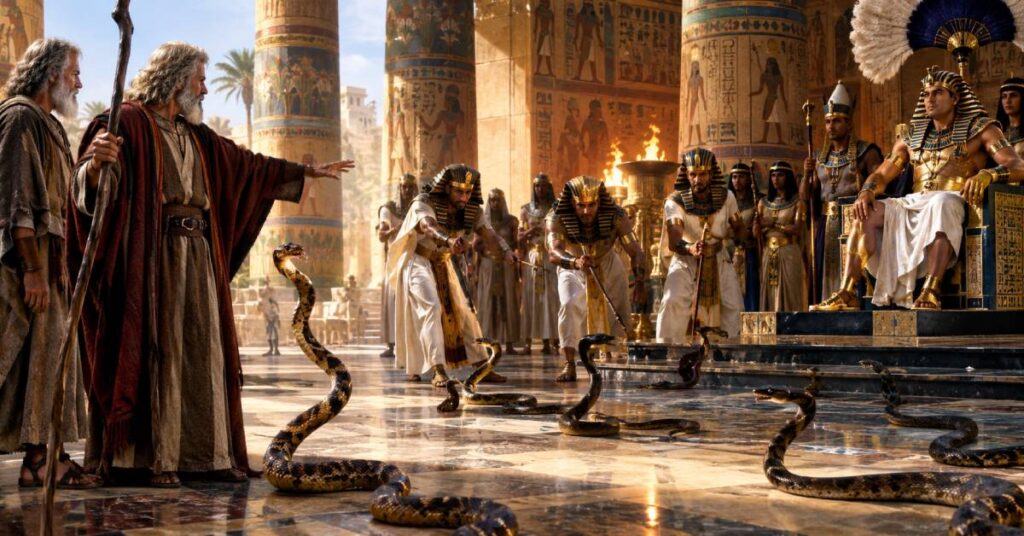
The scene is one of the most dramatic in all of Scripture. Two aging Hebrews, Moses and Aaron, stand before the throne of the most powerful man on earth. At God’s command, Aaron throws down his staff, and it becomes a serpent. Pharaoh is unimpressed. He summons his wise men and sorcerers, and “the magicians of Egypt also did the same by their secret arts. For each man cast down his staff, and they became serpents. But Aaron’s staff swallowed up their staffs” (Exodus 7:11–12, ESV).
That moment did not take place in a vacuum. Egypt was, in the imagination of the ancient world, the homeland of magic. Its priests guarded libraries of spells. Its mothers hung amulets around their children’s necks. Its physicians recited incantations over wounds, and its dead were buried with scrolls of “words of power” meant to carry them safely through the underworld. Magic, which the Egyptians called heka, served protection, healing, and divination; it was woven into birth, daily life, and death itself. When the God of Israel confronted Pharaoh, He was confronting the most sophisticated magical system of antiquity on its own ground.
The confrontation is not over. Thirty-five centuries later, magic has simply changed its wardrobe. Horoscopes run in the morning paper and pop up on smartphones. Tarot decks are sold beside greeting cards. “Manifesting,” crystal grids, and spell jars trend on social media, and a growing number of people describe themselves, without irony, as “Christian witches.” What Pharaoh’s magicians sought through incantation, many moderns seek through apps and influencers: knowledge that God has not given, and power that God has not granted.
This essay examines what the Bible teaches about spells, divination, charms, and sorcery, and why its warnings still matter. It traces the biblical vocabulary, devotes a full segment to the magical world of ancient Egypt, follows the prohibition from Moses through the prophets to the apostles, and listens to the witness of the early church. It then turns to the present: why these practices draw people away from God, how they have been repackaged for a modern audience, and how believers today can stand firm. The thesis is simple, and it runs through the whole canon. Magic and divination are not merely superstitions; they are counterfeit roads to knowledge and power that replace trust in God’s guidance with the pursuit of hidden things. Against them Scripture sets one sufficient answer: the living God, who has spoken finally and fully in His Son. And because no discussion of witches and spells can escape the calendar, the essay closes with a question many believers wrestle with every October: should a Christian keep the porch light on for Halloween? The answer, grounded in Scripture and Christian liberty, may surprise you.
❧ ✦ ❧
Defining the Terms
Before examining texts, we must know what we are looking for. English Bibles use a cluster of overlapping words: magic, sorcery, witchcraft, enchantment, divination, soothsaying, necromancy. The original languages are both richer and more precise, and careful exegesis begins there.
Working Definitions
Jiří Moskala, dean and professor of Old Testament exegesis at Andrews University, offers a helpful set of working definitions drawn from standard reference works. Magic is the attempt to influence the course of events by mysterious or supernatural forces. The occult refers to “hidden” or “secret” wisdom beyond ordinary human knowledge. Divination is the art of deducing the future or the unknown by reading some facet of nature or human life. Spiritism is the belief that the spirits of the dead can communicate with the living.
The distinction between magic and divination is worth keeping in view. Divination seeks to know what is hidden, especially the future; magic seeks to do something by supernatural aid, whether to heal, protect, curse, or compel. In practice, the two are joined at the hip. John Piper, preaching on Deuteronomy 18, observed that the knowledge sought by diviners is rarely idle curiosity:
The knowledge sought is not out of idle curiosity but out of a desire to exert some power over people or events.
— John Piper, “Jesus vs. the Occult,” Desiring God
The Old Testament Vocabulary
Deuteronomy 18:10–11 assembles more terms for occult practice than any other single passage of Scripture. After forbidding the burning of children as offerings, Moses lists eight practitioners who must not be found in Israel:
- Qōsēm qĕsāmîm, “one who practices divination.” The root qāsam is associated with casting lots, as in the arrows shaken by the king of Babylon in Ezekiel 21:21. Hastings’ Dictionary of the Bible notes that the word is generally used unfavorably.
- Mĕ‘ônēn, “one who tells fortunes” or “soothsayer.” Its derivation is debated; suggestions include reading the clouds, the muttering of the soothsayer, or the “evil eye.”
- Mĕnaḥēš, “one who interprets omens.” The verb nāḥaš means to seek or read an omen. It sounds like the Hebrew word for serpent, nāḥāš, and Moskala observes the striking echo of the serpent in Eden, even though most lexicographers trace the two words to different roots.
- Mĕkaššēp, “a sorcerer.” The noun kešep is rendered pharmakeia in the Greek Old Testament, suggesting the mixing of potions or the muttering of spells. This is the word in Exodus 22:18, “You shall not permit a sorceress to live.”
- Ḥōbēr ḥāber, “a charmer,” literally “one who binds a binding.” Piper renders the sense as “one who binds a spell,” the use of spiritual force to control another person or the course of events.
- Šō’ēl ’ôb, “a medium,” one who consults an ’ôb, a spirit of the dead or a “familiar spirit.” The woman at En-dor is called a mistress of an ’ôb (1 Samuel 28:7).
- Yiddĕ‘ōnî, “a spiritist,” literally a “knowing one,” is always paired with ’ôb in the Old Testament.
- Dōrēš ’el-hammētîm, “one who inquires of the dead,” the necromancer.
The list is deliberately comprehensive. Whether the means is a lot, an omen, a potion, a spell, or a séance, whether the goal is knowledge or control, the whole category is excluded.
The New Testament Vocabulary
The New Testament adds its own terms. Simon of Samaria “practiced magic” (mageuōn, Acts 8:9) and amazed the people with his “magic arts” (mageiais, 8:11). Elymas Bar-Jesus is called a magos (Acts 13:6, 8). The slave girl at Philippi had “a spirit of divination,” literally a “python spirit” (pneuma pythōna, Acts 16:16), recalling the serpent of the Delphic oracle. The Ephesian converts burned books of “magic arts” (ta perierga, Acts 19:19), literally “curious” or “meddlesome” things. Paul asks the Galatians, “Who has bewitched you?” (ebaskanen, Galatians 3:1), borrowing the language of the evil eye. Finally, pharmakeia and its cognates appear in the vice list of Galatians 5:20 and in Revelation 9:21; 18:23; 21:8; and 22:15.
Kevin Bauder of Central Baptist Theological Seminary points out a useful lexical caution. The same root that names Simon’s sorcery (magos) also names the wise men who worshiped the infant Christ (Matthew 2:1), and Daniel was made “chief of the magicians” in Babylon (Daniel 4:9) while giving all glory to God. The words themselves do not settle every question; what matters is the source of the power and the object of trust. Scripture distinguishes sharply between supernatural works that come from God and those that come from dark powers, even when it uses overlapping vocabulary.
Inductive and Intuitive Divination
Richard Belcher of Reformed Theological Seminary, lecturing on Deuteronomy 18, offers a clarifying framework. Ancient divination came in two broad types. Inductive divination uses an object to obtain information: arrows, livers, lots, stars, or cups. The king of Babylon at the fork in the road “shakes the arrows; he consults the teraphim; he looks at the liver” (Ezekiel 21:21). Modern equivalents include palm reading, tarot cards, Ouija boards, and horoscopes. Intuitive divination uses a person as a medium, someone who claims to channel a word from the gods or a message from the dead. Its modern forms include the séance, the channeler, and the television psychic who promises contact with deceased relatives.
Belcher identifies a third family of practices in Deuteronomy 18: those designed not merely to learn the future but to change it by manipulation, such as casting spells or offering a child in the fire to bend the outcome of a battle (compare 2 Kings 3:27). All three share a common thread. They are human techniques for prying open what God has not opened, or for forcing what God has not willed.
❧ ✦ ❧
Magic in the Land of the Pharaohs
No ancient culture shaped the biblical encounter with magic more than Egypt. Israel was born as a nation in its shadow; Joseph rose to power in its court; Moses was “instructed in all the wisdom of the Egyptians” (Acts 7:22). To understand why the God of the exodus spoke so decisively against sorcery, we must first enter the world His people left behind.
Heka: The Force Behind Creation
In Egyptian thought, magic was not a fringe activity but the very fabric of reality. Egyptologist Geraldine Pinch, writing for the BBC, explains the foundation:
In Egyptian myth, magic (heka) was one of the forces used by the creator to make the world. Through heka, symbolic actions could have practical effects.
— Geraldine Pinch, “Ancient Egyptian Magic,” BBC History
Heka was both a deified power and the practice of the art. It appears in the Pyramid Texts of the Old Kingdom and in the Coffin Texts of the First Intermediate Period. In Coffin Text Spell 261, Heka speaks as the primordial power that existed before the gods themselves came into being. Egyptologists describe heka as the force that sustained the world daily and even supplied the gods with their abilities. It was closely bound to maat, the principle of cosmic order: maat was the harmony, and heka the power by which harmony was secured.
This is a decisive theological point. In Egypt, magic was older than the gods and stronger than them; the gods themselves could be compelled by it. In Israel, by contrast, there is nothing older than the LORD, nothing beside Him, and nothing that can compel Him. “I am the LORD, who made all things, who alone stretched out the heavens . . . who frustrates the signs of liars and makes fools of diviners” (Isaiah 44:24–25). The difference between Egyptian heka and Hebrew faith is not merely a difference of technique; it is a difference of God.
Priests, Lector-Priests, and Protection-Makers
According to Pinch, priests were the chief practitioners of magic in pharaonic Egypt, guardians of a secret knowledge believed to be a gift of the gods “to ward off the blows of fate.” The most respected were the lector priests, who could read the ancient books of magic kept in temple and palace libraries. Popular stories credited them with bringing wax animals to life and rolling back the waters of a lake. The Westcar Papyrus preserves such tales, including that of a magician who fashioned a wax crocodile that came to life and seized an adulterer.
The Hebrew Bible preserves a trace of this world in its own vocabulary. The “magicians” (ḥarṭummîm) whom Pharaoh summoned to interpret his dreams (Genesis 41:8, 24) and whom he later set against Moses (Exodus 7:11) bear a title that most scholars derive from the Egyptian designation for the chief lector priest. Hastings’ Dictionary of the Bible describes them as scribes possessed of occult knowledge. The narrative of Exodus is therefore historically grounded: Moses faced not stage conjurers but the elite ritual specialists of the Egyptian court.
Below the priests were scorpion-charmers, midwives, and “wise women” who might be consulted about which ghost or deity was causing trouble. Amulets could be obtained from “protection-makers.” Pinch notes that none of these uses of magic was disapproved of by state or priesthood; only foreigners were regularly accused of evil magic. Magic in Egypt was not a dark underground; it was respectable, official, and everywhere.
Amulets, Wands, and Words of Power
Egyptians of every class wore protective amulets shaped like deities, sacred animals, or royal symbols: the scarab, the ankh, the Eye of Horus, the djed pillar. Household furniture bore images of the lion-dwarf Bes and the hippopotamus goddess Taweret, guardians against the forces of chaos at night. Curved ivory “wands,” incised with knife-wielding protective demons, may have been used to draw a protective circle around a mother in childbirth. The Johns Hopkins Archaeological Museum notes that an amulet’s power was understood to be “activated” by spells spoken over it.
The spoken word was central. A spell typically had two parts: the words to be recited and the actions to be performed. Everything depended on correct pronunciation, especially of the secret names of deities. Jeffrey Hays summarizes the logic: every being possessed a hidden name, and whoever knew it could compel that being. One myth tells how Isis tricked the sun god into revealing his secret name and thereby became as powerful as he. Some crocodile charms even threatened the gods themselves with exposure of their secret names, a stunning inversion of worship into blackmail.
The contrast with Israel is luminous. When Moses asked God’s name, he received not a password for manipulation but a self-revelation: “I AM WHO I AM” (Exodus 3:14). Israel was commanded not to take that name “in vain” (Exodus 20:7), a prohibition that in its ancient setting surely included any attempt to wield God’s name as a magical instrument. The name of the LORD is given for worship, not for leverage.
Healing, Cursing, and the Rites of Destruction
Pinch describes Egyptian magic as complementary to medicine rather than an alternative to it. Medical-magical papyri contain spells for physicians, priests of the plague goddess Sekhmet, and scorpion-charmers. The physician might proclaim himself to be Thoth healing the wounded eye of Horus, reenacting the myth so that the patient would be healed as Horus was. Stone stelae called cippi, showing the infant Horus trampling crocodiles and grasping serpents, were inscribed with healing spells; water poured over them was drunk by the sufferer.
Magic also had a darker face. The state practiced destructive magic: the names of foreign enemies and traitors were written on pots or figurines of bound captives, which were then smashed, burned, or buried. In the temples, images of the chaos serpent Apophis were spat upon, trampled, stabbed, and burned. The same arts could be turned inward. A conspiracy of courtiers and harem women against Ramesses III used a book of destructive magic from the royal library to make wax figurines and potions intended to harm the king. The conspirators were tried and condemned. Egypt itself knew that the power it revered could kill.
Magic for the Dead
The Egyptian preoccupation with death made magic indispensable to the afterlife. Mummies were wrapped with protective amulets. Elite burials included collections of funerary spells, the Coffin Texts and later the Book of the Dead, the latter containing nearly two hundred spells. The soul was believed to travel through an underworld filled with demons that could be overcome only by magic words and gestures. There were even spells to help the deceased when judged before the Forty-Two Judges of the Underworld. The “Opening of the Mouth” ritual was performed to reanimate the senses of the dead so they could eat, drink, and breathe in the next world.
Here the biblical contrast reaches its deepest point. The Egyptian hoped to talk his way past judgment with the right formula. The Christian knows that no incantation can silence the accusation of a holy God, and that no incantation is needed. Christ has borne the judgment Himself. As one Keep Believing Ministries sermon puts it, the sin debt was paid in full when Jesus cried, “It is finished”: no rituals needed, no circles to be drawn, no spells to be cast.
The Contest in Pharaoh’s Court
Against this backdrop, the plagues of Egypt take on their full significance. The magicians matched Aaron’s staff-serpent, turned water to blood, and summoned frogs “by their secret arts” (Exodus 7:11, 22; 8:7). Then they failed. When Aaron struck the dust, and it became gnats, the magicians tried and could not, and they confessed to Pharaoh, “This is the finger of God” (Exodus 8:19). By the sixth plague they could not even stand before Moses “because of the boils” (Exodus 9:11). The God of Israel was not simply outperforming Egypt’s magicians; He was dismantling Egypt’s entire spiritual order. “On all the gods of Egypt I will execute judgments: I am the LORD” (Exodus 12:12).
Jewish and Christian tradition named two of these magicians Jannes and Jambres. The names appear in the Damascus Document from Qumran, which says that Belial raised up “Yohanah and his brother” against Moses and Aaron, in the Targum of Pseudo-Jonathan, and in pagan writers such as Pliny the Elder and the philosopher Numenius, who called them sacred scribes of Egypt. Origen reports an apocryphal Book of Jannes and Jambres. Paul draws on this tradition when he writes, “Just as Jannes and Jambres opposed Moses, so these men also oppose the truth . . . but they will not get very far, for their folly will be plain to all, as was that of those two men” (2 Timothy 3:8–9). Paul’s point is pastoral as much as historical: counterfeit power always reaches its limit, and truth outlasts it.
One further Egyptian episode deserves mention. Joseph’s steward claims that the silver cup planted in Benjamin’s sack is the one by which his master “practices divination” (Genesis 44:5, 15). Moskala rightly observes that the story itself shows Joseph knew everything without the cup, because he had ordered it hidden. The claim was part of Joseph’s disguise as an Egyptian lord and a test of his brothers’ hearts. Joseph’s true insight came, as he had told Pharaoh, from God alone: “It is not in me; God will give Pharaoh a favorable answer” (Genesis 41:16).
The lesson of Egypt is therefore twofold. Magic is real enough to impress, as the magicians’ early successes show. But it is finite, it is derivative, and before “the finger of God” it collapses. Israel left Egypt not to build a better magic but to leave magic behind.
❧ ✦ ❧
The Mosaic Prohibition
Israel stood on the plains of Moab, poised to enter a land saturated with Canaanite religion. There, in Deuteronomy 18:9–14, Moses delivered the Bible’s most comprehensive prohibition of occult practice.
When you come into the land that the LORD your God is giving you, you shall not learn to follow the abominable practices of those nations. . . . For whoever does these things is an abomination to the LORD. . . . You shall be blameless before the LORD your God.
— Deuteronomy 18:9, 12–13 (ESV)
“You Shall Not Learn”
Piper’s exposition of this passage draws out six observations that remain unsurpassed for clarity. First, the practices are called “abominations” (tô‘ēbôt), a word for what God finds detestable. Second, the persons who give themselves to them become abominable in His sight, though, Piper adds, never beyond the reach of divine love. Third, occult practices are ranked beside the burning of children, a pairing meant to produce moral revulsion. Fourth, the LORD dispossesses nations because of these practices. Fifth, Israel is told not merely to avoid them but not even to learn them. Sixth, no practitioner is to be found among God’s people.
The fifth point deserves emphasis in an age of “just curious” experimentation. God did not say only, “Do not practice divination.” He said, “Do not learn to follow” these ways. Curiosity, apprenticeship, and dabbling are already steps on the road. Piper puts it pointedly: “Where the deed is evil, every inclination to the deed is evil.”
Revelation, Not Manipulation
The prohibition is not left hanging in the air. Immediately after forbidding the diviners, Moses gives Israel God’s alternative: “The LORD your God will raise up for you a prophet like me from among you, from your brothers; it is to him you shall listen” (Deuteronomy 18:15). The structure of the passage is the heart of the matter. The nations listen to fortune-tellers; Israel is to listen to God’s appointed spokesman. Peter later declares that Jesus Christ is this Prophet like Moses (Acts 3:22–23), and the writer of Hebrews announces that God, who once spoke through the prophets, “in these last days . . . has spoken to us by his Son” (Hebrews 1:1–2).
Belcher summarizes the contrast in four words: not manipulation, but revelation. Israel does not need to trick or bribe God for information; God will tell His people what they need to know. The governing principle is Deuteronomy 29:29: “The secret things belong to the LORD our God, but the things that are revealed belong to us and to our children forever.” Bob DeWaay of Critical Issues Commentary draws the logical conclusion: there are only two legitimate sources of knowledge open to us, what God has revealed in Scripture and what can be learned through ordinary observation of His creation. Everything else, the “secret information” pursued by diviners, is forbidden.
This also explains why true prophets never used divination. Moskala, citing John Oswalt, notes that there is no record of a Hebrew prophet’s message requiring confirmation through divination. The prophets did not produce God’s word by technique; they received it. Belcher’s survey of ancient Near Eastern prophecy at Mari reinforces the point. Even where pagan “intuitive” prophets existed, they were one technique among many and largely served to flatter the king. Israel’s prophets stood above the king and rebuked him in the name of a higher Lord.
Law Throughout the Torah
Deuteronomy 18 restates what Sinai had already declared. “You shall not interpret omens or tell fortunes” (Leviticus 19:26). “Do not turn to mediums or necromancers; do not seek them out, and so make yourselves unclean by them: I am the LORD your God” (Leviticus 19:31). “If a person turns to mediums and necromancers, whoring after them, I will set my face against that person” (Leviticus 20:6). Exodus 22:18 and Leviticus 20:27 prescribe the death penalty.
These penalties require careful interpretation. Moskala rightly observes that capital punishment for occult practice belonged to Israel’s theocratic order, a system that no longer exists; yet the severity of the penalty still declares an unchanging principle. The New Testament nowhere authorizes the church to wield the sword against sorcerers. Its weapons are the gospel, church discipline, and prayer (2 Corinthians 10:3–5; 1 Corinthians 5:12–13). As we shall see, the church’s later forgetfulness of this distinction produced some of the darkest chapters in its history.
❧ ✦ ❧
The Prophetic and Historical Witness
Israel’s history became a long commentary on Deuteronomy 18. Again and again the narratives show what happens when God’s people trade revelation for divination.
Balaam: No Enchantment Against Jacob
Balak, king of Moab, hired the renowned diviner Balaam to curse Israel, paying him “fees for divination” (Numbers 22:7). Balaam built altars, sought omens, and tried repeatedly. Each time, God turned the curse into blessing, until Balaam was forced to confess, “For there is no enchantment against Jacob, no divination against Israel” (Numbers 23:23). Belcher prefers to read the Hebrew preposition as “against”: no sorcery can succeed against the people God protects. Moskala adds that the whole story exposes the futility of trying to bend God’s will through lavish offerings. God is not a puppet.
Yet Balaam is a cautionary tale as well as a comfort. Having failed to curse Israel by divination, he taught Balak to seduce them into idolatry and immorality (Numbers 31:16; Revelation 2:14). DeWaay observes that Balaam thus failed two of Deuteronomy’s tests of a prophet: he used forbidden methods, and he led God’s people away from covenant faithfulness (Deuteronomy 13:1–5), even though God once spoke a true messianic prophecy through him (Numbers 24:17). Supernatural accuracy is not proof of divine approval.
Saul at En-dor
The tragedy of King Saul is Scripture’s most sustained narrative on necromancy. Saul had once expelled the mediums from the land (1 Samuel 28:3). But when the Philistines massed and “the LORD did not answer him, either by dreams, or by Urim, or by prophets” (28:6), Saul disguised himself and sought out a woman at En-dor who had a familiar spirit.
Interpreters have long debated what appeared to the medium. Some, including Moskala and the writer Sherif Michael, hold that a deceiving spirit impersonated Samuel, since Satan can masquerade as an angel of light (2 Corinthians 11:14). Many others, noting the medium’s terror and the accuracy of the prophecy, conclude that God sovereignly and exceptionally permitted Samuel himself to appear to pronounce judgment. Either way, the inspired verdict leaves no room for doubt:
So Saul died for his breach of faith. He broke faith with the LORD in that he did not keep the command of the LORD, and also consulted a medium, seeking guidance. He did not seek guidance from the LORD. Therefore the LORD put him to death.
— 1 Chronicles 10:13–14 (ESV)
Piper names the heart of Saul’s sin. When God was silent, Saul refused to humble himself and wait; he went around God for the information God withheld. Consulting a medium, Piper argues, belittles God as an inadequate revealer, as though He were either unable or unwilling to tell us what is good for us to know.
Rebellion as the Sin of Divination
Years earlier, when Saul spared the Amalekite king and the best of the spoil, Samuel rebuked him with words that have become the Bible’s most penetrating analysis of the occult: “For rebellion is as the sin of divination, and presumption is as iniquity and idolatry” (1 Samuel 15:23). The comparison is not accidental. Divination is rebellion in religious dress. It refuses to live within the limits God has set, and it reaches for what God has reserved for Himself. Conversely, rebellion is a kind of practical divination: when we reject God’s word, we inevitably go elsewhere for guidance. DeWaay presses the application: those who reject God’s revealed word become “diviners” in principle, because they seek their spiritual information from another source.
Manasseh: Sorcery and Grace
The most notorious royal practitioner was Manasseh of Judah, who “burned his son as an offering and used fortune-telling and omens and dealt with mediums and with necromancers” (2 Kings 21:6; compare 2 Chronicles 33:6). The northern kingdom had already fallen partly because “they used divination and omens” (2 Kings 17:17), and Manasseh’s reign sealed Judah’s sentence. Yet the Chronicler records an astonishing epilogue. In Assyrian captivity, Manasseh humbled himself, prayed, and was restored (2 Chronicles 33:12–13). Moskala rightly calls this “a miracle of conversion.” Even those steeped in sorcery may be redeemed by grace. The warnings of Scripture are never the last word for the penitent.
Isaiah’s Taunt and Ezekiel’s Charm-Sewers
The prophets added irony to indictment. Isaiah asks, “When they say to you, ‘Inquire of the mediums and the necromancers who chirp and mutter,’ should not a people inquire of their God? Should they inquire of the dead on behalf of the living? To the teaching and to the testimony!” (Isaiah 8:19–20). To Babylon, the capital of astrology, he issues a mocking challenge:
Stand fast in your enchantments and your many sorceries, with which you have labored from your youth . . . let them stand forth and save you, those who divide the heavens, who gaze at the stars, who at the new moons make known what shall come upon you.
— Isaiah 47:12–13 (ESV)
Ezekiel confronts false prophetesses who “sew magic bands upon all wrists” to “hunt souls,” and God promises to tear the charms from their arms and set His people free (Ezekiel 13:17–23). Micah announces, “I will cut off sorceries from your hand, and you shall have no more tellers of fortunes” (Micah 5:12). Even after the exile, Malachi lists sorcerers alongside adulterers and oppressors as objects of judgment (Malachi 3:5). The witness is unanimous across centuries and genres: magic is incompatible with covenant faithfulness.
❧ ✦ ❧
The New Testament: Christ Against the Powers
Some imagine that the Old Testament’s prohibitions belong to a superseded law. The New Testament proves the opposite. The coming of Christ does not soften the conflict with the occult; it brings it to a head.
Simon Magus: Power for Sale
In Samaria, a man named Simon “practiced magic in the city and amazed the people of Samaria, saying that he himself was somebody great” (Acts 8:9). The crowds called him “the power of God that is called Great.” When Philip preached Christ, Simon professed faith, but when he saw the Spirit given through the apostles’ hands, he offered money for the same power. Peter’s reply rings across the centuries: “May your silver perish with you, because you thought you could obtain the gift of God with money!” (Acts 8:20). Irenaeus, writing in the second century, observed that Simon assumed the apostles healed by a greater knowledge of magic rather than by God’s power. That is the magician’s error in a sentence. He cannot imagine power that is not a technique, a transaction, or a possession. Grace is unintelligible to him.
Elymas Bar-Jesus
On Cyprus the sorcerer Elymas, a court magician to the proconsul Sergius Paulus, opposed Paul and Barnabas and sought “to turn the proconsul away from the faith.” Paul, filled with the Spirit, called him “son of the devil, you enemy of all righteousness, full of all deceit and villainy,” and Elymas was struck blind for a season (Acts 13:6–12). Magic is not neutral; when the gospel advances, it shows itself as an enemy of the truth.
The Python Spirit at Philippi
At Philippi, a slave girl “who had a spirit of divination . . . brought her owners much gain by fortune-telling” (Acts 16:16). Her words were even accurate: “These men are servants of the Most High God, who proclaim to you the way of salvation.” Paul, greatly annoyed, commanded the spirit in the name of Jesus Christ to come out of her, and it did. GotQuestions.org notes that her ability to penetrate mysteries came from a demon that controlled her. Doreen Virtue, a former bestselling New Age author who came to faith in Christ, draws two lessons from the episode: there is a spiritual reality behind divination, and there are earthly profit motives that often accompany it. When the spirit left, the “gift” and the business both ended (16:19).
The Bonfire at Ephesus
Ephesus was famous for magic. Hastings’ Dictionary notes that “Ephesian letters” became a common name for amulets inscribed with magic spells. When God worked extraordinary miracles through Paul and the would-be exorcist sons of Sceva were overpowered by a demon, fear fell on the city, and the name of the Lord Jesus was extolled. Then came the most dramatic act of repentance in the book of Acts:
Also many of those who were now believers came, confessing and divulging their practices. And a number of those who had practiced magic arts brought their books together and burned them in the sight of all. And they counted the value of them and found it came to fifty thousand pieces of silver.
— Acts 19:18–19 (ESV)
Moskala estimates that fifty thousand drachmas represented roughly fifty thousand days of wages, a fortune by any measure. The converts did not sell their scrolls to recover the cost; they destroyed them. Piper’s comment captures the spirit of the scene: when the word of Christ captures a person’s mind and heart, all involvement with magical arts goes, for it is Jesus versus the occult, and one cannot have both. Luke’s summary is telling: “So the word of the Lord continued to increase and prevail mightily” (19:20).
Sorcery Among the Works of the Flesh
Paul lists pharmakeia among “the works of the flesh” alongside idolatry, enmity, and drunkenness, warning that “those who do such things will not inherit the kingdom of God” (Galatians 5:19–21). Notably, he was writing to churches, not to pagans. The warning assumes that professing believers could be tempted to fall back into such practices.
Revelation’s Final Word
The last book of the Bible gathers the theme into its vision of history’s end. Humanity under judgment refuses to repent of its “sorceries” (Revelation 9:21). Babylon the great, symbol of a seductive world system, deceived all nations “by your sorcery” (18:23). And in the closing chapters, “sorcerers” appear among those consigned to the lake of fire and excluded from the holy city (21:8; 22:15). GotQuestions.org observes that Revelation 21:8 uses pharmakois, rendered “sorcerers” or “those who practice magic arts.” From Exodus to Revelation, the canon speaks with one voice.
❧ ✦ ❧
Why the Warnings: How Magic Draws the Heart Away from God
Why does Scripture treat these practices with such severity? The answer is not that God is threatened by competition or that He begrudges human curiosity. The biblical writers identify at least five reasons, and each one shows how magic and divination replace trust in God’s guidance with the pursuit of hidden knowledge or spiritual power.
The Edenic Lie: “You Will Be Like God”
Moskala traces the origin of magic to the Garden of Eden, where the serpent, whom he calls “the first medium,” promised Eve that disobedience would bring godlike knowledge and freedom from death (Genesis 3:4–5). Piper reaches the same conclusion: the occult is a continuation of the ancient satanic deception, “Go beyond what God has appointed, and you shall become like God.” Keep Believing Ministries notes that modern Wicca itself expresses the desire to work with deities rather than bow before them. Every form of magic repeats Eden’s bargain: knowledge and power on one’s own terms, apart from God’s word.
Distrust of God’s Sufficiency
Divination presupposes that God has not told us enough, or will not. Piper’s diagnosis is sharp:
Consulting mediums, tea leaves, fortune cookies, horoscopes, crystal balls, palmists, or any other oracles beyond God’s Word is wrong because it belittles God as an inadequate revealer of mysteries.
— John Piper, “Jesus vs. the Occult”
The person who peeks at a horoscope is quietly saying that the Father’s guidance is insufficient and that His providence needs supplementing. This is the antithesis of the faith Jesus commends: “Do not be anxious about tomorrow, for tomorrow will be anxious for itself” (Matthew 6:34).
Rebellion and Spiritual Adultery
Leviticus 20:6 describes turning to mediums as “whoring after them.” The occult is adultery against the Lord who has betrothed His people to Himself. Piper extends the image to the church as the bride of Christ: to seek other oracles is to say that our Husband is unsatisfactory. Samuel’s equation of rebellion with divination (1 Samuel 15:23) completes the picture. Magic is not a neutral technology; it is a relational betrayal.
Divination Is Forbidden Because It Works
A common modern dismissal holds that occult practices are harmless because they are fake. Scripture never takes that position. The Egyptian magicians reproduced real signs; the Philippian girl spoke true words; Balaam’s reputation was earned. DeWaay tells of a Taiwanese boy tormented at night whose family consulted a blind fortune-teller. The man revealed a secret no outsider knew: that the boy had a twin who died at birth, and prescribed ancestor worship. When the family complied, the torment stopped. The deception, DeWaay argues, lay precisely in its success: the spirits released the boy because they had bound the whole family more firmly in spirit worship.
Divination is forbidden not because it does not work, but because it does. It works to put people in touch with spiritual forces and secret knowledge.
— Bob DeWaay, “The Dangers of Divination,” Critical Issues Commentary
Deceiving spirits will happily dispense a fact to sell a larger lie, whether that the dead are all in a “better place” or that one needs no Savior. Moskala concludes that from God’s perspective the occult is an ultimate evil “because it replaces God with demons.”
Fear, Greed, and Control
Finally, DeWaay observes that divination appeals to two basic human motives: fear and greed. People fear an unknown future, so they look for omens; they long for success, so they seek secret information. Belcher adds a third: the hunger for power. Divination and spellcraft promise control over a world that feels out of control. Christianity offers something better but harder: not control, but trust in the One who controls all things. The Didache, one of the earliest Christian documents outside the New Testament, closes its warning against omens with a striking counsel: “Receive the things that happen to you as good, knowing that nothing comes to pass apart from God.”
❧ ✦ ❧
The Witness of the Early Church
The early Christians lived in a Greco-Roman world thick with oracles, astrologers, amulets, curse tablets, and magical papyri. Their response was unanimous and unambiguous. The Historic Faith project, which compiles patristic testimony on the subject, counts more than a hundred early witnesses and nearly two hundred relevant quotations.
The Didache (late first century) folds magic into its catechesis of the moral law: “You shall not practice magic. You shall not practice witchcraft.” It warns, “My child, do not observe omens, since that leads to idolatry. Do not be an enchanter, an astrologer, or a purifier, and do not even be willing to look at these things.” The Shepherd of Hermas teaches that whoever consults a false prophet about any action “is an idolater, devoid of the truth, and foolish,” because “no spirit given by God needs to be asked.”
Tertullian reports that astrology, soothsaying, augury, and magic were “made known by the angels who sinned, and forbidden by God,” so that Christians “do not even make use of [them] in their own affairs.” He calls magic “a second idolatry.” Origen, answering the pagan critic Celsus, holds that magic and sorcery “derive their power from evil demons,” and he proposes a test that echoes Deuteronomy 13: examine those who claim supernatural power by their lives, their morals, and whether their works lead to the reformation of conduct. Lactantius traces astrology, divination, oracles, necromancy, and the art of magic to the fallen spirits as their inventors. The Apostolic Constitutions instruct believers, “You shall not use enchantments or purifications for your child. You shall not be a soothsayer or a diviner,” citing 1 Samuel 15:23 and Numbers 23:23.
After the Gospel, you will nowhere find either sophists, Chaldeans, enchanters, diviners, or magicians, except as clearly punished.
— Tertullian, On Idolatry 9
The church’s vigilance extended even to Christianized forms of divination. The practice of sortes biblicae, opening the Bible at random and treating the first words seen as an oracle, was common in late antiquity, yet several Gallic councils condemned it, including Vannes (465), Agde (506), and Orléans (511).
A Sober Word About the Witch Hunts
Honesty requires that we also face a darker history. Between the fifteenth and eighteenth centuries, European courts executed tens of thousands of people for alleged witchcraft; historian Brian Levack estimates roughly 45,000, and Cecil Maranville of Life, Hope & Truth cites a range of 40,000 to 60,000, most of them women. Confessions were frequently extracted by torture, and accusations often arose from personal disputes or simple misfortune.
It is worth noting that this was not the posture of the early or early medieval church. The Germanic Council of Paderborn in 785 actually outlawed belief in witches, and in the Byzantine East belief in witchcraft was often treated as superstition. Randall Frederick’s two-part survey at Theology and the City rightly traces how Renaissance hermeticism, astrology, and popular fear converged before the great hunts, though his reconstruction leans heavily on critical theories about the late composition of the Torah that traditional Christianity does not share, and he overstates Augustine’s position, who regarded demonic power as real yet able to produce only illusion within the limits God permits.
The lesson is twofold. The witch hunts were a grievous sin, a failure to distinguish Israel’s theocratic penalties from the church’s spiritual mission, and Christians should say so plainly. Keep Believing Ministries rightly urges believers not to go on “witch hunts” but to love practitioners as Jesus does. At the same time, as Maranville asks, in rightly rejecting the persecution of the innocent, has Western Christianity also lost sight of the reality of the spirit world? Repentance for past cruelty does not require surrender of biblical truth.
❧ ✦ ❧
Magic in the Modern Age
The occult has not disappeared from Western culture; it has been rebranded.
Witchcraft’s Modern Makeover
Maranville observes that entertainment has done more than anything else to reshape public perceptions, portraying witches as strong, independent women who practice “good magic,” offer healing, and champion causes. Virtue, who spent decades in New Thought churches and later in New Age and Wiccan circles before her conversion, identifies the main channels: occult practice is normalized on social media, packaged as self-care or healing, promoted as feminine empowerment through “divine feminine” language, framed as nature spirituality that blurs the Creator-creature distinction, and presented as intuition or psychic development. Belcher, citing a 1999 World magazine article by William E. Brown, notes the constant theme of power: horoscopes and numerology in the back of magazines, plus spell-casting for personal advancement, add up to what Brown called “the ultimate empowerment.”
The effect on the young is considerable. A Keep Believing Ministries sermon cites a 2006 Barna Group finding that three out of four American teenagers had engaged in at least one psychic or witchcraft-related activity, while fewer than three in ten churched teens had received any teaching from their church about the supernatural. The church’s silence has been as damaging as the culture’s noise.
Wicca and the Rede
Modern Wicca, the most organized form of contemporary witchcraft, generally centers on a god and goddess associated with the sun, moon, and the cycles of nature. Its ethic, the Wiccan Rede, reads, “An it harm none, do what ye will.” Many Wiccans sincerely reject Satanism; the 1974 principles of the Council of American Witches reject the concept of absolute evil and disclaim the worship of any entity known as Satan. Maranville acknowledges that not everyone who identifies as a witch is knowingly involved with demonic forces; some are dabbling at the edges of a world they do not understand.
Yet the biblical assessment does not rest on intentions. Maranville notes that Wiccan practice overlaps extensively with the magic and divination Scripture condemns, and that the honoring of sun and moon recalls the very idolatry forbidden in Deuteronomy 4:19. Scripture also teaches that what pagans sacrifice they offer “to demons and not to God” (1 Corinthians 10:20), whether or not they know it. A practice is not made safe by being called good. As Maranville concludes, witchcraft cannot be made good simply by calling it good.
“Christian Witchcraft”: Two Very Different Claims
The phrase “Christian witchcraft” is now used in two quite different senses, and clarity requires separating them.
The first describes people who identify as both Christian and witch. Anthropologist Jeremy McNabb, writing in On Knowing Humanity Journal (2022), conducted an ethnographic study of online communities of Christian witches. He found that nearly all were “deconstructing” their faith, often after being wounded by church scandals or controversies, and that they used personal altars, candles, sigils, crystals, and tarot or oracle cards. McNabb sorts them into three groups he calls Liberation, Liberal, and Adventist. Even the most conservative group, he reports, practices astrology and tarot, reinterpreting them as forms of the spiritual gift of prophecy.
McNabb’s research is sympathetic to his subjects, and it deserves a sympathetic hearing on one point: wounded people are seeking spiritual reality, and the church’s failures have sometimes driven them out. But the theological claim at the center of Christian witchcraft cannot stand. Scripture never permits prophecy to be produced by technique; Deuteronomy 18 forbids exactly that. Paul asks, “What fellowship has light with darkness? What accord has Christ with Belial?” (2 Corinthians 6:14–15). A Servants of Grace episode featuring Virtue rightly calls the “Christian witch” a blasphemous syncretism. One cannot drink the cup of the Lord and the cup of demons (1 Corinthians 10:21).
The second sense is metaphorical. Writers such as John Van Wagoner of Jesus Restores and the author of GoToHeavenNow use “the spirit of witchcraft” to describe manipulation, intimidation, and control, including inside churches: leaders who coerce giving with threats of curses, use “prophecy” to dominate, or replace Christ as mediator. The biblical warrant is 1 Samuel 15:23, which links rebellion with divination, and Galatians 3:1, where Paul calls legalistic pressure a kind of bewitching. This application has real value as a mirror for self-examination; Van Wagoner rightly asks his readers, “Am I operating in a spirit of witchcraft?” But it must be used carefully. When every opponent, policy, or movement one dislikes is labeled “witchcraft,” the word loses its biblical precision and becomes a weapon. The Bible’s primary concern is with literal occult practice and with the heart that reaches for power apart from God.
Divination Baptized
Perhaps the subtlest danger is divination dressed in Christian clothing. DeWaay imagines an Ouija board covered with Bible verses, whose pointer “guides” users to a text. Absurd? Yet, he notes, the believer who lets the Bible flop open and stabs a finger at a verse for guidance is using the same technique, the old sortes biblicae in modern form. He also recounts a pastor whose “prophetic” ministry was identified by a man who claimed to see colors emanating from his spread fingers, which DeWaay identifies as aura reading. The pastor’s defense, “God can use anything, and besides he was right,” is exactly the reasoning Deuteronomy 13 forbids. Methods are not neutral. Some means of spiritual knowledge God has ordained; all others are forbidden.
What About Fantasy Literature?
Christians differ in conscience about stories that contain wizards and spells, from Tolkien and Lewis to more recent bestsellers. Bauder argues for a “sliding scale.” At one end is real-world witchcraft; at the other, purely imaginative “magic” that merely uses the language of wonder to describe powers that exist only in an invented world. The closer a story’s magic comes to real occult practice, and especially if it glorifies or invites readers into that practice, the more objectionable it becomes. Sherif Michael, writing at BibleResources.org out of his own former entanglement in séances, astrology, and mantra yoga, takes a stricter view, warning that even “charming, candy-coated witchcraft” can desensitize children and open a door.
Both perspectives guard something important. Parents and readers should ask not merely whether a story uses the word “magic,” but what that magic is, whether it is tied to real-world occult techniques, and what the story teaches about where help and salvation come from.
❧ ✦ ❧
How Modern Believers Protect Themselves from the Influence of Witchcraft Spirits
If occult power is real, how should Christians respond? Scripture steers between two errors. C. S. Lewis, quoted in the Keep Believing Ministries sermon, named them in The Screwtape Letters:
There are two equal and opposite errors into which our race can fall about the devils. One is to disbelieve in their existence. The other is to believe, and to feel an excessive and unhealthy interest in them.
— C. S. Lewis, The Screwtape Letters
Neither fear nor fascination is the Christian posture. Instead, the New Testament offers a set of practical, Christ-centered safeguards.
Rest in Christ’s Finished Victory
The first defense is not a technique but a fact. At the cross, God “disarmed the rulers and authorities and put them to open shame, by triumphing over them in him” (Colossians 2:15). “The reason the Son of God appeared was to destroy the works of the devil” (1 John 3:8). “He who is in you is greater than he who is in the world” (1 John 4:4). Balaam’s confession still stands over every believer: there is no enchantment against Jacob. Belcher recalls Haitian immigrants in his Rochester congregation who lived in terror of voodoo, and the joy of telling them that Christ has more power than the witch doctor. Moskala concludes in the same vein: believers need not fear magic, because behind it stand fallen and already defeated powers. Christians do not need counter-charms, protective rituals, or “Christian” amulets. Reaching for such things would simply repeat the error in a new form.
Repent, Renounce, and Remove
The Ephesian believers did three things: they confessed, they divulged their practices, and they burned their books.
“Also many of those who were now believers came, confessing and divulging their practices. And a number of those who had practiced magic arts brought their books together and burned them in the sight of all. And they counted the value of them and found it came to fifty thousand pieces of silver.”
— Acts 19:18-19 (ESV)
Those who have dabbled in the occult should do likewise. Name the practice before God, renounce it, and remove its instruments from the home. Compelling Truth counsels that such objects should not be sold or given away, but destroyed. This follows the older command concerning the carved images of Canaan: “You shall not bring an abominable thing into your house” (Deuteronomy 7:26). Those with deep involvement would do well to seek the counsel and prayer of a mature, biblically grounded pastor.
Stay Within God’s Ordained Means
DeWaay’s most practical insight is that the antidote to divination is not a superior technique but faithful use of the ordinary means God has appointed: the Word, prayer, the ordinances, and Christian fellowship. These seem slow and mundane to a culture that wants instant answers. Yet “to the teaching and to the testimony” (Isaiah 8:20) remains God’s address for guidance. “If any of you lacks wisdom, let him ask God, who gives generously to all without reproach” (James 1:5). Anxiety about the future is to be brought to God in prayer, not to the tarot reader (Philippians 4:6–7).
Put On the Whole Armor of God
Paul does not tell believers to fight spiritual forces with spiritual techniques, but to stand in Christ: “Be strong in the Lord and in the strength of his might. Put on the whole armor of God, that you may be able to stand against the schemes of the devil” (Ephesians 6:10–11). The armor is truth, righteousness, the gospel of peace, faith, salvation, and the word of God, all received from Christ and wielded in prayer (6:14–18). James supplies the order of operations: “Submit yourselves therefore to God. Resist the devil, and he will flee from you” (James 4:7).
Test the Spirits
Because counterfeit spirituality often comes in Christian vocabulary, discernment is essential. “Beloved, do not believe every spirit, but test the spirits to see whether they are from God” (1 John 4:1). DeWaay summarizes Deuteronomy’s three tests of any claimed revelation: Does it use forbidden methods (18:10–12)? Does it fail in its predictions (18:22)? Does it lead away from faithfulness to God, even when accompanied by true signs (13:1–5)? Scripture, not experience, is the touchstone. Satan “disguises himself as an angel of light” (2 Corinthians 11:14).
Guard the Gates of the Home
Pat Domangue of OnFire Ministries describes how her own drift into darkness began with a single book by a clairvoyant that fed her curiosity, until years later she stood holding a manual of witchcraft and sensed God say, “That’s too far.” She now takes Psalm 101:3 as her rule: “I will not set before my eyes anything that is worthless.” Parents especially must guard the entertainment, games, and social media feeds that shape their children’s imaginations. The Keep Believing Ministries sermon offers practical counsel: let your children see God changing you, pray with them and expect answers, reach out to the lonely, take advantage of Christian community, and pay attention to what you watch and play. Above all, the church must teach. The Barna finding that most church-going teens had never heard a word about the supernatural from their church is an indictment that can be remedied.
Love Those Caught in the Snare
Finally, protection is not isolation. The same sermon reports conversations with two Wiccans, both raised in evangelical churches, who said they had rarely or never met a true Christian. Its counsel for witnessing is wise: do not be accusatory or argumentative, do not misrepresent their beliefs, show genuine love, put on your spiritual armor, and focus on a relationship with Jesus rather than religion or ritual. Manasseh’s restoration and the Ephesian bonfire remind us that the gospel has always reached sorcerers. “Live such good lives among the pagans that . . . they may see your good deeds and glorify God” (1 Peter 2:12, NIV).
❧ ✦ ❧
Halloween: Light in the Neighborhood
No essay on magic and the occult can avoid the question that arrives every October 31: may a Christian take part in Halloween? Some believers keep their porch lights off, convinced the holiday is a pagan festival in disguise. Others hand out candy with a clear conscience. Scripture, history, and the gospel itself give strong reasons to support the second course, so long as it is followed with wisdom.
A Christian Name and a Christian Calendar
The word *Halloween* is a contraction of “All Hallows’ Eve,” the evening before All Saints’ Day on November 1. For centuries, the church set aside that day to remember the faithful departed who now rest with Christ. The night before was a vigil, not a séance.
Popular writers often claim that Halloween is simply the Celtic festival of Samhain with a Christian coat of paint. Historians debate how much continuity actually exists, and many customs we associate with the night developed much later. Whatever pagan practices once clustered around late autumn, the church did what it has always done with the calendar: it claimed the time for Christ. Protestants have a further reason to mark the date. On October 31, 1517, Martin Luther posted his Ninety-Five Theses, and many churches still celebrate it as Reformation Day.
The Earth Is the Lord’s
Paul faced a close parallel in Corinth, where much of the meat sold in the market had passed through pagan temples. His answer was liberating. An idol “has no real existence,” and “the earth is the Lord’s, and the fullness thereof” (1 Corinthians 8:4; 10:26). A believer could eat that meat with thanksgiving. What he could not do was sit at the idol’s table and join its worship, for “you cannot drink the cup of the Lord and the cup of demons” (10:21).
The same distinction applies to Halloween. A pumpkin is a vegetable, a costume is cloth, and candy is sugar. None of these things is an occult rite. Fortune-telling booths, Ouija boards passed off as party games, and séances are a different matter, and everything this essay has shown about Deuteronomy 18 applies to them. The issue is not the date on the calendar. The issue is what we actually do.
Christian Liberty and Charity
Romans 14 governs the matter. “One person esteems one day as better than another, while another esteems all days alike. Each one should be fully convinced in his own mind” (14:5). The believer who abstains for conscience’s sake should not judge the one who participates. The one who participates should not despise the one who abstains, nor press a weaker brother to act against his conscience. Halloween is a question of wisdom and charity, not a test of orthodoxy.
The One Night Your Neighbors Knock
There is also a missionary opportunity. On most evenings, Christians struggle to meet the families on their own street. On Halloween, those families come to the door. A warm welcome, generous treats, and a friendly conversation embody the hospitality Scripture commands (1 Peter 4:9). Some believers include a short gospel tract or invite neighbors to a church harvest event. Others simply let their kindness speak. A dark porch says little about Christ. A lit one can say a great deal.
Mocking a Defeated Foe
Wiccans often describe Halloween as the night when the veil between the living and the dead grows thin. The Keep Believing Ministries sermon offers the Christian reply: at Christ’s death the temple veil was torn from top to bottom, opening access to God, not to spirits (Matthew 27:51). Medieval Christians sometimes dressed as devils and skeletons precisely to mock powers that Christ had already conquered. Luther is reported to have said that the devil cannot bear scorn.
Wisdom still applies. Christians should avoid costumes that glorify evil, celebrate gore, or treat the occult as fun, and should let Philippians 4:8 guide their choices. Within those limits, believers may join their neighbors on October 31 without fear. The Christian walks into the night not as a superstitious person hiding from darkness, but as a child of light who knows that Jesus has already won.
❧ ✦ ❧
Conclusion: The Finger of God and the Word Made Flesh
The story that began with rods turning into serpents in Pharaoh’s court ends, in the canon, with a city whose lamp is the Lamb, from which sorcerers are excluded and into which the nations bring their glory (Revelation 21:23–27; 22:15). Between those bookends Scripture tells one consistent story. Magic and divination promise knowledge and power apart from God. They flatter the human desire to be like God; they exploit fear and greed, and they deliver real but deceptive results. They are forbidden not because God is stingy but because He is sufficient, and because He has spoken.
Egypt’s magicians could imitate a few signs, but before the finger of God they confessed defeat. Babylon’s stargazers could chart the heavens, but they could not save themselves. Simon could amaze Samaria, but he could not buy the Spirit. The slave girl’s spirit could speak truth, but it could not stand before the name of Jesus Christ. And the scrolls of Ephesus, worth a fortune, went up in smoke while “the word of the Lord continued to increase and prevail mightily.”
The modern believer faces the same choice in new packaging: the horoscope app or the Word, the tarot spread or prayer, the spell jar or the throne of grace. Scripture’s invitation has not changed. “Should not a people inquire of their God?” (Isaiah 8:19). In Jesus Christ, the Prophet like Moses and the Word made flesh, God has told us everything we need to know to live and to die in peace. The secret things belong to the LORD. The revealed things belong to us. And the One who has revealed them has already won.
❧ ✦ ❧
Notes and Sources
Scripture quotations are from the English Standard Version (ESV) unless otherwise noted.
Bauder, Kevin T. “The Christian and Fantastic Literature, Part 10: Magic in Fantasy (Continued).” In the Nick of Time, Central Baptist Theological Seminary, May 6, 2022. https://centralseminary.edu/the-christian-and-fantastic-literature-part-10-magic-in-fantasy-continued/
Belcher, Richard P. “Understanding Divination: A Biblical Perspective.” Lecture, Reformed Theological Seminary. The Gospel Coalition sermon library. https://www.thegospelcoalition.org/sermon/divination/
Compelling Truth. “What Is a Biblical View of Divination?” https://www.compellingtruth.org/Bible-divination.html
DeWaay, Bob. “The Dangers of Divination: A Biblical Explanation of Divination and Why It Is Forbidden.” Critical Issues Commentary, Issue 82, May/June 2004. https://cicministry.org/commentary/issue82.htm
Domangue, Pat. “What the Bible Tells Us About the Reality and Danger of Magic.” OnFire Ministries. https://www.onfire-ministries.org/blog/danger-of-magic
Egypt Tours Portal (ETP Team). “Ancient Egyptian Magic: The Divine Force That Shaped Life, Death, and the Cosmos.” April 26, 2025. https://www.egypttoursportal.com/en-us/blog/ancient-egyptian-civilization/ancient-egyptian-magic-and-witchcraft/
Frederick, Randall S. “Modern Witchcraft, Pt. 1.” Theology and the City, November 14, 2015. https://theologyandthecity.com/2015/11/14/modern-witchcraft-pt-1/
Frederick, Randall S. “Modern Witchcraft, Pt. 2.” Theology and the City, November 22, 2015. https://theologyandthecity.com/2015/11/22/modern-witchcraft-pt-2/
GotQuestions.org. “What Are the Magic Arts in Revelation 21:8?” https://www.gotquestions.org/magic-arts-Revelation.html
GotQuestions.org. “What Does the Bible Say About Divination?” https://www.gotquestions.org/Bible-divination.html
GoToHeavenNow. “Christian Witchcraft Explained: How Spiritual Control Operates Inside the Church.” https://gotoheavennow.com/christian-witchcraft/
Hays, Jeffrey. “Magic in Ancient Egypt: Spells, Wands and Dreams.” Facts and Details. https://africame.factsanddetails.com/article/entry-1079.html
Johns Hopkins Archaeological Museum. “Ancient Egyptian Amulets.” https://archaeologicalmuseum.jhu.edu/staff-projects/ancient-egyptian-amulets
Keep Believing Ministries. “What Jesus Would Say to a Wiccan.” Sermon. https://www.keepbelieving.com/sermon/what-jesus-would-say-to-a-wiccan/
Maranville, Cecil. “Witchcraft’s Modern Makeover: Is It Really Harmless?” Life, Hope & Truth, October 26, 2026. https://lifehopeandtruth.com/life/blog/witchcrafts-modern-makeover-is-it-really-harmless/
McNabb, Jeremy. “Three Paradigms in Emerging Christian Witchcraft.” On Knowing Humanity Journal 6, no. 2 (July 2022): 37–46. https://www.researchgate.net/publication/363501002_Three_Paradigms_in_Emerging_Christian_Witchcraft
Michael, Sherif. “The Bible and Witchcraft: What the Bible Says About Witchcraft.” BibleResources.org (Christ Unlimited Ministries), April 19, 2007. https://bibleresources.org/witchcraft/
Moskala, Jiří. “Practice of Magic and Occultism in the Old Testament: Presuppositions, Responses, and God’s Attitude.” Journal of Adventist Mission Studies 11, no. 2 (2015): 1–16. https://digitalcommons.andrews.edu/cgi/viewcontent.cgi?article=1297&context=jams
OpenBible.info. “What Does the Bible Say About Spirit of Divination?” https://www.openbible.info/topics/spirit_of_divination
Pinch, Geraldine. “Ancient Egyptian Magic.” BBC History, February 17, 2011. https://www.bbc.co.uk/history/ancient/egyptians/magic_01.shtml
Piper, John. “Jesus vs. the Occult.” Sermon on Deuteronomy 18:9–12. Desiring God. https://www.desiringgod.org/messages/jesus-vs-the-occult
Robinson, F. E. “Magic, Divination, and Sorcery.” In Hastings’ Dictionary of the Bible. StudyLight.org. https://www.studylight.org/dictionaries/eng/hdb/m/magic-divination-and-sorcery.html
Servants of Grace. “The Rise of Wicca and Witchcraft: A Biblical Response.” Contending for the Word Q&A with Doreen Virtue. https://servantsofgrace.org/rise-of-wicca-and-witchcraft-biblical-response/
The Historic Faith. “Early Christian Views on Magic and Divination.” Compiled patristic sources (Didache; Shepherd of Hermas; Irenaeus, Against Heresies; Tertullian, Apology and On Idolatry; Origen, Against Celsus; Lactantius, Divine Institutes; Apostolic Constitutions). https://thehistoricfaith.com/early-christian-beliefs/magic-and-divination
Van Wagoner, John. “Examples of the Spirit of Witchcraft in American Culture Today.” Jesus Restores. https://www.jesusrestores.com/blog/examples-of-the-spirit-of-witchcraft-in-american-culture-today
Virtue, Doreen. “What Scripture Clearly Teaches About Magic, Spells, and Divination.” Contending for the Word Q&A, Servants of Grace, May 14, 2026. https://servantsofgrace.org/magic-sorcery-biblical-warning/
Virtue, Doreen. “How Wicca and Witchcraft Deceive by Appearing Harmless.” Contending for the Word Q&A, Servants of Grace. https://servantsofgrace.org/how-wicca-and-witchcraft-deceive-by-appearing-harmless/
Wikipedia. “Christian Views on Magic.” https://en.wikipedia.org/wiki/Christian_views_on_magic
Wikipedia. “Jannes and Jambres.” https://en.wikipedia.org/wiki/Jannes_and_Jambres
Wikipedia. “Sortes Biblicae.” https://en.wikipedia.org/wiki/Sortes_biblicae
❧ ✦ ❧
Research and drafting assistance: Claude (Anthropic), working under the author’s editorial direction. All quotations were checked against the source texts supplied or retrieved; final editorial judgment rests with the author.