
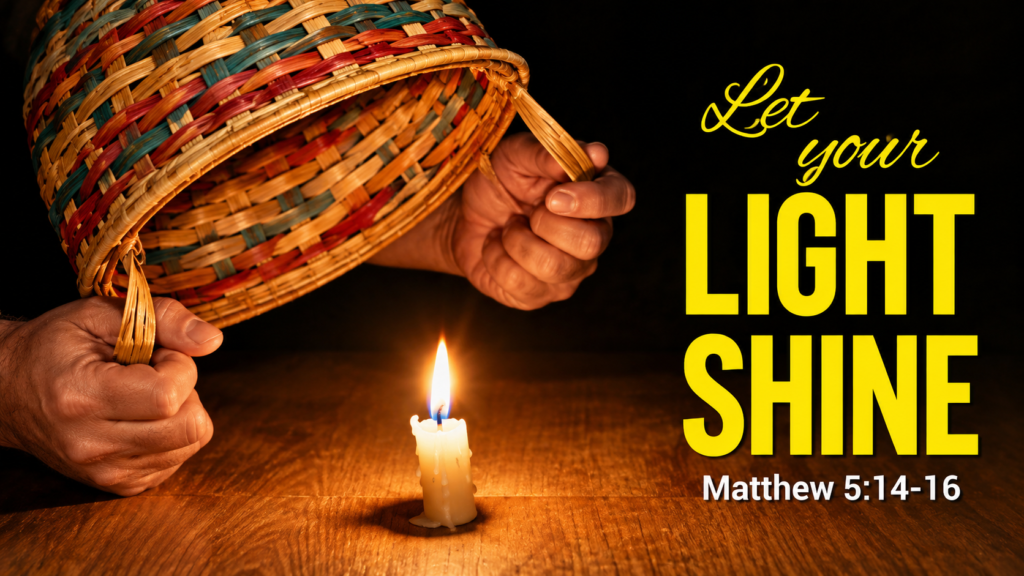
Lift the Basket: Living as the Light of the World
❧ ✦ ❧
The Night the Grid Went Dark
The storm came the way Arizona monsoons always do: a wall of dust first, then wind, then thunder that rattled the windows. Somewhere down the block, a transformer gave a sharp crack and a blue flash, and the whole neighborhood went dark.
Not dim. Dark. No streetlights, no glowing windows, no television flicker behind the blinds. Within minutes, front doors began to open as families stepped out into the warm, heavy night, wondering how long it would last.
Then someone noticed it. Three houses down, an older man had set a battery lantern on his porch rail. It was not a large light, and it was not especially bright. But on a street swallowed by darkness, it was the only thing anyone could see. One by one, neighbors drifted toward it. Children sat on his steps. Someone brought folding chairs. For two hours that small lantern became the center of the block.
Nobody walked over to admire the lantern. They came because, by its glow, they could finally see one another.
That is very close to what Jesus had in mind when He looked at a crowd of ordinary Galileans and spoke words that still take our breath away:
You are the light of the world. A city set on a hill cannot be hidden. Nor do people light a lamp and put it under a basket, but on a stand, and it gives light to all in the house. In the same way, let your light shine before others, so that they may see your good works and give glory to your Father who is in heaven.
— Matthew 5:14–16 (ESV)
❧ ✦ ❧
Words Spoken on a Mountainside
A City That Could Not Hide
The Sermon on the Mount was not preached to the religious elite. Its first hearers were fishermen, farmers, day laborers, and people who had just been told that the poor in spirit, the mourning, the meek, and the persecuted were blessed (Matthew 5:3–12). Then, without pausing, Jesus told these unremarkable people that they were the light of the world.
From the hills above the Sea of Galilee, His listeners could see towns perched on ridgelines. Many commentators point to Hippos, set on its flat-topped hill across the lake, whose walls caught the sun by day and whose lamps flickered by night. A city like that cannot apologize for being seen. Its location does the work.
The Little Clay Lamp
The lamp Jesus described was almost certainly a small clay vessel, about the size of a palm, filled with olive oil and fitted with a linen wick. Archaeologists unearth them all over Israel. The “basket” was a household grain measure. In a one-room Galilean home, a single lamp on its stand lit the entire household. Turning a measuring bowl over it would not only hide the flame; it would smother it. Jesus is gently smiling at the absurdity: no one lights a lamp in order to hide it.
❧ ✦ ❧
“You Are,” Not “Try to Become”
Notice the grammar. Jesus does not say, “You should become the light,” or “Try harder to shine.” He says, “You are.” The statement of identity comes before the command to act. The light is not something we manufacture by effort; it is something we have received. The same Lord who said “you are the light” also said this:
I am the light of the world. Whoever follows me will not walk in darkness, but will have the light of life.
— John 8:12 (ESV)
Our light is borrowed light, as the moon reflects the sun. Paul put it this way: “For God, who said, ‘Let light shine out of darkness,’ has shone in our hearts to give the light of the knowledge of the glory of God in the face of Jesus Christ” (2 Corinthians 4:6). And again: “for at one time you were darkness, but now you are light in the Lord. Walk as children of light” (Ephesians 5:8).
If you belong to Christ, you are not straining to earn a glow you lack. You already carry it. That is good news for every tired believer who feels too ordinary to matter.
❧ ✦ ❧
The Baskets We Reach For
Why would anyone cover a lamp? Most of us have our own reasons. Some of us cover it with fear: fear of ridicule, of awkward silence at work, of losing a friendship. Some of us cover it with busyness, and it is worth remembering that the grain measure was a work tool. Sometimes the ordinary business of life simply gets set on top of our witness. Others cover it with shame: “After what I’ve done, who am I to shine?”
Scripture answers that last objection directly: “But we have this treasure in jars of clay, to show that the surpassing power belongs to God and not to us” (2 Corinthians 4:7). Clay lamps were cheap, plain, and easily chipped. God has never needed polished vessels. Very often it is through the cracks that the light gets out.
Do all things without grumbling or disputing, that you may be blameless and innocent, children of God without blemish in the midst of a crooked and twisted generation, among whom you shine as lights in the world.
— Philippians 2:14–15 (ESV)
❧ ✦ ❧
Good Works That Point Upward
Jesus gives the purpose of the light in plain words: “so that they may see your good works and give glory to your Father who is in heaven.” The goal is not applause for the lamp. A chapter later He warns, “Beware of practicing your righteousness before other people in order to be seen by them” (Matthew 6:1). The two passages do not contradict each other. One aims at God’s glory; the other aims at our own. Remember the porch lantern: no one admired it. They were simply grateful for what it let them see.
And the works themselves are often small. Paul writes that “we are his workmanship, created in Christ Jesus for good works, which God prepared beforehand, that we should walk in them” (Ephesians 2:10). A meal carried to a grieving widow. Patience with a difficult coworker. Honesty when cutting a corner would never be noticed. Kindness to a weary cashier. A gentle, unhurried conversation about Jesus with a neighbor who asks why you seem different. Peter adds that such honorable conduct can lead even skeptics to “glorify God on the day of visitation” (1 Peter 2:12).
I believe in Christianity as I believe that the sun has risen: not only because I see it, but because by it I see everything else.
— C. S. Lewis, “Is Theology Poetry?”
That is the light we carry: not a spotlight trained on ourselves, but a lamp by which others can see everything else, and above all, see Him.
❧ ✦ ❧
Shining Right Where You Are
A city on a hill does not climb the hill each morning. It is simply there, and so it is seen. You do not need a pulpit or a platform. Your kitchen table, your office, your cul-de-sac, and your place in the grocery line are all lampstands God has already set in place.
And the light grows. “But the path of the righteous is like the light of dawn, which shines brighter and brighter until full day” (Proverbs 4:18). Isaiah’s summons still rings out to God’s people: “Arise, shine, for your light has come, and the glory of the LORD has risen upon you” (Isaiah 60:1).
When the power finally came back on that night, the neighbors went inside. But they did not forget the man with the lantern. Months later, they still waved a little longer when they passed his house.
Dear Christian, someone on your street is sitting in the dark tonight. Lift the basket. Be the light that shows the way.
❧ ✦ ❧
A Prayer for Today
Father, thank You that in Jesus You have called me out of darkness into Your marvelous light. Forgive me for the baskets I have placed over the lamp You lit. Give me courage where I am afraid, faithfulness where I am weary, and humility so that every good work points away from me and toward You. Set me where You want me to shine, and let those who see it give glory to You. In Jesus’ name, amen.
❧ ✦ ❧