
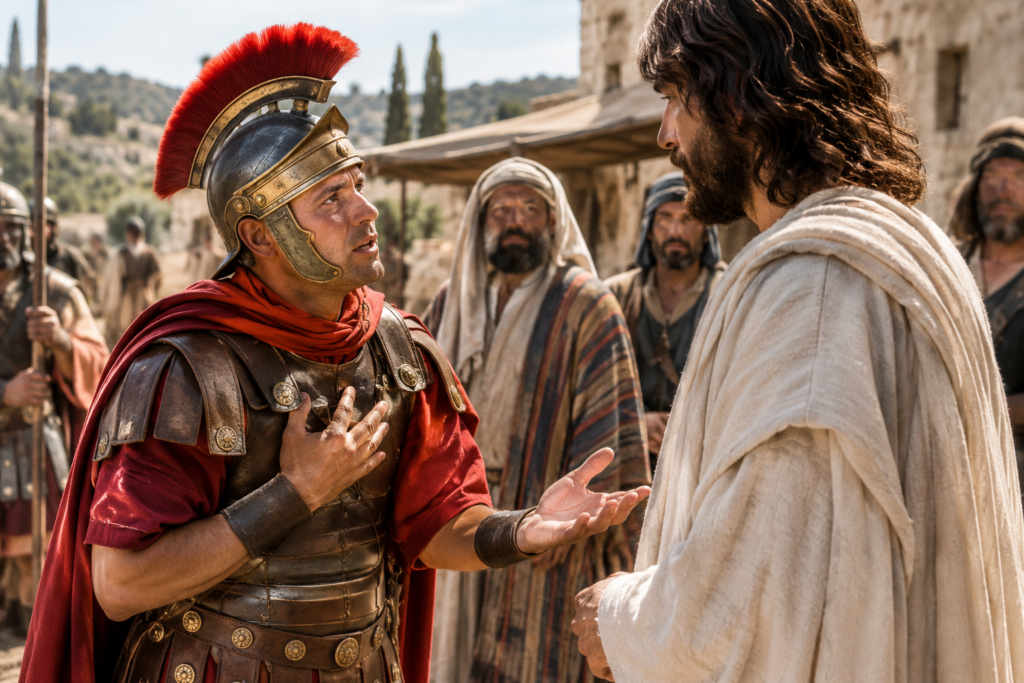
A devotional historical fiction on Matthew 8:5–13
❧ ✦ ❧
Introduction: The Longest Night in Capernaum
The lamp had burned down to a blue bead of flame, and still the boy would not stop shaking.
Lucius Valerius Crispus had seen men die of arrows, of spears, of wounds no surgeon could clean. A centurion learns early that death is a soldier of the line: it obeys orders, and it does not hurry. But on the mattress in his black-stone house beside the Sea of Galilee lay Kallias—fifteen, Syrian-born, bought in the slave market at Tyre and worth, Lucius now understood, more than everything he owned. Three days ago the boy had been laughing. Now his legs would not move, and every breath sounded like tearing cloth.
Lord, my servant lieth at home sick of the palsy, grievously tormented.
— Matthew 8:6, King James Version
The centurion’s name, past, and household in this story are imagined. The world around him is not.
❧ ✦ ❧
The World of the Centurion
Galilee, Around A.D. 28
Tiberius ruled the empire from the island of Capri. Pontius Pilate governed Judea. Galilee belonged to Herod Antipas, a client-ruler who had just built his capital, Tiberias, on the lake’s western shore, and who would soon imprison John the Baptist.
Capernaum sat on the lake’s northwest shore near the border with Philip’s territory and close to the trade road called the Via Maris. That made it a customs town—Matthew’s tax booth stood there (Matthew 9:9)—and Jesus made it His home (Matthew 4:13). Excavations uncovered a Roman-style bathhouse built over an earlier first-century structure of similar outline. Archaeologist John C. H. Laughlin wrote that if the earlier building was also a bathhouse,
“…this may confirm the existence of the Roman centurion and garrison at Capernaum…”
— John C. H. Laughlin, Biblical Archaeology Review 19:5 (1993)
Other scholars doubt Rome stationed troops inside a loyal client-king’s realm and conclude:
“…it is unlikely that Capernaum had a Roman garrison in the early first century.”
— Bible Odyssey, “Capernaum”
Since Herodian armies enlisted Gentiles and were organized on Roman lines, the centurion may well have served Antipas. This story imagines him as a Gentile from Sebaste in Samaria in Antipas’s service.
The Rank and the Barrier
A centurion commanded eighty to a hundred men and carried a vine staff as his badge. Soldiers in the Roman system could not legally marry, so a slave “dear unto him” (Luke 7:2) might be the closest thing he had to family. And a Gentile’s house was off-limits to a devout Jew: “it is an unlawful thing for a man that is a Jew to keep company, or come unto one of another nation” (Acts 10:28). Lucius knew that rule. It would matter.
❧ ✦ ❧
Part One: The God Without an Image
Lucius had grown up with household gods on a shelf by the door. But on a patrol down the Jordan, he had heard a prophet in camel’s hair answer his soldiers: “Do violence to no man… and be content with your wages” (Luke 3:14). The God of Israel, it seemed, cared how a man held a sword.
In Capernaum he began standing at the back of the synagogue. He heard of a God who made the world by a word—“Let there be light”—and who could not be carved or cast. Hear, O Israel: The LORD our God is one LORD. One Lord, one will running through everything: a soldier could understand that. When the old synagogue crumbled, Lucius paid for a new one. Still he stayed at the edge, uncircumcised, near the door, looking in.
❧ ✦ ❧
Part Two: The Sickness
Kallias had come to him as an orphan, bought to carry water and polish armor. But the boy’s laughter filled a house that had never known it. He learned Greek letters from his master and Hebrew letters from the synagogue boys. Without either of them saying it, he became a son.
Then came fever, a stiff neck, and legs that would not answer. The physician from Tiberias shook his head at the door: “When it reaches the chest, he will not breathe. Two days. Perhaps less.” For the first time in twenty years, Lucius did not know what order to give.
❧ ✦ ❧
Part Three: The Problem of Worthiness
All Capernaum knew of Jesus of Nazareth. He had cast out a spirit in the synagogue Lucius built, healed Simon’s mother-in-law, and touched lepers clean. Now He was coming down from the hills.
Lucius argued with himself through the night. I am a Gentile, an officer of the man who chained the Baptist. And if this rabbi enters my house, He becomes unclean, and I bring Him shame.
Then he remembered the synagogue reader: And God said, Let there be light: and there was light. No one had carried the light anywhere. God spoke, and it was so. Lucius stood. He knew what he would do.
❧ ✦ ❧
Part Four: “Only Say the Word”
The synagogue elders had already gone ahead, telling Jesus the centurion was worthy because he loved the nation and built their synagogue (Luke 7:3–5). But Lucius came too. Expecting splendor, he saw a sunburned workman among fishermen. Yet when their eyes met, he knew: This man has authority.
He bowed as a petitioner and pleaded for his servant. The reply came without a word about Gentiles or uncleanness:
I will come and heal him.
— Matthew 8:7, King James Version
Then Lucius spoke the words he had settled on in the dark:
Lord, I am not worthy that thou shouldest come under my roof: but speak the word only, and my servant shall be healed.
For I am a man under authority, having soldiers under me: and I say to this man, Go, and he goeth; and to another, Come, and he cometh; and to my servant, Do this, and he doeth it.
— Matthew 8:8–9, King James Version
It was a soldier’s theology. Authority need not be present to be obeyed; it need only be spoken. And Lucius had grasped that sickness itself stood under this Man’s command.
The Gospels say Jesus marveled only twice: at the unbelief of Nazareth (Mark 6:6), and here.
Verily I say unto you, I have not found so great faith, no, not in Israel. And I say unto you, That many shall come from the east and west, and shall sit down with Abraham, and Isaac, and Jacob, in the kingdom of heaven.
— Matthew 8:10–11, King James Version
Go thy way; and as thou hast believed, so be it done unto thee.
— Matthew 8:13, King James Version
❧ ✦ ❧
Part Five: The Selfsame Hour
He did not run. A soldier who has received an order from his commander does not run back to see whether it was carried out. He walked down the basalt street to his gate, where his weeping second-in-command pointed into the courtyard.
Kallias sat on the edge of the well in the morning sun, pale and blinking. When he saw his master, he stood—stood—and walked to him. The household told Lucius when it had happened, though he already knew: “his servant was healed in the selfsame hour” (Matthew 8:13).
That evening the centurion carried his clay household gods to the lake and dropped them into the water. Then he sat beside the boy and thanked the God who has no image—the God who had spoken, and it was so.
❧ ✦ ❧
Conclusion: The Roof He Never Entered
Unworthy, and Therefore Welcomed
The elders said, “He is worthy.” The centurion said, “I am not worthy.” That gap holds the whole Gospel. Heaven is not opened by what we have built or given, even synagogues. It opens to those who come with nothing to plead but the mercy of Christ. Spurgeon saw it plainly:
“…he, who was worthy, according to the statement of the Jews, was most unworthy in his own apprehension.”
— C. H. Spurgeon, “The Centurion’s Faith and Humility,” Sermon No. 800 (1868)
This is not weakness. It is the posture of saving faith, as Matthew Henry wrote:
“The more diffident we are of ourselves, the stronger will be our confidence in Christ.”
— Matthew Henry, Concise Commentary on Matthew 8:5–13
His Word Is Enough
The centurion never saw the miracle happen. He walked home on nothing but a promise. Every believer walks the same road. We have not seen Christ on the shore at Capernaum; we have His Word. The same Lord who spoke light out of darkness and health into a dying boy now speaks pardon to the guilty and life to the dead in sin. He does not need to be visible to be victorious. Faith takes Him at His Word and goes its way.
A Table Set for Outsiders
This Gentile soldier was the first fruit of a vast harvest. Jesus looked past him to a banquet where people from east and west will sit with Abraham, Isaac, and Jacob. If an officer of a pagan army, unclean and uncircumcised, could be welcomed by a single word, then no one who comes to Christ in humble faith will be turned away.
The Final Image
Picture it once more: a black-stone house by the lake, a doorway the Son of God never crossed, a boy walking across a sunlit courtyard on legs that were dead the night before. And at the threshold, a hardened soldier who has just learned that the Lord never needed to come under his roof, because He had already come into his heart.
“By calling himself unworthy, he showed himself worthy for Christ to come not into his house, but into his heart.”
— Augustine of Hippo, Sermon 62, NPNF¹ vol. 6
Whatever you carry today—a sick child, a failing body, a sin you cannot break—you do not need to bring Christ to the place of your need. Come as the centurion came, empty-handed and unworthy, and pray: Lord, I am not worthy… but only say the word.
❧ ✦ ❧
A Note on History and Imagination
The centurion’s name, origin, history, servant, and household are fictional. Scripture is quoted from the KJV. Matthew presents the centurion speaking to Jesus directly; Luke describes elders speaking for him. Since Augustine, interpreters have read Matthew as compressing the episode, and this story blends the two with Matthew at the center.
❧ ✦ ❧