
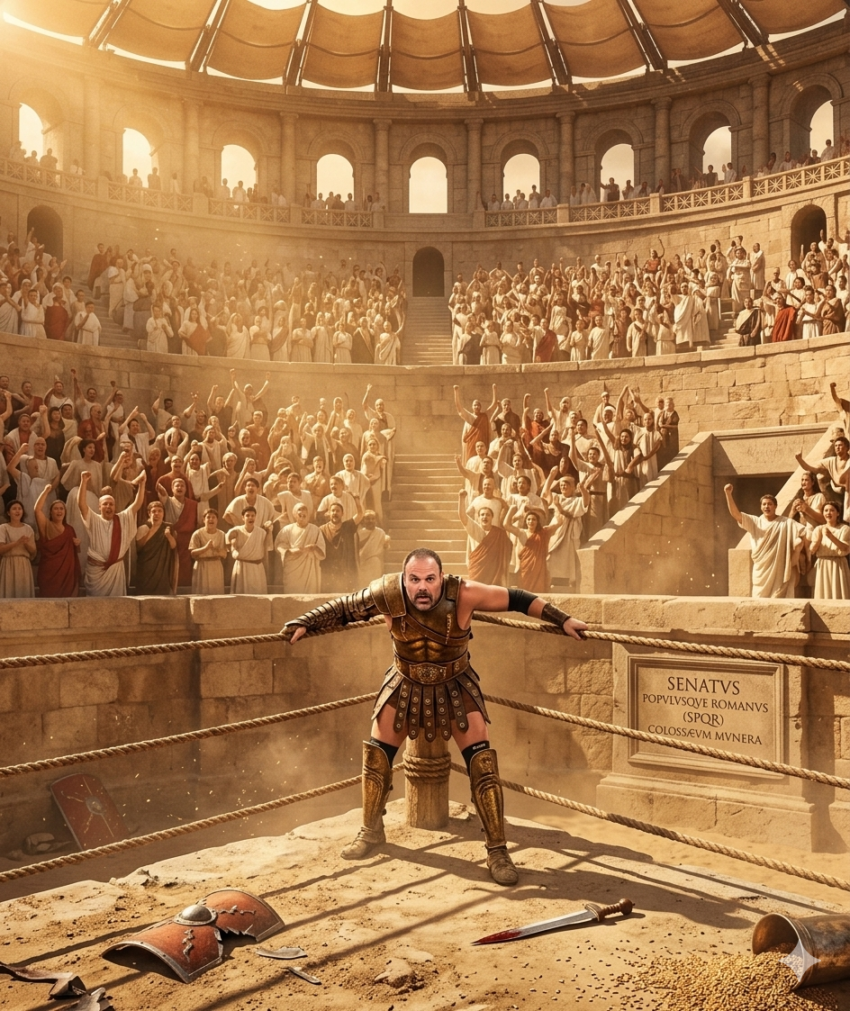
AI-generated image: In the house of God, the highest calling is not to be feared like a gladiator but trusted like a shepherd. The pastor who gathers applause by force may win a crowd for a season, yet only the one who walks in humility, truth, and self-giving love will leave a lasting mark on the souls entrusted to him.
From Mars Hill to Scottsdale
The Theology of a Repeated Collapse
A Critical Theological Analysis of the Ministry of Mark Driscoll
Introduction: The Question Beneath the Scandal
On October 14, 2014, Mark Driscoll resigned from the pulpit of Mars Hill Church, the multisite Seattle megachurch he had co-founded in 1996 and grown to roughly 14,000 attenders across 15 locations in 5 states. Within weeks, the Mars Hill network itself dissolved. The collapse felt, at the time, like the end of a chapter. By any conventional ecclesiastical measure, a pastor whose own elder board had concluded that he was guilty of patterns of arrogance, harsh speech, and domineering leadership, and who had abandoned a proposed plan of restoration rather than submit to it, would be finished. He was not finished.
Less than two years later, on the fiftieth anniversary of a beautiful mid-century church building in Scottsdale, Arizona, a new congregation gathered for an Easter Sunday service. By February 2016, Driscoll had formally launched The Trinity Church. By 2026, that church reports more than five thousand weekly attenders and has just signed a fifteen-and-a-half-million-dollar contract for a new campus four miles up the road. The man whose ministry was supposed to be over now leads a larger church than the one he lost.
It is tempting to read this as a story of grace, of a fallen leader given a second chance. It is also tempting to read it as a story of pure scandal, of an unrepentant pastor escaping accountability by flying to Phoenix. Neither reading goes deep enough. The deeper question is theological. What does it say about the contemporary American church when the same man, charged in 2014 with creating a culture of fear and removed by the very church-planting network he co-founded, can be reinstalled as the senior pastor of a thriving congregation by 2016, and stand to preach to thousands by 2026? What kind of ecclesiology, pastoral theology, and working assumptions about gift, success, and authority make that arc not only possible but profitable?
This essay argues that the Mars Hill collapse and the Trinity Church continuation are not two separate stories. They are one story, and the connecting thread is theological. The pattern at Mars Hill was not principally a problem of one man’s personality. It was a leadership theology in which platform, charisma, and “strong leadership” were baptized as ministry success while biblical qualifications for shepherding were quietly demoted. That theology was never seriously dismantled. It traveled with him. The point of this essay is not to repeat scandal headlines, although the documented record is part of the case. The point is to ask what traditional Christians ought to learn when a ministry survives a collapse in one location because its governing assumptions remain intact. And to any current members of Trinity Church, a respectful question must also be asked: have you prayerfully and honestly considered whether your association with this ministry still aligns with the standards of biblical shepherding, accountability, and Christian witness?
Section 1: The Mars Hill Pattern
To understand what happened in Scottsdale, one has to understand precisely what happened in Seattle. The popular memory of the Mars Hill collapse tends to flatten it into one of two stories: either a brilliant pastor brought down by enemies, or a brash celebrity who finally went too far. The actual record is more specific and more damning than either caricature.
In the spring and summer of 2014, formal charges were brought against Driscoll by twenty-one former Mars Hill pastors. Those charges named, in plain language, what others had been observing for years. Among them were the following findings that the church’s own elder body would later affirm:
“Pastor Mark exhibits lack of self-control by his speech and by verbally assaulting others. We believe that the way Pastor Mark leads has created a culture of fear instead of a culture of candor and safety. People are often afraid to ask questions or challenge certain ideas. Pastor Mark is verbally abusive to people who challenge him, disagree with him, or question him.”
— Formal charges from twenty-one former Mars Hill pastors, summarized in The Christian Century
On August 22, 2014, nine current Mars Hill pastors followed with their own letter, calling on Driscoll to step down not merely from the pulpit but “from all aspects of ministry and leadership” and to submit to a year-long restoration plan under the oversight of the church’s Board of Advisors and Accountability. Their letter included a remarkable on-the-record assessment from Paul Tripp, the widely respected biblical counselor who had served briefly on Mars Hill’s own oversight board before resigning.
“This is without a doubt the most abusive, coercive ministry culture I’ve ever been involved with.”
— Paul Tripp, quoted in the Mars Hill pastors’ letter, August 22, 2014
That assessment, from a man whose own writing on biblical counseling had been foundational to Mars Hill’s pastoral training, was not a fringe complaint. It came from inside the very accountability structure the church had created. Within days of the letter’s release, the Acts 29 Network, which Driscoll had co-founded in 1998 and once led, removed both Driscoll and Mars Hill from its membership. The Acts 29 board was equally direct:
“Over the past three years, our board and network have been the recipients of countless shots and dozens of fires directly linked to you and what we consider ungodly and disqualifying behavior. Based on the totality of the circumstances, we are now asking you to please step down from ministry for an extended time and seek help.”
— Acts 29 board letter to Mark Driscoll, August 2014
When Mars Hill’s board of overseers eventually published its findings, the verdict was carefully measured. They concluded that Driscoll had “at times, been guilty of arrogance, responding to conflict with a quick temper and harsh speech, and leading the staff and elders in a domineering manner.” They added a now-famous qualification: he had not been charged with immorality, illegality, or heresy. Most of the charges, they wrote, involved attitudes and behaviors reflected in a domineering style of leadership.
That last sentence is, theologically, where this story turns. The board treated the style of leadership as an issue distinct from disqualifying sin. Scripture does not. The pastoral standards of First Timothy 3 and Titus 1 explicitly require that an elder be temperate, self-controlled, gentle, and not quarrelsome or violent. They do not list domineering leadership as a stylistic preference. They list its opposite as a qualification. By the church’s own findings, Driscoll failed at the level of qualification, not merely at the level of personality. The framing that softened the verdict was already an early instance of the very pragmatism that would carry the pattern forward.
Driscoll resigned on October 14, 2014, before the proposed restoration plan could be implemented. In his resignation letter, he acknowledged that he had “at times” been guilty of pride, anger, and a domineering spirit, but he framed his departure as a response to harassment and threats and as a refusal to be a distraction. Mars Hill itself dissolved within months. By any reading of the record, the people closest to Driscoll, and the network he himself had built, judged him unfit. He left rather than submit to the process that would have tested whether he could be restored.
Section 2: Giftedness as Cover
One of the most haunting features of the Mars Hill story is that almost nobody who had spent significant time around Driscoll thought the ministry was healthy by the end. Many of them had thought so for years. Yet the ministry kept growing, and the warnings kept being deflected. Why?
The answer, repeated often enough after the collapse, was that Driscoll was genuinely gifted, and that his gifts were treated almost as proof that the criticisms had to be mistaken. Yet there is no small number of so-called Christian ministries, both now and in the recent past, that have grown around the charisma of a single individual, and Driscoll’s case fits that familiar pattern. Effectiveness in preaching, rapid numerical growth, and the apparent cultural relevance of an evangelical church flourishing in famously secular Seattle all became part of the argument. If God is so obviously blessing this work, the reasoning went, then surely the harshness can be overlooked, managed, or even reinterpreted as the cost of getting things done.
In that sense, the problem was not merely that one man was charismatic. It was that charisma was allowed to function as a theological defense, even when it should have raised more serious questions about character, accountability, and the long-term health of the church.
Tim Keller, in his comments to The New York Times around the time of Driscoll’s resignation, captured the ambivalence of even sympathetic observers:
“He was really important. In the Internet age, Mark Driscoll definitely built up the evangelical movement enormously. But the brashness and the arrogance and the rudeness in personal relationships, which he himself has confessed repeatedly, was obvious to many from the earliest days, and he has definitely now disillusioned quite a lot of people.”
— Tim Keller, quoted in The Christian Century coverage of Driscoll’s resignation
That observation is striking precisely because Keller is not a critic by temperament. He is acknowledging what was widely known. The traits that finally disqualified Driscoll had been visible from the earliest days. They were not hidden until 2014. They were tolerated for the better part of two decades, and one of the most candid retrospectives, written for The Gospel Coalition Australia, named the dynamic that allowed the toleration:
“The situation at Mars Hill took so long to come to a head because of the remarkable giftedness of Mark Driscoll (and others) in so many areas. His eccentricities were excused not just because his church grew, but because he himself did so many things in ways which were refreshing. The trouble was that he was also acting in ways which damaged many others. We must be bold and principled and not give in to the temptation to excuse the moral flaws of exceptionally capable ministry leaders.”
— The Gospel Coalition Australia, “Enduring Lessons from the Rise and Fall of Mars Hill”
This is not a peripheral observation. It is the heart of the theological diagnosis. American evangelicalism has, over many decades, drifted into an unstable arrangement in which giftedness functions as a substitute for godliness. The pastoral epistles place the order in exactly the opposite direction. The qualifications for an elder are, with one exception, character qualifications. The ability to teach is one entry on a long list of items that are otherwise about who the man is, not what he can do. When a tradition reverses that order, even tacitly, it builds a system that will reliably produce Mark Driscolls. It cannot do otherwise.
There is a deeper biblical theme at work here. Throughout Scripture, gifting is never the ultimate test of a leader. Saul was gifted. Solomon was gifted. Balaam, of all figures, prophesied truly. The Old Testament treats raw effectiveness as ambiguous, and the New Testament intensifies that note. Jesus, in Matthew 7, warns that on the last day many will appeal to mighty works performed in his name and will be told that he never knew them. Ministry success, biblically considered, is not self-validating. It can be a sign of God’s blessing. It can also be a temptation toward an idolatry that the gifted person and his admirers find very difficult to detect. When fruitfulness is measured by size, influence, and intensity rather than by holiness, accountability, and the long obedience of a Christlike character, the church has already lost the ability to evaluate its own leaders.
Section 3: Rebrand, Not Repentance?
Driscoll’s move to Phoenix was not simply a solitary reinvention; it was carried by a network of ministry allies. Trinity’s launch was publicly connected to former Mars Hill staff members Andy Girton and Brandon Anderson, while its governing board included Robert Morris and Jimmy Evans, with Larry Osborne serving in a wise-counsel role. In addition, Trinity’s broader circle of supporters included figures such as Josh McDowell, Perry Noble, Chris Hodges, Johnnie Moore, and Daryl DelHousaye, giving the new church immediate credibility and a ready-made evangelical platform. Driscoll also framed the relocation as a God-led response to hardship, which helped recast Phoenix as a place of renewal rather than merely a refuge after collapse.
Trinity’s own published account of its origins is theological in form. The church’s website narrates the story this way:
“As our first home for Trinity Church, the building is a great gift from God. Pastor Mark Driscoll was considering renting a building when he received a word from God that a church building off Highway 101 seating around 800 would soon be available. Nothing like that was on the market, so the Driscoll family prayed, trusting God’s provision. In a miracle of God, Pastor Mark was able to secure a purchase agreement, and gifts from individuals and more than 40 churches from around the world immediately started to come in.”
— The Trinity Church, official “About Us” page
That narrative is worth pausing over, because it is not theologically neutral. It frames the move from Seattle to Scottsdale as providential confirmation rather than as the unfinished business of a still-pending restoration plan. It speaks of a word from God, of miraculous provision, of forty churches sending gifts, all without any acknowledgment that the man being relocated was at the time under formal restoration recommendations from his previous elder board. It functions, theologically, as a substitute for the process Driscoll had abandoned. Where the elders had asked for submission, the new narrative offers transcendence. Where the elders had proposed accountability, the new narrative offers calling.
Driscoll’s account here should be understood as his version of events, not as a documented historical fact. In a 2015 interview with Hillsong’s Brian Houston, he framed his Mars Hill departure as a divine release, saying the Lord had shown him that “a trap had been set” and that he could not return to leadership. He repeated the claim more aggressively in a 2022 Trinity sermon, telling his Scottsdale congregation that Mars Hill leaders had supposedly planned to accuse him of adultery as their “nuclear option.” But that is only his own retelling. Sutton Turner, who served as executive elder and board member at Mars Hill from 2011 to 2014 and would have been in the room if such a plan existed, publicly disputed the story. The forty signatories of the 2021 letter likewise said the opposite: Driscoll left rather than submit to a restoration process that was still being offered to him.
One could put it more bluntly: Driscoll has offered a self-justifying narrative in which he is the victim of a hidden plot, but the available record does not document that plot. What is documented is that he resigned while Mars Hill was investigating formal charges, and that later leaders involved in the process rejected his reconstruction of events.
These two competing narratives matter because they reveal what kind of repentance, if any, took place between Mars Hill and Trinity. The biblical pattern of repentance is not subtle. It involves the acknowledgment of specific sins, the seeking out of those who were wronged, and the willing submission to those whose office it is to evaluate fitness for ministry. It does not bypass that submission by appeal to private revelation. The traveling of the same charisma into a new building and a new state, marketed under the language of providence and miracle, is not the same act as repentance. It may, in the end, be its precise opposite. As R. Scott Clark observed at the Heidelblog, the structural concern that runs through this story is that independent, unaccountable megachurch pastorates with no functioning boards of elders are the most reliable producers of unchecked behavior, regardless of the soundness of the doctrine being preached.
Whether the Trinity restart amounted to repentance or to institutional continuity under a new name is, ultimately, a question the documentary record can answer. By 2021, after seven years of attempting private and individual reconciliation, more than forty former Mars Hill elders concluded publicly that the answer was the latter.
Section 4: Ecclesiology Matters
It is here that the diagnosis becomes most clearly theological rather than merely behavioral. Several of the most thoughtful post-mortems of Mars Hill, written from quite different ecclesiological traditions, have converged on the same point: the Mars Hill collapse was an ecclesiological failure before it was a personal one.
Jonathan Leeman, writing for 9Marks, offered what is probably the most concentrated theological reading of the collapse, and his framing is worth quoting at length:
“With a story about the rise and fall of something, everyone wants to know who the good guys and bad guys are. There’s one bad guy I want to usher more clearly into the light, because I suspect many listeners overlooked him: pragmatism. Pragmatism is a results-driven orientation, especially results that can be measured, like dollars in the plate or bodies in the pew. It throws overboard almost everything else the Bible says about being a church in pursuit of those numeric goals.”
— Jonathan Leeman, “An Ecclesiological Take on ‘The Rise and Fall of Mars Hill,’” 9Marks
Leeman’s point is precise. The fundamental problem at Mars Hill was not that Driscoll was abrasive. It was the church’s polity, which is to say the structures by which authority was distributed and accountability enforced, had been designed in a way that concentrated power at the top and made it nearly impossible to challenge it from within. In 2007, Driscoll had pushed through a rewrite of the church’s bylaws that dramatically increased his decision-making authority. Two elders, Paul Petry and Bent Meyer, raised concerns. Both were removed from the eldership. Petry was put on a kind of internal trial, and Driscoll urged the congregation to shun his family. Petry’s associated charity saw donations drop by roughly eighty percent after Driscoll publicly discouraged giving to it.
Once those structural changes were in place, the church had no functioning mechanism by which to correct its senior pastor. Pastors who tried, like the nine signatories of the 2014 letter, lost their jobs. Of the nine, eight resigned or were terminated within weeks. The ninth was demoted. Mike Cosper’s podcast The Rise and Fall of Mars Hill, produced by Christianity Today, documents in detail how this concentration of power was achieved through procedural means and then defended in the language of mission and effectiveness.
The deepest theological lesson here is one that traditional Protestant ecclesiology has always insisted upon, even though American evangelicalism has often been impatient with it. Polity is not bureaucratic trivia. The Reformers and their heirs, whether Presbyterian, Congregationalist, or Reformed Baptist, all insisted that the office of pastor must operate within a structure of plural eldership and meaningful congregational accountability, precisely because they had observed across centuries what happens to even gifted men when those structures are absent. Calvin in Geneva. The Westminster Divines. The early American Baptists. None of them imagined that good intentions or strong preaching could substitute for the discipline of a properly constituted church.
When the Mars Hill story is read in this longer light, what looks like a failure of personality is revealed as a predictable failure of an ecclesiology that had quietly substituted founder rule for plural eldership and called it leadership. R. Scott Clark put the matter sharply when he observed that the case is being made, falsely, that Reformed faith logically leads to Driscoll’s behavior, when a far better case can be made that independent and unaccountable megachurch pastors with no functioning boards of elders logically lead to it. Mars Hill was Reformed in some of its doctrinal vocabulary and decidedly not Reformed in its polity. The polity is what failed.
Section 5: Theological and Doctrinal Distortions
Critics from across the traditional Protestant spectrum have, on the whole, been careful to make a particular kind of judgment about Driscoll’s theology. They have not generally accused him of denying the Trinity, the resurrection, or the bodily return of Christ. He affirms the historic creeds. The criticism has fallen, instead, on the level of application, where doctrines that are sound in the abstract have been put to uses that distort their biblical meaning. Three such distortions stand out.
Shepherding Became Ruling
The pastoral office, in the New Testament, is described in language drawn from shepherding. The pastor is to feed the flock, to know the sheep, to seek the lost one, to bind up the wounded, and to lay down his life for them. Peter’s charge in his first epistle is explicit: shepherds are not to lord it over those entrusted to them, but to be examples to the flock. The verb that the New Testament most often pairs with the pastoral office is the verb of caring, not commanding.
At Mars Hill, and apparently again at Trinity, the operative verb shifted. Pastoral leadership came to mean controlling outcomes, enforcing loyalty, and managing the institution’s reputation. People who challenged decisions were not engaged with as wounded sheep needing care. They were treated as threats to be neutralized. Of the cultural rule under which such treatment becomes normal, Cosper’s podcast offered ample testimony, and the 2021 elder letter offered a more concise summary. The elders wrote that they were saddened to learn that Driscoll had continued in a pattern of sinful actions toward staff and congregants at Trinity, and that his sinful leadership behaviors appeared similar to what he had exhibited at Mars Hill. When forty-one men who served alongside him in the church’s most successful years say that, traditional Christians have to take it seriously as evidence about the substance of his pastoral practice.
Repentance Became Reputation Management
A second distortion concerns the doctrine of repentance itself. In Reformed and broader Protestant theology, repentance is a turning from sin that involves contrition, confession, and the seeking of restoration with those who were wronged. It is one of the most concrete doctrines in the Christian life. It cannot, by its nature, be performed in a monologue. It requires the willingness to be evaluated by those who have the authority to evaluate.
The 2014 Mars Hill restoration plan was, in essence, a chance for that kind of repentance. It involved Paul Tripp’s oversight, the elder board’s judgment, and a path back to leadership at the same church if the process bore fruit. Driscoll resigned rather than submit to it. In the seven years that followed, former elders attempted privately to call him back to that process. The 2021 letter is, in part, the public record of that effort’s failure. The signatories noted that they had reached out to him privately and individually before going public, and concluded:
“We are troubled that he continues to be unrepentant despite the fact that these sins have been previously investigated, verified, and brought to his attention by his fellow Elders, prior to his abrupt resignation. Accordingly, we believe that Mark is presently unfit for serving the church in the office of pastor.”
— Public statement of more than forty former Mars Hill elders, July 2021
The substitution that has occurred between 2014 and the present is that public language about restoration has been generated, but the actual practice of repentance, which is to say submission to an authority capable of evaluating fitness, has not. What looks from the outside like a recovery is, on closer examination, a reputational repositioning. The man whose elders said he was unfit to pastor is now leading a larger church, but no body of pastors has rendered a contrary judgment. The contrary judgment came from a successful platform, not from a restored fellowship.
Strength Became a Virtue Without Cross-Shaped Restraint
The third distortion is the most subtle, and perhaps the most consequential. Driscoll’s public ministry has, from the beginning, leaned into a particular vision of masculinity. Some of that emphasis was a reaction against a real pastoral failure in evangelicalism, namely a tendency to feminize the public worship of an industrial-strength savior. Critics who dismiss the entire concern miss something important. Yet what began as a corrective has, over time, become its own theological category. Strength, forcefulness, swagger, and the willingness to speak in ways others will not come to function as if they were biblical virtues.
In the New Testament, strength is never abstracted from the cross. Authority is validated by sacrificial service. The Lord of the church is the one who, having all power in heaven and earth, washes his disciples’ feet. Paul boasts of his weaknesses. Peter writes, after a lifetime of walking with Christ, that the elders are to lead by being examples, not by domineering. When strength is detached from cross-shaped restraint, it becomes something else. It becomes intimidation dressed in theological language. The rebuke this pattern eventually provokes is not, as some have framed it, a feminizing complaint. It is a Christological one. A leadership style that does not visibly look like Christ’s leadership of his disciples is not, by definition, a Christian leadership style.
Women, Masculinity, and Distortion
One of the most revealing distortions in Driscoll’s ministry is the way his teaching on women repeatedly crossed the line from complementarian conviction into crude, domineering, and at times openly contemptuous rhetoric. Critics were not objecting to a thoughtful biblical distinction between men and women; they were objecting to a pattern of speech that treated women as spiritually suspect, culturally inferior, and in need of male correction in a way that often sounded less like shepherding and more like territorial control. That is a doctrinal problem because theology shapes tone, and tone reveals whether a pastor sees women as image-bearers to be honored or as liabilities to be managed.
Driscoll’s anti-feminist posture intensified the problem. He did not merely disagree with feminism; he often portrayed it as a hostile force that had weakened men, corrupted families, and damaged the church. That framing pushed his audience toward suspicion rather than discernment and turned gender discussion into a culture-war weapon. When a pastor repeatedly defines women and feminism in adversarial terms, he is not simply defending Scripture. He is teaching his people to absorb contempt under the guise of conviction.
The most serious issue is that this was not an accidental byproduct of blunt communication. It was part of the ministry style itself. Driscoll’s language about masculinity and femininity helped normalize a version of church leadership in which aggression was praised as courage, dominance was recast as strength, and women were too often spoken about as though they existed to be corrected rather than cherished. That is not the biblical pattern. It is a distorted moral climate dressed in Christian vocabulary.
A church shaped by that kind of rhetoric may still claim biblical fidelity, but it quietly trains its people to confuse harshness with faithfulness and control with leadership. That is why this is not a side issue. It is one of the clearest signs that the problem in Driscoll’s ministry was theological at the root, not merely stylistic at the surface.
Inside the Driscoll Family System
Grace Driscoll’s role is not incidental, and it should not be treated as a mere family detail. Trinity Church itself presents her as part of the ministry’s public identity, describing Mark and Grace as planting the church together and assigning her a visible role in teaching women about identity, womanhood, marriage, and family. That means any serious evaluation of Trinity must reckon not only with Mark Driscoll’s authority, but with the broader family-and-ministry ecosystem surrounding it. In a church already criticized for concentrating power in the hands of one man, the integration of spouse, children, and close family into the public ministry structure only strengthens the impression of a tightly controlled religious household rather than a properly accountable church.
That matters because Christian ministry is not supposed to function like a family brand. It is supposed to be governed by biblical standards, tested character, and real accountability. When a leadership culture is built around charisma, loyalty, and relational closeness, family involvement can become part of the shielding mechanism that protects the central figure from the scrutiny he should face. In that setting, the pastor’s wife may sincerely believe she is serving Christ, but her visible participation can still help normalize a system that critics believe never truly repented of the failures that brought Mars Hill down in the first place.
Grace Driscoll’s prominence among Trinity’s women speakers is not a small detail; it reflects a family-centered ministry model in which the pastor’s household is folded directly into the church’s public identity. In a setting already accused of concentrated authority, that arrangement deserves scrutiny.
So the question is not whether Grace Driscoll may speak, teach, or serve. The question is whether her public role at Trinity helps reinforce a ministry model built on the same personality-driven assumptions that should have been dismantled long ago.
Section 6: What Most Observers Missed
Many of the early commentaries on the 2014 collapse treated Mars Hill as an isolated scandal caused by a uniquely difficult personality. The framing was that a brilliant but flawed man had finally lost control of a movement that had been mostly healthy. On that read, the appropriate response was to mourn what had happened, learn the lessons of celebrity, and move on.
That framing has not aged well. The deeper pattern was structural and theological, not merely personal. The same polity that protected Driscoll at Mars Hill could be reproduced anywhere, with the same consequences, because the underlying assumptions had not been examined. Warren Throckmorton, the Grove City College psychology professor who has documented the case as carefully as anyone, has observed that Trinity Church was deliberately structured without an elder board, the same governance layer that had once held Driscoll accountable in Seattle. Without local elders, there is no internal body with formal authority to discipline the senior pastor.
This is why the Trinity allegations matter as theological evidence and not just as a fresh scandal. They suggest, with some specificity, that the underlying pattern is portable. The early Trinity controversies began surfacing publicly in 2021, when former Trinity head of security Chad Freese, a retired Marine Corps officer and cybersecurity professional, resigned and made his observations public. His allegations, which the church has disputed but which have been corroborated by other former staff and members in the reporting of Julie Roys’s investigations, included the use of a numerical “Spectrum of Trust” loyalty ranking. Freese’s description of the system, made in interviews with The Roys Report, was unsparing:
“It’s disgusting, like a cult. The more trust you have on the spectrum, the higher the number, the more access you will get to the [Driscoll] family. Everything is about the Driscolls.”
— Chad Freese, former director of security at The Trinity Church, in The Roys Report
The same reporting has documented the Manuele family case, in which a teenage romantic incident between a fifteen-year-old boy and Driscoll’s seventeen-year-old daughter was followed by, according to the family and Freese, the family’s removal from the church, trespass warnings, the filing of police reports, the issuance of a “BOLO” list of banned individuals, and the hiring by the church of a private security firm to conduct around-the-clock surveillance of the family. Other former members have alleged severance of family relationships, with grandparents prevented from seeing grandchildren over perceived disloyalty to the church. Multiple sources, including former staff, have alleged that cease-and-desist letters and threats of litigation have been used to discourage public criticism. Freese has stated on the record that Driscoll told staff the church had ten to eleven million dollars set aside to litigate against critics.
Whatever the final disposition of any particular allegation, the reporting collectively describes a leadership culture organized around centralized personal authority, the conditioning of access on loyalty, and the use of institutional resources against dissenters. That is the same description, with different vocabulary, that the Mars Hill elder board produced in 2014. The portability of the pattern is the point. The 2021 letter from forty-one former Mars Hill elders, written explicitly because they were hearing from members leaving Trinity, drew the same conclusion the original investigators had drawn. The leadership behaviors at Trinity, they wrote, appeared similar to what Driscoll had exhibited at Mars Hill. They asked him, again, to step down. He did not.
Section 7: Driscoll’s Remarkable Wealth
Among the questions traditional Christians legitimately ask about high-profile pastors is the question of money. Mark Driscoll has been one of the highest-earning evangelical pastors of his generation, and the trajectory of his personal wealth tells a great deal about how the contemporary American ministry economy actually works.
Public estimates of Driscoll’s personal net worth currently range from roughly $2.5 million to as much as $12.5 million, with the lower figure being the most commonly cited estimate from celebrity and Christian-press tracking services as of 2024 and 2025. The trajectory is more revealing than the absolute number. According to retrospective reports, Driscoll’s personal net worth grew from roughly $1 million in 2007 to more than $5 million by 2013 during his Mars Hill years. His current organization, Real Faith Ministries, listed total assets of approximately $1.28 million on its 2022 IRS filings, with revenues of $1.6 million for that year.
Several streams have contributed to that wealth, and each is theologically worth noting. First, Driscoll built one of the first genuinely internet-native pastoral platforms in American Christianity. He joined Twitter in 2007 and has produced nearly twenty-four thousand posts. His sermons, podcasts, books, and online courses have, since the late 1990s, occupied an unusually large slice of the digital evangelical market. Second, he has been a prolific author. His books have sold hundreds of thousands of copies, and his marriage book Real Marriage, co-authored with his wife Grace, reached the number-one position on the New York Times Best Seller list, although that book’s ranking later became controversial. Reporting at the time, including from the Seattle Times, indicated that Mars Hill Church spent approximately $210,000 of church funds with the marketing firm ResultSource to engineer the book’s placement on bestseller lists. Mars Hill itself eventually acknowledged the practice, calling it “unwise.”
In the period after Mars Hill, Driscoll restructured around a personal-brand ministry called first Mark Driscoll Ministries and later Real Faith. That restructuring, accomplished while still in transition between Seattle and Scottsdale, allowed him to retain control of his sermon archive and content library. Fourth, Trinity Church itself has grown into a substantial financial operation. By 2026, the church reports more than five thousand weekly attenders and has signed a $15.5 million contract for a new campus, financed with $2.765 million down and $12.735 million in debt to AG Financial Solutions, an arm of the Assemblies of God. The Religion Unplugged report on the purchase summarized the scale plainly:
“Trinity Church, a Scottsdale, Arizona, congregation led by controversial pastor Mark Driscoll, has purchased a vacant 116,200-square-foot office building for $15.5 million.”
— Religion Unplugged, March 11, 2026
None of this, by itself, is evidence of wrongdoing. Pastors of large congregations often draw substantial salaries, and prolific Christian authors do, in fact, sell books. The theological concern is more specific. Trinity Church has been criticized, including by former staff, for unusual opacity around clergy compensation, salary structure, and overall budgeting. Independent observers have noted that the church’s governance places key financial decisions within a small circle close to the Driscoll family. When that pattern is combined with the absence of a local elder board capable of meaningful oversight, the financial arrangement begins to look less like a normal pastorate and more like what the Trinity case has repeatedly been called by former insiders: a family business with religious branding. Whether one accepts that strong characterization or not, the pattern raises legitimate questions about the relationship between teaching ministry and personal enterprise that traditional Protestant ecclesiology has historically tried to keep distinct.
Section 8: Closing Application
If the Mars Hill collapse and the Trinity continuation are read as one story, what does the traditional Christian conclude? At least three things.
First, character is not optional. The pastoral epistles list character qualifications for a reason, and they list them before they list anything about gifting. Whenever a tradition begins to evaluate ministry primarily by results rather than by qualifications, it is in the process of forming pastors who will, sooner or later, behave the way Driscoll has behaved. The lesson is not that gifted men should be distrusted, but that gifting is a gift, and it is given to be exercised under the discipline of biblical character. When the order is reversed, even orthodoxy of doctrine cannot prevent the deformation of practice.
Second, polity matters. The American evangelical instinct to treat church government as adiaphora, as something Christians can disagree about while remaining united on the gospel, has a price. The price is that when crises arise, churches without functioning structures of plural eldership and congregational accountability have no internal mechanism for correction. Senior pastors with celebrity platforms and small inner circles can override almost any objection until the damage is undeniable. Traditional Reformed, Presbyterian, Congregational, and confessional Baptist communions have for centuries insisted on plural eldership and meaningful local accountability, not because they are paperwork enthusiasts, but because they are realistic about pastoral sin.
Third, repentance cannot be performed in a monologue. The biblical pattern of repentance involves submission to an authority capable of evaluating fitness. A pastor who has been removed by his elders for a pattern of domineering leadership cannot rehabilitate himself by relocating, rebranding, and producing new content. He can only be restored by a process that does what the original elders proposed and that he refused. To call anything else “restoration” is to redefine the word.
The most sobering reflection is that a ministry can collapse in one place and still survive elsewhere if the underlying assumptions about authority, gifting, and accountability remain untouched. Mars Hill is gone, but the theology and psychology that sustained it are not. A charismatic leader with serious flaws can still draw loyal followers because people often confuse confidence with conviction, boldness with holiness, and visible success with divine approval. Scripture repeatedly warns against exactly this kind of deception: “Do not be conformed to this world” and do not be “carried about with every wind of doctrine” [Romans 12:2; Ephesians 4:14]. It also warns that “the love of money is a root of all kinds of evils,” and that people can gather teachers “to suit their own passions” rather than truth [1 Timothy 6:10; 2 Timothy 4:3-4].
That is why the Trinity story matters. On the available evidence, it looks less like a break from Mars Hill than a continuation of the same pattern in a new setting, with new people now learning, by experience, what earlier followers learned a decade earlier. Scripture warns that false confidence in leaders can be spiritually devastating: “See to it that no one takes you captive by philosophy and empty deceit” [Colossians 2:8], and “be on your guard against false prophets” who come in sheep’s clothing [Matthew 7:15]. When a church cannot correct a domineering leader, it is already forming people to tolerate fear, rationalize abuse, and silence their own concerns in the name of loyalty. But the apostolic pattern is different: elders are not to “lord it over” the flock, but to be examples to it [1 Peter 5:2-3]. That is the standard Driscoll’s story keeps failing to meet.
Conclusion
Mark Driscoll’s story is a sobering reminder that theological language can be orthodox in wording and still be deeply compromised in practice. When authority is prized more than accountability, when charisma is mistaken for character, and when strength is detached from humility, the result is not merely a rough ministry style but a distorted picture of pastoral leadership itself. What happened at Mars Hill, and what has followed in Scottsdale, shows that unresolved leadership sins do not disappear when a church is renamed or restarted. They simply travel with the same assumptions intact.
For traditional Christians, the real concern is not whether a pastor can preach forcefully or build a large platform. The concern is whether his ministry reflects the shepherding pattern of Christ. Truth joined to gentleness. Conviction joined to holiness. Leadership joined to servant-hearted accountability. In that light, Driscoll’s legacy is less a model of bold evangelicalism than it is a warning. It is a warning about what happens when biblical vocabulary is separated from biblical virtue. It is a warning about what an unchecked ministry produces. And it is, perhaps most importantly, a warning to the rest of the church about the standard against which any pastor, including the most gifted, must be measured.
The standard remains what it has always been: a man who is above reproach, temperate, self-controlled, hospitable, gentle, not quarrelsome, not a lover of money, who manages his own household well, who holds firmly to the trustworthy word as it has been taught, who is able both to encourage others by sound doctrine and to refute those who oppose it. That portrait is from the New Testament, not from any one tradition’s polemic. It is the portrait against which every pastoral ministry, including Mark Driscoll’s, will finally be measured. The Trinity Church story is still being written. The standard, however, is settled.
Primary Sources Cited
1. Premier Christianity, “The Rise and Fall of Mark Driscoll”
https://www.premierchristianity.com/news-analysis/the-rise-and-fall-of-mark-driscoll/761.article
2. The Christian Century, “Pastors’ Letter on Mark Driscoll”
https://www.christiancentury.org/article/2014-08/pastors-letter-mark-driscoll-step-down-all-aspects-ministry-and-leadership
3. The Christian Century, “Mark Driscoll Resigns from Mars Hill Church”
https://www.christiancentury.org/article/2014-10/mark-driscoll-resigns-mars-hill-church
4. The Christian Century, “Mark Driscoll Removed from Acts 29”
https://www.christiancentury.org/article/2014-08/mark-driscoll-removed-acts-29-church-planting-network-he-helped-found
5. Religion News Service, “Full Text of Mars Hill Pastors’ Letter”
https://religionnews.com/2014/08/28/step-full-text-mars-hill-pastors-letter-mark-driscoll/
6. The Roys Report, “Former Mars Hill Elders: Mark Driscoll Unfit, Unrepentant”
‘Unfit’: Former Mars Hill Elders Call for Mark Driscoll to Step Down from Pastorate
7. The Roys Report, “Mark Driscoll Accused of Cult-Like Actions; 24/7 Surveillance”
Mark Driscoll Accused of Cult-Like Actions; 24/7 Surveillance, Mandated Loyalty
8. The Roys Report investigations index on Mark Driscoll
9. The Roys Report, “Trinity Church Pays $15.5M for Vacant Office Complex”
Mark Driscoll’s booming Trinity Church pays $15.5M for vacant office complex
10. Religion Unplugged, “Mark Driscoll’s Booming Trinity Church Pays $15.5M”
https://religionunplugged.com/news/2026/3/11/mark-driscolls-booming-trinity-church-pays-155m-for-vacant-office-complex
11. Religion Unplugged, “Mark Driscoll’s Safe Space in Arizona”
https://religionunplugged.com/news/2023/6/20/mark-driscolls-safe-space-in-arizona-2zxze
12. 9Marks, “An Ecclesiological Take on ‘The Rise and Fall of Mars Hill’”
13. The Gospel Coalition Australia, “Enduring Lessons from the Rise and Fall of Mars Hill”
https://au.thegospelcoalition.org/article/enduring-lessons-from-the-rise-and-fall-of-mars-hill/
14. Christianity Today, The Rise and Fall of Mars Hill podcast
https://www.christianitytoday.com/podcasts/the-rise-and-fall-of-mars-hill/
15. The Trinity Church official site, “About Us”
https://www.trinitychurch.com/about-us
16. The Trinity Church, “Lives and Legacies” campaign
https://www.trinitychurch.com/legacy
17. Wikipedia entry on Mark Driscoll
https://en.wikipedia.org/wiki/Mark_Driscoll
18. MinistryWatch, “Mark Driscoll’s Safe Space”
19. The Christian Post, “Trinity Church Acquires $15.5M Building”
https://www.christianpost.com/news/mark-driscolls-trinity-church-acquires-155m-building.html
20. Cause IQ, Real Faith / Mark Driscoll Ministries financial filings
https://www.causeiq.com/organizations/mark-driscoll-ministries,472485096/
A Note on Research Methods and Accuracy
In recent years, some have voiced concern that artificial intelligence may distort facts or introduce inaccuracies into serious research. That criticism deserves acknowledgment. However, AI has now evolved into the most powerful research instrument available to any dedicated scholar—capable of analyzing vast datasets, cross‑referencing historical records, and surfacing overlooked connections across sources. This work represents a collaboration between the author’s investigative inquiry, verified primary documentation, and the advanced analytic capabilities of AI research tools. Here, AI was not used as a ghostwriter or a shortcut for scholarship, but as a disciplined research partner devoted to rigor, accuracy, and transparency.
Every factual claim in this work has been subjected to active verification. Where AI‑generated content was used as a starting point, it was tested against primary sources, peer‑reviewed scholarship, official institutional documentation, and established historical records. Where discrepancies were found—and they were found—corrections were made. The author has made every reasonable effort to ensure that quotations are accurately attributed, historical details are precisely rendered, and theological claims fairly represent the positions they describe or critique.
That said, no work of this scope is immune to error, and the author has no interest in perpetuating inaccuracies in the service of an argument. If you are a reader—whether sympathetic, skeptical, or hostile to the conclusions drawn here—and you identify a factual error, a misattributed source, a misrepresented teaching, or a claim that cannot be substantiated, you are warmly and genuinely invited to say so. Reach out. The goal of this work is not to win a debate but to get the history right. Corrections offered in good faith will be received in the same spirit, and verified corrections will be incorporated into future editions without hesitation.
Truth, after all, has nothing to fear from scrutiny—and neither does this work.