
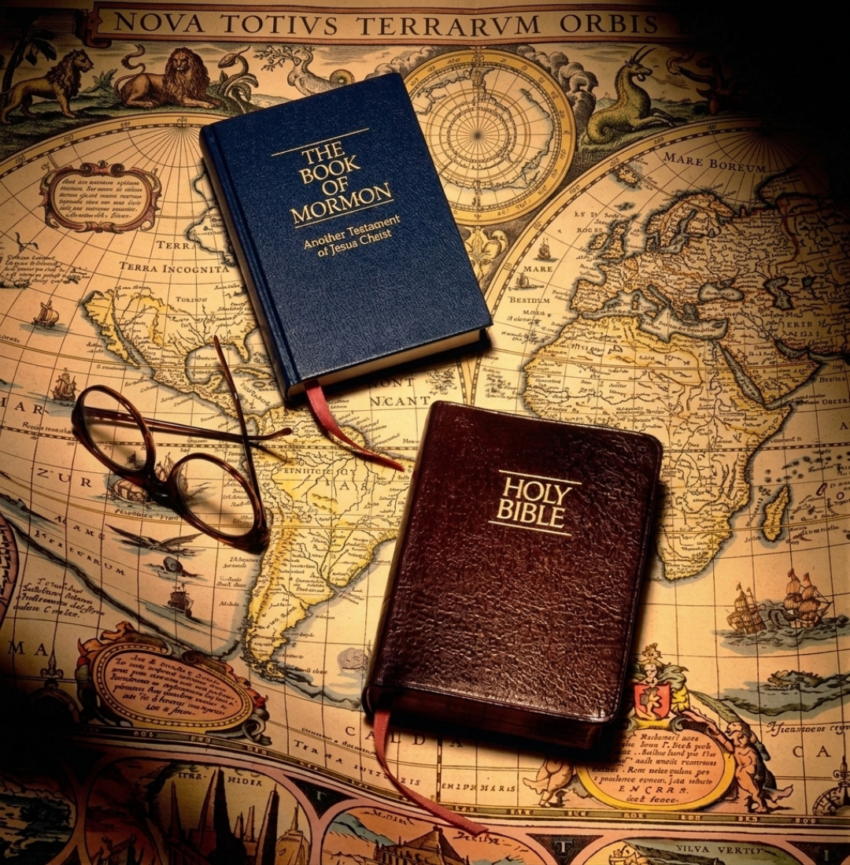
Does the Bible Alone Contain the “Fullness” of the Gospel? A Point-for-Point Examination of the New Testament, Historic Christian Teaching, and the Book of Mormon
◆ ◆ ◆
Introduction: A Farm Boy and a Family Bible
Sometime in the spring of 1820, according to the account he dictated years later, a fourteen-year-old boy in Manchester Township, New York, walked into a stand of trees behind his father’s farmhouse to pray. He went, by his own testimony, because of something he had read. He had been sitting with a book, troubled by the competing revival preachers of the Burned-over District, when a single sentence arrested him.
If any of you lack wisdom, let him ask of God, that giveth to all men liberally, and upbraideth not; and it shall be given him.
— James 1:5, King James Version
The book in Joseph Smith’s hand that morning was not a set of gold plates. It was not an angelic revelation. It was not a seer stone. It was the Holy Bible — the same volume that had sat in Protestant parlors and pulpits across New England for two centuries, the same volume his mother Lucy read, the same volume the Palmyra revivalists were arguing over. Whatever else one concludes about what happened in that grove, this much is a matter of the historical record and of Joseph Smith’s own narration: the entire Restoration begins with a teenager reading the Bible and finding it sufficient enough to send him to his knees.
That fact deserves more theological attention than it usually receives. The claim at the center of Latter-day Saint scripture is that the world in 1820 lacked the fullness of the gospel—that something essential had been lost, and that a new book was required to restore it. Yet the young man appointed to carry out that restoration was moved to seek God first by a verse from the very book said to be deficient. The Bible was not a stranger to the Smith family. It was in their house. It shaped their vocabulary, their piety, their disputes, and their expectations of what God sounded like when He spoke.
And a few years later, on October 8, 1829 — while the Book of Mormon was still being set in type — Oliver Cowdery walked into E. B. Grandin’s bookstore on Main Street in Palmyra and bought a large quarto King James Bible, an 1828 Phinney edition out of Cooperstown, for three dollars and seventy-five cents. He inscribed the flyleaf in his own hand. The Joseph Smith Papers preserve the wording. Cowdery called it “The Book of the Jews,” and recorded it as the property of Joseph Smith Junior and himself. That Bible would become the working text of the Joseph Smith Translation.
Consider the geography of that transaction. The very shop where the Book of Mormon was being printed also sold Joseph Smith the Bible. Both books came off the same street, from the same merchant, in the same season. The question this essay takes up is whether the second book was necessary at all — and whether the first one, the one already in his hand, had been lacking anything.
This is not a small question. It is the load-bearing question of the entire Latter-day Saint truth claim. If the Bible contains the fullness of the gospel, the theological premise for the Restoration collapses. If it does not, then the Christian church spent eighteen centuries preaching a partial message. There is no comfortable middle. And so the question deserves to be asked carefully, with the Latter-day Saint case stated at its strongest, in its own words, from its own sources, before it is weighed.
That is what follows. This essay proceeds point for point. It defines the disputed word. It states the Latter-day Saint position from Latter-day Saint scholarship and Latter-day Saint scripture. It compares, item by item, the Book of Mormon’s own definition of the gospel with the New Testament’s. It examines the question of whether the Book of Mormon is offered as history or as doctrine — a question on which the faith’s own defenders are not entirely agreed. It engages, directly and by name, two published apologetic answers from Ask Gramps. It addresses the persistent question of why so much King James text appears in a book said to have been engraved on plates centuries before the King James translators were born. And it closes with the question that gives this essay its title.
Notes on the “Restoration” and “Great Apostasy” Narrative
Contemporary scholarship in early Christian history has not been kind to the LDS great apostasy narrative. Far from vindicating Joseph Smith’s claim that the church fell into irreversible corruption shortly after the apostolic age, modern historical research — utilizing more sophisticated methodological tools than any previous generation of scholars possessed — has consistently confirmed the basic reliability of the traditional Christian account of church origins and continuous development. The LDS apostasy thesis was constructed in the nineteenth century without access to the manuscript discoveries, archaeological evidence, and social-scientific frameworks that now define the field. It has not fared well against them.
The Mormon claims of total apostasy and exclusive restoration rest not on historical evidence but on the credibility of Joseph Smith’s private revelations. When tested against Scripture, history, and contemporary scholarship, these claims are found wanting. The supposed “restoration” of Christianity by Joseph Smith was unnecessary because authentic Christianity was never lost.
This does not mean the church has been perfect throughout its history. Christians acknowledge the failures, corruptions, and divisions that have marked church history. However, these problems represent partial corruptions requiring reform, not total apostasy requiring restoration. The Protestant Reformation itself demonstrates the church’s capacity for self-correction based on the preserved Scriptures and the continuous witness of the Holy Spirit.
The implications of this evidence extend beyond academic interest to matters of eternal significance. If the Mormon claims about total apostasy are false—as the evidence clearly demonstrates—then the entire foundation of LDS authority and doctrine crumbles. The church does not need restoration because it was never lost. The gospel does not need correction because it was never corrupted beyond recognition. The priesthood does not need restoration because it was never entirely removed.Read the complete essay, “The Gates Did Not Prevail: A Biblical and Historical Case Against the LDS Great Apostasy Doctrine.”
◆ ◆ ◆
Part One: What Does “Fullness” Actually Mean?
The Greek Behind the English
Arguments collapse when words are permitted to drift. The English word “fullness” (spelled “fulness” in the King James Version and, following it, throughout Latter-day Saint scripture) translates the Greek noun πλήρωμα — pleroma — derived from the verb πληρόω, “to fill” or “to complete.” Standard lexical sources place it seventeen times in the New Testament. Baker’s Evangelical Dictionary of Biblical Theology, Thayer, and Mounce all converge on the same range of sense: that which fills, that which has been filled, a full measure, a completion, a bringing to its intended end.
Four of the seventeen occurrences are theologically inert — a patch filling a tear in a garment, baskets filled with fragments. One belongs to the prologue of John. The remaining twelve are Pauline. And when the Pauline uses are laid side by side, a striking pattern emerges. In the New Testament, “fullness” is rarely a bibliographic category. It is a Christological one.
For it pleased the Father that in him should all fulness dwell.
— Colossians 1:19, KJV
For in him dwelleth all the fulness of the Godhead bodily. And ye are complete in him, which is the head of all principality and power.
— Colossians 2:9–10, KJV
And of his fulness have all we received, and grace for grace.
— John 1:16, KJV
That ye might be filled with all the fulness of God.
— Ephesians 3:19, KJV
This is a decisive lexical observation, and it is one that ought to reframe the entire debate before the debate begins. When the New Testament speaks of fullness, it is not describing the completeness of a table of contents. It is describing a Person. The pleroma is not distributed across a canon; it dwells bodily in Jesus Christ. Paul’s astonishing claim in Colossians 2:9–10 is that the totality of deity resides in Christ, and — the second half of the sentence is the one usually left out of the argument — that believers are already complete in Him. The Greek is πεπληρωμένοι, a perfect passive participle: having been filled, and remaining so.
Paul wrote that sentence into a specific controversy. The Colossian error involved supplementation — additional observances, additional mediators, additional secret knowledge held to complete what Christ had begun. Paul’s answer was not that the supplements were incorrect in their details. He answered that supplementation as such misunderstands what Christ accomplished. There is no deficit to be filled, because the fullness is not a quantity of information. It is a Person, and believers are in Him.
This does not by itself settle the Latter-day Saint question, and it would be unfair to pretend it does. Latter-day Saint usage of “fulness of the gospel” derives not from Colossians but from the Doctrine and Covenants, where the phrase carries its own defined sense. But it does establish something important about the New Testament’s own vocabulary: on the Bible’s terms, the fullness is located in Christ and communicated to those united to Him. Any argument that the Bible lacks fullness must reckon with the fact that the Bible itself defines fullness in a way that makes the charge difficult to formulate.
The Latter-day Saint Usage
The phrase enters Latter-day Saint discourse through a handful of revelations dictated by Joseph Smith between 1829 and 1831.
… gave him power from on high, by the means which were before prepared, to translate the Book of Mormon; which contains a record of a fallen people, and the fulness of the gospel of Jesus Christ to the Gentiles and to the Jews also.
— Doctrine and Covenants 20:8–9
The same claim recurs at Doctrine and Covenants 27:5 and 135:3. But the most consequential passage — and the one that will return repeatedly in this essay — is Doctrine and Covenants 42:12, dictated in February 1831:
And again, the elders, priests and teachers of this church shall teach the principles of my gospel, which are in the Bible and the Book of Mormon, in the which is the fulness of the gospel.
— Doctrine and Covenants 42:12
Read that sentence slowly. Whatever else it does, it places the Bible and the Book of Mormon in the same grammatical basket and says that the fullness of the gospel is in them. It does not say the fullness is in the Book of Mormon exclusively. It does not say the Bible contributes a partial deposit that the Book of Mormon completes. The relative clause governs both nouns. This verse is not a critic’s proof text; it is canonized Latter-day Saint scripture, quoted approvingly in the Church’s own missionary manual, and it will prove to be the single most difficult text for the restoration argument to accommodate.
The 1981 Introduction to the Book of Mormon carries the same construction, describing the volume as containing the fullness of the everlasting gospel “as does the Bible.” Two words — “as does” — concede the entire disputed point in a printed preface distributed by the tens of millions.
◆ ◆ ◆
Part Two: The Latter-day Saint Case, Stated at Its Strongest
Fairness requires that the argument be met in its best form, not its weakest. Latter-day Saint scholars and leaders have addressed the “fullness” objection directly and repeatedly, and their answer is more sophisticated than critics sometimes allow. It runs as follows.
Argument One: “Gospel” Is a Technical Term, Not an Encyclopedia
The core Latter-day Saint response is definitional. “The gospel,” in Latter-day Saint usage, is not the sum of all revealed truth. It is a specific, bounded set of saving principles and ordinances. The Foundation for Apologetic Information and Research (FAIR) frames it exactly this way, arguing that the Book of Mormon teaches the doctrine of Christ with a plainness unequaled elsewhere, and therefore contains the fullness of the gospel in the only sense the term was ever meant to bear. FAIR grants without embarrassment that the Book of Mormon does not discuss baptism for the dead, celestial marriage, the three degrees of glory, or the corporeal nature of the Father, and does not treat that silence as a problem.
President Ezra Taft Benson stated the position with characteristic economy, teaching that the declaration of a fullness does not mean the volume contains every doctrine ever revealed, but rather the fullness of what salvation requires — taught plainly enough, he said, that children can learn it. President Harold B. Lee made the same move earlier, answering the baptism-for-the-dead objection by pointing to the Lord’s own definition of the gospel in Doctrine and Covenants 39:5–6 as repentance, baptism by water, and the baptism of fire and the Holy Ghost.
This is not evasion. It is a real distinction, and it is internally coherent. A textbook of arithmetic is not deficient because it omits calculus.
Argument Two: The Six-Point Nephite Formula
The most rigorous scholarly form of the argument belongs to Noel B. Reynolds of Brigham Young University, who published a detailed study in BYU Studies in 1991 arguing that the Nephite prophets employ a consistent, repeating six-point structure whenever they speak of “the gospel” or “the doctrine of Christ.” Reynolds distinguishes the gospel from the plan of salvation: the plan of salvation is what God has done — creation, fall, atonement, judgment — while the gospel is the set of instructions by which the atonement becomes effective in an individual life.
The Book of Mormon states the formula in the mouth of the resurrected Christ:
Behold I have given unto you my gospel, and this is the gospel which I have given unto you — that I came into the world to do the will of my Father, because my Father sent me. And my Father sent me that I might be lifted up upon the cross; and after that I had been lifted up upon the cross, that I might draw all men unto me… And it shall come to pass, that whoso repenteth and is baptized in my name shall be filled; and if he endureth to the end, behold, him will I hold guiltless before my Father at that day when I shall stand to judge the world… And no unclean thing can enter into his kingdom.
— 3 Nephi 27:13–19
This passage is the strongest ground the Latter-day Saint case occupies, and any honest treatment must acknowledge it. It is a clear, Christ-centered, atonement-focused definition of the gospel. It is not works-righteousness. It is not esoteric. It says nothing about temples, plural gods, eternal progression, or vicarious ordinances. It is, in substance, a sermon that a Baptist deacon in 1830 Palmyra could have listened to without objection.
That is precisely the observation on which this entire essay turns — though not in the direction Latter-day Saint apologists intend.
Argument Three: The Text Disclaims Exhaustiveness
Latter-day Saint defenders also point out, correctly, that the Book of Mormon explicitly denies being complete. Mormon states that he recorded only the lesser part of what Jesus taught, promising greater things to those who believe the lesser (3 Nephi 26:8–11). Moroni acknowledges imperfections in the record (Mormon 8:12). The 1830 title page states that if there be fault, it is the mistake of men. FAIR marshals these admissions to argue that no one — least of all the book’s own authors — ever claimed the volume was an exhaustive compendium.
The Latter-day Saint scholar Hugh Nibley pressed the point further still, suggesting that a fullness means the fullness of what a person is capable of receiving at a given moment rather than an infinity of knowledge. Ask Gramps quotes this framing approvingly.
Argument Four: The Open Canon
Finally, Latter-day Saints appeal to continuing revelation. The Ninth Article of Faith affirms belief that God will yet reveal many great and important things. On this reading, the Doctrine and Covenants and the Pearl of Great Price exist precisely to record what the ancient records did not contain: modern organizational instruction, temple ordinances, and structural policy. The absence of these things from a pre-Columbian American record is therefore not merely excusable but expected.
Taken together, these four arguments constitute a serious position. They are not special pleading. They are the reasoned answer of a tradition that has thought hard about an obvious objection. The remainder of this essay engages them on their merits.
◆ ◆ ◆
Part Three: Point for Point — The Nephite Gospel Beside the New Testament
If the Latter-day Saint case rests on the six-point formula of 3 Nephi 27, then the test is straightforward and entirely fair: take the formula on its own terms, point by point, and ask whether the New Testament teaches each element. Not vaguely. Not by inference. Explicitly, and with development.
Point One — Christ Came to Do the Father’s Will
3 Nephi 27:13 has Christ say that He came into the world to do the will of the Father who sent Him. The New Testament states this so frequently that selecting a proof text is a matter of restraint rather than search.
For I came down from heaven, not to do mine own will, but the will of him that sent me.
— John 6:38, KJV
The theme is developed in Hebrews with a depth the Book of Mormon does not attempt. Hebrews 10:5–10 places Psalm 40 on the lips of the incarnate Son, argues that the obedience of Christ replaces the entire sacrificial system, and concludes that believers are sanctified through the offering of His body once for all. That last phrase — ἐφάπαξ, ephapax — carries a finality that becomes important later in this essay. The Nephite formula states the doctrine. Hebrews unfolds it.
Point Two — Lifted Up Upon the Cross to Draw All Men
The Book of Mormon’s image is drawn from John, and drawn closely.
And as Moses lifted up the serpent in the wilderness, even so must the Son of man be lifted up: that whosoever believeth in him should not perish, but have eternal life.
— John 3:14–15, KJV
John 12:32–33 supplies the second half of the same construction — that being lifted up, He will draw all unto Him, with the evangelist adding the editorial note that this signified the manner of His death. The Nephite text reproduces both halves. It does not extend them. The Johannine metaphor of the elevated Son, with its Numbers 21 typology, is a New Testament construction that appears in the Book of Mormon already assembled.
Point Three — Judgment According to Works
That all will stand before Christ and be judged according to their works is stated in 3 Nephi 27:14–15. The New Testament states it in at least four independent streams of tradition.
For we must all appear before the judgment seat of Christ; that every one may receive the things done in his body, according to that he hath done, whether it be good or bad.
— 2 Corinthians 5:10, KJV
Paul says it again in Romans 2:6, quoting the Psalms and Proverbs. Matthew 25:31–46 dramatizes it. Revelation 20:12–13 pictures the opened books. Peter grounds it in the impartiality of the Father (1 Peter 1:17). And the New Testament does something the Book of Mormon does not: it holds judgment-according-to-works together with justification-by-faith-apart-from-works in a single sustained theological argument spanning Romans 2 through Romans 8. That synthesis — how a person justified by grace is nevertheless judged by works without contradiction — is one of the most demanding pieces of reasoning in the New Testament. The Book of Mormon asserts the first half. Paul reconciles both halves.
Point Four — Repent, Be Baptized, and Be Filled with the Holy Ghost
This is the point Latter-day Saint apologists most often present as the Book of Mormon’s distinctive clarity. It is also the point where the New Testament’s priority is most obvious.
Then Peter said unto them, Repent, and be baptized every one of you in the name of Jesus Christ for the remission of sins, and ye shall receive the gift of the Holy Ghost.
— Acts 2:38, KJV
Acts 2:38 states repentance, baptism in the name of Jesus Christ, remission of sins, and reception of the Holy Ghost in a single sentence of nineteen words in the Greek. It is difficult to imagine a formulation more plain or more compact. The Fourth Article of Faith — faith, repentance, baptism by immersion for the remission of sins, laying on of hands for the gift of the Holy Ghost — is, in its substance, a restatement of Acts 2:38 with the mode of baptism specified. Ask Gramps effectively concedes this, acknowledging that by the first of the two Latter-day Saint definitions of the gospel, both the Bible and the Book of Mormon can be said to contain the fullness.
That concession, published on a Latter-day Saint question-and-answer site, is not a small thing. It is the argument of this essay stated by the other side.
Point Five — Endure to the End
But he that shall endure unto the end, the same shall be saved.
— Matthew 24:13, KJV
The doctrine of perseverance is developed across the New Testament with a range that the Book of Mormon does not match. Colossians 1:22–23 conditions presentation before God upon continuing in the faith, grounded and settled. Hebrews 3:14 makes participation in Christ contingent on holding the beginning of confidence steadfast unto the end. Revelation places a promise to the overcomer at the close of each of the seven letters. And John 10:27–29 and Philippians 1:6 supply the countervailing assurance that the keeping is God’s work — a tension the church has wrestled with for two millennia and which the New Testament, unlike the Nephite formula, actually poses in its full difficulty.
Point Six — No Unclean Thing Can Enter
And there shall in no wise enter into it any thing that defileth, neither whatsoever worketh abomination, or maketh a lie.
— Revelation 21:27, KJV
Hebrews 12:14 states that without holiness no one shall see the Lord. 1 Corinthians 6:9–11 lists those who shall not inherit the kingdom — and then, in one of the most consequential sentences in the New Testament, says that such were some of the Corinthians, but they were washed, sanctified, justified. The Book of Mormon’s image of garments washed in the blood of the Lamb is itself a direct appropriation of Revelation 7:14.
The Result of the Comparison
Six points. Six New Testament sources, most of them multiple and independent. Not one element of the Nephite gospel formula lacks a clear biblical antecedent. Not one element is a genuine addition. The Book of Mormon’s definition of the gospel is, in every particular, a restatement of doctrine already present, already explicit, and in most cases already more fully developed in the New Testament.
This is not a hostile characterization. It is exactly what the Latter-day Saint case predicts. If the gospel is the six-point formula, and the New Testament contains the six-point formula, then by the Latter-day Saint definition the New Testament contains the fullness of the gospel. Doctrine and Covenants 42:12 says as much. The Book of Mormon’s own Introduction says as much. Ask Gramps says as much.
The Latter-day Saint apologetic has defended the Book of Mormon’s claim to a fullness so successfully that it has, in the process, established the Bible’s.
◆ ◆ ◆
Part Four: Where the New Testament Goes Further
The preceding section established parity. This one addresses a harder question, and it must be asked carefully to avoid unfairness: are there doctrines essential to salvation that the New Testament develops and the Book of Mormon does not?
The answer is yes, and the omissions are not peripheral.
Justification
The forensic doctrine of justification — God declaring the ungodly righteous on the basis of Christ’s imputed righteousness received through faith — receives sustained argumentative treatment across Romans 3–5 and Galatians 2–4. Paul builds it from Genesis 15:6, defends it against objection, traces its implications for Jew and Gentile, and stakes the legitimacy of the Gentile mission upon it.
Therefore being justified by faith, we have peace with God through our Lord Jesus Christ.
— Romans 5:1, KJV
The Book of Mormon uses the vocabulary of justification (2 Nephi 2:5, Alma 42:23–24) but does not construct the argument. Its most-quoted soteriological line — 2 Nephi 25:23, that we are saved by grace after all we can do — has generated substantial internal Latter-day Saint debate precisely because it admits a reading Paul spends three chapters excluding.
Union with Christ
The Pauline phrase ἐν Χριστῷ, “in Christ,” occurs upward of eighty times in the Pauline corpus and constitutes the structural center of Paul’s soteriology. Believers died with Christ, were buried with Him, were raised with Him, and are seated with Him. Romans 6, Galatians 2:20, Ephesians 2:4–6, and Colossians 3:1–4 develop a doctrine of participatory union that has no meaningful counterpart in the Book of Mormon.
Adoption and the Witness of the Spirit
The Spirit itself beareth witness with our spirit, that we are the children of God: and if children, then heirs; heirs of God, and joint-heirs with Christ.
— Romans 8:16–17, KJV
The New Testament doctrine of υἱοθεσία — adoption as sons, with the Spirit crying Abba in the believer’s heart (Galatians 4:4–7) — supplies the assurance of relationship that Latter-day Saint theology seeks through other means.
The Church as the Body of Christ
Ephesians and 1 Corinthians 12 develop an ecclesiology in which the church is Christ’s body, gifted by one Spirit, built on apostles and prophets with Christ as chief cornerstone, growing into maturity. The Book of Mormon describes church organization in the Americas but offers nothing comparable to the Pauline body-of-Christ theology.
The Resurrection Argument
1 Corinthians 15 is the most sustained argument for and about resurrection in ancient literature. Paul names living eyewitnesses, invites verification, concedes that if Christ is not risen the faith is futile and the apostles are liars, and then constructs a theology of the resurrection body. Nothing of this argumentative character exists in the Book of Mormon.
Historical Verifiability
The New Testament repeatedly anchors itself in checkable public history. Luke addresses a named patron and describes his method (Luke 1:1–4). Paul lists resurrection witnesses and notes that most are still living (1 Corinthians 15:6). Peter denies following cleverly devised fables (2 Peter 1:16). John claims physical handling of the Word of life (1 John 1:1–3). Paul tells Agrippa the events were not done in a corner (Acts 26:26).
The Book of Mormon offers eleven witnesses to plates that are no longer available for examination, a language attested nowhere outside the text, and a geography the Church itself declines to specify. This is a difference in evidentiary kind, not merely degree. It is stated here as a factual comparison, not as an accusation.
◆ ◆ ◆
Part Five: Is It History, or Is It Doctrine?
A recurring feature of conversations with Latter-day Saints is the observation — offered sincerely and often in good faith — that the Book of Mormon is primarily a historical record. A history of a fallen people. A chronicle. On this reading, asking why it omits temple ordinances is like asking why the book of Judges omits the doctrine of the Trinity.
The difficulty is that this is not how the Church describes the book.
The Keystone Claim
Preach My Gospel, the Church’s official missionary curriculum, devotes an entire chapter to the Book of Mormon’s role. It presents President Benson’s threefold keystone framing: keystone in the witness of Christ, keystone in the fulness of doctrine, and foundation of testimony. Benson’s conclusion is stark — that just as an arch collapses when the keystone is removed, so the entire Church stands or falls with the truthfulness of the Book of Mormon.
That is not the language of a supporting historical appendix. Note also the second of the three: fullness of doctrine. The Church’s own manual places doctrinal fullness at the center of the book’s function, not history.
Preach My Gospel goes further still. It instructs missionaries to use the Book of Mormon as their main source for teaching the restored gospel, gives priority to Book of Mormon passages, and supplies a chart mapping each missionary lesson to Book of Mormon references. It then offers a list of what it calls “questions of the soul” — does God exist, does He know me, what is the purpose of life, why is life hard, what happens when I die — and answers every one of them from the Book of Mormon alone.
Every one of those questions is answered in the Bible, at length, and with a depth the cited Nephite passages do not reach. That a missionary manual can pose the fundamental questions of human existence and route all of them through a single non-biblical volume is itself an answer to whether the book is being presented as history or as doctrine.
The Presidential Claim
The same chapter quotes President Russell M. Nelson’s 2017 general conference address, in which he states that the Book of Mormon provides the fullest and most authoritative understanding of the Atonement to be found anywhere, that these truths are taught more powerfully there than in any other book, and that the full power of the gospel is contained in it.
A historical chronicle does not contain the full power of the gospel. A doctrinal authority does. The Church cannot have it both ways, and in its official curriculum it does not try to: the Book of Mormon is presented as the doctrinal keystone, the primary teaching text, and the most authoritative source on the Atonement in existence.
This matters because it removes the historical-record defense. If the Book of Mormon were merely a chronicle, its doctrinal omissions would be unremarkable. But the Church does not present it as merely a chronicle. It presents it as the doctrinal foundation on which everything else rests. And a doctrinal foundation that omits exaltation, eternal progression, the plurality of gods, premortal existence, the three degrees of glory, eternal marriage, vicarious baptism, the Word of Wisdom, and the modern priesthood structure is a foundation that does not support the building erected upon it.
The Honest Statement of the Dilemma
The dilemma can be stated with precision, and Latter-day Saints should feel free to answer it in either direction:
If the Book of Mormon is primarily history, it cannot be the keystone of doctrine, and Benson’s framing overstates the case. If it is primarily doctrine, then its doctrinal content — which is, as demonstrated above, the New Testament’s doctrinal content — does not establish anything the Bible had not already established, and the distinctive teachings that actually differentiate the Church from historic Christianity are absent from the very book said to contain the fullness.
Latter-day Saint scholarship has a third answer, and it deserves to be named: the Book of Mormon’s function is evidentiary rather than informational. It exists not to supply doctrine but to authenticate a prophet, and through him a priesthood, and through that priesthood the ordinances revealed later. On this reading, the book is a credential rather than a curriculum.
This is the most defensible version of the position. But it is also, quietly, a very large concession — because it means the phrase “fullness of the gospel” is not doing the work that Latter-day Saint missionary presentation implies it does, and because it relocates the entire weight of the Restoration onto the historicity of the book rather than onto its message. Benson understood this. That is what the keystone metaphor means.
◆ ◆ ◆
Part Six: Engaging the Ask Gramps Explanations
Ask Gramps is a long-running Latter-day Saint question-and-answer site, unaffiliated with the Church but widely read by members. Two of its articles address this precise question, and because they represent the answer an ordinary Latter-day Saint is most likely to encounter, they merit direct engagement.
The First Answer: The Bible Once Had It, But Lost It
In February 2024, a correspondent named Laurie wrote in with an honest difficulty. She had assumed the Bible contained the fullness of the gospel, could find little discussion of it, and had Evangelical friends she wished to understand. The published answer grants that the Bible contains much of the gospel, then invokes the Eighth Article of Faith — that the Bible is the word of God as far as it is translated correctly — and grounds the qualification in 1 Nephi 13.
And the angel of the Lord said unto me: Thou hast beheld that the book proceeded forth from the mouth of a Jew; and when it proceeded forth from the mouth of a Jew it contained the fulness of the gospel of the Lord… Wherefore, thou seest that after the book hath gone forth through the hands of the great and abominable church, that there are many plain and precious things taken away from the book.
— 1 Nephi 13:24, 28
The answer’s logic is therefore: the Bible originally contained the fullness; corruption removed plain and precious things; the Book of Mormon and modern revelation restore them.
Four responses are in order, and they should be made without heat.
First, the argument is circular in its evidentiary structure. The sole evidence that plain and precious things were removed from the Bible is a text that itself requires the removal to be true. There is no external manuscript, patristic citation, versional witness, or lectionary fragment adduced. The claim is not established by evidence; it is established by the book whose necessity the claim is meant to demonstrate.
Second, the manuscript evidence runs the other way decisively. When 1 Nephi was dictated in 1829, essentially nothing of the modern textual apparatus existed. Since then the discipline has produced Codex Sinaiticus (recovered 1844–1859), Papyrus 52 (dated to the first half of the second century), the Chester Beatty papyri, the Bodmer papyri including P66 and P75, and a Greek manuscript tradition now numbering in the thousands, alongside Latin, Syriac, Coptic, Armenian, and Georgian versions and a vast body of patristic quotation. If a great and abominable institution had systematically excised covenants and doctrines from the New Testament early enough for the corrupted text to reach all nations, that excision would have to have occurred before the second century and left no trace across a manuscript tradition that was already geographically dispersed and textually uncontrolled. The variants that scholarship has in fact recovered are overwhelmingly orthographic and grammatical, and the two most substantial disputed passages — the longer ending of Mark and the pericope of the woman taken in adultery — are additions to the text, not deletions from it. The textual history of the New Testament is a history of accretion at the margins, not of doctrinal excision at the core.
Third — and this is the most striking feature of the Ask Gramps answer — the article itself then quotes Doctrine and Covenants 42:12, which states that the principles of the gospel are in the Bible and the Book of Mormon, in which is the fullness. The answer offers this verse as reassurance that Latter-day Saints do value the Bible. But the verse does more than reassure. It contradicts the argument the answer has just made. If plain and precious things were removed from the Bible such that it no longer contains the fullness, then Doctrine and Covenants 42:12 could not place the Bible inside the clause. The revelation was dictated in 1831, after 1 Nephi was published. Latter-day Saint scripture is not consistent with itself here, and the Ask Gramps article places the two claims within a few hundred words of each other without noticing the tension.
Fourth, the answer closes by commending a challenge issued by Elder Bruce R. McConkie in the October 1983 general conference. The challenge is admirable in its confidence: draw up a list of one hundred to two hundred doctrinal subjects, divide a page into two columns headed Book of Mormon and Bible, work through the Book of Mormon verse by verse, place each teaching under its heading, then locate the parallel in the Old and New Testaments. McConkie predicted the outcome — that Lehi and Jacob would be found to excel Paul on the atonement, that Alma’s sermons would surpass anything in the Bible, that Nephi would outdo Isaiah, Jeremiah, and Ezekiel combined on the scattering and gathering of Israel, and that Mormon on faith, hope, and charity would exceed what even Paul attained.
This challenge should be accepted, not deflected. It is a testable proposal, and it is to McConkie’s credit that he framed it in falsifiable terms. But the exercise contains a structural problem its author appears not to have anticipated. Consider his final example — Mormon on faith, hope, and charity. The passage is Moroni 7:44–48. Set it beside 1 Corinthians 13, and the columns do not diverge; they merge. Moroni 7:45 reproduces the Pauline catalogue of love’s attributes in sequence — suffering long, kind, not envious, not puffed up, seeking not her own, not easily provoked, thinking no evil, rejoicing not in iniquity but in truth, bearing, believing, hoping, enduring all things. The order is Paul’s. The clauses are Paul’s. The King James renderings are Paul’s. Moroni 7:46–47 then follows 1 Corinthians 13:8–13 into charity never faileth and the primacy of charity among the three.
The two-column exercise cannot demonstrate that Mormon exceeds Paul when the Mormon column is, at the decisive points, a transcription of the Paul column. And this observation generalizes. Where the Book of Mormon is most doctrinally impressive, it is most verbally dependent on the King James New Testament. Where it departs from King James language, it is generally narrative rather than doctrinal. McConkie’s challenge, honestly performed, does not produce two columns. It produces one column copied twice.
The Second Answer: Fullness as Personal Capacity
A second Ask Gramps article addresses what is meant by the fullness of the gospel regarding the Book of Mormon. It distinguishes two Latter-day Saint senses of the term — the foundational principles and ordinances necessary for salvation, and the broader totality of all revealed truth — and concedes that by the first measure both the Bible and the Book of Mormon can be said to contain the fullness. It quotes Benson to the effect that fullness does not mean every teaching ever revealed. And it invokes Nibley’s framing that fullness means the fullness of what a person is capable of receiving at a given moment.
The first concession is the essay’s own conclusion and requires no rebuttal. The second is unobjectionable. The third does not survive examination.
If “fullness” denotes the fullness of what an individual is presently capable of receiving, then the word has become a variable rather than a measure. Any book, of any content, given to any reader, contains the fullness of what that reader can currently receive. A children’s catechism would qualify. So would a hymnal. The term ceases to distinguish anything, and in particular it ceases to distinguish the Book of Mormon from the Bible — which is the one thing the doctrine was introduced to do. A definition that makes the disputed claim unfalsifiable has not defended the claim; it has dissolved it.
◆ ◆ ◆
Part Seven: Two Apostles, One Conference, Two Answers
The internal difficulty is not confined to nineteenth-century texts or to unofficial websites. It surfaced in a single general conference.
In April 2007, Elder M. Russell Ballard delivered a Sunday morning address titled “The Miracle of the Holy Bible.” He spoke of the Bible warmly, saying that in it we learn of Christ’s life and doctrines, of His Church, and of His priesthood — and concluding that without the Bible we would not know of His Church then, nor would we have the fulness of His gospel now.
That afternoon, in the same conference, Elder L. Tom Perry spoke on “The Message of the Restoration,” declaring that the fulness of the gospel of Jesus Christ has been restored to the earth, and identifying the Book of Mormon as the volume containing the fulness of the everlasting gospel.
The Christian researcher Sharon Lindbloom drew attention to the juxtaposition, and the observation is difficult to answer. Ballard’s claim is that the Bible is a necessary condition of the present possession of the fullness. Perry’s claim is that the fullness was absent from the earth until restored through the Book of Mormon. Both men were sustained as prophets, seers, and revelators. Both spoke in the same session of the same conference. Both statements were printed in the same issue of the Ensign.
Charity requires acknowledging that Ballard may have meant the Bible and Book of Mormon jointly. But even on that generous reading, the Bible is doing indispensable work — which is precisely what Perry’s restoration framing denies. The tension is real, and it is a tension internal to Latter-day Saint teaching rather than one imported by critics.
◆ ◆ ◆
Part Eight: Why Does the Book of Mormon Contain So Much Bible?
This question is asked constantly and answered rarely with adequate precision. It deserves both the numbers and the counterarguments.
The Scale of the Overlap
The Church itself supplies the Isaiah figures. A footnote at 2 Nephi 12:2 in the 1981 and 2013 editions of the Book of Mormon states that comparison with the King James Bible shows differences in more than half of the 433 Isaiah verses quoted in the Book of Mormon, while about 200 verses have the same wording as the King James Version. Roughly two hundred verses are verbally identical to a translation completed in 1611.
Isaiah is only the beginning. 3 Nephi 12–14 reproduces the Sermon on the Mount. 3 Nephi 24–25 reproduces Malachi 3–4. Moroni 7 follows 1 Corinthians 13. Moroni 10 echoes 1 Corinthians 12. Jacob 1 tracks Hebrews 3. And a substantial body of shorter Pauline and Johannine phraseology is distributed throughout.
The Chronological Problem
The Old Testament citations pose no difficulty on the book’s own terms: Lehi’s family is said to have carried the brass plates containing Isaiah. The New Testament material is a different matter. Nephi, writing around 600 B.C., uses language found in the Pauline epistles. Alma, in the first century B.C., uses phrases from Hebrews. King Benjamin, around 124 B.C., speaks in the vocabulary of the Johannine and Pauline writings. These are documents composed after A.D. 50 by authors who had not been born.
And there is a second layer. Where the King James translators made choices now recognized as translational infelicities — or rendered from a Greek text later found to differ — those same choices appear in the Book of Mormon. Italicized words in the King James Version, which mark English supplied by the translators with no counterpart in the underlying manuscripts, appear in Book of Mormon passages.
The Latter-day Saint Response
Latter-day Saint scholarship has taken this seriously and has produced substantive answers, which should be stated accurately.
Royal Skousen, whose critical text project on the Original and Printer’s Manuscripts is a genuine scholarly achievement, argues that the King James material was not physically copied from a Bible during dictation. His argument turns on Oliver Cowdery’s spelling: Cowdery consistently misspells certain words in the biblical passages in ways he would not have if he were reading from a printed King James text. Skousen proposes instead that Joseph received the text visually through the interpreters, King James wording included, and was at liberty to modify it.
FAIR adds several supporting arguments: that using King James English as a base allows genuine differences to stand out; that a fresh independent translation would have produced distracting variation in wording without corresponding gain in meaning; that removing all the biblical material would still leave a great deal of Book of Mormon text; and that a deceiver would hardly plagiarize the one book his readership knew best.
Assessment
These responses are not frivolous. The Skousen manuscript argument in particular is empirical and has force against the crude version of the plagiarism charge — the image of Joseph Smith reading aloud from an open Bible.
But note carefully what the responses address and what they leave untouched. They address mechanism. They do not address theology.
The theological problem is this. Latter-day Saint scripture holds that the Bible was corrupted by the removal of plain and precious things. The Book of Mormon exists, on this account, to restore what was lost. Yet when the restored record reaches the passages it shares with the Bible, it delivers them in the wording of a seventeenth-century English translation of the allegedly corrupted text — including that translation’s italicized supplements and its known infelicities. Skousen’s seer-stone-supplied-page proposal explains how this could happen without a Bible on the table. It does not explain why a restoration of plain and precious things would restore them in the exact words of the tradition said to have lost them.
Nor does the response resolve the chronology. That pre-Christian prophets speak in the settled theological vocabulary of first-century apostles remains the central difficulty, and it is a difficulty about the text’s content rather than its transmission.
It is only fair to note that a range of Latter-day Saint scholars hold a “loose control” theory of translation, on which Joseph rendered ancient concepts in the biblical idiom most familiar to him and to his readers. On that view, the King James phraseology is a translational garment, not the original fabric. This is a coherent position, and readers should weigh it. It carries a cost, however: the more the wording is attributed to Joseph Smith’s nineteenth-century idiom, the harder it becomes to appeal to the text’s wording as evidence of ancient origin — and the more the Book of Mormon’s doctrinal formulations become indistinguishable from what a well-read Bible reader of 1829 would produce.
◆ ◆ ◆
Part Nine: The Historical Context — 1830 and 1844
The strongest historical observation in this entire discussion is also the least polemical, because it requires no accusation. It requires only a chronology.
What the Book of Mormon Teaches About God
The Book of Mormon’s theology proper is, by the standards of later Latter-day Saint doctrine, remarkably conventional. Abinadi teaches that Christ is both the Father and the Son (Mosiah 15:1–4). The pre-incarnate Christ tells the brother of Jared that He is the Father and the Son (Ether 3:14). Alma 11:26–31 has Amulek deny that there is more than one true and living God. 2 Nephi 31:21 speaks of one God without end. There is no plurality of gods, no exalted man, no eternal progression, no premortal spirit birth, no three degrees of glory, no eternal marriage, no baptism for the dead, no temple endowment, no Word of Wisdom, no Aaronic and Melchizedek priesthood structure as later organized.
The 1830 text is, theologically, a work of the American frontier revival: passionately Christ-centered, anti-Universalist, anti-Calvinist on foreordination, exercised about infant baptism (Moroni 8), exercised about secret combinations at the height of the anti-Masonic excitement following the Morgan affair of 1826, and preoccupied with the origin of the American Indians — a subject of intense popular speculation in the 1820s.
The Chronology of the Distinctive Doctrines
Every doctrine that most sharply distinguishes The Church of Jesus Christ of Latter-day Saints from historic Christianity postdates the Book of Mormon:
• 1830 — the Book of Mormon is published: a Christ-centered volume with no distinctively Latter-day Saint theology
• 1832 — the vision of the three degrees of glory (D&C 76)
• 1833 — the Word of Wisdom (D&C 89)
• 1836 — the Kirtland temple ordinances begin to take shape
• 1840 — baptism for the dead is publicly introduced at Nauvoo
• 1842 — the Nauvoo endowment is instituted, months after Joseph Smith’s initiation into Freemasonry
• 1843 — the revelation on eternal and plural marriage is recorded (D&C 132)
• 1844 — the King Follett discourse: God was once a man; men may become gods; the plurality of gods is preached
A related textual datum belongs here. In the 1830 edition, 1 Nephi 11:18 read that Mary was the mother of God; 1 Nephi 11:21 called the child the Eternal Father. In 1837 these and related readings were altered to read “the Son of God” and “the Son of the Eternal Father.” The change is small in ink and large in significance: it moves the text away from the modalistic idiom of 1830 toward the increasingly distinct Godhead theology of the later 1830s.
The Two Readings
Two interpretations of this chronology are available, and intellectual honesty requires stating both.
The Latter-day Saint reading is that revelation proceeds line upon line, precept upon precept (2 Nephi 28:30; Isaiah 28:10). God gives what a people can bear. The 1830 Saints were not prepared for Nauvoo theology; by 1844 they were. On this reading the sequence is pedagogical, not evolutionary, and the absence of the later doctrines from a pre-Columbian record is exactly what one would expect.
The critical reading, advanced by historians including Grant Palmer and by a substantial body of scholarship in the Mormon history field, is that the sequence is the ordinary signature of a developing theology: an author begins within his inherited religious framework and moves outward as his confidence, his community, and his ambitions grow. On this reading, the 1830 book looks Protestant because in 1830 Joseph Smith’s theology was Protestant.
The two readings account for the same data. What distinguishes them is not the chronology but the prior question of whether the revelatory claim is granted. And that is why the “fullness” question matters so much: it is one of the few points where the two readings make different predictions. If God revealed a fullness in 1830 and then revealed a great deal more that is required for exaltation, the word “fullness” was either used loosely or used prematurely.
◆ ◆ ◆
Part Ten: The Book They Already Had
Return now to the question posed at the outset. The Smith family owned a Bible. Joseph read it well enough that a single verse in the epistle of James redirected his life. Lucy Mack Smith’s memoir describes a household preoccupied with religion. Palmyra in the 1820s was saturated with Scripture; the Bible was the common possession of nearly every literate family in the district.
Why, then, did the search for the true church not begin and end in that book?
This question must be asked with care, because it is easy to ask it uncharitably — as though the answer were laziness or bad faith. It is neither. Joseph Smith’s own account gives a coherent explanation: he read James 1:5, prayed, and received an answer telling him that the creeds were an abomination and the professors corrupt. On his own testimony, the Bible sent him to prayer, and the prayer sent him away from the Bible’s churches.
But notice the shape of that sequence, because it contains the whole difficulty in miniature. The Bible functioned, in the decisive moment of Joseph Smith’s life, exactly as its own doctrine of sufficiency claims it functions. It gave wisdom to a young man who lacked it. It directed him to God. It equipped him to act. James 1:5 did not require supplementation to accomplish its purpose. It worked.
What did not happen — and this is an observation about method rather than about motive — is that the young man did not then take the same book and search it for the answer to the question that troubled him. He did not read the Pastoral Epistles for the marks of a true church, or Acts for the pattern of its founding, or Ephesians for its constitution, or Galatians for what happens when a gospel is supplemented. He asked, received an answer by vision, and proceeded from the vision rather than from the text.
That is a legitimate procedure if one grants the vision. It is not a test of the Bible’s sufficiency. The Bible’s claim to contain all things necessary for salvation was never actually put to the trial in 1820 — not because it failed, but because the trial was not conducted. The verdict of insufficiency was delivered before the evidence was examined.
And nine years later, on a street in Palmyra, Oliver Cowdery paid three dollars and seventy-five cents for a Bible at the same shop where the Book of Mormon was in press — and inscribed it, in the flyleaf preserved by the Joseph Smith Papers, as “The Book of the Jews.” The label is worth sitting with. Not the book of the Church. Not the word of God. The Book of the Jews — a possession of somebody else, acquired now as raw material for correction.
◆ ◆ ◆
Part Eleven: What the Bible Claims for Itself
The doctrine of the sufficiency of Scripture is not an invention of Protestant polemics. It is a claim the New Testament makes about itself, and it is worth stating precisely, because it is frequently overstated by its friends and caricatured by its critics.
The Central Text
And that from a child thou hast known the holy scriptures, which are able to make thee wise unto salvation through faith which is in Christ Jesus. All scripture is given by inspiration of God, and is profitable for doctrine, for reproof, for correction, for instruction in righteousness: that the man of God may be perfect, throughly furnished unto all good works.
— 2 Timothy 3:15–17, KJV
Two Greek words carry the argument. The first is θεόπνευστος, theopneustos — God-breathed — a word Paul appears to have coined, locating the origin of Scripture in the exhalation of God rather than the inspiration of the writer. The second is the pair ἄρτιος (artios, “complete,” rendered “perfect” in the King James) and ἐξηρτισμένος (exērtismenos, “thoroughly equipped”). Paul does not say Scripture is helpful. He says it produces a person who is complete and fully outfitted for every good work.
That is a sufficiency claim in the strict sense: not that Scripture answers every question a human being might ask, but that it lacks nothing required for the purpose for which it was given.
The Supporting Testimony
… that ye should earnestly contend for the faith which was once delivered unto the saints.
— Jude 3, KJV
The Greek is ἅπαξ παραδοθείσῃ — delivered once for all. The adverb ἅπαξ denotes a completed, unrepeatable act. Jude does not describe a faith in progress.
According as his divine power hath given unto us all things that pertain unto life and godliness.
— 2 Peter 1:3, KJV
But though we, or an angel from heaven, preach any other gospel unto you than that which we have preached unto you, let him be accursed.
— Galatians 1:8, KJV
Paul’s anathema in Galatians is directed at supplementation, not at contradiction. The Judaizers did not deny Christ; they added to Him. Paul treats addition as a species of denial — which is the same logic that drives Colossians 2:9–10.
And many other signs truly did Jesus in the presence of his disciples, which are not written in this book: but these are written, that ye might believe that Jesus is the Christ, the Son of God; and that believing ye might have life through his name.
— John 20:30–31, KJV
John’s statement is the model of a properly limited sufficiency claim. He concedes explicitly that his book is not exhaustive — and asserts in the same breath that what he has written is adequate for its purpose: belief, and life through Christ’s name. Selectivity and sufficiency are not in tension. A book may omit a great deal and still contain everything necessary.
This distinction dissolves much of the apparent force of the Latter-day Saint objection. The Christian claim has never been that the Bible is an encyclopedia. It is that the Bible is enough.
How the Traditions Actually Divide
It would be inaccurate to present this as a uniform Christian consensus, and the differences deserve fair statement.
The Reformation traditions state the doctrine formally. Article VI of the Thirty-Nine Articles holds that Scripture contains all things necessary to salvation, and that nothing read therein nor provable thereby is to be required of any man as an article of faith. The Westminster Confession (1.6) makes the same claim while acknowledging that some circumstances of worship and government are ordered by the light of nature and Christian prudence.
Roman Catholic and Eastern Orthodox teaching affirms the inspiration and centrality of Scripture while holding that it is transmitted and interpreted within the living tradition of the Church. The Second Vatican Council’s Dei Verbum treats Scripture and Tradition as flowing from the same divine wellspring. Many Catholic theologians distinguish material sufficiency — that all revealed truth is present in Scripture at least implicitly — from formal sufficiency, which they deny.
These are real disagreements, and this essay does not pretend to resolve them. But observe what unites Catholic, Orthodox, and Protestant against the Latter-day Saint claim: none of these traditions holds that the apostolic deposit was lost and required restoration through a new volume of scripture, and none holds that the New Testament fails to contain the gospel of salvation. The dispute among the historic traditions concerns the interpretive authority under which Scripture is read. It does not concern whether the gospel survived.
◆ ◆ ◆
Part Twelve: Is the Book of Mormon Necessary?
The conclusion follows from what has been established, and it should be stated as a conclusion rather than as a taunt.
On the Latter-day Saint definition of the gospel — faith in Christ, repentance, baptism, the gift of the Holy Ghost, enduring to the end, and salvation through the Atonement — the New Testament contains every element, explicitly, and in most cases with greater theological development. Latter-day Saint scripture concedes it at Doctrine and Covenants 42:12. The Introduction to the Book of Mormon concedes it in the phrase “as does the Bible.” Ask Gramps concedes it in print. Elder Ballard came close to conceding it from the conference pulpit.
The doctrines that are genuinely distinctive to the Restoration — exaltation, eternal progression, the plurality of gods, premortal existence, the three degrees of glory, celestial marriage, vicarious ordinances, the temple endowment — are absent from the Book of Mormon. They are found in the Doctrine and Covenants, the Pearl of Great Price, and the discourses of the Nauvoo period. Which means the volume said to contain the fullness of the gospel contains none of the doctrines that make the Restoration a restoration.
The most rigorous Latter-day Saint answer, as noted earlier, relocates the Book of Mormon’s function from content to credential: the book is not necessary because of what it teaches but because of what its existence proves. It authenticates Joseph Smith, and Joseph Smith authenticates everything that follows.
This is honest, and it should be honored as such. But it changes the question entirely. It means the Book of Mormon’s value is evidentiary rather than doctrinal — and it means that every claim resting upon it rests, ultimately, on historical and evidentiary questions: the plates, the witnesses, the translation, the geography, the anachronisms, the King James material. Benson said as much when he wrote that the whole Church stands or falls with the truthfulness of the Book of Mormon. That is not a claim about the sufficiency of its doctrine. It is a wager on its historicity.
◆ ◆ ◆
Conclusion: The Book Already in His Hand
A boy sat in the woods with a Bible open on his knee, and a sentence about wisdom moved him to pray. Everything that followed — the visions, the plates, the church, the trek, the temples, the millions who now carry two books instead of one — begins from that moment of a young man finding the Bible sufficient enough to act on.
That is the irony at the center of this subject, and it is not a rhetorical flourish. It is a documented sequence. The Restoration’s founding narrative depends on the Bible’s power to instruct, convict, and direct — the very power its doctrine of the Great Apostasy denies the Bible retained.
This essay has argued, point for point, that the Book of Mormon’s own six-point definition of the gospel is contained entire within the New Testament; that the New Testament develops justification, union with Christ, adoption, the church as Christ’s body, and the resurrection with a depth the Book of Mormon does not reach; that the Church’s own missionary curriculum presents the Book of Mormon as doctrinal keystone rather than historical chronicle, closing off the history-not-doctrine defense; that Doctrine and Covenants 42:12 and the Book of Mormon’s Introduction both place the Bible inside the fullness; that the Ask Gramps explanations rest on a circular corruption argument that the manuscript evidence does not support and on a redefinition of “fullness” that dissolves the term; that two apostles gave incompatible answers in a single conference; that the King James material in the Book of Mormon raises a theological problem the mechanical explanations do not reach; and that every distinctive Restoration doctrine postdates 1830.
None of this is offered as an attack on the sincerity, devotion, or moral seriousness of Latter-day Saints, whose commitment to family, service, and Christ’s name is evident to anyone who lives among them. It is offered as an argument about texts, and it invites an argument in reply.
The New Testament’s own word for fullness — pleroma — is not a measure of pages. Paul used it to say that in Christ all the fullness of the Godhead dwells bodily, and that those who are in Him are complete. If that sentence is true, the search for a supplementary fullness is not merely unnecessary. It is a search for something that was never missing.
The book was already in his hand.
◆ ◆ ◆
SOURCES AND FURTHER READING
Every source listed below was consulted directly. Where a source is a community discussion board rather than scholarship, that is noted in the entry. Scriptural quotations are from public-domain texts.
Latter-day Saint Official and Apologetic Sources
“Chapter 5: Use the Power of the Book of Mormon,” Preach My Gospel: A Guide to Sharing the Gospel of Jesus Christ (2023). The Church of Jesus Christ of Latter-day Saints.
https://www.churchofjesuschrist.org/study/manual/preach-my-gospel-2023/13-chapter-5?lang=eng
“The Book of Mormon and the fulness of the gospel.” FAIR (Foundation for Apologetic Information and Research).
https://www.fairlatterdaysaints.org/answers/The_Book_of_Mormon_and_the_fulness_of_the_gospel
“Question: What does it mean when it is said that the Book of Mormon contains the ‘fulness of the gospel?’” FAIR.
https://www.fairlatterdaysaints.org/answers/The_Book_of_Mormon_and_the_fulness_of_the_gospel
“The Book of Mormon as the most correct book.” FAIR.
https://www.fairlatterdaysaints.org/answers/The_Book_of_Mormon_as_the_most_correct_book
“Bible passages in the Book of Mormon.” FAIR. (Royal Skousen manuscript argument.)
https://www.fairlatterdaysaints.org/answers/Bible_passages_in_the_Book_of_Mormon
“Isaiah and the Book of Mormon.” FAIR. (Source of the 433-verse footnote statistic.)
https://www.fairlatterdaysaints.org/answers/Isaiah_and_the_Book_of_Mormon
Michael Parker, “The Book of Mormon and the Fulness of the Gospel.” FAIR Publications Archive.
https://www.fairlatterdaysaints.org/archive/publications/the-book-of-mormon-and-the-fulness-of-the-gospel
Noel B. Reynolds, “The Gospel of Jesus Christ as Taught by the Nephite Prophets,” BYU Studies 31, no. 3 (Summer 1991): 31–50.
https://byustudies.byu.edu/content/gospel-jesus-christ-taught-nephite-prophets
“Fulness of the Gospel.” Encyclopedia of Mormonism. Brigham Young University.
https://eom.byu.edu/index.php/Fulness_of_the_Gospel
“If the Book of Mormon Contains the Fullness of the Gospel, Why Does It Not Contain Many Latter-day Saint Teachings?” Scripture Central.
https://scripturecentral.org/q-and-a/if-the-book-of-mormon-contains-the-fullness-of-the-gospel-why-does-it-not-contain-many
Daniel Peterson, “Does the Book of Mormon contain the ‘fulness’ of the gospel?” Deseret News, May 15, 2014.
https://www.deseret.com/2014/5/15/20541389/does-the-book-of-mormon-contain-the-fulness-of-the-gospel/
“An Overview of Book of Mormon Insights.” BYU Religious Studies Center.
https://rsc.byu.edu/book-mormon-insights/overview-book-mormon-insights
“Joseph Smith’s Translation of the Bible.” BYU Religious Studies Center. (Documents the October 8, 1829 Bible purchase.)
https://rsc.byu.edu/joseph-smith-translation/joseph-smiths-translation-bible
“Bible Used for Bible Revision.” The Joseph Smith Papers. (Cowdery flyleaf inscription.)
https://www.josephsmithpapers.org/paper-summary/bible-used-for-bible-revision/5
Kent P. Jackson, “Joseph Smith’s Cooperstown Bible: The Historical Context of the Bible Used in the Joseph Smith Translation.” BYU Studies.
https://byustudies.byu.edu/article/joseph-smiths-cooperstown-bible-the-historical-context-of-the-bible-used-in-the-joseph-smith-translation
Latter-day Saint Question-and-Answer and Community Sources
“Does the Bible contain the fulness of the gospel?” Ask Gramps, February 13, 2024.
https://askgramps.org/does-the-bible-contain-the-fulness-of-the-gospel-2/
“Does the Bible contain the fulness of the gospel?” Ask Gramps (earlier entry).
https://askgramps.org/does-the-bible-contain-the-fulness-of-the-gospel/
“What is meant by the fullness of the gospel regarding the Book of Mormon?” Ask Gramps.
https://askgramps.org/what-is-meant-by-the-fullness-of-the-gospel-regarding-the-book-of-mormon/
“In Nephi 13:34 it says ‘much’ of my gospel. Can you shed some light on this?” Ask Gramps. (Ezra Taft Benson quotation.)
https://askgramps.org/in-nephi-1334-it-says-much-of-my-gospel-can-you-shed-some-light-on-this/
“What Is the Fulness of the Gospel?” Book of Mormon Study Notes, January 27, 2019.
https://bookofmormonstudynotes.blog/2019/01/27/what-is-the-fulness-of-the-gospel/
“How the Book of Mormon Contains the Fullness of the Gospel.” ScriptureSight, May 2019.
https://scripturesight.blogspot.com/2019/05/how-book-of-mormon-contains-fullness-of.html
“BoM says of itself it is comparable to the Bible and contains the fulness of the gospel.” Christianity Stack Exchange, Question 101729.
https://christianity.stackexchange.com/questions/101729/bom-says-of-itself-it-is-comparable-to-the-bible-and-contains-the-fulness-of-the
r/exmormon, “What’s your definitive evidence that the BoM is…” Reddit discussion thread. (Community discussion; cited as a record of lay argument, not as scholarship.)
https://www.reddit.com/r/exmormon/comments/1lfn7a5/whats_your_definitive_evidence_that_the_bom_is/
Exmormon Foundation discussion board, thread 213244. (Community discussion; cited as a record of lay argument, not as scholarship.)
https://www.exmormon.org/phorum/read.php?2,213244
Christ VM group discussion thread. Facebook. (Community discussion.)
https://www.facebook.com/groups/christvm/posts/5915991131835099/
Christian Response and Comparative Sources
Sharon Lindbloom, “Where the Fulness of the Gospel Resides.” Mormonism Research Ministry, November 9, 2007. (Ballard and Perry, April 2007 general conference.)
https://mrm.org/where-the-fulness-of-the-gospel-resides
“The Book of Mormon: The Keystone of Mormon Doctrine.” Mormonism Research Ministry.
https://mrm.org/the-book-of-mormon-the-keystone-of-mormon-doctrine
“Crash Course Mormonism: The Gospel.” Mormonism Research Ministry.
https://mrm.org/gospel-doctrine
“Book of Mormon; Fullness of the Gospel?” Life After Ministry.
https://lifeafterministry.com/2011/04/book-of-mormon-fullness-of-the-gospel-2/
“Fullness of the Gospel?” Tough Questions Answered, May 19, 2009.
https://www.toughquestionsanswered.org/2009/05/19/fullness-of-the-gospel/
“Fulness of the Gospel.” Truth in Love Ministry Digital Dictionary.
https://tilm.org/digital-dictionary/fulness-of-the-gospel/
Biblical Theology, Lexical, and Sufficiency Sources
“Fullness.” Baker’s Evangelical Dictionary of Biblical Theology, ed. Walter A. Elwell. Bible Study Tools.
https://www.biblestudytools.com/dictionary/fullness/
“G4138 — plērōma.” Strong’s Greek Lexicon with Thayer’s. Blue Letter Bible.
https://www.blueletterbible.org/lexicon/g4138/kjv/tr/0-1/
“πλήρωμα (plērōma).” Bill Mounce Greek Dictionary.
https://www.billmounce.com/greek-dictionary/pleroma
“What is the doctrine of sufficiency?” BibleAsk.
https://bibleask.org/what-is-the-doctrine-of-sufficiency/
“What is the doctrine of the sufficiency of Scripture?” GotQuestions.org.
https://www.gotquestions.org/sufficiency-of-Scripture.html
“What is the gospel message?” GotQuestions.org.
https://www.gotquestions.org/gospel-message.html
“What are life’s biggest questions?” GotQuestions.org.
https://www.gotquestions.org/lifes-biggest-questions.html
“What is the foundation of the faith?” GotQuestions.org.
https://www.gotquestions.org/foundation-of-the-faith.html
“What Is the Gospel?” Cru.
https://www.cru.org/us/en/train-and-grow/spiritual-growth/core-christian-beliefs/what-is-gospel.html
“The Sufficiency of Scripture.” The Gospel Coalition.
https://www.thegospelcoalition.org/essay/the-sufficiency-of-scripture/
“Article VI: Of the Sufficiency of the Holy Scriptures for Salvation.” Church Society.
https://www.churchsociety.org/resource/article-6-of-the-sufficiency-of-the-holy-scriptures-for-salvation/
“Soteriology: The Doctrine of Salvation.” Bible.org.
https://bible.org/article/soteriology-doctrine-salvation
“Essential Doctrines of Christianity.” Bible Institute of Ministry (BINMIN).
https://binmin.org/essential-doctrines-of-christianity/
“Understanding Biblical Descriptors of Salvation.” Christian Apologetics Ministry.
https://capmin.org/understanding-biblical-descriptors-salvation/
“Salvation Bible Verses.” Bible Study Tools Topical Index.
https://www.biblestudytools.com/topical-verses/salvation-bible-verses/
Wyatt Graham, “Why the Bible Is So Important for the Christian Life.”
https://www.wyattgraham.com/p/why-the-bible-is-so-important-for-the-christian-life
“The Role of the Bible in Theology and Apologetics.” Apologetics for the Church.
https://apologeticsforthechurch.org/the-role-of-the-bible-in-theology-and-apologetics/
“The Meaning of Life: A Biblical Answer.” TruthStory.
https://truthstory.org/blog/meaning-life-biblical-answer/
“The Five Basic Doctrines.” Scribd document collection.
https://www.scribd.com/document/451323729/THE-FIVE-BASIC-DOCTRINES-docx
“Twelve Doctrines of Christianity.” Reference compilation.
https://fullpdfword.com/look-up/mLBA46/605722/5041042-12-doctrines-of-christianity
Primary Scriptural and Historical Texts
The Holy Bible, Authorized (King James) Version, 1611/1769. Public domain.
The Book of Mormon, 1830 edition and current editions. The Church of Jesus Christ of Latter-day Saints.
The Doctrine and Covenants, sections 20, 27, 39, 42, 76, 89, 132, 135.
The Pearl of Great Price, Joseph Smith—History and the Articles of Faith.
Joseph Smith, History of the Church, ed. B. H. Roberts, 7 vols. (Deseret Book, 1957), 4:461. Public domain.
Brigham Young, Journal of Discourses 9:311 (July 13, 1862); George A. Smith, Journal of Discourses 12:335. Public domain.
Harold B. Lee, Teachings of Harold B. Lee (Salt Lake City: Bookcraft, 1996), 156.
Ezra Taft Benson, A Witness and a Warning (Salt Lake City: Deseret Book, 1988), 18–19.
Bruce R. McConkie, “What Think Ye of the Book of Mormon?” General Conference, October 1983.
https://www.churchofjesuschrist.org/study/general-conference/1983/10/what-think-ye-of-the-book-of-mormon?lang=eng
Russell M. Nelson, “The Book of Mormon: What Would Your Life Be Like without It?” Ensign/Liahona, November 2017, 61–62.
https://www.churchofjesuschrist.org/study/general-conference/2017/10/the-book-of-mormon-what-would-your-life-be-like-without-it?lang=eng
M. Russell Ballard, “The Miracle of the Holy Bible,” Ensign, May 2007, 80–82.
L. Tom Perry, “The Message of the Restoration,” Ensign, May 2007, 85–88.
Grant H. Palmer, An Insider’s View of Mormon Origins (Salt Lake City: Signature Books, 2002), 124.
Royal Skousen, The Book of Mormon Critical Text Project. Brigham Young University.
A Note on Research Methods and Accuracy
In recent years, some have voiced concern that artificial intelligence may distort facts or introduce inaccuracies into serious research. That criticism deserves acknowledgment. However, AI has now evolved into the most powerful research instrument available to any dedicated scholar—capable of analyzing vast datasets, cross‑referencing historical records, and surfacing overlooked connections across sources. This work represents a collaboration between the author’s investigative inquiry, verified primary documentation, and the advanced analytic capabilities of AI research tools. Here, AI was not used as a ghostwriter or a shortcut for scholarship, but as a disciplined research partner devoted to rigor, accuracy, and transparency.
Every factual claim in this work has been subjected to active verification. Where AI‑generated content was used as a starting point, it was tested against primary sources, peer‑reviewed scholarship, official institutional documentation, and established historical records. Where discrepancies were found—and they were found—corrections were made. The author has made every reasonable effort to ensure that quotations are accurately attributed, historical details are precisely rendered, and theological claims fairly represent the positions they describe or critique.
That said, no work of this scope is immune to error, and the author has no interest in perpetuating inaccuracies in the service of an argument. If you are a reader—whether sympathetic, skeptical, or hostile to the conclusions drawn here—and you identify a factual error, a misattributed source, a misrepresented teaching, or a claim that cannot be substantiated, you are warmly and genuinely invited to say so. Reach out. The goal of this work is not to win a debate but to get the history right. Corrections offered in good faith will be received in the same spirit, and verified corrections will be incorporated into future editions without hesitation.
Truth, after all, has nothing to fear from scrutiny—and neither does this work.