
An AI Exposition and Supplemental Bible Study of Luke 18:1–8, as preached by
Pastor David Jerome at East Valley International Church, September 13, 2026.
The Parable of the Persistent Widow
Prayer does not fit us for the greater work; prayer is the greater work.
— Oswald Chambers, My Utmost for His Highest
.
And he spake a parable unto them to this end, that men ought always to pray, and not to faint; saying, There was in a city a judge, which feared not God, neither regarded man: and there was a widow in that city; and she came unto him, saying, Avenge me of mine adversary. And he would not for a while: but afterward he said within himself, Though I fear not God, nor regard man; yet because this widow troubleth me, I will avenge her, lest by her continual coming she weary me. And the Lord said, Hear what the unjust judge saith. And shall not God avenge his own elect, which cry day and night unto him, though he bear long with them? I tell you that he will avenge them speedily. Nevertheless when the Son of man cometh, shall he find faith on the earth?
— Luke 18:1–8, Authorized Version
◆ ◆ ◆
I. The Work Behind the Work
There is a sentence that has quietly troubled the praying church for a hundred years. Oswald Chambers wrote it in a devotional paragraph so brief that most readers pass over it before it can do its damage: prayer does not prepare us for the greater work, he said; prayer is itself that greater work. Read quickly, it sounds like pious exaggeration. Read slowly, it is an indictment. For most of us organize our lives on precisely the opposite assumption. We treat prayer as the vestibule and ministry as the house. We pray before the sermon, before the surgery, before the board meeting, before the mission trip, as though prayer were the tuning of the instrument and the real music began afterward. We say, with entire sincerity and no awareness of the blasphemy in it, that we have done all we can do and now all that is left is prayer.
Our Lord Jesus Christ takes the opposite view, and in Luke 18:1–8 He argues for it. He does not argue with a syllogism. He argues with a story about a woman no attorney would have represented, pressing a case no court would have prioritized, before a man no argument could move. The story is short, faintly comic, and utterly serious. It has been called the Parable of the Unjust Judge, which emphasizes the wrong place, and the Parable of the Persistent Widow, which puts it in the right one. What follows is an attempt to hear it as Luke’s first readers would have heard it — not as a lesson in devotional technique, but as marching orders for a church that must live a long time in the dark.
II. Where the Parable Stands
Parables are not free-floating. They are set in an argument, and this one is set in a very particular argument that begins back in Luke 17:20. The Pharisees have asked when the kingdom of God will come. Jesus answers them briefly and then turns to His disciples with something far heavier. He tells them that days are coming when they will long to see one of the days of the Son of Man and will not see it (17:22). He speaks of the days of Noah, when people ate and drank and married until the flood came, and of the days of Lot, when they bought and sold and planted and built until fire fell (17:26–30). He warns them not to look back like Lot’s wife. He tells them that the coming will be as visible as lightning and as sudden as a snapped thread.
So the disciples are given two facts that sit uneasily together. First, the Son of Man is certainly coming. Second, He is not coming yet, and the interval will be long enough to make them ache. It is exactly at that seam — between the certainty of the end and the unbearable length of the middle — that Luke sets our parable. Chapter and verse divisions obscure this. Read Luke 17 and 18 as a single breath, and the parable becomes what it actually is: the Lord’s answer to the question, How shall we survive the waiting?
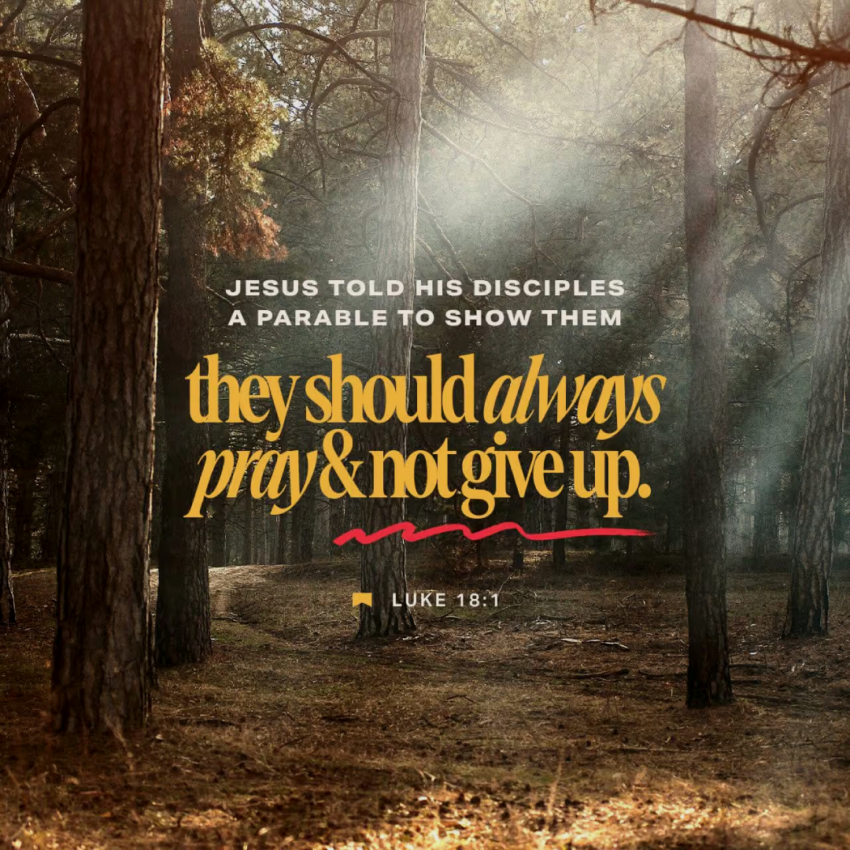
Luke then does something he does only rarely, and does twice in a row here. He tells us the point before he tells us the story. “And he spake a parable unto them to this end, that men ought always to pray, and not to faint” (18:1); nine verses later he introduces the next parable the same way (18:9). We are not left to guess. But notice how the purpose is worded, because the wording is the whole sermon in miniature.
The verb rendered “ought” is the Greek deî (δεῖ), the impersonal verb of moral and even divine necessity — the same word Luke uses when he says the Christ must suffer. Prayer here is not presented as a spiritual amenity for those with a temperament for it. It is a necessity of the created order for people in our position. And the alternative is stated with unnerving simplicity. The Greek is pantote proseuchesthai kai mḗ enkakein — always to pray and not to lose heart. The verb enkakein is not a soft word. It carries the sense of losing one’s nerve, going slack, turning cowardly, collapsing in the middle of a long effort. The Authorized Version’s “faint” is exactly right if we hear it as a soldier faints in the field rather than as a lady faints at bad news.
Which means Jesus offers only two options. There is no third. A believer facing a long delay either prays or caves. There is no neutral posture, no dignified holding pattern, no mature stoicism that neither prays nor despairs. The moment we stop asking, the collapse has already begun; we simply have not felt it yet.
III. A Judge Who Feared Neither God Nor Man
“There was in a city a judge, which feared not God, neither regarded man” (18:2). Ten words, and a complete moral autopsy.
Understand first what a judge was supposed to be in Israel. Jehoshaphat’s charge to the judges he appointed is the classic statement: they were to consider what they did, because they judged not for man but for the LORD, who was with them in the judgment; therefore let the fear of the LORD be upon them (2 Chronicles 19:6–7). Moses had said the same thing — judges must not respect persons, must not take a bribe, must hear the small as well as the great, because the judgment is God’s (Deuteronomy 1:16–17; 16:18–20). A judge in Israel occupied a borrowed throne. He sat in God’s seat, on loan, and the fear of God was the one thing that made the arrangement safe.
This man has none of it. And Jesus adds the second clause, that he “regarded not man” — the Greek ouk entrepomenos, meaning he felt no shame before people, was not embarrassed by their opinion, could not be made to blush. In an honor-and-shame culture, that is not a small failing; it is armor plating. Consider what it makes him. He cannot be moved by the fear of divine judgment, because he does not believe in it. He cannot be moved by public disgrace, because he is beyond humiliation. He cannot be moved by pity, because Luke tells us nothing whatever about a conscience. Every ordinary lever a poor person might use has been removed.
There is a historical edge here as well. Jewish civil disputes were normally heard by a panel; a lone magistrate sitting on his own authority suggests a salaried official of the Herodian or Roman administration, the kind of functionary the rabbis complained about bitterly, whose docket moved according to who had paid. Which leaves exactly one lever that would work on such a man — money — and the widow, of course, has none. That is precisely why Jesus made her a widow.
IV. A Widow Who Would Not Go Away
Scripture has a category for people like her, and God has attached His own name to it. The law forbade afflicting any widow or fatherless child, and warned that if they cried at all to God He would surely hear their cry (Exodus 22:22–24). Moses declared that the LORD executes the judgment of the fatherless and the widow (Deuteronomy 10:18). The psalmist called Him a father of the fatherless and a judge of the widows in His holy habitation (Psalm 68:5). Isaiah’s opening indictment of Judah reaches its climax in the charge that the widow’s cause did not come before them (Isaiah 1:17, 23). Jesus is not choosing a random sympathetic figure. He is choosing the one person in the ancient world whose neglect God had specifically promised to notice.
She has no husband to speak for her, and depending on her circumstances, she may have had no adult son or brother-in-law either. She has no advocate, no money, no standing, no leverage, and quite possibly no legal voice of her own in that courtroom. Her petition is a single legal demand: “Avenge me of mine adversary.” The verb is ekdikḗson me, and the Authorized Version’s “avenge” has misled generations of readers into hearing a vengeful spirit. She is not asking for revenge. She is asking for a ruling. “Vindicate me” or “grant me justice against my opponent” is the sense. Someone has taken what was hers — a field, an inheritance, a pledge, a debt owed to her dead husband — and she wants a verdict.
Luke’s grammar is doing quiet work here. In verse 3, the imperfect tense (ḗrcheto, “she kept coming”) tells us this was not a single dramatic appearance but a routine. She came, and came, and came. She had no eloquence to deploy and no bribe to offer. What she had was arithmetic. She possessed more tomorrows than the judge possessed patience, and she was willing to spend every one of them.
Then Jesus lets us eavesdrop. “He said within himself” — Luke loves these interior monologues, and they are never flattering; the rich fool talks to himself in 12:17, the unjust steward in 16:3, the prodigal in 15:17. Here the judge reasons aloud in his own head: “Though I fear not God, nor regard man; yet because this widow troubleth me, I will avenge her, lest by her continual coming she weary me.”
The phrase behind “weary me” is one of the most delightful in the Gospels. The verb is hypōpiazēi (ὑπωπιάζῃ), a term from the boxing ring meaning to strike someone beneath the eye — to give a man a black eye. Paul uses the same word in 1 Corinthians 9:27 to describe buffeting his own body. Interpreters divide over whether Jesus means the judge fears literal bruising, comic as that is, or fears the blackening of his reputation. Either way, the humor is the point, and the humor is load-bearing. The man who fears neither heaven nor earth is worried about getting punched by a widow. The immovable has been moved.
Notice with care what did not move him. Not justice. Not compassion. Not the law of God. Not the shame of the city. Only inconvenience. He grants the verdict for the same reason a man finally fixes a dripping tap — to get some sleep. And this is exactly the man Jesus wants us to study.
V. The Logic of the Lesser and the Greater
“And the Lord said, Hear what the unjust judge saith” (18:6). It is a startling instruction. Listen to the scoundrel. Attend to the reasoning of a corrupt man, because the argument of the parable runs straight through his self-interest and out the other side.
This is where a great deal of preaching on Luke 18 goes wrong. The parable is not an allegory in which the judge stands for God and prayer is a technique for wearing down divine reluctance. Read that way, it makes God a bureaucrat and prayer a form of harassment, and it contradicts everything else our Lord taught about the Father. The parable works instead by contrast, in the classical rabbinic form of qal wahomer — “light and heavy,” the argument from the lesser to the greater. Jesus uses it constantly: if God clothes the grass, how much more you (12:28); if you, being evil, know how to give good gifts, how much more your heavenly Father (11:13). The friend at midnight in Luke 11:5–8 is the same parable in a different costume.
Set the two figures side by side, and the force of it lands:
-
The judge is unjust; God is righteous in all His ways and holy in all His works.
-
The judge is a stranger to her; God calls those who cry to Him his own elect — a phrase of covenant possession and settled affection.
-
The judge is irritated by her voice; God is not wearied by the voices of His children, having Himself commanded them to speak.
-
The judge acts to be rid of her; God answers in order to draw His people nearer.
-
The judge grants the verdict grudgingly, to protect his own comfort; God vindicates gladly, because His own honor is bound up with the vindication of His people.
Follow the arithmetic. If sheer persistence can extract justice from a man who has no interest in it whatsoever, then what shall we expect from a Father who has already pledged Himself to us in blood? The parable does not teach us to pester God. It teaches that persistence works even in the worst imaginable case — and then asks what we suppose it accomplishes in the best. The judge yields because he is unjust. God answers because He is just.
VI. “Though He Bear Long With Them”
And yet Jesus does not pretend the waiting away. He puts it right in the middle of His promise: “And shall not God avenge his own elect, which cry day and night unto him, though he bear long with them?” (18:7).
That final clause is one of the hardest in Luke’s Gospel. The verb is makrothumai, the great biblical word for longsuffering, and grammarians have argued for centuries over its object. Is God longsuffering toward His elect, patient with the crudeness of their praying? Is He longsuffering over their case, holding back a verdict? Or is He longsuffering toward their oppressors, delaying judgment on the wicked for reasons of mercy — which is what Peter says explicitly: that the Lord is not slack concerning His promise but longsuffering, not willing that any should perish (2 Peter 3:9)?
The last reading has the deepest pastoral roots, and it exposes the raw nerve of the Christian life. The very patience that makes God slow to judge the wicked is the patience that makes His people feel abandoned. The mercy that delays the verdict is the same mercy that once delayed a verdict on us. Every believer who has cried “How long?” has been standing, unknowingly, inside the answer. The souls under the altar in Revelation 6:9–11 ask the identical question and receive the identical reply: rest yet a little season. Delay is not denial. It is patience aimed at somebody else, and one day we will be glad of it.
Notice too how Luke characterizes the praying. They “cry day and night unto him” — the participle is boōntōn, from the verb for shouting, the noise a person makes under duress. This is not composed liturgical murmuring. It is the sound Israel made in Egypt when their cry came up to God, and He remembered His covenant (Exodus 2:23–24). Luke’s picture of prayer in this parable is not a serene soul in a quiet room. It is a widow at a locked door.
Then comes the promise, and it must be handled honestly: “I tell you that he will avenge them speedily” (18:8). The phrase is en tachei, and the plain reading of it as “very soon” has caused sincere people real distress, because two thousand years is not soon. The word carries the sense of suddenness and swiftness as much as immediacy — when it comes, it will come quickly and completely, without further delay once it begins. Which is exactly the picture Jesus has just painted in chapter 17. In the days of Noah and of Lot, nothing happened for a very long time, and then everything happened at once. God’s answers are often slow in coming and sudden in arriving.
And there is a mercy hidden in the interval. Delay separates faith from its rewards long enough to prove that it was faith and not calculation. A widow who is answered on the first morning has learned nothing about herself. The widow of the parable found out, over months of humiliating trips to that courthouse, exactly what she believed about justice — and so will we.
VII. Why Prayer Is the Greater Work
We may now say plainly what the parable assumes and what Chambers only compressed into a sentence. Prayer is not the preparation for the church’s real work. It is the church’s real work. Five reasons stand in the text and in the wider witness of Scripture.
1. It is the only labor whose results cannot be manufactured.
Every other work of the church can be counterfeited by sufficiently competent people. Attendance can be built by programming, atmosphere by lighting, eloquence by study, growth by marketing, the appearance of revival by sheer momentum. No committee has ever voted an answer to prayer into existence. The widow could not forge a verdict; she could only obtain one. Prayer is the one enterprise in which we contribute nothing but the asking, and God supplies everything but the asking, which is precisely why it is the work that flesh most despises.
2. It is the warfare itself, not the drill before the battle.
Paul ends the armor of God with the instruction to pray always with all prayer and supplication in the Spirit, watching thereunto with all perseverance (Ephesians 6:18) — and the perseverance he names is the widow’s virtue exactly. She was not getting ready to plead her case. Her coming was the case. The church that prays is not warming up for the engagement; it is already fully engaged at the only point where the decisive outcomes are determined.
3. It is the work that forms the worker.
Augustine, writing to the noblewoman Proba about why we should pray at length when God already knows our need, answered that the delay is not for God’s information but for our capacity: long desire stretches the soul so that it becomes able to hold what God is preparing to give. This is why persistence is commanded. God is not being talked around. We are being enlarged. A prayer answered on the first asking would have arrived in a vessel too small to carry it.
4. It is the labor performed without visible wages.
Nearly every other form of Christian service pays something back immediately — a thank-you, a full room, a completed project, a visible result. Prayer often pays nothing at all for years. Which means it is the purest test of whether we believe God is there. The widow walking home for the fortieth time with no verdict in her hand is the picture of every intercessor who has prayed for a wayward child for a decade. That walk home is the greater work precisely because nothing about it feels like work well done.
5. It is the present occupation of the Son of God.
The New Testament names one continuing activity of the exalted Christ more often than any other. He is able to save to the uttermost those who come to God by Him, seeing He ever lives to make intercession for them (Hebrews 7:25). It is Christ who died, yes, and is risen again, who is even at the right hand of God, who also makes intercession for us (Romans 8:34). If the enthroned Lord of glory, having finished the atonement, occupies Himself with intercession, then prayer cannot possibly be the amateur hour of the church. It is the family business. To pray is to be drawn into what our Lord is doing at this moment.
VIII. “Shall He Find Faith on the Earth?”
The parable ends with a hook in it. “Nevertheless when the Son of man cometh, shall he find faith on the earth?” (18:8).
Everything before that sentence has been about God’s reliability. This sentence is about ours. And it is worth noticing that in the Greek the noun carries the definite article — tḗn pistin, “the faith” — which may well mean this faith, the particular faith the parable has just defined. The parable has not defined faith as a doctrinal position, a moment of decision, or a warm interior feeling. It has defined faith behaviorally, as the disposition to keep coming back to a door that has not yet opened. In Luke 18, faith is what a widow does on the fortieth morning.
So the question is not whether Christ will be faithful; verse 8a has already settled that, and it is not reopened. The question is whether He will find, when He arrives, a people still asking. And the danger the Lord identifies is not that we will formally renounce the creed. Practical atheism rarely announces itself. It is much quieter than that. It consists in continuing to believe that God exists while ceasing to ask Him for anything — keeping the doctrine and abandoning the practice, holding the theology of a Father while living the schedule of an orphan. A church can recite an impeccable statement of faith on Sunday and function all week as though heaven were an empty office.
Jesus does not answer His own question. He leaves it standing in the room like an unopened letter, and every generation of the church must open it. He will certainly come. Whether He finds us still at the door is the one part of this parable that has not yet been written.
◆ ◆ ◆
IX. For Study and Reflection
Observation — What does the text actually say?
-
What reason does Luke give in verse 1 for the parable, and what two alternatives does that verse set before the disciples? Why does he tell us the point in advance?
-
List everything Jesus tells us about the judge and everything He tells us about the widow. What does each of them lack? What does each of them have?
-
According to verses 4–5, what finally moves the judge? What does not move him?
-
How many questions does Jesus ask in verses 7–8, and which of them does He answer?
Interpretation — What does the text mean?
-
Read Luke 17:20–37 immediately before this passage. How does the promise of the Son of Man’s coming change the way you hear the parable?
-
If the judge does not represent God, what is the logical relationship between him and God in the argument? Compare Luke 11:5–13 and Luke 12:22–31 for the same pattern of reasoning.
-
How would you explain the difference between the persistence Jesus commends here and the vain repetitions He condemns in Matthew 6:7? Where exactly does the line fall?
-
Take the phrase “though he bear long with them” and read it alongside 2 Peter 3:9 and Revelation 6:9–11. What does divine patience cost the people of God, and why is it still mercy?
-
Luke 18:9–14, the Pharisee and the tax collector, follows immediately. Read the two parables as a pair. What does the first teach about how long to pray, and the second about how to come?
Application — What does the text require?
-
Name the petition you have quietly stopped bringing to God because too much time has passed. Be specific; unnamed prayers are the easiest to abandon.
-
Where in your life have you said, in effect, “all we can do now is pray”? What does this parable say about that sentence?
-
Is there an injustice — in your family, your church, your community — that you have accepted as permanent because no earthly authority will address it? The widow’s adversary was real and her judge was corrupt, and she still went back.
-
If the Lord returned this week, would He find you still asking, or would He find a believer who has kept the doctrine and quietly retired the practice?
• Be committed to prayer.
• Be consistent in prayer.
• Be comforted by prayer.Pastor David Jerome
A few practical helps follow naturally from the parable. Write your petitions down and date them, because a written prayer is harder to abandon quietly than a remembered one, and a dated prayer teaches you what God has actually done over years. Fix hours for prayer rather than waiting for inclination; the widow did not go to the courthouse when she felt inspired. Pray Scripture back to God, especially the psalms of complaint, which will keep you honest about the delay without letting you become bitter in it. Enlist others, because persistence is far easier in company than alone. And above all, refuse to read silence as refusal. The verdict in this parable was already certain long before the morning it was delivered.
◆ ◆ ◆
X. The Sound at the Judge’s Door
Picture the scene as Jesus left it. Evening comes down over that unnamed city. The judge bolts his door, pleased with himself, having heard nothing from God and caring nothing for men. And somewhere across town a widow with no money, no advocate, and no earthly reason for optimism is banking her fire and planning tomorrow’s walk to the courthouse. She is not clever. She is not powerful. She has one strategy, and it is not a strategy at all; it is simply that she has decided not to stop.
That woman is the church in the interval between the ascension and the return. We have no leverage over history. We cannot compel the nations, or force revival, or manufacture a single conversion, or bring the Son of Man back one hour before the Father’s appointed time. What we can do — what we are commanded to do, on pain of collapse — is come again tomorrow. And the astonishing thing our Lord wants us to grasp is that this is not the least we can do. It is the greatest. It is the work that reaches where our hands cannot, the work that touches the throne, the work in which we are joined to the intercession of the Son Himself.
The judge in the story yielded to a widow he despised. Our Father is not a judge to be worn down; He is a Father who has already given us His Son and cannot now be imagined withholding anything lesser. Between the promise and its fulfillment there is a long dark corridor, and there is exactly one way to walk it without fainting.
Men ought always to pray, and not to faint.
◆◆◆
Colophon
This study was researched and drafted in collaboration with Claude, an AI research assistant developed by Anthropic, operating under the author’s direction and editorial authority. The doctrinal positions expressed in this essay are the author’s own, and the author is ultimately responsible for its contents. Scripture citations are from the KJV and are reproduced in abbreviated form with full references supplied.
A Note on Research Methods and Accuracy
In recent years, some have voiced concern that artificial intelligence may distort facts or introduce inaccuracies into serious research. That criticism deserves acknowledgment. However, AI has now evolved into the most powerful research instrument available to any dedicated scholar—capable of analyzing vast datasets, cross‑referencing historical records, and surfacing overlooked connections across sources. This work represents a collaboration between the author’s investigative inquiry, verified primary documentation, and the advanced analytic capabilities of AI research tools. Here, AI was not used as a ghostwriter or a shortcut for scholarship, but as a disciplined research partner devoted to rigor, accuracy, and transparency.
Every factual claim in this work has been subjected to active verification. Where AI‑generated content was used as a starting point, it was tested against primary sources, peer‑reviewed scholarship, official institutional documentation, and established historical records. Where discrepancies were found—and they were found—corrections were made. The author has made every reasonable effort to ensure that quotations are accurately attributed, historical details are precisely rendered, and theological claims fairly represent the positions they describe or critique.
That said, no work of this scope is immune to error, and the author has no interest in perpetuating inaccuracies in the service of an argument. If you are a reader—whether sympathetic, skeptical, or hostile to the conclusions drawn here—and you identify a factual error, a misattributed source, a misrepresented teaching, or a claim that cannot be substantiated, you are warmly and genuinely invited to say so. Reach out. The goal of this work is not to win a debate but to get the history right. Corrections offered in good faith will be received in the same spirit, and verified corrections will be incorporated into future editions without hesitation.
Truth, after all, has nothing to fear from scrutiny—and neither does this work.