
A Traditional Christian Examination
❧ ✦ ❧
Introduction: A Microphone Lowered for a Four-Year-Old
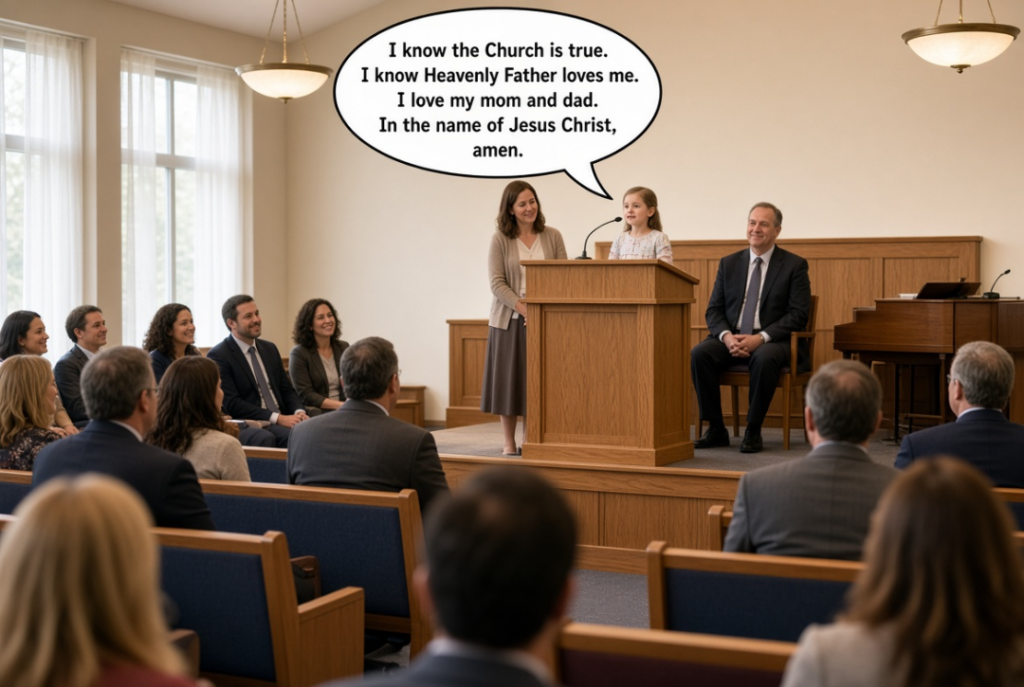
On the first Sunday of almost any month, in almost any of the thousands of Latter-day Saint meetinghouses that dot the American West, a familiar scene unfolds. The bishop invites the congregation to share testimonies. After a pause, a small figure makes its way toward the stand—sometimes alone, more often with a mother or father close behind. Someone bends the microphone downward. The child, eyes barely clearing the pulpit, speaks in a voice the whole chapel leans forward to hear: I know the Church is true. I know Heavenly Father loves me. I love my mom and dad. In the name of Jesus Christ, amen. A murmur of tenderness moves across the pews. The child returns to her seat, and the meeting goes on.
For most Latter-day Saints, few moments in worship are sweeter. For an outside observer—and, increasingly, for many who once sat in those pews themselves—the moment raises a question that is at once psychological, theological, and pastoral. What, precisely, has just happened? Has a four-year-old borne witness to knowledge she received from God? Or has a much-loved child performed, with complete sincerity, a script she learned from the adults she trusts most?
The answer to that question, this essay will argue, explains a statistic that the Washington Post reported this week but did not pause to examine:
The percentage of Americans raised within the Church of Jesus Christ of Latter-day Saints who have stayed affiliated has dropped from 70 percent to 54 percent in the past two decades, according to a Pew Research analysis released Tuesday. Most of those leaving the faith are becoming religiously unaffiliated, a trend happening among all U.S. faith groups. Latter-day Saints have among the lowest retention rates of such groups, Pew has found. At the same time, people who stay in the church are among the most religious Americans. They are the most likely group to pray daily, go to services and say religion is important in their lives.
— The Washington Post, “Fewer Americans raised Mormon are staying in the faith, study finds,” September 22, 2026
The Post notes the paradox and moves on. Yet the paradox is the story. How can one faith community lose nearly half of the children it raises and, at the same time, retain the most devout adult membership of any major religious group in the nation? What cultural pressures produce a people who pray daily, attend faithfully, and rank religion as supremely important—while so many of their own sons and daughters walk away, most of them into no faith at all?
The thesis of this study is simple to state. The two halves of the Pew finding are not a contradiction but a single phenomenon viewed from opposite sides. The same cultural architecture that produces extraordinary devotion in those who remain produces extraordinary departure in those who do not. At the foundation of that architecture lies a practice that begins almost as soon as a child can speak: the public bearing of testimony—the declaration “I know”—before the child can know what she is declaring. What the Latter-day Saint tradition sometimes calls “borrowed light,” and what contemporary writers call “borrowed belief,” is voiced from the pulpit as personal knowledge. For some, that inherited certainty hardens into lifelong devotion. For others, it cracks under the weight of adulthood—and when it cracks, it tends to break all the way through.
A word about method and tone. This essay approaches its subject from the perspective of historic, creedal Christianity, and it makes no secret of that commitment. But it is not a polemic. The Latter-day Saint parents who lead their children to the pulpit do so out of love, and the faith and discipline of Latter-day Saint families are admired well beyond their own church. The critique offered here is of ideas and practices, not of persons. Wherever possible, Latter-day Saints are allowed to speak in their own words—through official publications, faithful writers, and candid members—and former members are heard alongside them. The goal is understanding, not scorekeeping.
❧ ✦ ❧
I. The Statistic and the Question Behind It
What Pew Actually Found
The report behind the headline is Pew Research Center’s Tradition and Change Among Latter-day Saints in the U.S., released on September 22, 2026, and drawn chiefly from the Center’s 2023–24 Religious Landscape Study. That survey of 36,908 American adults included 565 current Latter-day Saints—414 lifelong members and 151 converts—along with 316 former members. Its findings on retention are stark. Among Americans raised in the Church, 70 percent still identified with it in 2007, 64 percent in 2014, and just 54 percent in 2023–24. Some 28 percent of those raised as Latter-day Saints now claim no religion at all, double the 2007 share. By comparison, roughly three-quarters of Americans raised Jewish, Muslim, or religiously unaffiliated retain their childhood identity.
Fairness requires a qualification that the Post omitted. Pew itself notes that when Latter-day Saint retention is compared with individual Protestant denominational families—Methodists, Presbyterians, and the like—the Church actually retains more of its children than most of them, largely because Protestants switch freely among denominations while remaining Protestant. The Latter-day Saint departure problem is real, but it is distinctive in shape more than in size: those who leave do not drift to a neighboring congregation; overwhelmingly they leave religion altogether.
The report’s most revealing numbers, however, concern childhood. Pew compared adults raised in the Church who remain with adults raised in the Church who left. The lifelong members were far more likely to recall that religion was very important to them personally as children (64 percent versus 27 percent), that religion was very important to their families (82 versus 55), that they attended services at least weekly (90 versus 72), and that they received seven or more years of religious education (48 versus 34). Pew reports that each of these differences holds even after controlling for demographic factors. Today, 72 percent of lifelong members pray daily; only 27 percent of former members do.
Two further findings deserve attention. First, about three in four current Latter-day Saints were raised in the faith; only about a quarter are converts. The American Church, in other words, is overwhelmingly a church of what members themselves call “cradle Mormons.” Second, on several measures lifelong members appear more religious than converts—97 percent of lifelong members, for instance, affirm a spiritual reality beyond the natural world, compared with 83 percent of converts. Pew is careful to note that the convert sample is small and that on some measures, such as daily prayer, the two groups are statistically indistinguishable. Still, the pattern is striking. In most religious movements the convert is the zealot. Among American Latter-day Saints, formation from infancy appears to matter as much as persuasion in adulthood—perhaps more.
The Survivor’s Portrait
A crucial insight follows. The description “most religious Americans” is, in part, the portrait of a population that has passed through a filter. When a community sets a high bar for belonging and those who cannot clear it depart, the remaining population will be devout almost by definition. Notre Dame sociologist Christian Smith, interviewed by Religion Unplugged, observed that Latter-day Saint young people tend not to drift into a comfortable middle range of religiosity, as many Catholic and Protestant young people do. They either remain fully committed or leave entirely. His summary is memorable:
There are not a lot of somewhat Mormon people.
— Christian Smith, quoted in Emma Penrod, “Growth in the LDS Church is slowing — but not for reasons you might suspect,” Religion Unplugged, April 2020
Smith attributes this to the demanding, nearly all-encompassing character of Latter-day Saint life: annual worthiness interviews, the tithe, seminary for every teenager, a volunteer calling for every adult, and a doctrine of prophetic authority that leaves little room for negotiation. The Church, he suggests, has built-in mechanisms that make mediocre membership very difficult to sustain.
So the Post’s two paragraphs are describing a single sorting process. But a filter alone does not explain why the bar sits where it does, or why the pressures begin so early. Pew’s own data point the way: some of the sharpest differences between those who stayed and those who left appear in their childhood religious formation. The story of “the most religious Americans” is, at bottom, a story about children.
❧ ✦ ❧
II. A Peculiar People: The Historical Roots of Intensity
Born Under Siege
Latter-day Saint intensity did not arise in a vacuum. The movement was born in the “Burned-over District” of western New York during the Second Great Awakening, a region so repeatedly swept by revival fires that contemporaries said there was nothing left to burn. Camp meetings, emotional conversions, and fierce competition among sects formed the spiritual atmosphere of Joseph Smith’s youth; his own accounts of his first religious experience are framed by confusion amid rival revivalists. From its birth, then, the movement inherited the revival culture’s emphasis on inward, felt experience as the seal of religious truth—a point to which we will return.
The first generation of Latter-day Saints also endured sustained hostility. They were driven from Jackson County, Missouri, in 1833; expelled from the state after the conflict of 1838 and Governor Lilburn Boggs’s notorious executive order; and forced from Nauvoo, Illinois, after Joseph Smith’s killing at Carthage Jail in 1844. The exodus to the Great Basin in 1846–47 became the founding epic of a covenant people. Communities that survive persecution by cohesion tend to prize cohesion ever after. Christian Smith, in the same interview, links this history to what he describes as a heel-digging posture in which members are either with the Church or against it. The pioneer narrative—retold in Primary lessons and reenacted in youth “treks” to this day—still frames Latter-day Saint identity as a people set apart.
The Reformation of 1856 and the Warning About Borrowed Light
Within a decade of the arrival in the Salt Lake Valley, Church leaders worried openly that the rising generation would inherit the faith without possessing it. In 1856–57, during what historians call the “Mormon Reformation,” leaders such as Jedediah M. Grant called members to searching self-examination, catechism-style questioning, and rebaptism. In that setting, Heber C. Kimball, a counselor to Brigham Young, issued the warning that would become a permanent fixture of Latter-day Saint vocabulary:
To meet the difficulties that are coming, it will be necessary for you to have a knowledge of the truth of this work for yourselves. The difficulties will be of such a character that the man or woman who does not possess this personal knowledge or witness will fall. If you have not got the testimony, live right and call upon the Lord and cease not till you obtain it. If you do not you will not stand. … The time will come when no man nor woman will be able to endure on borrowed light. Each will have to be guided by the light within himself.
— Heber C. Kimball (1856), in Orson F. Whitney, Life of Heber C. Kimball, p. 450
Every religious movement eventually faces this second-generation problem. H. Richard Niebuhr observed nearly a century ago that sects tend to become churches precisely when their children, born into the fold rather than converted into it, come of age. The Latter-day Saint answer to the problem was distinctive: testimony—a personal, experiential spiritual witness—would be expected of every member, and the expectation would be extended ever earlier into childhood. Kimball’s warning, in other words, was meant to drive the rising generation toward first-hand conviction. Whether the practices that grew up around it accomplish that goal, or merely teach children to speak the language of first-hand conviction, is the question at the center of this essay.
The Institutional Architecture
Over the following century and a half, the Church built one of the most thorough systems of religious belonging in the modern world. Congregations (wards) are assigned by address; one does not shop for a church. Clergy are unpaid lay members, so nearly every adult holds a “calling.” Home visits—once called home teaching and visiting teaching, now “ministering”—assign members to watch over one another. Teenagers attend daily seminary. Young men and increasingly young women serve full-time missions. Access to the temple, and therefore to the ordinances Latter-day Saints believe necessary for exaltation, requires a recommend obtained through periodic interviews on belief and behavior.
Even the Church’s most determined evangelical critics acknowledge the strengths of this system. Eric Johnson of Mormonism Research Ministry, in a widely read list of “10 Things Christians Can Learn from the Mormons,” commends Latter-day Saints for their devotion to heritage, their moral seriousness, their systematic religious education of youth, their care for struggling members, and above all their commitment to family. He also notes, with admirable economy, that the culture does not tolerate lukewarm membership:
Nominal Mormonism is frowned upon.
— Eric Johnson, “10 Things Christians Can Learn from the Mormons,” Mormonism Research Ministry
Johnson is careful to add a caution. The same organizational strength that mobilizes members, he observes, can become a hazard where a laity is not permitted to question its leaders; and the same attentiveness that keeps members from slipping away operates in a system where a member is registered to one ward and has, in his words, nowhere else to go. The virtue and the pressure are two faces of one structure.
❧ ✦ ❧
III. The Architecture of Pressure
None of the pressures described below is sinister in intent. Nearly all arise from sincere love and a genuine desire for children’s eternal welfare. But pressures they are, and together they explain why Latter-day Saint religiosity is so intense among those who remain and so often all-or-nothing among those who leave.
1. The Covenant Path as a Timetable
A Latter-day Saint child’s spiritual life comes with a calendar known in advance. Baptism at eight. Priesthood ordination for boys and temple proxy baptisms for both boys and girls at around twelve. Seminary through high school. A mission at eighteen or nineteen. Temple marriage. Each threshold is preceded by an interview with a bishop, and each is celebrated publicly. The structure gives children clarity and purpose—but it also means that stepping off the path is visible to everyone. A missed milestone is not a private matter; it is a public absence.
2. Worthiness Made Visible
In most Christian traditions, the state of a believer’s conscience is largely hidden from the congregation. In Latter-day Saint practice, worthiness is often observable. A young person who has been counseled not to partake of the sacrament must let the tray pass, in full view of the ward. Lynn, a lifestyle blogger raised in Payson, Utah, recalls how humiliating that small gesture felt as a teenager, and how interviews about personal failings with a middle-aged bishop left her uneasy for years. Temple weddings, which exclude family members without a recommend, make the same distinction visible at life’s most important celebrations. When worthiness is public, private doubt carries public consequences—and children learn early that the safest course is to look, sound, and act certain.
3. The Family as the Stakes
At the center of Latter-day Saint theology stands the eternal family, sealed in the temple and destined to continue beyond death. The doctrine is, for many members, the most beautiful thing their faith offers. It also raises the stakes of belief to the highest imaginable level. Lynn describes her experience of that teaching as making family itself into leverage: failure to keep the standards meant, as she understood it as a girl, forfeiting eternity with the people she loved. Whatever one makes of her interpretation, the social facts are plain. Pew finds that 72 percent of lifelong members are married, compared with 42 percent of former members, and the Deseret News reports that 87 percent of married Latter-day Saints have a spouse of the same faith—the highest rate of any major American religious group. When nearly everyone one loves is inside, leaving is not a change of opinion. It is a rupture.
4. The Village That Watches
Patrick Mason of Utah State University told Religion Unplugged that the local ward is the Church’s greatest strength, a “village” in which people genuinely care for one another across every dimension of life. He is right. Yet the same article records the experience of a very different group: Ryan Sorensen of QuitMormon, a legal service that processes resignations, described inactive members who find they cannot simply fade away, because leaders and missionaries keep returning and the inactive member becomes, in effect, a project. Lynn, for her part, describes growing up with the sense that neighbors were keeping tabs on one another’s garments, drinks, and Sunday habits. The mechanism that shepherds some is experienced by others as surveillance. Both descriptions can be true of the same ward.
5. Certainty as Culture
Perhaps the most distinctive feature of Latter-day Saint religious speech is its idiom of certainty. Members do not ordinarily say, “I believe the Book of Mormon is scripture.” They say, “I know.” The temple recommend interview asks members whether they have a testimony; the monthly fast and testimony meeting invites them to declare it. Christian Smith notes that the Church’s teaching that its president speaks for God leaves little room for negotiation. In such a culture, uncertainty is not a normal stage of faith but a warning sign—something to be resolved quickly, or hidden.
6. Doubt as Danger
The final pressure is the treatment of honest questions. In 2015, Marisa and Carson Calderwood were excommunicated in Washington State. The Latter-day Saint writer Gina Colvin—herself a practicing member—described them as missions, temple marriage, children, service.
Cradle Mormons who had done everything they were required to do
— Gina Colvin, “The Foolishness of the Calderwood Excommunications,” KiwiMormon (Patheos), May 2015
Their offense, as Colvin describes it, was speaking openly about their questions and doubts. Her lament was not that of an outsider but of a believer who feared that every such discipline signals to thousands of quiet questioners that they no longer belong.
The same tension appears in a thoughtful 2014 essay by the Latter-day Saint philosopher Adam Miller, addressed to a student in crisis. Miller counseled the student not to be consumed by questions that cannot be settled by evidence, and to focus instead on the practical, grace-oriented work that he believes Mormonism aims at. The essay drew more than a hundred responses. Several commenters, including faithful members, made the same essential objection: one cannot bracket the truth claims in lived Mormonism, because lived Mormonism requires one to affirm them—in testimony meetings, in recommend interviews, in lessons and callings. One commenter observed that it is very hard to remain in good standing if one cannot regularly stand and affirm the Restoration’s foundational claims.
Here is the hinge of the whole matter. In Latter-day Saint culture, testimony is not an optional private conviction. It is a recurring public act, and the habit of performing it begins in early childhood.
❧ ✦ ❧
IV. Cradle Mormons: Faith as Birthright
Latter-day Saints speak of children born to temple-sealed parents as “born in the covenant.” Pew’s data confirm that such cradle members make up roughly three-quarters of the American Church. What does faith look like when it arrives by birth rather than by choice?
In 2015, Kevin Barney, a respected contributor to the long-running Latter-day Saint blog By Common Consent, posed a remarkable thought experiment. A descendant of Latter-day Saints on both sides reaching back to the 1830s, Barney confessed that his own membership had involved no real choice at all:
I simply fell into it by birth.
— Kevin Barney, “Would You Have Converted to the Faith?” By Common Consent, December 11, 2015
Barney went on to say that he could not imagine joining the Church as an adult convert, and he invited lifelong members to ask themselves whether they would have converted had they not been raised in it. The responses are a study in candor. A number of lifelong members answered frankly that they would not have. One wrote that Joseph Smith’s story remained a hard sell even after a lifetime in the faith. Another, raised by convert parents, said she envied converts not for their experience but because she wished she had been given a choice at all. Another suggested that being raised to stay Mormon cultivates a conformist rather than a truth-seeking disposition—a personality oriented toward staying rather than searching. Others, it must be said, offered moving accounts of conversion and conviction, and one commenter wisely noted that conversion is a lifelong process rather than a single moment. But the overall picture is unmistakable: a significant number of devoted lifelong members suspect that their faith is inseparable from their upbringing.
That is precisely what “borrowed belief” means. And it begins earlier than many realize. Lynn recalls her baptism at eight, performed by her father:
I didn’t know what I was really doing.
— Lynn, “Growing up LDS and where I stand today,” LovebyLynn, April 2021
She simply knew, she writes, that everyone was baptized at eight, and that declining was not an option.
A Tension in Latter-day Saint Doctrine
Here the Church’s own theology raises an important question. Latter-day Saint scripture teaches that little children are not accountable for sin and must not be baptized until they reach the “years of accountability,” fixed by revelation at eight (see Moroni 8; Doctrine and Covenants 29:46–47). Parents are charged to prepare them:
And again, inasmuch as parents have children in Zion, or in any of her stakes which are organized, that teach them not to understand the doctrine of repentance, faith in Christ the Son of the living God, and of baptism and the gift of the Holy Ghost by the laying on of the hands, when eight years old, the sin be upon the heads of the parents. … And their children shall be baptized for the remission of their sins when eight years old.
— Doctrine and Covenants 68:25, 27 (1831)
The logic of this revelation is that a child younger than eight lacks the understanding necessary to make a covenant. Yet, as we will see, the same tradition invites children well below that age to stand before a congregation and declare that they know the Church is true, that Joseph Smith was a prophet, and that a living prophet leads the Church today. If a six-year-old is not yet mature enough to be accountable for her own sins, on what ground is she presumed mature enough to certify divine revelation?
❧ ✦ ❧
V. The Child at the Pulpit
How Children Learn to Testify
The formation of children’s testimonies is not left to chance. In 1994, the Church News, an official publication of the Church jointly published with the Deseret News, ran a reader-contributed “how-to” column on helping children bear testimony properly. The paper noted that such contributions should not be regarded as official doctrine, but it published them as models of faithful practice. The first item on its summary checklist was telling:
Teach children the language of a testimony.
— Church News, “How to help children learn to properly bear their testimonies,” June 18, 1994
The contributors described their methods with evident love. One couple advised teaching children specifically to testify of Christ, of Joseph Smith, and of the Book of Mormon. Another family practiced testimonies weekly at family home evening and gave the children gentle reminders of what to include—gratitude for the prophet, for the priesthood, for local leaders. A father described teaching his children the “elements” of a testimony just as one teaches the elements of a prayer. Another family’s dinner-table tradition meant that the youngest children, as the parents put it, had never known any other way. A bishop encouraged parents to accompany small children to the pulpit to help them put their testimonies into words.
The results are exactly what one would expect. In 2014, a Latter-day Saint mother writing at LDSBlogs described asking her sons, ages four and six, what their testimonies were. Their answers followed the familiar pattern: the Church is true; Heavenly Father and Jesus love me; I believe in the Holy Ghost; families can be together forever. She acknowledged, with real honesty, that her boys relied heavily on her own testimony and those of their father and teachers, and she concluded:
For now, however, it is enough that they know through the testimonies of others.
— Anonymous author, “Even Mormon Children Can Have a Testimony,” LDSBlogs, February 2014
She grounded that conviction in a Latter-day Saint revelation that distinguishes two spiritual gifts:
To some it is given by the Holy Ghost to know that Jesus Christ is the Son of God, and that he was crucified for the sins of the world. To others it is given to believe on their words, that they also might have eternal life if they continue faithful.
— Doctrine and Covenants 46:13–14 (1831)
Notice what has happened. The revelation carefully separates knowing by the Holy Ghost from believing on the words of those who know. The mother’s sentence collapses the two: her children “know” through the testimonies of others. Even by the categories of Latter-day Saint scripture, what her sons possess is the second gift—belief resting on the words of trusted people. Yet the language they are taught to speak at the pulpit is the language of the first.
Ask Gramps, a long-running independent Latter-day Saint question-and-answer site, addressed this very practice. Its answer is warm and generally supportive of children bearing testimony; it acknowledges that some observers wonder whether young children are simply repeating what they have been taught, notes that leaders have discouraged parents from whispering entire testimonies into children’s ears, and then makes a striking concession:
No one can give another person a testimony.
— Ask Gramps, “Should little children be permitted to bear their testimonies in Sacrament Meeting?”
If that is so—and on this point traditional Christians wholeheartedly agree—then what, exactly, is the four-year-old at the pulpit expressing?
“A Testimony Is Found in the Bearing of It”
The answer lies in a distinctive Latter-day Saint teaching about how testimony is acquired. Elder Boyd K. Packer, responding to missionaries who asked how they could testify before they had a testimony, famously counseled:
A testimony is to be found in the bearing of it.
— Boyd K. Packer, as quoted in “Bearing Pure Testimony,” Religious Educator 1, no. 1 (2000)
Elder Dallin H. Oaks has taught the same principle: one gains or strengthens a testimony by bearing it. In this epistemology, speech precedes conviction. The declaration “I know” is not the report of knowledge already possessed; it is the means by which the feeling of knowledge is acquired.
From the standpoint of social psychology, this is not mysterious. Leon Festinger’s theory of cognitive dissonance (1957) showed that people tend to bring their private attitudes into line with their public commitments. Daryl Bem’s self-perception theory (1972) demonstrated that people often infer what they believe by observing what they themselves say and do. E. Tory Higgins and William Rholes documented the “saying-is-believing” effect (1978): tailoring a message to please an audience measurably alters the speaker’s own memory and attitudes. Children are especially shaped by these dynamics. The developmental psychologist Paul Harris, in Trusting What You’re Told (2012), has shown that young children learn most of what they know about unseen realities by trusting the testimony of adults—a normal and even rational way to learn.
None of this proves that Latter-day Saint truth claims are false; that is not the argument here. The argument is epistemological. When the phrase “I know” is rehearsed from toddlerhood, in an atmosphere of warmth and approval, the adult’s later sense of knowing cannot serve as independent evidence that God has spoken. It is exactly what well-documented human processes would produce whether or not God had spoken. The practice, in other words, cannot distinguish a divine witness from a successful socialization. And a method that cannot tell the difference between revelation and repetition is not a reliable method for either.
❧ ✦ ❧
VI. Can a Young Child “Feel the Holy Ghost”? Examining the Official Counsel
The most carefully considered official statement on children’s testimonies appeared in the Church’s flagship magazine in 2002:
Young children should be encouraged to bear testimony in sacrament meeting only when they feel the Holy Ghost prompts them to do so, and when they can do so on their own. By not directing their expressions, we are conveying the important principle that testimonies are not a recitation of words but an opportunity to express sincere feelings related to the truths of the gospel of Jesus Christ.
— Elder Carl B. Cook, Area Authority Seventy, “When Children Want to Bear Testimony,” Ensign, December 2002
Read charitably; this is counsel of restraint, and it deserves credit. It aims to stop parents from coaching, and the same article reproduces a 2002 First Presidency letter suggesting that younger children might share testimonies at home or in Primary until they are old enough to do so in fast and testimony meeting. Many Latter-day Saints share the discomfort that prompted the counsel. Yet the counsel rests on a premise it never examines: that a young child can recognize a prompting of the Holy Ghost and distinguish it from ordinary emotion. That premise cannot bear the weight placed upon it. Six problems stand in the way.
1. The Developmental Problem
Children in what Jean Piaget called the preoperational stage—roughly ages two to seven—think concretely and struggle to reflect on their own mental states. Research on “source monitoring” (Marcia Johnson and colleagues, 1993) shows that young children have particular difficulty identifying where a thought, memory, or feeling came from. John Flavell’s studies of children’s knowledge about thinking (1995) found that preschoolers routinely underestimate and misdescribe their own inner mental activity. A four-year-old can feel warmth, safety, excitement, and the wish to please; what she cannot reliably do is identify the source of those feelings. To ask her whether the Holy Ghost is prompting her is to ask for a metacognitive judgment that many adults find difficult.
2. The Labeling Problem
Children do not arrive at the idea that a particular warm feeling is “the Spirit” on their own. Latter-day Saint teaching for children describes the Holy Ghost in affective terms—peace, warmth, a still small voice—and adults teach children to attach that label to their experiences. Elder Cook’s own article encourages parents to ask children what they felt in their hearts during a gospel discussion. The questions are gentle and loving, but their effect is to supply the interpretive category. When a child feels secure and happy in a loving family setting and is told that the feeling is the Holy Ghost, the label itself is borrowed. The child is then invited to testify “when she feels the Holy Ghost prompts her”—that is, when she experiences the feeling adults have taught her to call by that name.
3. The Circularity Problem
The same article states that our testimonies grow, in large part, because the Holy Ghost confirms the truthfulness of the testimonies borne by others. It then quotes Elder Henry B. Eyring’s three-step pattern: parents teach a truth, testify that they know it, and live consistently with it, after which the Spirit confirms both the truth and the parents’ knowledge of it—and so testimony is passed down within a family. Consider the structure of this model. The parent’s testimony comes first; the child’s feeling follows; the feeling is then interpreted as the Spirit’s confirmation of the parent’s testimony. This is borrowed belief furnished with a supernatural certificate of authenticity.
4. The Content Problem
Elder Cook opens with a charming story. At a stake conference, he invited an older youth named Brian Cox to testify, and a very young boy of the same name came forward instead. Given the option to sit down, the little boy insisted on speaking, and bore a spontaneous testimony: Joseph Smith was called of God, the Church is led by a prophet, and he was grateful for Jesus, his blessings, and his family. Elder Cook commends the testimony precisely because it was unrehearsed. He later describes a young girl who thanked Joseph Smith for “restoring our Church,” and he assures readers that her words were her own.
But spontaneity of delivery is not independence of content. Compare the boy’s testimony with the Church News checklist: Christ, Joseph Smith, the Book of Mormon, the living prophet. The child who has heard the same formula on the first Sunday of every month since birth needs no rehearsal; the formula is already his native tongue. The words may truly be “his own” in the sense that no one whispered them into his ear that morning. They are not his own in the sense that matters—he did not arrive at them by any process of knowing that could be distinguished from absorption.
5. The Accountability Problem
As noted above, Latter-day Saint doctrine holds that children younger than eight are not accountable, because they lack the understanding required to make covenants. Yet the counsel presupposes that the same children can discern the promptings of the Holy Ghost and act upon them by making a public witness—not merely to the love of God, which a child can grasp in a childlike way, but to the truth of a specific church, a nineteenth-century prophet, and a book of scripture. The two positions sit uneasily together. Either young children possess the discernment to certify revelation, in which case the ground for delaying their accountability weakens; or they do not, in which case the premise of the counsel collapses.
6. The Approval Problem
Elder Cook contrasts the Spirit-led child with the child who must be prompted or who is chiefly seeking the approval of others. The distinction is sound in principle but impossible to apply in practice. No observer—not the parent, not the bishop, and certainly not the child—can reliably tell the two apart. And the congregation’s response to a small child’s testimony—the smiles, the soft murmur, the parent’s visible pride, the hugs afterward—is itself among the most powerful social reinforcers a young child can experience. A child does not need to be coached to learn what earns that response. She needs only to be watching.
What Scripture Says About Children and the Knowledge of God
Traditional Christianity does not dismiss the faith of children. Jesus rebuked His disciples for turning children away and declared that the kingdom belongs to such as these (Mark 10:14–15). Paul reminded Timothy that from childhood he had known the holy Scriptures (2 Timothy 3:15). The Psalmist marveled that God ordains strength out of the mouths of babes (Psalm 8:2). Children can trust Christ, and Christian parents rightly long for them to do so.
Yet Scripture’s most detailed portrait of a child in the house of God draws a distinction that the practice of early testimony erases. The boy Samuel was dedicated to the Lord from weaning. He lived in the sanctuary, wore a linen ephod, and ministered before the Lord under Eli the priest. And yet:
Now Samuel did not yet know the LORD, neither was the word of the LORD yet revealed unto him.
— 1 Samuel 3:7 (KJV)
When the Lord finally called him, Samuel mistook the divine voice for Eli’s—three times. It took an experienced adult to recognize what the child could not. Two lessons follow. First, Scripture holds apart what Latter-day Saint practice tends to fuse: a child may be surrounded by sacred things, may serve sincerely, may speak the language of the sanctuary—and still not yet know the Lord. Second, Eli’s role was not to supply Samuel with a feeling or a formula. It was to point the boy directly to God: “Speak, LORD; for thy servant heareth” (1 Samuel 3:9). What followed was not an inward glow but objective, specific words that were later publicly vindicated; the Lord “did let none of his words fall to the ground” (3:19).
This points to a bigger difference in the very meaning of testimony. In the New Testament, testimony (Greek martyria) is witness to public events:
That which was from the beginning, which we have heard, which we have seen with our eyes, which we have looked upon, and our hands have handled, of the Word of life; … That which we have seen and heard declare we unto you.
— 1 John 1:1, 3 (KJV)
Luke wrote his Gospel so that Theophilus might “know the certainty” of what he had been taught, grounding that certainty in eyewitness accounts carefully investigated (Luke 1:1–4). The apostles testified to a resurrection they had seen (Acts 2:32). When the New Testament speaks of the Spirit’s inward witness, the content of that witness is our adoption in Christ—“that we are the children of God” (Romans 8:16)—not a confirmation of an institution’s claims about its own authority, prophet, or scripture. And Scripture repeatedly warns that inward feelings must be tested, not trusted as self-authenticating: “The heart is deceitful above all things” (Jeremiah 17:9); “believe not every spirit, but try the spirits whether they are of God” (1 John 4:1); the Bereans were commended because they “searched the scriptures daily, whether those things were so” (Acts 17:11); “Prove all things; hold fast that which is good” (1 Thessalonians 5:21).
Honesty requires a word of self-examination here. Evangelical Protestants are not immune to the error described in this section. Children have been pressed into praying the “sinner’s prayer” under the emotional intensity of camp bonfires and altar calls, and some evangelical subcultures prize feelings as proof nearly as much as any other tradition. We have covered this concept in our post, “A Theological Examination of “The Sinner’s Prayer” in Modern Evangelism.”
It is no accident that the Latter-day Saint emphasis on felt confirmation grew from the same revivalist soil of the Second Great Awakening that shaped much of American evangelicalism. The critique offered here applies wherever emotional experience is treated as proof of truth—in a Latter-day Saint chapel or in a Baptist youth camp.
❧ ✦ ❧
VII. “Borrowed Belief”: Anatomy of a Concept
In recent years, the phrase “borrowed belief” has entered discussion of faith formation, often in a form like the following:
The concept of borrowed belief refers to relying on the spiritual testimony, convictions, and faith of others (such as parents, teachers, or mentors) while they are still forming their own independent beliefs. In Latter-day Saint (LDS) doctrine and theology, from which this specific term often originates, it is viewed as a natural, necessary, and healthy starting point for spiritual growth rather than a permanent state.
— A representative definition of “borrowed belief” in contemporary discussion (as supplied for this study)
The Latter-day Saint Lineage of the Idea
The concept does indeed have deep Latter-day Saint roots, though its history is more ambivalent than the definition suggests. Heber C. Kimball’s 1856 warning, quoted above, treated “borrowed light” as a danger: those who lived on it would fall. A 1971 general conference address titled “Man Cannot Endure on Borrowed Light” reaffirmed that the Church’s underlying strength lies in the personal testimonies of its individual members and that each must gain a personal knowledge of the truth. In October 2022, Elder Quentin L. Cook of the Quorum of the Twelve drew on the imagery of Doctrine and Covenants 76, contrasting the sun’s own light with the moon’s reflected light and linking the latter to those who are not valiant in the testimony of Jesus; one cannot, he taught, reach the celestial kingdom on borrowed light.
Other Latter-day Saint voices have treated borrowed light far more positively. In a BYU devotional, Richard D. Osguthorpe described how he had leaned on the faith of his mother and grandparents during dark seasons, and he argued that borrowed light, though it may expire, has no return date and is a genuine spiritual resource. His conclusion captures the “healthy starting point” view:
We can make borrowed light our own.
— Richard D. Osguthorpe, BYU devotional, as summarized by the BYU McKay School of Education
Latter-day Saint thought, then, holds two ideas in tension: borrowed light as a peril to be escaped, and borrowed light as a seed to be cultivated. The definition supplied above reflects the second. It deserves a careful response.
Where the Concept Is Right
Let it be said plainly: every child begins with borrowed belief. There is no other way to begin. Scripture itself honors faith passed down through a family:
When I call to remembrance the unfeigned faith that is in thee, which dwelt first in thy grandmother Lois, and thy mother Eunice; and I am persuaded that in thee also.
— 2 Timothy 1:5 (KJV)
Moses commanded Israel’s parents to teach God’s words diligently to their children (Deuteronomy 6:6–7). Paul Harris’s research confirms that learning from trusted testimony is a normal, rational feature of childhood. The traditional Christian objection, therefore, is not to borrowing. Children must borrow. The objection concerns how the loan is labeled, how it is secured, and whether the borrower is ever permitted to examine it.
Where the Concept Fails: Four Challenges
1. The Mislabeled Loan
Anyone trained in business knows that a loan recorded as equity misstates the balance sheet. The books may look strong for a time, but the misstatement is exposed the moment the loan is called. The “I know” formula records borrowed belief as owned knowledge. Doctrine and Covenants 46 distinguishes those who know from those who believe on their words; the pulpit formula erases the distinction. A child is not taught to say, honestly, “I believe what my mom and dad believe, and I love Jesus.” She is taught to say “I know.” Repeated monthly for years, and reinforced by the psychological processes described above, the declaration produces the felt certainty it claims to report. The “starting point” is thus never presented to the child as a starting point. It is presented as the destination already reached.
2. The Missing Exit Ramp
A starting point implies a journey—a path along which borrowed belief is examined, tested, and either owned or relinquished. But the culture described in Section III imposes real costs on that journey. Lynn recalls being told, in effect, that searching outside approved sources was spiritually dangerous. The Calderwoods lost their membership for voicing questions. A former member writing under the name “A Call For Reform”—whose broader account is sharply polemical and whose framing this essay does not adopt—offers one observation worth weighing. He recalls being taught, from early childhood, how to answer objections to his faith before he was old enough to evaluate them, and he summarizes the effect:
The framework is not built to ask, but to answer.
— A Call For Reform, “Mind Control: A Mormon Case Study,” Medium, May 2025
If the only path from borrowed belief to owned belief runs through honest questions, and honest questions are culturally costly, then borrowed belief is described as temporary but structured to be permanent.
3. The Candid Confession
No passage in the sources consulted for this study is more poignant than a sentence from Adam Miller’s 2014 letter. Miller, one of the most respected Latter-day Saint philosophers of his generation, wrote that after nearly forty years of three-hour Sunday meetings:
I’ve never seen or heard or felt anything supernatural.
— Adam Miller, “Letter to a CES Student,” Times & Seasons, October 28, 2014
Miller did not regard this as a disaster; he believed his faith was transforming him in quiet, ordinary ways. He did not deny that others have such experiences. But he acknowledged that he could speak of them only at second hand, based on what others report. His honesty is admirable, and it reveals something important: borrowed light can remain borrowed for a lifetime, even in one of the most thoughtful and faithful members of the Church. The “natural starting point” may turn out to be the whole road.
4. Fragility Under Load
Writing about professional ethics rather than religion, the strategic advisor Xenia Tao has observed that borrowed beliefs provide structure, certainty, and social acceptance, but that they are fragile; when tested, they crumble, leaving confusion and a crisis of identity. She proposes a searching question for anyone examining an inherited conviction:
Who benefits from me believing this?
— Xenia Tao, “The Silent Cost of Borrowed Beliefs,” 2025
The question can be pressed too far; parents who teach their children the faith are not scheming beneficiaries. But the underlying observation holds. When a child’s belief is sustained chiefly by family approval and communal belonging, it rests on relationships rather than reasons. When adulthood tests it—through history encountered online, a mission experience, a moral disagreement, a personal crisis—there may be nothing underneath. Pew’s numbers suggest that for nearly half of those raised in the Church, the loan is eventually called. Jana Riess, a Latter-day Saint scholar interviewed by Religion Unplugged, noted that what has changed is not only that young members leave, but that they no longer come back. Christian Smith added that former Latter-day Saints often leave with more anger than former members of other faiths, feeling that something was taken from them. That resentment becomes intelligible when one remembers the lifelong member on By Common Consent who wished only that she had been given a choice.
The Two Halves Explained
We are now in a position to answer the question the Washington Post left unasked. Latter-day Saint children are formed from infancy in a culture of public certainty, visible worthiness, family-centered eternal stakes, communal watchfulness, and costly doubt. Their earliest religious speech is a declaration of knowledge they cannot yet possess. For many, that borrowed belief is progressively reinforced—by missions, temple marriage, callings, genuine spiritual experiences, and a community that truly cares for them—until it becomes the settled conviction of the most devout religious population in America. For others, the borrowed belief cracks. And because it was voiced from the beginning as knowledge, and because the culture offers almost no middle ground, there is nowhere to stand once the knowing fails. They do not become “somewhat Mormon.” They become, in overwhelming numbers, nothing at all.
The Post’s two paragraphs, in short, describe one mechanism. The same formation that makes the survivors “the most religious Americans” makes the departures so complete.
❧ ✦ ❧
VIII. A Better Inheritance: From Borrowed Faith to Owned Faith
“Now We Believe, Not Because of Thy Saying”
The Gospel of John contains what may be the clearest biblical account of borrowed belief becoming owned faith. A Samaritan woman, having met Jesus at a well, returns to her town and tells everyone what He said to her. Many believe because of her word. Then they go to see Jesus for themselves:
And many of the Samaritans of that city believed on him for the saying of the woman, which testified, He told me all that ever I did. … And said unto the woman, Now we believe, not because of thy saying: for we have heard him ourselves, and know that this is indeed the Christ, the Saviour of the world.
— John 4:39, 42 (KJV)
Three features of this passage deserve emphasis. First, the Samaritans’ initial faith was genuinely borrowed, and the text treats it without scorn; the woman’s testimony was the means God used to bring them to Christ. Second, the movement from borrowed to owned faith did not occur through a feeling about the woman or her community. It occurred through direct encounter with the Person of Christ and His words. Third, the woman’s testimony pointed away from herself. She did not ask her neighbors to affirm her, her village, or her religious tradition. She said, in effect, “Come, see a man”—and then she stepped aside.
Teaching Children Honestly
What would faithful, honest formation of children look like? Several principles emerge from Scripture and from the historic Christian tradition.
Let children speak the language of trust rather than the language of certainty. The Reformers distinguished three elements of faith: notitia (knowledge of its content), assensus (assent to its truth), and fiducia (personal trust). A young child can possess genuine fiducia—real trust in a loving Savior—long before notitia and assensus mature. “I love Jesus” and “I believe Jesus loves me” are honest sentences on a child’s lips. “I know this church is true” is not.
Anchor faith in its object, not in the believer’s feelings. The Christian gospel rests on public, historical claims that can be examined: that Christ died for our sins, was buried, and rose again on the third day, and was seen by many witnesses (1 Corinthians 15:3–8). Feelings rise and fall; the empty tomb does not.
Welcome questions as part of faith, not as a threat to it. Thomas doubted, and Jesus met him with evidence rather than excommunication (John 20:24–29). A desperate father cried, “Lord, I believe; help thou mine unbelief” (Mark 9:24), and Jesus answered his prayer rather than rebuking his honesty. Peter charged believers to be ready always to give “a reason of the hope” within them (1 Peter 3:15). A faith that can survive only by avoiding questions has already confessed its weakness.
Expect personal appropriation, but do not manufacture it. Parents can pray for, prepare for, and rejoice in the day a child embraces Christ as her own. They cannot produce that day through rehearsal, emotional atmosphere, or public performance. James Fowler’s influential Stages of Faith (1981) suggested that the move from a conventional, community-given faith to a personally examined one typically comes in late adolescence or adulthood, if it comes at all. Wise churches make room for that passage rather than treating it as apostasy in the making.
Love children unconditionally, whatever their questions. Where family belonging is contingent on belief, belief becomes a hostage. Where a child knows she will be loved whether she believes or doubts, her eventual faith—if it comes—will be free, and therefore truly hers.
What Traditional Christians Should Learn
None of this licenses complacency on the part of traditional Christians. Eric Johnson’s list of lessons from Latter-day Saints is a rebuke worth hearing: many evangelical churches barely catechize their children at all, know little of their own history, and let absent members slip away unnoticed. Johnson closes by recalling Walter Martin’s famous challenge—whether Christians are willing to show the same devotion to the truth that others show to their convictions. A child raised with no spiritual formation has no inheritance to examine. The answer to borrowed belief is not less formation of children but more honest formation: rich teaching, faithful example, and patient love, joined to a candid acknowledgment that a child’s faith is a trust held in escrow until she is able to claim it for herself.
❧ ✦ ❧
Conclusion: When the Loan Comes Due
Return, then, to the little girl at the pulpit, her eyes just clearing the lectern. She is deeply loved. Her words are sincere. Her parents are not deceivers but devoted disciples doing what they believe God asks of them. Yet sincerity is not knowledge, and love is not evidence. She has not yet heard the Lord for herself; like Samuel in the temple, she ministers in the house of God without yet knowing Him. There is nothing shameful in that—it is simply what it means to be four years old. The danger lies only in teaching her to call it something else.
Heber C. Kimball was right: no one can endure on borrowed light. The tragedy is that a practice intended to kindle personal testimony may instead teach children to mistake the reflected glow of their parents’ faith for a light of their own. For many, that reflected light will hold through a lifetime of devoted service, and they will be counted among “the most religious Americans.” For nearly half, if Pew is right, it will fail in adulthood. And because they were taught from infancy that the glow was the light, many will conclude, when it fades, that there was never any light at all.
The historic Christian answer is that there is a Light which need not be borrowed, because He gives Himself freely to every person who comes:
I am the light of the world: he that followeth me shall not walk in darkness, but shall have the light of life.
— John 8:12 (KJV)
The best gift any parent, pastor, or congregation can offer a child is not a script to recite but a Savior to meet—so that one day, having heard Him for herself, she can say with the Samaritans: Now I believe, not because of thy saying, but because I have heard Him myself.
❧ ✦ ❧
A Note on Sources
All primary resources specified for this study were requested. Five Reddit threads (listed below) could not be retrieved because the platform blocks automated access; none of their content is quoted or characterized in this essay. The Washington Post article is quoted from the excerpt supplied for this study and is supplemented by the underlying Pew Research Center report. Quotations from modern copyrighted sources are kept deliberately brief, with other material summarized in the author’s own words; Scripture is quoted from the King James Version, and nineteenth-century Latter-day Saint texts are quoted from their published forms.
Works Cited and Consulted
A Call For Reform. “Mind Control: A Mormon Case Study.” Medium, May 26, 2025. https://medium.com/@ACallForReform/mind-control-a-mormon-case-study-5fbfb2ca1e27
Anonymous. “Even Mormon Children Can Have a Testimony.” LDSBlogs, February 2014. https://ldsblogs.com/1448/even_mormon_children_can_have_a_testimon
Ask Gramps. “Should little children be permitted to bear their testimonies in Sacrament Meeting?”
https://askgramps.org/should-little-children-be-permitted-to-bear-their/
Barney, Kevin. “Would You Have Converted to the Faith?” By Common Consent, December 11, 2015. https://bycommonconsent.com/2015/12/11/would-you-have-converted-to-the-faith/
“Bearing Pure Testimony.” Religious Educator 1, no. 1 (2000). Religious Studies Center, BYU. https://rsc.byu.edu/vol-1-no-1-2000/bearing-pure-testimony
Church News. “How to help children learn to properly bear their testimonies.” June 18, 1994. https://www.thechurchnews.com/1994/6/18/23256916/how-to-help-children-learn-to-properly-bear-their-testimonies/
Colvin, Gina. “The Foolishness of the Calderwood Excommunications.” KiwiMormon, Patheos, May 2015. https://www.patheos.com/blogs/kiwimormon/2015/05/the-foolishness-of-the-calderwood-excommunications/
Cook, Carl B. “When Children Want to Bear Testimony.” Ensign, December 2002. https://www.churchofjesuschrist.org/study/ensign/2002/12/when-children-want-to-bear-testimony?lang=eng
Cook, Quentin L. General conference address, October 2022 (Liahona, November 2022). https://www.churchofjesuschrist.org/study/liahona/2022/11/57cook
Deseret News. “Latter-day Saints among the most likely Americans to report happy family life, says major new study.” September 22, 2026.
https://www.deseret.com/faith/2026/09/22/latter-day-saints-among-the-most-likely-americans-to-report-happy-family-life-says-major-new-study/
Evans, Jonathan, and Rebecca Leppert. Tradition and Change Among Latter-day Saints in the U.S. Pew Research Center, September 22, 2026.
Evans, Jonathan, and Rebecca Leppert. “Lifelong Latter-day Saints are more religious than both former members and converts.” Pew Research Center, September 22, 2026. https://www.pewresearch.org/religion/2026/09/22/lifelong-latter-day-saints-are-more-religious-than-both-former-members-and-converts/
Johnson, Eric. “10 Things Christians Can Learn from the Mormons.” Mormonism Research Ministry, 2009.
Lynn. “Growing up LDS and where I stand today.” LovebyLynn, April 8, 2021. http://www.lovebylynn.com/growing-up-lds-and-where-i-stand-today/
“Man Cannot Endure on Borrowed Light.” General conference address, April 1971 (Ensign, June 1971).
https://www.churchofjesuschrist.org/study/ensign/1971/06/man-cannot-endure-on-borrowed-light?lang=eng
Miller, Adam. “Letter to a CES Student.” Times & Seasons, October 28, 2014. https://archive.timesandseasons.org/2014/10/letter-to-a-ces-student/index.html
Osguthorpe, Richard D. BYU devotional, summarized by the BYU McKay School of Education. https://autism.byu.edu/news/%22to-believe-on-their-words%22
Penrod, Emma. “Growth in the LDS Church is slowing — but not for reasons you might suspect.” Religion Unplugged, April 2020.
https://religionunplugged.com/news/2020/4/15/growth-in-the-lds-church-is-slowingbut-not-for-reasons-you-might-suspect
Tao, Xenia. “The Silent Cost of Borrowed Beliefs.” 2025.
https://www.xeniatao.com/ideas/silent-cost-of-borrowed-beliefs
The Washington Post. “Fewer Americans raised Mormon are staying in the faith, study finds.” September 22, 2026.
https://www.washingtonpost.com/religion/2026/09/22/fewer-americans-raised-mormon-are-staying-faith-study-finds/
Whitney, Orson F. Life of Heber C. Kimball. Salt Lake City, 1888; p. 450.
Scholarly works referenced: Bem, D. J., “Self-Perception Theory” (1972); Festinger, L., A Theory of Cognitive Dissonance (1957); Flavell, J. H., F. L. Green, and E. R. Flavell, Young Children’s Knowledge About Thinking (1995); Fowler, J. W., Stages of Faith (1981); Harris, P. L., Trusting What You’re Told (2012); Higgins, E. T., and W. S. Rholes, “‘Saying Is Believing’” (1978); Johnson, M. K., S. Hashtroudi, and D. S. Lindsay, “Source Monitoring” (1993); Niebuhr, H. R., The Social Sources of Denominationalism (1929).