
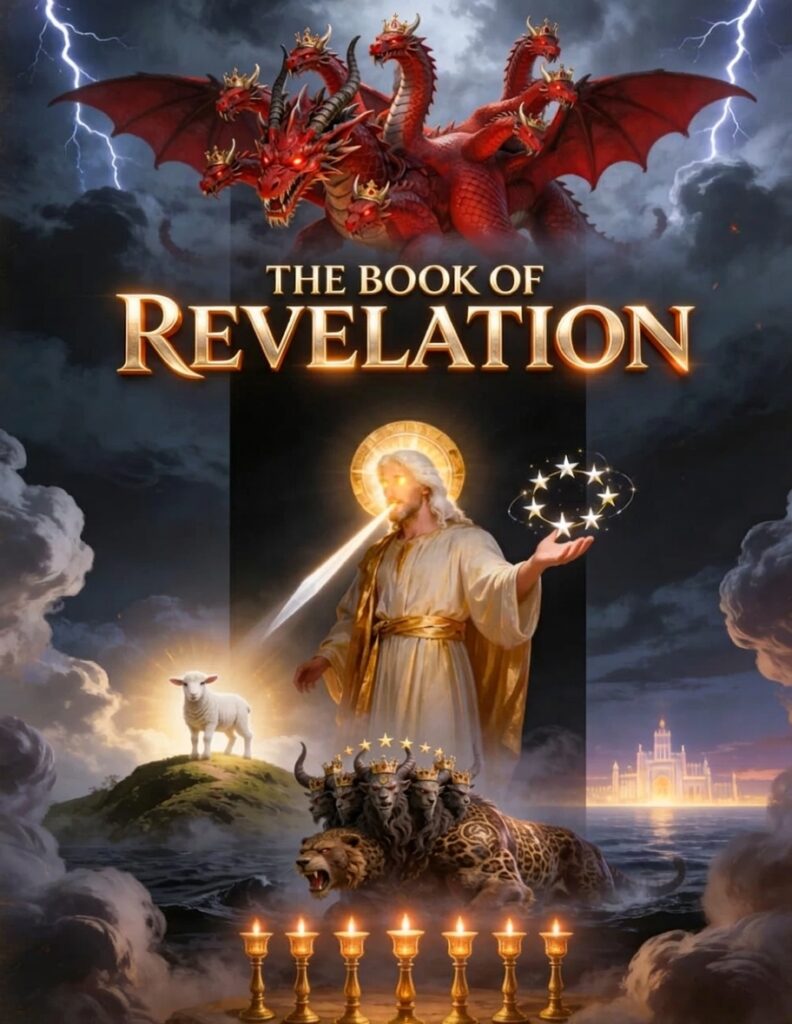
THE UNVEILING OF JESUS CHRIST
A Chapter-by-Chapter Exposition of the Book of Revelation
for Pastors, Students, and Serious Readers of Scripture
“Blessed is the one who reads aloud the words of this prophecy,
and blessed are those who hear, and who keep what is written in it,
for the time is near.” — Revelation 1:3
INTRODUCTION
Why the Last Book Is Not the Least
There is a strange asymmetry in the way the Church reads her own Scriptures. We labor over Romans. We preach through John. We mine the Psalms for every ounce of comfort they will yield. And then we arrive at the final twenty-two chapters of the canon — the chapters that gather every thread the Bible has been weaving since Eden and tie them off in a single, blazing knot — and we grow oddly quiet. Some avoid Revelation because it has been abused. Others avoid it because it has been over-explained, chopped into charts and timetables that seem to have more to do with the morning newspaper than with the Lamb who was slain. Still others avoid it out of a kind of reverent embarrassment, sensing that the book asks something of them they are not sure they are prepared to give.
That silence is a loss, and it is a loss the book itself anticipates. Revelation is the only book in the Bible that pronounces a blessing on the person who simply reads it aloud (1:3), and it repeats that blessing at the end for good measure (22:7). It is, in other words, a book that expects to be handled — read in public, heard by congregations, obeyed by ordinary Christians who are frightened and tired and tempted to compromise. It was not written for specialists. It was written for seven struggling churches in a Roman province, and through them for every church that has ever had to decide whether Caesar or Christ holds the title deed to history.
James Durham, preaching through this book to his Glasgow congregation in the 1650s, felt the weight of the undertaking and said so plainly at the outset of his very first lecture:
It may look well presumptuous-like to read, or undertake to open this Book.
— James Durham, A Commentary Upon the Book of Revelation (Glasgow, 1680), Lecture I
And then he went about it anyway, week after week, before the sermon, for the good of his people. That is the posture this guide attempts to imitate: sober, unhurried, unwilling to pretend to certainties the text does not supply, and equally unwilling to leave the book on the shelf because it is difficult.
What follows is a chapter-by-chapter exposition of Revelation from chapter one through chapter twenty-two. It is written for pastors who must preach it, for students who must exegete it, and for serious lay readers who are tired of being handed either a chart or a shrug. It aims to be careful without being cold, reverent without being vague, and honest about disagreement without being combative. Where the major orthodox readings diverge, they are laid side by side with their strengths and their weaknesses. Where the text is genuinely obscure, that obscurity is named rather than papered over. And throughout, the working conviction is the one the book announces in its opening five words: this is the revelation of Jesus Christ, and everything else in it is subordinate to that.
❖ ❖ ❖
Authorship, Audience, and Historical Setting
The Author
The book identifies its human author four times, and always by the same unadorned name: John (1:1, 1:4, 1:9, 22:8). He does not claim apostolic office. He calls himself a doulos — a bondservant — and addresses his readers as fellow bondservants. He describes himself as their brother and companion in tribulation, kingdom, and patient endurance (1:9). This is a striking absence of credentialing for a book that makes such enormous claims, and it tells us something about the author’s self-understanding: he is a scribe under orders, not an authority in his own right.
The traditional identification of this John with John the son of Zebedee, the apostle and evangelist, is early and widespread. Justin Martyr, writing near the middle of the second century, attributes the Apocalypse to one of Christ’s apostles. Irenaeus, later in the same century, knows the book well and connects it to the disciple who leaned on Jesus’ breast. Tertullian, Hippolytus, and Origen follow. Against this stands an argument first raised by Dionysius of Alexandria in the third century and revived by much modern criticism: the Greek of Revelation is markedly different from the Greek of the Fourth Gospel, and the theological idiom differs as well.
The objection deserves a fair hearing. Revelation’s Greek is rough in places, with grammatical irregularities that a polished stylist would not produce. But several considerations blunt the force of the argument. Genre accounts for a great deal; apocalyptic visionary prose is not narrative prose, and the heavy Semitic coloring of Revelation’s syntax may reflect deliberate imitation of the Greek Old Testament rather than incompetence. Circumstance accounts for more; a man writing under duress on a penal island had neither the leisure nor perhaps the amanuensis available to the author of a carefully composed Gospel. And the vocabulary overlaps are not trivial: Christ as Logos and Christ as Lamb are distinctive of both books.
This commentary proceeds on the traditional identification while acknowledging that the case is cumulative rather than conclusive. Nothing in the exposition depends on it. What matters theologically is what John himself claims: that the revelation originated with God, was given to Christ, was communicated by an angel, and was written down faithfully (1:1–2). The chain of custody, not the celebrity of the scribe, is what secures the book’s authority.
The Recipients
John writes to seven named congregations in the Roman province of Asia — the western portion of what is now Turkey: Ephesus, Smyrna, Pergamum, Thyatira, Sardis, Philadelphia, and Laodicea (1:11). These were real churches with real problems. The order in which they are listed traces a circular postal route: north from Ephesus along the coast to Smyrna and Pergamum, then inland and southeast through Thyatira, Sardis, Philadelphia, and finally Laodicea. A courier carrying a single scroll could make that circuit efficiently, and each church would hear not only its own message but all six of the others.
That detail matters more than it first appears. The seven messages of chapters two and three never circulated as independent letters. They were always embedded in the whole book, and every church heard every word. Whatever Christ said to Laodicea, Smyrna heard. Whatever he said to Smyrna, Laodicea heard. The number seven, which recurs throughout Revelation with almost obsessive frequency, signals completeness. These seven are not the only churches in Asia; they are a representative and sufficient cross-section of the whole church in every age.
The Date and the Pressure
Two dates command scholarly support. An earlier date, in the late 60s under Nero, is defended on several grounds: the count of kings in 17:10 works neatly if Nero is the one who “is”; the trampling of the holy city in 11:2 may anticipate Jerusalem’s fall in AD 70; and the beast’s healed mortal wound in 13:3 may echo the legend that Nero would return.
The majority position places the book near the end of Domitian’s reign, around AD 90–96, following the explicit testimony of Irenaeus. This dating fits the internal evidence well. Domitian pressed the titles dominus et deus — “our lord and god” — and every one of the seven cities in Revelation 1:11 practiced imperial cult by the late first or early second century. The blasphemous mouth of the beast in 13:5 has an obvious referent in that world.
This guide follows the later date without treating the question as decisive for interpretation. What is decisive is the situation that either date presupposes. John’s readers were not facing empire-wide systematic persecution so much as something subtler and in some ways harder: relentless social, economic, and religious pressure to make one small accommodation. Join the trade guild, and share its patron deity’s feast. Burn the pinch of incense; it costs nothing. Say the words; they are only words. Revelation exists to make that “only” impossible.
❖ ❖ ❖
Genre: What Kind of Book Is This?
Revelation announces its own genre in its opening verses, and it announces three at once.
It is an apocalypse. The first word of the Greek text is apokalypsis — an unveiling, a disclosure of what was hidden. The term links this book to a body of Jewish and Christian literature that includes portions of Isaiah and Ezekiel and, above all, Daniel 7–12. Apocalyptic literature characteristically does three things: it discloses heavenly realities to earthly readers, it reframes present suffering in light of coming judgment and vindication, and it summons its audience to endure by showing them what is actually true beneath the surface of what appears to be true.
It is prophecy. John calls his book a prophecy (1:3) and returns to that word repeatedly (22:7, 10, 18–19). Biblical prophecy is not primarily prediction; it is the authoritative delivery of God’s word to God’s people, which frequently includes prediction. John receives revelation “in the Spirit” as the Old Testament prophets did, and he is commanded to write what he sees and hears. His book therefore stands in the line of Isaiah, Jeremiah, Ezekiel, and Daniel, and it must be read with the interpretive habits appropriate to that line.
It is a letter. Revelation opens with a standard epistolary greeting — author, recipients, “grace to you and peace” (1:4–5) — and closes with a benediction of grace (22:21) just as Paul’s letters do. This is not incidental packaging. The letter form situates Revelation among the authoritative writings read aloud in Christian assemblies for the instruction and comfort of the gathered church.
The composite is best described as apocalyptic prophecy in the form of a circular letter. Each element constrains the others. The apocalyptic element warns us that symbol is the primary medium. The prophetic element warns us that the symbols mean something real. The epistolary element warns us that the whole was addressed to identifiable people in identifiable circumstances, and that any reading which makes the book unintelligible to its first hearers has probably gone wrong.
❖ ❖ ❖
How Symbolism Functions in Revelation
The most common error in reading Revelation is not that people take it too literally or too symbolically. It is that they fail to notice that the book teaches its readers how to read it.
Revelation 1:1 contains a small but significant verb. The revelation was “made known” — Greek sēmainō, a word that can mean “signified” or “communicated by sign.” It is cognate with sēmeion, “sign.” The same verb appears in the Greek of Daniel 2:30 and 2:45, where God discloses the meaning of a symbolic dream to a king. That is not a coincidence; Revelation 1:1 contains several verbal parallels to Daniel 2. The opening verse is thus a piece of instruction: expect symbolic communication.
But symbol is not the opposite of reality. This is where a great deal of confusion enters. A symbol points to something. The stars are angels of the churches; the lampstands are churches; the golden bowls of incense are the prayers of the saints; the fine linen is the righteous deeds of the saints. In each case John tells us so explicitly. The symbol is not the reality, but neither is it a decoration hung over a void. It is a picture of something.
John Schultz put the point in a way worth pausing over. Reflecting on whether theology can be poetry, he concluded that it is — poetry of the highest order.
In a sense, poetry is more realistic and is reality itself.
— Rev. John Schultz, Commentary to Revelation, Bible-Commentaries.com
He meant that the imagery of Revelation renders the essence of coming events more accurately than a flat chronicle ever could. A photograph of a battlefield tells you where the bodies lay. A great painting of the same field can tell you what it was. Revelation is doing the second thing, and doing it under inspiration.
Three questions discipline the interpretation of any symbol in this book:
- Where does the image come from? The Old Testament is the primary quarry. Revelation never formally quotes the Old Testament, yet the great majority of its verses allude to it. The beast from the sea comes from Daniel 7. The four living creatures come from Ezekiel 1. The trisagion comes from Isaiah 6. A second, lesser source is the first-century Roman world, whose imperial imagery John repeatedly recasts and subverts.
- How is the image used elsewhere in Revelation? The book is its own best lexicon. Lampstands are defined in 1:20; the definition governs 11:4. The seven spirits are identified with torches in 4:5 and with the Lamb’s eyes in 5:6. Consistency within the book takes precedence over ingenuity from outside it.
- What response does the vision call for? Every vision in Revelation is aimed at the will as well as the mind. If an interpretation produces speculation rather than worship, repentance, and endurance, it has almost certainly missed the point.
A word about numbers is necessary here, because numerical symbolism runs through the book from beginning to end. Seven signifies completeness or perfection: seven churches, seven spirits, seven lampstands, seven seals, seven trumpets, seven bowls, seven beatitudes. Twelve and its multiples signify the people of God: twelve tribes, twelve apostles, twelve gates, twelve foundations, and the 144,000 which is twelve squared multiplied by a thousand. Three and a half — expressed variously as forty-two months, 1,260 days, and “a time, times, and half a time” — is drawn from Daniel and signifies a bounded period of trial. Four signifies the created order: four corners, four winds, four living creatures. Six, falling short of seven, signifies incompleteness, which is part of what makes 666 so devastating a number.
None of this means the numbers are merely symbolic. It means their symbolic freight is the primary thing, and that a reader who counts without listening has not yet read.
❖ ❖ ❖
The Four Interpretive Frameworks
Christians who confess the same creed have read Revelation in markedly different ways for nearly two millennia. Four broad approaches are conventionally distinguished. Each has produced serious exegetical work; each has characteristic strengths and characteristic failure modes. A reader who understands all four will read the book better than a reader who has only ever been handed one.
Preterism
The preterist reads Revelation as addressing events that were near at hand for John and his first readers — principally the destruction of Jerusalem in AD 70 and the trajectory of the Roman Empire. The interpretive engine is the book’s own insistence that these things “must soon take place” and that “the time is near” (1:1, 1:3, 22:10).
Strengths. Preterism takes the epistolary situation seriously and the plain force of the book’s temporal language. It refuses to let Revelation float free of the seven churches to whom it was addressed, and it produces readings that would have made sense to the first audience.
Weaknesses. Consistent or “full” preterism, which holds that all of Revelation was fulfilled in the first century, must explain away the resurrection of the dead, the final judgment, and the new creation — and in doing so it collides with the ecumenical creeds. Partial preterism avoids this by affirming that the book also points forward to Christ’s return and the consummation, and it is by far the more defensible form.
Historicism
The historicist reads Revelation 6:1–20:6 as a continuous prophetic survey of church history from the first century to the return of Christ, with particular visions mapped onto particular epochs and figures. This was the dominant Protestant reading from the Reformation into the nineteenth century, and it is the framework within which James Durham worked.
Strengths. Historicism honors the conviction that God is genuinely sovereign over the actual course of history and that the book has something to say about it. Its best practitioners produced weighty pastoral theology in the process.
Weaknesses. The approach has proven notoriously unstable. Interpreters in every generation have located themselves near the end of the sequence, and the identifications have required continual revision as history refused to stop. The selection of which events count as fulfillments is difficult to control exegetically. Few interpreters follow the approach today.
Futurism
The futurist reads chapters four through twenty-two as concerning events still future to John and to us — typically a coming period of tribulation, the career of a personal Antichrist, the return of Christ, a millennial kingdom, and the eternal state. This is the most widely held view among conservative evangelicals in the English-speaking world today, and it comes in several varieties, including dispensational premillennialism and the prewrath position.
Strengths. Futurism takes the book’s eschatological orientation with full seriousness and refuses to dissolve the promise of Christ’s personal return into metaphor. It preserves the expectation of a real consummation of history.
Weaknesses. Futurism can render the book largely irrelevant to the churches that first received it — which is a serious problem for a text explicitly addressed to them. In its more popular forms it has proven vulnerable to date-setting, newspaper exegesis, and a fascination with the Antichrist that displaces the Lamb. Its more careful practitioners are alert to these dangers and resist them.
Idealism
The idealist reads Revelation’s visions as portraying the ongoing conflict between God and the forces of evil throughout the church age, rather than as encoding particular historical events past or future. The symbols function something like parables: they teach believers in every generation to see reality truly.
Strengths. Idealism accounts well for the book’s recurring cycles, its symbolic idiom, and its perennial pastoral usefulness. It explains why Christians under Diocletian, under the Reich, and under the Cultural Revolution have all found this book addressed to them.
Weaknesses. Pressed to an extreme, idealism can evacuate the book of concrete reference altogether — as though the millennium were merely a way of saying that God is still on his throne, and the Antichrist merely a symbol with no possible historical embodiment. If no genuine adversary ever appears, the types have nothing to be types of.
The Approach Taken Here
Most serious interpreters today are eclectic, and this guide is no exception. The position adopted might be called redemptive-historical — a reading that borrows deliberately from each of the four.
With the preterists, this guide holds that the whole book, not merely chapters one through three, is shaped by the actual circumstances of John and the seven churches, and that any reading unintelligible to them is suspect. With the idealists, it holds that Revelation’s visions address every generation of the church between the ascension and the return, and that this is why the book has never gone stale. With the futurists and historicists, it holds that Revelation speaks truly and concretely about a real return of Christ, a real judgment of evil, and a real restoration of all things — events which have not yet occurred and which will occur.
Where a passage admits more than one orthodox reading, the alternatives are presented fairly and the reasons for a preference are given. On the millennium in particular, the three historic positions are laid out without polemic, because godly and careful readers have held all three.
❖ ❖ ❖
A Hermeneutical Method for Reading Revelation Responsibly
Method matters here more than in almost any other book, because the interpretive decisions are made so early and their consequences compound so quickly. The Sola Scriptura commentators put the danger bluntly:
If our hermeneutic is controlled by our preconceived theology, then the Bible can be twisted.
— Charles Cooper et al., Revelation Commentary, Sola Scriptura
That warning cuts in every direction, and it cuts against this guide as much as any other. A method that can only ever confirm what its user already held is not a method; it is a mirror.
Seven working principles govern the exposition that follows.
- Read for the author’s intended meaning. The question is not what the text can be made to mean but what John, writing under inspiration to seven churches in Asia, meant to communicate.
- Let the Old Testament set the vocabulary. When John describes a beast rising from the sea with ten horns, he is not inventing; he is drawing on Daniel 7 and expecting his readers to hear it. The single most productive discipline in reading Revelation is turning to the Old Testament passage behind the image.
- Let Revelation interpret Revelation. The book explains many of its own symbols. Those explanations are binding. Where the book does not explain a symbol, note the silence rather than filling it.
- Distinguish observation, interpretation, and application, and distinguish degrees of confidence. Some things in Revelation are explicit; some are probable; some are genuinely speculative. This guide attempts to label them as such. A commentator who speaks with equal confidence about the identity of the Lamb and the identity of the two witnesses has not served his readers.
- Respect the structure. Revelation is not a flat chronological sequence. The recurrence of lightning, rumblings, thunder, and earthquake at the close of the seals (8:5), the trumpets (11:19), and the bowls (16:18) strongly suggests recapitulation — that the cycles cover overlapping ground with increasing intensity rather than running consecutively. The phrase “in the Spirit,” which appears at 1:10, 4:2, 17:3, and 21:10, marks major divisions.
- Refuse simplistic one-to-one decoding. A symbol should not be reduced to a single historical referent unless the text strongly supports it. The identification of Babylon with a particular modern city, or of the mark of the beast with a particular technology, is exactly the kind of move the book’s own symbolic method discourages.
- Read toward worship. Revelation contains more worship than any other book in the New Testament. Chapters four and five are the interpretive heart of the whole; every judgment cycle proceeds from that throne. An interpretation that leaves the reader anxious rather than adoring has misread the genre.
Brian Tabb captured the working principle of a responsible reading in a phrase worth keeping close:
Its potent prophetic pictures are not riddles to be solved but reliable revelation.
— Brian J. Tabb, Revelation, TGC Bible Commentary
The distinction is exactly right. A riddle invites cleverness. A revelation invites obedience.
❖ ❖ ❖
Why Revelation Matters
Doctrinally
Revelation is the capstone of biblical revelation, and it contributes to virtually every locus of Christian doctrine. Its Christology is the highest in the New Testament: the Lamb receives the worship reserved for God alone, bears divine titles, shares the divine throne, and holds the keys of Death and Hades. Its doctrine of God is uncompromisingly monotheistic and relentlessly Trinitarian in shape. Its ecclesiology sees the church as lampstand, kingdom, priesthood, bride, and witness. Its eschatology alone gives us a sustained account of the final judgment and the new creation. And its theology of worship — who may be worshiped, who may not, and what worship costs — is the most developed in Scripture.
Pastorally
The book was written to churches under pressure, and it works. It tells suffering Christians the truth about their situation: that they are not abandoned, that their prayers are heard and answered (5:8; 8:3–5), that their deaths are not defeats, and that the empire which seems permanent is already under sentence. It also tells comfortable Christians the truth about their situation, which is often more alarming. Laodicea, not Smyrna, receives the harshest word in the book.
Spiritually
Above all, Revelation reorients desire. It shows the reader two cities and asks which one he actually wants. It shows two women — a prostitute glittering with borrowed wealth, and a bride adorned for her husband — and asks which one he finds beautiful. It shows two marks, two books, two destinies. The book does not merely inform; it re-sorts the affections.
❖ ❖ ❖
Reading Revelation Alongside the Rest of Scripture
Revelation is the least self-sufficient book in the Bible. It assumes the whole canon and rewards the reader who brings it.
From Genesis come the serpent, the tree of life, the river, and the promise of the seed who will crush the serpent’s head. Revelation 21–22 is deliberately constructed as Eden restored and surpassed: the tree is there, the river is there, the curse is gone, and this time there is no serpent.
From Exodus come the plagues that model the trumpets and bowls, the Passover lamb, the song of Moses, the tabernacle, and the covenant formula “a kingdom of priests,” which Revelation applies to the church.
From Daniel come the beasts from the sea, the little horn, the Ancient of Days, the one like a son of man coming with clouds, the sealed book, the time-times-and-half-a-time, and the resurrection of the just and the unjust. No book shapes Revelation more.
From Ezekiel come the throne vision, the four living creatures, the scroll that is eaten, the measuring of the temple, Gog and Magog, and the city whose name is “The Lord Is There.”
From Isaiah come the trisagion, the new heavens and new earth, the wiping away of tears, the invitation to come and drink without money, and the first-and-last titles.
From Zechariah come the four horses, the lampstand and olive trees, the seven eyes of the Lord, and the mourning of those who look on the one they pierced.
From the Psalms comes above all Psalm 2, whose Messiah rules the nations with a rod of iron — a phrase Revelation applies to Christ and, remarkably, to his overcoming people.
From the Gospels comes the Olivet Discourse, whose sequence of wars, famines, earthquakes, persecution, and cosmic disturbance runs closely parallel to the seal judgments.
From Paul comes the theology of the church as body and bride, the doctrine of the man of lawlessness, and the vision of a final subjection of all things in which God is all in all.
The practical implication is simple. A reader who works through Revelation with a good cross-reference Bible open beside it will learn more than a reader who works through it with a chart.
❖ ❖ ❖
How to Use This Guide
Each chapter of Revelation receives eight sections.
A. Chapter Overview summarizes the flow and purpose of the chapter and locates it within the argument of the book.
B. Historical and Literary Context supplies the background and identifies literary features, echoes, and contrasts.
C. Exegetical Commentary works through the chapter in meaningful units, explaining key phrases, symbols, and allusions, and distinguishing what is explicit from what is probable and what is speculative.
D. Biblical-Theological Connections traces the chapter’s links to the Old Testament and the rest of the New, and shows how it develops the book’s great themes.
E. Theological Significance states the doctrinal contributions of the chapter.
F. Pastoral and Devotional Application draws out implications for faith, endurance, repentance, worship, and hope.
G. Chapter Summary states the central message in brief.
The exposition is fullest where the text is theologically densest — chapters 1, 2–3, 4–5, 6–7, 11, 12–14, 17–18, and 19–22 — and more economical where the material is more straightforward. Readers working through the book in a group may find it useful to read the chapter of Revelation aloud first, then the Overview and Exegetical Commentary.
One final word before we begin. Robert Balie, commending Durham’s lectures to the reader in 1658, said that they laid a bridge over a very deep river. That is a fair description of what any commentary on Revelation can hope to do. The bridge is not the river, and it is certainly not the far shore. It is a way across. Use it, and then look up.
CHAPTER ONE
The Unveiling of the Glorified Son
A. Chapter Overview
Revelation 1 does three things in twenty verses, and it does them with remarkable economy. It establishes the origin and authority of the book (vv. 1–3). It greets the seven churches with a Trinitarian benediction and breaks into doxology (vv. 4–8). And it records the foundational vision from which everything else in the book proceeds: the risen Christ walking among seven golden lampstands (vv. 9–20).
The chapter functions as an overture. Nearly every major theme of the book is sounded here in miniature and will be developed later at length: the sovereignty of the eternal God, the enthronement of the slain and risen Lamb, the coming of Christ with the clouds, the mourning of the nations, the church as light-bearing witness, the reality of tribulation, the necessity of endurance, and the blessing that attends hearing and keeping this word. The self-descriptions Christ gives here in verses 12–18 will be redistributed, one by one, across the seven messages of chapters two and three — so that each church hears the aspect of Christ’s glory that its own situation most requires.
Structurally, verse 19 has been treated by many interpreters as the book’s outline: what John has seen, what is, and what is to take place after this. Whether this is a deliberate table of contents or an allusion to Daniel 2 is disputed, and the question is treated below.
B. Historical and Literary Context
John writes from Patmos, a small volcanic island in the Aegean roughly thirty-seven miles off the coast of Asia Minor, southwest of Miletus. Roman authorities used such islands for relegatio — banishment, a penalty applied to those judged politically inconvenient. John states his offense plainly: the word of God and the testimony of Jesus (1:9). He is not on holiday and not on retreat. He is a prisoner of the empire whose defeat he is about to describe.
The literary shape of the chapter is worth noticing. Verses 1–3 form a third-person superscription; verses 4–8 shift to first-person epistolary greeting; verses 9–20 shift again to first-person narrative vision. Verses 1–3 and 22:6–7 are tightly parallel — angel sent to John, things that must soon take place, blessing on the one who keeps this prophecy — forming an inclusio that brackets the entire book.
The vision itself is constructed almost entirely from Old Testament materials, principally Daniel 7 and 10, Ezekiel 1 and 43, and Isaiah 11 and 49. John is not inventing a new Christ; he is showing us the Christ of the prophets, now revealed.
C. Exegetical Commentary
The Chain of Revelation (1:1–2)
“The revelation of Jesus Christ.” The phrase can be read as revelation from Christ or revelation about Christ, and the grammar permits both. The parallel New Testament uses of apokalypsis Iēsou Christou tilt toward “about,” and the content of the book overwhelmingly confirms it: every vision unfolds some aspect of his majesty. But he is also the revealer (22:16). Both are true, and the book requires both.
The verse traces a precise chain of custody: God gives the revelation to Christ; Christ sends it by his angel; the angel communicates it to John; John writes to the servants. Nothing here originates with John. This is the point of his repeated self-designation as doulos, a bondservant. The Moody exposition captures the emphasis of the opening word:
Far from hiding the truth, the book of Revelation reveals it.
— John MacArthur, Revelation 1–11, Moody Publishers
That is the correct starting posture. The book is named for its transparency, not its opacity.
“The things that must soon take place.” The Greek en tachei is capable of two senses: quickly, once begun; or soon, in the near future. Interpreters divide, and the division tracks larger commitments. Preterists take it temporally and find fulfillment in the first century. Some futurists take it as describing the manner of the events — that once they begin they will unfold rapidly — precisely because nineteen centuries have passed. Others take it as expressing imminence: not a calculation of dates but the settled New Testament conviction that the next great act on God’s calendar is at hand and may break in at any moment.
The last reading seems best. The phrase is drawn from Daniel 2:28, where it stands in an explicitly eschatological frame, and it pairs in verse 3 with “the time is near.” Biblical prophecy characteristically foreshortens; the prophet sees the mountain range without measuring the valleys between the peaks. The pastoral function of such language is not to permit calculation but to forbid complacency.
The First Beatitude (1:3)
Seven beatitudes punctuate Revelation (1:3; 14:13; 16:15; 19:9; 20:6; 22:7; 22:14). The first blesses three activities: reading aloud, hearing, and keeping. The shift from singular (“the one who reads”) to plural (“those who hear”) describes a first-century assembly. Copies of scriptural books were expensive and scarce; one reader read, and the congregation heard.
Note the third verb. Blessing does not attach to comprehension. It attaches to obedience. Durham pressed this hard on his congregation, and the point deserves the same pressure now: a man may unfold every mystery in the book and remain, in the terms of James 1:23–24, a man who glances in a mirror and forgets his own face.
The Trinitarian Greeting (1:4–5a)
Grace and peace come from three sources, named in an unusual order.
“Him who is and who was and who is to come” is the Father, and the phrase is a deliberate expansion of the divine name revealed at the burning bush (Exodus 3:14). Strictly, the third element should be “who will be”; John writes “who is to come” instead. That is not carelessness. It is theology. The eternal God is not merely everlasting; he is the God who is coming to set the world right.
“The seven spirits who are before his throne” is more disputed. Some read it as an order of angels, noting that spirits can denote angels and that a position before the throne suggests subordination. The stronger reading takes it as the Holy Spirit in the fullness of his operations, for three reasons: grace and peace are wished from this source, which is inappropriate to creatures; the seven spirits are identified with the Lamb’s seven eyes in 5:6, which is divine omniscience; and Isaiah 11:2 in the Greek lists a sevenfold endowment of the Spirit upon the Messiah, while Zechariah 4 associates seven lamps with the eyes of the Lord and with the Spirit’s power. Durham argued the point at length and concluded that these can be no other than the Holy Ghost.
“Jesus Christ, the faithful witness, the firstborn of the dead, and the ruler of kings on earth” draws all three titles from Psalm 89:27, 37. Each carries pastoral freight for a persecuted church. He witnessed faithfully unto death, so they may. He is firstborn from the dead — not first in sequence, since others were raised before him, but first in rank and the guarantee of the rest. He rules the kings of the earth, including the one who exiled John.
Doxology (1:5b–6)
John cannot get past the titles without breaking into praise. Three affirmations: Christ loves us — present tense, continuous; he freed us from our sins by his blood — aorist, a completed act at the cross; and he made us a kingdom and priests to his God and Father. The last phrase quotes Exodus 19:6 and applies Israel’s covenant vocation to the church without qualification. Everything the church is, she is by purchase.
The Theme Announced (1:7–8)
Verse 7 fuses Daniel 7:13 with Zechariah 12:10. Christ comes with the clouds; every eye sees him; those who pierced him see him; all the tribes of the earth mourn. The mourning is deliberately ambiguous in the source text and remains so here. Zechariah’s mourning is repentant. Revelation’s context suggests that for many it will be the mourning of terror. Both are probably in view, and the reader is meant to ask which will be his own.
Verse 8 gives God’s own speech: “I am the Alpha and the Omega.” First and last letters of the Greek alphabet, and thus everything between. The title is applied to the Father here and to Christ at 22:13 — one of the most significant Christological data in the book.
The Vision of the Son of Man (1:9–20)
John identifies himself by what he shares with his readers: tribulation, kingdom, and patient endurance, all “in Jesus.” The three are not a sequence but a simultaneity. Christians reign now in an inaugurated sense and suffer now in a real sense, and endurance is what holds the two together until the kingdom is consummated.
“In the Spirit on the Lord’s day” (v. 10). The phrase “in the Spirit” recurs at 4:2, 17:3, and 21:10, marking the book’s four major visionary units. “The Lord’s day” most probably means Sunday, the day of resurrection on which Christians gathered. There is a quiet irony here: a man cut off from the assembly on the day of assembly receives a vision for the assemblies.
The description of the glorified Christ in verses 12–16 is a composite portrait, not a photograph. Each feature carries meaning:
- Seven golden lampstands — the churches (v. 20), recalling the tabernacle lampstand and Zechariah 4. Christ walks among them; he is not absent from his churches, however small or pressured.
- Long robe and golden sash — priestly, and possibly royal (Exodus 28:4; Isaiah 22:21).
- Hair white as wool — drawn directly from the description of the Ancient of Days in Daniel 7:9. The one like a son of man now bears the attributes of the one to whom he was presented.
- Eyes like a flame of fire — penetrating knowledge (Daniel 10:6). Nothing in the churches is hidden.
- Feet like burnished bronze — strength and stability, and possibly judgment, since bronze is the metal of the altar.
- Voice like many waters — overwhelming authority (Ezekiel 1:24; 43:2).
- Seven stars in his right hand — sovereign possession and protection.
- Sharp two-edged sword from his mouth — his word (Isaiah 11:4; 49:2; Hebrews 4:12), by which he judges both the nations and false teaching within the church.
- Face like the sun — unveiled divine glory, as at the transfiguration.
John’s response is the only appropriate one: he falls as though dead (v. 17), joining Isaiah, Ezekiel, and Daniel in the collapse of a creature before uncreated glory. And then the hand that holds the stars touches him. The gesture is the pastoral center of the chapter. The same hand that upholds the churches steadies the frightened man.
“I have the keys of Death and Hades” (v. 18). Keys signify authority. Christ has not merely survived death; he has taken custody of it. Nothing in the rest of the book — no beast, no plague, no martyrdom — can be read apart from this claim.
“Write therefore the things that you have seen, and those that are, and those that are to take place after this” (v. 19). Many futurist interpreters treat this as the outline of the book: chapter 1, chapters 2–3, chapters 4–22. The reading has real appeal and the phrase meta tauta does recur at 4:1. Two cautions are in order. First, the same wording alludes again to Daniel 2:28–29, which may indicate that John is characterizing the book’s revelatory mode rather than dividing it. Second, the seven messages contain both present and future material, which blurs any strict partition. This guide treats verse 19 as a genuine structural signal but not as a rigid outline, and notes that even the Sola Scriptura commentators, who write from a futurist standpoint, judge the simple three-part scheme too simplistic to bear the weight often placed on it.
D. Biblical-Theological Connections
The chapter is a tissue of Old Testament allusion. Daniel supplies the son of man coming with clouds, the white hair of the Ancient of Days, the fiery eyes and bronze limbs of the heavenly man in chapter 10, and the “what must take place” formula of chapter 2. Ezekiel supplies the voice like many waters and the prophet’s prostration. Zechariah supplies the lampstand imagery and the mourning of those who pierced him. Exodus supplies the divine name and the kingdom-of-priests vocation. Isaiah supplies the sword of the mouth and the first-and-last titles.
Thematically, chapter 1 inaugurates several trajectories the book will develop: worship, in the doxology of verses 5–6; kingdom, in the assertion that Christ rules earth’s kings; witness, in the title “faithful witness” that will be applied to Antipas and to the martyrs; perseverance, in verse 9; and the return of Christ, announced in verse 7 and consummated in chapter 19.
E. Theological Significance
The deity of Christ is asserted here as forcefully as anywhere in the New Testament. The one who appears to John bears the attributes of the Ancient of Days, claims the title “the first and the last” which Isaiah reserves for the Lord alone (Isaiah 44:6), calls himself “the living one,” and holds authority over death and the grave. These are not honors conferred on a creature.
The chapter also establishes the doctrine of Scripture that governs the book. Revelation is not John’s speculation. It is the word of God and the testimony of Jesus, delivered through an ordained chain and secured by the threat and promise of 22:18–19.
Ecclesiologically, the lampstand image defines the church by function. A lampstand does not generate light; it holds it up. The church exists to bear the light of Christ into a dark world, and a lampstand that ceases to do this can be removed (2:5).
F. Pastoral and Devotional Application
The most pastorally significant fact in this chapter is where Christ is standing. He is among the lampstands. He is not observing the churches from a distance, and he is not waiting for them to improve before he draws near. The seven churches to whom he walks include one that is dying, one that is lukewarm, and several that are tolerating serious sin. He is there anyway.
The second is what he does with a terrified man. John, who had leaned against Jesus at supper, cannot stand in his presence now. Glory undoes him. And Christ’s response is to touch him and say, do not be afraid. Every believer who has ever felt the distance between what God is and what he himself is may take that gesture as addressed to him.
The third is the definition of the Christian life given in verse 9: tribulation, kingdom, endurance — in Jesus. Any account of discipleship that promises the second without the first, or demands the third without supplying the second, has departed from the apostolic pattern.
G. Chapter Summary
Revelation 1 unveils the risen Christ in his glory as the faithful witness, the firstborn from the dead, the ruler of earth’s kings, and the living one who holds the keys of Death and Hades — and it shows him walking among his churches with the stars in his hand. Everything the book will later say about suffering, judgment, and consummation rests on this: the one who was dead is alive forever, and he has not left his people.
CHAPTERS TWO AND THREE
Christ’s Messages to the Seven Churches
A. Chapter Overview
Chapters two and three contain seven messages dictated by the risen Christ to seven congregations in Asia. They are not letters in the ordinary sense; they were never sent separately, and each church heard all seven. They are best understood as a single seven-part oracle addressed to the whole church through seven representative situations.
The sequence follows a consistent pattern:
- Instruction to write to the church’s angel
- A self-description of Christ, drawn from the vision of chapter 1
- “I know” — an assertion of exhaustive knowledge
- Commendation
- Correction
- A command to repent, or to hold fast
- The summons: “He who has an ear, let him hear what the Spirit says to the churches”
- A promise to the one who conquers
Two churches receive no rebuke: Smyrna and Philadelphia, both of them poor, pressured, and outwardly unimpressive. One church receives no commendation: Laodicea, which is wealthy, comfortable, and self-satisfied. That inverse relationship between visible prosperity and spiritual health is one of the most searching things in the New Testament.
The promises to the conquerors form a chain that runs forward into the book’s final chapters: the tree of life (2:7 → 22:2), escape from the second death (2:11 → 20:6), the new name (2:17 → 3:12), authority over the nations (2:26 → 20:4), white garments and the book of life (3:5 → 20:12), the pillar in the temple and the name of the city (3:12 → 21:2), and a share in Christ’s throne (3:21 → 22:5). The seven messages are not a detachable preface. They are the doorway into the whole vision.
B. Historical and Literary Context
The seven cities lay along a circular road in the Roman province of Asia, and Christ’s self-descriptions and promises repeatedly engage the local texture of each place. This is not incidental color; it is evidence that the risen Lord addresses churches in their actual circumstances.
- Ephesus was the leading city of Asia and among the largest in the empire, home to the temple of Artemis, one of the ancient wonders. The promise of the tree of life counters Artemis’s reputed gift of life at her tree-shrine.
- Smyrna was a beautiful harbor city thirty-five miles north, a center of imperial cult with a temple to the goddess Roma. Its athletic games made the “crown of life” vivid.
- Pergamum was the provincial capital and Asia’s foremost site of emperor worship, crowned by a great altar of Zeus and a shrine to Asclepius. The local governor held the power of the sword; Christ presents himself as the one whose sword proceeds from his mouth.
- Thyatira was a commercial town famous for its trade guilds, each with a patron deity, each requiring participation in cultic meals. This is the pressure behind the Jezebel controversy: a Christian craftsman who would not join the guild could not work.
- Sardis had a glorious past and a diminished present, a fortress city twice captured because its watchmen slept. The command “wake up” would have stung.
- Philadelphia sat on a major trade route in an earthquake zone; its citizens periodically fled the city and camped outside. The promise of becoming an immovable pillar who “shall never go out of it” lands precisely.
- Laodicea was wealthy in banking, famous for black wool and for an eye ointment, and dependent on water piped from six miles away that arrived tepid. Gold refined by fire, white garments, and eye salve are offered to a city that thought it had all three.
Ian Mackervoy draws the necessary conclusion from this local specificity — that particularity is precisely what makes the messages universal:
The problems that these churches had are like the problems of the church in all ages.
— Ian Mackervoy, From Now to the End of Time, EasyEnglish Bible
An older interpretive tradition read the seven churches as seven successive periods of church history. The view should be handled gently but declined. It has no explicit textual support; the periodization must be determined subjectively; it strips the first-century congregations of direct application; and it tends to encourage date-setting. The messages address types of churches, not epochs, and every type is present in every age.
C. Exegetical Commentary
The Angels of the Churches (2:1 and parallels)
Each message is addressed to “the angel” of a church. Three readings compete. The word may mean a human messenger — the courier or the presiding minister. It may denote the corporate character or spirit of the congregation. Or it may mean a heavenly being associated with the church. The last is most likely, given that angelos elsewhere in Revelation almost invariably means a heavenly being, and given that the stars which represent them are held in Christ’s hand. The effect is to remind embattled congregations that their situation has an unseen dimension and that heavenly help is nearer than it appears. The reading is not certain, and nothing in the exposition depends on it.
Ephesus (2:1–7): Orthodoxy Without Love
Christ commends this church generously: hard work, endurance, refusal to tolerate evil men, and successful testing of self-styled apostles found to be liars. They hate the works of the Nicolaitans, and Christ hates them too. This is a doctrinally vigilant congregation.
And yet: “You have abandoned the love you had at first.” The Greek verb in verse 5 is “you have fallen” — a word of altitude. They had been high and are now lower.
Interpreters debate whether “first love” means love for Christ or love for one another; the two references cannot finally be separated, and the two lampstand references in the passage may suggest a third dimension — that they have forgotten their vocation as light-bearers to a dark city. The phrase is better read as a matter of priority than of chronology. First love is not the enthusiasm of new converts; it is the love that comes first, the love that is the reason for everything else. Ephesus still did all the right things. They no longer did them for the right reason.
The remedy is three imperatives: remember, repent, do the works you did at first. Note the sequence. Memory precedes repentance, and repentance issues in action. Note also the threat: “I will remove your lampstand.” A church that ceases to love ceases to shine, and a lampstand that does not shine has no reason to exist. The warning has been executed often enough in history to be taken seriously; there is today little trace of Christianity in the region where these seven congregations flourished.
Smyrna (2:8–11): Poverty That Is Wealth
The shortest message, and one of only two without rebuke. Christ presents himself as “the first and the last, who died and came to life” — precisely the aspect of his glory a church facing martyrdom needs.
“I know your tribulation and your poverty (but you are rich).” The parenthesis is the whole message in three words. Christ does not deny their material destitution; he reclassifies it.
“The slander of those who say that they are Jews and are not, but are a synagogue of Satan.” The phrase is severe and has been gravely misused. It must be read carefully. John is himself a Jew, writing in a wholly Jewish idiom, and his complaint is not ethnic. He is making the same argument Paul makes in Romans 2:28–29: that covenant identity is finally a matter of the heart. Local synagogue authorities were denouncing Christians to Roman officials, and to align oneself against God’s Messiah and his people is to serve the adversary, whatever one’s ancestry. The text gives no warrant whatsoever for hostility toward Jewish people; a reader who takes it that way has inverted its logic.
“Tribulation for ten days.” Not a calendar measure. Ten is a round number signifying a limited, defined period — probably an allusion to the ten days of testing endured by Daniel and his friends in Babylon (Daniel 1:12–14). The suffering will be real, intense, and bounded.
“Be faithful unto death, and I will give you the crown of life.” The crown is the victor’s wreath of the games, not the diadem of a monarch. And the promise to the conqueror is escape not from the first death but from the second (20:6, 14).
Pergamum (2:12–17): Faithful Under Threat, Careless in Doctrine
“Where Satan’s throne is.” The phrase has been variously located: the great altar of Zeus on the acropolis, the shrine of Asclepius, the concentration of imperial cult, or the judicial authority under which Antipas was killed. Certainty is not available and probably not necessary. Pergamum was a place where the powers of the age were unusually concentrated, and the church there lived under real danger. They held fast Christ’s name and did not deny the faith even when Antipas — named as “my witness, my faithful one” in an echo of Christ’s own title in 1:5 — was executed.
The rebuke concerns tolerance of two teachings. Balaam, who could not curse Israel and so taught Balak to seduce them instead (Numbers 22–25; 31:16), stands for the strategy of destroying God’s people through compromise rather than confrontation. What the frontal assault could not accomplish, the dinner invitation did. The Nicolaitans are unnamed elsewhere, and their doctrine is not specified; the name derives from words meaning “conquer” and “people,” which may hint at a claim to victorious living without obedience. Ephesus hated their works; some in Pergamum tolerated them.
To the conqueror: hidden manna, and a white stone with a new name. The manna recalls the jar preserved in the ark (Exodus 16:32–34) — bread that did not spoil — and Christ as the living bread (John 6:51). The white stone is genuinely obscure. Ancient associations include a juror’s ballot of acquittal, a ticket of admission to a feast, and a token of victory in the games. No two commentators agree, and this guide does not pretend otherwise; each proposed background yields a fitting sense, and the new name known only to its bearer is in any case the emphasis.
Thyatira (2:18–29): The Longest Message to the Least City
Christ appears here as “the Son of God” — the only occurrence of that exact title in Revelation — with eyes like fire and feet like bronze. In a city whose patron deity was reputed to be a son of Zeus, the designation is pointed.
The commendation is warm and, unlike Ephesus, ascending: love, faith, service, endurance, and latter works exceeding the first. This is a church that is growing.
The rebuke: “You tolerate that woman Jezebel.” The name is symbolic, drawn from Ahab’s queen who promoted Baal worship and murdered the prophets (1 Kings 16:31; 21:25). The historical Jezebel of Thyatira claimed prophetic authority and taught believers to eat food sacrificed to idols and to practice sexual immorality. In a guild-dominated economy, her teaching was almost certainly a permission: join the guild, attend its feast, participate in what accompanies it, and understand that the idols are nothing anyway.
The charge is not that the church committed her sin but that it tolerated her. Christ expected the congregation to exercise discipline, and it declined. Verse 24 refers to those who “have not learned what some call the deep things of Satan” — most likely the false teachers’ own boast that superior knowledge permitted them to enter idolatrous settings without harm.
The judgment is severe: a bed of suffering, great tribulation for her partners unless they repent, and death for her children. Christ notes that he gave her time to repent and she refused; the severity follows patience, not haste. “I am he who searches mind and heart” (v. 23) echoes Jeremiah 17:10, a divine prerogative.
To the conqueror: authority over the nations and the rod of iron of Psalm 2 — the Messiah’s own prerogative, shared with his people — and the morning star, which Christ later identifies as himself (22:16).
Sardis (3:1–6): A Reputation for Life
“You have the reputation of being alive, but you are dead.” The Greek word for reputation is onoma, “name,” and it recurs four times in this short message: reputation, names, and name twice in verse 5. The theme is identity — the difference between the name one has among people and the name one has with Christ.
Nothing is commended. Five imperatives are issued: wake up, strengthen what remains, remember, keep, repent. The military metaphor is local; Sardis fell twice to enemies who scaled the acropolis while the watch slept.
“I have not found your works complete in the sight of my God.” They were busy. The problem was not inactivity but activity measured against the wrong standard — themselves, or neighboring congregations, rather than the glory of God.
Yet a remnant exists: a few names who have not soiled their garments. Three promises follow: white garments, an unerased name in the book of life, and confession before the Father and the angels. The negative form of the second promise (“I will never blot out”) has generated debate about the security of the believer. The construction is emphatic reassurance rather than implied threat; nevertheless, the warning is real, and both must be held. Scripture consistently addresses the visible church with warnings that the elect will heed and the false will not.
Philadelphia (3:7–13): Little Power, Open Door
Christ is “the holy one, the true one” — titles Isaiah applies to the Lord — and the holder of “the key of David,” alluding to Isaiah 22:22. Keys mean authority; what he opens no one shuts.
“I know that you have but little power, and yet you have kept my word and have not denied my name.” This is the most encouraging sentence addressed to any of the seven churches. Smallness is not rebuked. Weakness is not rebuked. Faithfulness is what is seen.
“I will keep you from the hour of trial” (v. 10) is among the most contested verses in the book, because pretribulational interpreters cite it as evidence that the church will be removed before a coming period of tribulation. The exegetical question is what tēreō ek (“keep from”) means. The nearest linguistic parallel is John 17:15, where Christ asks the Father not to take his disciples out of the world but to keep them from the evil one — that is, to preserve them within danger rather than to extract them from it. That parallel favors preservation. It is also true that a promise of preservation offers a persecuted church genuine comfort either way. This guide leans toward preservation through, while acknowledging that thoughtful interpreters read it otherwise and that the verse alone cannot settle a system.
The promises engage the city’s earthquakes directly: a pillar that will never go out, and three names written on the conqueror — God’s name, the city’s name, and Christ’s new name.
Laodicea (3:14–22): The Church Christ Stands Outside Of
Christ is “the Amen, the faithful and true witness, the beginning of God’s creation” — the last phrase best understood as origin or ruler, not as first creature.
“You are neither cold nor hot.” The common reading — that cold means hostile, hot means fervent, and lukewarm means half-hearted — struggles, because Christ says he wishes they were cold. The local water supply supplies a better sense. Hierapolis had hot springs, therapeutic and useful. Colossae had cold streams, refreshing and useful. Laodicea’s water arrived through miles of pipe, tepid and nauseating. The charge is not measured zeal but uselessness. They offered neither healing nor refreshment to anyone.
“I am rich, I have prospered, and I need nothing.” The boast echoes Hosea 12:8. Christ’s verdict inverts every civic pride: wretched, pitiable, poor, blind, and naked — in a banking center, a textile center, and a city famous for eye salve. He counsels them to buy from him gold refined by fire, white garments, and salve for their eyes.
“Those whom I love, I reprove and discipline.” The severity is an expression of love, not its absence (Proverbs 3:11–12; Hebrews 12:5–6).
“Behold, I stand at the door and knock.” The verse is commonly used in evangelistic appeals, and it is not wholly inappropriate there. But its address is to a church. The Lord of the church is depicted outside his own congregation, seeking entry. The image may evoke a master returning home (Luke 12:36) or a lover at the door (Song of Songs 5:2). The promised result is a shared meal — restored fellowship, offered to the least commendable of the seven.
And to this church, of all seven, comes the greatest promise: a seat with Christ on his throne. Grace is not proportioned to merit.
D. Biblical-Theological Connections
The messages are saturated with Old Testament material: Eden’s tree of life (Genesis 2–3), the manna of the wilderness (Exodus 16), Balaam and Balak (Numbers 22–25), Jezebel (1 Kings 16–21), the book of life (Exodus 32:32), the key of David (Isaiah 22:22), the rod of iron (Psalm 2:9), the searching of hearts (Jeremiah 17:10), the morning star (Numbers 24:17), and the Gentile nations bowing before God’s people (Isaiah 49:23; 60:14), which Revelation strikingly reapplies.
The verb nikaō, “conquer,” which structures every promise, is the same verb used of Christ in 5:5 and 17:14. Believers do not conquer as the beast conquers, by force (13:7). They conquer as the Lamb conquered, by faithful witness and self-sacrifice (12:11).
E. Theological Significance
Christ is Lord of the church. He knows it exhaustively, judges it accurately, commends it generously, corrects it firmly, and disciplines it out of love. Every message begins with a self-description and ends with a promise; the Christology and the eschatology frame the ethics.
The messages also establish that the church is a mixed body under continual assessment. Doctrinal purity without love is condemned. Love without discipline is condemned. Reputation without reality is condemned. Prosperity without dependence is condemned. Only faithfulness under pressure escapes rebuke — and it is precisely the churches with the least to show for themselves that receive it.
F. Pastoral and Devotional Application
Read these seven messages in order and ask which one is addressed to your congregation. Most churches will find themselves in more than one.
Note that Christ’s diagnosis differs from every diagnosis a church would make of itself. Sardis had a reputation for life. Laodicea felt rich. Smyrna, which felt poor, was rich. The gap between self-assessment and Christ’s assessment is the most frightening thing in these chapters and the most useful.
Note too that six of the seven churches are told to repent or hold fast, and every one is told to hear. The book’s first application is not to interpret world events. It is to examine one’s own congregation and one’s own heart.
G. Chapter Summary
The risen Christ addresses seven real congregations in their actual circumstances, commending faithfulness, exposing compromise, and calling every church in every age to repent, endure, and conquer. The promises made to the conquerors are the promises fulfilled in the book’s final vision: those who hold fast will eat from the tree of life, escape the second death, bear a new name, share Christ’s reign, and dwell in the city of God.
CHAPTERS FOUR AND FIVE
The Throne, the Scroll, and the Lamb
A. Chapter Overview
If Revelation has an interpretive center, it is here. Chapters four and five form a single vision in two movements, and everything that follows — every seal, trumpet, and bowl, every beast and every plague — proceeds from this room.
Chapter four presents God enthroned: the Creator, holy, sovereign, unrivaled, receiving unceasing worship from living creatures and elders. Chapter five presents a crisis and its resolution: a sealed scroll in the right hand of the one on the throne, a search for someone worthy to open it, John’s tears when no one is found, and then the appearance of the slain and standing Lamb who takes the scroll and receives the worship of heaven, earth, and sea.
The movement from chapter four to chapter five is the movement from creation to redemption, and the two chapters together answer the question every persecuted reader is asking: who is actually running this? The answer is given before a single judgment falls. History is not adrift. It is a sealed document in the hand of God, and it has been entrusted to the Lamb who was slain.
B. Historical and Literary Context
“After this I looked, and behold, a door standing open in heaven” (4:1). Open-heaven visions are a prophetic convention (Ezekiel 1:1; Matthew 3:16; Acts 10:11), and the phrase “in the Spirit” in 4:2 marks the beginning of the book’s second major visionary unit, running through 16:21.
The throne-room scene draws on three great Old Testament visions and fuses them. From Isaiah 6 come the seraphic “Holy, holy, holy” and the six wings. From Ezekiel 1 come the four living creatures with their four faces, the expanse like crystal, and the surrounding radiance. From Daniel 7 come the throne set in place, the myriads of attendants, the opened books, and — decisively for chapter five — the one like a son of man who approaches the Ancient of Days and receives an everlasting kingdom.
Readers should also hear the imperial resonance. A first-century audience knew what a throne room looked like: a sovereign, a court, courtiers in white, acclamations, and crowns. John describes the true court, and in doing so relativizes every earthly one. The acclamation “Worthy are you, our Lord and God” uses language a Roman audience would have recognized from the vocabulary of imperial honors. Domitian, if the later dating is correct, was insisting on dominus et deus. John shows his readers where those words actually belong.
Note also what John does not describe. He gives no description of the one seated on the throne beyond light refracted through gemstones — jasper, carnelian, emerald. There is no face, no form, no figure. The reticence is deliberate and reverent.
C. Exegetical Commentary
The Throne (4:1–6a)
The throne is mentioned some fourteen times in this chapter alone, and everything else is positioned in relation to it: before the throne are the seven torches and the sea of glass; around the throne are the rainbow, the twenty-four thrones, the elders, and the living creatures; from the throne come lightning and thunder; and on the throne sits God Almighty. In a book written to people whose lives were shaped by other thrones, this spatial insistence is the theology.
The rainbow (v. 3) recalls the covenant sign given after the flood (Genesis 9:13–17). Mercy encircles the throne from which judgment will proceed. That is not decoration; it is a promise.
The twenty-four elders (v. 4) are not identified. Two readings compete. They may represent the redeemed — twelve tribes plus twelve apostles, the whole people of God — pointing to Revelation 21:12–14 and Matthew 19:28. Or they may be an exalted angelic order, since they are distinguished from the redeemed in 5:9–10 in the better-attested reading of that verse, and since they present the prayers of the saints rather than offering their own. The number may also echo the twenty-four priestly divisions of 1 Chronicles 24. Certainty is not available here; this guide inclines toward an angelic order without insisting on it. Their white garments signify purity and their golden crowns signify honor — crowns which, significantly, they throw down.
Lightning, rumblings, and thunder (v. 5) are the sights and sounds of Sinai (Exodus 19:16). The same formula recurs at the close of the seals (8:5), the trumpets (11:19), and the bowls (16:18), and this repetition is one of the strongest structural arguments for recapitulation.
The seven torches of fire are identified as the seven spirits of God — the Holy Spirit in the fullness of his operations, as in 1:4 and 5:6, with Zechariah 4:2–10 in the background.
The sea of glass, like crystal (v. 6) may recall the bronze sea of the temple, the expanse over the creatures’ heads in Ezekiel 1:22, or the sea as the biblical symbol of chaos — here perfectly still before the throne. In 15:2 it appears mingled with fire, with the conquerors standing on it.
The Living Creatures and the Song of Creation (4:6b–11)
The four living creatures combine features of Isaiah’s seraphim (six wings, the thrice-holy) and Ezekiel’s cherubim (four faces, covered with eyes). Their faces — lion, ox, human, eagle — have traditionally been read as representing the noblest, the strongest, the wisest, and the swiftest of God’s creatures. On that reading, they stand for the whole created order, rendering the praise for which it was made.
Their song is Trinitarian in shape and comprehensive in scope: holy in character, almighty in power, eternal in being, and coming in judgment. It never stops.
The elders respond by falling down and casting their crowns before the throne. This is one of the most theologically freighted gestures in Scripture. Whatever honor a creature possesses is derived, and the proper use of a crown is to surrender it. Their declaration supplies the reason for worship in verse 11: God is worthy because he created all things, and because all things exist by his will. Chapter four thus grounds worship in creation. Chapter five will ground it in redemption.
The Sealed Scroll (5:1–4)
“A scroll written within and on the back, sealed with seven seals.” Writing on both sides recalls the scroll of Ezekiel 2:9–10, full of lamentation and mourning and woe. Sealed documents appear in Isaiah 29:11 and Daniel 12:4. In the Roman world, seals authenticated a document and prevented tampering; seven seals signify a complete and inviolable sealing.
What is the scroll? Proposals include the Lamb’s inheritance, the title deed to creation, the covenant will of God, and — most probably — God’s hidden purpose for judgment and salvation, the plan by which history reaches its appointed end. The content is disclosed as the seals are broken.
“Who is worthy to open the scroll?” The angel’s question produces a cosmic silence. No one in heaven, on earth, or under the earth can open it. And John weeps — loudly, the Greek suggests. His tears are not sentimentality. If the scroll cannot be opened, God’s purposes cannot be executed, evil is never judged, the martyrs are never vindicated, and history has no resolution. John weeps because the alternative to an opened scroll is a meaningless universe.
The Lion Who Is a Lamb (5:5–7)
“Weep no more; behold, the Lion of the tribe of Judah, the Root of David, has conquered.” Both titles are royal and militant. The lion of Judah comes from Jacob’s blessing (Genesis 49:9–10); the root of David comes from Isaiah 11:1, 10. John is told to expect a conquering king.
“And between the throne and the four living creatures… I saw a Lamb standing, as though it had been slain.”
This is the single most important interpretive move in the book, and it must not be softened. What John hears is a Lion. What John sees is a slaughtered Lamb. The vision does not replace the audition; it interprets it. The Messiah has conquered — the verb is emphatic — but the manner of his conquest is the opposite of what the imagery of lions leads one to expect. He conquered by being killed.
Everything downstream depends on this. When Revelation later says that believers conquer (12:11), it means they conquer as the Lamb conquered. When the beast conquers the saints (13:7), it is a parody. When the rider on the white horse goes out to war in chapter 19, his robe is already dipped in blood before the battle begins.
The Lamb is described with seven horns and seven eyes. Horns are strength; seven horns is perfect power. The eyes are identified as the seven spirits sent into all the earth — perfect knowledge, and an allusion to Zechariah 4:10. This is no vulnerable animal. It is a slain Lamb possessing omnipotence and omniscience.
“He went and took the scroll from the right hand of him who was seated on the throne” (v. 7). The scene deliberately recalls Daniel 7:13–14, where one like a son of man approaches the Ancient of Days and is given dominion. That which was prophesied is here enacted.
The New Song and the Widening Chorus (5:8–14)
The response is worship in expanding concentric circles.
First the living creatures and elders, each with a harp and golden bowls of incense which are explicitly identified as the prayers of the saints. This is a detail of enormous pastoral weight: the prayers of ordinary, suffering believers are in golden bowls before the throne of God, and they are answered — dramatically — in 8:3–5.
Their new song gives the ground of the Lamb’s worthiness: “for you were slain, and by your blood you ransomed people for God from every tribe and language and people and nation.” The verb agorazō is a commercial term used for purchasing slaves out of bondage. The fourfold formula — tribe, language, people, nation — recurs seven times in Revelation and always signals universality. And the redeemed are made “a kingdom and priests,” applying Exodus 19:5–6 to a people who transcend every ethnic boundary.
Then myriads of angels — an uncountable number — ascribe to the Lamb a sevenfold acclamation: power, wealth, wisdom, might, honor, glory, and blessing.
Then every creature in heaven, on earth, under the earth, and in the sea joins, and the song is now addressed jointly to “him who sits on the throne and to the Lamb.” The living creatures say Amen and the elders fall down.
The trajectory is the argument. Worship offered to God alone in chapter four is offered to God and the Lamb together in chapter five, with no hint of impropriety and no rebuke. Elsewhere in this same book, angels twice refuse worship in the strongest terms (19:10; 22:8–9). The contrast is not accidental. The Lamb receives what no creature may receive.
D. Biblical-Theological Connections
Isaiah 6 supplies the trisagion and the shape of prophetic commissioning. Ezekiel 1–2 supplies the living creatures, the crystal expanse, and the two-sided scroll. Daniel 7 supplies the throne, the court, and the presentation of the son of man. Exodus supplies Sinai’s thunder, the Passover lamb, and the kingdom-of-priests formula. Genesis 9 supplies the rainbow; Genesis 49 and Isaiah 11 supply the lion and the root. Zechariah 4 supplies the seven eyes. Psalm 141:2 stands behind the incense.
Thematically, these chapters establish worship as the book’s controlling activity, the Lamb as its controlling image, and the throne as its controlling location. They also introduce the theology of conquest by sacrifice that governs the entire remainder of the book.
E. Theological Significance
On God. He is Creator, and creation is the ground of his worthiness. He is holy, almighty, eternal, and coming. He is sovereign over history, which is a document in his hand rather than a process beyond his control.
On Christ. The Christology here is as high as any in Scripture. The Lamb stands in the midst of the throne, possesses divine omniscience and omnipotence, takes the scroll from the Father’s hand, and receives the identical worship offered to the one seated on the throne. Yet he is a Lamb, and his worthiness rests on his death. Deity and self-sacrifice are not in tension; they are unified in him.
On the atonement. The redemption described in 5:9 is particular in its efficacy and universal in its scope: he purchased people from every tribe and nation. The price is his blood; the result is a kingdom of priests.
On prayer. The prayers of the saints are not merely heard. They are stored, presented, and acted upon. What is offered in the golden bowls of 5:8 is hurled to the earth in 8:5.
F. Pastoral and Devotional Application
A church under pressure needs, above all else, to know what is true. Chapters four and five supply it. Before John is shown a single judgment, he is shown the throne. Before he is shown the beast, he is shown the Lamb. The order is pastoral strategy: fear is answered not by argument but by a truer vision.
The elders’ crowns are worth sitting with. Everything a Christian has that is worth having was given, and the fitting response is to give it back. There is no honor a believer can hold that is better held than laid at the foot of that throne.
And John’s tears are worth sitting with too. He wept because he thought the scroll would stay shut. Many believers live as though it had. The answer to that grief is not a better attitude; it is a slain Lamb who is already holding the scroll.
G. Chapter Summary
Before any judgment falls, John is shown the throne of God — holy, sovereign, and the object of unceasing worship as Creator — and then the slain and standing Lamb, who alone is worthy to open the sealed scroll of God’s purposes because by his blood he ransomed a people from every nation. History is not adrift; it is in the hand of the Lamb, and heaven’s response is worship.
CHAPTERS SIX AND SEVEN
The Seals Opened and the People of God Sealed
A. Chapter Overview
Chapter six records the opening of the first six seals. Four horsemen ride out in succession — conquest, slaughter, scarcity, and death. The fifth seal reveals the souls of martyrs beneath the altar crying for justice. The sixth seal brings cosmic collapse and the terror of the earth’s inhabitants, closing with a question that hangs in the air: “who can stand?”
Chapter seven answers it. Before the seventh seal is opened, the vision pauses. John sees four angels restraining the winds until the servants of God are sealed on their foreheads. He hears a number — 144,000 from the tribes of Israel — and then he sees a multitude no one can number, from every nation, standing before the throne in white robes with palm branches, ascribing salvation to God and to the Lamb.
The two chapters must be read together. Chapter six shows the world as it is under judgment. Chapter seven shows the church as it is under protection. The terrified question of 6:17 and the standing multitude of 7:9 are set side by side deliberately.
B. Historical and Literary Context
The seals are patterned on two sources. The four horses draw on Zechariah’s visions of colored horses patrolling the earth (Zechariah 1:8–11; 6:1–8). The sequence as a whole runs closely parallel to the Olivet Discourse (Matthew 24): false messiahs, wars, famines, earthquakes, persecution and martyrdom, and finally cosmic disturbance. That parallel is one of the strongest arguments that the seals describe the whole period between Christ’s ascension and his return rather than a compressed final crisis.
Interpreters divide predictably. Preterists locate the seals in first-century Roman upheaval. Futurists locate them in a coming tribulation. Idealists read them as characterizing the entire church age. This guide reads them as describing the age between the comings — genuinely operative from the first century, intensifying toward the end, and not exhausted by any single historical episode.
The seven seals fall into a four-plus-three pattern that recurs with the trumpets and the bowls: the first four are grouped and share a common form; the last three shift register. Chapter seven’s interlude between the sixth and seventh seals is likewise a pattern that recurs (10:1–11:14 stands between the sixth and seventh trumpets).
C. Exegetical Commentary
The Four Horsemen (6:1–8)
The living creatures — who worship the Lamb in chapter five — now summon the horsemen with a single word: “Come.” The judgments proceed from the throne room. Whatever else these riders are, they are not autonomous.
The white horse (vv. 1–2). Its rider carries a bow, receives a crown, and goes out conquering. Interpretation divides sharply. Some identify him with Christ, since Christ rides a white horse in 19:11 and since the spread of the gospel is a form of conquest. The identification is old and not absurd. But several considerations weigh against it. The rider here receives a single crown (stephanos, a victor’s wreath); the Christ of chapter 19 wears many diadems. This rider carries a bow; Christ’s weapon is the sword of his mouth. And it would be strange for the Lamb to open a seal releasing himself. The stronger reading takes the white horse as a parody — militaristic conquest that mimics Christ’s victory, anticipating the beast who is permitted to conquer the saints (13:7).
The red horse (vv. 3–4). Its rider takes peace from the earth and is given a great sword. Red is the color of bloodshed. War is not merely permitted; it is a judgment.
The black horse (vv. 5–6). Its rider holds scales, the instrument of rationing. The prices quoted represent roughly a day’s wage for a day’s grain — inflation on the order of ten or twelve times normal. Barley, the poor man’s grain, buys three times as much and is three times less nourishing. Yet oil and wine are protected. The limitation is significant: scarcity, not annihilation. God’s judgments in this book are consistently bounded.
The pale horse (vv. 7–8). Its rider is named Death, with Hades following, and they are given authority over a fourth of the earth to kill by sword, famine, pestilence, and wild beasts. The four instruments are drawn directly from Ezekiel 14:21, God’s “four disastrous acts of judgment.” A fourth — again, a limit.
The Fifth Seal: The Cry Under the Altar (6:9–11)
The scene shifts from earth to heaven. John sees the souls of those slain for the word of God and their witness — the same two grounds given for his own exile (1:9). Their location under the altar recalls the sacrificial system, in which the blood of the offering was poured out at the base of the altar (Leviticus 4:7). Their deaths were not accidents; they were offerings.
“O Sovereign Lord, holy and true, how long before you will judge and avenge our blood?” This is not personal vindictiveness. It is the prayer of Psalm 79 and Zechariah 1:12 — a request that God vindicate his own name and character in a world where the wicked appear to prosper unchecked. Christians who find the imprecatory note uncomfortable should note that the martyrs address God as holy and true and leave the judgment entirely to him.
The answer is a white robe, an instruction to rest a little longer, and a sobering disclosure: the number of their fellow servants who will be killed as they were is not yet complete. God’s timetable includes more martyrdoms. That is a hard word, and the text does not soften it. What it offers instead is the assurance that the number is known, which is to say that no death is random.
The Sixth Seal: The Day of the Lord (6:12–17)
Earthquake, blackened sun, blood-red moon, falling stars, a receding sky, displaced mountains and islands. Every image comes from the Old Testament day-of-the-Lord tradition (Isaiah 13:9–13; 34:4; Joel 2:10, 31; Haggai 2:6) and from the Olivet Discourse (Matthew 24:29).
How literally should this be taken? The imagery is conventional prophetic language for the collapse of world order under divine judgment, and in the Old Testament it is applied to the fall of Babylon and Edom — historical events. That should caution against wooden literalism. But it should also caution against evacuating the language of reference. Prophetic hyperbole describes real catastrophes; the language is figurative and the events are not.
The response is a catalogue of humanity that deliberately levels every distinction: kings, great ones, generals, the rich, the powerful, slave and free. All hide. All say the same thing — a quotation of Hosea 10:8, later spoken by Christ on the way to the cross (Luke 23:30). They would rather be crushed by mountains than face the one on the throne.
“The great day of their wrath has come, and who can stand?” The phrase “the wrath of the Lamb” is one of the most arresting in Scripture. It is not a contradiction. The gentleness of the Lamb and the severity of his judgment are the same character seen from two sides. What one experiences depends entirely on where one stands in relation to him.
The Interlude: The Sealed and the Standing (7:1–17)
The sealing (vv. 1–8). Four angels hold back four winds. Another angel, bearing the seal of the living God, orders a delay until God’s servants are sealed on their foreheads. The background is Ezekiel 9:4–6, where a mark on the forehead spares the faithful when judgment sweeps through Jerusalem. Sealing signifies ownership and protection — and, as 9:4 later confirms, the sealed are exempted from certain judgments.
Note carefully what the seal protects against. It does not exempt anyone from tribulation; the multitude in verse 14 comes out of great tribulation, and many of them are martyrs. It marks them as God’s and preserves them from his wrath and from spiritual destruction.
The 144,000 (vv. 4–8). Interpretation divides. One reading takes the number as a literal or representative body of ethnic Jews saved during a final tribulation. Another takes it as a symbolic figure for the whole people of God. Several features favor the symbolic reading. The number is twelve squared multiplied by a thousand — a construction of completeness, not a census. The tribal list does not match any Old Testament list: Judah is placed first (as the messianic tribe), Dan is omitted, and Manasseh is included alongside Joseph. And the structure of the chapter parallels chapter five exactly: what John hears (a Lion; 144,000 from Israel) is reinterpreted by what he sees (a Lamb; an innumerable multitude from every nation).
That parallel is the strongest argument, and this guide follows it: the 144,000 and the great multitude are two portraits of the same reality. The first emphasizes that God knows and preserves the full number of his own; the second emphasizes that his own are drawn from every people on earth. The reading is not certain, and interpreters of real ability hold the alternative; but the literary structure of the book favors it.
The great multitude (vv. 9–12). “A great multitude that no one could number, from every nation, from all tribes and peoples and languages, standing before the throne.” The verb answers the question of 6:17 directly. Who can stand? These can — not because they are stronger, but because their robes have been washed.
They hold palm branches, associated with the Feast of Booths and with Israel’s exodus deliverance. They cry “Salvation belongs to our God who sits on the throne, and to the Lamb.” The angels respond with a sevenfold doxology.
The explanation (vv. 13–17). An elder asks who they are, then answers his own question: “These are the ones coming out of the great tribulation. They have washed their robes and made them white in the blood of the Lamb.”
The paradox of the phrase is the theology of the whole book: blood does not whiten, and yet this blood does. It is the only cleansing agent Revelation ever names.
Whether “the great tribulation” designates a specific terminal period or the whole era of the church’s affliction is disputed. Daniel 12:1 speaks of a time of distress unlike any before it; John has already called himself a partner in “the tribulation” (1:9) and Christ has told Smyrna it will have tribulation (2:9–10). This guide reads it as the sustained affliction of God’s people throughout the age, intensifying at its close — a reading that lets the promise belong to persecuted Christians in every generation without denying a final intensification.
The closing verses are among the tenderest in Scripture and are woven entirely from Isaiah: no hunger, no thirst, no scorching heat (Isaiah 49:10); the Lamb as shepherd leading to springs of living water; and God wiping away every tear (Isaiah 25:8). The image of the Lamb as shepherd is a deliberate paradox and the point of it is intimacy: the one who was slaughtered leads the flock.
D. Biblical-Theological Connections
Zechariah 1 and 6 supply the horses. Ezekiel 14 supplies the four judgments; Ezekiel 9 supplies the sealing of foreheads. Leviticus supplies the altar and the poured-out blood. Isaiah 13, 25, 34, and 49 supply the day-of-the-Lord imagery and the consolation of chapter seven’s close. Joel 2 supplies the darkened sun and bloodied moon. Hosea 10:8 supplies the cry to the mountains. Genesis 12–22 stands behind the innumerable multitude — the fulfillment of God’s promise to multiply Abraham’s offspring and bless all nations.
Thematically, these chapters develop judgment (bounded, throne-issued, and never arbitrary), perseverance (the martyrs told to rest a little longer), witness (the ground of their deaths), and the Lamb (whose wrath terrifies and whose shepherding comforts).
E. Theological Significance
Providence and judgment. The judgments are opened by the Lamb, summoned by the living creatures, and repeatedly limited — a fourth, a third, five months, ten days. Evil is real and it is leashed.
Martyrdom. Revelation refuses to treat the deaths of the faithful as defeats. They are sacrifices poured at the base of the altar, their cry is heard, their vindication is delayed but certain, and their number is fixed.
Perseverance and preservation. Sealing does not remove believers from danger; it secures them within it. This is the same logic as Christ’s prayer in John 17:15 and Philadelphia’s promise in 3:10.
Election and universality. The 144,000 and the innumerable multitude together assert both that God knows exactly who is his and that his people come from every nation on earth.
F. Pastoral and Devotional Application
The four horsemen describe the world most people actually live in — a world of war, of economic scarcity, of disease and death. Revelation does not deny any of it. What it denies is that these things are outside God’s government or beyond his limit.
The martyrs’ question — how long? — is the most honest prayer in the book, and God does not rebuke it. He answers with a robe, a word of rest, and a reason. Christians who are waiting for God to act on some injustice may pray this prayer without apology.
And chapter seven’s closing promise deserves to be read slowly by anyone who is grieving. The tears are not denied, minimized, or explained. They are wiped away, by God himself, in the end.
G. Chapter Summary
The Lamb opens the seals, and the world’s ordinary horrors — conquest, war, famine, death — are revealed as judgments under divine limit, moving toward a day when no one can stand. Then the vision pauses to show who will stand: a people sealed as God’s own, drawn from every nation, brought through great tribulation, robed in white by the blood of the Lamb, and shepherded by him to springs of living water where God wipes away every tear.
CHAPTERS EIGHT AND NINE
The Trumpets Sound
A. Chapter Overview
The seventh seal is opened, and heaven falls silent for about half an hour (8:1). Out of that silence come seven angels with seven trumpets, and before they sound, an angel offers the prayers of the saints with incense at the golden altar — then fills the censer with fire and hurls it to the earth (8:3–5). The trumpet judgments are the answer to those prayers.
Trumpets one through four strike the created order: land, sea, fresh water, and the heavenly lights, each affecting a third. An eagle then cries three woes over the earth’s inhabitants (8:13). Trumpets five and six constitute the first two woes: demonic locusts released from the abyss to torment (but not kill) those without God’s seal, and a vast cavalry released from the Euphrates that kills a third of mankind. The section closes with the most sobering verse in either chapter: the survivors did not repent (9:20–21).
B. Historical and Literary Context
The controlling background is the exodus. The trumpets are modeled on the plagues of Egypt: hail and fire (Exodus 9:23), water turned to blood (Exodus 7:20), darkness (Exodus 10:21–23), and locusts (Exodus 10:12–15). The typology is deliberate, and it carries an argument. God once judged an empire that enslaved his people and refused to let them go; he will do so again.
A second pattern is de-creation. The trumpets undo the days of Genesis 1 in sequence: earth and vegetation, sea and sea creatures, rivers and springs, sun and moon and stars, and finally mankind. The world made in six days is unmade in stages — but only partially, a third at a time, in keeping with God’s promise in Genesis 8:21.
Trumpets in Scripture summon armies, announce theophany at Sinai, and proclaim the day of the Lord (Joel 2:1; Zephaniah 1:16). All three resonances are present.
On the relationship between seals, trumpets, and bowls, this guide follows the recapitulation reading argued in the introduction. The trumpets are not simply the next seven events after the seals. The cycles cover overlapping ground with increasing intensity: a third of the sea becomes blood at the second trumpet (8:8–9), while the whole sea becomes blood at the second bowl (16:3). The judgments intensify as the end approaches.
C. Exegetical Commentary
Silence and Incense (8:1–5)
The half hour of silence is one of the most evocative moments in the book. Prophetic tradition summons silence before the Lord when judgment approaches (Habakkuk 2:20; Zephaniah 1:7; Zechariah 2:13). Heaven, which has been singing without ceasing since chapter four, stops.
Then an angel with a golden censer offers much incense with the prayers of all the saints on the altar before the throne. This is the same altar beneath which the martyrs cried in 6:9. The smoke of the incense and the prayers rises together to God.
And then the censer is filled with fire from the altar and thrown to the earth, accompanied by thunder, rumblings, lightning, and an earthquake. The sequence is the theological key to the whole trumpet section: the judgments are the answer to the prayers. What ascended in 8:4 descends in 8:5. The martyrs asked “how long”; this is the beginning of the reply.
The First Four Trumpets (8:6–12)
First (v. 7): hail and fire mixed with blood; a third of the earth, trees, and all green grass burned. The seventh Egyptian plague, intensified.
Second (vv. 8–9): a great burning mountain thrown into the sea; a third of the sea becomes blood, a third of sea creatures die, a third of ships are destroyed. The image of a burning mountain hurled down recalls Jeremiah 51:25, where Babylon is called a destroying mountain that God will make a burnt mountain — an anticipation of Revelation 18:21.
Third (vv. 10–11): a great star named Wormwood falls on the rivers and springs; a third of the waters turn bitter and many die. Wormwood in the Old Testament is a metaphor for the bitterness of judgment (Jeremiah 9:15; 23:15) and of suffering (Lamentations 3:15, 19). The contrast with 7:17 and 22:1 is pointed: the world’s water becomes undrinkable while the Lamb leads his people to springs of living water.
Fourth (v. 12): a third of the sun, moon, and stars struck; a third of the day and night darkened. The ninth Egyptian plague, and a standard day-of-the-Lord motif (Isaiah 13:10; Joel 2:10).
Each is partial. Each is a warning. That is the function of a trumpet.
The Eagle’s Warning (8:13)
A solitary eagle in midheaven cries, “Woe, woe, woe to those who dwell on the earth.” The phrase “those who dwell on the earth” is a technical term in Revelation for unbelieving humanity — people whose identity and hope are bounded by the present order (3:10; 6:10; 11:10; 13:8; 17:8). The remaining three trumpets will strike not the environment but the people.
The Fifth Trumpet: The Abyss Opened (9:1–12)
A star fallen from heaven is given the key to the shaft of the abyss. Whether this star is an evil angel (possibly Satan; cf. Luke 10:18) or a servant angel executing God’s will is disputed. The perfect participle “fallen” leans toward the former; but in 20:1 an angel comes down from heaven holding the key to the abyss, which makes it unlikely that God entrusts that key to Satan. The safest conclusion is that the identity is uncertain and the authority is delegated: he was given the key.
From the shaft rises smoke that darkens the sun, and from the smoke come locusts with the power of scorpions. Four constraints are imposed: they must not harm vegetation, they may harm only those without God’s seal, they may not kill, and they are limited to five months.
The description in verses 7–11 is a chain of similes — like horses prepared for battle, like crowns of gold, like human faces, like women’s hair, like lions’ teeth — and John’s own language signals that he is straining to describe something for which he has no category. Joel 1–2 stands behind the imagery throughout. These are not insects. They are a demonic torment released under divine permission.
Their king is the angel of the abyss, Abaddon in Hebrew and Apollyon in Greek, both meaning Destroyer. Interpreters have identified him with Satan, with the Antichrist, with the angel of death, and with personified Destruction. The Greek name may also carry a barbed allusion to Apollo, whose emblem was sometimes a locust and whom Domitian claimed as patron.
“In those days people will seek death and will not find it” (v. 6). This is the horror of the fifth trumpet. It is not annihilation. It is unrelieved torment with no exit — which is precisely why it functions as a warning about a judgment that has no end at all.
The Sixth Trumpet: The Euphrates Released (9:13–21)
A voice from the four horns of the golden altar — the same altar as 6:9 and 8:3, again binding judgment to prayer — orders the release of four angels bound at the Euphrates. The Euphrates was the traditional frontier from which invasion came (Jeremiah 46:2, 10), and the imagery anticipates the sixth bowl (16:12).
The army numbers “twice ten thousand times ten thousand” — two hundred million, a figure a thousand times the size of Rome’s legions and clearly symbolic of an uncountable host (cf. Daniel 7:10). The horses breathe fire, smoke, and sulfur, recalling Sodom (Genesis 19:24) and anticipating the lake of fire (20:10). A third of mankind is killed.
“The rest of mankind… did not repent” (vv. 20–21). This is the theological punchline of the entire trumpet cycle, and it is devastating. Judgment on this scale does not produce repentance. Survivors go on worshiping demons and idols of gold, silver, bronze, stone, and wood — “which cannot see or hear or walk” — and go on with murders, sorceries, sexual immorality, and thefts.
The description of idols echoes Psalm 115:4–8 and Deuteronomy 4:28, and the point of those passages is that worshipers become like what they worship. Those who bow to things that cannot see or hear become people who will not see or hear. That is why the trumpets do not work. Judgment alone cannot soften a heart; it can only reveal what is there.
D. Biblical-Theological Connections
Exodus 7–10 supplies the plague structure. Genesis 1 supplies the de-creation sequence; Genesis 8:21 supplies the restraint; Genesis 19 supplies fire and sulfur. Joel 1–2 supplies the locusts and the trumpet of the day of the Lord. Jeremiah 9, 23, 46, and 51 supply wormwood, the northern invader, and the burning mountain. Psalm 115 and Deuteronomy 4 supply the theology of idolatry. Isaiah 13 supplies the darkened lights.
Thematically, these chapters develop judgment as answered prayer, worship by way of its counterfeit, and witness by way of its rejection.
E. Theological Significance
On prayer. The single most important theological claim in these chapters is structural: the prayers of the saints are gathered, presented, and then poured out as judgment. Nothing offered to God in the golden bowls is lost.
On judgment. Divine judgment in Revelation is measured, warning, and penultimate. The thirds are mercy. Full judgment comes later, and even then it comes only after repeated opportunity.
On human sin. The refusal to repent under overwhelming judgment establishes that the human problem is not insufficient evidence. Pharaoh hardened his heart through ten plagues; humanity hardens through six trumpets. The gospel is necessary because judgment is not sufficient.
On evil. Demonic forces in Revelation are terrifying and thoroughly leashed. They are released, given authority, and limited — every verb is passive, and God is the implied agent.
F. Pastoral and Devotional Application
Believers who wonder whether their prayers matter should read 8:3–5 slowly. The prayer offered in a hospital room or in the dark at three in the morning goes into a golden bowl, is mingled with incense, and rises before the throne of God. It is not filed. It is answered.
The refusal of the survivors to repent is a warning against a common assumption — that if God would only make himself unmistakable, people would believe. Revelation says otherwise. What changes a heart is not spectacle but the Lamb.
And the seal of God matters here. The locusts may harm only those without it. Christians facing genuine spiritual assault should note both halves of that: the assault is real, and there is a boundary they cannot cross.
G. Chapter Summary
Out of the silence following the seventh seal, the prayers of the saints rise with incense and return as fire upon the earth. Six trumpets sound partial, warning judgments modeled on the plagues of Egypt — striking land, sea, rivers, sky, and finally humanity itself — and the survivors do not repent. God’s judgments are real, measured, and answered prayer; but they cannot by themselves produce a new heart.
CHAPTERS TEN AND ELEVEN
The Open Scroll and the Two Witnesses
A. Chapter Overview
Between the sixth and seventh trumpets comes an extended interlude, just as chapter seven interrupted the seals. Its function is the same: in the middle of terrifying judgment, to show the church who she is and what she is for.
Chapter ten presents a mighty angel with a little scroll, straddling sea and land, who swears that there will be no more delay. Seven thunders speak, and John is forbidden to write what they said. He is commanded to eat the scroll, which is sweet in his mouth and bitter in his stomach, and told that he must prophesy again about many peoples and nations.
Chapter eleven presents the measuring of the temple, the ministry of two witnesses who prophesy for 1,260 days, their death at the hands of the beast, their public humiliation, their resurrection and ascension, and a great earthquake in which the survivors give glory to God. The seventh trumpet then sounds, and heaven declares the kingdom of the world to have become the kingdom of our Lord and of his Christ.
These are among the most contested chapters in Revelation, and the exposition below marks the disputed points as disputed.
B. Historical and Literary Context
Chapter ten is modeled on Ezekiel 2:8–3:3, where the prophet is given a scroll written on both sides with lamentation and mourning and woe, told to eat it, and finds it sweet as honey. The angel’s oath in 10:5–7 alludes to Daniel 12:7, where a figure raises his hand to heaven and swears by the one who lives forever.
Chapter eleven draws on Ezekiel 40–47 (the measuring of the temple), Zechariah 2:1–2 (the measuring of Jerusalem), Zechariah 4:2–14 (the lampstand and two olive trees), and the ministries of Moses and Elijah (Exodus 7:17; 1 Kings 17:1). The time designations — forty-two months, 1,260 days — come from Daniel 7:25 and 12:7.
The reference to “the great city… where their Lord was crucified” (11:8) situates the drama in Jerusalem while simultaneously calling that city Sodom and Egypt — a symbolic naming that resists simple geography.
C. Exegetical Commentary
The Mighty Angel (10:1–4)
The angel’s description is exalted: wrapped in a cloud, a rainbow over his head, a face like the sun, legs like pillars of fire. The language deliberately echoes descriptions of God and of the Son of Man elsewhere in the book (1:15–16; 4:3; 14:14).
Some interpreters have concluded that this figure is Christ himself. Three considerations tell against it. Revelation never elsewhere calls Jesus an angel. The phrase “another mighty angel” connects him to the mighty angel of 5:2. And he swears by the one who lives forever and created all things — an oath a divine person would not naturally take. This guide takes him as a resplendent angelic representative, while noting that the older identification with Christ has a respectable pedigree.
His posture — one foot on the sea and one on the land — signifies that his message concerns the whole created order.
The seven thunders. John hears them, prepares to write, and is told to seal up what they said. This is the only sealed material in a book explicitly forbidden to be sealed (22:10). The point is restraint: God has not disclosed everything, and the reader is being taught that some of what God knows is simply not ours. Attempts to guess the content of the thunders miss the lesson entirely.
The Oath and the Scroll (10:5–11)
“There would be no more delay” — better, no more time in the sense of postponement. The mystery of God, announced to his servants the prophets, will be fulfilled when the seventh trumpet sounds. Paul uses “mystery” for God’s purpose in Christ to bring in the Gentiles (Colossians 1:26–27), and something similar is likely here: the completion of God’s saving and judging purpose.
John eats the little scroll. Whether this is the same scroll as chapter five’s is debated; the strongest case is that it is the same scroll, now open because the Lamb has unsealed it, and now to be internalized and proclaimed.
Sweet in the mouth, bitter in the stomach. Ezekiel’s scroll was sweet; John adds the bitterness. God’s word is sweet because it is true and life-giving (Psalm 19:10; 119:103; Jeremiah 15:16), and bitter because a faithful prophet must announce judgment. Any preacher who finds only sweetness in this book has not read it, and any who finds only bitterness has not either.
“You must again prophesy about many peoples and nations and languages and kings” (v. 11). The Greek preposition can mean “about” or “against.” Both are probably intended: Revelation contains a message of judgment for the nations and a vision of nations redeemed (5:9; 7:9).
The Measured Temple (11:1–2)
John is given a measuring rod and told to measure the temple, the altar, and the worshipers, but to leave out the outer court, which is given over to the nations to trample for forty-two months.
Interpretations divide sharply.
- Preterist: the passage refers to the Roman siege and destruction of Jerusalem in AD 70.
- Dispensational futurist: it refers to a rebuilt temple in Jerusalem and Jewish worshipers during a coming tribulation.
- Symbolic: measuring, like sealing (7:2–8) and eating the scroll (10:8–10), is a parabolic action signifying God’s ownership and safekeeping of his people.
Several considerations favor the symbolic reading. The word naos elsewhere in Revelation consistently designates God’s dwelling — in heaven (11:19; 14:17) and finally filling the new creation, where there is no temple building at all (21:22). Revelation identifies “the holy city” with the New Jerusalem (21:2, 10). And the New Testament regularly calls the church God’s temple (1 Corinthians 3:16; 2 Corinthians 6:16; Ephesians 2:21). On that reading, the measured sanctuary and the trampled court are not two groups of people but two aspects of one reality: God’s people may be harmed outwardly and cannot be touched at the level that matters.
Forty-two months equals 1,260 days equals three and a half years equals “a time, times, and half a time” (12:14). The figure comes from Daniel and appears five times in Revelation. Some read it as a literal final period. The symbolic reading takes it as a bounded era of suffering and witness extending from the ascension to the return — a broken seven, a period of trial that is real but always cut short. This guide follows the latter while acknowledging the former is held by careful interpreters.
The Two Witnesses (11:3–13)
They prophesy for 1,260 days in sackcloth, the garment of mourning and the call to repent. They are described as two olive trees and two lampstands — an image from Zechariah 4, where a lampstand flanked by two olive trees represents God’s work carried forward by his Spirit through his anointed servants.
Who are they? Ancient and modern readers have proposed Enoch and Elijah (both taken to heaven without dying) or Moses and Elijah (since the witnesses shut the sky and turn water to blood). But Revelation has already defined lampstands as churches (1:20), and that definition should govern. The strongest reading takes the two witnesses as a symbol of the witnessing church — two, because Scripture requires two witnesses for valid testimony (Deuteronomy 19:15).
Their ministry is protected until it is complete, and then the beast — introduced here for the first time, in anticipation of chapter 13 — makes war on them and kills them. Their bodies lie unburied for three and a half days in the street of the great city, symbolically called Sodom and Egypt, where their Lord was crucified. The world watches and celebrates and exchanges gifts, because these two prophets had been a torment.
That detail is uncomfortably realistic. Faithful witness is not experienced by the world as neutral. It torments, and its silencing is felt as relief.
Then the breath of life from God enters them, they stand, and they are called up to heaven in a cloud while their enemies watch — a public vindication patterned on Ezekiel 37 and on Christ’s own resurrection and ascension. An earthquake destroys a tenth of the city, seven thousand are killed, and the rest are terrified and give glory to the God of heaven.
Whether that final phrase indicates genuine repentance or merely forced acknowledgment is disputed. The phrase elsewhere in Scripture usually denotes real repentance, and this would be a rare note of conversion in the book’s judgment sequences. It is at minimum a striking contrast to 9:20–21.
The Seventh Trumpet (11:14–19)
The seventh trumpet does not describe a plague. It announces a coronation.
“The kingdom of the world has become the kingdom of our Lord and of his Christ, and he shall reign forever and ever.” The declaration is in the past tense — an accomplished fact announced from heaven before it is visible on earth.
The elders’ hymn identifies what has come: God has taken his great power and begun to reign; the nations raged and God’s wrath came; the time for judging the dead, rewarding the servants and prophets and saints, and destroying the destroyers of the earth has arrived. That last phrase is one of the most striking in the book — those who ruin the earth will themselves be ruined.
The chapter closes with the opening of God’s temple in heaven and the appearance of the ark of the covenant, followed by lightning, thunder, an earthquake, and heavy hail. The ark was the sign of God’s covenant presence and had been lost for centuries. Its appearance declares that God has not forgotten his covenant.
D. Biblical-Theological Connections
Ezekiel 2–3 supplies the eaten scroll; Ezekiel 37 supplies the breath of life entering corpses; Ezekiel 40–47 supplies the measuring. Daniel 12 supplies the oath and the time designations. Zechariah 2 and 4 supply the measuring line, the lampstand, and the olive trees. Exodus and 1 Kings 17 supply the plagues and drought of the witnesses. Psalm 2 stands behind the raging nations of 11:18.
Thematically, these chapters develop witness (the church’s central vocation), kingdom (announced at the seventh trumpet), covenant (the ark revealed), and perseverance (the witnesses protected until their testimony is finished).
E. Theological Significance
On the church’s vocation. The identity of the church in Revelation is witness. She is a lampstand: she holds up light she did not generate. The two witnesses prophesy, are killed, and are vindicated — which is the shape of Christ’s own ministry and therefore the shape of hers.
On divine restraint in revelation. The sealed thunders establish that God has not told us everything, and that the appropriate response to what he has withheld is not speculation but trust.
On the kingdom. The seventh trumpet announces the decisive transfer of sovereignty. The kingdom of the world does not gradually improve into the kingdom of God; it becomes his by his act.
On covenant. The ark’s appearance in heaven answers the fear that God has abandoned his promises. He has not. The covenant is intact, and it is in heaven, beyond the reach of any empire.
F. Pastoral and Devotional Application
The sweet-and-bitter scroll is a description of every faithful ministry. Those who preach the whole counsel of God will find it sweet in the mouth and heavy in the stomach, and the heaviness is not a sign that something has gone wrong.
The two witnesses are killed only when “they have finished their testimony” (11:7). Not before. That single clause has sustained persecuted Christians for two thousand years, and it deserves to be committed to memory. No servant of God is removed until the work is done.
And the seventh trumpet is worth hearing when the news is bad. Heaven announces the transfer of the world’s kingdom as a settled fact while the beast is still at work on earth. The Christian’s confidence is not a forecast. It is a report.
G. Chapter Summary
In the interlude before the seventh trumpet, God commissions his prophet afresh with a scroll both sweet and bitter, and portrays his church as two witnesses who prophesy, are killed, and are publicly vindicated. Measured and preserved at the level that matters, the church is outwardly vulnerable and inwardly untouchable — and when the seventh trumpet sounds, heaven declares that the kingdom of the world has become the kingdom of our Lord and of his Christ.
CHAPTERS TWELVE THROUGH FOURTEEN
The Dragon, the Beasts, and the Lamb on Mount Zion
A. Chapter Overview
In chapter twelve, Revelation pulls back the curtain. The judgments of the seals and trumpets have described what happens; chapters twelve through fourteen explain why. Behind the empire stands a dragon, and behind the dragon stands a war that began before human history and will end after it.
Chapter twelve introduces the three principal actors of that war: a woman clothed with the sun who gives birth to a male child, a great red dragon who waits to devour the child, and the child himself, caught up to God and to his throne. War breaks out in heaven; the dragon is thrown down; and having failed to destroy the child, he pursues the woman and then makes war on the rest of her offspring.
Chapter thirteen shows the dragon’s strategy on earth. He summons two beasts — one from the sea, wielding political and military power, and one from the earth, wielding religious and economic coercion. Together with the dragon they form a counterfeit trinity, and they demand what belongs to God alone: worship.
Chapter fourteen answers. The Lamb stands on Mount Zion with the 144,000; three angels proclaim eternal gospel, the fall of Babylon, and the doom of those who worship the beast; a beatitude is pronounced over those who die in the Lord; and the harvest of the earth is reaped.
The movement is deliberate: the enemy is unveiled, his methods are exposed, and then the Lamb is shown standing — already — on the mountain.
B. Historical and Literary Context
Chapter twelve draws on Genesis 3:15 (the enmity between the serpent and the woman’s seed), Genesis 37:9 (Joseph’s dream of sun, moon, and eleven stars), Isaiah 26:17 and 66:7 (Zion in labor), and Daniel 7–8 (the beast casting down stars). Chapter thirteen is built almost entirely from Daniel 7: the sea, the composite features of lion, bear, and leopard, the ten horns, the blasphemous mouth, and the war against the saints.
The first-century resonance is unmistakable. A beast rising from the sea would evoke Rome, which came to Asia across the water. Seven heads would evoke the seven hills. A demand for worship enforced by local officials, with economic consequences for refusal, describes the imperial cult as practiced in these very cities. The trade-guild pressure behind the Thyatira message stands directly behind the mark of the beast.
But the imagery is not exhausted by Rome. Daniel’s beasts were a sequence of empires, and Revelation’s beast bears the composite features of all of them. The vision addresses a recurring pattern that Rome instantiated and that later powers have instantiated again.
C. Exegetical Commentary
The Woman, the Dragon, and the Child (12:1–6)
“A great sign appeared in heaven.” The word sēmeion signals a symbol.
The woman. Clothed with the sun, the moon beneath her feet, a crown of twelve stars, and in labor. The imagery of Joseph’s dream identifies the twelve stars with the twelve tribes. The woman is best understood as the covenant people of God — Israel, from whom the Messiah comes, and by extension the community of faith across both covenants, since verse 17 speaks of “the rest of her offspring” who keep God’s commandments and hold the testimony of Jesus. She is not Mary, though Mary is included in what she represents. She is not simply the church, since the church did not bring forth the Messiah. She is the people of God, whose long labor produced the child.
The dragon. Great, red, with seven heads, ten horns, and seven diadems, sweeping a third of the stars from heaven with his tail. Verse 9 identifies him unambiguously: the ancient serpent, the devil, Satan, the deceiver of the whole world. Only in Revelation is he called a dragon. The seven diadems on his head represent claimed sovereignty; the third of the stars is generally read as the angels who fell with him (cf. vv. 7, 9).
The child. Male, destined to rule all nations with a rod of iron (Psalm 2:9), caught up to God and to his throne. This is Christ, and the compression is startling: the entire earthly ministry passes in a single clause between birth and ascension. The point is not biography but outcome. Satan tried to devour him and failed.
The flight. The woman flees to a place prepared by God in the wilderness, where she is nourished for 1,260 days. The wilderness is the classic place of both danger and divine provision (Exodus 16; 1 Kings 17). The number is the same bounded period as 11:2–3.
War in Heaven (12:7–12)
Michael and his angels fight the dragon and his angels, and the dragon is defeated and thrown down to the earth.
When does this happen? The passage is not a flashback to a primeval fall, though such a fall is presupposed. The heavenly voice in verse 10 states the ground of the victory: “they have conquered him by the blood of the Lamb and by the word of their testimony, for they loved not their lives even unto death.” The decisive event is the cross. Satan’s role as “the accuser of our brothers” is ended not by superior force but by an atonement that leaves nothing to accuse.
This is the interpretive center of the three chapters. The saints conquer by three things: the blood of the Lamb (objective — what Christ has done), the word of their testimony (subjective — what they confess), and a willingness to die (practical — what they will pay). None of the three is military.
“Woe to you, O earth and sea, for the devil has come down to you in great wrath, because he knows that his time is short!” This explains the intensity of evil in the present age. Satanic fury is not evidence of satanic strength. It is evidence of a defeated enemy running out of time.
War on Earth (12:13–17)
The dragon pursues the woman; she is given eagle’s wings (Exodus 19:4; Isaiah 40:31) and nourished for a time, times, and half a time. The earth swallows the river he spews after her. Failing again, he goes off “to make war on the rest of her offspring, on those who keep the commandments of God and hold to the testimony of Jesus.”
That final phrase defines the church in Revelation by two marks: obedience and confession.
The Beast from the Sea (13:1–10)
The dragon stands on the sand of the sea, and a beast rises from it. Ten horns, seven heads, ten diadems, blasphemous names. It combines the leopard, bear, and lion of Daniel 7 — every previous empire concentrated in one. The dragon gives it his power, throne, and great authority.
One head has a mortal wound that has been healed, and the whole earth marvels and worships. This is a parody of resurrection. The beast counterfeits the Lamb who was slain and lives.
“Who is like the beast, and who can fight against it?” is a blasphemous inversion of a confession made of God throughout the Old Testament (Exodus 15:11; Psalm 35:10).
Note the passives in verses 5–7: it was given a mouth, it was allowed to exercise authority for forty-two months, it was allowed to make war on the saints and to conquer them. God remains sovereign over the beast’s permitted range. And note the terrible frankness of verse 7: the beast is permitted to conquer the saints. Revelation does not promise that faithful Christians will win visible battles.
Verse 10 is therefore the necessary conclusion: “Here is a call for the endurance and faith of the saints.” The response to persecution is not armed resistance but endurance.
Identifying the beast. Preterists identify it with Rome and often with Nero specifically. Historicists identified it with the papacy — Durham argued this at length, in the standard Protestant idiom of his century, and the reader of a seventeenth-century commentary should understand that identification as a product of the Reformation’s polemical setting rather than as settled exegesis. Futurists identify it with a coming individual Antichrist. Idealists see it as the pattern of God-opposing state power in every age.
The most defensible reading holds several of these together. The beast is a real pattern of coercive, worship-demanding power that Rome embodied, that later regimes have embodied, and that Scripture indicates will find a final and personal embodiment before the end (2 Thessalonians 2:3–10; 1 John 2:18). This reading preserves the text’s relevance to its first readers, to the persecuted church throughout history, and to the consummation.
The Beast from the Earth (13:11–18)
The second beast has two horns like a lamb and speaks like a dragon — the most economical description of religious deception in Scripture. It looks harmless. It sounds like the enemy.
Its function is entirely derivative: it exercises the first beast’s authority and makes the earth worship the first beast. It performs great signs, including fire from heaven (a counterfeit of Elijah, 1 Kings 18:38), deceives the earth’s inhabitants, and animates an image of the beast so that it speaks and can order executions. Later in the book it is simply called the false prophet (16:13; 19:20; 20:10).
The mark. It is placed on the right hand or the forehead — a deliberate parody of the seal of God on the foreheads of his servants (7:3; 14:1), and an echo of the Deuteronomic command to bind God’s words on hand and forehead (Deuteronomy 6:8). Without it, no one may buy or sell.
Speculation about the mark’s technological form has generated an enormous popular literature and very little exegesis. The text’s concern is not mechanism but allegiance. Every person in Revelation bears one mark or the other; there is no third category. The economic sanction is the point: faithfulness will cost something material.
666. “Let the one who has understanding calculate the number of the beast, for it is the number of a man, and his number is 666.” The verse explicitly invites interpretation, and interpreters have obliged for two thousand years.
The most widely held proposal is gematria, the practice of summing the numeric values of letters. “Nero Caesar” transliterated into Hebrew consonants yields 666, and the variant reading 616 found in some manuscripts corresponds to an alternate Latin spelling — a coincidence that many find persuasive. A second and complementary approach is symbolic: six falls short of seven three times over, and the number therefore signifies the beast’s ultimate and comprehensive failure to be what it claims. A third approach reads it as identifying a future individual.
Honesty requires saying that certainty is not available. The gematria proposal is attractive and may well be right; the symbolic reading is almost certainly at least partly right; and the history of confident identifications is a history of embarrassment. What the text plainly says is that the number is the number of a man — that the beast, for all its pretension, is finally something less than God.
The Lamb on Mount Zion (14:1–5)
The chapter turns without transition. “Then I looked, and behold, on Mount Zion stood the Lamb, and with him 144,000 who had his name and his Father’s name written on their foreheads.”
The contrast with chapter thirteen is total and deliberate. There: a beast, a mark, coerced worship, an image. Here: the Lamb, a name, willing worship, a new song.
The 144,000 are the sealed of chapter seven — the complete people of God. They are described as those “who have not defiled themselves with women, for they are virgins.” The language is almost certainly metaphorical, drawing on the prophetic use of sexual imagery for idolatry (Hosea 1–3) and on Paul’s presentation of the church as a pure virgin betrothed to Christ (2 Corinthians 11:2). They are those who have refused spiritual adultery with Babylon.
They are firstfruits; they follow the Lamb wherever he goes, and in their mouth no lie was found — a contrast with the deceiving beast.
The Three Angels (14:6–13)
The first proclaims “an eternal gospel” to every nation, tribe, language, and people, with a summons to fear God, give him glory, and worship the Creator. That a gospel is proclaimed to all nations in the midst of judgment is a mercy easily overlooked.
The second announces the fall of Babylon — the first mention of the city that will dominate chapters 17 and 18 — in the past tense, before her judgment is described. Her fall is so certain it may be reported as history.
The third pronounces the most severe warning in the New Testament on those who worship the beast and receive its mark. The imagery of the cup of God’s wrath, undiluted, comes from Jeremiah 25:15 and Psalm 75:8.
Then, immediately, the second beatitude of the book: “Blessed are the dead who die in the Lord from now on… that they may rest from their labors, for their deeds follow them.” The juxtaposition is intentional. The world’s worst outcome for a faithful Christian is called blessed.
The Harvest (14:14–20)
Two reapings. The first is conducted by “one like a son of man” seated on a cloud with a golden crown and a sharp sickle — Christ, in an image drawn from Daniel 7:13 and Joel 3:13. The second is conducted by an angel who gathers the grape harvest and throws it into the great winepress of the wrath of God.
Whether the two harvests represent the gathering of the redeemed and the gathering of the wicked, or two aspects of a single judgment, is disputed. The grain harvest is not explicitly negative; the vintage clearly is. This guide inclines toward the former reading without insisting on it.
The winepress is trodden outside the city, and blood flows to the height of a horse’s bridle for 1,600 stadia — roughly two hundred miles, four squared times ten squared, a number signifying total and universal judgment. The imagery is drawn from Isaiah 63:1–6.
D. Biblical-Theological Connections
Genesis 3:15 is the seedbed of the whole section: the serpent, the woman, and the enmity between her seed and his. Genesis 37 supplies the sun, moon, and stars. Exodus 15 and 19 supply the incomparability formula and the eagles’ wings. Daniel 7–8 supplies the beasts, the horns, the blasphemy, and the war on the saints. Isaiah 26, 63, and 66 supply the labor imagery and the winepress. Joel 3 supplies the sickle. Psalm 2 supplies the rod of iron. Jeremiah 25 supplies the cup of wrath. Hosea supplies the marriage metaphor behind the virginity of the 144,000. From the New Testament, 2 Thessalonians 2 and 1 John 2 supply the theology of the man of lawlessness and of antichrists.
E. Theological Significance
On evil. Revelation’s account of evil is neither dualist nor naive. Satan is a real, personal, powerful adversary — and a created, defeated, time-limited one. He does not have a throne of his own; he gives his throne to a beast. Every grant of authority in chapter thirteen is expressed as something given.
On the atonement. Satan’s decisive defeat is the cross. The accuser is silenced not by counter-accusation but by blood that removes the ground of accusation.
On the church. The saints conquer by the Lamb’s blood, their testimony, and their willingness to die. This is the most important sentence in the book for Christian ethics under persecution.
On worship. The counterfeit trinity of dragon, beast, and false prophet exists to secure worship. The fundamental conflict in Revelation is not political but liturgical: who will be worshiped?
On perseverance. The beast is permitted to conquer the saints. Faithfulness is therefore defined not by outcomes but by endurance.
F. Pastoral and Devotional Application
Christians who feel that evil is escalating should hold together two things this section teaches. First, the intensity is real. Second, it is the fury of a defeated enemy who knows his time is short. A cornered animal is dangerous, but a cornered animal is losing.
The three-part formula of 12:11 deserves to be memorized and used. The blood of the Lamb answers accusation. The word of testimony answers silence. And loving not one’s life even unto death answers the fear that makes both of the first two impossible.
Chapter thirteen ought to make every Christian ask a practical question: what would it cost me, materially, to refuse the mark? The pressures the seven churches faced were mostly economic. So are ours.
And the second beatitude is worth taking to a funeral. Blessed are the dead who die in the Lord. Not comforted. Not consoled. Blessed.
G. Chapter Summary
Behind the visible conflicts of history stands a dragon who failed to devour the Messiah, was cast down by the blood of the cross, and now makes war on the woman’s offspring through a beast that wields coercive power and a false prophet that enforces false worship. Against this counterfeit trinity stands the Lamb on Mount Zion with his sealed people, an eternal gospel proclaimed to every nation, the announced fall of Babylon, and a blessing pronounced over those who die in the Lord. The saints conquer not by force but by the blood of the Lamb, the word of their testimony, and a love for Christ greater than their love for their own lives.
CHAPTERS FIFTEEN AND SIXTEEN
The Bowls of God’s Wrath
A. Chapter Overview
Chapter fifteen is short and almost entirely liturgical. John sees a sign in heaven: seven angels with seven plagues, “which are the last, for with them the wrath of God is finished.” Before a single bowl is poured, he sees those who have conquered the beast standing beside a sea of glass mingled with fire, singing the song of Moses and the song of the Lamb. Then the heavenly sanctuary opens, the seven angels emerge, and one of the living creatures hands them seven golden bowls full of God’s wrath.
Chapter sixteen pours them out: on the earth, the sea, the rivers and springs, the sun, the throne of the beast, the Euphrates, and finally into the air, followed by the declaration “It is done!”
The bowls parallel the trumpets closely and exceed them. Where a trumpet struck a third, a bowl strikes the whole. Where the trumpets warned, the bowls conclude. And the response is identical to the response to the trumpets: they did not repent.
B. Historical and Literary Context
The exodus typology reaches its climax here. The plagues of sores, blood, darkness, and frogs correspond directly to Egyptian plagues (Exodus 7–10). The song of Moses (15:3) refers to the song at the sea in Exodus 15, sung after deliverance and the destruction of Pharaoh’s army — the paradigmatic act of redemption through judgment. The tent of witness (15:5) is the tabernacle. The smoke filling the sanctuary so that no one can enter (15:8) recalls Exodus 40:34–35 and 1 Kings 8:10–11.
The imagery of pouring is also drawn from prophetic descriptions of God pouring out his wrath (Psalm 69:24; Jeremiah 10:25; Ezekiel 22:31; Zephaniah 3:8).
C. Exegetical Commentary
The Song by the Sea of Glass (15:1–4)
Those who have conquered the beast stand beside — or, as the Greek may equally suggest, upon — the sea of glass mingled with fire. The image reverses the exodus: Israel stood on the far shore of a sea through which they had passed. These stand at the sea of glass first seen in 4:6, now shot through with fire.
They sing “the song of Moses, the servant of God, and the song of the Lamb.” Not two songs but one, in which the deliverance at the Red Sea and the deliverance at the cross are recognized as a single act of God. The lyrics are a mosaic of Old Testament phrases — from Psalms 86, 98, 111, 139, from Deuteronomy 32, from Jeremiah 10, from Amos 4 — and remarkably, the song contains no gloating. It celebrates God’s works, his ways, his justice, and then says: “All nations will come and worship you.”
That is a significant note. Even in a chapter introducing the final plagues, the vision of the nations worshiping is not abandoned.
The Sanctuary and the Bowls (15:5–8)
“The sanctuary of the tent of witness in heaven was opened.” The tabernacle is the place of God’s covenant presence, and the judgments proceed from it. The seven angels emerge clothed in pure bright linen with golden sashes — priestly attire, echoing the description of Christ in 1:13. They receive golden bowls, the same vessels that held the prayers of the saints in 5:8.
“No one could enter the sanctuary until the seven plagues of the seven angels were finished.” This is the most sobering verse in the chapter. In Exodus and 1 Kings, glory filled the sanctuary so that the priests could not stand to minister. Here, while these plagues run their course, there is no access — no intercession, no mediation. The time for that has passed. The verse implies its own converse: while access remains open, it must be used.
The Seven Bowls (16:1–21)
First (v. 2): painful sores on those with the mark of the beast. The sixth Egyptian plague (Exodus 9:10). Note the targeting: unlike the trumpets, the bowls are aimed at those marked by the beast.
Second (v. 3): the sea becomes as the blood of a corpse and every living thing in it dies. The trumpet struck a third (8:8–9); the bowl strikes all.
Third (vv. 4–7): rivers and springs become blood. The angel of the waters responds with a doxology of judgment: “Just are you, O Holy One… For they have shed the blood of saints and prophets, and you have given them blood to drink. It is what they deserve!” And the altar itself answers, “Yes, Lord God the Almighty, true and just are your judgments!”
That altar is the one beneath which the martyrs cried in 6:9. Their prayer is being answered, and the correspondence between crime and punishment is exact. Revelation’s judgments are never arbitrary; they are the moral shape of sin made visible.
Fourth (vv. 8–9): the sun scorches people with fire. “They cursed the name of God… and they did not repent and give him glory.”
Fifth (vv. 10–11): the throne of the beast is struck, and its kingdom is plunged into darkness — the ninth Egyptian plague, aimed this time not at a place but at a regime. People gnaw their tongues in anguish, curse God, and do not repent.
Sixth (vv. 12–16): the Euphrates dries up to prepare the way for the kings from the east. Three unclean spirits like frogs — the second Egyptian plague — come from the mouths of the dragon, the beast, and the false prophet, performing signs and assembling the kings of the world for battle.
Into the middle of this comes a sudden first-person interruption from Christ: “Behold, I am coming like a thief! Blessed is the one who stays awake.” The third beatitude, dropped without warning into a description of mustering armies. Its placement is pastoral: the church is being told to stay dressed and alert while the world assembles for war.
Armageddon (v. 16). Har-Magedon most likely means “the mountain of Megiddo.” Megiddo was a plain, not a mountain — a strategic pass in northern Israel where Barak defeated Sisera (Judges 5:19) and where Josiah died (2 Kings 23:29). The mismatch between “mountain” and the actual topography, together with Revelation’s consistently symbolic use of place names (Sodom, Egypt, Babylon), suggests that Armageddon designates the final confrontation between the powers of the world and God rather than a coordinate on a map. Whether it also has a geographic dimension is disputed and cannot be settled here. What the text emphasizes is the gathering, not the battle — and when the battle finally comes in 19:19–21, it is over almost before it begins.
Seventh (vv. 17–21): the bowl is poured into the air, and a great voice from the throne says “It is done!” Lightning, thunder, the greatest earthquake in human history. The great city splits into three parts, the cities of the nations fall, Babylon is remembered before God and given the cup of his wrath, every island flees, mountains vanish, and hundred-pound hailstones fall.
“And they cursed God for the plague of the hail.” The last recorded human response in the bowl sequence is blasphemy. The trumpets could not produce repentance, and neither can the bowls. The point is now unmistakable: judgment reveals the heart; it does not change it.
D. Biblical-Theological Connections
Exodus 7–10, 15, and 40 supply the plagues, the song, and the glory-filled tabernacle. Deuteronomy 32 and the Psalms supply the language of the song of the Lamb. Jeremiah 10 and Ezekiel 22 supply the poured-out wrath. Judges 5 and 2 Kings 23 supply Megiddo. Isaiah 11:15 and Jeremiah 50–51 supply the drying of the river before an invading force.
Thematically, these chapters develop judgment (now complete rather than partial), worship (the song by the sea), holiness (the sanctuary no one may enter), and the return of Christ (the thief-beatitude at the center).
E. Theological Significance
On divine justice. The third bowl’s doxology is the theological center of the section. God’s judgments are declared just by the very altar under which the martyrs’ blood was poured. Revelation never asks the reader to accept that God is powerful without also insisting that he is right.
On worship in judgment. That the conquerors sing before the bowls are poured establishes the pattern: worship precedes and interprets judgment rather than following it.
On the limits of judgment. Neither trumpets nor bowls produce repentance. This is a profound argument for the necessity of grace. Sinners are not persuaded into the kingdom by force of circumstance; they are drawn by the Lamb.
On the finality of the sanctuary’s closure. There is a moment after which intercession is no longer available. Revelation does not specify when it comes; it insists that it does.
F. Pastoral and Devotional Application
The song of Moses and the Lamb is the church’s song. It joins the Red Sea and Calvary and treats them as one work of one God. Congregations that sing about the cross without the exodus, or about deliverance without the Lamb, are singing half the song.
The interruption at 16:15 is addressed directly to the reader. In the middle of an account of armies assembling, Christ says: stay awake, keep your garments on. The Christian’s task while the world mobilizes is not analysis. It is watchfulness and integrity.
And the closing of the sanctuary is a word for anyone who has been putting something off with God. There is a door, and it is open, and Revelation is emphatic that it does not stay open forever.
G. Chapter Summary
Before the last plagues fall, the conquerors sing the song of Moses and of the Lamb beside the sea of glass, declaring God’s ways just and true. Then seven bowls complete what the trumpets began — striking the whole rather than a third, aimed at those who bear the beast’s mark, and vindicating the martyrs with judgments the altar itself pronounces righteous. And still the earth’s inhabitants curse God and refuse to repent, proving that judgment can expose a heart but cannot renew one.
CHAPTERS SEVENTEEN AND EIGHTEEN
Babylon the Great: Her Character and Her Fall
A. Chapter Overview
An angel invites John to see the judgment of “the great prostitute who is seated on many waters,” and carries him in the Spirit into a wilderness. He sees a woman arrayed in purple and scarlet, glittering with gold and jewels, holding a golden cup full of abominations, drunk with the blood of the saints, and seated on a scarlet beast with seven heads and ten horns. On her forehead is a name of mystery: Babylon the great, mother of prostitutes and of earth’s abominations.
Chapter seventeen explains her. Chapter eighteen buries her. The second chapter is a funeral dirge in the classic prophetic form — an announcement of the fall, a summons to God’s people to come out, three laments from kings, merchants, and seafarers, a symbolic act of destruction, and a final catalogue of everything that will never be heard in her again.
Together these chapters are Revelation’s most sustained critique of a civilization, and they are aimed not primarily at Babylon’s violence but at her seductiveness.
B. Historical and Literary Context
The immediate referent for John’s first readers was Rome. The seven heads are explained as seven mountains on which the woman sits (17:9) — an unmistakable allusion to the city of seven hills. The woman is described in terms that evoke Roma, the personified goddess who appeared on coinage and in temples throughout Asia as a dignified matron representing Rome’s power and virtue. John recasts her as a drunken prostitute. The catalogue of cargo in 18:12–13 is an inventory of Rome’s actual import trade, and it ends with the most damning item: “slaves, that is, human souls.”
But “Babylon” is a symbolic name, and the symbol is older and larger than Rome. Babylon in the Old Testament is the city of Genesis 11, built to make a name for itself; the empire that destroyed the temple and carried Judah into exile; and the object of the great oracles of Isaiah 13, 21, 47 and Jeremiah 50–51, from which Revelation 18 borrows extensively. Babylon is the archetype of the human city organized against God — proud, wealthy, idolatrous, and violent.
The literary counterpart is essential. Revelation offers two cities and two women. Babylon the prostitute is set against the New Jerusalem, the bride. The parallels are deliberate: an angel with a bowl carries John into a wilderness to see the prostitute (17:1–3) and an angel with a bowl carries him to a high mountain to see the bride (21:9–10). The reader is being asked to choose.
C. Exegetical Commentary
The Woman and the Beast (17:1–6)
“Seated on many waters.” Explained in verse 15 as peoples, multitudes, nations, and languages. Babylon’s power is broad-based; she has global reach.
“With whom the kings of the earth have committed sexual immorality.” The prophets routinely used adultery for both idolatry and for the political-economic entanglements that accompanied it (Isaiah 23:17; Nahum 3:4). Babylon’s seduction operates through alliance and commerce as well as through worship.
“Arrayed in purple and scarlet, adorned with gold and jewels and pearls.” She is genuinely beautiful, and the text does not deny it. Her cup is golden. The horror is what the golden cup contains.
“Drunk with the blood of the saints.” This is the second charge. Babylon does not merely seduce; she kills. And John’s reaction in verse 6 — he marvels greatly — suggests he was as struck by her splendor as by her cruelty.
The Mystery Explained (17:7–18)
The angel’s explanation is the most difficult passage in Revelation, and honest exposition must say so.
“The beast that was, and is not, and is about to rise from the bottomless pit and go to destruction.” The formula parodies the divine name of 1:4 and 1:8. Where God is the one who is, was, and is to come, the beast was and is not — a being defined by absence, headed for destruction.
“The seven heads are seven mountains on which the woman is seated; they are also seven kings, five of whom have fallen, one is, the other has not yet come.” Interpreters have proposed many schemes. Counting Roman emperors from Julius or from Augustus, with or without the brief claimants of AD 69, produces various results; some count from Nero. Each scheme requires adjustments, and none is free of difficulty. Others read the seven kings as a symbolic totality of world empires — Egypt, Assyria, Babylon, Medo-Persia, Greece, Rome, and a final one — which fits the pattern of Daniel but requires that “five have fallen” be treated loosely.
This guide does not resolve the question, and readers should be suspicious of commentaries that resolve it too quickly. What the passage plainly teaches is more important than the arithmetic: political power in the service of the beast is sequential and temporary. Kings rise and fall in succession. The eighth belongs to the seven and goes to destruction. The Lamb, by contrast, is described in the same passage as “Lord of lords and King of kings” (17:14), with those who are with him called and chosen and faithful.
“The ten horns… are ten kings who have not yet received royal power.” They receive authority for one hour with the beast and give their power to him.
Verse 16 contains one of the great ironies of the book: the beast and the ten horns will hate the prostitute, and will make her desolate and naked, and devour her flesh and burn her up with fire. Babylon is not destroyed by an invading righteous army. She is destroyed by the very powers she rode. Evil is finally self-consuming — and verse 17 adds that God put it into their hearts to do it.
The Fall Announced (18:1–8)
An angel with great authority illuminates the earth and cries, “Fallen, fallen is Babylon the great!” — quoting Isaiah 21:9. The perfect tense announces as accomplished what has not yet been narrated.
Then a second voice: “Come out of her, my people, lest you take part in her sins.” The summons is drawn from Jeremiah 51:45 and Isaiah 52:11, and it is the practical center of these two chapters. Note carefully what it is not. It is not a call to geographic withdrawal; John’s readers were not being told to leave their cities, and the seven churches were expected to stay in Ephesus and Laodicea. It is a call to disentanglement — to refuse Babylon’s values, her worship, and her methods while continuing to live in her streets.
The reason follows: “lest you share in her plagues.” And the ground of judgment: “for her sins are heaped high as heaven, and God has remembered her iniquities.” Her boast — “I sit as a queen, I am no widow, and mourning I shall never see” — quotes Isaiah 47:8. It is the boast of every civilization that has believed itself permanent.
Three Laments (18:9–19)
The kings weep for the loss of power and pleasure, standing far off in fear.
The merchants weep for the loss of a market, and John lists their cargo in a catalogue of twenty-eight items descending from gold and silver through fine fabrics, spices, foodstuffs, livestock, and finally “slaves, that is, human souls.” The order is the indictment. In Babylon’s economy, human beings appear last, after the cattle. Every commentator on this passage should linger there.
The seafarers weep for the loss of a shipping trade.
All three laments have the same structure and the same content: woe, woe, for in a single hour she has been laid waste. And all three grieve not for Babylon but for themselves. Not one mourner regrets her cruelty. They regret their revenue.
The Millstone and the Silence (18:20–24)
Heaven is summoned to rejoice — saints, apostles, and prophets — because God has given judgment for them against her. A mighty angel throws a great millstone into the sea, enacting Jeremiah’s instruction to sink a scroll of judgment in the Euphrates (Jeremiah 51:63–64).
Then a catalogue of absence, and it is one of the most haunting passages in Scripture: no more music of harpists or trumpeters, no craftsman of any craft, no sound of the mill, no lamp shining, no voice of bride and bridegroom. The list is not of luxuries but of ordinary human goods — music, work, bread, light, marriage. When a civilization built on the trade in human souls falls, everything it touched goes silent with it.
The final charge: “in her was found the blood of prophets and of saints, and of all who have been slain on earth.”
D. Biblical-Theological Connections
Genesis 11 supplies the archetype of the city that builds to make a name. Isaiah 13, 21, 23, 47, and 52 supply the fall of Babylon, the queen’s boast, and the call to come out. Jeremiah 50–51 supplies the millstone, the summons to flee, and much of the dirge’s language. Ezekiel 26–28 supplies the lament over Tyre, whose structure Revelation 18 closely follows. Nahum 3 supplies the seductive prostitute city. Daniel 7 supplies the beast and horns.
Thematically, these chapters develop judgment, holiness (the call to come out), and the great contrast between the two cities that governs the book’s conclusion.
E. Theological Significance
On idolatry. Babylon is not primarily a place but a system — a way of organizing human life around wealth, self-glory, and the consumption of people. She is judged for her seduction as much as for her violence.
On the church’s relation to culture. “Come out of her, my people” defines a posture. Christians live within Babylon and must not belong to her. Neither assimilation nor separatism is the answer; disentangled residency is.
On divine justice. Babylon falls by the hand of the powers she used. Evil devours itself, and God governs even that.
On economics. Revelation’s judgment on Babylon is startlingly material. The indictment is a cargo list. A theology that treats economic arrangements as morally neutral has not read chapter eighteen.
F. Pastoral and Devotional Application
The most useful question these chapters ask is not “which modern city is Babylon?” It is “where am I entangled?” Babylon’s appeal in Revelation is not that she is frightening but that she is gorgeous — purple, scarlet, gold, pearls. John himself marveled. Anyone who reads these chapters without feeling some pull has probably not understood them.
Consider also the list of what falls silent. The end of Babylon is not portrayed as a triumph over an alien evil but as a genuine loss of things that were good in themselves — music, craftsmanship, weddings — because they had been yoked to something that was not. That is a serious warning about what we allow our ordinary goods to serve.
And the call to come out is a call the church has always had to obey in its own generation and its own idiom. The specifics change. The command does not.
G. Chapter Summary
Babylon the great — the archetypal human city built on pride, luxury, idolatry, and the trade in human souls — is unveiled as a gorgeous prostitute riding the beast, and then buried. She is destroyed by the very powers she rode, mourned only by those who profited from her, and silenced completely. God’s people are commanded to come out of her, not by leaving the world but by refusing to belong to it.
CHAPTERS NINETEEN AND TWENTY
The Rider, the Reign, and the Last Judgment
A. Chapter Overview
Chapter nineteen opens with the only occurrences of “Hallelujah” in the New Testament — four of them, in a heavenly liturgy celebrating Babylon’s fall and the arrival of the marriage supper of the Lamb. Then heaven opens, and a rider appears on a white horse, called Faithful and True, whose robe is dipped in blood and whose name is the Word of God. The beast and the kings of the earth assemble against him; the beast and false prophet are captured and thrown into the lake of fire; the rest are killed by the sword of his mouth.
Chapter twenty presents Satan’s binding for a thousand years, the reign of those who had been beheaded for their testimony, Satan’s release and final deception, his consignment to the lake of fire, and the great white throne judgment at which the dead are judged from the books and Death and Hades are destroyed.
Chapter twenty is the most disputed chapter in the Bible. This exposition presents the three historic positions fairly before indicating a preference, because the question is one on which faithful, careful, orthodox Christians have differed for the whole history of the church.
B. Historical and Literary Context
Chapter nineteen’s rider draws on Isaiah 63:1–6 (the treader of the winepress in blood-stained garments), Isaiah 11:4 (striking the earth with the rod of his mouth), and Psalm 2 (ruling with a rod of iron). The invitation to the birds (19:17–18) is drawn almost verbatim from Ezekiel 39:17–20, the aftermath of the Gog oracle.
Chapter twenty’s Gog and Magog explicitly invoke Ezekiel 38–39. The great white throne draws on Daniel 7:9–10 (thrones set, books opened) and Daniel 12:2 (resurrection to life or to shame).
The chapter also stands in the stream of Jewish and early Christian expectation of a messianic kingdom, and the early church contains advocates of more than one reading. Justin Martyr and Irenaeus expected a literal earthly reign; Augustine, in The City of God, argued for an amillennial reading that became dominant in the West for a thousand years. This is not a dispute between orthodoxy and novelty.
C. Exegetical Commentary
The Hallelujah Chorus (19:1–10)
Four hallelujahs. The first (vv. 1–2) praises God because his judgments are true and just, and because he has avenged the blood of his servants. The second (v. 3) notes that the smoke of Babylon goes up forever. The third (v. 4) comes from the elders and living creatures. The fourth (vv. 6–8) announces the marriage of the Lamb.
“His Bride has made herself ready; it was granted her to clothe herself with fine linen, bright and pure.” And immediately: “for the fine linen is the righteous deeds of the saints.” The two halves are held together with precision. The clothing is granted — grace — and it is her righteous deeds — obedience. Revelation refuses to separate them.
“Blessed are those who are invited to the marriage supper of the Lamb.” The fourth beatitude. The wedding imagery runs back through Hosea, Isaiah 54 and 62, and forward through Jesus’ parables and Paul’s presentation of the church as a bride (2 Corinthians 11:2; Ephesians 5).
John falls to worship the angel and is sharply refused: “You must not do that! I am a fellow servant with you… Worship God.” The refusal is significant precisely because the Lamb, in chapter five, does not refuse. The angel’s rebuke ends with a definition worth memorizing: “the testimony of Jesus is the spirit of prophecy.” All true prophecy points to Christ.
The Rider on the White Horse (19:11–16)
Heaven itself opens — not a door this time, as in 4:1, but the sky.
“Faithful and True.” The title given to Christ in 3:14, now the name of the warrior.
“His eyes are like a flame of fire, and on his head are many diadems.” Compare the rider of the first seal, who wore a single victor’s wreath and carried a bow. This rider wears many royal crowns. The contrast confirms that the two riders are not the same.
“He has a name written that no one knows but himself.” Even at the moment of full disclosure, something remains beyond us.
“He is clothed in a robe dipped in blood.” Interpreters divide: is this the blood of his enemies, drawn from Isaiah 63, or his own blood shed at the cross? The Isaiah allusion is strong, and it is the more common reading. But note the sequence: the robe is already bloodstained before the battle begins in verse 19. If the blood is his own, then the victory of chapter nineteen is being credited to Calvary — which is exactly the logic of 5:5–6 and 12:11. This guide inclines toward the Isaiah reading while noting that the sequence favors the other, and that the two are not mutually exclusive.
“The name by which he is called is The Word of God.” The only place outside John’s Gospel and first epistle where this title is used.
“From his mouth comes a sharp sword with which to strike down the nations.” This is how the battle is fought and won. Not with cavalry — the armies of heaven follow him in white linen, not armor, and they are never said to fight. He speaks, and it is over.
“On his robe and on his thigh he has a name written, King of kings and Lord of lords.”
The Battle That Isn’t (19:17–21)
An angel summons the birds to the great supper of God — a grotesque counterpart to the marriage supper of verse 9. Two suppers are offered in this chapter, and everyone attends one of them.
The beast and the kings gather to make war. And then, in a single verse, the beast is captured and the false prophet with him, and both are thrown alive into the lake of fire. The rest are slain by the sword from the rider’s mouth. There is no battle narrative. The confrontation the book has been building toward for eighteen chapters is resolved in two sentences.
That brevity is the theology. The outcome was never in question.
The Binding of Satan (20:1–3)
An angel with the key to the abyss and a great chain seizes the dragon, binds him for a thousand years, throws him into the pit, shuts and seals it “so that he might not deceive the nations any longer, until the thousand years were ended.”
Note the stated purpose of the binding. It is specific: to prevent the deception of the nations. It is not said to prevent all satanic activity.
The Thousand Years (20:4–6)
John sees thrones and those seated on them, and the souls of those beheaded for the testimony of Jesus and the word of God, who had not worshiped the beast or received its mark. “They came to life and reigned with Christ for a thousand years.” The rest of the dead did not come to life until the thousand years were ended. “This is the first resurrection. Blessed and holy is the one who shares in the first resurrection!” — the fifth beatitude.
The three positions.
Premillennialism holds that Christ returns (chapter 19) before a literal thousand-year reign on earth (20:4–6), after which Satan is released, defeated, and the final judgment occurs. Strengths: it follows the narrative sequence of chapters 19–20 as written; it takes “came to life” in verse 4 in the same physical sense as the resurrection of “the rest of the dead” in verse 5, which is grammatically natural; and it has early patristic support in Justin and Irenaeus. Weaknesses: it requires a complex arrangement in which glorified and non-glorified people coexist and rebellion breaks out after Christ’s visible reign; and it depends heavily on reading Revelation 20 as chronologically consecutive to 19 in a book that elsewhere recapitulates.
Within premillennialism, dispensational forms add a pretribulational rapture of the church and a strong distinction between Israel and the church; historic premillennialism does not. The prewrath position, represented among the sources consulted for this guide, places the church’s removal after the great tribulation but before the outpouring of God’s wrath.
Amillennialism holds that the thousand years is the present church age, symbolically expressed; that Satan is bound in the specific sense that he cannot prevent the gospel from reaching the nations (Matthew 12:29; Luke 10:18; John 12:31); and that the “first resurrection” is the believer’s entrance into heavenly life at death or at regeneration. Strengths: it accounts for the book’s pervasive symbolic numbering; it fits the recapitulation structure, treating 20:1–6 as a recapitulation of the age described in chapters 12–19 rather than a sequel; and it explains why the binding is defined specifically in terms of deceiving the nations. Weaknesses: “they came to life” must be taken in a different sense in verse 4 than in verse 5, which is exegetically awkward; and the present age does not obviously look like a period in which Satan is bound.
Postmillennialism holds that the gospel will progressively triumph, producing an extended era of Christian influence, after which Christ returns. Strengths: it takes seriously the biblical promises of the kingdom’s growth and the discipling of nations. Weaknesses: it has less direct exegetical support in Revelation 20 than either alternative, and the historical record has not been kind to its optimism.
Assessment. This guide inclines toward an amillennial reading, principally because of the book’s consistent symbolic use of numbers, the recapitulating structure evidenced by the repeated Sinai formula, and the specific definition of the binding as preventing the deception of the nations. But the case is not decisive, and the strongest objection to it — the shift in the sense of “came to life” between verses 4 and 5 — is a real one that amillennial interpreters have never fully answered.
What matters far more than the position adopted is the substance all three affirm: Christ will return personally, visibly, and gloriously; Satan will be finally and permanently destroyed; the dead will be raised; every person will be judged; and God will make all things new. On these, all three positions agree, and on these Scripture is unambiguous. A church that divides over the millennium while agreeing on the resurrection has lost its proportion.
The Last Rebellion (20:7–10)
Satan is released, deceives the nations at the four corners of the earth, and gathers Gog and Magog for battle. They surround the camp of the saints and the beloved city — and fire comes down from heaven and consumes them. Again, no battle. The devil is thrown into the lake of fire where the beast and false prophet are, and they are tormented day and night forever.
Gog and Magog come from Ezekiel 38–39, where they represent a coalition of hostile nations decisively destroyed by God. Their appearance here signals the final and complete end of organized opposition.
The Great White Throne (20:11–15)
“Then I saw a great white throne and him who was seated on it. From his presence earth and sky fled away, and no place was found for them.”
The dead, great and small, stand before the throne. Books are opened, and another book, the book of life. The dead are judged “according to what they had done.” The sea gives up its dead; Death and Hades give up theirs and are then themselves thrown into the lake of fire — “this is the second death, the lake of fire.” And anyone whose name is not found written in the book of life is thrown in with them.
Two sets of books, and the relationship between them is the heart of the passage. Judgment is according to works — the evidence, the public demonstration of a life’s actual allegiance. But the decisive question is whether a name is in the book of life. Works are the proof; grace is the ground.
The finality of this scene should not be softened. Revelation offers no third option and no reversal after it.
D. Biblical-Theological Connections
Isaiah 11, 63, 54, and 62 supply the sword of the mouth, the winepress, and the marriage imagery. Psalm 2 supplies the rod of iron. Ezekiel 38–39 supplies both the birds’ feast and Gog and Magog. Daniel 7 and 12 supply the thrones, the books, and the two-fold resurrection. Exodus 32:32 stands behind the book of life. Genesis 3:15 finds its terminus here: the serpent’s head is finally crushed.
E. Theological Significance
On the return of Christ. Personal, visible, glorious, and decisive. He comes as Faithful and True, wearing many crowns, bearing the name King of kings and Lord of lords, and he conquers by his word.
On the defeat of evil. Satan, the beast, and the false prophet all end in the same place. Evil is not eternally co-equal with good; it is temporary, defeated, and finally removed.
On judgment. Universal, individual, evidentiary, and final. No one is missing; the sea, Death, and Hades yield everyone.
On the second death. Death itself dies. The last enemy is destroyed (1 Corinthians 15:26).
On assurance. The believer’s confidence rests not on the quality of the record in the books of deeds but on the presence of a name in the book of life — a name Christ has promised never to blot out (3:5).
F. Pastoral and Devotional Application
Two suppers are set in chapter nineteen. Every reader will be at one of them. Revelation does not permit the modern assumption that most people are somewhere in the middle.
The bride “has made herself ready,” and her linen is granted to her and is her righteous deeds. Christians tempted to set grace against holiness should sit with that verse until the tension resolves. What God gives, he gives in such a way that it becomes ours genuinely.
The brevity of both battles is a pastoral gift. Christians expend enormous anxiety on the strength of the opposition. Revelation dispatches the beast in one verse and the final rebellion in one sentence of fire.
And the great white throne is a mercy to preach honestly. A gospel that never mentions it is not the gospel Revelation preaches.
G. Chapter Summary
Heaven erupts in hallelujahs at Babylon’s fall and the marriage of the Lamb; Christ returns as Faithful and True, King of kings and Lord of lords, and conquers the beast and his armies by the sword of his mouth. Satan is bound, released, and destroyed forever, and at the great white throne every person is judged from the books — according to their deeds, and according to whether their name is written in the book of life. Death itself is thrown into the lake of fire.
CHAPTERS TWENTY-ONE AND TWENTY-TWO
All Things New
A. Chapter Overview
The last two chapters are the destination of the entire Bible. John sees a new heaven and a new earth, the holy city coming down out of heaven from God, and hears the great announcement from the throne: “Behold, the dwelling place of God is with man.” Every tear is wiped away; death, mourning, crying, and pain are gone; and the one seated on the throne says, “Behold, I am making all things new.”
An angel then shows John the city in detail — its dimensions, its walls, its gates, its foundations, its light, and its inhabitants — followed by a river of the water of life and the tree of life whose leaves are for the healing of the nations. The curse is gone. God’s servants see his face.
The book closes with a series of attestations, warnings, and invitations, and with the church’s answering prayer: “Come, Lord Jesus!”
B. Historical and Literary Context
These chapters are constructed almost entirely from the Old Testament. Isaiah 65:17 and 66:22 supply the new heavens and new earth. Isaiah 25:8 supplies the wiping away of tears. Isaiah 54:11–12 supplies the city built with precious stones. Isaiah 60 supplies the nations bringing their glory and the city needing no sun. Ezekiel 40–48 supplies the measured city and the river flowing from the sanctuary, and the final words of Ezekiel — “The Lord Is There” — are answered here. Zechariah 14 supplies the living waters and the absence of night. And Genesis 2 supplies the river and the tree of life.
The structure sets these chapters in deliberate parallel to chapters 17–18. An angel with one of the seven bowls carried John into a wilderness to see the prostitute; an angel with one of the seven bowls now carries him to a great, high mountain to see the bride. Babylon and the New Jerusalem are the book’s two cities, and the reader has been asked all along to decide which one he belongs to.
C. Exegetical Commentary
The New Creation (21:1–8)
“A new heaven and a new earth, for the first heaven and the first earth had passed away, and the sea was no more.”
The Greek word for “new” here is kainos, which connotes newness of quality rather than newness of origin. The debate over whether the present creation is annihilated and replaced or renewed and transfigured cannot be settled from this word alone, but the weight of biblical evidence — Romans 8:19–23, which speaks of creation itself being set free — favors renewal. The resurrection of the body is the pattern: the same, and gloriously different.
“The sea was no more.” Not a comment on oceanography. In biblical imagery, the sea is the realm of chaos, the source of the beast (13:1), and the barrier that separated exiled John from his churches. Its absence means that everything hostile and separating is gone.
“The holy city, new Jerusalem, coming down out of heaven from God, prepared as a bride adorned for her husband.” The city is a bride. The categories fuse deliberately: this is a place and a people, and the two cannot be separated.
“Behold, the dwelling place of God is with man. He will dwell with them, and they will be his people, and God himself will be with them as their God.” This is the covenant formula that runs from Exodus 6:7 through Leviticus 26:11–12 and Ezekiel 37:27, finally and fully realized. The word translated “dwelling place” is skēnē, tabernacle — the same root as John 1:14, where the Word became flesh and tabernacled among us. What began at Bethlehem is completed here.
“He will wipe away every tear from their eyes.” The gesture is personal, and it is God’s own. Not an angel; not a mechanism. Isaiah 25:8 promised it; here it is done.
“Behold, I am making all things new.” Present tense. And then a rare interruption: “Write this down, for these words are trustworthy and true.” God interrupts his own vision to insist on its reliability, which suggests he knows how difficult it is to believe.
“It is done!” — echoing 16:17, but now the finality is redemptive rather than punitive. “I am the Alpha and the Omega, the beginning and the end.” And the invitation: “To the thirsty I will give from the spring of the water of life without payment” (Isaiah 55:1).
Verse 8 supplies the counterpart. The list of the excluded begins, strikingly, with “the cowardly” — those who would not confess Christ when it cost something. In a book written to churches under pressure, that placement is not accidental.
The City Described (21:9–27)
Its glory (vv. 9–11). Radiant with the glory of God, like jasper, clear as crystal — the same stone used to describe the one on the throne in 4:3.
Its walls and gates (vv. 12–14). Twelve gates with twelve angels, inscribed with the names of the twelve tribes, three on each side (following the arrangement of Numbers 2 and Ezekiel 48). Twelve foundations bearing the names of the twelve apostles. Israel and the church are built into the same structure. The city has no seams.
Its dimensions (vv. 15–17). Twelve thousand stadia — roughly 1,400 miles — in length, width, and height. A perfect cube.
This is the interpretive key to the whole description. The only cube in the Old Testament is the Most Holy Place (1 Kings 6:20), where God’s presence dwelt and which one man entered one day a year. The New Jerusalem is a Most Holy Place the size of a continent, and all God’s people live inside it. The measurements are not architecture. They are theology.
The wall measures 144 cubits — twelve squared again.
Its materials (vv. 18–21). Gold like clear glass; foundations adorned with twelve jewels, drawn from the high priest’s breastpiece (Exodus 28:17–20); each gate a single pearl. The imagery is of transparency and light rather than opulence. Even the gold is see-through. Nothing in this city is opaque, because nothing in it is hidden.
Its temple and its light (vv. 22–23). “And I saw no temple in the city, for its temple is the Lord God the Almighty and the Lamb.” The whole city is the sanctuary, so no building within it is needed. “And the city has no need of sun or moon to shine on it, for the glory of God gives it light, and its lamp is the Lamb” (Isaiah 60:19).
Its inhabitants (vv. 24–27). The nations walk by its light and the kings of the earth bring their glory into it; its gates are never shut; and nothing unclean enters. Isaiah 60 stands behind all of this. The gates that are always open express perfect security — gates are shut against danger, and there is none.
The River and the Tree (22:1–5)
“The river of the water of life, bright as crystal, flowing from the throne of God and of the Lamb through the middle of the street of the city.” Ezekiel 47’s river, which grew deeper as it flowed from the temple and brought life wherever it went.
“On either side of the river, the tree of life with its twelve kinds of fruit, yielding its fruit each month. The leaves of the tree were for the healing of the nations.” Genesis 2 restored — and surpassed. In Eden there was one tree and access was lost. Here the tree lines both banks and bears continually.
“No longer will there be anything accursed.” The curse of Genesis 3 is undone.
“They will see his face, and his name will be on their foreheads.” This is the beatific vision — the thing Moses asked for and was denied (Exodus 33:20). And the mark on the forehead answers the mark of the beast: two marks, and only one of them lasts.
“And they will reign forever and ever.” The vocation given to humanity in Genesis 1:28 is finally exercised.
The Epilogue (22:6–21)
The closing verses parallel the prologue with deliberate precision: the angel sent to show God’s servants what must soon take place, the trustworthy and true words, the blessing on those who keep the prophecy.
“Behold, I am coming soon.” Repeated three times in this chapter (vv. 7, 12, 20).
The sixth beatitude (v. 7) blesses the one who keeps the words of this prophecy. John again falls before the angel and is again refused: “You must not do that… Worship God.” That the same mistake is made twice, and refused twice, in a book so concerned with false worship, is instructive about how easily reverence misfires.
“Do not seal up the words of the prophecy of this book, for the time is near” (v. 10). The contrast with Daniel 12:4, where the words were sealed until the end, is the point: what was closed is now open.
“Let the evildoer still do evil… and the righteous still do right” (v. 11) is a solemn statement about the hardening of settled character as the end approaches.
The seventh and final beatitude (v. 14): “Blessed are those who wash their robes, so that they may have the right to the tree of life.”
“I am the root and the descendant of David, the bright morning star” (v. 16) — both David’s source and David’s son, and the morning star promised to Thyatira (2:28).
“The Spirit and the Bride say, ‘Come.’ And let the one who hears say, ‘Come.’ And let the one who is thirsty come; let the one who desires take the water of life without price” (v. 17). The book that has described such terrors ends with an invitation, and the invitation is free.
The warning against adding or taking away (vv. 18–19) follows the pattern of Deuteronomy 4:2 and 12:32. It concerns this prophecy specifically and reflects the seriousness of tampering with God’s word.
And then the last exchange in the Bible: “Surely I am coming soon.” “Amen. Come, Lord Jesus!” Followed by grace.
D. Biblical-Theological Connections
Genesis 1–3 supplies the creation, the river, the tree, the curse, and the dominion mandate — every one of them resolved. Exodus supplies the tabernacle, the covenant formula, the high priest’s stones, and Moses’ denied request to see God’s face. 1 Kings 6 supplies the cube. Isaiah 25, 54, 55, 60, 65, and 66 supply the tears, the jeweled city, the free invitation, the nations’ glory, and the new heavens and earth. Ezekiel 37, 40–48 supply the covenant formula, the measured city, the river, and the name “The Lord Is There.” Zechariah 14 supplies the living water and the absence of night.
The whole canon closes its circle here. The Bible begins with God walking in a garden with humanity and ends with God dwelling in a garden city with humanity, and everything between is the story of how the second was secured.
E. Theological Significance
On the goal of redemption. The end of the biblical story is not disembodied souls in a distant heaven. It is a renewed creation, a city, a river, a tree, embodied people, and God dwelling among them. Christian hope is emphatically material.
On the presence of God. The central promise is not the absence of pain but the presence of God; the absence of pain follows from it.
On worship. With no temple and no sun, the city’s architecture and its illumination are both God himself. Worship is not one activity among others there; it is the atmosphere.
On the church. The bride is a city and the city is a bride. God’s people are his dwelling place.
On assurance and warning. The same chapters that promise the water of life without price also list who is excluded and warn against tampering with the prophecy. Revelation ends with both an open gate and a real threshold.
F. Pastoral and Devotional Application
For the bereaved: God wipes away the tears himself. Not by declaring that they were unwarranted, but by ending what caused them.
For the weary: the last thing said to the church in the Bible is an invitation to drink, free of charge. The book that opens with a terrifying vision of the glorified Christ closes with an offer of water.
For the compromising: the list of the excluded begins with the cowardly. Revelation’s final word on the cost of discipleship is that there is a cost to avoiding it.
For everyone: read 22:4 slowly. They will see his face. Every promise in Scripture converges there.
G. Chapter Summary
The Bible ends where it was always going: a new heaven and a new earth, a city that is a bride, a Most Holy Place large enough to live in, a river and a tree, a curse undone, a face at last seen — and God himself dwelling with his people, wiping away every tear. And to any who are thirsty, the Spirit and the Bride say: come, and take the water of life without price.
CONCLUDING SYNTHESIS
The Whole Book in One View
A Theological Summary
Revelation is a book about who is on the throne.
That sounds too simple for a work of such difficulty, but every complication in the book serves it. The seven churches are addressed by one who walks among them and knows them exhaustively. The scroll of history is in the hand of the one seated on the throne and can be opened only by the Lamb. The seals, trumpets, and bowls are released, permitted, limited, and answered from that throne. The dragon has no throne; he gives his to a beast. Babylon sits as a queen and is dethroned in a single hour. And at the end, the throne of God and of the Lamb stands in the middle of a city, and his servants reign forever.
The book’s answer to persecution is therefore not a strategy but a vision. It does not tell the churches of Asia how to escape Rome. It tells them what is actually true about Rome, and about the God whose court Rome unknowingly stands in.
Its answer to compromise is the same. Laodicea is not offered a program. It is offered gold, garments, salve, and a shared meal — and a knock at a door.
And its answer to grief is neither denial nor explanation. It is a promise that God himself will do the wiping.
The Major Motifs
Worship. Revelation contains more worship than any other New Testament book, and worship is the central battleground. The question running through every chapter is not who has power but who receives adoration. The dragon, beast, and false prophet exist to secure worship; the angels twice refuse it; the Lamb receives it without qualification. Every human being in the book worships something, and the mark on the forehead simply records the choice.
The Lamb. Twenty-eight times John calls Christ the Lamb — the book’s most characteristic title. He is announced as a Lion and appears as a slaughtered Lamb, and that reversal governs everything: how he conquered, how his people conquer, and why his wrath is more terrible than any beast’s.
The Throne. Mentioned more than forty times. It is the fixed point around which everything else is arranged.
Witness. Martys and its cognates run through the book from Christ the faithful witness (1:5) through Antipas (2:13), the souls under the altar (6:9), and the two witnesses (11:3). The church’s vocation is testimony, and testimony has always been costly.
Endurance. Hypomonē is the characteristic Christian virtue in Revelation (1:9; 2:2; 13:10; 14:12). Not triumph. Not escape. Endurance.
Judgment. Always issuing from the throne, always limited before the end, always just, and always vindicated by those who suffered.
Covenant and Kingdom. The church is a kingdom and priests (1:6; 5:10), the ark appears in heaven (11:19), and the covenant formula “they will be his people, and God himself will be with them” is the climax of the book (21:3).
New Creation. The story ends where it began, with a garden, a river, a tree, and God present — but now a city, now secure, now without a serpent.
Lamb, Throne, Church, Babylon, Beast, and New Jerusalem
These six are best understood as three pairs, and the pairs are set against each other deliberately.
The Throne and the Beast’s Throne. God’s throne is the source of all legitimate authority. The dragon’s authority is derivative and given away — he confers his throne on the beast, who exercises it for a limited period by permission. Every grant of power in chapter thirteen is expressed in the passive voice. The beast is a parody of the Lamb: it has a mortal wound that was healed, it receives worship, it has a name and a number, and it makes war and conquers. It is everything Christ is, inverted.
Babylon and the New Jerusalem. Two cities, two women, two destinies, and two identical angelic escorts. Babylon is a prostitute who seduces and consumes; Jerusalem is a bride who is adorned and cherished. Babylon is drunk with blood; Jerusalem has every tear wiped away. Babylon is gorgeous on the outside and full of abomination within; Jerusalem is transparent, and her gold is like clear glass. Babylon falls in a single hour; Jerusalem descends from God. Every reader lives in one and belongs to the other, and the book’s central practical command — come out of her, my people — is about maintaining that distinction while the two overlap.
The Lamb and the Church. The relationship is the book’s deepest structure. The Lamb conquers by being slain; the church conquers by the blood of the Lamb, the word of her testimony, and a willingness to die (12:11). The Lamb is the faithful witness; the church is a company of witnesses. The Lamb receives a name no one knows; the church receives a new name. The Lamb sat down on his Father’s throne; the overcomer will sit with him on his (3:21). The church is the bride of the Lamb, and the marriage supper is the goal of history.
Suffering, Conquest, and Final Victory
Revelation redefines every one of these words.
Suffering is not evidence of God’s absence. John writes from exile. Antipas is dead. The souls under the altar were killed. The beast is expressly permitted to conquer the saints (13:7). The two witnesses are killed and lie unburied while the world celebrates. Revelation never promises that faithfulness will be rewarded with safety in this age. What it promises is that suffering is bounded, known, numbered, and answered.
Conquest is not military. The verb nikaō structures the seven promises of chapters two and three, and it is used of Christ in 5:5 and of the saints in 12:11 — in both cases describing victory won through death. The beast also conquers (13:7), and that is precisely the parody. Two kinds of conquest are on offer in this book, and they look nothing alike.
Victory is God’s act, not a human achievement. Babylon is destroyed by the beast she rode. The beast’s armies fall to a word from the rider’s mouth. The final rebellion ends with fire from heaven. Every decisive moment in Revelation is over almost before it is described, because the outcome was settled at the cross.
Final Encouragements for the Church Today
Read the book. It carries a blessing for reading, hearing, and keeping, and the church that leaves it unread has forfeited something Christ intended her to have.
Read it for worship, not for calculation. Every generation that has used Revelation as a decoder ring has been embarrassed. Every generation that has used it as a call to endurance has been strengthened.
Locate yourself among the seven churches. That is the book’s first and most obvious application, and it is the one most often skipped.
Expect cost. The pressures that faced Ephesus and Thyatira were social and economic, not primarily violent, and they were more dangerous for it. Faithfulness will cost something, and Revelation is written to make that cost thinkable.
Do not fear. The book’s first word to a terrified man is a hand on the shoulder, and the words do not be afraid. Its last words are an invitation to drink and a prayer for Christ’s return.
Look up. The bridge is not the far shore. Cross it, and then look up.
❖ ❖ ❖