
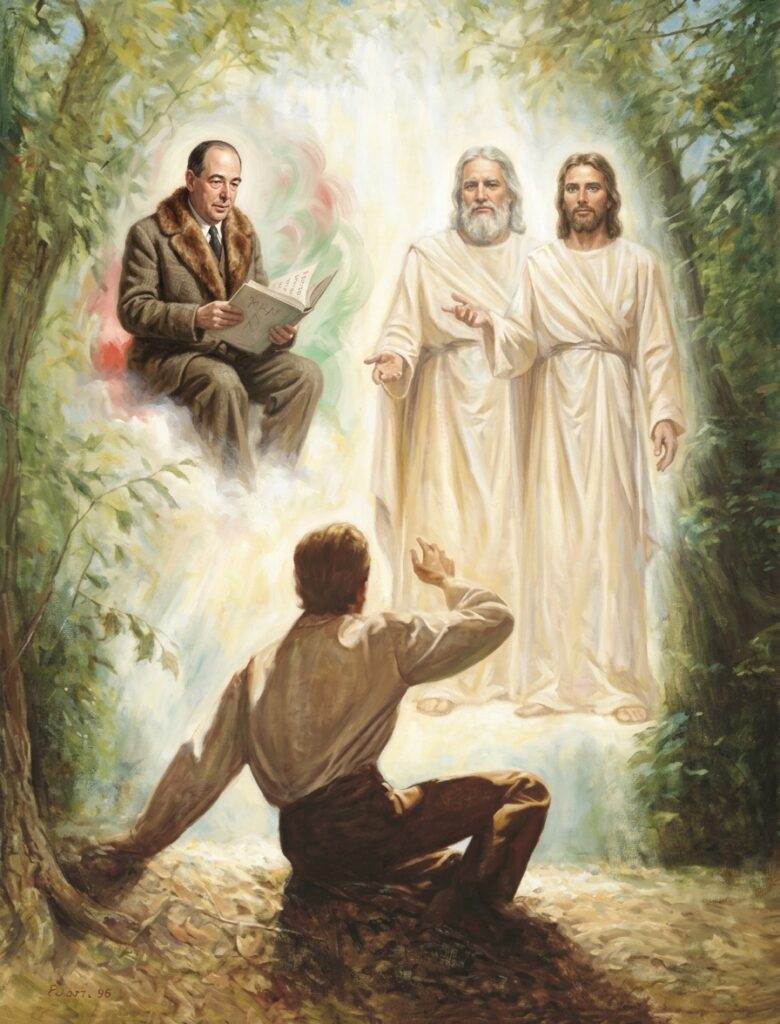
The Thirteenth Apostle Who Never Was: C. S. Lewis at General Conference
Introduction: A Borrowed Voice in the Conference Center
This weekend, October 3 and 4, 2026, The Church of Jesus Christ of Latter-day Saints convenes its 196th Semiannual General Conference. Tens of thousands fill the Conference Center on Temple Square, and millions more listen in some eighty languages. The speakers are apostles, prophets, and other general officers whom Latter-day Saints sustain as authorized messengers of God. Their words will be printed, indexed, studied in Sunday classrooms, and quoted for years to come.
You may have noticed empty parking lots at LDS Meetinghouses on your way to your own church.
LDS Newsroom: October 2026 General Conference
General conference takes place two times a year (April and October) as a global gathering where members from around the world pause to learn from Church leaders about the gospel of Jesus Christ. The conference is streamed and broadcast live in over 80 languages, allowing people anywhere to access it in gatherings large and small and in homes and family settings. Regular Sunday services in Church meetinghouses are not held on the weekends when general conference takes place.
Somewhere in the long tradition of that pulpit stands an unlikely figure. He was an Oxford don born in Belfast in 1898, a Church of England communicant, a man who enjoyed his pipe and his pint and recited the Nicene Creed. He died on November 22, 1963, the same afternoon John F. Kennedy was shot in Dallas, and his passing went largely unnoticed. Yet for half a century Clive Staples Lewis has been quoted from Latter-day Saint pulpits more often than nearly any other writer outside the faith. His presence is so constant that one Latter-day Saint website proposed, only half in jest, that he deserves an honorary ecclesiastical title.
The paradox is sharp. Lewis knew the Latter-day Saints only from a distance, and what little he said about them was not warm. In a letter to a correspondent in Salt Lake City, he objected, in so many words, to any church that made total abstinence from alcohol a condition of membership, calling such a requirement a “tyrannic and unscriptural insolence.” He regarded the Book of Mormon as Joseph Smith’s own composition, modeled on the Bible the way Milton’s epic was modeled on Virgil. And yet, according to Brigham Young University historian Mary Jane Woodger, proxy baptism and the temple endowment have since been performed on his behalf. Few figures illustrate so vividly the gap between being quoted and being agreed with.
This essay examines that gap from the standpoint of historic, creedal Christianity. Its argument is threefold. First, the Latter-day Saints’ use of Lewis is overwhelmingly a matter of borrowed illustration rather than shared doctrine. Second, where Lewis has been pressed into doctrinal service, most conspicuously on the question of human deification, he has been misread in ways his own writings refute. Third, the sheer frequency of quotation has produced, among many ordinary members, an impression of theological kinship that the evidence cannot sustain. Remarkably, the most careful Latter-day Saint scholars concede much of this. The question is not whether Latter-day Saints may admire Lewis; anyone may, and many evangelicals wish more of their own people read him. The question is whether admiration has been allowed to blur a distinction Lewis himself guarded jealously: the difference between the language of Christian devotion and the content of Christian doctrine.
The discussion proceeds in stages. It first measures the phenomenon, then places it in the historical development of Latter-day Saint thought, then examines what Lewis actually knew and said. It next traces five doctrinal fault lines that run beneath the shared vocabulary, tests two popular claims made by Latter-day Saint writers online, and asks why Lewis, rather than any of a half-dozen other great Christian authors, became the borrowed voice of choice. A final section states the Latter-day Saint case as fairly as possible before drawing conclusions.
✦ ❦ ✦
I. Measuring the Phenomenon
From a Single Reference to a Permanent Fixture
The most careful census of Lewis’s presence in official Latter-day Saint discourse remains Mary Jane Woodger’s study, first presented at a BYU Religious Studies Center symposium and published in 2000. Woodger found no references to Lewis by general authorities until the year of his death, when Richard L. Evans mentioned him in a book. Lewis did not appear in a general conference address until October 1977, when Paul H. Dunn of the Seventy quoted a single aphorism. From that modest beginning, his use grew steadily. Woodger counted roughly 130 Lewis citations in the works of general authorities, including some ninety-five in books they authored, and she identified Elder Neal A. Maxwell as the driving force behind the trend, with Elder Jeffrey R. Holland next in line.
Woodger’s study also corrected an inflated popular claim. Contrary to the oft-repeated assertion that Lewis was the most-quoted non-Latter-day Saint in conference history, she found that within her window both Ralph Waldo Emerson and Abraham Lincoln outpaced him, and her figures place Lewis on roughly eighteen conference occasions against some 1,347 addresses delivered between 1977 and 1997. Later counts, measured over different periods, reached different results. Writing for the Deseret News in 2013, attorney James Jardine reported that since 1971 Lewis had been cited thirty-one times in conference talks against twenty for Shakespeare. A 2009 Deseret News report by Michael De Groote, summarizing the research of Marianna Richardson and Christine Thackeray, put Lewis at roughly one hundred references in church-sponsored publications, about a third of them in conference, and thousands across Latter-day Saint writing generally.
“But Mormons love C. S. Lewis.”
— Michael De Groote, Deseret News, June 5, 2009
https://www.deseret.com/2009/6/5/20321778/what-c-s-lewis-thought-about-mormons/
The precise ranking matters less than the pattern. Lewis has become an ambient presence in Latter-day Saint religious culture, heard from stake pulpits and Relief Society lessons as readily as from the Conference Center. Deseret Book, the church-owned retailer, sold more than two thousand Lewis volumes in a single year in the late 1990s, according to Woodger, and it continues to stock his major works.
Who Quotes Him, and How
The roster of Lewis’s Latter-day Saint quoters is distinguished. Elder Maxwell, who once referred to Lewis as “our friend,” wove him into dozens of books. Elders James E. Faust and Dallin H. Oaks, now President of the Church, praised his insight. The late President Jeffrey R. Holland, who died in December 2025, drew on him repeatedly. The single most influential instance came in April 1989, when President Ezra Taft Benson delivered “Beware of Pride,” perhaps the most widely remembered Latter-day Saint sermon of the late twentieth century. Benson credited Lewis once, but Evan Stephenson, writing in Dialogue: A Journal of Mormon Thought, set Benson’s key sentences beside the chapter on pride in Mere Christianity and demonstrated that the sermon’s architecture tracked Lewis closely, point by point. Woodger reached the same conclusion: much of the talk, she judged, was couched in Lewis’s own examples.
A Latter-day Saint website’s catalogue of conference uses illustrates the range. Barbara B. Smith quoted Lewis on the dignity of homemaking in 1979; Marvin J. Ashton used his parable of the house God rebuilds into a palace; Rex D. Pinegar borrowed his insight that life’s interruptions are life itself; Robert L. Backman cited his summons to surrender the whole natural self; Holland invoked his claim that no square inch of the universe is neutral ground; Susan W. Tanner quoted his meditation on a society of “possible gods and goddesses”; and Tad R. Callister deployed his famous trilemma concerning Jesus’ identity.
“He May as Well Be “Elder” C. S. Lewis”
— Jasmine Turner, headline, +Faith (AddFaith.org), August 1, 2018
https://addfaith.org/blog/faith/lds-conference/he-may-as-well-be-elder-c-s-lewis/
Most of these citations are ethical or devotional: they concern pride, suffering, discipline, and love, subjects on which nearly all Christians agree. Two of them, however, are doctrinally freighted, and they reveal the deeper dynamic this essay will explore. Tanner’s “gods and goddesses” passage has been read by Latter-day Saint writers as an endorsement of exaltation. Callister’s trilemma, originally Lewis’s argument that Jesus’ self-claims leave no room for treating him as a mere moral teacher, was redeployed in a talk titled “The Book of Mormon—a Book from God,” lending Lewis’s logic to a book Lewis himself regarded as a human composition. In these two moves, illustration quietly becomes confirmation.
✦ ❦ ✦
II. The Historical Setting: From Restoration Exclusivism to Christian Kinship
A Faith Founded on the Apostasy of Others
To understand why Latter-day Saint leaders reach for Lewis, one must recall how differently the movement began. The Restoration rested on the premise of a Great Apostasy: the claim that, after the death of the apostles, authority and essential truth were lost from the earth until restored through Joseph Smith. In the canonized 1838 account of his First Vision, Smith reports being told that the creeds of the existing churches were an abomination and their professors corrupt. As Blair Dee Hodges observes in Dialogue, condemnation of apostate Christendom appears in each of Smith’s known accounts of the vision. Early Latter-day Saints did not seek allies among the Protestant clergy; they defined themselves against them. Stephenson notes in passing that nineteenth-century apostles such as Orson Pratt and Charles W. Penrose had nothing kind to say about the Church of England, Lewis’s own communion.
The social and political climate deepened the separation. Driven from Ohio, Missouri, and Illinois, the Saints gathered in the Great Basin, practiced plural marriage openly from 1852, and endured decades of federal prosecution. In that isolation, Latter-day Saint theology developed along lines sharply distinct from creedal Christianity. Joseph Smith’s 1844 King Follett discourse taught that God himself was once a man; Lorenzo Snow’s famous couplet summarized the trajectory: “As man now is, God once was; as God now is, man may be.” Revelations taught that the Father has a body of flesh and bones (D&C 130:22) and that intelligence was not created or made (D&C 93:29). None of this sought or required the approval of Oxford.
The Turn Toward Respectability
The twentieth century reversed the polarity. After the 1890 Manifesto and Utah statehood, the church steadily assimilated into American life, and by mid-century it sought recognition as a respectable, patriotic, and recognizably Christian body. Lewis’s American popularity surged in exactly these decades. Woodger notes that he was firmly established in American literary and religious circles by the 1950s and reached mass popularity in the 1970s and 1980s, the same years Elder Maxwell, a former university administrator, rose through church leadership carrying a well-thumbed library of Lewis. Maxwell credited President Harold B. Lee with teaching him that the church need not fear truth from outside sources. The doctrinal warrant came from Joseph Smith’s own maxim, frequently cited in this context, that Mormonism receives truth “let it come from whence it may.”
By the 1990s, the question “Are Mormons Christian?” had become a public controversy, pressed by evangelical critics and answered by Latter-day Saint scholars such as Robert L. Millet, who led formal academic dialogues with evangelicals. Millet himself suggests that the Saints’ attraction to Lewis may be connected to these attacks: Lewis’s famous refusal, in the preface to Mere Christianity, to adjudicate who is or is not a Christian in the deepest sense offered welcome shelter. Millet adds a second, sociological observation: a lay church whose Sunday sermons are delivered by ordinary members may be especially inclined to adopt writers who reduce difficult ideas to memorable images.
“I have no intention of contorting him into one.”
— Robert L. Millet, “The Theology of C. S. Lewis: A Latter-day Saint Perspective,” Interpreter 40 (2020)
https://scholarsarchive.byu.edu/cgi/viewcontent.cgi?article=1309&context=interpreter
The trajectory, then, is clear. A movement that began by declaring the creeds an abomination came, a century and a half later, to quote with deep affection the twentieth century’s most effective defender of those creeds. Lewis served a purpose that no Latter-day Saint author could serve: he was an unimpeachably orthodox Christian voice whose ecumenical reticence allowed him to be quoted without endorsing any rival church’s claim to authority. That usefulness, however, is precisely what makes his doctrinal use so precarious.
✦ ❦ ✦
III. What Lewis Himself Knew and Said
Some Latter-day Saints imagine Lewis as a man who simply never encountered the Restoration and would have embraced it had he done so. The record does not support the picture. Stephenson documents that Lewis had heard of the Book of Mormon and, in his lecture on the literary impact of the Authorized Version, classed it as a work based on the Bible in the way Milton’s epic was based on Virgil. The implication is unmistakable: as Milton was the author of Paradise Lost, Joseph Smith was the author of the Book of Mormon.
The letter to the Salt Lake City correspondent, preserved in Lewis’s collected letters and discussed by De Groote, Hodges, and Millet alike, is more direct. Lewis disclaimed expertise in interdenominational disputes, which he called regrettable, and then registered his strong objection to any church that made teetotalism a condition of membership. In the fuller text, quoted by the evangelical ministry MormonInfo, he adds that Christ turned water into wine and made wine the medium of the one rite he imposed on all his followers, and he dismisses the requirement as provincial. W. Clayton Kimball, a Latter-day Saint admirer who surveyed Lewis’s entire corpus for BYU Studies in 1972, concluded, by Stephenson’s report, that none of the plausible references to the church could be called sympathetic.
Fairness requires restraint here. Some critics have speculated that the vegetarian, teetotaling Scrubb family in The Voyage of the Dawn Treader was a jab at Latter-day Saints, but De Groote rightly notes that Lewis’s stepson Douglas Gresham described the Scrubbs as simple faddists. Anti-Mormon readers can over-read Lewis as easily as Latter-day Saint readers can. The point is not that Lewis was hostile; it is that he was uninterested, and where he did engage, he dissented.
Lewis also left explicit instructions about how to read his silences. In the preface to Mere Christianity, he asked readers not to draw fanciful inferences from what he declined to discuss and said that his own views on disputed matters were no secret: they could be found in the Book of Common Prayer. He was, in other words, an Anglican who expected to be read as one. He also knew how readers behave.
“Almost anything can be read into any book if you are determined enough.”
— C. S. Lewis, Reflections on the Psalms (1958), as cited by Evan Stephenson
https://www.dialoguejournal.com/articles/the-last-battle-c-s-lewis-and-mormonism/
✦ ❦ ✦
IV. Overlay Without Substance: Five Doctrinal Fault Lines
The pattern this essay calls overlay works like a translucent sheet laid over a map. Lewis’s words are placed atop Latter-day Saint doctrine; where the shapes roughly coincide, the match is celebrated; where they diverge, the sheet is trimmed. What the overlay never does is change the underlying map. The vocabulary transfers; the grammar does not. Five fault lines show where the two systems separate beneath the shared words.
1. The Being of God
For Lewis, God is the uncreated, self-existent ground of all being, the Creator of everything that is not himself, existing outside time and without a body. Stephenson documents Lewis’s repeated insistence that anthropomorphic language about God must never be taken literally, and he notes that in The Screwtape Letters the senior devil advises his apprentice to distract a praying man by fixing his mind on mental images of God as an embodied being. Lewis held the Nicene doctrine of the Trinity without reservation. Latter-day Saint doctrine, by contrast, teaches that the Father has a glorified body of flesh and bones, that he was once a man who progressed to godhood, and that the Father, Son, and Holy Ghost are three distinct beings united in purpose. Millet himself, to his credit, names the nature of God, creation from nothing, and the Nicene Trinity as points on which Latter-day Saints would take issue with Lewis. These are not peripheral matters; they concern who God is.
2. The Origin of Humanity
Lewis taught that human beings are creatures: made, not begotten, called into existence from nothing by a Creator of an entirely different order. Book IV of Mere Christianity turns on precisely this distinction between begetting and making, which Lewis drew from the Nicene Creed’s confession that the Son is “begotten, not made.”
“What God begets is God; just as what man begets is man.”
— C. S. Lewis, Mere Christianity, Book IV, as cited by Evan Stephenson
https://www.dialoguejournal.com/wp-content/uploads/sbi/articles/Dialogue_V30N04_55.pdf
The sentence is decisive. In Lewis’s theology, only the Son is begotten of the Father; human beings are made, and what God makes is not God. Latter-day Saint theology teaches the reverse: that human intelligence is uncreated and co-eternal with God, and that human spirits are literally begotten offspring of heavenly parents. Stephenson observes that Lewis, writing in The Four Loves, said plainly that we know nothing of previous existences. When Millet reads Lewis’s famous theme of joy, the inconsolable longing for a home we have never seen, as a literal memory of premortal life, he supplies a meaning Lewis explicitly disclaimed. Lewis’s longing pointed forward to heaven, not backward to a pre-earth existence.
3. Deification: The Crux of the Matter
No Lewis passages are more beloved among Latter-day Saints than those in which he speaks of believers becoming “little Christs,” of a society of “possible gods and goddesses,” and of God’s intention to make the feeblest and filthiest of us into dazzling, radiant, immortal creatures. Stephen E. Robinson’s entry on Latter-day Saint doctrine in the Encyclopedia of Mormonism, a standard reference work, introduced one such passage by stating that Latter-day Saints would agree with Lewis. Woodger found the same passage used by Bruce C. Hafen and in an Ensign article by Elder Alexander B. Morrison.
Yet Lewis’s language belongs to an ancient Christian tradition, called theosis or deification, that runs from Irenaeus and Athanasius through the Eastern Orthodox churches. In that tradition, redeemed human beings come to share in the divine life by grace, as iron placed in fire glows with heat that is not its own. They never cease to be creatures; they never become uncreated; they never acquire a godhood of the same kind as the God who made them. Stephenson shows that Lewis used the word “gods” as Boethius did, to mean happy and perfected human beings, and that Lewis spelled out his meaning precisely.
“Like with the likeness proper to men.”
— C. S. Lewis, The Weight of Glory, as cited by Evan Stephenson
https://www.dialoguejournal.com/articles/the-last-battle-c-s-lewis-and-mormonism/
Lewis compared the glorified believer and God to different instruments playing the same melody, each in its own fashion. The image of the mirror in the very passage Latter-day Saints love makes the same point: a mirror reflects light it does not generate. Evangelical apologist Rob Sivulka states the distinction concisely.
“Becoming gods is quite different from the only God who is God by nature.”
— R. M. Sivulka, MormonInfo.org, “Was C. S. Lewis a Crypto-Mormon?”
https://www.mormoninfo.org/discussion-35/was-c-s-lewis-a-crypto-mormon-3756
Woodger herself, writing as a faithful Latter-day Saint, conceded the point. Reading these uses of Lewis, she wrote, might lead members to infer that Lewis agreed with the Latter-day Saint principle of eternal progression, and he did not. She noted that the idea of a man becoming a God in the Latter-day Saint sense is foreign to Anglican theology, and that Lewis once compared the condescension of the Incarnation to a man becoming a slug or a crab. The deification passages, in short, are the clearest instance of overlay: identical words, opposite ontologies.
4. Time, Eternity, and Progression
Lewis held the classical view, articulated by Augustine and Boethius, that God exists in an eternal present, outside the succession of time, so that all moments are simultaneously present to him. He used the idea to explain how God can attend to millions of prayers at once. Latter-day Saint scripture and teaching run in a different direction. The Book of Abraham places God near a governing star, Kolob, by whose revolutions his time is reckoned, and Doctrine and Covenants 130 ties divine time to the place of God’s residence. Wilford Woodruff taught that God himself is increasing in knowledge, power, and dominion, and that the same is true of his children, though Bruce R. McConkie later dissented. Stephenson concluded that adopting Lewis’s doctrine of God would require Latter-day Saints first to discard their belief in eternal progression. One cannot have both Lewis’s timeless God and Woodruff’s progressing one.
5. Church, Authority, and Ordinances
Lewis’s ecclesiology was modest and creedal. Hodges documents that Lewis regarded any baptism performed in the name of the Father, the Son, and the Holy Ghost as valid regardless of who administered it, and that he advised a correspondent that one was free to take from other systems whatever did not contradict the Nicene Creed. The Creed was his boundary. Joseph Smith rejected precisely that boundary; he said the creeds set up stakes that told believers how far they might go and no further. Latter-day Saint soteriology requires ordinances performed by restored priesthood authority, including proxy ordinances for the dead. Lewis would have regarded additional scripture and a restored priesthood as unnecessary additions to the faith once delivered.
A Case Study in Trimming: “Give Me All”
The overlay is sometimes visible in the editing itself. In October 2021, Elder Holland quoted Lewis’s celebrated passage from Mere Christianity in which Christ demands not part of a person but the whole self. Mike Rabus of Mormonism Research Ministry compared the conference text with Lewis’s original and counted six ellipses and fourteen bracketed insertions. Among the omissions were Lewis’s sentences declaring that Christ has come not to torment the natural self but to kill it, and that half-measures are useless, as well as the phrase extending Christ’s claim to desires we think innocent. Rabus argues that these omissions soften Lewis’s account of fallen human nature to fit a theology in which the natural self is less radically compromised.
“He shouldn’t be considered an authoritative source on Mormon doctrine.”
— Mike Rabus, Mormonism Research Ministry, January 17, 2022
https://mrm.org/holland-2021-general-conference
One may debate Holland’s intent; editing for time is a normal feature of public speaking, and Rabus acknowledges that Holland affirmed “no halfway measures” elsewhere in the same talk. The structural point stands regardless. When Lewis is quoted, the parts of his thought that sit uneasily with the receiving system tend to fall away, and the remainder sounds more congenial than the whole.
✦ ❦ ✦
V. “Plenty of Overlap”? Examining a Forum Claim
In May 2024, a long-time participant on the Mormon Dialogue and Discussion Board noticed a high councilor reading from a Lewis book during a sacrament meeting talk and asked when and why Lewis had become so acceptable in Latter-day Saint worship, when teachers were often told to use only church-approved materials. One respondent, posting as LoudmouthMormon, replied that he had never heard Lewis quoted in church, was not opposed to it, and saw common ground.
“Plenty of overlap between his brand of Christianity and ours.”
— LoudmouthMormon, Mormon Dialogue & Discussion Board, May 23, 2024
https://www.mormondialogue.org/topic/75914-cs-lewis/
The comment is friendly and sincere, and it represents a widespread sentiment. It does not, however, survive examination. Four considerations show why.
The Empirical Premise
The respondent’s own experience notwithstanding, Lewis is among the most frequently quoted non-Latter-day Saint authors in the church’s history, as the data reviewed above demonstrate. Another participant in the same thread promptly supplied the Deseret News figures. The premise is not a fault of the poster; it testifies to how thoroughly Lewis has become part of the ambient religious culture, so familiar that his quotations no longer register as borrowings.
What the Overlap Contains
Stephenson, writing for a Latter-day Saint readership, listed the genuine points of agreement: Lewis believed in prayer, in miracles, in the deity of Jesus and his atonement, in God’s love and forgiveness, in the truth and usefulness of the scriptures, and in praising and trusting God. Then he added the decisive observation that the majority of these parallels correspond to any number of Christian and even non-Christian religions. Overlap at this level does not distinguish. A Roman Catholic, an Eastern Orthodox priest, a Baptist, and a Methodist could each claim the same list. Overlap that every tradition shares cannot establish a special kinship between any two of them.
Shared Vocabulary, Different Grammar
Languages offer a useful analogy. Two tongues may share thousands of loanwords while differing entirely in grammar; the shared words create a pleasant sense of familiarity, but sentences built from them can mean very different things. Lewis and Latter-day Saint teaching share the words Father, Son, god, grace, atonement, and eternal. They do not share the grammar that governs those words: whether God is created or uncreated, embodied or incorporeal, timeless or progressing; whether human beings are creatures or co-eternal intelligences; whether becoming “gods” means participation by grace or attainment of the same kind of godhood. On every one of those grammatical questions, Lewis and Latter-day Saint doctrine take opposite sides.
Lewis’s “Brand”
Finally, the phrase “his brand of Christianity” inadvertently names the problem. Lewis’s brand was “mere Christianity,” the common faith of the creeds, which he said could be found in the Book of Common Prayer. That is the very body of doctrine the First Vision narrative identifies as apostate. The overlap is therefore greatest where it is least distinctive and smallest where it matters most. Latter-day Saints and Lewis agree that pride is deadly and suffering can sanctify; they disagree about the nature of the God who sanctifies.
It is worth noting that Latter-day Saint voices in the same discussion thread recognized this. One participant expressed the hope that Lewis remains a staunch Anglican in the hereafter and called the rumor that he was “almost Mormon” ill-informed. Another observed that many denominations cast Lewis as secretly one of their own, a byproduct of his deliberate neutrality. Hodges, citing journalist Richard Ostling, records that Latter-day Saints sometimes regard Lewis as “almost a crypto-Mormon,” and Stephenson notes that some Catholics regard him as a Catholic in embryo. When every tradition finds itself in a mirror, the mirror is telling us more about the readers than about the author.
“Almost a crypto-Mormon.”
— Richard Ostling, as quoted by Blair Dee Hodges, Dialogue 43, no. 3 (2010)
https://www.dialoguejournal.com/articles/all-find-what-they-truly-seek-c-s-lewis-and-the-virtuous-unbeliever/
✦ ❦ ✦
VI. “A Thinking Man’s Theologian”? Getting the Category Right
In January 2025, the Latter-day Saint devotional site ZionWisdom.com published a post on Lewis drawn from the 1999 BYU volume C. S. Lewis: The Man and His Message. It opens with a memorable line.
“C. S. Lewis is a thinking man’s theologian.”
— ZionWisdom.com, January 5, 2025
https://zionwisdom.com/2025/01/05/c-s-lewis/
The phrase originates with Robert Millet, who used it in his introduction to that volume and repeated it in his 2020 Interpreter article. There is an instructive irony in the ZionWisdom post: two paragraphs after the “thinking man’s theologian” line, it reproduces Millet’s own caveat that Latter-day Saints do not turn to Lewis for the final word on doctrinal expansion, clarification, or interpretation, nor measure truth by his insights. The source quoted to elevate Lewis also limits him.
Kind but Accurate
Let us be kind but accurate: C. S. Lewis was not a theologian. He was a literary scholar of the first rank, a fellow and tutor in English at Magdalen College, Oxford, from 1925 to 1954, and thereafter the first holder of Cambridge’s chair of Medieval and Renaissance English. His academic formation was in classics, philosophy, and English literature. He held no theological degree, was never ordained, and wrote no systematic theology. He described himself, in the preface to Mere Christianity, as a very ordinary layman of the Church of England, and in an essay collected in God in the Dock he described his role as that of a translator, turning Christian doctrine into the vernacular for people who would never read the professionals.
His contemporaries agreed. Austin Farrer, Lewis’s friend and an Oxford theologian of real distinction, wrote that Lewis laid no claim to the learning that would have made him a theologian. Hodges notes that Lewis referred to himself throughout his life as an amateur theologian and resisted systematizing his thought. Stephenson begins his catalogue of misconceptions with the flat statement that Lewis was not a theologian, adding that no one insisted on the point more than Lewis himself. The Oxford establishment was so conscious of the distinction that it reportedly held Lewis’s popular apologetics against him when two prestigious chairs were filled.
“Disliked the thought of a professor of English literature winning fame as amateur theologian.”
— Friends of Lewis, as reported by James Jardine, Deseret News, November 22, 2013
https://www.deseret.com/2013/11/22/20530104/c-s-lewis-writings-have-profound-effect-on-latter-day-saints/
Why the Category Matters
This is not pedantry. A theologian’s statements are weighed as precise, technical claims within a disciplined system; an apologist’s images are weighed as persuasive illustrations aimed at a general audience. When Latter-day Saint writers treat Lewis’s apologetic imagery, such as his “gods and goddesses,” as a technical theological statement congruent with exaltation, they commit a double category error: first they make Lewis a theologian, and then they make him a theologian of their own system. Lewis’s most devoted evangelical admirers decline the first step. John Piper, who credits Lewis with shaping his spiritual life, nonetheless told an audience in 2010 that Lewis is not a guide to careful biblical doctrine.
“His value is not in his biblical exegesis.”
— John Piper, 2010 address, as reported in Towers, Southern Baptist Theological Seminary, November 2013
https://equip.sbts.edu/publications/towers/elephant-in-the-room-evangelicals-continue-to-value-c-s-lewis-despite-theological-differences/
The more accurate descriptors are well established: Christian apologist, lay theologian, literary scholar, and imaginative writer of genius. Each is honorable. None authorizes the use of Lewis as doctrinal confirmation for any system, least of all one whose doctrine of God he explicitly rejected.
✦ ❦ ✦
VII. Why Lewis? Why Not Chesterton, Keller, Schaeffer, Tozer, or Sayers?
The choice of Lewis over other great Christian writers is itself evidence. G. K. Chesterton, Dorothy L. Sayers, A. W. Tozer, Francis Schaeffer, and Timothy Keller were all brilliant, widely read, and eminently quotable. None has become a fixture of Latter-day Saint preaching as Lewis has. The reasons illuminate both Lewis and the nature of the borrowing.
What Makes Lewis Uniquely Usable
Six features set Lewis apart. First, his deliberate non-denominationalism: by confining himself to “mere Christianity,” he avoided the ecclesial claims about Rome, Canterbury, or Geneva that would collide with the Restoration narrative of universal apostasy. Second, several of his theological emphases happen to align with Latter-day Saint instincts: a robust doctrine of free will, an explicit rejection of the Calvinist doctrine of total depravity (which Millet highlights), an inclusivist hope for sincere seekers outside Christianity (dramatized by Emeth in The Last Battle and discussed at length by Hodges), a skepticism toward the penal substitutionary theory of the atonement that his friend Martyn Lloyd-Jones criticized, a balanced image of faith and works as the two blades of a pair of scissors, and the deification language already discussed. Third, his prose is unusually rich in concrete metaphor, which makes it ideal for sermons. Fourth, his American popularity peaked precisely as the church sought mainstream acceptance. Fifth, he had a devoted apostolic champion in Elder Maxwell; William G. Dyer, reviewing Maxwell in BYU Studies, remarked, as Stephenson records, that Maxwell turned to writers like Lewis at least as often as to Joseph Smith or the scriptures. Sixth, Lewis died in 1963 and could not answer back.
The Alternatives
Set beside these features, the alternatives reveal why they are harder to borrow. G. K. Chesterton, whose Everlasting Man helped bring Lewis to faith, entered the Roman Catholic Church in 1922, and his apologetics culminate in the living authority of that church. To quote Chesterton at length is to invite the question of which church holds authority, a question the Restoration answers very differently. Dorothy L. Sayers, Lewis’s friend and fellow Anglican, argued that the dogma is the drama: that the Nicene doctrines of the Trinity and Incarnation are not dry abstractions but the most exciting story ever told. Her apologetics leave no room for doctrinal vagueness about the nature of God.
A. W. Tozer’s The Knowledge of the Holy is a sustained meditation on God’s self-existence, immutability, infinitude, and incomprehensibility. Read in sequence, its chapters amount to a point-by-point contradiction of an exalted-man theology. Francis Schaeffer, a Reformed Presbyterian, built his work on biblical inerrancy and the sufficiency of a closed canon of Scripture, convictions that preclude additional scripture. Timothy Keller, whose The Reason for God updated Lewis for a twenty-first-century city, framed the gospel in the classic Reformed terms of justification by faith alone and penal substitution, terms that sit uneasily with the Book of Mormon’s teaching that one is saved by grace “after all we can do” (2 Nephi 25:23).
Each of these writers is more doctrinally explicit than Lewis on exactly the points where Latter-day Saint theology departs from historic Christianity. Lewis’s genius for ecumenical reticence, his strategic silence on contested questions, becomes in another tradition’s hands a blank space that can be filled with that tradition’s own meanings. The selection of Lewis is not random. He is the most theologically under-determined of the great modern apologists, and therefore the most borrowable.
✦ ❦ ✦
VIII. Digging for Doctrine: The Archaeology of Quotation
An analogy from another field clarifies what Lewis quotations can and cannot establish. The Book of Mormon describes populous civilizations in the ancient Americas, with cities, metallurgy, horses, chariots, and a final battle involving hundreds of thousands. A century of interest, and the sincere work of capable Latter-day Saint archaeologists, has not produced the kind of direct and independent confirmation that would settle the matter: an inscription, a place name, or a stratum recognizable as distinctively Nephite. Many Latter-day Saint scholars now favor limited-geography models and acknowledge the absence of direct evidence, while maintaining their faith on other grounds. The ground has been excavated; the foundation stones have not appeared.
Quotations of Lewis function in a strikingly similar way. Excavate the 130 citations Woodger catalogued, along with the decades of quotation since, and one finds a great deal of attractive surface material, but no doctrinal foundation stone. Woodger herself drew exactly this conclusion.
“Never used as the source of, or as a confirmation for, doctrine.”
— Mary Jane Woodger, “The Words of C. S. Lewis as Used by the Leadership of the LDS Church,” Harvest Magazine, February 2000
http://www.crlamppost.org/woodger.htm
Elder Maxwell, Lewis’s greatest Latter-day Saint champion, said the same about himself at the 1998 BYU centennial conference, and earlier he had written that he did not get his theology from such men.
“It is not doctrine for which I look to Lewis.”
— Elder Neal A. Maxwell, in C. S. Lewis: The Man and His Message, ed. Skinner and Millet (1999)
https://novus2.com/righteouscause/wp-content/uploads/2026/10/Lewis-Man-and-Message.pdf
Millet, in the introduction to the same volume, agreed that Lewis was neither an apostle nor a prophet and that Latter-day Saints do not measure truth by his insights. The leaders’ own testimony thus concedes the central thesis of this essay. Lewis is decoration, not foundation.
Why the Concession Does Not Settle the Matter
If the leaders concede the point, why does it matter? Because the people in the pews rarely hear the disclaimer. Stephenson observed that because some general authorities like to quote Lewis, a large number of Latter-day Saints have concluded that his teachings are inspired. He recorded a branch president’s assurance that Lewis was a “dry Mormon” who had surely accepted the fullness of the gospel in the spirit world, and an institute teacher who recommended The Voyage of the Dawn Treader as the key to understanding Deuteronomy. Woodger noted that when the First Presidency, apostles, and Seventies quote Lewis, many members take notice and feel that his ideas are inspired. On the Mormon Dialogue board, one participant summarized the dynamic succinctly: when something is done in general conference, everyone feels it has been approved.
A quotation from an authoritative pulpit functions as an endorsement by association. Over time it generates a halo of kinship that no single citation claims but that the accumulation implies. And the halo is curated: the Lewis who appears at the pulpit is the Lewis of pride, suffering, and discipleship, not the Lewis of creation from nothing, divine incorporeality, and the Trinity. The line between illustration and confirmation is not always kept, either. Woodger herself acknowledged that two books defining Latter-day Saint doctrine used Lewis’s words to represent Latter-day Saint teaching, and the Encyclopedia of Mormonism, a reference work, enlisted Lewis on deification. Where Lewis is used as a doctrinal witness, he is a witness who, called to testify in full, would contradict the case.
✦ ❦ ✦
IX. The Latter-day Saint Case, Stated Fairly
Scholarly integrity requires presenting the strongest form of the opposing view. Latter-day Saint scholars offer a coherent rationale for their use of Lewis. Joseph Smith taught that a fundamental principle of Mormonism is to receive truth from whatever source; the Book of Mormon teaches that everything which invites to do good and to believe in Christ is inspired of God (Moroni 7:16); and President Gordon B. Hinckley famously invited people of other faiths to bring all the good they have and let the church add to it. Joseph F. Smith taught that truth found in fragments throughout the world originated with God. On this view, quoting Lewis does not claim him; it harvests truth wherever it grows.
Hodges adds a theological dimension. Lewis’s own openness to truth in other traditions, his image of philosophical systems as doors that can lead into Christianity as well as out of it, and his hope for sincere seekers such as Emeth all resemble the Latter-day Saint approach. From a Latter-day Saint perspective, Hodges suggests, Lewis is himself a “virtuous unbeliever” whose labor in God’s vineyard is honored and whose path to the fullness remains open beyond death. Millet’s scholarship deserves credit for its candor: he lists the doctrinal differences, disclaims any effort to make Lewis a Latter-day Saint, and acknowledges Lewis’s objection to the Word of Wisdom.
Evangelicals, moreover, have no monopoly on Lewis and no immunity from selective reading. The Southern Baptist Theological Seminary’s Towers catalogued evangelical reservations: Lloyd-Jones faulted Lewis’s views on reason and the atonement, Kevin DeYoung criticized his inclusivism, and Piper listed six significant disagreements, including Lewis’s rejection of inerrancy, even while affirming his enduring value. Catholics, too, have claimed him. Every tradition quotes Lewis selectively.
A Response
These points have real force, and they warrant charity. Still, three differences remain. First, the Latter-day Saint quotations come from a pulpit that members sustain as prophetic, which confers on them an authority that a seminary professor’s citation does not carry. Second, evangelicals who quote Lewis share his creed, the Nicene confession of one God in three persons, even when they differ with him on soteriology or Scripture; their disagreements are within the family. Third, the selective use of Lewis by Latter-day Saint writers crosses the boundary at the doctrine of God itself, the point on which Lewis was clearest and most insistent. The principle of receiving truth from whence it may come is admirable, but it cuts both ways. If Lewis is a reliable source of truth about pride, grace, and suffering, consistency invites a hearing for his truth about God, the Creator who made all things from nothing and who is, eternally, Father, Son, and Holy Spirit.
✦ ❦ ✦
Conclusion: The Wine and the Bottles
Evan Stephenson, writing in an independent Latter-day Saint journal nearly thirty years ago, concluded that Lewis and Latter-day Saint theology bear little resemblance to one another at the level of fundamental assumptions. He put the point in a memorable image drawn from the Gospels: one would sooner fit a camel through the eye of a needle than do what so many have attempted.
“Pour C. S. Lewis’s wine into Joseph Smith’s bottles.”
— Evan Stephenson, “The Last Battle: C. S. Lewis and Mormonism,” Dialogue 30, no. 4 (1997)
https://www.dialoguejournal.com/articles/the-last-battle-c-s-lewis-and-mormonism/
His summary verdict was that in Lewis, Latter-day Saints do not find a unique figure who mirrors their own theology; they find common ground between themselves and their fellow Christians. That is a gracious and accurate conclusion, and it is the right place for this essay to land as well. The common ground is real. Lewis’s insight into pride, temptation, suffering, and the cost of discipleship belongs to every reader willing to receive it, and it is no small thing that millions of Latter-day Saints have been moved by an Anglican’s witness to Christ.
But common ground is not common doctrine. The overlap lies in the vocabulary of devotion; the divergence lies in the grammar of belief. Lewis’s Christ is the eternally begotten Son of an uncreated, incorporeal, timeless God; the human destiny he describes is participation in that God’s life by grace, the glory of a mirror rather than of a sun. No amount of quotation can change what he meant, and the most thoughtful Latter-day Saint scholars do not pretend otherwise.
There remains the matter of the proxy ordinances performed on Lewis’s behalf. His eternal destiny is not ours to adjudicate, and Latter-day Saints understand such ordinances as offers that the departed are free to accept or decline. Historically, however, Lewis lived and died a communicant of the Church of England who told his readers that his views on disputed questions were written in the Book of Common Prayer. Honoring a man includes honoring the convictions he chose.
The best response to the Latter-day Saint affection for Lewis is not to begrudge it but to complete it. Read Lewis whole, and the borrowed fragments return to the faith they came from. Lewis believed that there is one God, eternal and uncreated, who made all things from nothing and was never anything other than God. He believed that this one God is Father, Son, and Holy Spirit, three persons sharing one divine nature, and that the Son is begotten, not made, while every human soul is made, not begotten. He believed that the eternal Son took on human flesh in the womb of Mary, died for the sins of the world, and rose bodily from the grave. He believed that men and women are fallen creatures whose rescue comes from God’s grace, not from their own climb toward godhood. He believed that the glory awaiting the redeemed is the glory of a mirror that reflects a light it will never generate. He believed that this faith had been delivered once for all and confessed in the ancient creeds, and he told his readers they would find his convictions in the Book of Common Prayer. These were not the margins of Lewis’s thought; they were its foundation, the ground on which every memorable sentence quoted from a Latter-day Saint pulpit was built. Lewis said he believed in Christianity as he believed the sun had risen: not only because he saw it, but because by its light he saw everything else. That light is the God of the creeds. To warm oneself in Lewis’s sentences while setting aside the God who gave them their meaning is to love the rays and refuse the sun. If his clarity about lesser things has persuaded so many, his clarity about the greatest things deserves an equal hearing, and that hearing leads not to a restored gospel but back to the one he never stopped confessing.
✦ ❦ ✦
SOURCES AND BIBLIOGRAPHY
Primary Resources Specified for This Study
Millet, Robert L. “The Theology of C. S. Lewis: A Latter-day Saint Perspective.” Interpreter: A Journal of Latter-day Saint Faith and Scholarship 40 (2020): 243–262. Reprinted from “To Seek the Law of the Lord”: Essays in Honor of John W. Welch (2017). BYU ScholarsArchive PDF.
https://scholarsarchive.byu.edu/cgi/viewcontent.cgi?article=1309&context=interpreter
Millet, Robert L. “The Theology of C. S. Lewis: A Latter-day Saint Perspective.” Interpreter Foundation web edition (same text as above).
https://interpreterfoundation.org/journal/the-theology-of-c-s-lewis-a-latter-day-saint-perspective
Stephenson, Evan. “The Last Battle: C. S. Lewis and Mormonism.” Dialogue: A Journal of Mormon Thought 30, no. 4 (Winter 1997): 43–69. Web edition.
https://www.dialoguejournal.com/articles/the-last-battle-c-s-lewis-and-mormonism/
Stephenson, Evan. “The Last Battle: C. S. Lewis and Mormonism.” Dialogue 30, no. 4. PDF edition.
https://www.dialoguejournal.com/wp-content/uploads/sbi/articles/Dialogue_V30N04_55.pdf
Stephenson, Evan. “The Last Battle” (University of Illinois Press / Scholarly Publishing Collective PDF, DOI 10.2307/45226387). The supplied Silverchair link carries an expired access token and returned an error; the article was read in full via the two Dialogue editions above.
https://watermark02.silverchair.com/45226387.pdf
Hodges, Blair Dee. “‘All Find What They Truly Seek’: C. S. Lewis, Latter-day Saints, and the Virtuous Unbeliever.” Dialogue: A Journal of Mormon Thought 43, no. 3 (Fall 2010).
https://www.dialoguejournal.com/articles/all-find-what-they-truly-seek-c-s-lewis-and-the-virtuous-unbeliever/
De Groote, Michael. “What C. S. Lewis Thought about Mormons.” Deseret News (Mormon Times), June 5, 2009.
https://www.deseret.com/2009/6/5/20321778/what-c-s-lewis-thought-about-mormons/
Jardine, James. “C. S. Lewis’ Writings Have Profound Effect on Latter-day Saints.” Deseret News, November 22, 2013. The supplied Wayback Machine link was blocked to automated retrieval; the article was read at the live URL below.
https://www.deseret.com/2013/11/22/20530104/c-s-lewis-writings-have-profound-effect-on-latter-day-saints/
Woodger, Mary Jane. “The Words of C. S. Lewis as Used by the Leadership of the LDS Church.” Harvest Magazine, February 2000; archived by the Cumberland River Lamp Post. The supplied Wayback Machine link was blocked; the article was read at the live URL below.
http://www.crlamppost.org/woodger.htm
Sivulka, R. M. “Was C. S. Lewis a Crypto-Mormon?” MormonInfo.org.
https://www.mormoninfo.org/discussion-35/was-c-s-lewis-a-crypto-mormon-3756
Mormon Dialogue & Discussion Board. “CS Lewis” (thread begun by MustardSeed, May 23, 2024; comment by LoudmouthMormon).
https://www.mormondialogue.org/topic/75914-cs-lewis/
Skinner, Andrew C., and Robert L. Millet, eds. C. S. Lewis: The Man and His Message: A Latter-day Saint Perspective. Salt Lake City: Bookcraft, 1999. Includes Millet’s introduction and Neal A. Maxwell, “C. S. Lewis: Insights on Discipleship.”
https://novus2.com/righteouscause/wp-content/uploads/2026/10/Lewis-Man-and-Message.pdf
“*C. S. Lewis.” ZionWisdom.com, January 5, 2025 (posted by “kdm”).
https://zionwisdom.com/2025/01/05/c-s-lewis/
Hanbury, Aaron Cline. “Elephant in the Room: Evangelicals Continue to Value C. S. Lewis Despite Theological Differences.” Towers 12, no. 4 (November 2013), Southern Baptist Theological Seminary.
https://equip.sbts.edu/publications/towers/elephant-in-the-room-evangelicals-continue-to-value-c-s-lewis-despite-theological-differences/
Turner, Jasmine. “He May as Well Be ‘Elder’ C. S. Lewis.” +Faith (AddFaith.org), August 1, 2018.
https://addfaith.org/blog/faith/lds-conference/he-may-as-well-be-elder-c-s-lewis/
Rabus, Mike. “Review of ‘The Greatest Possession’ (Apostle Jeffrey R. Holland, Oct. 2021 General Conference).” Mormonism Research Ministry, January 17, 2022.
https://mrm.org/holland-2021-general-conference
Facebook group post (Christvm group). This post could not be retrieved: Facebook blocks automated access to group content. It is not quoted or relied upon in this essay.
https://www.facebook.com/groups/christvm/posts/24359220257085573/
Supplementary Sources Consulted
Church of Jesus Christ of Latter-day Saints Newsroom. “October 2026 General Conference.”
https://newsroom.churchofjesuschrist.org/event/october-2026-general-conference
Seariac, Hanna. “7 Times C. S. Lewis Was Quoted in General Conference.” Deseret News, March 19, 2023.
https://www.deseret.com/faith/2023/3/19/23645025/top-cs-lewis-quotes-lds-general-conference/
Schoenbaum, Hannah (Associated Press). “Jeffrey R. Holland, Next in Line to Lead Church of Jesus Christ of Latter-day Saints, Dies at 85.” December 27, 2025.
https://www.opb.org/article/2025/12/27/jeffrey-holland-lds-dies-85
Stephenson, Evan. “The Last Battle: C. S. Lewis and Mormonism.” Scholarly Publishing Collective landing page (confirms DOI 10.2307/45226387).
https://scholarlypublishingcollective.org/uip/dial/article/30/4/43/241118/The-Last-Battle-C-S-Lewis-and-Mormonism
✦ ❦ ✦
A Note on Method and Authorship
This study was researched and drafted with the assistance of Claude, an AI model developed by Anthropic, serving as a scholarly research collaborator. Every primary source specified for the project was requested and read before drafting; where a link was blocked or expired, the live original or a confirmed equivalent was located and documented above. Quotations from copyrighted sources are kept brief and are attributed with their URLs; all other source material is paraphrased. Final editorial judgment, theological conclusions, and responsibility for the published text rest with the author and The Righteous Cause.