
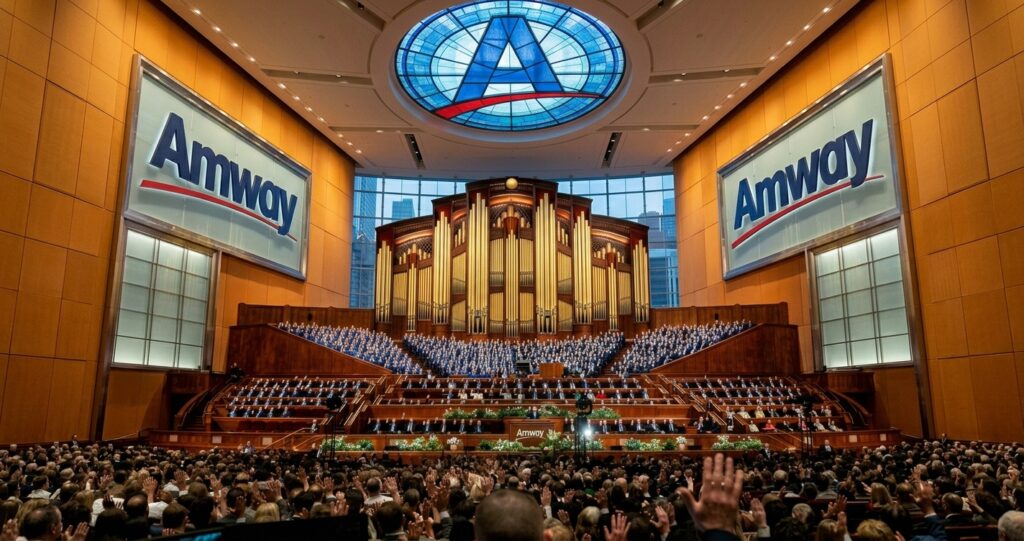
Why the Church’s twice-yearly broadcast feels so much like an Amway
distributor rally and what its polished vocabulary leaves unsaid
❧ ✦ ❧
Introduction: Welcome to the Rally
Somewhere in a hotel ballroom in the American Midwest, a man in a well-pressed suit is walking to a lectern. The lights soften. The music swells, then hushes. He smiles the smile of someone who has given this talk before and will give it again, and he begins to tell twenty thousand people that the life they want is within reach, if they will only trust the system, stay faithful to the plan, and keep buying the product.
Now shift the scene two thousand miles west. A man in a well-pressed suit is walking to a pulpit in the Conference Center in Salt Lake City. The lights are soft. The choir has just finished. He smiles at someone who has given this talk before and will give it again, and he begins to tell millions of viewers that the life they want is within reach, if they will only trust the Lord, stay on the covenant path, and keep paying a full tithe.
The resemblance is not perfect, and it would be unfair to pretend it is. But it is close enough that people on both sides of the comparison keep noticing it. Former Amway distributors who drift into ex-Mormon forums say the language feels familiar. Former Latter-day Saints who stumble into an Amway function say the same thing in reverse. And even faithful members, the people who actually love General Conference, have been heard to describe it as part worship service and part sales meeting.
This essay takes that comparison and runs with it, for a while, with a grin. Twice a year, the Church of Jesus Christ of Latter-day Saints holds what its own publications describe as an opportunity to receive direction from God through a living prophet and apostles. Twice a year, a great many people, including a surprising number of the faithful, quietly reach for the coffee they are not supposed to drink. Something about that gap between billing and experience is worth examining.
But a fair warning before we begin. The comparison to a sales convention is fun, and most of this essay will treat it that way. At a certain point, though, the jokes stop, because underneath the polish there is a real theological question: what happens when an institution learns to sound almost exactly like historic Christianity while quietly meaning something quite different by the same words? When we get there, I will say so plainly.
For now, find a comfortable chair, a plate of cinnamon rolls, and a bingo card. The choir will now favor us with a selection.
❧ ✦ ❧
Two Conventions, One Playbook
The Stage, the Lineup, and the Upline
Amway, founded in 1959 by Rich DeVos and Jay Van Andel in Ada, Michigan, built its culture around two things: products and meetings. The products were soap, vitamins, and cosmetics. The meetings were where people learned to believe in the products, the business, and, above all, the people on stage who had already made it.
A former distributor described those meetings on Reddit’s ex-Mormon forum, where she had been lurking because the posts “resonate deeply” with her experience:
Meetings were constant. At least every other week for a couple hours, plus these absolutely soul-crushing four-day weekends that ran from 9 a.m. to midnight. You’d be stuck in an overcrowded ballroom or stadium with 200+ people, blasting music, screaming about how jobs are terrible.
— u/flckeringfirefly, “Parallels with Amway,” r/exmormon, https://www.reddit.com/r/exmormon/comments/1jqzeea/parallels_with_amway/
General Conference does not run until midnight, and nobody screams about anything. That is part of the joke, which we will come to. But the architecture is recognizable. There is a stage. There is a fixed hierarchy of people entitled to stand on it. There is a top tier whose words carry the most weight (in Amway, the Diamonds and Crown Ambassadors; in the Church, the fifteen men sustained as “prophets, seers, and revelators”). There is a middle tier auditioning for promotion. One Reddit wag summed up the purpose of conference for the Seventies in five words: “Tryouts to see which 70 is getting promoted.”
The October 2026 conference, the 196th Semiannual General Conference, held October 3 and 4, featured thirty-seven talks across four general sessions. Of the speakers, the overwhelming majority were male General Authorities; a handful were women leading the Church’s auxiliary organizations. The Salt Lake Tribune’s David Noyce describes the speakers in his explainer on why the paper covers the event:
The speakers include members of the governing First Presidency and the Quorum of the Twelve Apostles, along with other male general authorities and a few churchwide women’s leaders.
— David Noyce, “What is LDS General Conference? And why does The Tribune cover it?” The Salt Lake Tribune, Oct. 10, 2023, https://www.sltrib.com/religion/2023/10/10/what-is-lds-general-conference-why/
An Amway veteran would feel right at home with the seating chart.
“Be a Product of the Product”
Every Amway distributor learns the phrase early: be a product of the product. You use the soap, the vitamins, and the toothpaste, not necessarily because they are the best on the market, but because loyalty to the product line is a sign of loyalty to the business. The same former distributor recalled:
I was expected to use their everything: deodorant, hair products, cosmetics, laundry soap, toothpaste, mouthwash, cleaners, energy drinks, bars, vitamins—all of it. Even though their vitamins wrecked my stomach. But hey, “be a product of the product,” right?
— u/flckeringfirefly, “Parallels with Amway,” r/exmormon, https://www.reddit.com/r/exmormon/comments/1jqzeea/parallels_with_amway/
General Conference has no laundry soap. But it does have an unmistakable emphasis on the one product that keeps the organization running. In October 2026, two separate talks were devoted to tithing: Elder Patricio M. Giuffra’s “Trusting the Lord Through Tithes and Offerings” and Elder Moisés Villanueva’s “Prove Me Now Herewith,” the latter title borrowed from Malachi 3:10. Elder Giuffra put the principle plainly:
The law of tithing is a law of faith. … the windows of heaven are opened according to our obedience.
— Elder Patricio M. Giuffra, “Trusting the Lord Through Tithes and Offerings,” October 2026 General Conference, https://www.churchofjesuschrist.org/study/general-conference/2026/10/24giuffra?lang=eng
He also quoted President Nelson’s claim that “tithing can break cycles of poverty in poor nations and families.” In fairness, many Christian traditions teach tithing, and the Malachi text is shared Scripture. The difference, and the reason the Amway comparison bites, is that in the Church payment of a full tithe is a condition of temple worthiness, and temple worthiness is a condition of the highest blessings the faith offers. A commenter in r/mormon put it bluntly: if you stop paying, “you are declared ‘unworthy’ of going to God’s house.” The product is not optional if you want to stay in the business.
Every Member a Distributor
The heart of Amway’s model is recruitment. A distributor who sells soap makes a little money; a distributor who recruits other distributors makes a lot more. Rockwell Porter Johnson, a former member writing for the Medium publication Recovering Mormon, drew the parallel directly:
It’s logically impossible for Mormons to see you as anything other than a potential convert.
— Rockwell Porter Johnson, “Amway and the Mormon Church: You Might Be Surprised At the Similarities,” Recovering Mormon (Medium), https://medium.com/recovering-mormon/amway-and-the-mormon-church-5ba7b444ed0
That is a strong claim, and a great many Latter-day Saints who are genuinely good friends to their non-member neighbors would rightly push back on it. But Johnson’s broader observations are harder to dismiss. He notes the Church’s longstanding motto, “Every Member a Missionary,” and compares it to Amway’s expectation that every distributor recruit. He even observes that Amway’s famous recruiting pitch, “Drawing Circles,” bears an uncanny resemblance to the circles missionaries draw when they teach the Plan of Salvation.
The October 2026 conference season fit the pattern. In the week before conference, the Church News promoted a new set of “Love, Share, Invite” videos in which three General Authorities told how a simple invitation from a sister, a friend, or a cousin led to their conversion. During the conference itself, Bishop Sean Douglas spoke on “The Hour of Your Mission Is Come,” reminding young men of their priesthood responsibility to serve. None of this is sinister. Evangelism is a Christian duty, and Jesus told His followers to go and make disciples. But the format, the slogans, and the success stories told from the stage will feel very familiar to anyone who has sat through an Amway “open meeting.”
In Fairness to the Distributors
Before going further, two caveats are in order, because the evidence rules for this essay matter.
First, Amway itself is a lawful business. In 1979, the Federal Trade Commission concluded that Amway’s model was not an illegal pyramid scheme, though it did require changes to the company’s earnings claims. Comparing the Church to Amway is a comment on style and structure, not an accusation of fraud.
Second, the people in the seats are not the joke. An atheist YouTuber who attended General Conference and later published a critical video made a point that one Reddit commenter paraphrased this way: he kept meeting nice, earnest believers, and he could not quite work out how the institution was producing that kind of person. Another commenter in the same thread observed that the change in ordinary Latter-day Saints “clearly … does not come from the charismatic leadership.” Whatever one concludes about the institution, the sincerity of millions of members deserves respect. This essay is about the messaging, not the messengers’ hearts.
❧ ✦ ❧
The Voice: Soft, Slow, and Strangely Soothing
The Conference Voice
If you have watched more than one session of General Conference, you know the voice. It is unhurried. It drops at the end of sentences. It pauses where a lesser speaker would plow ahead. It sounds, in a word, reassuring, and it sounds remarkably similar whether the speaker grew up in Utah, Brazil, Ghana, or Tonga.
In an earlier essay on these pages, I described the phenomenon this way:
The cadence itself becomes evidence of spiritual authority.
— The Righteous Cause, “The ‘Stepford Prophets’ Speak: Analysis of LDS General Authority Speech Patterns,” March 23, 2026, https://novus2.com/righteouscause/2026/03/23/the-stepford-prophets-speak-analysis-of-lds-general-authority-speech-patterns/
That essay also acknowledged that “this is not necessarily cynical manipulation.” Most of the speakers sincerely mean what they say, and nobody needs a manual to absorb a style after forty years of hearing it.
The academic literature supports the existence of the style, if not every theory about its purpose. In a 2019 master’s thesis in linguistics at Brigham Young University, Stephen Thomas Betts analyzed roughly ten thousand conference texts and identified a cluster of syntactic features characteristic of “General Conference talk.” He found that the strongest predictor of the style was the speaker’s birth decade, and he described conference talk as:
A ‘high performance event’ in which speakers converge stylistically.
— Stephen Thomas Betts, “‘General Conference talk’: Style Variation and the Styling of Identity in Latter-day Saint General Conference Oratory,” M.A. thesis, Brigham Young University, 2019, https://scholarsarchive.byu.edu/cgi/viewcontent.cgi?article=8519&context=etd
In other words, people who speak at conferences learn to sound like people who speak at conferences. President Gordon B. Hinckley, reflecting on the event in October 1995, put a happier spin on the same observation, as the Deseret News later recalled: “The personalities are different. But the spirit is the same.” Anyone who has watched new Amway recruits pick up the cadence of their upline will recognize the process.
Why No Hellfire?
On Quora, someone asked why General Authorities speak “in soothing soft-spoken words instead of using a little hell-fire and damnation.” The faithful answers were thoughtful. One member explained that the still, small voice of the Spirit is easier to hear when nobody is yelling. Another noted that Latter-day Saint theology does not really have a hell in the traditional sense, since outer darkness is reserved for very few.
One answer, though, came from a respondent who said they had studied voice and diction at BYU:
We laughed about their Conference Voices CONSTANTLY in my Voice & Diction course at Brigham Young University. It is utterly contrived and meant to put the listener either straight to sleep, or straight into a happy, trancelike state.
— Anonymous respondent, “Why do general authorities of the Church of Jesus Christ of Latter-day Saints all speak in general conference in soothing soft-spoken words…?” Quora, https://www.quora.com/Why-do-general-authorities-of-the-Church-of-Jesus-Christ-of-Latter-day-Saints-all-speak-in-general-conference-in-soothing-soft-spoken-words-instead-of-using-a-little-hell-fire-and-damnation-in-their-talks
That respondent went on to claim, on the authority of a professor, that General Authorities are coached in how to sound like General Authorities. I cannot verify that claim, and readers should treat it as one person’s recollection rather than fact. What can be said is that the faithful Quora answers actually agree on the basic observation: the style is soft by design, because the speakers believe softness invites the Spirit. Critics and believers disagree about why the voice exists. Hardly anyone disagrees that it exists.
And here is where the Amway comparison flips on its head. Amway rallies are loud. The music blares, the crowd cheers, and the speakers shout. General Conference is the opposite: the energy level of a library during finals week. If Amway is a rock concert, conference is a string quartet playing in the lobby of a very nice bank. Both, however, are performances designed to produce a feeling, and both rely heavily on the feeling to carry the message.
❧ ✦ ❧
Even the Faithful Are Nodding Off
The Child Who Said It Out Loud
One of the most charming moments in recent conference history came when Elder Jeffrey R. Holland read aloud a letter from a child. Religion columnist Jana Riess, a practicing Latter-day Saint, quoted it with evident delight:
General Conference was Boring why Do we half to Do it? tell me why.
— quoted by Jana Riess, “Ah, General Conference — Remind me why we do this?” The Salt Lake Tribune / Religion News Service, April 4, 2022, https://www.sltrib.com/religion/2022/04/04/jana-riess-ah-general/
Riess then made the case that the child had a point. She described conference as a blend of worship, a corporate sales meeting, and a fan convention. She praised families who make the weekend bearable by baptizing it “in a cascade of sugar,” and she offered the immortal judgment that conference cinnamon rolls “are fully canonical,” provided they are iced. She also mentioned the popular game of marking a bingo card every time a speaker says “covenant path,” and she observed that the annual reading of the Church audit report “conveys no real information whatsoever.”
That last observation deserves a footnote of its own. The Church audit report, read aloud every April, assures the membership that finances were handled in accordance with Church policy. Amway distributors would recognize the genre: the assurance that the numbers are fine, delivered without the numbers. On r/mormon, in a thread titled “It’s the hypocrisy for me,” one commenter reduced the whole matter to seven words: “The church wouldn’t qualify for a temple recommend.”
The Quiet Confession
It is no secret, even among believers, that conference can be hard to sit through. Gabriella Loosle, writing for the faith-friendly site Add Faith, admitted that she had used the talks as a sleep aid, comparing the cadence to white noise, and offered strategies to stay awake. Her advice was earnest and kind: listen while doing chores, pick a word to track, and do not feel guilty. Her title asked the question everyone was thinking:
Trouble focusing during General Conference doesn’t mean you’re a bad Mormon.
— Gabriella Loosle, “Why Is General Conference So Boring?” Add Faith, Sept. 29, 2017, https://addfaith.org/blog/uncategorized/why-is-general-conference-so-boring/
Alan Rock Waterman, a believing but heterodox member writing on his Pure Mormonism blog in 2010, went further. He reported that many fellow members privately agreed with him that conference had lost its spark, and he suggested a reason:
It’s not easy to feel the spirit from a talk that in all likelihood was ghostwritten by a staff member.
— Alan Rock Waterman, “Why General Conference Is So Dang Boring,” Pure Mormonism, March 30, 2010, https://puremormonism.blogspot.com/2010/03/why-general-conference-is-so-dang.html
Whether conference talks are in fact ghostwritten is something Waterman asserts rather than proves, and readers should weigh it accordingly. His milder claim, that talks are “vetted by committee and approved beforehand,” is consistent with the fixed timetables and prepared texts that have characterized conference since radio and television broadcasts began in 1923 and 1949, as the Deseret News has documented.
At the blog Wheat & Tares, the writer known as Dave B. argued that the Church should simply abolish General Conference in its present form, calling it a “marathon of four or five two-hour sessions in two days.” He also offered the most memorable line in this whole genre:
Two speakers could drop dead with heart attacks and it would still be pronounced a wonderful Conference.
— Dave B., “Let’s Just Abolish General Conference,” Wheat & Tares, Oct. 11, 2022, https://wheatandtares.org/2022/10/11/lets-just-abolish-general-conference/
And on Reddit, a former true-believing member offered perhaps the most honest self-assessment: “As a TBM, boredom was my number one complaint. The talks were usually terrible. I was trained in Toastmasters, so I always got lots of compliments on my talks. It’s not that I’m great; the bar is just so low.”
A Fair Counterpoint
Not everyone thinks the problem lies with conference. Writing at Times & Seasons, Stephen C. argued that declining conference viewership probably reflects our shrinking attention spans, not a decline in the Church. Modern entertainment competes with “everything that was ever made,” he wrote, and “General Conference will always be less immediately appealing.” That is a reasonable point, and it is worth keeping in view. A two-hour sermon block was never going to beat a streaming series for excitement.
Still, the counterpoint concedes the central observation. Even the defenders agree that conference is, by modern standards, slow. The question is whether the slowness carries enough substance to justify itself. That brings us to the content.
❧ ✦ ❧
Glittering Generalities: Can It Reasonably Be Concluded?
What the Term Means
In the 1930s, the Institute for Propaganda Analysis popularized a list of seven common persuasion devices. One of them was the “glittering generality”:
A glittering generality or glowing generality is an emotionally appealing phrase so closely associated with highly valued concepts and beliefs that it carries conviction without supporting information or reason.
— “Glittering generality,” Wikipedia, https://en.wikipedia.org/wiki/Glittering_generality
Classic examples include “freedom,” “family values,” and “hardworking families.” Nobody is against any of them, which is precisely why they work. A glittering generality does not argue; it glows.
The October 2026 Collection
Reading through the talk summaries and texts from October 2026, one finds no shortage of glow. A sampling of lines that circulated after conference:
- “Your Saviour is your lift. He is your ever-rising air.” (Elder Patrick Kearon)
- “The Redeemer rescues not by shortening our course but by helping us lengthen our stride.” (Elder Michael A. Dunn)
- “God is shaping us into something only He knows we can become.” (Sister Tamara W. Runia)
- “His grace is for all.” (President Dallin H. Oaks)
- “In His time and way, Jesus Christ will deliver you.” (Elder Kevin J. Hathaway)
Each of these is pleasant, quotable, and suitable for a cutesy font on a kitchen wall, which one Reddit commenter suggested is exactly the point: conference gives leaders “that witty word or phrase that members will print out in cutesy fonts and hang in important places as a reminder.” Amway veterans will recall the equivalent: “attitude of gratitude,” “fake it till you make it,” and “the system works if you work it.”
None of these lines is false, and several echo genuine biblical themes. The criticism is not that they are wrong but that they are thin. A frustrated commenter on r/mormon captured it in a post titled “IMO, Nothing was inspiring in general conference today,” describing “a lot of self-help platitudes,” and another commenter in the same thread made the sharper point:
What I’ve come to realize is that General Conference contains lots of mentioning Jesus Christ in a vague way but very little teaching about his life and message.
— commenter, “IMO, Nothing was inspiring in general conference today,” r/mormon, https://www.reddit.com/r/mormon/comments/1scp2y4/imo_nothing_was_inspiring_in_general_conference/
Another summed up the whole experience as “the same mile-wide and an inch deep messages.”
A Measured Verdict
So, can it reasonably be concluded that much of the speaker messaging at General Conference amounts to glittering generalities? With one qualification, yes.
The qualification is this. Some talks do make concrete claims and give concrete instruction. President D. Todd Christofferson’s October 2026 talk on gambling was specific and even prophetic in the ordinary sense of the word: “gambling is morally wrong,” he said, and he named smartphones and prediction markets as new threats. Commentators across the spectrum, including a popular left-leaning streamer, praised it. Elder Quentin L. Cook spoke pointedly against online bullying. These talks have content.
But the theological core of the conference, the material that addresses who God is, what salvation is, and why this Church in particular is necessary, tends to stay at the level of glow. The speakers affirm, they testify, they invite, and they reassure. What they rarely do is explain. And as we will see, that pattern is most noticeable precisely where the Church’s distinctive doctrines are concerned.
❧ ✦ ❧
The Same Old Inventory in the Basement
The Restoration of … What, Exactly?
Every Amway household of a certain era had a basement full of product it would never sell: cases of soap, cartons of vitamins, boxes of cleaning concentrate. It was bought because buying it was part of staying in good standing. Nobody talked about it at the rallies.
The Church’s basement is full of doctrine. It is all still there, never formally discarded, and none of it gets brought upstairs on conference weekend.
Consider the word “Restoration.” It appears all over Latter-day Saint discourse, and its cousins appeared throughout October 2026. Elder David A. Bednar referred to “the covenants and ordinances of the Savior’s restored gospel.” President Oaks closed the conference with the testimony that “this is the restored gospel of Jesus Christ in His Church of Jesus Christ of Latter-day Saints.” Elder Vaiangina Sikahema bore witness “of the truths of the restored gospel and of living prophets, seers, and revelators.”
But what was restored? What was lost? Here the conference goes quiet. Elder Bednar’s talk, for example, used the phrase “restored gospel” without explaining what the Restoration restored. Elder Sikahema came closest, saying that after the deaths of the ancient apostles “there was no revelation to prophets” for centuries, and that “Joseph helped restore the Savior’s Church with prophets, seers, and revelators who held priesthood keys.” That is the doctrine of the Great Apostasy in miniature, and it is about as much detail as the casual listener receives.
Here is what sits in the basement, all of it taught by Joseph Smith or his successors and none of it formally repudiated:
- The teaching, from Joseph Smith’s King Follett discourse of 1844, that God “was once as we are now,” and Lorenzo Snow’s famous couplet, “As man now is, God once was; as God now is, man may be.”
- The doctrine of exaltation, in which faithful Latter-day Saints may become gods and inherit all that the Father has.
- The existence of a Heavenly Mother, addressed in the Church’s own Gospel Topics essays.
- The premortal existence of all human beings as literal spirit children of heavenly parents.
- The three degrees of glory, temple ordinances for the dead, and the eternal sealing of families as conditions of the highest heaven.
These are not fringe teachings. They are the reason the Church exists as a separate body rather than as one more Protestant denomination. Yet they are rarely given an explanatory talk at General Conference. President Gordon B. Hinckley, asked by Time magazine in 1997 about the teaching that God was once a man, answered, “I don’t know that we teach it. I don’t know that we emphasize it.” That answer captures the conference strategy in a sentence: the doctrine has not been abandoned; it has simply been left in the basement.
The Model T Club
One Reddit user offered an analogy so good it deserves to be quoted at length. Imagine joining a club for restorers of Model T Fords, he wrote, having been promised that a man named Joseph had found a lost factory manual written by Henry Ford himself. You go to the twice-yearly convention expecting deep technical workshops. Instead:
They aren’t really giving any new or detailed information on Ford products–they are repeating subjects like how an engine works, how to drive a car, why you shouldn’t speed because it’s illegal (oh, and Chevy’s or Pontiacs are of the devil)–IOW the super-basic crap you already know about cars!
— u/TheShermBank, “General Conference is pointless,” r/exmormon, https://www.reddit.com/r/exmormon/comments/1fw60lu/general_conference_is_pointless/
That is the “Restoration” problem in a nutshell. The Church claims to hold a restored manual containing truths lost for centuries. At its most prominent teaching event, it talks mostly about how to drive.
❧ ✦ ❧
The Choir Formerly Known as Mormon
No General Conference is complete without the Tabernacle Choir at Temple Square, and October 2026 was no exception. The choir was joined by thirteen new global members from thirteen countries and territories, who sang during several sessions. The music was, by every account, lovely.
Longtime viewers will remember that the choir was once the Mormon Tabernacle Choir, a name it carried proudly for generations. In 2018, the choir was renamed as part of President Russell M. Nelson’s campaign to retire the nicknames “Mormon” and “LDS.” President Nelson’s language was not gentle:
To remove the Lord’s name from the Lord’s Church is a major victory for Satan.
— President Russell M. Nelson, “The Correct Name of the Church,” October 2018 General Conference, https://www.churchofjesuschrist.org/study/general-conference/2018/10/the-correct-name-of-the-church?lang=eng
Fast forward to 2026. On April 17 of this year, the Church and its intellectual-property arm, Intellectual Reserve, Inc., filed suit in the U.S. District Court for the District of Utah against John Dehlin and the Open Stories Foundation, which produces the Mormon Stories podcast. The complaint alleges trademark infringement, unfair competition, and copyright infringement, targeting the “Mormon Stories” name together with design elements such as a blue palette, light rays, fonts, and Church-copyrighted photographs. In fairness to the Church, its spokesman has said “this case is not about preventing people from using the word Mormon,” and the Church’s filings say Dehlin may criticize the Church and use the word in connection with his podcast. Dehlin, for his part, has filed counterclaims seeking cancellation of eleven Church registrations, including the bare mark MORMON. As of this writing, the motion to dismiss is pending.
Readers interested in the legal details can consult my earlier coverage. For present purposes, the irony is enough. Here is an institution that publicly gave up the name “Mormon,” calling its use a victory for Satan, and then went to federal court to protect its rights in that same name. The Church’s own attorney, on a September 2026 podcast, contrasted Mormon Stories with Heather Gay’s Bad Mormon brand, saying of the latter: “You’re not thinking, ‘Oh, I bet that’s affiliated with the Church.'” The Church had opposed Gay’s federal trademark application before she withdrew it in 2024.
Amway veterans will recognize the instinct: you may quietly retire a product line, but you never let a competitor pick it up.
❧ ✦ ❧
Where Are the New Revelations?
The Prophets, Seers, and Revelators Who Do Not Reveal
If you had never heard of General Conference and someone told you that fifteen men sustained as “prophets, seers, and revelators” would address the world for two days, you might reasonably expect revelation. You might expect a “thus saith the Lord.” You might expect a new section of scripture.
In the 1830s and 1840s you would have gotten one. The great majority of the Doctrine and Covenants’ 138 sections came through Joseph Smith in the space of roughly fifteen years, many of them in the first-person voice of God. Since Joseph Smith died in 1844, the canonized additions have been few: a revelation to Brigham Young on the trek west (Section 136, 1847), Joseph F. Smith’s vision of the redemption of the dead (Section 138, 1918, canonized decades later), and two Official Declarations, the 1890 Manifesto ending the public practice of plural marriage and the 1978 declaration extending the priesthood to men of all races. Both declarations were announced administratively, not in revelatory first person.
October 2026 brought a talk titled “Prophets, Seers, and Revelators.” Elder Sikahema exhorted listeners not to treat “the oracles of God” as “a light thing,” and he quoted Jeffrey R. Holland’s question from 2004: “Does God reveal His will to prophets and apostles as in days of old?” The talk did not describe any specific new revelation.
The ex-Mormon humor here writes itself, and Reddit wrote it. Asked “What’s the point of general conference?” one commenter replied: “So they can reveal the current revelations they have received from the lord……🦗“ The crickets are the punchline. Another commenter, in the r/mormon thread quoted earlier, wondered aloud how, “for a religion that claims that these guys are ‘prophets, seers, and revalators,'” the most historic part of the session was “a change in the name card formatting.”
Alan Rock Waterman, the believing blogger quoted earlier, put the matter more soberly: “it would appear that modern Prophets are no longer receiving direct communication from God.”
The Defense: Pearls and Privacy
Believers have answers to this, and they deserve a hearing. On Quora, members explained that prophets may receive revelations that are personal, or meant for later, or too sacred to share. One respondent cited Matthew 7:6, the warning against casting pearls before swine. Another offered a clever reading of Amos 3:7: the verse says God reveals His secret to the prophets, “I does not say … who will then tell everyone, everything, all the time.”
That defense is internally consistent, but it creates a problem for conference. If the prophets’ revelations are mostly private, the semiannual gathering cannot be justified as a venue for revelation. And if conference is mostly counsel, encouragement, and reminders, then it is functionally a very large sacrament meeting. Which brings us to the Church’s own sales pitch.
❧ ✦ ❧
“God Speaks to All His Children.” So Why the Conference?
The Church’s young-adult publication explains the purpose of conference like this:
Why are so many people willing to dedicate an entire weekend to this conference? Latter-day Saints believe that God speaks to all His children. Because of this, general conference is more than just a semiannual meeting—it’s an opportunity to receive direction from God through a living prophet and apostles.
— “6 Things to Know about General Conference,” YA Weekly, March 2021, https://www.churchofjesuschrist.org/study/ya-weekly/2021/03/6-things-to-know-about-general-conference?lang=eng
Read that again slowly, and the logic gets slippery. God speaks to all His children. Because of this, we need a conference where He speaks through fifteen particular men. The “because” is doing a lot of work.
The Church’s own teaching on revelation sharpens the puzzle. In October 2022, Elder Dale G. Renlund taught that personal revelation is real and available, but that it must stay within its “purview”:
Only the prophet receives revelation for the Church.
— Elder Dale G. Renlund, “A Framework for Personal Revelation,” October 2022 General Conference, https://www.churchofjesuschrist.org/study/general-conference/2022/10/14renlund?lang=eng
So God speaks to all His children, but about the Church He speaks only to one. If a member’s personal revelation ever conflicted with the prophet’s direction, the member would be the one presumed deceived. Elder Renlund warned that outside the framework, “no matter our brilliance or talent, we can be deceived and crash and burn.”
Amway had a similar arrangement. Every distributor was free to think for himself, as long as he did what his upline told him. As the former distributor quoted earlier recalled, even big purchases “had to go through our upline first.”
To be fair, the Church’s leaders insist that conference is meant to be studied and acted on long after the broadcast ends. Elder Matthieu Bennasar, an Area Seventy, urged members in the United Kingdom to return to the talks again and again: “There is no shortcut to spiritual growth, we have to do the work.” That is sound advice for any sermon. It does not, however, explain why this particular set of sermons requires a living prophet.
The real answer to “why do we need a conference?” may be more mundane. One Reddit commenter noted that conference “provides the next 6 months of required lesson and sacrament meeting material,” which is not far from the truth, given how often conference talks become Sunday lesson material. Another called it “Mormon firmware updates.” And one, perhaps the wisest of all, observed: “It gives every ward organist two days a year off.”
❧ ✦ ❧
Setting Down the Microphone: Where the Humor Ends
A note to the reader: the tone shifts here.
Up to this point, I have tried to keep things light. The Conference Voice, the bingo cards, the cinnamon rolls, the crickets: these are the things that make General Conference an easy target for affectionate satire, and many Latter-day Saints laugh at them too.
What follows is not a joke, and I do not want it read as one. The deepest irony of General Conference is not the soft voices or the long sessions. It is that a body of teaching very different from historic Christianity is presented, twice a year, in vocabulary that sounds almost exactly like historic Christianity. The audience hears “grace,” “Savior,” “child of God,” and “covenant,” and a traditional Christian listener might reasonably conclude that nothing separates the two faiths but some unusual history and a choir. That conclusion would be mistaken. The same words carry different definitions, and conference rarely tells the listener which dictionary is in use.
“I Am a Child of God”
Two talks in October 2026 bore this title or a close variant: Elder Hutch U. Fale’s “I Am a Child of God” and President Rosemary K. Chibota’s “A Child of God.” Any Christian could say the phrase. But Elder Fale made the Latter-day Saint meaning explicit by quoting the Church’s 1995 proclamation on the family:
Each is a beloved spirit son or daughter of heavenly parents, and, as such, each has a divine nature and destiny.
— quoted by Elder Hutch U. Fale, “I Am a Child of God,” October 2026 General Conference, https://www.churchofjesuschrist.org/study/general-conference/2026/10/26fale?lang=eng
In Latter-day Saint doctrine, this is literal. Every human being was born in a premortal existence as the spirit offspring of a Heavenly Father and a Heavenly Mother, and the “divine destiny” is to become like them. In biblical Christianity, by contrast, human beings are creatures made in God’s image (Genesis 1:27), and we become children of God by adoption through faith in Christ: “But as many as received him, to them gave he power to become the sons of God, even to them that believe on his name” (John 1:12; see also Romans 8:15 and Galatians 4:4–5). The difference is not a nuance. It is the difference between a Creator and His creatures on the one hand, and a divine family of the same species on the other.
“His Grace Is for All”
President Oaks’s Sunday morning talk was headlined by the Church News as “His grace is for all.” Grace is the most Christian word there is, and the line was warmly received. But in the same talk, President Oaks explained the terms:
If our sins are to be forgiven through His Atonement, we must comply with the conditions He has prescribed, including faith, repentance, and baptism.
— President Dallin H. Oaks, “The Gospel of Jesus Christ Is for All,” October 2026 General Conference, https://www.churchofjesuschrist.org/study/general-conference/2026/10/49oaks?lang=eng
He went on to urge “the weekly renewing of your covenants by partaking of the sacrament” and regular temple attendance for those who have been endowed. Elder Fale described receiving Christ through “priesthood ordinances and covenants” and faithfulness to them as “the only way to exaltation.” Elder Bednar called the covenants and ordinances “spiritual credentials” and added that “ongoing faithfulness is required for those credentials to be valid.”
In the Book of Mormon, the classic summary is 2 Nephi 25:23: “for we know that it is by grace that we are saved, after all we can do.” In the New Testament, the classic summary is Ephesians 2:8–9: “For by grace are ye saved through faith; and that not of yourselves: it is the gift of God: not of works, lest any man should boast.” Both texts use the word grace. They do not mean the same thing by it. In one, grace completes what the believer’s covenant faithfulness makes possible. In the other, grace is a gift received by faith, which then produces works as its fruit (Ephesians 2:10).
“Exaltation” and “Covenant Path”
The word “exaltation” appeared in at least one October 2026 talk, and the phrase “covenant path” appeared often enough to earn its own square on Jana Riess’s bingo card. In Latter-day Saint usage, exaltation is not merely heaven; it is the highest degree of the celestial kingdom, where the faithful, sealed in eternal marriage, may become like God. The covenant path is the sequence of ordinances- baptism, confirmation, priesthood for men, the temple endowment, and the sealing- that leads there.
Historic Christianity speaks of covenant too, but it speaks of the new covenant in Christ’s blood (Luke 22:20; Hebrews 8–10), established once for all by His sacrifice, not a ladder of ordinances administered by a particular priesthood. When a conference speaker says “covenant,” a traditional Christian hears Hebrews. The speaker means the temple.
“Restoration”
Finally, the word that holds all of this together. To speak of a Restoration is to assert an apostasy. Elder Sikahema did so, gently, when he said that for centuries “there was no revelation to prophets.” Historic Christianity holds that Christ’s promise, “upon this rock I will build my church; and the gates of hell shall not prevail against it” (Matthew 16:18), was kept. The Latter-day Saint claim is that it was not, at least not in the sense of authority and ordinances. That is a serious claim, and it deserves to be stated plainly, defended openly, and examined critically. What it should not be is assumed, in a soft voice, under the cover of a word that sounds like renewal.
Some former members have noticed the gap from the inside. Responding to a long r/exmormon essay comparing Church leadership to the Pharisees of the Gospels, one reader wrote that it finally explained “why I am post-mormon Christian,” adding: “I had to leave Mormonism, because of my Christianity. Mormonism went apostate, not me.”
This is the heart of the “Christian-lite” phenomenon. The messaging is designed, or at least has evolved, to sound Christian to Christian ears while leaving the distinctive doctrines unspoken. A traditional Christian visitor would leave with the impression of common ground. A Latter-day Saint would leave confirmed in a system that historic Christianity does not recognize as its own. Both would have heard the same words.
❧ ✦ ❧
Continuing Revelation: A Biblical Rebuttal
The doctrine that most clearly separates Latter-day Saint theology from historic Christianity, and the one that makes General Conference necessary in principle, is continuing revelation. The Church teaches that God continues to reveal new doctrine to living prophets, that the canon is open, and that the words of the living prophet may supersede those of past prophets. Here is why traditional Christianity does not accept that claim.
The Finality of the Son
The opening of the Letter to the Hebrews contrasts two eras of revelation:
God, who at sundry times and in divers manners spake in time past unto the fathers by the prophets, Hath in these last days spoken unto us by his Son, whom he hath appointed heir of all things, by whom also he made the worlds.
— Hebrews 1:1–2, King James Version
The contrast is deliberate. Under the old covenant, revelation came piecemeal, “at sundry times,” through many prophets. In the “last days,” which the New Testament writers understood to have begun with Christ’s coming (Acts 2:16–17), God has spoken in His Son. The Son is not one more prophet in a series; He is the culmination of the series. A doctrine of continuing revelation that adds new and different doctrine after the Son implies that God’s speech in Christ was incomplete.
The Faith Once Delivered
Jude urged his readers to “earnestly contend for the faith which was once delivered unto the saints” (Jude 3). The Greek word translated “once,” hapax, means once for all. The faith is not delivered in installments. It was handed over, complete, through Christ and His apostles. Paul likewise told the Ephesians that the church is “built upon the foundation of the apostles and prophets, Jesus Christ himself being the chief corner stone” (Ephesians 2:20). A foundation is laid once. One does not keep pouring it.
The Sufficiency of Scripture
Paul told Timothy that Scripture is “profitable for doctrine, for reproof, for correction, for instruction in righteousness: that the man of God may be perfect, throughly furnished unto all good works” (2 Timothy 3:16–17). If Scripture thoroughly equips the believer for every good work, there is no doctrinal gap for new revelation to fill. This is why historic Christians, whether Catholic, Orthodox, or Protestant, have treated the apostolic deposit as closed, even as they have disagreed about tradition and church authority.
Testing the Prophets
The Bible does not forbid prophecy; it demands that prophecy be tested. Deuteronomy 18:20–22 warns that a prophet who speaks in God’s name what God has not commanded is a false prophet. Paul tells the Galatians that even if “an angel from heaven” preached “any other gospel” than the one already received, he should be accursed (Galatians 1:8). The Bereans were commended because they “searched the scriptures daily, whether those things were so” (Acts 17:11), checking even the Apostle Paul against the Scripture they already had.
Applied to Latter-day Saint teaching, the test is straightforward. Do the distinctive doctrines- a God who was once a man, a plurality of exalted beings, salvation conditioned on temple ordinances- agree with the gospel already delivered? Traditional Christianity answers no. By the biblical standard, then, the doctrine of continuing revelation is not a strength of the system but the very point at which it departs from apostolic Christianity.
A Fair Acknowledgment
In fairness, Christians themselves debate whether gifts such as prophecy continue today. Continuationists, including many Pentecostals and charismatics, believe they do. But even continuationists generally hold that any modern prophecy is subordinate to Scripture and cannot add to the doctrine of the faith. That is the decisive point. The issue is not whether God still guides His people; it is whether anyone today can receive binding new doctrine that revises the faith once delivered. On that question, historic Christianity, across its traditions, has said no.
The Dilemma for Conference
And so General Conference finds itself in an awkward position. If continuing revelation is the Church’s defining claim, the absence of new revelation at its most important gathering is a problem. If, on the other hand, conference is really about encouragement drawn from Scripture and shared Christian themes, then it is doing what any good church does every Sunday, and it no longer demonstrates the need for a Restoration at all. Either way, the glittering generalities are not a neutral choice of style. They are what allow the institution to avoid choosing.
❧ ✦ ❧
Conclusion: Leaving the Ballroom
When the last Amway rally of the weekend ends, the distributors file out of the ballroom, a little hoarse, a little inspired, and carrying the same products they brought in. On Monday the basement still holds the same cases of soap.
When the last session of General Conference ends, millions of viewers turn off the broadcast, a little drowsy, often genuinely encouraged, and carrying the same questions they brought in. On Monday the basement still holds the same doctrines.
It would be easy to end this essay with a final joke, and there are plenty to choose from. But I would rather end with a question for both kinds of readers. To my Latter-day Saint friends, many of whom are kinder neighbors than I deserve: if the teachings that make your church distinctive are true, why are they so rarely explained from the pulpit where they would matter most? And to my fellow traditional Christians: when we hear familiar words in a familiar tone, are we careful enough to ask what they mean?
The man at the lectern will be back in April. The voice will be soft, the choir will be lovely, the cinnamon rolls will be canonical, and somebody, somewhere, will win at covenant-path bingo. Pull up a chair. Just bring a dictionary.
❧ ✦ ❧
A Note on Method
This essay was researched and drafted with the assistance of Claude, an AI model made by Anthropic, working as a research collaborator. All quotations from October 2026 conference talks were checked against the Church’s published texts. Reddit and Quora material was supplied by the author because those sites block automated access. Observations attributed to anonymous online commenters are presented as their perceptions, not as fact. Editorial judgment and final responsibility rest with the author.
❧ ✦ ❧
Sources
Loosle, Gabriella. “Why Is General Conference So Boring?” Add Faith, September 29, 2017. https://addfaith.org/blog/uncategorized/why-is-general-conference-so-boring/
B., Dave. “Let’s Just Abolish General Conference.” Wheat & Tares, October 11, 2022. https://wheatandtares.org/2022/10/11/lets-just-abolish-general-conference/
Bennasar, Matthieu. “Applying the Lessons of General Conference.” The Church of Jesus Christ of Latter-day Saints, United Kingdom. https://uk.churchofjesuschrist.org/applying-the-lessons-of-general-conference
Betts, Stephen Thomas. “‘General Conference Talk’: Style Variation and the Styling of Identity in Latter-day Saint General Conference Oratory.” M.A. thesis, Brigham Young University, 2019. https://scholarsarchive.byu.edu/cgi/viewcontent.cgi?article=8519&context=etd
C., Stephen. “General Conference and Our Shrinking Attention Spans.” Times & Seasons, September 28, 2022. https://archive.timesandseasons.org/2022/09/general-conference-and-our-shrinking-attention-spans/index.html
Church News Staff. “October 2026 General Conference: Announcements, Talk Summaries, Photos, Session Highlights.” Church News, October 5, 2026. https://www.thechurchnews.com/members/2026/09/29/general-conference-october-2026-lds-talk-session-summaries/
Church of Jesus Christ of Latter-day Saints. “6 Things to Know about General Conference.” YA Weekly, March 2021. https://www.churchofjesuschrist.org/study/ya-weekly/2021/03/6-things-to-know-about-general-conference?lang=eng
Church of Jesus Christ of Latter-day Saints. October 2026 General Conference (talk index). https://www.churchofjesuschrist.org/study/general-conference/2026/10?lang=eng
Deseret News. October 2026 General Conference talk summaries (PDF). https://media.deseret.com/media/misc/pdf/October2026GeneralConferenceEnglishPDFs.pdf
Johnson, Rockwell Porter. “Amway and the Mormon Church: You Might Be Surprised At the Similarities.” Recovering Mormon (Medium). https://medium.com/recovering-mormon/amway-and-the-mormon-church-5ba7b444ed0
Nelson, Russell M. “The Correct Name of the Church.” October 2018 General Conference. https://www.churchofjesuschrist.org/study/general-conference/2018/10/the-correct-name-of-the-church?lang=eng
Noyce, David. “Latest from Mormon Land: The Notable, Quotable and Laughable Conference Remarks.” The Salt Lake Tribune, October 8, 2026. https://www.sltrib.com/religion/2026/10/08/lds-general-conference-notable/
Noyce, David. “What Is LDS General Conference? And Why Does The Tribune Cover It?” The Salt Lake Tribune, October 10, 2023. https://www.sltrib.com/religion/2023/10/10/what-is-lds-general-conference-why/
October 2026 General Conference talks cited: Bednar, “Sealed by the Holy Spirit of Promise” (54bednar); Christofferson, “O Be Wise” (19christofferson); Dunn, “The Ninety and Ten” (28dunn); Fale, “I Am a Child of God” (26fale); Giuffra, “Trusting the Lord Through Tithes and Offerings” (24giuffra); Hathaway, “Jesus Christ Is the Great Deliverer!” (16hathaway); Kearon, “Jesus Lives to Lift” (27kearon); Oaks, “The Gospel of Jesus Christ Is for All” (49oaks) and “Closing Remarks” (510oaks); Runia, “The Sculpting of Our Souls” (13runia); Sikahema, “Prophets, Seers, and Revelators” (15sikahema). Each at https://www.churchofjesuschrist.org/study/general-conference/2026/10/[code]?lang=eng
Quora. “Why do general authorities of the Church of Jesus Christ of Latter-day Saints all speak in general conference in soothing soft-spoken words instead of using a little hell-fire and damnation in their talks?” https://www.quora.com/Why-do-general-authorities-of-the-Church-of-Jesus-Christ-of-Latter-day-Saints-all-speak-in-general-conference-in-soothing-soft-spoken-words-instead-of-using-a-little-hell-fire-and-damnation-in-their-talks
Quora. “Why might general authorities of the LDS Church choose not to share specific details about their prophetic revelations?” https://www.quora.com/Why-might-general-authorities-of-the-LDS-Church-choose-not-to-share-specific-details-about-their-prophetic-revelations
Reddit, r/exmormon. u/bigbags. “How the hypocrisy of The Church of Jesus Christ of Latter-day Saints has led it into a modern-day apostasy.” https://www.reddit.com/r/exmormon/comments/1d7gbt6/modernday_pharisees_how_the_hypocrisy_of_the/
Reddit, r/exmormon. u/chromedbooked1. “What’s the point of general conference?” https://www.reddit.com/r/exmormon/comments/1fvo3eo/whats_the_point_of_general_conference/
Reddit, r/exmormon. u/flckeringfirefly. “Parallels with Amway.” https://www.reddit.com/r/exmormon/comments/1jqzeea/parallels_with_amway/
Reddit, r/exmormon. u/TheShermBank. “General Conference is pointless.” https://www.reddit.com/r/exmormon/comments/1fw60lu/general_conference_is_pointless/
Reddit, r/mormon. u/aka_FNU_LNU. “IMO, Nothing was inspiring in general conference today.” https://www.reddit.com/r/mormon/comments/1scp2y4/imo_nothing_was_inspiring_in_general_conference/
Reddit, r/mormon. u/sevenplaces. “Atheist goes to General Conference. He criticizes the way the church is led, how the church uses money and how boring the talks are.” https://www.reddit.com/r/mormon/comments/1vliy04/atheist_goes_to_general_conference_he_criticizes/
Reddit, r/mormon. u/Zengem11. “It’s the hypocrisy for me.” https://www.reddit.com/r/mormon/comments/no4x0k/its_the_hypocrisy_for_me/
Renlund, Dale G. “A Framework for Personal Revelation.” October 2022 General Conference. https://www.churchofjesuschrist.org/study/general-conference/2022/10/14renlund?lang=eng
Riess, Jana. “Ah, General Conference — Remind Me Why We Do This?” The Salt Lake Tribune / Religion News Service, April 4, 2022. https://www.sltrib.com/religion/2022/04/04/jana-riess-ah-general/
The Righteous Cause. “Bad Mormon, Good Evidence: The Podcast Interview That Could Sink the LDS Church’s Lawsuit.” September 30, 2026. https://novus2.com/righteouscause/2026/09/30/bad-mormon-good-evidence-the-podcast-interview-that-could-sink-the-lds-churchs-lawsuit/
The Righteous Cause. “The ‘Stepford Prophets’ Speak: Analysis of LDS General Authority Speech Patterns.” March 23, 2026. https://novus2.com/righteouscause/2026/03/23/the-stepford-prophets-speak-analysis-of-lds-general-authority-speech-patterns/
The Righteous Cause. “Vexatious by Design: When the LDS Church Says ‘Come Unto Christ,’ Does It Mean Through the Courthouse Door?” August 29, 2026. https://novus2.com/righteouscause/2026/08/29/vexatious-by-design-when-the-lds-church-says-come-unto-christ-does-it-mean-through-the-courthouse-door/
Toone, Trent. “Video: Simple Invitations Led 3 Church Leaders to Find the Gospel of Jesus Christ.” Church News, September 25, 2026. https://www.thechurchnews.com/leaders/2026/09/25/video-simple-invitations-led-3-church-leaders-find-gospel-jesus-christ/
Walker, Joseph. “General Conference Through the Years Is Different but the Same.” Deseret News, April 1, 2013. https://www.deseret.com/2013/4/1/20517276/general-conference-through-the-years-is-different-but-the-same/
Waterman, Alan Rock. “Why General Conference Is So Dang Boring.” Pure Mormonism, March 30, 2010. https://puremormonism.blogspot.com/2010/03/why-general-conference-is-so-dang.html
Wikipedia. “Glittering Generality.” https://en.wikipedia.org/wiki/Glittering_generality