
Where Were You When I Laid the Foundations of the Earth?
Cosmic Collisions, Missing Witnesses, and the God Who Was There
❧ ✦ ❧
Introduction: The Planet No One Watched Being Born
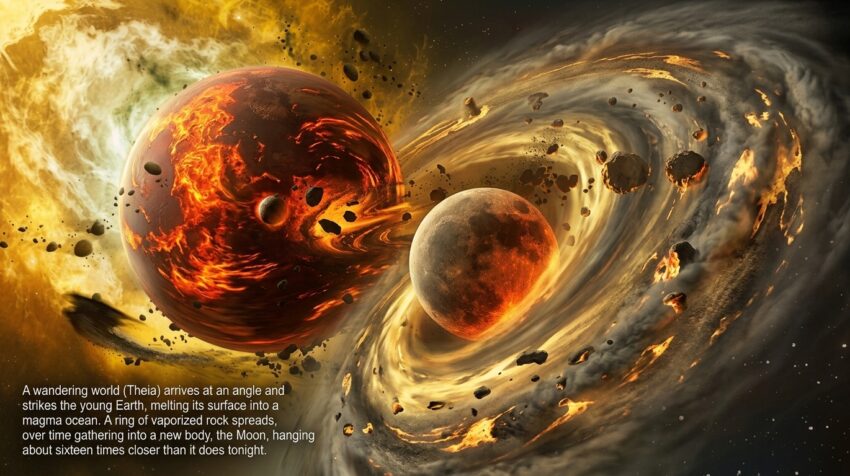
Picture the scene as many textbooks now paint it. A young, glowing Earth is spinning through a crowded, violent solar system. A wandering world the size of Mars comes out of the dark at an angle and strikes it. The planet’s surface melts into an ocean of magma. A ring of vaporized rock spreads into orbit, and over time it gathers into a new body, the Moon, hanging about sixteen times closer than it does tonight. It is a breathtaking story, and a popular science narrative tells it with confidence:
Many astronomers believe that after millions of years of asteroid bombardment, Earth was struck by an object about the size of Mars, in what is known as the Giant Impact Hypothesis, or the Thea Impact. This cataclysmic event generated enough heat to liquefy Earth’s surface, and turn it into a vast ocean of molten magma.
— Earth Impact, video transcript (supplied source)
Note the first two words: many astronomers believe. That phrase is honest, and it is the subject of this essay. No telescope recorded the collision. No instrument measured the magma ocean. No human, and no camera, was present when the first grains of dust supposedly clumped into planetesimals. Everything we are told about Earth’s beginning is a reconstruction. It is drawn from cosmochemistry, isotope ratios in meteorites, laboratory experiments at crushing pressures, and computer simulations of colliding bodies. None of these can observe the event they describe.
Secular accounts differ from one another in many respects, as we shall see. But they share one non-negotiable requirement: time, and lots of it. Every naturalistic model of Earth’s origin requires millions of years, and in the end billions, because without immense spans of time the unguided processes they invoke cannot do the work assigned to them.
More than three thousand years ago, the Creator of the earth put a question to a suffering man named Job. It still stands over every textbook diagram and every supercomputer simulation:
Where wast thou when I laid the foundations of the earth? declare, if thou hast understanding.
— Job 38:4 (KJV)
This essay proceeds in two movements. First, it examines the secular account on its own terms, and it lets recognized secular experts show where that account is contested, revised, or unresolved. Second, it turns to the only account of Earth’s origin that claims an eyewitness, the testimony of Genesis, and considers how God created the earth, and why.
❧ ✦ ❧
The Secular Story: From Dust Cloud to Molten World
The Standard Model in Brief
The mainstream narrative is easy to summarize. NASA’s planetary fact sheet says it in one sentence:
Earth formed when gravity pulled swirling gas and dust in to become the third planet from the Sun.
— Kevin Ward, “Facts About Earth,” NASA Science
In fuller form, the account begins with a solar nebula, a rotating cloud of gas and dust. Some disturbance caused it to collapse. National Geographic is careful to label the trigger a guess: “One common hypothesis among scientists is that a distant star collapsed, creating a supernova explosion.” The Sun ignited at the center about 4.6 billion years ago. The leftover material flattened into a disk. Encyclopaedia Britannica describes what follows: “Within this disk, particles began to stick together through the process of accretion.” Dust became pebbles, pebbles became boulders, boulders became planetesimals, and planetesimals became Mars-sized protoplanets. Britannica adds that “Earth formed from a mixture of rocky and metallic planetesimals.” Heat from impacts and radioactive decay melted the young planet. Iron and nickel sank to form the core, and lighter rock rose to form the mantle and crust.
Three Theories Rejected
The Moon has always been part of this story, and its history is a useful case study in how origin science works. The transcript recounts that, for most of the twentieth century, three explanations competed. George Howard Darwin (son of Charles) proposed fission: a rapidly spinning molten Earth flung off a chunk that became the Moon. The capture theory held that the Moon formed elsewhere and was later caught by Earth’s gravity. The co-formation theory proposed that Earth and Moon accreted side by side from the same material.
Then the Apollo astronauts brought back roughly 400 kilograms of lunar rock, and all three theories failed. Fission required Earth to spin about once an hour, far more angular momentum than the Earth-Moon system possesses. Capture could not explain how Earth would slow a fast-moving body enough to hold it. Co-formation could not explain why Earth and Moon, built from a common reservoir, differ chemically. The transcript states the result plainly:
With none of the three main theories of the Moon’s formation being correct, scientists needed a new explanation, one that would accommodate all of the available data and resolve the contradictions of the old hypotheses.
— Earth Impact, video transcript (supplied source)
That explanation became the Giant Impact Hypothesis. A hypothetical planet called Theia struck the proto-Earth about 4.5 billion years ago, and the Moon formed from the debris. Theia itself, the transcript concludes, “died, giving birth to the Moon we still see today.”
Why Every Model Needs Deep Time
The specific steps vary from author to author, but the timescale does not shrink. The University of Chicago’s explainer says the move from dust to protoplanets “takes tens of millions of years.” Oxford’s Bernard Wood, writing in Physics Today, puts core formation alone at roughly 30 to 40 million years, and the planet’s whole assembly at “a period of about 100 Myr from the beginning of the solar system.” National Geographic says the planet then cooled “over a few hundred million years” and that oxygen began building up in the atmosphere only about 2.7 billion years ago. Time is not incidental to these models. It is what makes them work.
❧ ✦ ❧
Examining the Instruments: How Planetary Scientists Reach Their Conclusions
If no one watched Earth form, how do scientists arrive at such detailed chronologies? The honest answer is that they infer. Wood’s survey in Physics Today is one of the clearest accounts of the toolkit, and it is worth stating plainly what each tool can and cannot do.
Meteorites as Stand-Ins
First, scientists treat certain meteorites, especially CI carbonaceous chondrites, as samples of the raw material Earth was built from, because their composition closely matches the Sun’s (apart from hydrogen and helium). The Earth’s composition is then compared against this reference. The method assumes that today’s meteorites are representative leftovers of the building blocks, that they have stayed unaltered for billions of years, and that the Sun’s present composition reflects the original nebula.
Radiometric Clocks
Second, geochemists use radioactive decay systems: long-lived uranium-lead, rubidium-strontium and samarium-neodymium, and short-lived “extinct” systems such as hafnium-182 decaying to tungsten-182. These are real measurements of real isotope ratios, done with impressive precision. But turning a ratio into a date requires assumptions about starting conditions, closed systems, and how fully metal and silicate mixed during violent impacts. Wood himself notes that the 30 to 40 million-year figure for core formation depends on the assumption that each increment of metal fully re-equilibrated with the surrounding rock, and that disequilibrium during energetic impacts could lengthen the timescale.
Simulations in Place of Witnesses
Third, and increasingly, the story is built inside computers. N-body simulations model thousands of planetesimals colliding. Giant-impact simulations test which impactor sizes, speeds, and angles might produce a Moon like ours. These are powerful tools, but a simulation shows only what could happen under the inputs a researcher chooses. It cannot show what did happen. The University of Chicago explainer is candid about this:
Planetary scientists need to find an impact simulation that can not only match the moon’s chemistry,
— Sasha Warren, “How the Earth and moon formed, explained,” University of Chicago News
The sentence goes on to list the other conditions the simulation must also satisfy: the Moon’s distance and its initial spin. The explainer notes that this has not yet been fully achieved.
The Admission That No Record Survives
Finally, the most important point. A Medium essay on Earth’s origins states the matter with unusual candor:
No remnants of the planet’s earliest development have survived.
— Dark Energy Articles, “How Was the Earth Created?” Medium (December 12, 2022)
This is the core epistemological problem. Supernovae, planetesimals, protoplanetary disks, magma oceans, and cosmic collisions are inferred backward from present-day evidence through chains of theory. Each link may be reasonable on its own. But the chain as a whole describes an unrepeatable, unobserved past event. It is historical inference, not experimental observation. As we will see, a careful reader of Richard Feynman’s definition of science should take that distinction seriously.
❧ ✦ ❧
The Experts Cross-Examine Themselves
The strongest critique of the secular origin narrative does not need to come from creationists. It comes from the secular literature itself. When the standard sources are read side by side, they reveal a field in active, unresolved disagreement on almost every major point.
Theia: The Impactor No One Can Describe
The Giant Impact Hypothesis is called the “most widely accepted explanation.” Yet the University of Chicago explainer concedes:
Although scientists agree that the moon formed because of an impact, the details of the impact are still up for debate.
— Sasha Warren, University of Chicago News
The details in question are hardly minor: “Scientists still don’t agree on how big the impacting object was, how fast it was travelling,” and “Some scientists even argue that multiple impacts might have formed the Moon, instead of just one!” The same explainer notes that it is not even agreed whether the impactor should be called Theia.
The deeper problem is chemical. The transcript says the Moon was rejected as a sister planet because it differs from Earth. But the giant-impact simulations predict that most of the Moon should be made of the impactor, and that should make it differ from Earth even more. Instead, the Moon turns out to be a near-perfect isotopic twin of Earth. Wood states the paradox directly:
The Moon is chemically and isotopically much more like Earth than it ought to be
— Bernard Wood, “The formation and differentiation of Earth,” Physics Today 64:12 (2011)
So a hypothesis adopted because the Moon is too different from Earth must now explain why it is so similar. The UChicago explainer notes two rival rescues: either Theia happened to form very near Earth, or the impact vapor mixed thoroughly. Neither has been demonstrated.
The transcript also says that “water was not found in the samples of lunar material,” and treats a bone-dry Moon as key evidence for a scorching impact. Later re-analyses of lunar volcanic glass, beginning in 2008, did detect water inside the Moon, and the volatile-depletion question is still debated. The UChicago explainer lists two competing explanations for it. Evidence once presented as settled has had to be reinterpreted.
The Chondrite Problem
The model’s raw material is also under challenge. For decades, the working assumption was that Earth was assembled from chondritic meteorites. ETH Zurich planetary scientist Paolo Sossi, reporting in Nature Astronomy, puts it bluntly:
The problem with this theory is that no mixture of these chondrites can explain the exact composition of the Earth
— Paolo Sossi, ETH Zurich, quoted in “New insights into Earth’s formation,” Phys.org (2022)
The usual fix was that impact heat boiled away Earth’s light elements. Sossi notes that this too fails the test. If heating were responsible, Earth should be depleted in light isotopes, “But that is precisely what the isotope measurements do not show.” His team’s alternative, a random mixing of many differentiated planetesimals scattered by a migrating Jupiter, is itself another simulation. IFLScience’s headline for the study was telling: “We May Finally Know How the Earth Formed.” After centuries of confident textbook diagrams, finally is an extraordinary admission.
Wet or Dry? The Contested Origin of Water
Earth is a water world, and water is essential to the biblical description of the planet and to every form of life. Yet the secular sources cannot agree on where it came from. Space.com reports that “Scientists think Earth started off as a waterless mass of rock,” yet the same article relays evidence for liquid water “already present on Earth during its first 500 million years.” National Geographic credits asteroids, saying “Experiments suggest nearly 30% of the water in the asteroids could have remained on Earth.” Caltech’s 2023 study in Science Advances concludes that Earth was built mostly from hot, dry rock, and that most of its water arrived only during the last fifteen percent of its formation. Popular Mechanics, reporting on a separate Sossi and Bower study, adds a further complication. Earth’s isotopic signature matches the inner solar system almost exclusively:
Our analysis shows that all elements, irrespective of their geochemical character or nucleosynthetic origin, record the same isotopic [origin]
— Paolo Sossi and Dan Bower, Nature Astronomy, quoted in “Scientists Just Discovered Where the Earth Actually Came From,” Popular Mechanics
But the water-bearing, carbon-rich meteorites come from the outer solar system, beyond a Jupiter that supposedly blocked them. The article’s own conclusion is speculative: “maybe much of the carbon came along with it.” The ingredients of a habitable world have to be smuggled in late, past a gravitational barrier, by impactors whose contribution is still being argued over.
“Earth Does Not Have One Single Age”
Even the planet’s age, usually presented as a single confident figure, turns out to be less tidy than it looks. Wood writes:
Earth does not have one single age of formation.
— Bernard Wood, Physics Today (2011)
The UChicago explainer dates the Moon-forming impact anywhere from 60 to 175 million years after the solar system formed, a margin of more than 100 million years. Wood adds that the Moon’s exact age is unconstrained and that earlier limits have been questioned.
None of this means planetary scientists are careless. They are doing exactly what scientists should do: testing, revising, and admitting what they do not know. But it does mean the public is often handed a smoothed-over story that the specialists themselves do not hold with such certainty. The Giant Impact Hypothesis did not win because it was observed. It won because its predecessors were falsified, and it is now under pressure from the same kind of evidence. What is presented as history is, in truth, the current leading reconstruction.
❧ ✦ ❧
How Did God Create The Earth?
At this point our essay turns from the laboratory to the Word of God. The turn is deliberate and, I would argue, scientifically honest. Richard Feynman defined the principle of science this way, and physicist Richard Liangchen Wang uses the definition as the foundation of a recent paper in the journal Theology and Science:
The principle of science, the definition, almost, is the following: The test of all knowledge is experiment. Experiment is the sole judge of scientific “truth.”
— Richard Feynman, The Feynman Lectures on Physics, Vol. 1, quoted in Richard Liangchen Wang, “Evidence-Based Creationism: The Origin of the Universe,” Theology and Science (2025)
By that standard, the formation of the Earth is not an experiment anyone can run. It is a singular event in the unobserved past. For any singular past event, the most valuable evidence is testimony from someone present. Scripture claims to be exactly that: the record of the One who was there.
By His Word, Out of Nothing
Genesis opens with one of the most consequential sentences ever written: “In the beginning God created the heaven and the earth” (Genesis 1:1). The Hebrew verb bara is used in the Old Testament only with God as its subject. The text describes no pre-existing nebula, no supernova trigger, and no surplus dust. The New Testament makes the doctrine of creation ex nihilo explicit:
Through faith we understand that the worlds were framed by the word of God, so that things which are seen were not made of things which do appear.
— Hebrews 11:3 (KJV)
The mode of creation is speech. “For he spake, and it was done; he commanded, and it stood fast” (Psalm 33:9). Mike Boling of Servants of Grace summarizes: “God spoke creation into existence,” and quotes Old Testament scholar John Currid: “God’s creative work was effortless; he spoke, and the universe came into existence.” Here is the decisive difference between the two accounts. The secular model needs time to do creative work. In Scripture, the Creator’s word does the work, and time is simply the stage on which it unfolds.
Forming and Filling: The Architecture of the Six Days
Genesis 1:2 describes the earth as initially “without form, and void,” unformed and unfilled. The six days that follow answer those two conditions in an elegant literary and theological structure. On Days One through Three, God forms realms by separation: light from darkness, the waters above from the waters below, dry land from sea. On Days Four through Six He fills those realms: lights in the heavens, birds and sea creatures, land animals, and finally humanity. The Theology of Work Project observes that creation “is solely an act of God” and that “God’s power is more than sufficient to create and maintain the creation.”
Astrophysicist Dr. Jason Lisle draws out a striking consequence of the biblical order. In Genesis, Earth exists before the Sun, Moon, and stars, which appear on Day Four. That reverses the nebular sequence entirely:
God spent five of the six creation days forming and filling the Earth.
— Dr. Jason Lisle, “Worlds of Creation: Earth,” Biblical Science Institute (2020)
In Lisle’s phrase, “Earth is three days older than any other planet.” The Moon in Scripture is not the wreckage of a collision. It is a “lesser light” set in place on purpose “for signs, and for seasons, and for days, and years” (Genesis 1:14-16). Lisle notes its remarkable features: it is unusually large relative to its planet, it stabilizes Earth’s axial tilt, it drives the tides, and its size and distance permit total solar eclipses.
The traditional Christian reading takes these as ordinary days, a position grounded in the text itself (“the evening and the morning were the first day”) and confirmed by the Fourth Commandment: “For in six days the LORD made heaven and earth, the sea, and all that in them is, and rested the seventh day” (Exodus 20:11). Answers in Genesis summarizes the view:
God created ‘the heavens and the earth’ fully formed and functioning in six days, about 6,000 years ago
— Answers in Genesis, “Creation”
Scholarly integrity requires noting that not all Christians, and not all of this essay’s sources, share that chronology. Wang, for example, accepts the conventional 13.8-billion-year Big Bang framework and argues that both young-earth and old-earth readings of Genesis lie outside science altogether. University of Washington geologist David Montgomery, writing in GSA Today, argues that modern flood geology reverses scientific method: “Geologists assess theories by how well they fit data, and creationists evaluate facts by how well they fit their theories.” The charge deserves a serious answer, and the answer is this. Every reconstruction of the unobserved past begins with starting assumptions. The secular model assumes that only natural processes have ever operated. As the previous section showed, it then reinterprets the data whenever the data refuse to fit, from a “dry” Moon that turned out to hold water to a Theia that keeps changing size. The question is not whether we bring presuppositions to the evidence, but whose presuppositions are trustworthy: those of finite observers who arrived billions of years late by their own reckoning, or those of the Creator who was there.
Formed to Be Inhabited
If Scripture tells us how God made the earth, it is equally clear about what He made it for. The prophet Isaiah gives the earth’s design brief:
For thus saith the LORD that created the heavens; God himself that formed the earth and made it; he hath established it, he created it not in vain, he formed it to be inhabited: I am the LORD; and there is none else.
— Isaiah 45:18 (KJV)
Simon Turpin of Answers in Genesis draws out the implication: “Why would God wait billions of years if his purpose was to have human life on the earth?” The physical evidence of design fits this purpose remarkably well. Earth sits at the right distance from a stable star for liquid water. Its atmosphere is about twenty percent oxygen. A magnetic field shields its surface. A large Moon steadies its tilt. Astrobiologist Guillermo Gonzalez, interviewed by Lee Strobel, concludes after listing such factors:
All these factors have to be met at one place and time in the galaxy
— Guillermo Gonzalez, quoted in “How a Finely Tuned Earth Makes the Case for a Creator,” Stand to Reason (2024)
A conservative estimate cited in the same discussion puts the odds of all those conditions aligning on one planet at roughly one in a thousand trillion. Gonzalez and philosopher Jay Richards add a further observation: the same conditions that make Earth habitable also make it an exceptional platform for observing the universe. Strobel concludes: “I think God intentionally created a habitat for us that allows us to see him through the creation that he has left behind.”
Laws That Testify to a Lawgiver
Wang’s paper makes a complementary argument. The fundamental physical laws are universal, mathematically exact, and strikingly simple, and rules of that kind, he contends, do not arise from matter but are imposed by a mind. He quotes the Nobel laureate Eugene Wigner:
The miracle of the appropriateness of the language of mathematics for the formulation of the laws of physics is a wonderful gift which we neither understand nor deserve.
— Eugene Wigner, quoted in Wang, Theology and Science (2025)
Wang also recalls astrophysicist Robert Jastrow’s famous image of the scientist who scales the mountains of ignorance only to be “greeted by a band of theologians who have been sitting there for centuries.” The Apostle Paul anticipated the point nearly two millennia ago: “For the invisible things of him from the creation of the world are clearly seen, being understood by the things that are made, even his eternal power and Godhead; so that they are without excuse” (Romans 1:20).
❧ ✦ ❧
Created With Purpose
The secular account answers “how” with collisions and “when” with billions of years. It has no answer at all to “why.” Naturalism cannot assign purpose to an accident. Scripture, by contrast, is saturated with purpose. The sources gathered for this essay, spanning Reformed, evangelical, and apologetic traditions, agree with notable unity on what that purpose is.
For His Glory
The first and governing answer is the glory of God:
Thou art worthy, O Lord, to receive glory and honour and power: for thou hast created all things, and for thy pleasure they are and were created.
— Revelation 4:11 (KJV)
John Piper puts it with characteristic directness: “God created the world for his glory.” He immediately guards the statement against misunderstanding. God does not gain glory He lacks. “We don’t glorify God by improving his glory, but by seeing and savoring and showing his glory. We magnify his glory like a telescope, not a microscope.” Kyle Keltz of Southern Evangelical Seminary, drawing on Aquinas, explains why this is not divine vanity. A perfect God lacks nothing, so creation flows from the overflow of His goodness: “As infinite love, God most likely created to spread His goodness and love.” GotQuestions cites Jonathan Edwards to the same effect. God’s “disposition to communicate himself, or diffuse his own FULLNESS, was what moved him to create the world.”
To Display Himself and Invite Celebration
Because creation displays God, it is meant to be read. “The heavens declare the glory of God; and the firmament sheweth his handywork” (Psalm 19:1). Silverio Gonzalez of Cru describes creation as revelation that calls for joy:
Creation is God’s gift to Himself, and creation is a gift that leads to celebration.
— Silverio Gonzalez, “Why Did God Create the World?” Cru
That Mankind Should Seek Him
The Apostle Paul, preaching to Athenian philosophers who held their own theories of origins, connected the shape of the inhabited earth directly to the human search for God:
And hath made of one blood all nations of men for to dwell on all the face of the earth, and hath determined the times before appointed, and the bounds of their habitation; That they should seek the Lord, if haply they might feel after him, and find him, though he be not far from every one of us.
— Acts 17:26-27 (KJV)
Kerry Duke of Tennessee Bible College draws the application: “God made us and He put us on the earth that He made so that we should seek the Lord.” The earth is not a random rock on which we happen to live. It is an appointed meeting place between the Creator and those made in His image.
To Be Tended, Enjoyed, and Ruled
God gave the earth to humanity as a trust. “The heaven, even the heavens, are the LORD’s: but the earth hath he given to the children of men” (Psalm 115:16). The first commission, “Be fruitful, and multiply, and replenish the earth, and subdue it: and have dominion” (Genesis 1:28), gives human work dignity from the very beginning. The Theology of Work Project insists that “Genesis argues against any notion that the material world is any less important to God than the spiritual world.” Sam Kneller of The Explanation looks forward to the eschatological horizon of Revelation 5:10, calling Earth “the practice ground for ALL humans now,” a training place for those who will “reign on the earth.”
Creation Bound to Redemption
Finally, and most gloriously, the creation of the earth cannot be separated from the cross. The New Testament identifies the Creator as the Son: “All things were made by him; and without him was not any thing made that was made” (John 1:3). “For by him were all things created, that are in heaven, and that are in earth… all things were created by him, and for him” (Colossians 1:16). Piper traces creation’s purpose all the way to Calvary:
God created the world to display his glory so that his people might know, love, and show him.
— John Piper, “Why Did God Create the World?” Desiring God (2012)
Boling adds: “Creation is the outworking of God’s divine plan of redemption, established in eternity past” (Ephesians 1:4). Lisle observes that what finally sets Earth apart from every other world is not its oxygen or its oceans. It is that this is where the Creator Himself took on flesh, died, and rose again. Earth was made to be inhabited, and in the fullness of time it was inhabited by God incarnate.
❧ ✦ ❧
Conclusion: The God Who Was There
The secular account of Earth’s origin is a monument to human ingenuity: meteorites weighed atom by atom, isotopes counted in mass spectrometers, collisions replayed on supercomputers. Its practitioners deserve respect for their diligence and for the candor with which their own literature admits what remains unknown. But on its own terms it remains a reconstruction. It has no witness, and no surviving record of the earliest stages, and its central narrative has been rewritten more than once within living memory. Theia’s size is unknown. The chondrite recipe does not add up. The source of the oceans is disputed. Even the age of the planet, as one Oxford geochemist has written, is not “one single age.”
Against that shifting backdrop stands a different kind of account. It does not claim to be a laboratory reconstruction. It claims to be testimony. It tells us that the earth was spoken into existence, formed and filled with intention, set beneath a Moon placed “for signs, and for seasons,” and fitted out to be inhabited. It tells us that the earth exists for the glory of its Maker, as a place where people made in His image might seek Him and find Him, and as the stage on which the Creator would redeem His creation.
Every theory of origins finally reduces to a question of trust. The secular model asks us to trust inferences drawn billions of years after the fact. Scripture invites us to trust the One who answered Job from the whirlwind, because He alone was there when the foundations of the earth were laid. In the words of the apostle Peter, men who reject the Creator are “willingly… ignorant” that “by the word of God the heavens were of old, and the earth standing out of the water and in the water” (2 Peter 3:5). The heavens still declare His glory. The earth was formed to be inhabited. And the God who laid its foundations still calls every inhabitant to come and know Him.
❧ ✦ ❧
CITATIONS
“Earth Impact.” Video transcript supplied by the author. Popular-science narration on the Giant Impact Hypothesis.
Answers in Genesis. “Creation.” https://answersingenesis.org/creation
Boling, Mike. “Creation: Why, How, and When Did God Create the Universe?” Servants of Grace, January 12, 2017 (modified October 7, 2022). https://servantsofgrace.org/creation-god-create-universe/
Britannica Editors. “How Was Earth Created?” Encyclopaedia Britannica. https://www.britannica.com/science/How-Was-Earth-Created
Caltech News. “Earth Formed from Dry, Rocky Building Blocks.” California Institute of Technology, July 5, 2023. Reporting on Weiyi Liu, François Tissot, et al., Science Advances. https://www.caltech.edu/about/news/earth-formed-from-dry-rocky-building-blocks
Dark Energy Articles. “How Was the Earth Created? What Did It Look Like in the Beginning and How Old Is Our Planet?” Medium, December 12, 2022. https://medium.com/@darkenergyarticles/how-was-the-earth-created-what-did-it-look-like-in-the-beginning-and-how-old-is-our-planet-9639ec3e8daf
Duke, Kerry. “Why Did God Create the World?” My God and My Neighbor (podcast), Tennessee Bible College, May 7, 2025. https://www.tn-biblecollege.edu/podcast/my-god-and-my-neighbor/why-did-god-create-the-world/
GotQuestions.org. “Why Did God Create the World?” https://www.gotquestions.org/why-did-God-create-the-world.html
Gonzalez, Silverio. “Why Did God Create the World?” Cru. https://www.cru.org/us/en/train-and-grow/spiritual-growth/why-did-god-create-world.html
Harvey, Ailsa, and Charles Q. Choi. “Planet Earth: Everything You Need to Know.” Space.com, November 9, 2021 (updated April 12, 2023). https://www.space.com/54-earth-history-composition-and-atmosphere.html
Keltz, Kyle. “Why Did God Create Anything?” Southern Evangelical Seminary, August 27, 2019. https://ses.edu/why-did-god-create-anything/
Kneller, Sam. “God’s Creation of Earth. Why? Decoding the Breathtaking Divine Plan.” The Explanation, March 14, 2024. https://theexplanation.com/gods-creation-of-earth-why-decoding-divine-plan/
Lisle, Jason. “Worlds of Creation: Earth.” Biblical Science Institute, April 10, 2020. https://biblicalscienceinstitute.com/astronomy/worlds-of-creation-earth/
Montgomery, David R. “The Evolution of Creationism.” GSA Today 22, no. 11 (November 2012). https://rock.geosociety.org/net/gsatoday/archive/22/11/pdf/i1052-5173-22-11-4.pdf
National Geographic Society. “Formation of Earth.” National Geographic Education. https://education.nationalgeographic.org/resource/formation-earth/9th-grade/
OpenBible.info. “What Does the Bible Say About Why God Created the World?” https://www.openbible.info/topics/why_god_created_the_world
Phys.org. “New Insights into Earth’s Formation.” ETH Zurich / NCCR PlanetS, July 2022. Reporting on Paolo Sossi et al., Nature Astronomy. https://phys.org/news/2022-07-insights-earth-formation.html
Piper, John. “Why Did God Create the World?” Desiring God, September 22, 2012. https://www.desiringgod.org/messages/why-did-god-create-the-world
Popular Mechanics. “Scientists Just Discovered Where the Earth Actually Came From.” Reporting on Paolo Sossi and Dan Bower, Nature Astronomy. https://www.popularmechanics.com/science/environment/a71115118/earth-inner-solar-system/
Schmutzer, Andrew, and Alice Mathews. “God Creates the World (Genesis 1:1–2:3).” Theology of Work Project. https://www.theologyofwork.org/old-testament/genesis-1-11-and-work/god-creates-the-world-genesis-11-23/
Stand to Reason. “How a Finely Tuned Earth Makes the Case for a Creator.” Guest author, featuring Lee Strobel, Guillermo Gonzalez, and Jay Richards, July 29, 2024. https://www.str.org/w/how-a-finely-tuned-earth-makes-the-case-for-a-creator
Taub, Benjamin. “We May Finally Know How the Earth Formed Thanks to Intriguing New Hypothesis.” IFLScience, July 11, 2022. https://www.iflscience.com/we-may-finally-know-how-the-earth-formed-thanks-to-intriguing-new-hypothesis-64392
Turpin, Simon. “The Earth: Formed for a Purpose.” Answers in Genesis, July 20, 2022. https://answersingenesis.org/creationism/earth-formed-purpose/
Wang, Richard Liangchen. “Evidence-Based Creationism: The Origin of the Universe.” Theology and Science (2025). https://www.tandfonline.com/doi/full/10.1080/14746700.2025.2592330
Ward, Kevin. “Facts About Earth.” NASA Science, updated December 5, 2025. https://science.nasa.gov/earth/facts/
Warren, Sasha. “How the Earth and Moon Formed, Explained.” University of Chicago News, Explainer Series (reviewed April 2026). https://news.uchicago.edu/explainer/formation-earth-and-moon-explained
Wood, Bernard J. “The Formation and Differentiation of Earth.” Physics Today 64, no. 12 (December 2011). https://physicstoday.aip.org/features/the-formation-and-differentiation-of-earth
Scripture quotations are from the King James Version (public domain).
Research and drafting assistance provided by Claude (Anthropic),
working as a research collaborator under the author’s full editorial direction.