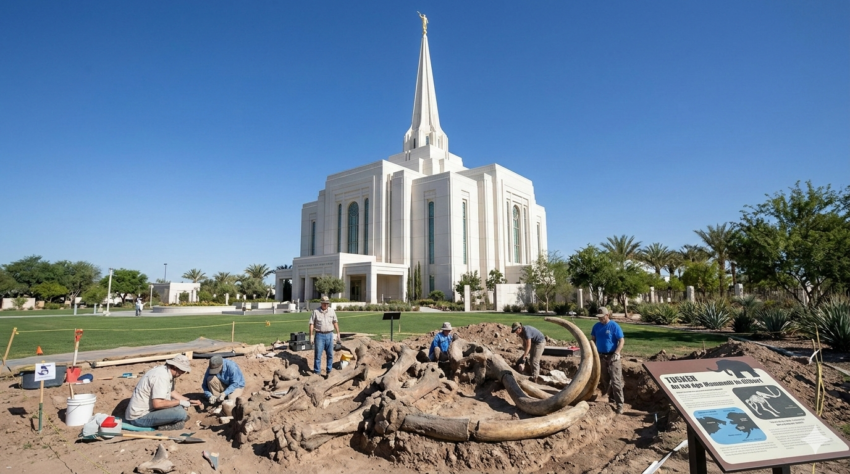
Illustration:Faith meets the fossil record. This Google Gemini AI illustration captures the
introduction to the blog post, highlighting the irony of a modern religious monument
standing beside a scientifically verifiable prehistoric excavation site.
A Scholarly Examination of Book of Mormon Archaeology in Light of Current Evidence
“Biblical archaeologists can barely keep pace with the confirmations.
Book of Mormon archaeologists are still explaining the silences.”
Introduction: The Temple That Loomed Over the Mammoth
The Gilbert, Arizona, Temple, owned by the Church of Jesus Christ of Latter-day Saints, stands at 195 feet tall and 85,326 square feet. The structure, which took three years to complete, opened in early 2014 and was open for public tours for about a month before being formally dedicated in March.
There is a particular irony embedded in the gleaming white spires of the Gilbert, Arizona, Temple of The Church of Jesus Christ of Latter-day Saints. Rising at the edge of Discovery Park — a green space that earned its name in the most literal way possible — the temple’s pristine, man-made facade stands in quiet contrast to what lies beneath the surrounding ground. During the park’s original construction, workers unearthed the fossil remains of a Columbian mammoth: an authentic, scientifically verifiable relic of genuine prehistoric life on the Sonoran Desert floor.
The juxtaposition is difficult to ignore. Here stands one of the most architecturally ambitious religious institutions in the world — a church with over 350 temples built, under construction, or announced globally — planting its gleaming towers atop land that offers its own, far older testimony. The mammoth left bones. It left evidence. It left something that science can date, classify, and confirm without a prayer or a prompting.
The Book of Mormon, by contrast, describes three distinct civilizations inhabiting the American continent for over 2,600 years — civilizations that, according to the text, built great cities, smelted steel, rode horses into battle, wielded chariots, maintained written records in Hebrew and Reformed Egyptian, and perished in wars that claimed millions of lives. Yet the ground beneath those 350 temples — and everywhere else across the Americas — has offered nothing. No cities. No inscriptions. No chariots. No swords. No bones from those battles. Not a single artifact that any non-Mormon archaeologist has ever confirmed as connected to the Book of Mormon narrative.
The mammoth, at least, had the courtesy to leave proof.
The temple does not acknowledge the mammoth. The mammoth, of course, cannot acknowledge the temple. But the juxtaposition speaks volumes. Below the surface of this carefully manicured corner of Gilbert, Arizona, the ground told a real story — a story corroborated by bone, by carbon dating, by peer-reviewed science. Above the surface, the church has erected a monument to a different kind of story: one told in the Book of Mormon, a narrative of vast civilizations, mighty wars, and a Hebrew-descended people who supposedly inhabited this same American continent for over twenty-six centuries.
As of 2026, the LDS Church has over 350 temples either built, under construction, or officially announced around the world — a building campaign of staggering ambition and financial commitment. The Church’s tithing-funded construction program has intensified even as the question beneath the surface has grown more awkward, not less: where is the evidence?
This article is not written to mock the faithful. The millions of Latter-day Saints who worship in those gleaming temples are, by all accounts, sincere, generous, and community-minded people. Faith of that kind deserves respect. It does not, however, deserve exemption from honest inquiry — and neither does any other faith tradition, including the traditional Christianity to which many of this article’s readers may themselves belong.
The Bible does not ask for a faith that hides from scrutiny. It demands one that can withstand it. The Apostle Paul wrote plainly in 1 Thessalonians 5:21: “Test everything; hold fast what is good” (ESV). The Apostle John was equally direct: “Beloved, do not believe every spirit, but test the spirits to see whether they are from God” (1 John 4:1, ESV). These are not the instructions of a tradition that fears examination. They are the instructions of a tradition that believes honest examination will confirm rather than destroy what is true. Biblical Christianity has historically welcomed the archaeological, historical, and textual scrutiny that has, as this article documents, returned confirmation after confirmation. The invitation to test is not a vulnerability. It is a confidence.
That same standard applies here — without favoritism and without exemption. The historical claims of the Book of Mormon are among the most specific, most testable, and most falsifiable in the history of world religion. They name civilizations, describe geographies, specify time periods, and catalog material culture across 2,600 years of American history. These are not vague spiritual impressions. They are claims about the physical world — the kind of claims that archaeology, genetics, and linguistics were built to evaluate.
The ground has been tested. The DNA has been tested. The linguistics have been tested. The institutions responsible for those tests — from the Smithsonian to peer-reviewed journals to BYU’s own faculty — have rendered their assessments with unusual consistency. This article presents those assessments not as an assault on sincere people, but as the application of the same standard that Paul instructed every believer to apply: test everything. What follows is the test. The results speak for themselves.
For many Latter-day Saints, the search for archaeological evidence of the Book of Mormon is not merely an academic exercise — it is a matter of profound personal consequence. The existence or absence of tangible proof can shake or solidify a faith that, for most members, was instilled from childhood rather than arrived at through independent investigation. Some find comfort in the vague cultural parallels that LDS apologists present as confirmation. Others quietly set the question aside, trained by their community to treat historical doubt as a spiritual deficiency rather than a reasonable response to the evidence.
This is where the institutional answer to the archaeological problem reveals itself most clearly. When the ground fails to cooperate, the Church does not say: “We were wrong.” It says: “You’re asking the wrong question.” The mechanism for this redirection is what former members often call the “Just pray about it” principle — the Moroni Promise of Moroni 10:4, which instructs readers to ask God in sincere prayer whether the Book of Mormon is true, with the assurance that the Holy Spirit will confirm its truthfulness as a felt, personal witness. The evidentiary question is not answered. It is dissolved.
Archaeology cannot compete with a warm feeling in the chest, particularly when members have been taught since infancy to interpret that feeling as divine confirmation. As researchers Nieminen, Loikkanen, Ryökäs, and Mustonen observed in Theology and Science (2020), the LDS Church relies heavily on testimonials to combat doubt — calling upon “subjective emotions” rather than “objective evidence,” and treating contradictory narratives as spiritually deficient rather than factually relevant. Many ex-Mormons report that the earnest conviction they once felt about the Book of Mormon’s truthfulness was inseparable from the fact that they had been told it was true before they were old enough to evaluate the claim.
The transition from personal faith to institutional evasion is not accidental. It is the design. And it is precisely why the archaeological question matters as much as it does — because a church that pre-emptively declares its central historical claims immune to historical scrutiny is not expressing humility. It is foreclosing accountability.
History is not decided by sincerity. It is not confirmed by warm feelings, unanimous congregations, or the architectural grandeur of 350 temples. It is confirmed by evidence — the kind you can hold, date, and submit for peer review. This essay presents that evidence as it would be presented to any fair-minded jury: without embellishment, without apology, and without the exit ramp of faith as a substitute for facts.
The contrast between what archaeology has confirmed about the Bible and what two centuries of searching have failed to find for the Book of Mormon is not a matter of degree. It is not subtle, or partial, or waiting on further excavation. It is total. That contrast — documented in the dirt, in the genes, in the silence of professional archaeologists on six continents — is what this article has set out to establish.
Section 1: What the Book of Mormon Demands of Archaeology
Before examining what archaeology has or has not found, it is essential to establish precisely what the Book of Mormon claims — because the scale of those claims determines the magnitude of what should exist in the ground. It is also necessary to acknowledge upfront that modern LDS writers and apologists have mounted seemingly sophisticated rebuttals to nearly every point of criticism. As we will see, however, the ingenuity of those responses consistently outpaces the evidence behind them.
The Book of Mormon describes three distinct migrations to the American continent: the Jaredites (c. 2500–600 BC), who traveled from the Tower of Babel; the Nephites and Lamanites (c. 600 BC–421 AD), descendants of a Jerusalem family led by a man named Lehi; and a smaller group called the Mulekites, also from Jerusalem. Collectively, these civilizations are said to have inhabited the Americas for approximately 2,600 years.
These were not small, primitive encampments. The Book of Mormon explicitly describes:
• Massive cities with temples, palaces, and market centers
• Advanced metallurgy — iron, steel, brass, and gold
• Horse-drawn chariots and wheeled vehicles
• Sophisticated written records in both Hebrew and a script Joseph Smith called “Reformed Egyptian”
• Extensive agriculture, including wheat, barley, and other Old World crops
• Large domesticated animals — cattle, horses, asses, elephants, and swine
• Silk production
• Wars of civilizational scale: Ether 15:2 describes a single battle producing nearly two million casualties among men alone, implying a total death toll — including wives and children — of perhaps six million
Ether 15:2
He saw that there had been slain by the sword already nearly two millions of his people, and he began to sorrow in his heart; yea, there had been slain two millions of mighty men, and also their wives and their children.
To put that warfare scale in perspective: the combined military deaths on all sides during the entire four-year Western Front campaign of World War I — fought with machine guns, artillery, poison gas, and sustained industrial bombardment — numbered approximately four million. The Book of Mormon describes comparable or greater carnage executed with Bronze Age technology, by a civilization that left no identifiable trace.
What the Apologists Say — and Why It Falls Short
Confronted with this list of absent evidence, LDS apologists have developed a body of responses that, on first reading, can appear quite compelling. The primary arguments deserve fair examination — and honest rebuttal.
The “Limited Geography” Defense: The most intellectually prominent modern apologist response comes from the late BYU professor John L. Sorenson, whose landmark work An Ancient American Setting for the Book of Mormon (1985) and later Mormon’s Codex (2013) argued that BOM events took place within a compressed Mesoamerican geography of perhaps 400 miles diameter, not across the entire Western Hemisphere. This is a significant retreat from the church’s original hemispheric model — and it is a retreat driven entirely by the absence of evidence, not by any new discovery. Critics note that the BOM’s own text repeatedly implies a hemispheric scope, and that shrinking the geography to fit the silence is not the same as explaining the silence. As scholar Brigham Madsen observed, the limited geography model creates its own problem: if other pre-existing peoples already filled the Americas, the BOM’s central narrative about Israelite ancestors of the Native Americans collapses entirely.
The Anachronism Tap Dance:FAIR LDS openly concedes the most damaging anachronisms — horses, cattle, sheep, goats, elephants, wheels, chariots, wheat, silk, steel, and iron did not exist in pre-Columbian America during BOM times. Their proposed solution? The word “horse” in the BOM may actually refer to a deer or tapir. This argument has been met with well-deserved ridicule from critics and Mormon scholars alike. Joseph Smith knew what a horse was. The “most correct book on earth” — his own description of the BOM — uses the word “horse” fourteen times. If deer and tapirs were meant, the word “horse” becomes a translation error of breathtaking proportions in a text Smith claimed to have rendered by divine gift.
The “Absence of Evidence” Dodge:FAIR LDS and other apologists regularly invoke the principle that “absence of proof is not proof of absence” — archaeology is ongoing, they argue, and future discoveries may yet vindicate the BOM. This sounds reasonable in isolation. But it ignores a critical asymmetry: absence of evidence is significant when you are searching for something as large, long-lived, and materially complex as the civilizations described. As Robert Clifton Robinson’s November 2025 scholarly analysis states directly: “Not one ancient city described in the Book of Mormon has ever been discovered,” — and that standard, applied uniformly, is the same standard by which the Bible has been confirmed hundreds of times over. We are not waiting for a single potsherd. We are waiting for any trace at all of two and a half millennia of multi-continental civilization.
The “Nahom” Gambit:Apologists frequently cite the discovery of an altar in Yemen bearing the tribal name “NHM” — claimed as a confirmation of the BOM’s mention of a burial place called “Nahom” during Lehi’s journey (also discussed below in Section 9). This is among the most cited pieces of “evidence” in LDS apologetic literature. It is also among the weakest: NHM is a common Semitic root appearing across the ancient Near East, the altar dates to a period far broader than Lehi’s journey, and the connection requires assuming that a common tribal name in a region the text describes Lehi passing through constitutes confirmation of the text’s divine origin. By this standard, any ancient map of the Middle East “confirms” the BOM.
This is not a request for a few potsherds. This is not a matter of hoping to find one inscription or one coin. The Book of Mormon, taken literally, demands a vast, recognizable, multi-layered material record spanning two and a half millennia across a major portion of the Western Hemisphere. The creativity of LDS apologists has proven boundless. The ground, however, has remained unpersuaded — and silent.
While some scholars and researchers focus on finding archaeological evidence to validate the Book of Mormon, others take a different approach. They argue that the spiritual and theological significance of Mormonism should not rely solely on archaeological proof. Instead, they emphasize the importance of faith and personal experiences in shaping one’s belief system.
Of course, scholarship does not replace spiritual witness as a source of testimony. As Elder B. H. Roberts (1857–1933) of the Seventy said:
“The power of the Holy Ghost … must ever be the chief source of evidence for the Book of Mormon. All other evidence is secondary … No arrangement of evidence however skillfully ordered; no argument, however adroitly made, can ever take its place.”
The Smithsonian Standard
The Smithsonian Institution, America’s premier scientific research establishment, has addressed this question formally. Though it simplified its public-facing statement in 1998, the institution reaffirmed in subsequent correspondence that it stood by the substance of its earlier, more detailed statement:
The Book of Mormon is a religious document and not a scientific guide. The Smithsonian Institution has never used it in archeological research and any information that you may have received to the contrary is incorrect.
— Ann Kaupp, Head, Anthropology Outreach Office, National Museum of Natural History, Smithsonian Institution, 1999 (reaffirmed 2012)
The backstory behind the Smithsonian’s statement is more revealing than the statement itself — and it is far older than most people realize. The rumor that the Smithsonian Institution used the Book of Mormon as a guide in its archaeological fieldwork did not originate in the 1980s. Researchers who have traced it carefully have documented its roots as far back as the 1930s, making it one of the most durable fabrications in LDS missionary culture.
The earliest documented instance appears in a 1936 letter circulated among LDS mission circles in Europe, in which a local Church president enthusiastically reported that the Smithsonian had discovered ancient cement roads in South America consistent with BOM descriptions, and that the institution was actively using the Book of Mormon in its research. The letter spread rapidly through mission networks. When word reached Salt Lake City, Church President Heber J. Grant was alarmed enough to send an urgent cablegram — not a letter, a cablegram — instructing that the story not be published because “we have reason to believe that statements made therein are not authentic.” The institutional leadership knew the claim was false in 1936. It circulated among missionaries for decades anyway.
By the early 1980s, the rumor had resurged with new energy in LDS culture. Members and missionaries were repeating — in lessons, in letters, and in door-to-door conversations — that the prestigious Smithsonian Institution was actively using the Book of Mormon as a fieldwork guide, lending the text an aura of mainstream scientific endorsement it had never earned and never been offered. One former member, writing at A Letter to an Apostle, recalled: “I am old enough to remember back in the 1980s, hearing within church circles that the prestigious Smithsonian Institute was using the Book of Mormon as a guide in its leading archaeological research.” The claim was passed along not as rumor but as established fact — a missionary talking point with the implied authority of America’s most respected scientific institution behind it.
The volume of inquiries eventually became impossible for the Smithsonian to ignore. In 1996, Smithsonian directors felt compelled to draft a formal written response — a standard form letter sent to the steady stream of people writing to confirm an endorsement the institution had never given. That original letter was detailed and unambiguous, listing specific scientific objections to the Book of Mormon’s historical claims. The formal denial, in other words, does not exist because the Smithsonian volunteered a critique of Mormonism. It exists because the fabricated endorsement had been used as a missionary tool for sixty years, and the institution was left with no choice but to respond in writing, on letterhead, for the public record.
In 1998, the Smithsonian quietly simplified its form letter to a less detailed statement, removing the specific list of BOM anachronisms. Mormon apologetic organization FARMS — now the Neal A. Maxwell Institute — immediately implied this revision represented a scientific retreat, crediting John Sorenson’s 1995 critique as having persuaded the Smithsonian to soften its position. This interpretation was false. When directly asked in 2012 whether the institution had revised its scientific position on the Book of Mormon, Smithsonian correspondent Mr. Kremer replied: “In checking with our anthropology department, I have been informed that the statement you received from Ms. Kaupp is still correct — no revisions.” The Smithsonian had changed the wording of its public letter. It had not changed its conclusion.
National Geographic’s response followed an identical pattern. After receiving repeated inquiries from LDS members and missionaries asking the organization to confirm archaeological support for the Book of Mormon, National Geographic responded in writing that it “does not know of anything found so far that has substantiated the Book of Mormon.” Like the Smithsonian, National Geographic did not volunteer this assessment. It was compelled to issue it — a correction to an endorsement it had never made, forced into print by the persistence of a claim that had been circulating in missionary culture without any factual basis.
The Smithsonian rumor is, in miniature, the entire story of Book of Mormon archaeology: a claim born of institutional desire, sustained by repetition rather than evidence, corrected by the relevant authorities, and then reinterpreted by LDS apologists as a retreat rather than a reaffirmation. The institution said no. The missionaries kept knocking.
These are not the responses of hostile or ideologically motivated organizations. These are the responses of mainstream science operating by standard evidentiary rules — institutions so routinely approached with the assumption of endorsement that they were compelled to put their denials in writing, on letterhead, for the public record.
Section 2: Two Centuries of Digging — and Nothing
It would be one thing if archaeology had simply not yet gotten around to investigating Book of Mormon claims. It would be another matter entirely if motivated, well-funded, Mormon researchers had spent decades actively looking — and come up empty. The second scenario is precisely what has occurred.
Thomas Stuart Ferguson and the New World Archaeological Foundation
Thomas Stuart Ferguson was a Mormon attorney and fervent believer who dedicated much of his adult life to proving the Book of Mormon through archaeology. He founded the New World Archaeological Foundation (NWAF) in the early 1950s, which eventually received substantial funding from Brigham Young University and the LDS Church itself — funding that one account describes as “large appropriations” directed specifically toward Ferguson’s search for BOM confirmation in Mesoamerica. Ferguson led or sponsored decades of excavations in Mesoamerica, convinced that the ruins of Nephite civilization were waiting to be uncovered. In a 1952 letter, he expressed absolute confidence: “The archaeological data now available is consistent with the Book of Mormon.”
They were not. They would never be.
By 1970, Ferguson’s faith had not merely wavered — it had collapsed entirely, and on multiple fronts simultaneously. In December of that year, Ferguson visited Jerald and Sandra Tanner of Utah Lighthouse Ministry and told them frankly that he had not only abandoned the Book of Abraham — after consulting two Egyptologists who confirmed the papyrus Joseph Smith “translated” was in reality an ordinary Egyptian funerary text with no connection to Abraham — but that he had concluded Joseph Smith was not a prophet and that Mormonism was not true. His disillusionment with the Book of Mormon followed the same trajectory. In a 1976 letter, written privately and apparently not intended for publication, Ferguson stated his final conclusion with devastating directness:
“The real implication of the paper is that you can’t set the Book of Mormon geography down anywhere — because it is fictional and will never meet the requirements of the dirt-archaeology. I should say — what is in the ground will never conform to what is in the book.”
— Thomas Stuart Ferguson, private letter, February 2, 1976
Just two months before his death in 1983, Ferguson was still privately working on a project he believed would demonstrate that the Book of Mormon was a 19th-century production rather than an ancient document.
The Church’s Response: Dismissal, Posthumous Rehabilitation, and Reframing. The institutional response to Ferguson’s conclusions followed a pattern by now familiar in LDS history: ignore the evidence, manage the messenger, and rehabilitate the legacy.
During his lifetime, the Church made no public acknowledgment of Ferguson’s private crisis of faith. He continued to attend church, maintain social relationships within the LDS community, and — critically — conceal his true conclusions from his own family. His son Larry Ferguson, unaware of his father’s private correspondence, later published material presenting his father as a faithful believer to the end. The appearance of posthumous faithfulness was, in significant part, a product of Ferguson’s own unwillingness to publicly declare what he privately concluded — a silence the Church’s culture of social consequence effectively encouraged.
FAIR Latter-day Saints, in its formal response to Ferguson’s legacy, has pursued a two-track strategy of dismissal and minimization. On the dismissal track, FAIR argues that Ferguson “was never an expert on archaeology and the Book of Mormon” and that he “was not one whose opinion on these matters should be given undue weight.” This is a remarkable position for an organization whose predecessors celebrated Ferguson as a pioneering LDS archaeological researcher and whose church provided him with “large appropriations” to conduct exactly the research FAIR now retroactively declares him unqualified to evaluate. The Church funded the expert. When the expert’s conclusions proved inconvenient, the Church’s apologists demoted him to amateur.
On the minimization track, FAIR argues that Ferguson’s private conclusions represented a temporary faith crisis rather than a settled intellectual position, pointing to an undated statement — of disputed authorship and provenance — in which Ferguson appears to reaffirm his faith, which his widow submitted to Church Apostle Ezra Taft Benson after Ferguson’s death. The problem is timing: just weeks before this statement was allegedly written, Ferguson was actively working on a project to demonstrate the Book of Mormon was a 19th-century fraud. The document’s lack of a date, its typed rather than handwritten signatures, and its convenient arrival in apostolic hands after Ferguson’s death make it, at minimum, an unreliable counter to twenty years of documented private correspondence.
Ferguson himself, in a moment of bitter clarity recorded in one of his final letters, anticipated exactly this kind of institutional management. He wrote: “The day will probably come, but it is far off, when the leadership of the Church will change the excommunication rules so that people can, without penalty, honestly investigate the Church and its history.” That day has not yet come. What has come instead is the standard institutional response: the man who spent decades and Church money searching for proof of the Book of Mormon, and concluded that no proof exists, has been reclassified by LDS apologists as someone whose opinion on the Book of Mormon should not be given undue weight.
The man the Church funded to find the evidence. The man who found nothing. The man who said so privately. The man whose conclusions were then dismissed by the institution that hired him. This is not an isolated story in the history of LDS archaeology. It is the template.
Dee F. Green: The Myth of Mormon Archaeology
In 1969, Mormon archaeologist Dee F. Green published a landmark article in Dialogue: A Journal of Mormon Thought that set a standard for intellectual honesty within the tradition. Green’s conclusions were blunt:
The first myth we need to eliminate is that Book of Mormon archaeology exists… no Book of Mormon location is known with reference to modern topography.
— Dee F. Green, Dialogue: A Journal of Mormon Thought, 1969
Green’s argument was precise: what gets labeled “Book of Mormon archaeology” is not archaeology at all — it is motivated reasoning dressed in archaeological clothing. Real archaeology identifies sites, excavates them, and evaluates what is found against known chronology and cultural context. Book of Mormon archaeology begins with the conclusion and works backward, cherry-picking ambiguous data points that can be made to sound consistent with the narrative.
The Heartland Research Group and the Mississippi River
More recent efforts have fared no better. The Heartland Research Group, operating from the hypothesis that the Book of Mormon took place in North America near the Mississippi River, conducted extensive investigations near Montrose, Iowa, seeking the ancient city of Zarahemla. Their own summary of the project’s findings offered an unintentionally devastating assessment. When asked directly whether they had found Zarahemla, the project’s own update read: “Short answer: No.”
John Lefgren of the Heartland Research Group has claimed that in AD 320, Montrose, Iowa, was home to “the largest city in North America” — a metropolis of approximately 100,000 people that he identifies as the Book of Mormon’s Zarahemla, a city he compares in religious significance to Jerusalem. It is a remarkable claim. It is also one that mainstream archaeology has effectively answered — not by refuting the Zarahemla theory directly, but by documenting in considerable detail exactly what was actually happening in Iowa in AD 320. The picture it presents makes Lefgren’s assertion nearly impossible to take seriously.
What modern archaeologists have established about Iowa in the fourth century AD is this: the region was inhabited by Woodland period peoples — specifically the late stages of the Havana-Hopewell cultural tradition, a dispersed network of semi-sedentary hunter-gatherers and small-scale horticulturalists who built burial mounds, worked copper, produced decorated ceramics, and cultivated native plants like goosefoot and little barley along river valleys. These were real people, and their archaeological record is genuinely interesting. University of Iowa researchers using magnetic imaging have identified Havana-Hopewell burial mounds in southeast Iowa — the very region of the Montrose dig — dating to approximately 100 BC through AD 300. The Toolesboro Mound Group, located in southeast Iowa near the Mississippi River and among the most significant Hopewell sites in the state, shows mound construction and use ending around AD 200 — a century before Lefgren’s claimed Zarahemla peak.
What the Hopewell people of Iowa did not have — in AD 320 or at any other time — was a city. Not a city of 100,000. Not a city of 10,000. Not a city of any size, by any archaeological definition. The Hopewell tradition across the entire Midwest was characterized by dispersed settlements, seasonal encampments, and ceremonial gathering sites — not urban centers. The nearest pre-Columbian settlement that any archaeologist has ever described as approaching urban scale was Cahokia, located across the Mississippi River in what is now southwestern Illinois, which reached its population peak of an estimated 10,000–20,000 people around AD 1100 — eight centuries after Lefgren’s claimed Zarahemla and across the river from where he claims it stood. As one commenter familiar with the regional archaeology noted bluntly when the Montrose dig was announced: “Montrose was used by Indigenous people, yes, but not at the scale being claimed. The nearest pre-Columbian city of any real size is Cahokia.”
The Iowa Geological Survey’s published summary of prehistoric Iowa cultures confirms that even sedentary agriculture in western Iowa did not begin until approximately AD 800 — nearly five centuries after the city of 100,000 that Lefgren insists was flourishing at Montrose. Before that transition, Iowa’s ancient inhabitants lived in small bands, hunted game, gathered wild plants, and built burial mounds on river terraces. They left stone tools, pottery fragments, copper ornaments, and earthworks. They left no cities, no inscriptions, no chariots, no evidence of Hebrew literacy, and no material culture consistent with any description in the Book of Mormon.
Some Heartland theorists, undeterred by this inconvenient reality, have attempted to identify the Hopewell people themselves as the Nephites — pointing to stone tablets found in mounds as possible Paleo-Hebrew inscriptions and citing the Hopewell timeline of 550 BC to AD 400 as consistent with the BOM narrative. These claims have been examined and rejected by mainstream archaeologists. No professional epigrapher has authenticated any Paleo-Hebrew inscription from a Hopewell mound site, and the tablets in question have been attributed to 19th-century production or misidentified natural markings. The Hopewell people, like every other pre-Columbian culture in the Americas, left a material record that is fully explicable without reference to the Book of Mormon — and fully inconsistent with it.
The Book of Mormon describes Zarahemla as a great city, a seat of government, a hub of civilizational life. What the ground at Montrose and its surroundings actually preserves from AD 320 is the archaeological footprint of a dispersed, mound-building, hunter-gatherer people who had not yet developed agriculture, had no writing system of any kind, and whose most permanent structures were burial earthworks built over log-lined tombs. The comparison to Jerusalem is not merely unsupported. It is archaeologically absurd.
Research is ongoing but so far I think there is a general consensus that these berms are man-made, not of modern construction, and have the potential to be part of the wall defenses of the ancient city of Zarahemla and that it is worth our continued study and exploration (especially when the weather is better). The berms are where we would expect the walls to be for the ancient city of Zarahemla.
Short answer: No.
In February 2016, a team of LDS archaeologists led by Dr. F. Richard Hauck of the Archaeological Research Institute (ARI) — a Utah-based nonprofit Hauck himself incorporated in 1989 — arrived at Khor Kharfot on the Omani coast, armed with a three-year excavation contract signed with Sultan Qaboos’s advisory council and the breathless promotional coverage of Meridian Magazine, which promised readers “day-by-day coverage of this spiritual and archaeological adventure” at “the edge of our ancient scriptural history.” The trip was framed as nothing less than a potential landmark in LDS history — LDS Living described it as “absolutely fascinating,” reporting breathlessly that “the remains of an ancient Hebrew temple” had been discovered and that Khor Kharfot was “probably the only viable candidate for Nephi’s Bountiful.”
During the month of February 2016 a team of archaeologists, scholars and divers, headed by Dr. F. Richard Hauck, will be at Nephi’s Bountiful on a dig to find answers to some critical questions about conditions there in 600 BC. Representing Meridian, the Proctors will be there as well to give our readers day-by-day coverage of this spiritual and archaeological adventure. Come with us to the edge of the Arabian Peninsula and the edge of our ancient scriptural history.
The original three-year contract ran from 2016 to 2018. When it expired without producing the confirmatory evidence that had been promised to the faithful, Hauck’s team did not conclude that the site had failed them. They obtained a second five-year renewal, signed October 10, 2022, with the Omani Ministry of Heritage and Tourism — extending their excavation license through 2026. Campaigns 6 and 7, conducted in 2022 and 2023, expanded the investigation to five separate loci across the site. The 2022–2023 Excavation Summary Report, authored by Hauck and available from ARI’s website as a $10 digital download, summarizes findings across Neolithic, Iron Age, and Islamic period occupation layers.
What that report does not contain — what a decade of excavation at Khor Kharfot has not produced — is any confirmed archaeological evidence linking the site to Lehi, Nephi, or any event described in the Book of Mormon. The occupations documented at Khor Kharfot span the Neolithic period through the Islamic era, representing thousands of years of coastal habitation by Arabian peoples whose cultural and material record is consistent with known Arabian archaeological traditions. Dr. Hauck’s own earlier assessment, published in Meridian Magazine, acknowledged that the site’s most visible ancient structures date to an “expansion phase” he hypothesized at “sometime between 2500 and 1800 BC” — well over a thousand years before Lehi’s supposed arrival in 600 BC — and that a second major occupation was Islamic. The window in which Nephi’s family might have camped at the site, by Hauck’s own chronology, falls precisely between two documented occupation periods, in an archaeological gap that has produced no distinctive material culture of any kind.
A January 2025 paper published in the LDS-aligned Interpreter journal, titled “Finding Nephi’s Ore,” continued to argue for Khor Kharfot’s candidacy by pointing to specular hematite deposits in the surrounding region as a potential source for the tools Nephi supposedly used to build his ship. The argument is characteristic of the entire enterprise: the region has iron ore. Ancient people extracted iron in Oman. Therefore — somehow — this confirms that a specific Biblical figure built a specific ship at this specific location in 600 BC. The logical leap required is roughly the distance from Oman to the Americas.
After a decade of fieldwork, two excavation contracts, multiple field campaigns, and considerable donor funding from the Khor Kharfot Foundation of The Woodlands, Texas, the confirmed findings at Khor Kharfot are: Neolithic occupation layers, Iron Age artifacts, Islamic period architecture, double rows of ancient stones of uncertain purpose, and a tower whose function Hauck’s own team can “only speculate on.” The pottery shard and bead from the original 2016 campaign remain the most widely publicized artifacts the effort has produced.
What began as a “spiritual and archaeological adventure” has become, a decade later, an ongoing excavation of a site that has told archaeologists a great deal about ancient Arabia — and nothing at all about the Book of Mormon.
Photos from the dig at what LDS archaeologists think is Nephi’s Bountiful has uncovered several small treasures. See was it’s like digging at Khor Kharfot and see what has been uncovered with over 30 photos from Meridian Magazine. Here’s just a taste:
We are all curious to know what might have been left behind at Nephi’s Bountiful. It wasn’t until November 8, 2015 that the gracious Omani government granted a permit to be able to dig for the first time at Khor Kharfot. This truly sounds like exotic work, daily boat rides into a remote beach on the Arabian Sea and hiking up to an area with an ancient sanctuary. Admittedly it is very exotic, but it is also just plain dirty work. We will be offering some of these dirty positions to Meridian readers in future expeditions. Stay tuned. For now, come with us and get a real visual on the work that has been started at this, the very best candidate for Bountiful where Nephi built the ship.
We were curious to see what would come out of the pits. This was an especially nice incised shard and got everyone quite excited. When you go through a lot of dirt and a lot of rocks and a lot of shells and then find this, it can make your whole day. Here was one of those treasures–a small, man-made bead from a yet undetermined time period.Each artifact is bagged and marked as to which pit, which quadrant of the pit and which level of the pit it came from.
The Anachronism Inventory
Even setting aside the question of where the Book of Mormon civilizations might have been located, the text itself presents a formidable list of items that did not exist in pre-Columbian America. Wikipedia’s article on anachronisms in the Book of Mormon, drawing on peer-reviewed scholarship, documents the following as absent from the pre-Columbian archaeological record despite appearing prominently in the Book of Mormon narrative:
• Horses (Equus ferus caballus), which went extinct in the Americas approximately 10,000 years ago, and were not reintroduced until the Spanish conquest • Cattle, sheep, goats, asses, swine, and elephants as domesticated animals • Wheat, barley, and other Old World grain crops • Iron and steel metallurgy • Brass and silk • Chariots with wheels — no pre-Columbian wheeled vehicle has ever been found in functional use anywhere in the Americas • Swords with metal blades of the described type • Any form of writing resembling Hebrew or Reformed Egyptian
Grant Hardy, a respected scholar of Book of Mormon studies who approaches the text sympathetically, acknowledged in 2023 the scope of the problem:
There are no authenticated reports of pre-Columbian New World sites that show any evidence of Old World influence in the form of pottery, tools, weapons, inscriptions, or agricultural products.
— Grant Hardy, 2023, as cited in Wikipedia, “Anachronisms in the Book of Mormon“
The Unscientific Scramble to Fill the Gaps: What is remarkable is not merely that the evidence is absent — it is the lengths to which LDS researchers and apologists have gone in their attempts to manufacture plausible substitutes for it. These efforts, while occasionally dressed in academic language, consistently fail to meet the most basic standards of peer-reviewed science.
The “Deer-as-Horse” Argument:FAIR LDS, the church’s primary apologetic organization, has proposed that the word “horse” in the Book of Mormon may have been a translation accommodation — that Joseph Smith rendered the word “horse” to describe animals the ancient inhabitants associated with horses, such as deer, tapirs, or even large dogs. This argument collapses under minimal scrutiny. Joseph Smith grew up in rural New England and upstate New York, surrounded by horses. He claimed to have translated the Book of Mormon by divine gift — by direct revelation from God through the Urim and Thummim or a seer stone. If the translation was divinely superintended, the persistent appearance of the word “horse” fourteen times throughout the text is either a divine error or a deliberate deception. Neither option is reassuring. No peer-reviewed journal has ever published this “deer-as-horse” hypothesis as a credible zoological or linguistic claim.
The Curelom and Cumom Defense: The Book of Mormon mentions two animals — “cureloms” and “cumoms” — described as “useful to man” but left entirely untranslated in Ether 9:19. LDS apologists have seized on this untranslated pair as a mark of the text’s authentic ancient pedigree, arguing that these mystery animals may represent mammoths, mastodons, or other now-extinct megafauna whose Jaredite names Joseph Smith could not have fabricated because he would not have known what they were. The argument is designed to look like humility — see, Smith didn’t just make something up — but it collapses the moment you read the surrounding verse carefully.
Ether 9:19 reads in full: “And they also had horses, and asses, and there were elephants and cureloms and cumoms; all of which were useful unto man, and more especially the elephants and cureloms and cumoms.” Consider what this verse asks us to accept simultaneously. Joseph Smith — translating by divine gift through the power of God, using either the Urim and Thummim or a seer stone placed in a hat — successfully rendered the English words “horses,” “asses,” and “elephants” for animals mentioned in the same breath. He did not write, “and they had animals whose names I cannot translate.” He produced confident, specific English vocabulary for three of the five animals in the list. Then, for two of them, the divine translation mechanism apparently stalled — producing not English words but untranslated placeholder terms that have never been identified in any ancient language, Semitic or otherwise.
The logical options here are not flattering. Either the divine translation process was selectively unreliable — which raises serious questions about everything else Smith claimed to translate — or the two untranslated terms were deliberately left opaque to create exactly the impression apologists now exploit: the appearance of authentic linguistic mystery. A genuinely ancient text translated by a genuinely fallible human scholar might reasonably preserve untranslated terms. A text translated by divine revelation, on demand, with God’s direct assistance, has no such excuse for selective incompleteness in the middle of a single sentence.
There is also a deeper irony embedded in this argument that apologists appear not to notice. The presence of “elephants” in the same verse is itself one of the most thoroughly documented anachronisms in the entire Book of Mormon. No elephant species survived in the Americas into the period described by the Jaredite narrative. Mammoths and mastodons went extinct in North America approximately 10,000–13,000 years ago — thousands of years before the Tower of Babel chronology the BOM requires. So the apologist position, fully extended, is this: the word “elephant” in Ether 9:19 refers to a real animal that was actually extinct long before the story takes place. At the same time, the two untranslated words beside it are authentic ancient terms for other animals that also left no archaeological trace. The verse that was supposed to demonstrate Smith’s authenticity instead demonstrates, in a single sentence, both a confirmed anachronism and an unverifiable fabrication.
The curelom and cumom defense does not strengthen the case for the Book of Mormon. It illuminates, with unusual precision, exactly how LDS apologetics operates: turning the absence of evidence into the appearance of evidence, and calling the resulting confusion proof.
The Cement Cities Defense: Responding to the problem of missing stone cities, LDS apologists — particularly John L. Sorenson and the team at Book of Mormon Central — have pointed enthusiastically to ancient Mesoamerican cement construction, most notably at Teotihuacán north of present-day Mexico City, as confirmation of the Book of Mormon’s description of building “with cement” in Helaman 3:7–11. FAIR Latter-day Saints states the conclusion flatly: “The Book of Mormon places it in exactly the right spot and time period for Mesoamerican use of this building material”. Sorenson went further, declaring: “The first-century-BC appearance of cement in the Book of Mormon agrees strikingly with the archaeology of central Mexico”.
This is, at first glance, one of the more superficially compelling arguments in the LDS apologetic arsenal. Lime cement did appear in Mesoamerican construction, cement use at Teotihuacán is well-documented, and the approximate chronology does overlap with the BOM’s Helaman period. The argument sounds like science. It is dressed in the language of archaeology. And it falls apart the moment you read Helaman 3:7 carefully — not just the word “cement,” but the entire passage.
Helaman 3:7 reads: “And there being but little timber upon the face of the land, nevertheless the people who went forth became exceedingly expert in the working of cement; therefore they did build houses of cement, in the which they did dwell.”
The text is explicit: the people used cement because there was little timber. This is the Book of Mormon’s own stated explanation for the cement cities. It is also, as archaeologists have established, precisely the opposite of what the evidence shows about Mesoamerican cement production. As researchers at the University of Alabama, Huntsville documented in a 2012 study widely covered by Science Daily, the Maya required staggering quantities of timber to produce lime cement — an estimated 20 trees per single square meter of cityscape. The forests of Mesoamerica were cleared not only for agriculture but specifically to fuel the massive burning process required to convert limestone into usable lime plaster. Far from being a solution to a timber shortage, Mesoamerican cement construction demanded timber on an almost incomprehensible scale — and its use contributed directly to the regional deforestation that archaeologists have documented as a factor in Maya civilizational stress.
In other words, the Book of Mormon’s cement passage does not merely fail to match the archaeological record. It contradicts it in its own explanatory logic. Joseph Smith’s text says: little timber, therefore cement. The archaeological record says: massive timber requirements, therefore cement. The apologist argument that Teotihuacán’s cement confirms the BOM requires the reader not to notice that the BOM’s reason for using cement is the archaeological opposite of the actual reason cement was used in Mesoamerica.
Beyond this fatal internal contradiction, the broader argument suffers from the same confusion of the general with the specific that runs through virtually all LDS archaeological apologetics. Pre-Columbian peoples used cement. So did the Romans. So did the ancient Egyptians. So did the builders of Mohenjo-daro. The existence of lime-based construction materials across the ancient world has no more power to confirm the BOM’s specific narrative than the existence of ancient roads confirms that Paul of Tarsus walked on any particular one. Genuine archaeological confirmation requires identifying a specific site, dateable to a specific period, with specific material culture matching a specific description in the text — the standard by which Assyrian letters to named kings of Judah, forty-foot dam walls built by named biblical monarchs, and the garden at the burial site of Jesus have confirmed the Bible in 2025 alone.
Genuine archaeological confirmation does not work by finding a material that exists somewhere on a continent and declaring it consistent with a text. It works by identifying a specific site, with specific artifacts, in a specific cultural context, dateable to a specific period, matching a specific description in the text — the same standard by which the Assyrian letter to Hezekiah, the Pool of Siloam dam wall, and the village of Bethsaida have confirmed the Bible in 2025 alone. By that standard, a lime-mortar floor at Teotihuacán — a site no serious LDS scholar has ever definitively linked to a named BOM city — confirms nothing. It is the archaeological equivalent of finding an ancient road and concluding that Paul must have walked on it.
The Field Expeditions: What the Searches Actually Found
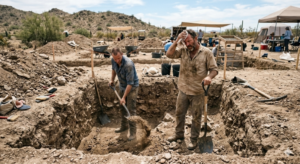
A moment of weary introspection during another unproductive dig. For the Mormon archaeologist, the physical fatigue carries a weight that secular researchers never have to bear — the gnawing possibility that the silence beneath the soil is not a gap waiting to be filled, but an answer already given. Image is AI generated, via Google Gemini.
Both of the following efforts were introduced earlier in this article in the context of the LDS Church’s broader pattern of motivated but fruitless searching. They bear a closer look here, because the specific details of what was found — and how those findings were presented to the faithful — reveal something important about the gap between LDS archaeological claim and LDS archaeological reality.
The Heartland Research Group’s Zarahemla dig near Montrose, Iowa (begun December 2021) proceeded from the assertion that a great BOM city — described in the text as a civilization comparable in religious significance to Jerusalem — lay buried beneath the Mississippi River bottomland of a small Iowa town. After multiple seasons of excavation by an organization whose entire theoretical framework depends on finding exactly this site, the results were as follows: some earthen berms of ambiguous origin, no datable artifacts, no inscriptions, no structural remains, and no connection of any kind to any event, person, or description in the Book of Mormon. The group’s own published summary managed to compress this outcome into a single sentence of unintentional comedy: “Research is ongoing but so far I think there is a general consensus that these berms are man-made.”
Man-made dirt mounds in Iowa. That is the complete evidentiary harvest of years of faith-driven excavation at what believers consider the New World equivalent of Jerusalem.
The Yemen “Bountiful” expedition of February 2016 fared no better, though it was considerably more exotic in its presentation. The artifacts ultimately recovered and displayed to supporters consisted of a single incised pottery shard of unconfirmed date and a small bead described as being from a “yet undetermined time period.” The expedition’s own published account called the bead “one of those treasures” that “can make your whole day.” No provenance was established. No date was confirmed. No connection to Nephi, Lehi, or any BOM event was ever documented.
Taken together, these two expeditions — one in the American Midwest, one on the Arabian Sea coast — perfectly encapsulate the entire enterprise of LDS archaeological research: substantial institutional enthusiasm, genuine personal devotion, exotic and well-funded logistics, and results that would not survive ten minutes of peer review. A pottery shard. A bead. Some berms. These are not the findings of a civilization. They are the findings of a search that found nothing, dressed up in the language of discovery for an audience that has been taught to receive even the smallest ambiguity as confirmation.
The pattern across all of these efforts is not one of science informing faith. It is one of faith directing the search and then interpreting the most minimal results — an ambiguous berm, an incised shard, a common Semitic place name — as confirmation of a predetermined conclusion.
The items listed above — horses, steel, wheat, chariots, silk — are not obscure or debatable. They are foundational material signatures of the civilization the Book of Mormon describes. Their complete absence from the pre-Columbian archaeological record of the Americas is not a gap waiting to be filled. It is a verdict waiting to be acknowledged.
Section 3: The DNA Knockout
A 2015 peer-reviewed study published in Nature by Skoglund, Reich, et al. confirmed that Native American populations trace their genetic origins to ancient East Asian migrations, with zero evidence of Near Eastern or Israelite ancestry. The finding directly contradicts the Book of Mormon’s central claim that the indigenous peoples of the Americas descended from a Hebrew family departing Jerusalem around 600 BC. Population genetics has not merely raised a question about that claim. It has answered one. Source: Skoglund, P., Mallick, S., et al., “Genetic Evidence for Two Founding Populations of the Americas,” Nature, Vol. 525, pp. 104–108 (2015).
If the absence of archaeological evidence constitutes reasonable doubt, the evidence from population genetics constitutes scientific consensus. The DNA record of the Americas has now been mapped with extraordinary precision, and its verdict is unambiguous.
The Population Genetics of Native Americans
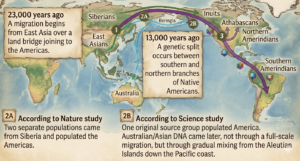
Modern genetic science has established with near-certainty that the indigenous populations of the Americas descend from ancient migrations from northeast Asia, not from a family of Israelites departing Jerusalem around 600 BC. The landmark 2015 genome-wide study published in Nature by Skoglund, Mallick, Reich, and colleagues — analyzing ancient and modern Native American DNA across North and South America — confirmed that “all Native American groups studied to date can trace all or much of their ancestry to a single ancestral population that probably migrated across the Bering land bridge from Asia more than 15,000 years ago”. The study found no Semitic, Middle Eastern, or Israelite genetic signature in any Native American population tested.
A companion study published simultaneously in Science by Raghavan, Steinrücken, Harris, and colleagues — analyzing high-coverage whole genomes from Native Americans across both continents — reached identical conclusions, establishing that all present-day Native Americans “originated from the same migration” from northeast Siberian ancestors, with an initial divergence from East Asian populations dated to approximately 23,000 years ago. These results are supported by D-statistics, MSMC analyses, and ancient DNA from the 12,600-year-old Clovis-associated Anzick-1 genome — one of the oldest human remains ever recovered in the Americas — which shows unambiguously East Asian ancestry with no trace of Near Eastern admixture.
The Nature study did identify one genuinely surprising finding: a small subset of Amazonian populations — specifically the Suruí and Karitiana peoples of Brazil — show a distant genetic affinity to Australasian and Melanesian populations, suggesting a second, ancient migration stream that the researchers designated “Population Y”. This finding is real, peer-reviewed, and scientifically significant. It is also precisely the opposite of what LDS apologists need. Population Y traces to Australo-Melanesian ancestry, not to the ancient Near East. Its presence in the deepest Amazon reflects migrations from Asia that predate the Book of Mormon’s timeline by tens of thousands of years, and it has no connection whatsoever to any Semitic, Hebrew, or Israelite population. If anything, its discovery strengthens the case against BOM historicity: even the most anomalous genetic signal in the entire Native American genome traces back to Asia — and scientists “spent a lot of time being sceptical and incredulous about the finding and trying to make it go away, but it just got stronger” before publishing it. The signal the LDS Church needs — an Israelite founding population arriving by ship in 600 BC — is not anomalous. It is simply absent.
The genetic verdict, delivered across multiple independent research teams using whole-genome sequencing technology that did not exist when Thomas Murphy first published his DNA analysis in 2002, is not ambiguous, not preliminary, and not open to the interpretation that a small founding group might have been genetically swamped. As Southerton himself noted in the retraction of his earlier “small population” concession — quoted on FAIR’s own website — whole-genome analysis has now advanced to the point where even a founding group of ten individuals would leave a detectable genomic signal after 2,600 years of described population growth. The technology has caught up with the question. The answer has not changed. It has only become more precise, more replicable, and more damning.
Thomas W. Murphy, an anthropologist and Latter-day Saint, published the first peer-reviewed academic article on DNA and the Book of Mormon in 2002 — a landmark essay titled “Lamanite Genesis, Genealogy, and Genetics,” included in the anthology American Apocrypha: Essays on the Book of Mormon (Signature Books, 2002). Murphy’s conclusion was direct and unambiguous: “To date, no intimate genetic link has been found between ancient Israelites and indigenous Americans, much less within the time frame suggested by the Book of Mormon. Instead of lending support to an Israelite origin as posited by Mormon scripture, genetic data have confirmed already existing archaeological, cultural, linguistic, and biological data, pointing to migrations from Asia as the primary source of American Indian ancestry.”
Over 98% of Native Americans tested carry mitochondrial DNA haplogroups A, B, C, or D — markers whose closest matches outside the Americas are found in Mongolians and south Siberians, not in any Middle Eastern or Semitic population. The remaining approximately 1% carry haplogroup X, which appears in a broad distribution across south Siberia, Europe, and the Near East but shows no clustering pattern consistent with a single Israelite founding event in 600 BC.
Murphy’s findings were subsequently reinforced by plant biologist and former Mormon Simon Southerton, whose 2004 book Losing a Lost Tribe: Native Americans, DNA, and the Mormon Church extended Murphy’s analysis across a wider genetic dataset and reached the same conclusion. Together, Murphy and Southerton established the genetic case against BOM historicity on peer-reviewed scientific grounds that have never been scientifically overturned — only theologically contested.
The FAIR rebuttal to Southerton’s Losing a Lost Tribe is available in full at fairlatterdaysaints.org and runs to hundreds of individual responses organized chapter by chapter. It is worth reading in its entirety — not because it refutes Southerton, but because it cannot, and the document’s own structure makes that impossibility visible.
Consider what FAIR’s rebuttal actually accomplishes. It disputes Southerton’s characterization of LDS institutional culture, his description of past prophetic statements about Lamanite ancestry, and his tone in various online postings. What it does not dispute — what it cannot dispute — are the core genetic findings: that over 99% of Native American DNA traces to East Asian origins, and that no Israelite genetic signature has been identified anywhere in the pre-Columbian Americas. FAIR’s own published material concedes this explicitly, stating: “Now that FAIR has finally conceded that American Indian DNA is essentially all derived from Asia, I also agree with them that the debate should be about the theology” — a quote FAIR reproduces from Southerton himself, apparently without recognizing that reproducing this concession on their own website ends the scientific argument entirely.
The document also inadvertently preserves one of the most damaging self-refutations in the DNA debate. Southerton’s 2014 clarification — quoted by FAIR — directly dismantles the “small founding group” defense that remains FAIR’s primary genetic argument: “I made the original statement at a time when whole genome sequence analysis was a long way off. It’s true that if a small group (say 10 people) entered a massive population (say 1 million), that it would be hard to detect their mitochondrial or Y chromosome DNA. But technology has moved very rapidly and whole genome studies are now almost routine. So, my original statement is no longer true.” FAIR quotes this on its own website. The technology that once made the “small founding group” argument marginally plausible has since advanced to the point where Southerton himself retracted it — and FAIR preserved the retraction in its own rebuttal, apparently unaware of what it meant for their central argument.
The FAIR rebuttal, in short, is the document that LDS apologists wrote to defend the historicity of the Book of Mormon against genetic science, and which ends up confirming, in their own words, that the science won.
The institutional response to Murphy’s research is itself revealing. Rather than engaging the science on its merits, the LDS Church summoned Murphy to a formal disciplinary council on charges of apostasy in 2002 — a proceeding that was ultimately called off at the last minute, though Murphy has confirmed it was never formally resolved. FAIR Latter-day Saints, in its own published response to Murphy, did not dispute his core genetic findings. Instead, it questioned his methodological assumptions, argued that modern Jewish DNA may not accurately represent ancient Israelite DNA, and pointed to a Y-chromosome marker (Q-P36) shared between some Native Americans and some Ashkenazi Jewish populations as evidence of a possible ancient connection. Independent geneticists have not accepted this argument as confirmation of BOM historicity — the shared marker predates any Israelite population by thousands of years and reflects far older population movements out of Central Asia.
The implications are not ambiguous. The Book of Mormon’s central narrative requires that a family of Israelites arrived in the Americas around 600 BC and that their descendants eventually populated significant portions of the continent. Over the course of a thousand years, those descendants are described as numbering in the millions — millions who fought, died, intermarried, and filled the land with their civilizations. If this population existed, it left DNA. DNA does not disappear. It accumulates, blends, and persists across thousands of generations.
No trace of Lehite DNA has been found. Not one marker. Not one genetic signature consistent with a Near Eastern founding population embedded within Native American genomes.
The Apologist Retreat and Its Fatal Contradiction
Confronted with this evidence, LDS apologists at FAIR Latter-day Saints have largely conceded the DNA data while arguing that the Lehite founding group was simply too small to affect the gene pool. As FAIR’s own published material states directly: “If a small group of Israelites entered such a massive native population it would be very, very hard to detect their genes 200, 2000 or even 20,000 years later”. A 2023 FAIR Conference presentation extended this further, arguing that since every Native American alive today would have had “more than a nonillion” potential ancestors going back to the time of Lehi’s supposed landing, the genetic signature of a small founding group would have been mathematically swamped out of detectability.
This argument deserves close examination, because it creates a logical contradiction that no amount of theological creativity can resolve.
The FAIR position essentially requires the reader to hold two irreconcilable ideas at once. On one hand, the Lehite group was so small — FAIR’s own literature references a founding party of perhaps ten to twenty individuals — that after a thousand years of described population growth and civilizational development, it left no detectable genetic trace whatsoever in a continent-wide indigenous gene pool. On the other hand, this same founding group is the progenitor civilization described in Ether 15:2 as producing armies numbering in the millions, with a single battle alone generating nearly two million casualties among men, implying a total death toll, including wives and children, of perhaps six million.
Both claims cannot simultaneously be true. A founding population that remained too genetically insignificant to register in modern DNA testing — diluted, as FAIR argues, into statistical invisibility against a surrounding population of millions — could not have produced civilizations numbering in the tens of millions within the same timeframe. A civilization that fielded armies of two million men would have long since saturated the genetic record of the continent. The DNA would not be hiding. It would be everywhere.
It is worth noting that FAIR’s retreat to the “small founding group” defense was not a position born of scientific integrity. It was a response to a crisis. For over 170 years after the Book of Mormon’s publication in 1830, the official LDS teaching — repeated by prophets and general authorities from Joseph Smith through Spencer W. Kimball — was that Native Americans were the descendants of Lehi, full stop. The 1981 edition of the Book of Mormon’s introduction stated plainly that the Lamanites “are the principal ancestors of the American Indians.” It was not until 2006, after geneticist Simon Southerton published Losing a Lost Tribe: Native Americans, DNA, and the Mormon Church, that the Church quietly amended that introduction to read that the Lamanites “are among the ancestors of the American Indians.” One word — “among” — replaced a century and a half of prophetic teaching, inserted without announcement, without apology, and without acknowledgment of what it meant.
FAIR has since argued, with a straight face, that the small-population model was never incompatible with LDS teaching and was not “cobbled together to save a floundering Book of Mormon from the threat of DNA science.” The timing of the Book of Mormon’s introduction revision tells a different story. When the prophets speak, and the science disagrees, the prophets — it turns out — get quietly edited.
The apologist retreats to a “small founding group” does not save the historicity of the Book of Mormon. It dismantles it — and in doing so, it also dismantles a hundred and seventy years of prophetic teaching that the church has never publicly retracted.
Section 4: What Non-Mormon Archaeology Has Found in the Americas
It is important to frame the absence of Book of Mormon evidence against the presence of real, documented, extensively confirmed pre-Columbian civilizations. The Americas were not empty before Columbus. They were filled with complex, sophisticated societies that left abundant material records. The relevant point is that none of those material records bear any resemblance to what the Book of Mormon describes.
North America: Cahokia and the Hopewell Tradition
The Mississippian culture, centered at Cahokia near present-day St. Louis, represented one of the most significant urban centers in pre-Columbian North America. At its peak around 1100 AD, Cahokia may have housed as many as 20,000 people. Its massive earthen mounds, organized civic spaces, and long-distance trade networks represent a genuine large-scale civilization.
But Cahokia shows zero linguistic, genetic, or material connection to the descriptions in the Book of Mormon. No Old World writing. No Hebrew inscription. No Near Eastern DNA. No horses, steel, or chariots.
The Hopewell Tradition (100 BC–500 CE) — spanning much of the eastern United States — is frequently cited by LDS Heartland theorists as evidence consistent with Book of Mormon narratives. But the Hopewell culture had no written language, no domesticated horses, no steel, and no chariots. These are not peripheral Book of Mormon details — they are among the four most fundamental material requirements of the narrative. A civilization that possessed none of them cannot be identified as Nephite.
Mesoamerica: The Olmec, Maya, and Aztec
In Mesoamerica, the archaeological record is even richer and even more damaging to Book of Mormon claims. The Olmec, Maya, and Aztec civilizations left stunning, detailed archaeological records — temples, ball courts, astronomical observatories, market centers, trade routes, and written inscriptions covering thousands of years of history. Their writing systems have been substantially decoded and bear no resemblance whatsoever to Hebrew or Reformed Egyptian.
Yale archaeologist Michael Coe, one of the foremost authorities on Mesoamerican civilization, offered the most direct professional assessment available:
There is not one professionally trained archaeologist, who is not a Mormon, who sees any scientific justification for believing the Book of Mormon’s historical claims to be true.
— Michael D. Coe, Yale University, as cited in Mormon Stories, ‘Archaeology and the Book of Mormon‘
Michael Coe’s expertise is in the very cultures that LDS apologists most frequently attempt to co-opt as Book of Mormon civilizations. His assessment is not the result of anti-religious bias. It is the result of a lifetime spent studying the actual evidence.
Section 5: The Bible vs. the Book of Mormon — Unearthing a Comparison
This section does not argue that Biblical archaeology disproves the Book of Mormon. That is not its purpose, and that is not how evidence works. What Biblical archaeology provides here is something more methodologically valuable: a comparative backdrop — a working demonstration of what the archaeological record looks like when it is responding to a text that describes real places, real people, and real events. The contrast that emerges is not manufactured. It is simply what happens when you hold two truth-claiming historical texts up to the same evidentiary standard.
That standard, applied to the Bible, has produced what professional archaeologists have described as an inconvenience of abundance. Archaeologists working in the ancient Near East face a landscape so saturated with confirming material that they must prioritize which discoveries to publish first. New inscriptions bearing the names of biblical figures surface regularly. Cities mentioned in the Old Testament are identified, excavated, and dated with increasing precision. Seals bearing the names of officials mentioned in specific biblical passages turn up in the sifting buckets of Jerusalem excavations. Letters from named Assyrian kings to named Israelite monarchs emerge from the soil of the City of David. The garden described in the Gospel of John at the site of the crucifixion is confirmed beneath a church floor. The hometown of three apostles is identified beyond reasonable archaeological doubt when a wildfire clears the foliage from a hillside.
None of this proves the theological claims of Christianity or Judaism. A confirmed inscription bearing the name of Pontius Pilate — which exists, discovered at Caesarea Maritima in 1961 — does not prove the resurrection. A seal bearing the name of the prophet Isaiah — discovered in Jerusalem in 2018 — does not prove Isaiah’s prophecies were divinely inspired. What these discoveries prove is something more limited and more important for this discussion: they prove that the biblical narrative is embedded in real history, real geography, and a real material world that archaeology can find, date, and examine. The text is touching the ground. The ground is responding.
The Book of Mormon makes the same category of claim. It does not ask to be read as allegory or spiritual metaphor. It presents itself as a history — a detailed, geographically specific, materially rich account of real civilizations in real locations over a real span of 2,600 years. By its own terms, it should be touchable. The ground should be responding.
Biblical archaeology, in this context, is not a weapon aimed at the Book of Mormon. It is a mirror — reflecting back, with uncomfortable clarity, what a historically grounded ancient text actually looks like when archaeology examines it. The reflection that the Book of Mormon produces in that mirror is not a diminished version of the biblical image. It is an absence. Not fewer artifacts, not smaller cities, not harder-to-find inscriptions. Nothing confirmed. Nothing identified. Nothing that the professional archaeological community — including the Mormon archaeologists who spent careers and Church funds looking — has ever been able to hold up and say: this is it. This is the thing the Book of Mormon describes.
That absence, set against the abundance that Biblical archaeology continues to produce year after year, is not a coincidence. It is, as Richard Packham observed, precisely what the evidence against a hypothesis looks like — and in any honest court of inquiry, it is what the evidence demands we acknowledge.
The late Dr. William Foxwell Albright, widely regarded as the foremost American archaeologist of the ancient Near East, wrote words that have only grown more accurate with time:
No archaeological discovery has ever controverted a Biblical reference. Discovery after discovery has established the accuracy of innumerable details.
— Dr. William F. Albright, as widely cited in biblical archaeology literature
Now contrast this with the situation in Book of Mormon archaeology. Archaeological societies have issued form-letter rejections to LDS inquiries about the Book of Mormon. No such form letters exist for biblical archaeology, because confirmation keeps arriving. The contrast is not a matter of different standards being applied — it is a matter of different evidence being found.
The Top Biblical Archaeology Discoveries of 2025 Alone
To make this contrast vivid and current, consider what biblical archaeology confirmed in a single calendar year — 2025 — while Book of Mormon archaeology continued to explain why it had found nothing.
• Discovery #1: Assyrian Cuneiform Inscription in Jerusalem (October 2025) A pottery shard bearing an Akkadian inscription was discovered in Jerusalem — the first Assyrian inscription from the First Temple period ever found there. Petrographic analysis confirmed the clay originated from the Tigris River basin, establishing that the object was genuinely transported from Mesopotamia. A preliminary translation read: “Dear King of Judah, send the tribute quickly before the first of Av.” This directly corroborates 2 Kings 18:7’s account of Hezekiah’s refusal to pay tribute to the Assyrian king Sennacherib.
• Discovery #2: Pool of Siloam Dam Wall (August 2025) A monumental dam wall — forty feet high and twenty-six feet wide — was unearthed during ongoing Pool of Siloam excavations in Jerusalem. Carbon-14 dating placed its construction between 805 and 795 BC, during the reign of King Joash, who is explicitly credited in 2 Kings with major infrastructure projects. The physical structure matches the biblical description with engineering-level precision.
• Discovery #3: AI Redates the Dead Sea Scrolls (June 2025) An international research team used an artificial intelligence system called “Enoch” — combining radiocarbon dating with advanced paleographic analysis — to date 135 Dead Sea Scroll fragments. Remarkably, one-third of the manuscripts tested proved to be older than previously thought, including fragments of the book of Daniel. Critics had long argued that Daniel’s remarkably specific prophecies must have been written after the events they describe. The new AI-assisted dating pushes the composition of those fragments back, consistent with genuine prophetic authorship.
• Discovery #4: Ancient Garden Beneath the Church of the Holy Sepulchre (March 2025) Excavations beneath the floor tiles of the Church of the Holy Sepulchre in Jerusalem uncovered archaeobotanical evidence of olive trees and grapevines dating to the pre-Christian era. John 19:41 specifically describes the site of Jesus’s burial as being in a garden. The discovery provides direct physical confirmation of that detail at the specific site Christians have venerated for nearly two millennia.
• Discovery #5: Bethsaida Confirmed by Wildfire (July 2025) When a wildfire burned away dense foliage at el-Araj on the northern shore of the Sea of Galilee, it exposed the widespread remains of a Roman-period village surrounding an ongoing excavation. The exposed evidence removed virtually all remaining scholarly doubt that el-Araj is indeed Bethsaida — the hometown of apostles Peter, Andrew, and Philip as identified in the Gospel of John (John 1:44).
• Discovery #6: Temple Mount Bulla with Biblical Name (July 2025) The Temple Mount Sifting Project recovered a clay seal impression (bulla) reading “Belonging to Yed[a’]yah, son of Asayahu” — a precise match to an official who served King Josiah, named in 2 Kings 22:12 as one of the king’s messengers. The seal came from an individual whose existence was previously known only from Scripture. Now it is known from the ground.
• Discovery #7: Colossae Necropolis (October 2025) The first-ever systematic excavations at Colossae in modern Turkey unearthed a necropolis containing sixty intact, rock-cut tombs approximately 2,200 years old. This confirmed not only the existence of the city but its character and period — directly corroborating the city to which the apostle Paul addressed his letter to the Colossians (Colossians 1:7). The excavations were announced through licensed archaeological channels with peer-reviewed publications expected to follow.
Biblical archaeologists have a hard time keeping up with confirmations.
Book of Mormon archaeologists have a hard time explaining why there are none.
In 2025 alone, archaeology confirmed a letter from an Assyrian king to a named King of Judah, a forty-foot dam wall built by a named biblical monarch, the garden at the tomb of Jesus, the hometown of three apostles, and the city where Paul’s epistle to the Colossians was received. These are not vague cultural parallels. These are specific names, specific places, specific events — all named in Scripture and all confirmed in the ground.
In the same year, Book of Mormon archaeology remained exactly where it had been since 1830: explaining silences.
Section 6: The Apologist Response — and Why It Fails
LDS apologists have not been passive in the face of this evidence. They have developed an elaborate and often sophisticated body of literature intended to reframe the absence of evidence as something other than evidence of absence. This section examines the most prominent strategies and the reasons why each ultimately fails.
The Jasmin Rappleye Claim (January 2026)
In January 2026, LDS apologist Jasmin Rappleye claimed that “a new large-scale study has shown that nearly every Book of Mormon detail once thought to be impossible has now been discovered in archaeology.” This is a remarkable claim, and it deserves to be evaluated by the same standards applied throughout this article.
Which details, specifically? In which peer-reviewed journals were they published? Confirmed by which non-Mormon archaeologists? The critical distinction — one that LDS apologists consistently blur — is the difference between a vague cultural parallel and specific confirmation. Ancient peoples across the globe used stone boxes. That is not confirmation that Moroni buried gold plates in New York. Ancient Mesoamerican cultures practiced some form of ritual warfare. That is not confirmation of the battles of Cumorah.
Apologists frequently present what academics would call “hit list” arguments: compiling a long list of superficial similarities between ancient American cultures and Book of Mormon descriptions, then presenting the list as cumulative evidence of authenticity. The problem is that with a narrative spanning 2,600 years and covering an entire hemisphere, coincidental parallels with some ancient culture somewhere are essentially guaranteed. The relevant question is whether there is any specific, identified, peer-reviewed archaeological confirmation. There is not.
BYU’s Own Voice of Dissent: Ray T. Matheny
One of the most significant critiques of LDS apologetic archaeology has come from within BYU itself. Ray T. Matheny, a professor of anthropology at Brigham Young University and a practicing Latter-day Saint, delivered a paper at the Sixth Annual Sunstone Theological Symposium in August 1984 that cut through the apologetic fog with unusual candor. After twenty-two years of working in Mesoamerican archaeology, Matheny concluded:
“I would say in evaluating the Book of Mormon that it has no place in the New World whatsoever … I have felt that Mormons have been grasping at straws for a very long time trying to thread together all these little esoteric finds, out of context, and they really don’t have much meaning when they’re isolated.”
— Ray T. Matheny, Sunstone Symposium, August 25, 1984
Three years later, in a 1987 letter responding to a direct inquiry about Book of Mormon archaeology, Matheny was equally unsparing:
“While some people choose to make claims for the Book of Mormon through archaeological evidences, to me they are made prematurely, and without sufficient knowledge. I do not support the books written on this subject … I believe that the authors are making cases out of too little evidence and do not adequately address the problems that archaeology and the Book of Mormon present … Speculation, such as practiced so far by Mormon authors, has not given church members credibility.”
— Ray T. Matheny, letter dated December 17, 1987
Matheny’s criticism was directed not at enemies of the faith but at fellow Mormon scholars whose methodology he believed was actively undermining the Church’s credibility with anyone who actually knew the field.
The Official and Institutional Response: Silence and Dismissal. The LDS Church’s response to Matheny has been largely one of studied institutional indifference — a silence that speaks volumes given the source. Matheny was not a critic writing from outside the faith. He was a tenured BYU professor, a practicing Latter-day Saint, and a credentialed field archaeologist with over two decades of Mesoamerican experience. The Church could not credibly dismiss him as an apostate or an anti-Mormon agitator. So it did the next most convenient thing: it ignored him.
The Church’s Archaeological Committee had already established, years earlier, a policy that any archaeology officially sponsored by the Church — funded by tithing revenue — should “concern itself only with the culture history interpretations normally within the scope of archaeology,” and that “any attempt at correlation or interpretation involving the Book of Mormon should be eschewed.” In other words, the Church’s own archaeologists were formally instructed not to connect their findings to the BOM — a policy that conveniently insulates the institution from accountability when those findings produce nothing confirmatory.
FAIR Latter-day Saints has attempted to address Matheny primarily by arguing that his Sunstone remarks were informal, that important qualifying language was omitted from printed transcripts, and that his personal views do not represent the institutional position of BYU or the Church. This response is itself revealing: when Mormon archaeologists confirm the BOM, their credentials are cited as authoritative. When Mormon archaeologists contradict it — from inside BYU, after twenty-two years in the field — their remarks are reframed as casual, out of context, and insufficiently representative.
The LDS Church has also, on occasion, deployed a more aggressive institutional maneuver: in 1979, it published an official rebuke of the “Limited Tehuantepec Theory,” labeling it “harmful” and a “challenge” to prophetic statements about the location of the Hill Cumorah in New York. The Church, in other words, was willing to formally condemn a geographic theory proposed by its own scholars — not on archaeological grounds, but because it contradicted earlier prophetic statements. Science was not the referee. Prophecy was. And when the two conflict, the Church has consistently shown that prophecy wins — until the prophecy quietly gets reworded, as with the Book of Mormon’s introduction and the Lamanite ancestry claim, without announcement or apology.
Matheny’s voice remains one of the most important in this entire debate precisely because it cannot be explained away by anti-Mormon bias. He was one of theirs. He knew the field. He told the truth. And the institution he served chose, in the end, to look the other way.
The MH370 Problem: Unfalsifiability as a Feature
A revealingdiscussion thread on the r/mormon subreddit made a pointed comparison that is worth stating briefly: like the search for Malaysia Airlines Flight MH370, Book of Mormon archaeology has become an exercise in searching an ever-expanding area after every predicted location comes up empty. MH370’s search zone shifted from the South China Sea to the southern Indian Ocean to targeted debris fields as each prior theory failed — not because new evidence pointed elsewhere, but because the previous search zone had been exhausted without result. The Book of Mormon’s geography has followed an identical pattern. The Mesoamerican theory was dominant for decades. When it produced nothing confirmatory, the Heartland theory rose to replace it. When Heartland came up empty in Iowa, the search shifted to the Arabian coast, to South America, to the Great Lakes, to the Malay Peninsula — each proposed by serious LDS scholars, not fringe theorists, each revision driven not by new evidence pointing to a new location but by the failure of evidence to appear at the previous one.
The critical difference is this: MH370 is a real plane. Its absence from the expected search zone is genuinely puzzling precisely because we know it exists and must be somewhere. The Book of Mormon civilizations have no such established existence.A theory that can accommodate every geography on earth — that can migrate from Guatemala to Iowa to Oman without losing its proponents — is, by definition, a theory that cannot be falsified. And a theory that cannot be falsified is not history. It is theology wearing the costume of archaeology, and the costume becomes less convincing with every relocation.
Cultural Parallels Without Confirmation: The Kealakai Article
An article from Kealakai — the literary journal of BYU Hawaii — exemplifies the genre of apologetic writing that presents “evidence” by accumulating cultural similarities. The piece, titled “Unearthing Faith Through Historical Finds,” presents a sequence of intriguing parallels between ancient Near Eastern practices and Mesoamerican customs: ancient stone boxes, writing on metal, patterns of covenant ritual.
The problem is methodological. Parallels between cultures are expected, not remarkable. Human beings across cultures developed similar practices because they faced similar challenges. The apologetic leap — from “ancient peoples wrote on metal”to “therefore the gold plates of Nephi are plausible” — does not constitute archaeological confirmation. It constitutes rhetorical momentum. The peer-reviewed standard asks: Is there a specific, identified, confirmed connection? The answer remains no.
Section 7: The Institutional Retreat
Perhaps the most revealing evidence in this entire discussion is not found in the ground at all. It is found in what LDS leadership has said — quietly, carefully, over many decades — about the impossibility of expecting archaeological proof.
The Official Position
Elder Joseph Fielding Smith, who would later become the tenth President of the LDS Church, wrote in 1956 that “it is my judgment that there is not a single piece of irreducible archaeological evidence that has been found which supports the Book of Mormon.” Smith was not a liberal critic or a disaffected member. He was one of the most orthodox and traditionalist leaders in LDS history, and he acknowledged the evidentiary reality decades before the DNA evidence arrived.
The B.H. Roberts Admission
B.H. Roberts (1857–1933) of the First Council of Seventy, one of the most intellectually formidable minds in early twentieth-century LDS leadership, undertook a private study of archaeological and scientific challenges to the Book of Mormon that was only published posthumously. His conclusion was devastating in its honesty:
The power of the Holy Ghost… must ever be the chief source of evidence for the Book of Mormon. All other evidence is secondary… No arrangement of evidence however skillfully ordered; no argument, however adroitly made, can ever take its place.
— Elder B.H. Roberts (1857–1933), First Council of Seventy, LDS Church, as cited in multiple primary sources
Read carefully, Roberts’s statement is not merely a spiritual encouragement. It is a pre-emptive concession. It establishes that spiritual experience must be the primary warrant for Book of Mormon belief precisely because the evidentiary warrant cannot bear the weight. Roberts knew this in the early twentieth century.
The FAIR LDS Disclaimer
FAIR LDS — the LDS Church’s most sophisticated official-adjacent apologetics organization — has explicitly stated that “scholarship does not replace spiritual witness as a source of testimony.” The organization was founded specifically to provide well-documented answers to criticisms of LDS doctrine. After decades of effort, its clearest statement on the archaeology question is that archaeology cannot and should not be the measure.
This is a remarkable institutional position. When an organization whose central historical claims include two-thousand-year-old civilizations, metallurgy, migrations, and warfare declares that those claims cannot and should not be evaluated by the standards of history, that is not theological humility. It is an admission dressed as doctrine. It is saying, in effect: do not look at the ground, because the ground has not been helpful.
Section 8: The Reasonable Doubt Standard
Richard Packham, a former Mormon who became a legal scholar, articulated what has become the most widely cited analytical framework for evaluating Book of Mormon historical claims. Packham’s argument is essentially this: in a court of law, the evidence against the historicity of the Book of Mormon would not merely raise reasonable doubt — it would produce a verdict.
The legal standard for reasonable doubt does not require absolute certainty in the negative. It requires only that a reasonable person, examining the totality of the evidence, cannot be confident beyond a reasonable doubt in the affirmative claim. Applied to the Book of Mormon:
Two centuries of motivated, Church-funded archaeological investigation have produced zero confirmed Book of Mormon sites.
DNA evidence spanning the entire indigenous population of the Americas shows no trace of a Lehite founding population.
Every significant animal, crop, technology, and material described in the Book of Mormon as characteristic of these civilizations is either confirmed absent from pre-Columbian America or undetectable in the archaeological record.
The four non-Mormon institutions most qualified to evaluate the claims — the Smithsonian, National Geographic, and the academic archaeological communities at major research universities — have unanimously declined to identify any archaeological support.
The civilizations that did exist in pre-Columbian America — Maya, Olmec, Mississippian, Hopewell — left overwhelming material records despite being, in many cases, less grand in scale than what the Book of Mormon describes.
The civilizations that really did exist in the ancient world — the ones that left their names in the Hebrew Bible — keep turning up in the ground. Jericho. Jerusalem. Colossae. Bethsaida. Nineveh. Assyria. Each year, the list of confirmed biblical references grows longer. Each year, the list of confirmed Book of Mormon archaeological evidence remains at zero.
The contrast is, as the Smithsonian’s statement implied, total. The Bible describes a world that left traces everywhere archaeologists have thought to look. The Book of Mormon describes a world that, in two centuries of determined searching, has left no trace at all.
When the ground speaks this consistently and this unanimously, the reasonable person is obligated to listen.
Section 9: A Detailed Response to Jeff Lindsay’s ‘Book of Mormon Evidences’
Jeff Lindsay, a chemical engineer by training and a thoughtful Mormon apologist by avocation, has maintained one of the most comprehensive and widely read collections of Book of Mormon apologetics at jefflindsay.com/BMEvidences.shtml. Lindsay’s work spans multiple pages and engages seriously with both the evidentiary challenges and what he presents as positive evidence for the Book of Mormon’s authenticity. His arguments deserve a serious, point-by-point response — not dismissal.
Lindsay himself is admirably transparent about his methodology. He acknowledges from the outset that what he is offering is “not proof but indications of plausibility.” This intellectual honesty is commendable, and this response should be read in the same spirit.
The Nahom / Bountiful Argument
Lindsay’s most frequently cited and arguably strongest evidence involves Arabian Peninsula geography. He points to the NHM tribal region in Yemen (which he renders as “Nahom”) as a potential match for the Book of Mormon’s “Nahom” — a place where Ishmael was buried (1 Nephi 16:34). He further points to a lush coastal location in Oman (“Khor Kharfot”) as a plausible candidate for the Book of Mormon’s “Bountiful,” where Lehi’s family built a ship.
This is the most legitimate piece of evidence in Lindsay’s collection, and it deserves serious engagement. The NHM tribal altar inscriptions date to roughly the right period, and the location is geographically consistent with a southward journey from Jerusalem. Khor Kharfot does feature timber suitable for shipbuilding, fruit trees, and freshwater — matching Book of Mormon descriptions of Bountiful.
However, several significant qualifications apply. First, the NHM inscriptions spell the root consonants as N-H-M, which is a common Semitic root meaning “to comfort” or related to mourning — making it an extremely common toponym throughout the ancient Near East. Identifying the NHM tribal region as the specific “Nahom” of the Book of Mormon requires assuming that Joseph Smith correctly anticipated a common Semitic root appearing in the approximate region a southward journey from Jerusalem would pass through. This is not impossible, but it is much weaker evidence than apologists typically present.
Second, the existence of a real Arabian location that could have served as a waypoint for a journey from Jerusalem does not confirm that the journey occurred. It confirms only that the geography of the region is internally consistent with such a journey being narratively plausible. Critics of the Bible could point out that the geography of the Arabian Peninsula makes a journey from Egypt to Canaan plausible, without thereby confirming the Exodus.
Third, and most decisively, even if Nahom and Bountiful are confirmed, this establishes at most that the text accurately describes a portion of the Old World journey. The Book of Mormon’s evidentiary crisis is not in Arabia — it is in America, where the civilizations described should have left a material record and have not.
Chiasmus in the Book of Mormon
Lindsay, following the work of John Welch, argues that the presence of chiasmus — an ancient Hebrew poetic and literary structure — in the Book of Mormon constitutes evidence of ancient authorship. Chiasmus involves a pattern of ideas arranged symmetrically around a central theme (A-B-C-B’-A’), and Welch identified several chiastic passages in the Book of Mormon text.
This argument has been popular in LDS apologetic circles since the 1960s, but it faces several serious challenges. First, chiasmus as a literary structure is not uniquely Hebraic — it appears in ancient Greek, Mesopotamian, and other literary traditions, and arguably in any sufficiently long and repetitive text. Statistical work by non-Mormon linguists has questioned whether the chiasmus identified in the Book of Mormon rises above what would be expected by chance in a text of its length.
Second, even granting the presence of genuine chiasmus, this would establish only that Joseph Smith (or whatever entity produced the text) was aware of Hebraic literary patterns. It does not establish that ancient Hebrew prophets were writing in the Americas. The presence of a literary technique says nothing about geographical or historical claims.
The Metal Plates Argument
Lindsay argues that the use of metal plates for record-keeping — once considered an anachronism by critics — has since been corroborated by the discovery of ancient writings on metal across several Old World cultures. He cites the Pyrgi Tablets (Etruscan gold plates), the Copper Scroll from Qumran, and various Near Eastern examples.
This is a legitimate partial point. Ancient peoples did write on metal, and critics who claimed this was impossible were overstating their case. However, the existence of metal writing in the Old World does not confirm that metal writing occurred in the New World in the specific form the Book of Mormon describes — gold plates in upstate New York. The question is not whether metal writing is plausible in the abstract but whether any metal writing, in any recognizable form, has been found in the appropriate American context. It has not.
Hebraisms and Linguistic Patterns
Lindsay and other apologists point to features of the Book of Mormon’s English text that resemble Hebrew grammatical structures — the “and it came to pass” construction, cognate accusatives, construct state patterns, and similar features — as evidence that the text was translated from a Semitic original.
The difficulty with this argument is that Joseph Smith produced the Book of Mormon in an environment thoroughly saturated with biblical language. The King James Bible, with its Hebraized English, was the most widely read text in antebellum America. A nineteenth-century American steeped in the King James Bible would naturally produce a text with Hebraic cadences without any dependence on a genuine Semitic original. This is precisely what we would expect from an author deeply immersed in biblical English, and it is not distinguishable, by linguistic analysis alone, from a genuine translation.
Furthermore, scholars have identified extensive verbatim passages in the Book of Mormon drawn from the 1769 King James Version of the Bible — including passages from Isaiah chapters 48-54, which most mainstream biblical scholars now attribute to an anonymous author writing during the Babylonian captivity, between 586 and 538 BC. This means the Book of Mormon, which departed Jerusalem around 600 BC, contains material that had not yet been written when Lehi’s family left. This is not a Hebraism. It is an anachronism of authorship.
The Overall Assessment of Lindsay’s Evidence
Jeff Lindsay’s collection is the most comprehensive and intellectually honest body of LDS apologetic evidence available. Examined carefully, it demonstrates that the Book of Mormon contains internally consistent geography (at least for its Old World sections), literary features consistent with ancient Semitic texts, and some cultural details that are not inconsistent with what we know of the ancient Near East.
What it does not contain — what no LDS apologetic work has yet produced— is specific, identified, peer-reviewed archaeological confirmation of any Book of Mormon civilization, city, battle site, inscription, or biological marker in the American continent.
Lindsay himself acknowledges this. His stated goal is not proof but “plausibility.”The difficulty is that plausibility is not history.And the world is generously supplied with ancient narratives whose internal geography is consistent, whose literary features are sophisticated, and whose cultural details are not obviously impossible — none of which we accept as confirmed history on those grounds alone.
Consider the range of parallels:
Homer’s Iliad and Odyssey contain detailed, internally consistent Aegean geography, sophisticated literary structures including ring composition and oral formulaic patterns, and cultural details consistent with Late Bronze Age Greece. Scholars have debated for over a century whether a historical Trojan War underlies the text. The plausibility of the narrative’s geography does not settle the question — only archaeology at Hisarlik and the Linear B tablets have moved the needle toward historicity, and even then the debate continues.
Plato’s Atlantis narrative in Timaeus and Critias is internally geographically consistent, embedded in a text by one of history’s most brilliant writers, and contains cultural and architectural details that some scholars have seriously proposed as echoes of Minoan Crete or the volcanic destruction of ancient Thera. Atlantis has never been confirmed as historical. Its internal coherence has not changed that verdict.
The Epic of Gilgamesh contains a flood narrative that predates Genesis, with consistent internal geography, emotionally and literarily sophisticated content, and cultural details consistent with ancient Mesopotamia. Similar flood narratives appear across dozens of cultures with internally consistent geographies — from Cameroon to the Pacific Northwest — many of which, Smithsonian Magazine notes, may reflect real but local geological events rather than a single global catastrophe. Internal consistency in these narratives tells us something about the cultures that produced them. It does not confirm the supernatural claims embedded within them.
Internal consistency and stylistic authenticity are genuinely interesting qualities in an ancient text. They do not transform a narrative into confirmed history. Only confirmed history does that — and confirmed history requires exactly what Lindsay, for all his effort, has not been able to provide: something in the ground.
Conclusion: Speaking Honestly to Sincere People
This article has attempted throughout to maintain a distinction between the claims of the Book of Mormon and the people who believe in it. The two are separable. Millions of sincere, intelligent, morally serious people have found meaning, community, and genuine spiritual transformation through engagement with Latter-day Saint faith. Nothing in this article is intended to diminish that.
But meaning is not the same as history. Spiritual transformation is not the same as archaeological confirmation. And it is possible to respect people deeply while being honest with them about evidence.
The evidentiary situation as of 2026 is this: the Bible continues to be confirmed by archaeology at a rate that professional archaeologists describe as difficult to keep pace with. Seven major confirmations in a single calendar year — 2025 alone — include an Assyrian king’s letter to a named King of Judah, a forty-foot dam wall built by a named biblical monarch, the garden at the burial site of Jesus confirmed beneath the Church of the Holy Sepulchre, and the hometown of three apostles identified beyond reasonable doubt at el-Araj. The pace of confirmation shows no sign of slowing.
This is worth pausing on — not merely as a point of comparison, but as a pointed one. The LDS Church is, by any reasonable measure, one of the wealthiest religious organizations on earth. A 2023 whistleblower disclosure revealed that Ensign Peak Advisors, the Church’s investment arm, manages an investment portfolio estimated at over $100 billion — a fund so vast it dwarfs the endowments of most Ivy League universities combined. The Church collects tithing from over 17 million members worldwide. It owns agricultural land, shopping malls, media outlets, and insurance companies. It has the financial infrastructure to fund virtually any archaeological, genetic, or historical inquiry it chooses to commission, at any scale, in any location on earth.
And yet what has all of that institutional wealth and organizational muscle produced in two centuries of searching? A pottery shard of undetermined age on an Omani beach. Some ambiguous earthen berms in Iowa. A Yemeni altar inscription bearing a common Semitic root. A cement-construction parallel that would equally “confirm” any ancient text mentioning buildings. A deer that might have been a horse, if you squint at the translation and set aside the divine nature of the translation process entirely.
The Book of Mormon has produced no confirmed archaeological site, no confirmed inscription, no confirmed biological marker, and no confirmed material evidence of any kind — not in two centuries of investigation, and not despite decades of Church-funded work led by devoted Mormon scholars who wanted, more than anyone, to find something. Thomas Stuart Ferguson gave years of his professional life and the LDS Church’s money to the search before concluding that the Book of Mormon “will never meet the requirements of the dirt-archaeology … it is fictional.” Dee F. Green, a Mormon archaeologist writing in Dialogue: A Journal of Mormon Thought, declared flatly in 1969 that “Book of Mormon archaeology” did not exist as a legitimate field because no confirmed location had ever been identified. These were not hostile outsiders. These were believing Latter-day Saints who followed the evidence to a conclusion the evidence demanded.
A church that can build 350 temples across six continents, manage a $100 billion investment portfolio, and dispatch missionaries to every corner of the globe has no shortage of resources to bring to bear on a historical question it considers central to its truth claims. The silence from the ground is not, therefore, a product of insufficient effort or inadequate funding. It is the result of two hundred years of motivated, well-financed searching that has found nothing — because, as the accumulated weight of archaeology, genetics, and linguistic science now strongly suggests, there is nothing to find.
Beneath the Gilbert, Arizona Temple, the mammoth fossils rest in the earth as they have for ten thousand years — specific, physical, verifiable, and real. Above the surface, the question persists: where is the evidence of the civilizations the Book of Mormon describes?
The ground has spoken. It continues to speak. The honest response to what it is saying requires more than faith. It requires listening.
The first myth we need to eliminate is that Book of Mormon archaeology exists. Biblical archaeology can rightly be called a type of archaeology, but not so with Book of Mormon archaeology, largely because what is being posited is largely a hypothesis unverified.
— Dee F. Green, Mormon archaeologist, Dialogue: A Journal of Mormon Thought, 1969
Additional Research Sources and References
The following sources were consulted and employed in the preparation of this article. Readers are encouraged to examine each source independently.
Joseph Smith wasn’t exactly the Dale Carnegie of his day…
“God made Aaron to be the mouthpiece for the children of Israel, and He will make me be god to you in His stead, and the Elders to be mouth for me; and if you don’t like it, you must lump it.”
~ Teachings of the Prophet Joseph Smith, 363.
A Note on Research Methods and Accuracy
This work represents a collaboration between the author’s own historical research, primary source documentation, and the emerging capabilities of artificial intelligence research tools. AI assistance was employed throughout the investigative process — not as a ghostwriter or a substitute for scholarship, but as a rigorous research partner: surfacing sources, cross-referencing claims, identifying scholarly consensus, and flagging potential errors before they could reach the page.
Every factual claim in this work has been subjected to active verification. Where AI-generated content was used as a starting point, it was tested against primary sources, peer-reviewed scholarship, official LDS documentation, and established historical records. Where discrepancies were found — and they were found — corrections were made. The author has made every reasonable effort to ensure that quotations are accurately attributed, historical details are precisely rendered, and theological claims fairly represent the positions they describe or critique.
That said, no work of this scope is immune to error, and the author has no interest in perpetuating inaccuracies in the service of an argument. If you are a reader — whether sympathetic, skeptical, or hostile to the conclusions drawn here — and you identify a factual error, a misattributed source, a misrepresented doctrine, or a claim that cannot be substantiated, you are warmly and genuinely invited to say so. Reach out. The goal of this work is not to win a debate but to get the history right. Corrections offered in good faith will be received in the same spirit, and verified corrections will be incorporated into future editions without hesitation.
Truth, after all, has nothing to fear from scrutiny — and neither does this work.