

From Ramps and Sledges to Hydraulic Elevators and Human Counterweights:
The Complete Survey of Every Theory, Ancient to Cutting-Edge
INTRODUCTION: THE PROBLEM THAT WILL NOT SLEEP

Checkmate, archaeologists. 🛸
Stand at the base of the Great Pyramid of Giza on a late winter morning, when the desert air is still cool, and the plateau stretches toward Cairo in a pale amber haze. You will understand immediately why this structure has colonized the human imagination for more than four thousand years. The thing is too big. Not too big to comprehend, exactly, you can walk its perimeter, measure its angles, count the courses of stone rising above you. The problem is more profound than that. It is too big to have been built. And yet, self-evidently, it was.
The Great Pyramid of Khufu, known in the ancient world as “Akhet Khufu,” the Horizon of Khufu, stands 146 meters in its original completed form, though centuries of stone removal for other building projects have reduced it to approximately 138 meters today. It contains roughly 2.3 million stone blocks, each weighing between two and fifteen tons, with the massive granite slabs covering the burial chamber topping sixty tons apiece. The entire structure covers 5.5 hectares of desert plateau, more than ten football fields, and its base is so precisely leveled that the deviation across its entire surface is less than two centimeters. The Giza plateau as a whole, encompassing three major pyramids, the Great Sphinx, causeways, temples, and workers’ villages, was constructed in less than a century under five successive pharaohs. The engineering precision, as the late geologist Robert Schoch famously noted, is “comparable to modern construction methods using laser leveling.”
The question, as it always has been, is: how? With what technology? Through what organizational genius? Employing what mechanical principles did a Bronze Age civilization without iron tools, without wheeled vehicles of any substantial load capacity, and without any verified use of the pulley, at least until very recently, raise two million multi-ton stones to heights that would challenge a modern construction crew?
That question has never been more alive than it is today. In the space of barely two years, from 2024 through early 2026, a remarkable burst of scholarship has proposed, challenged, and refined theories that range from the quietly brilliant to the genuinely audacious. A peer-reviewed paper published in the journal Nature has proposed that the Great Pyramid was built from the inside out, using an internal network of pulley-like counterweight systems. A separate study published in PLOS One has argued that the first stepped pyramid in Egypt, Djoser’s monument at Saqqara, was constructed with the aid of a hydraulic elevator, water channeled from a nearby dam and used to float massive stones upward through internal shafts. A Korean independent researcher has proposed that the pyramids were not built up at all, but were originally oversized trapezoidal masses that were subsequently carved down to their familiar pointed form. And satellite imaging has uncovered a 64-kilometer-long lost branch of the Nile, its banks touching thirty-one pyramid sites, that has transformed our understanding of how raw materials arrived at the construction sites in the first place.
None of these theories has yet been definitively proven. Archaeology proceeds slowly, carefully, and with exasperating inconclusiveness — and in Egypt’s case, that pace is further throttled by the gatekeeping of former antiquities chief Zahi Hawass, whose tight control over site access and research permissions has long frustrated independent scholars. He last held formal government power as Minister of Antiquities in 2011, a position he was dismissed from in July of that year amid widespread protests over his domineering management style and alleged financial impropriety. Despite having no official authority, Hawass retains enormous de facto influence over who gains access to Egyptian archaeological sites, making him a persistent gatekeeper even in his private capacity.
Yet despite these barriers, the convergence of new scanning technologies, satellite remote sensing, fresh papyrological evidence, and the intellectual energy of a new generation of engineers and Egyptologists has brought us closer than at any point in the four-thousand-year history of this question to understanding what actually happened on the Giza plateau in the twenty-sixth century before the Common Era.
This essay surveys that intellectual landscape, from the ancient testimony of Herodotus to the peer-reviewed journals of 2025 and 2026. It examines the engineering challenges, the classical and modern theories, the experimental archaeology, the fringe ideas that turn out not to be so fringed after all, and the stubborn mysteries that remain. It is, in short, the story of humanity’s most enduring engineering puzzle, and of the remarkable people who have devoted their lives to solving it.
I. THE ARITHMETIC OF IMPOSSIBILITY
The Scale of the Problem
Before any theory of construction can be evaluated, it is necessary to understand, in precise quantitative terms, exactly what the builders of the Great Pyramid were required to accomplish. The numbers, when examined closely, are staggering in a way that casual familiarity tends to obscure.
The Great Pyramid was almost certainly completed within the approximately twenty-year reign of the Pharaoh Khufu, who ruled during the Fourth Dynasty of the Old Kingdom, around 2589–2566 BCE. Construction likely began at the outset of his reign and was substantially complete before his death. Working from that constraint and from the estimate of 2.3 million blocks, a figure accepted by the majority of mainstream Egyptologists, the logistics become punishing.
The arithmetic is unforgiving: even on a 20-year build you’re placing roughly 315 stones a day; on a 10-hour shift that’s one every two minutes, not just dumped, but set: lifted half a meter, aligned on shims, and released without chipping an arris.
– Brad Porter and Jay Douglas, Medium, November 2025
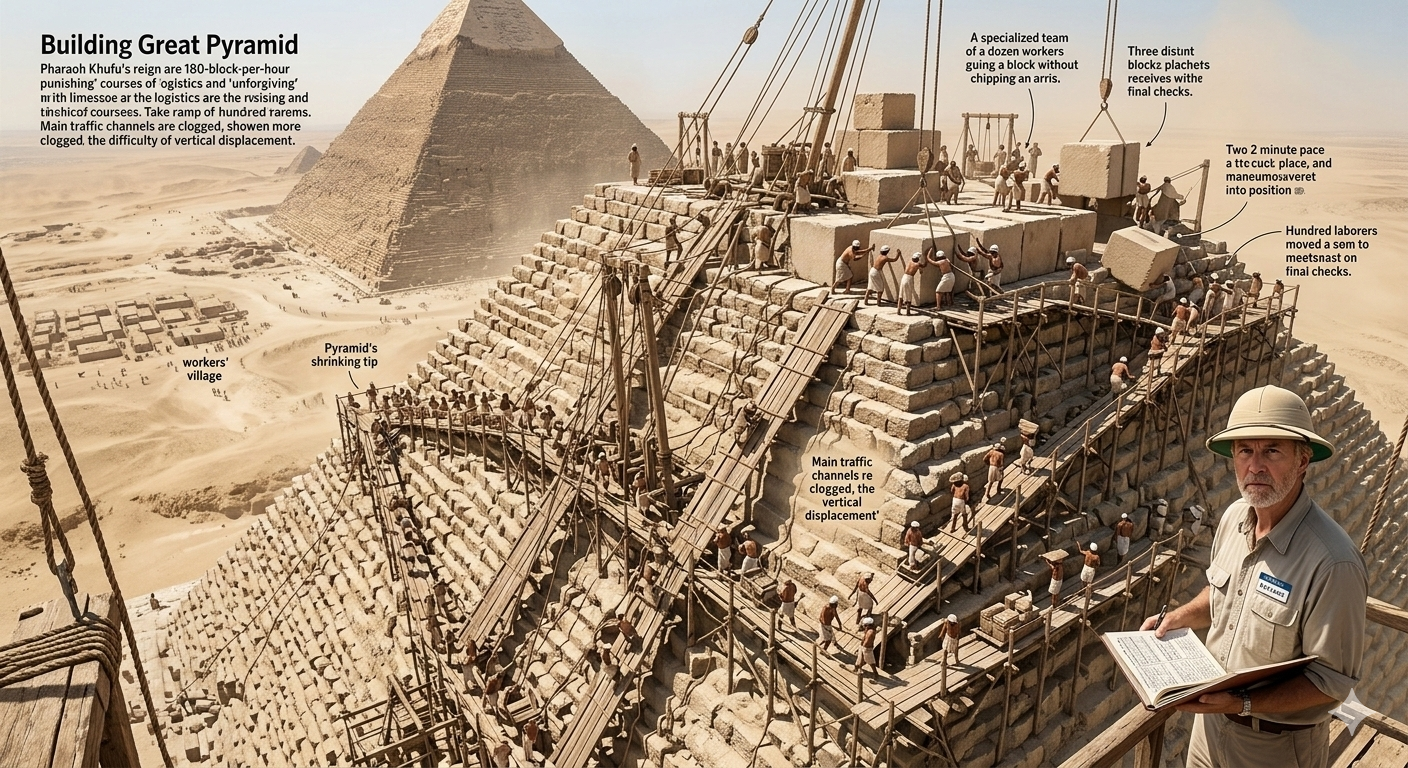
That calculation, made by a team of engineers who developed what they call the Porter-Douglas Counterweight theory, puts the essential problem in crystalline terms. The challenge is not merely one of brute force, of moving enormous weight across flat ground, which can be accomplished with enough manpower, sledges, and lubrication. The challenge is one of vertical displacement, repeated with machine-like consistency over two decades, in a structure whose geometry becomes more unforgiving with every additional course of stone.
A construction management study conducted by the firm Daniel, Mann, Johnson and Mendenhall in association with Harvard Egyptologist Mark Lehner estimated the total project required an average workforce of approximately 14,567 people, with a peak of 40,000. Without pulleys, wheels, or iron tools, they calculated that a sustained rate of 180 blocks per hour, three blocks per minute across the entire workforce, would have been necessary. The base courses, each block weighing two to three tons, are relatively manageable by comparison to what comes later. As the pyramid rises, the logistical problem intensifies geometrically: fewer workers can operate on the shrinking platform at each level, while the blocks must travel greater vertical distances.
Add to this the specific challenge of the massive granite components. The burial chamber of Khufu, located deep within the pyramid’s core, is roofed with nine granite beams, each weighing approximately fifty to sixty tons, quarried at Aswan, nearly nine hundred kilometers upstream on the Nile. These beams had to be transported overland to the river, floated on barges during the Nile’s high-water season, unloaded at Giza, and then raised to a height of roughly forty-three meters above the pyramid’s base. No ancient text tells us how this was done. The feat remains, in purely mechanical terms, extraordinary.
It is against this backdrop of logistical extremity that every theory, from the prosaic to the outlandish, must be measured. The question is not whether ancient Egyptians were capable of great organization and ingenuity. The papyrological evidence discovered since 2013 proves beyond a reasonable doubt that they were. The question is specifically mechanical: what machines, what physical principles, what innovations in force multiplication allowed them to do this work at the required pace?
The Documentary Record: What the Egyptians Left Behind
For most of the nineteenth and twentieth centuries, the most important ancient source on pyramid construction was a passage from Herodotus, written around 450 BCE, two thousand years after the Great Pyramid was built. Herodotus visited Egypt during the reign of the Persian Achaemenid empire, when the pyramids were already ancient monuments, and recorded what his local guides told him.
The pyramid was built in steps… After laying the stones for the base, they raised the remaining stones to their places by means of machines formed of short wooden planks. The first machine raised them from the ground to the top of the first step. On this there was another machine, which received the stone upon its arrival and conveyed it to the second step, whence a third machine advanced it still higher.
– Herodotus, Histories, Book II, c. 450 BCE
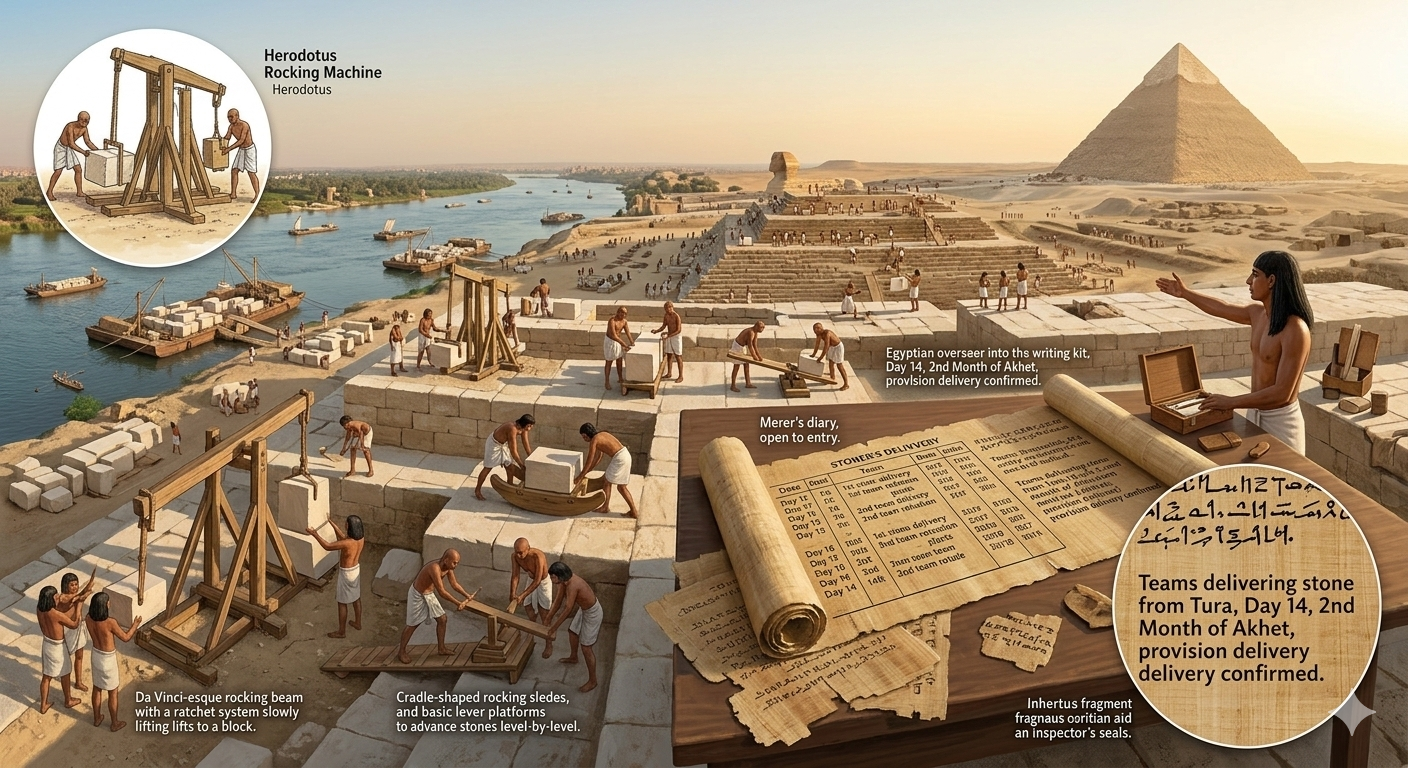
This passage, tantalizing, imprecise, and recorded from oral tradition two millennia after the fact, has launched a thousand theories. What were the ‘machines formed of short wooden planks’? Leonardo da Vinci studied the passage and designed a rocking-beam device that could, in theory, inch a block upward using a ratchet system. Modern engineers have proposed shaduf-style levers, compound pulley systems, and cradle-shaped rocking devices. Every interpretation is consistent with the passage, and none has been definitively confirmed archaeologically.
The situation changed dramatically in 2013. Between 2011 and 2013, fragments of papyrus logbooks were discovered by French Egyptologist Pierre Tallet at Wadi al-Jarf near the Red Sea, the world’s oldest papyrus documents, written by a man named Merer, an inspector of works who supervised one of the teams delivering stone to the construction site of the Great Pyramid during the reign of Khufu.
It shows it was a very large logistical undertaking, but just a building project nonetheless.
– Dr. Roland Enmarch, Senior Lecturer in Egyptology, University of Liverpool, quoted in BBC Science Focus, September 2025
Merer’s diary documents teams of workers shuttling limestone blocks from the quarries at Tura, across the Nile, to the Giza site. It describes the organizational complexity of the operation, the rotation of crews, the provisioning of workers, and the management of boats, with a matter-of-factness that is perhaps its most remarkable quality. There is no mystery in these pages, no sense of supernatural accomplishment. There are work schedules, supply deliveries, and the occasional mention of delays. The pyramids, the diary insists, were built by human beings doing an extremely demanding job with extraordinary efficiency.
What the diary cannot tell us, because Merer was a logistics officer, not a construction engineer, is the specific mechanical means by which the stones were lifted into place. For that, we must turn to the theories.
II. THE CLASSICAL THEORIES: RAMPS, SLEDGES, AND THE PROBLEM OF GRAVITY
The Ramp Hypothesis
The dominant theory in mainstream Egyptology for most of the twentieth century was the external ramp, a massive earthwork structure, built of rubble and mortar, up which stone blocks were dragged on wooden sledges. The image is intuitive and has the advantage of simplicity: build a gentle slope, drag things up it, raise the slope as the pyramid rises, dismantle when done.
The problem, as many researchers have noted, is one of geometry. To maintain a practical working grade, one that does not require impossibly large labor forces to drag multi-ton blocks, an earthen ramp steep enough to reach the top of the Great Pyramid would need to extend for well over a kilometer and would itself require a volume of material comparable to the pyramid’s own mass. No archaeological trace of such a construction has ever been found.
If you don’t have a very steep ramp, then you need a ramp of such enormous proportions to get to the top of the Great Pyramid that it would be a greater engineering feat than [building] the pyramid itself.
– Dr. Roland Enmarch, University of Liverpool, BBC Science Focus, September 2025
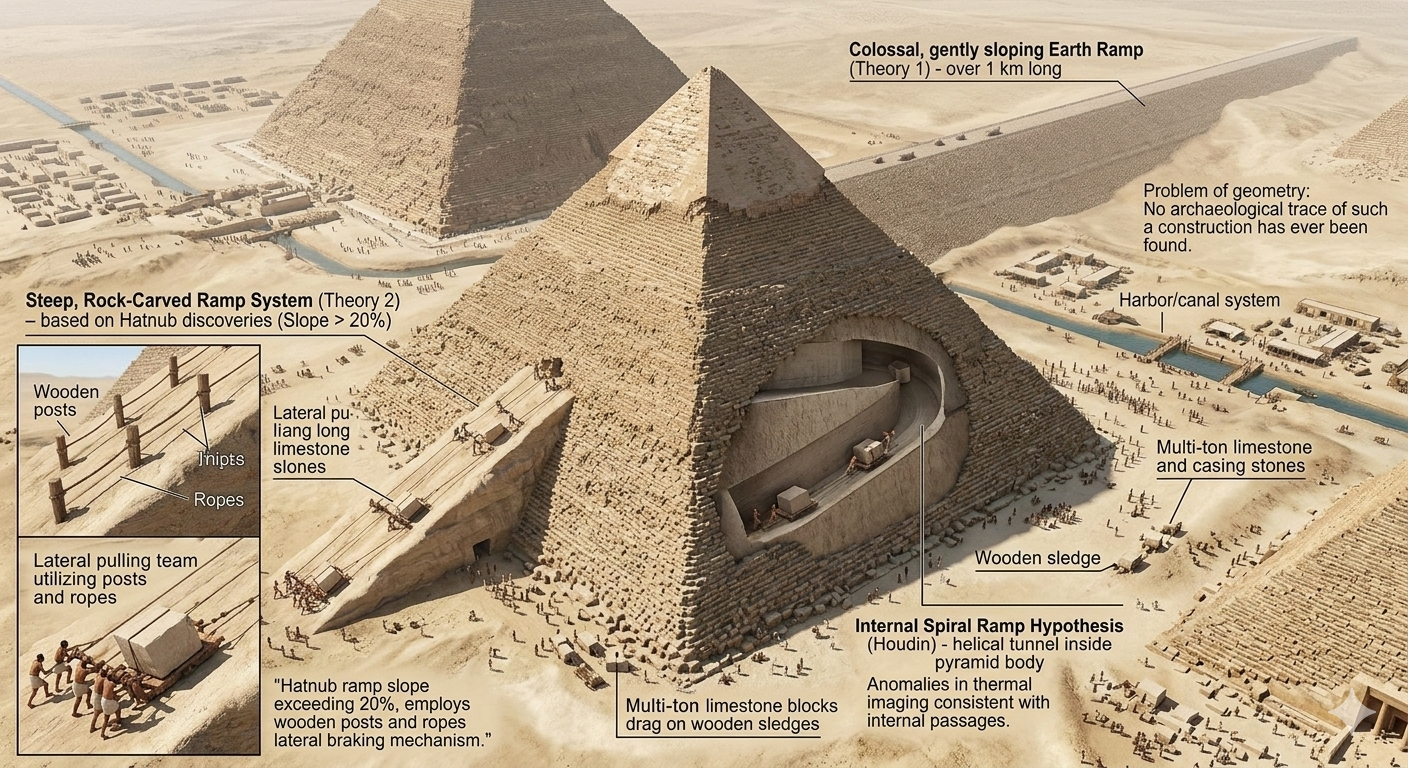
The discovery in 2018 of a ramp system carved into rock at the alabaster quarry at Hatnub in the Eastern Desert, by Dr. Enmarch’s team at the University of Liverpool, added important nuance to the debate. The ramp at Hatnub is far steeper than previously assumed possible, a slope exceeding 20 percent, and it employs a system of wooden posts and ropes running along the sides of the ramp, presumably allowing workers to use a kind of lateral braking or pulling mechanism. This suggested that the Egyptians may have employed steep ramps in conjunction with rope-assisted traction, rather than relying on gradual inclines alone.
Various modifications to the basic ramp hypothesis have been proposed. The spiral ramp, winding around the exterior of the pyramid as it rose, would have been shorter than a straight ramp but would have created challenges at each corner. The internal ramp hypothesis, associated primarily with French architect Jean-Pierre Houdin, proposes a helical tunnel inside the pyramid itself, spiraling upward within the body of the structure. Houdin’s computer modeling found anomalies in the pyramid’s thermal imaging consistent with internal passages, though direct verification remains impossible without destructive investigation.
The honest assessment of the ramp hypothesis, in all its variants, is that it solves the problem of moving blocks horizontally at grade, but becomes increasingly implausible as an explanation for the upper courses of the pyramid, where logistical constraints make any external ramp geometry nearly impractical.
Wet Sand, Sledges, and Lubrication: The Ground-Level Evidence
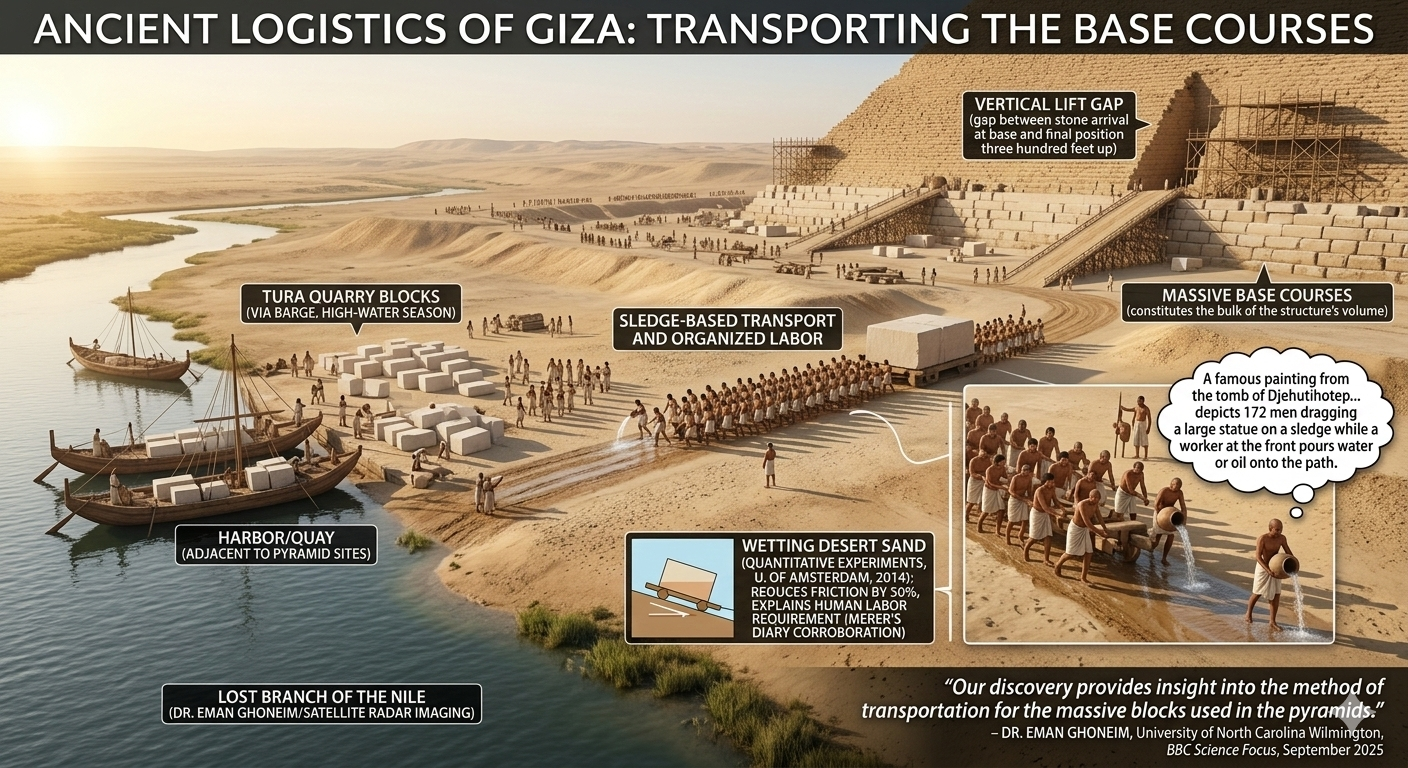
For the lower portions of the pyramid, the massive base courses that constitute the bulk of the structure’s volume, the combination of wooden sledges and lubricated trackways appears well-attested archaeologically. A famous painting from the tomb of Djehutihotep at El-Bersheh, dating to the Middle Kingdom, depicts 172 men dragging a large statue on a sledge while a worker at the front pours water or oil onto the path. Experiments conducted at the University of Amsterdam in 2014 demonstrated quantitatively that wetting desert sand with a precise amount of water reduces the friction under a sledge by approximately fifty percent, sufficient to explain the human labor requirements recorded for large-scale stone transport.
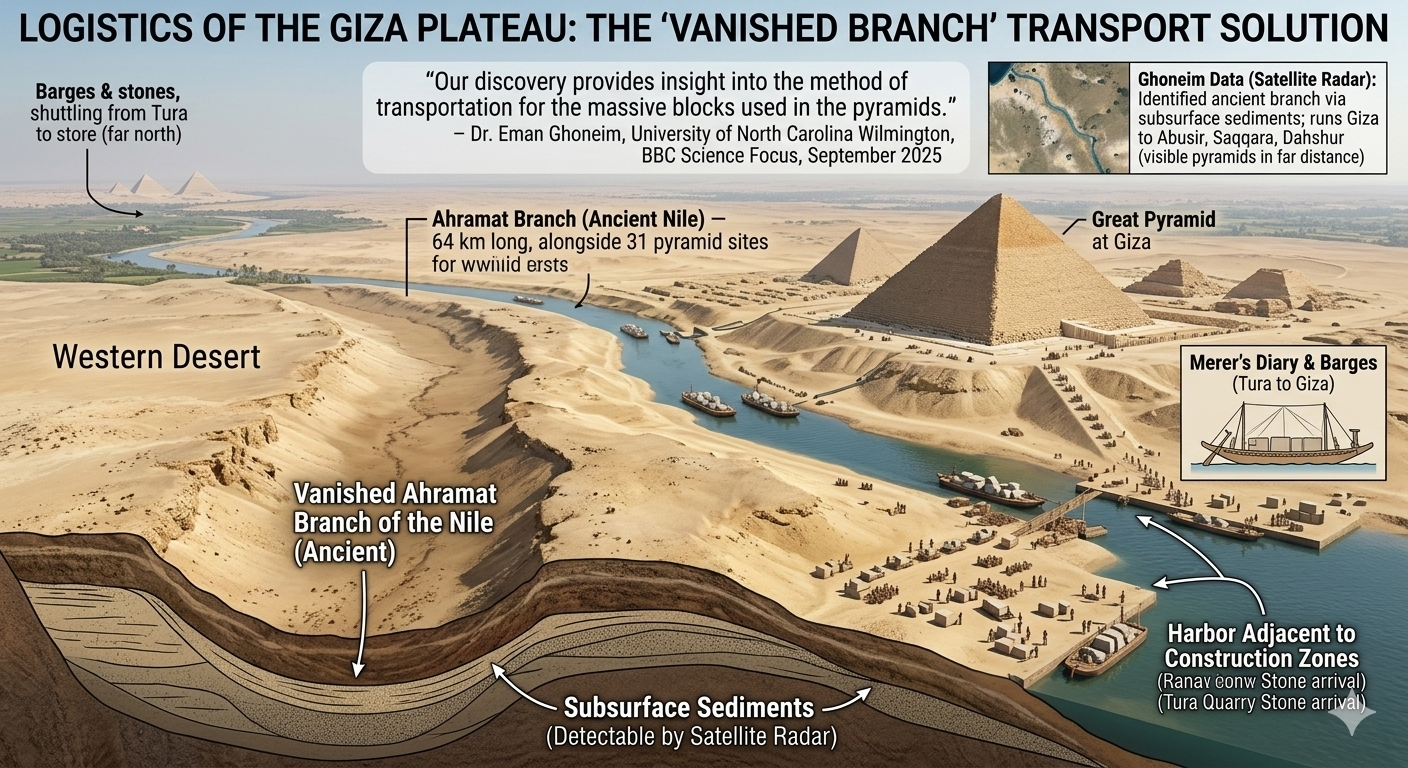
The diary of Merer corroborates this picture of water-borne and sledge-based logistics. Blocks quarried at Tura were loaded onto barges during the Nile’s high-water season, floated to a harbor at the base of the Giza plateau, unloaded, and then pulled to the construction site. The recently discovered lost branch of the Nile, a 64-kilometer ancient watercourse identified by Dr. Eman Ghoneim and her colleagues using satellite radar imaging, explains why the harbors were adjacent to the pyramid sites. The Nile once came to the builders; it did not require the builders to transport stone across the open desert.
Our discovery provides insight into the method of transportation for the massive blocks used in the pyramids.
– Dr. Eman Ghoneim, University of North Carolina Wilmington, BBC Science Focus, September 2025
This combination of water transport, wet-sand sledging, and organized labor accounts beautifully for the horizontal movement of stone. It does not, on its own, account for the vertical lift. And it is in that gap, between stone arriving at the base and stone arriving at its final position three hundred feet in the air, that the most inventive theorizing of the past two years has concentrated.
III. THE PULLEY REVOLUTION: BUILDING FROM THE INSIDE OUT
The Scheuring Study: A Peer-Reviewed Bombshell
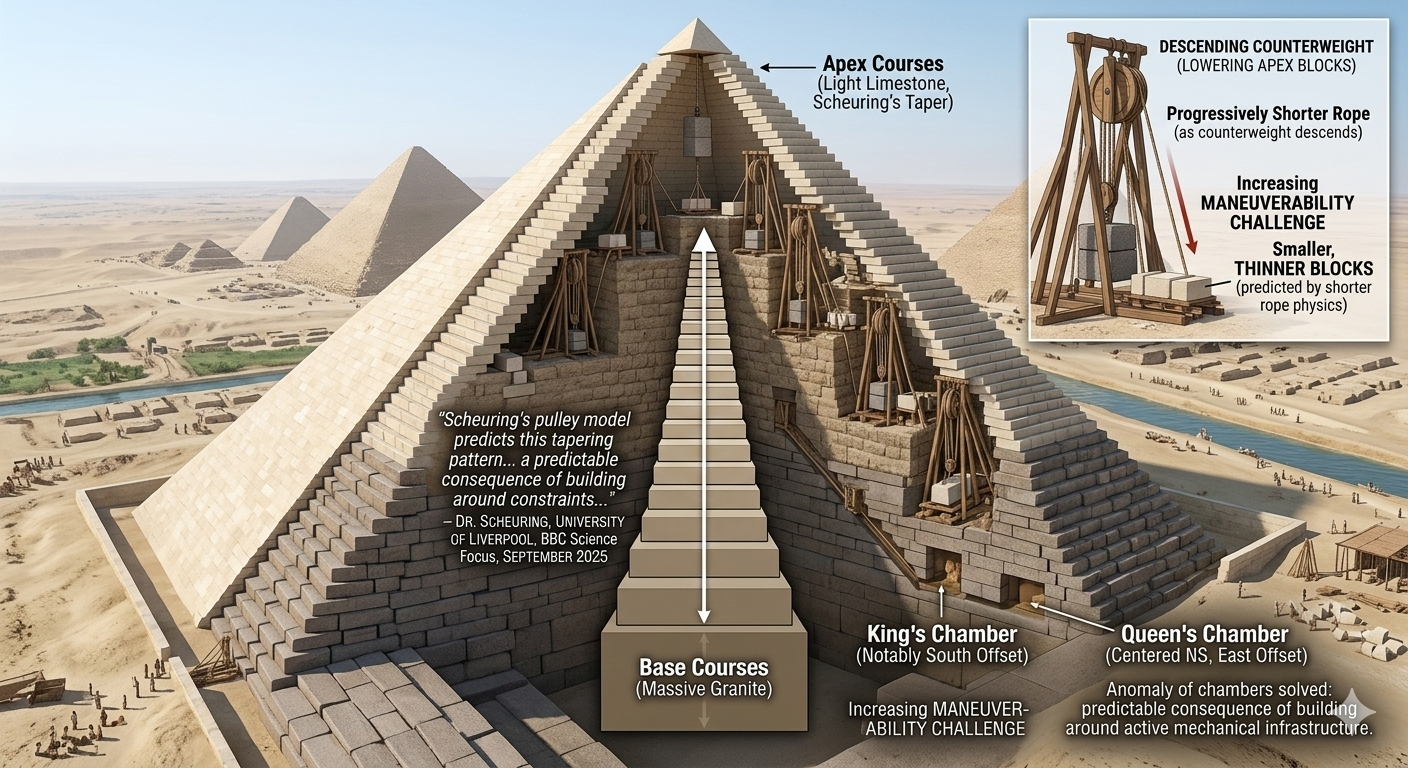
In the autumn of 2025, a paper appeared in the journal npj Heritage Science, a publication of the Nature Portfolio, that reframed the engineering question in terms so specific, so architecturally grounded, and so mechanically rigorous that it immediately forced a serious re-evaluation of established orthodoxy. Its author, Dr. Simon Andreas Scheuring of Weill Cornell Medicine in New York, proposed that the Great Pyramid was not built from the ground up using external ramps, but from the inside out, using a complex internal network of pulley-like counterweight systems.
The core of Scheuring’s argument is that the pyramid’s existing internal passages, features that Egyptologists have traditionally interpreted as ceremonial corridors or burial infrastructure, are better understood as the mechanical skeleton of a construction machine. The Grand Gallery, that extraordinary corbelled hall running at a 26.5-degree incline through the pyramid’s heart, was not primarily a passageway to the King’s burial chamber. It was a sliding ramp for massive granite counterweights. The Ascending Passage, sharing the identical 26.5-degree angle, formed a continuous inclined track along which counterweights could be slid downward, generating the force necessary to hoist construction blocks upward elsewhere in the structure.
The construction proposal based on analysis of the pyramid’s architecture and masonry is physically advantageous and can explain the fast construction.
– Dr. Simon Andreas Scheuring, npj Heritage Science / Nature, 2025
The most provocative element of Scheuring’s analysis concerns the Antechamber, a small granite room positioned immediately before the King’s Chamber, traditionally interpreted as a security feature, a portcullis system designed to thwart tomb robbers. Scheuring examined the architectural details of this space and concluded that it cannot function as a portcullis: the mechanics are simply wrong, and no comparable portcullis system appears in any earlier pyramid. Instead, he argues, the Antechamber served as the primary fulcrum of the pulley mechanism, the point around which rope-and-beam assemblies transmitted the energy of descending counterweights into ascending construction blocks.
The physical evidence Scheuring marshals for this interpretation is extensive. The Grand Gallery’s floor shows scrape marks inconsistent with foot traffic but consistent with heavy sledges moving repeatedly through the space. The Ascending Passage has an unusually hard, polished floor surface. Grooves carved into the Antechamber’s granite walls appear precisely positioned for rope guidance. Stone supports that once held wooden beams are still visible. And the discovery in the 1930s of a small granite object on the Giza plateau, previously uninterpretable, now appears consistent with a miniature pulley-like device, suggesting that Khufu’s chief architect, Hemiunu, may have experimented with small-scale versions before implementing the system at full construction scale.
I think these height-decay patterns are a signature of the physics of how the blocks were lifted. As they were lifted on ropes and then pulled laterally, the courses get thinner within each section as it is much easier to pull a hanging weight laterally when it is still hanging on a long rope, while it gets ever more difficult to extract it from a shorter rope.
– Dr. Simon Andreas Scheuring, via email to Artnet, October 2025
The Porter-Douglas Counterweight: Humans as the Machine
In November 2025, a different team of engineers, Brad Porter, a technology executive and robotics founder, and Jay Douglas, along with their daughters Kirsten Porter and Rose Douglas, published an independent theory on Medium that arrives at some similar conclusions through a different mechanical pathway. Their proposal, which they call the Porter-Douglas Counterweight, also invokes Herodotus’s description of machines formed of short wooden planks operating course by course. But where Scheuring envisions the pyramid’s internal passages as the primary mechanical infrastructure, Porter and Douglas propose a simpler, more distributed system: the counterweights are human beings.
The Porter-Douglas model envisions a shaduf-style lever, the shaduf being a well-known ancient Egyptian device for lifting water, using a pivoted beam with a bucket on one arm and a counterweight on the other, adapted for pyramid construction. In this system, a block arrives at a given course level on a sledge. The arm of a short lever takes the load via rope and sling. A team of workers then climbs the pyramid steps to the next level and boards a small platform on the opposite arm of the lever. The team’s combined weight riding the platform down approximately 1.5 meters raises the stone block by the same amount. The guides position the block before allowing anyone to step off. The process repeats.
In a deep study through the literature, we can find no one who has postulated this simplest counterweight of all: humans.
– Brad Porter, Medium, November 2025
The mathematics is straightforward. A single two-ton block requires forty workers of fifty kilograms each at a one-to-one lever ratio, or twenty workers at a two-to-one ratio, occupying a platform roughly the size of a moderate living room. The system scales easily for heavier blocks. And crucially, it uses the human body’s most efficient muscle group, the quadriceps and gluteal muscles engaged in descending stairs, rather than the far less efficient muscle groups used in rope-pulling, which fatigues rapidly and provides inconsistent force.
This theory has the virtue of mechanical elegance and Occam’s Razor simplicity. It uses materials, short wooden planks, ropes, and people, that were unambiguously available. It matches Herodotus’s description precisely: not a highway, but a final-lift machine staged at every level as the pyramid rises. It distributes the lifting infrastructure across the entire construction face, avoiding the traffic-chokepoint problems that plague ramp theories. And it provides a satisfying explanation for why Herodotus described separate machines at each step rather than a single continuous mechanism.
Whether the Porter-Douglas system and Scheuring’s internal pulley system are mutually exclusive is an interesting question. They are not necessarily so. The Grand Gallery mechanism may have handled the most massive components, the great granite beams, while distributed shaduf-like levers handled the more numerous limestone blocks at the pyramid’s face. Construction engineering at this scale rarely employs a single solution.
IV. WATER AND STONE: THE HYDRAULIC THEORIES
Djoser’s Pyramid and the Hydraulic Elevator
While the pulley theories have dominated headlines concerning the Great Pyramid of Giza, a parallel and equally remarkable theoretical development has been occurring forty kilometers to the south, at the ancient necropolis of Saqqara. There, the Pyramid of Djoser, the world’s first monumental stone building, constructed around 2650 BCE under the architect Imhotep, a figure so revered that later generations deified him, may conceal within its interior the evidence of an even more radical construction technology.
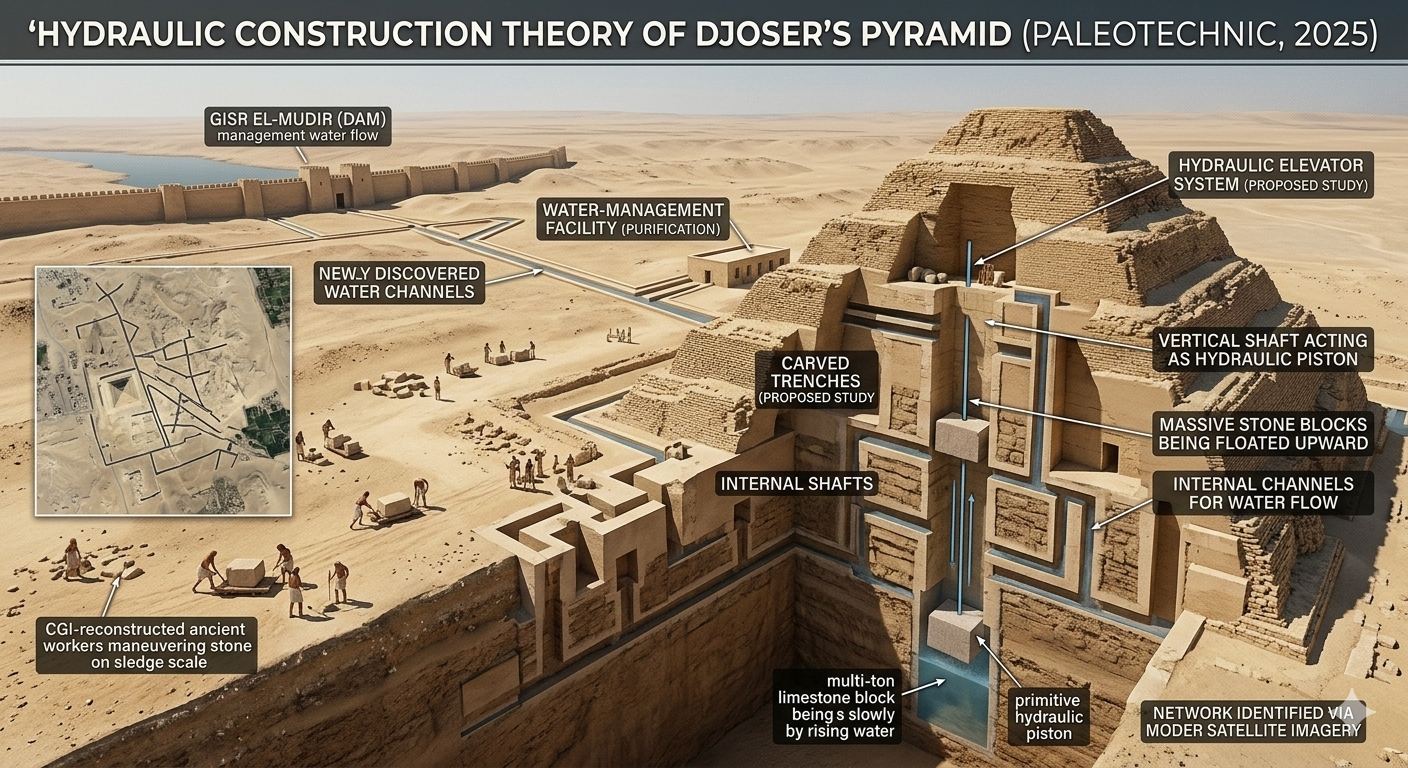
In late 2025, a study published in the journal PLOS One by Xavier Landreau of the Paleotechnic research institute in Paris and his colleagues proposed that Djoser’s stepped pyramid was constructed with the aid of a hydraulic elevator, a system in which water channeled from a nearby dam through a network of carved trenches and internal shafts could float massive stone blocks upward through the pyramid’s structure as water levels rose.
The researchers combined decades of archaeological records with modern satellite imagery to identify what they interpret as a network of trenches and shafts carved into the pyramid’s interior. Their proposed mechanism invokes the nearby walled structure known as Gisr el-Mudir as a dam that managed water flow toward the pyramid. An adjacent building appears consistent with a purification or water-management facility. Together, these elements form what the researchers argue is a hydraulic system of startling sophistication, one in which water pressure at the pyramid’s center could force stone blocks upward through vertical shafts, the water acting as a primitive hydraulic piston.
Channels found inside the pyramid may once have carried water to power a kind of hydraulic propulsion system, effectively acting as a primitive lift. This idea could completely change how we understand early Egyptian construction.
– Dorian De Schaepmeester, Futura-Sciences, December 2025
The proposal is supported by the geological context of the Third Dynasty period. Saqqara in 2650 BCE sat in a far greener, more temperate landscape than the arid plateau of today. Periodic rains across northeastern Africa created fertile, well-watered conditions. The Nile and its branches were more numerous and more active. Water, in short, was not a scarce resource in the way it would later become. The use of hydraulic engineering for monument construction, while radical to modern sensibilities shaped by the current Egyptian desert, may have been entirely practical for the world in which Imhotep worked.
The theory has faced significant scholarly pushback. Frank Müller-Römer, the German archaeologist and Egyptologist whose work on pyramid construction ramps is authoritative, argues that the hydraulic theory contradicts established archaeological evidence showing Djoser’s pyramid was built in multiple stages, beginning as a flat-roofed mastaba and expanded incrementally. Dr. Roland Enmarch of the University of Liverpool is skeptical on engineering grounds: nothing in the PLOS One paper, he argues, demonstrates how the Egyptians could have applied pressurized hydraulics sufficient to raise stones to the pyramid’s full height of 62 meters. Modern hydraulic engineering capable of that would require a pressure system that leaves no evidence in the archaeological record.
These are legitimate objections. But the hydraulic theory deserves serious consideration rather than dismissal precisely because it takes the Egyptians’ actual engineering environment seriously, their proximity to water, their demonstrated skill in irrigation and canal management, their ability to think about construction in terms that were not limited to brute mechanical force. Whether or not the specific PLOS One model survives further scrutiny, it has productively expanded the range of mechanisms that must be considered.
The Lost Nile and the Water Highway
Whatever lifting mechanisms were used at the construction site, the problem of getting 2.3 million blocks to the Giza plateau in the first place required a logistical infrastructure of remarkable scale. The solution, it now appears, was water, specifically, a now-vanished branch of the Nile that brought the building site to the quarries as effectively as any road system could have.
In 2024, Dr. Eman Ghoneim and her team at the University of North Carolina Wilmington published the results of a satellite radar survey that identified a 64-kilometer ancient Nile branch, since named the Ahramat Branch, whose course runs alongside thirty-one pyramid sites, including those at Giza, Abusir, Saqqara, and Dahshur. The branch silted up and disappeared sometime after the Old Kingdom period, its existence preserved only in the subsurface sediments detectable by modern radar systems capable of penetrating desert sand.
This discovery resolves one of the most persistent logistical puzzles in Egyptology. The pyramids are located at the edge of the Western Desert, miles from the modern Nile. How were millions of multi-ton blocks transported across that desert? The answer, the Ghoneim data suggests, is that they largely were not. The ancient Nile came to the pyramid sites, permitting direct water transport from quarries in the north to harbors adjacent to the construction zones. Merer’s diary, with its matter-of-fact descriptions of barges shuttling stone from Tura to Giza, now makes complete geographical sense.
V. THE RADICAL REFRAMINGS: THEORIES THAT INVERT THE QUESTION
Not Built Up, But Carved Down: Huni Choi’s Revolutionary Proposal
Among the most intellectually stimulating new theories of recent years is one proposed by a Korean independent researcher named Huni Choi, brought to wider attention in February 2026 through a detailed video analysis by architecture YouTuber Dami Lee. Choi’s proposal inverts the fundamental assumption that underlies every other construction theory: that the pyramids were built upward, course by course, from ground level.
What if, Choi asks, they were not built at all, in the conventional sense, but were instead carved down from a larger pre-existing mass?
The Great Pyramid wasn’t built on its own, but through a chain of ‘sacrificial’ structures designed to be ‘cannibalized.’ The idea is that the pyramids were ‘overbuilt,’ starting with a gigantic trapezoidal mass with an integrated ramp system, which, after being topped out, was then carved down into the pyramid shape we still find so familiar.
– Description of Huni Choi’s theory, Open Culture, February 2026
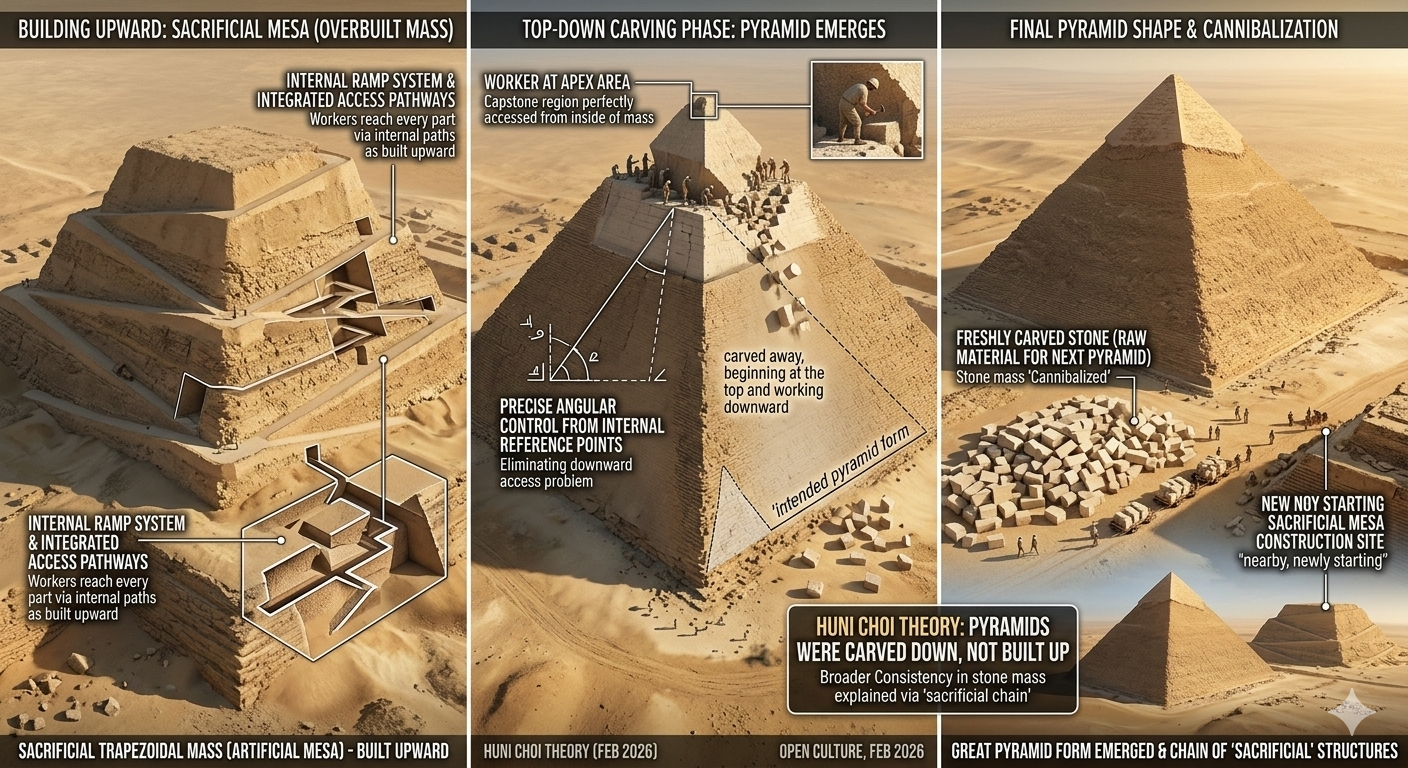
In this model, the initial construction phase creates not a pyramid but a far larger trapezoidal structure, a kind of artificial mesa or plateau with built-in ramps and access routes integrated throughout its mass. Workers can reach every part of this structure via internal pathways as it is built upward. Once the full height is achieved, the outer portions of the trapezoid are systematically carved away, beginning at the top and working downward, until the familiar triangular pyramid profile emerges. The carved-away stone is then available as raw material for the next pyramid in the sequence, explaining what Choi sees as a remarkable consistency in the total stone mass across successive Giza pyramids.
This theory has several compelling advantages over conventional bottom-up construction models. It eliminates the ramp problem: the trapezoidal mass is its own ramp system, with access routes embedded throughout. It solves the notorious engineering puzzle of the pointed apex, which has bedeviled pyramid-construction theorists because the geometry of the very top, the capstone, is impossible to access from the outside once the structure approaches its final height. If the capstone region is carved from the inside of a larger mass, working downward, this problem vanishes. It also explains how the builders could have maintained precise angular control throughout the construction process, since they would have been carving to pre-established reference points rather than extrapolating upward from a base.
The weakest element of Choi’s theory is the question of evidence. Archaeological theories of this kind are notoriously difficult to confirm or refute. The trapezoidal sacrificial structure, if it existed, no longer exists; by definition, it was removed to create the pyramid. The only physical evidence would be in the isotopic or structural analysis of the pyramid’s outer casing stones, which might show characteristics of having been cut downward from a larger mass rather than placed upward from below. That analysis has not been performed. As Open Culture noted in covering the theory, unlike physics, an archaeological hypothesis of this kind remains difficult to prove decisively without technological breakthroughs enabling new forms of analysis of the pyramids themselves.
Nevertheless, Choi’s proposal represents the kind of paradigm-challenging thinking that has, historically, preceded genuine advances in archaeological understanding. The conventional assumption that upward construction was the only available strategy has never been rigorously tested. Choi’s theory tests it.
The Atlantis Distraction and the Alien Hypothesis
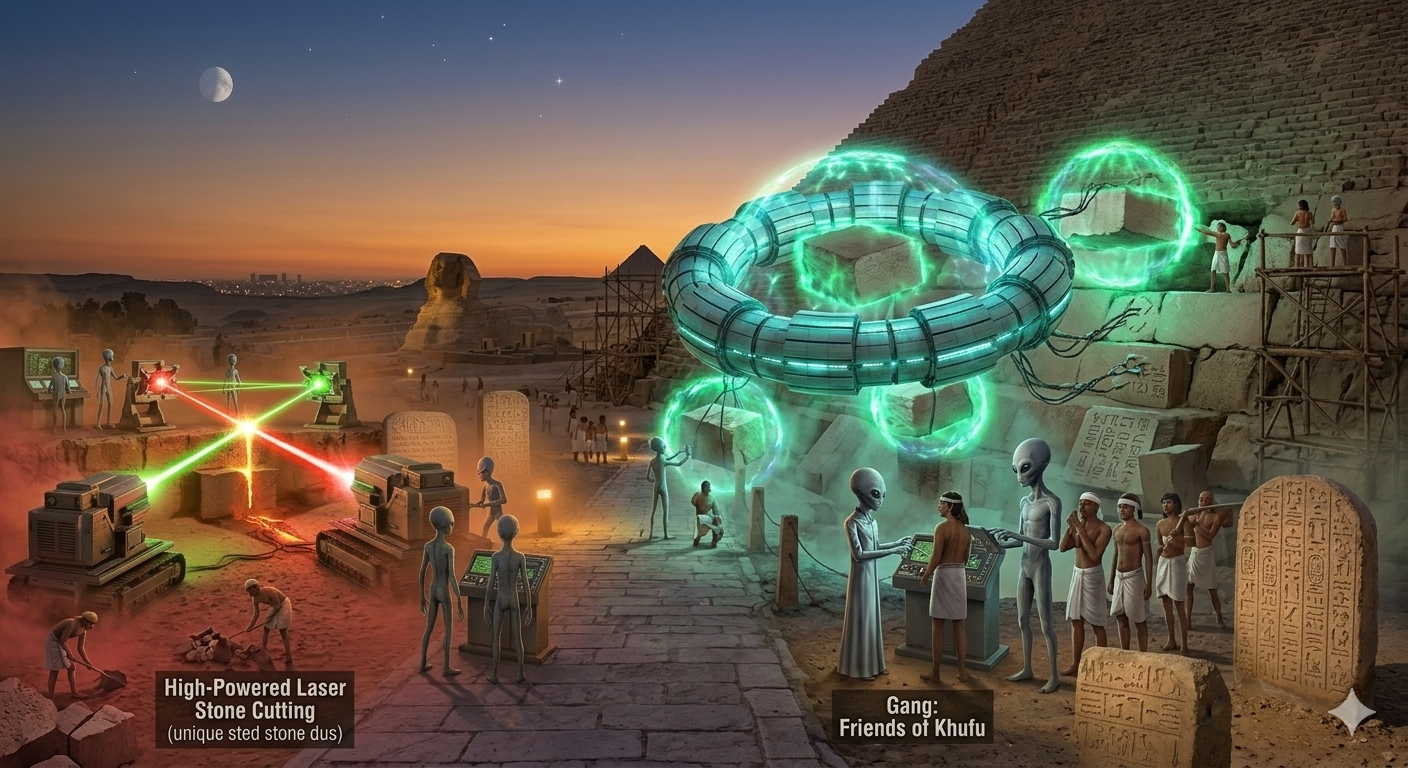
No survey of pyramid construction theories would be complete without honest engagement with the fringe, those explanations that invoke forces or civilizations beyond the known historical record. The most persistent of these is the ancient-astronaut hypothesis, the claim that the pyramids were built with the assistance, direct or technological, of extraterrestrial visitors. A related but distinct tradition, associated particularly with the mid-twentieth-century American clairvoyant Edgar Cayce, holds that the true builders were refugees from the legendary continent of Atlantis, using a technology of stone levitation that operated through forces in nature that modern science has yet to rediscover.
These theories are not taken seriously by professional Egyptologists, and the reasons are straightforward. The pyramid construction process is extensively documented in the archaeological record, through workers’ settlements, tool marks, graffiti left by construction gangs, administrative records, and logbooks such as Merer’s diary. The organizational and logistical infrastructure of pyramid building is the infrastructure of human institutional life: grain rations, work gangs with nicknames, inspectors with administrative authority, supply chains stretching from the Sinai copper mines to the Aswan granite quarries. There is no gap in this record into which a supernatural or extraterrestrial intervention can be inserted without contradicting the evidence.
People need to understand how the Egyptians moved these 60-ton stones. This was a national project that ancient Egyptians participated in to make their king into a god.
– Dr. Zahi Hawass, Egyptologist and Scientific Advisor, ScanPyramids Project, quoted in History.com, January 2026
The more interesting intellectual question is why these theories retain such popular appeal despite the weight of evidence against them. National Geographic writer Ben McGrath, in a notable December 2025 feature, traced this fascination partly to the seductive notion of lost wisdom, the idea that civilizations before our own possessed knowledge or capabilities that we have somehow forgotten. The pyramids, in their combination of overwhelming scale and apparent simplicity, seem to demand an explanation commensurate with their grandeur. Ramps, sledges, and wet sand feel inadequate to the task. The emotional logic of the alien hypothesis is not that it explains the evidence, but that it matches the affective weight of the monument.
The honest answer to that emotional logic is the one that good historians have always provided: human beings, organized at scale, motivated by a fusion of coercion, faith, and collective pride, are capable of achievements that dwarf what any individual or small group could imagine. The pyramids are not evidence that ancient Egyptians needed outside help. They are evidence of what ancient Egyptians were.
VI. HIDDEN CHAMBERS AND COSMIC RAYS: THE VIEW FROM INSIDE
The ScanPyramids Project and the Secrets Within
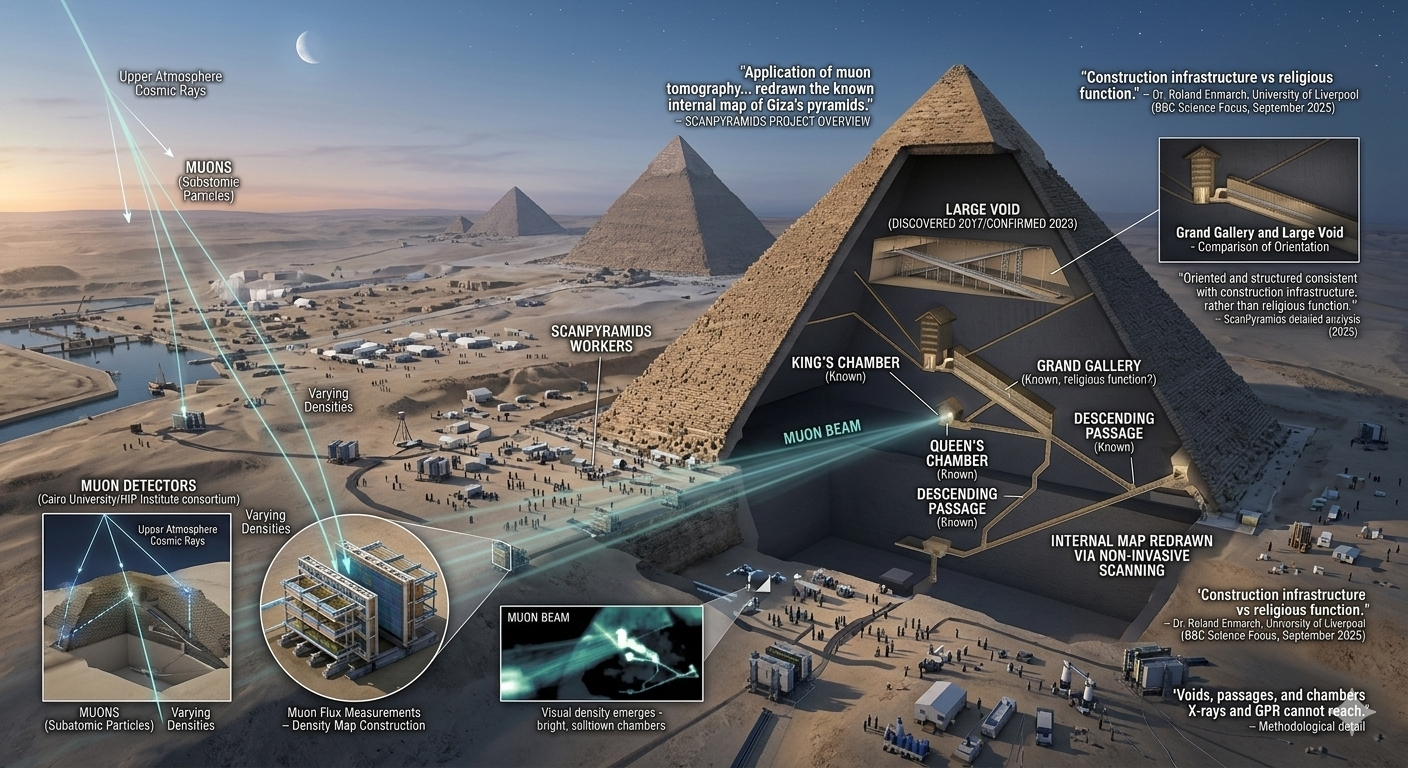
The most significant recent development in our understanding of the Giza pyramids comes not from a new theory but from new technology, specifically, the application of muon tomography to the non-invasive scanning of pyramid interiors. Muons are subatomic particles produced in cosmic ray interactions in the upper atmosphere. They pass through matter at rates that vary with density: through space, they pass freely; through stone, they are partially absorbed. By placing detectors inside and around a pyramid and measuring the muon flux from different directions, researchers can construct three-dimensional density maps of the structure’s interior, revealing voids, passages, and chambers that X-rays and ground-penetrating radar cannot reach.
The ScanPyramids project, led by a consortium from Cairo University and France’s Heritage Innovation Preservation Institute, has used this technology to produce results that have redrawn the known internal map of Giza’s pyramids. In 2017, the project announced the discovery of a large void above the Grand Gallery, a space approximately thirty meters long, with a cross-section comparable to the Grand Gallery itself, whose existence had been entirely unknown. In 2023, a detailed analysis confirmed this void and suggested that it, like the Grand Gallery itself, may be oriented and structured in a way consistent with construction infrastructure rather than religious function.
In 2025, the same scanning techniques were applied to the Pyramid of Menkaure, the smallest of the three main Giza pyramids, with results that have raised as many questions as they have answered. German and Egyptian archaeologists using radar, electrical resistivity, and ultrasound detected an air-filled void on the pyramid’s east side that may contain a hidden second entrance, and a second void in the mortuary temple to the east that may contain religious statuary.
It is certainly an intriguing discovery.
– Peter Der Manuelian, Harvard University Egyptologist, Director of the Digital Giza Project, quoted in History.com, January 2026
Whether these voids represent unknown burial chambers, construction infrastructure, or stress-relief features built into the pyramid’s structure, spaces designed to distribute the weight of the overlying stone, remains unclear. Dr. Zahi Hawass, who serves as scientific adviser to the ongoing exploration project, has suggested that many such voids may simply be relics of construction: internal passageways or cavities used to move stone blocks, redistribute weight, or stabilize the structure as it rose.
If Scheuring’s pulley-and-counterweight theory is correct, this interpretation takes on added significance. The unknown voids in the Great Pyramid, and there may be more that the ScanPyramids project has not yet detected, might be the collapsed or sealed remnants of the mechanical infrastructure that built the structure from the inside out. The Grand Gallery’s construction-ramp function would explain not only the void above it but the characteristic wear patterns that Scheuring has identified in its surface. The hidden passages and sealed chambers of Giza may not be the secrets of the pharaohs. They may be the decommissioned machine rooms of the builders.
VII. THE ENGINEERING OF MEANING: WHY THE PYRAMIDS WERE BUILT
The Political Economy of Monument
Understanding how the pyramids were built is inseparable from understanding why they were built, and why built in this form, at this scale, with this specific combination of astronomical precision and logistical extravagance. The engineering choices made at Giza were not purely technical decisions. They were also political, religious, and ideological choices, and any complete account of pyramid construction must integrate these dimensions.
The Fourth Dynasty pharaohs, Sneferu, Khufu, Khafre, Menkaure, lived in a society undergoing a period of administrative centralization without parallel in the ancient world. The transition from the decentralized, regionally organized polity of the Early Dynastic period to the hyper-centralized bureaucratic state of the Old Kingdom created both the organizational capacity and the political motivation for monumental construction. The pyramid was the physical instantiation of pharaonic ideology: the king as living god, the state as divine machinery, death as a transition to a permanent celestial realm rather than an ending.
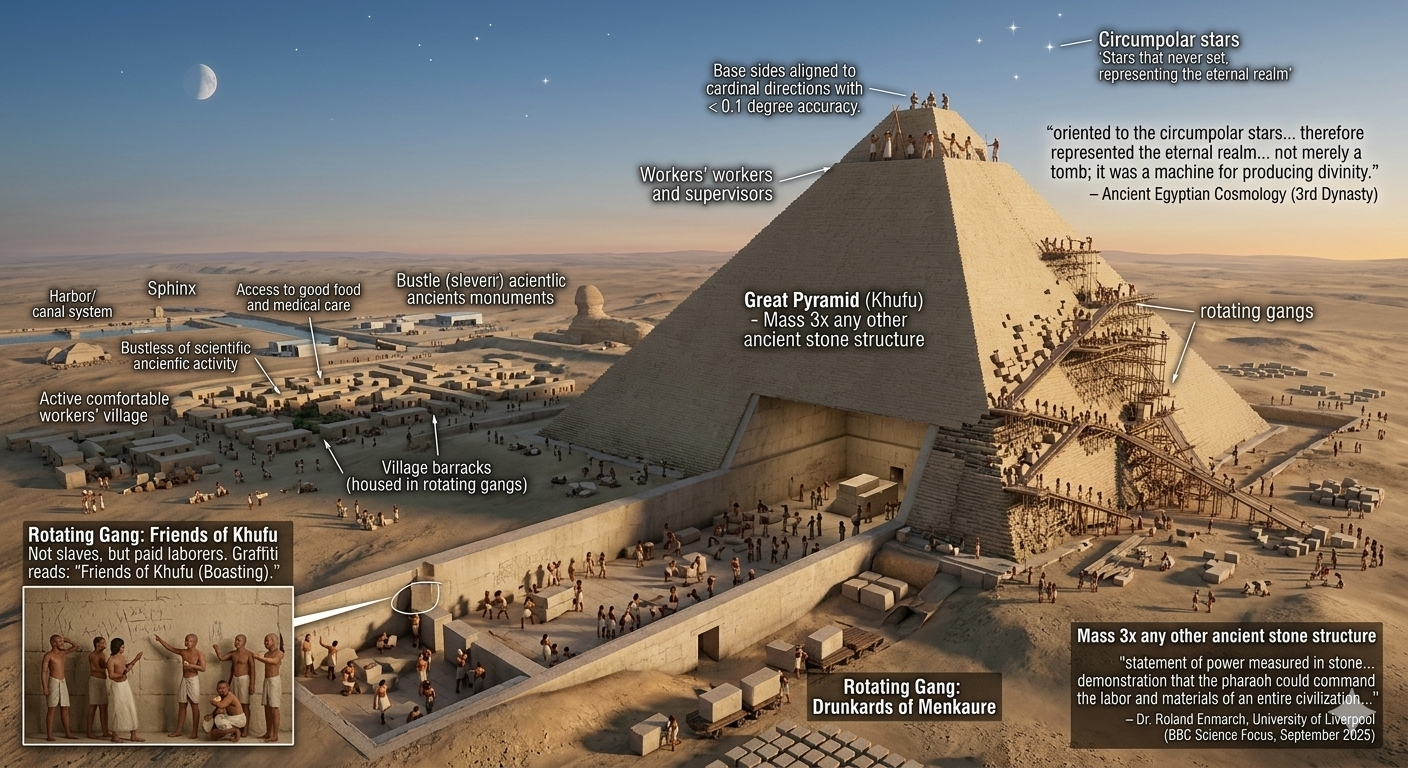
The sheer scale of the Great Pyramid, its mass three times that of any other ancient stone structure, was not accidental or merely the product of available resources. It was a statement of power measured in stone, a demonstration that the pharaoh could command the labor and materials of an entire civilization in service of his eternal life. The workers who built it, not slaves, as the popular imagination has it, but paid laborers organized in rotating gangs with names like ‘Friends of Khufu’ and ‘Drunkards of Menkaure,’ housed in comfortable workers’ villages with access to good food and medical care, were participants in something that transcended mere employment. The graffiti they left in the pyramid’s construction chambers reads not like a complaint but like boasting.
The astronomical orientation of the pyramids, their base sides aligned to the cardinal directions with an accuracy of less than one-tenth of a degree, reflects a cosmological program as much as an engineering achievement. The Egyptians oriented the pyramid to the circumpolar stars, which never set below the horizon and therefore represented, in their cosmology, the eternal realm to which the pharaoh’s soul would ascend. The building was not merely a tomb; it was a machine for producing divinity.
The Organization of Labor
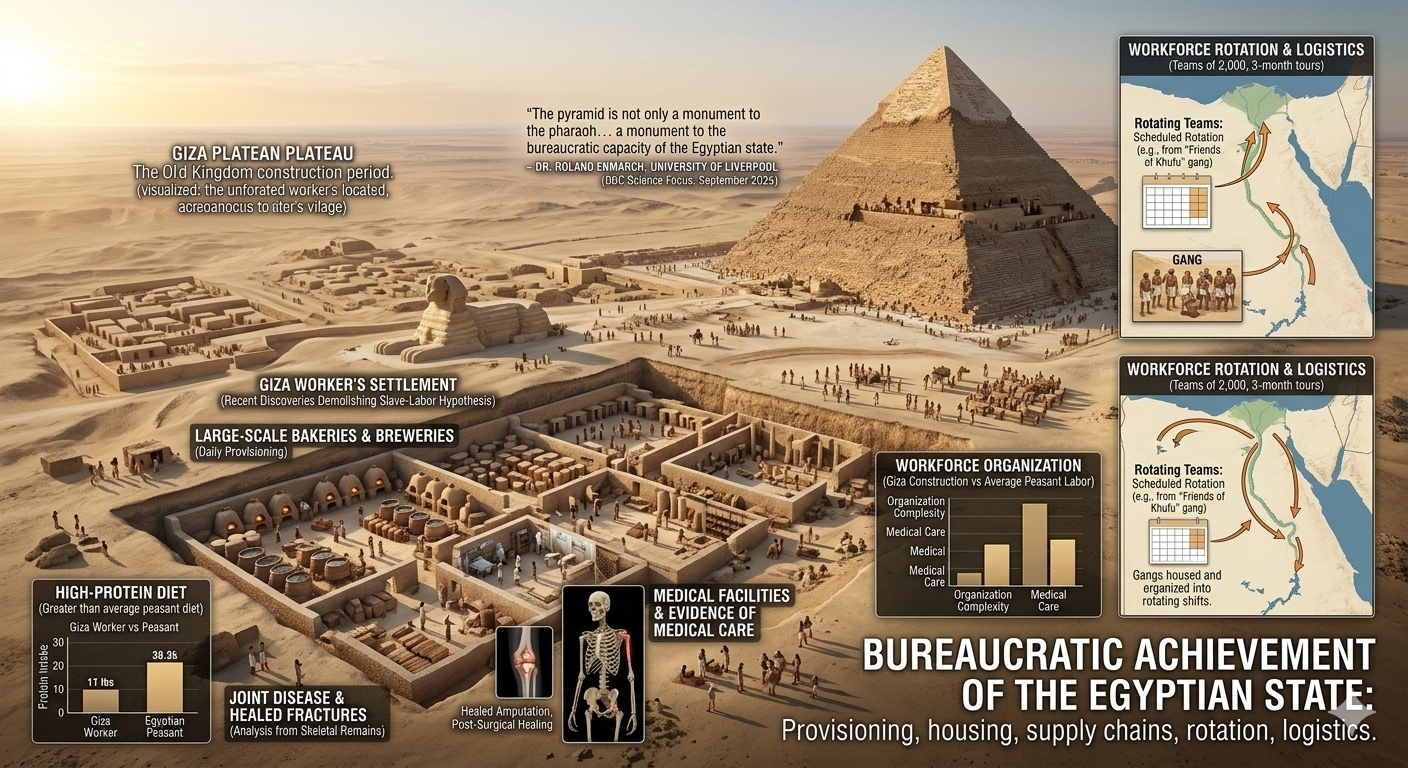
One of the most important contributions of recent Egyptological scholarship has been the progressive demolition of the slave-labor hypothesis. The discovery of workers’ settlements at Giza, with their bakeries, breweries, medical facilities, and evidence of a diet richer in protein than that of the average Egyptian peasant, has established beyond reasonable doubt that the pyramid builders were organized workers, not slaves. They were rotated in from across Egypt in teams of approximately 2,000, serving tours of duty of perhaps three months before returning home. They were injured in the course of their work, the skeletal evidence shows a high rate of healed fractures and joint disease, and they were cared for when injured, as evidenced by amputated limbs that show post-surgical healing.
The organizational genius required to maintain a workforce of this size, discipline, and productivity for twenty years continuously, provisioning them, housing them, managing the supply chains of food and raw materials, scheduling the rotation of thousands of workers across hundreds of construction tasks, was itself an engineering achievement of the first order. The pyramid is not only a monument to the pharaoh. It is a monument to the bureaucratic and administrative capacity of the Egyptian state.
VIII. THE SYNTHESIS: WHAT WE NOW KNOW, AND WHAT WE DO NOT
Toward a Composite Understanding
The current state of scholarship on pyramid construction suggests that no single theory, not the ramp, not the pulley, not the hydraulic lift, not any variant of these, is likely to provide a complete account of what happened on the Giza plateau over those twenty years. The most intellectually honest position is what might be called the multi-method hypothesis: that the builders of the Great Pyramid employed a range of techniques, selected and combined based on the specific challenges of each phase of construction, using materials and physical principles that were available to them and that they had refined over decades of practice on smaller structures.
The horizontal transport problem appears well-solved by the combination of the lost Nile branch and wet-sand sledging. The documentary and experimental evidence for both is strong. The lower courses of the pyramid, the massive base blocks that are easiest to access and most vulnerable to the logistics of large-scale horizontal movement, were probably placed using ramp systems of the type confirmed at Hatnub, combined with lubricated sledge tracks.
For the middle courses, some variant of the distributed lever system, whether in the form of the Porter-Douglas human-counterweight model or simpler shaduf-style mechanisms, may have provided the course-by-course lifting that Herodotus’s sources described. The mathematics support this, the mechanical principle is ancient Egyptian in origin, and the description of machines formed of short wooden planks operating at each step fits this model better than any ramp hypothesis.
For the upper courses, the most logistically challenging part of the construction, where the working platform is small and the vertical distances are greatest, Scheuring’s internal pulley and counterweight system becomes most compelling. The architectural evidence he has marshaled from the Grand Gallery, the Ascending Passage, and the Antechamber is specific and arresting. The tapering of block heights toward the apex as a mechanical signature of the rope-and-fulcrum physics is an insight that will be difficult to unseat without a compelling alternative explanation.
For the special-case problem of the massive granite blocks, the burial chamber beams, the Antechamber’s portals, some combination of internal pulley mechanics and crane-like lever systems seems most consistent with the physics. These blocks were too heavy and too few to be handled by the same methods as the more numerous limestone courses. They required purpose-designed solutions applied with extraordinary precision.
The hydraulic theories, fascinating as they are, face the most significant archaeological and engineering objections. Landreau’s proposal for Djoser’s pyramid requires further physical evidence before it can be accepted. But the identification of water-management infrastructure at Saqqara and the broader context of ancient Egypt’s sophisticated irrigation engineering suggest that hydraulic thinking should not be dismissed. The Egyptians were, above all, a civilization built on the intelligent management of water.
What Remains Unknown
Despite the remarkable advances of the past several years, the honest accounting reveals how much remains unknown. We do not know, with any certainty, what the Great Pyramid’s internal voids contain or what purpose they served. We do not know how the granite ceiling beams of the King’s Chamber were placed. We do not have a confirmed, complete mechanism for any single phase of the construction process. We have well-supported hypotheses, some very well-supported indeed, but the direct physical evidence that would definitively close the question, a discovered pulley mechanism still in place, a preserved ramp complete with tool marks and logistical infrastructure, an internal shaft clearly engineered for hydraulic use, has not been found.
The Egyptian antiquities law that prohibits destructive investigation of the Giza pyramids is both a legal and ethical necessity. These are the most significant surviving monuments of the ancient world, and the temptation to drill holes through them in pursuit of knowledge must be resisted. The growing sophistication of non-invasive scanning technologies, muon tomography, ground-penetrating radar, electrical resistivity imaging, and laser scanning, offers the best hope for filling these gaps without compromising the monuments themselves.
In the last few decades, we’ve been getting an increasingly good idea of what must have been going on. I’m sure [archaeologists] are going to carry on finding really fascinating stuff.
– Dr. Roland Enmarch, University of Liverpool, BBC Science Focus, September 2025
CONCLUSION: THE ENDURING ARGUMENT
There is a scene that has repeated itself, in various forms, across two and a half millennia of pyramid scholarship. Someone, a Greek tourist, a medieval Arab traveler, a Renaissance polymath, a nineteenth-century explorer, a twenty-first-century engineer in a Mississippi backwoods or a Manhattan laboratory, stands before these structures and is seized by the conviction that the accepted explanation cannot be right. The scale is too vast. The precision is too perfect. The apparent simplicity of the historical record cannot account for the complexity of the achievement.
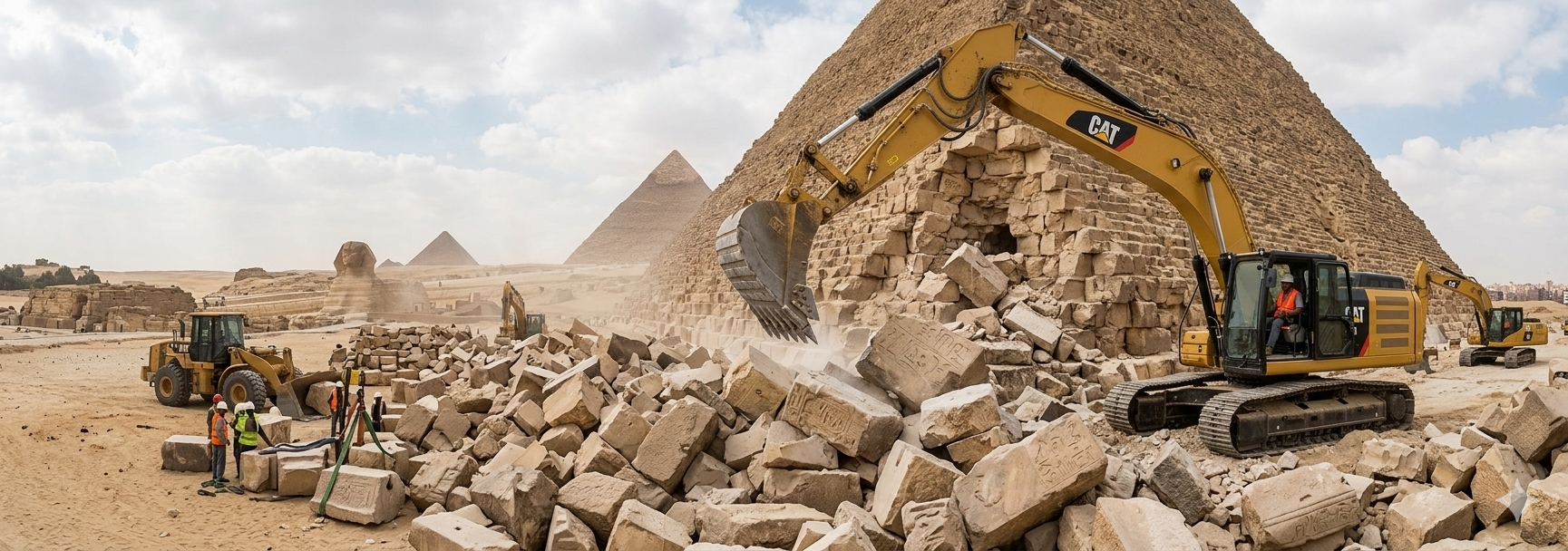
That conviction has driven some of history’s greatest intellectual dead ends, Cayce’s Atlantean levitation, the ancient-astronaut theories, the endless variants of the hidden-knowledge hypothesis. But it has also driven some of its most productive scholarship. Mark Lehner, who began his career as a credulous student of Caycean mysticism, became, through the discipline of evidence-based investigation, one of the world’s foremost Egyptologists. Roland Enmarch, sifting the inscriptions of the Hatnub quarry, discovered a ramp that challenged forty years of conventional assumptions about what the Egyptians were capable of engineering. Simon Scheuring, looking at the Grand Gallery through an engineer’s eyes rather than an archaeologist’s, saw not a ceremonial corridor but a counterweight track.
The pyramids reward this kind of disciplined audacity. They are not mysteries in the supernatural sense; they were built by human beings using human tools, human intelligence, and human organizational capacity, and the evidence for this is overwhelming and conclusive. But they are mysteries in the deeper sense: structures so complex, so precisely executed, and so old that they continually exceed our explanatory frameworks and demand new ones.
The theories examined in this essay, the internal pulley system, the human counterweight, the hydraulic elevator, and the carved-down trapezoid, are not equally well-supported. Some will survive further scrutiny; others will not. But each represents a serious attempt to take the Egyptians on their own terms: as an engineering civilization of the first order, working with the materials and physical principles available to them, solving problems that were genuinely difficult in genuinely innovative ways.
What is most striking about the current moment in pyramid research is not any single theory but the acceleration of the field itself. The combination of Merer’s diary, satellite radar discovery of the lost Nile branch, muon tomography of hidden voids, the Hatnub ramp discovery, and the spate of new engineering analyses from 2024 through 2026 represents more new substantive knowledge about pyramid construction than had accumulated in the previous several decades. The questions are sharpening. The evidence is accumulating. The mystery, for the first time in centuries, is beginning to yield.
The pyramids were built by people. That remains the most astonishing fact about them.