
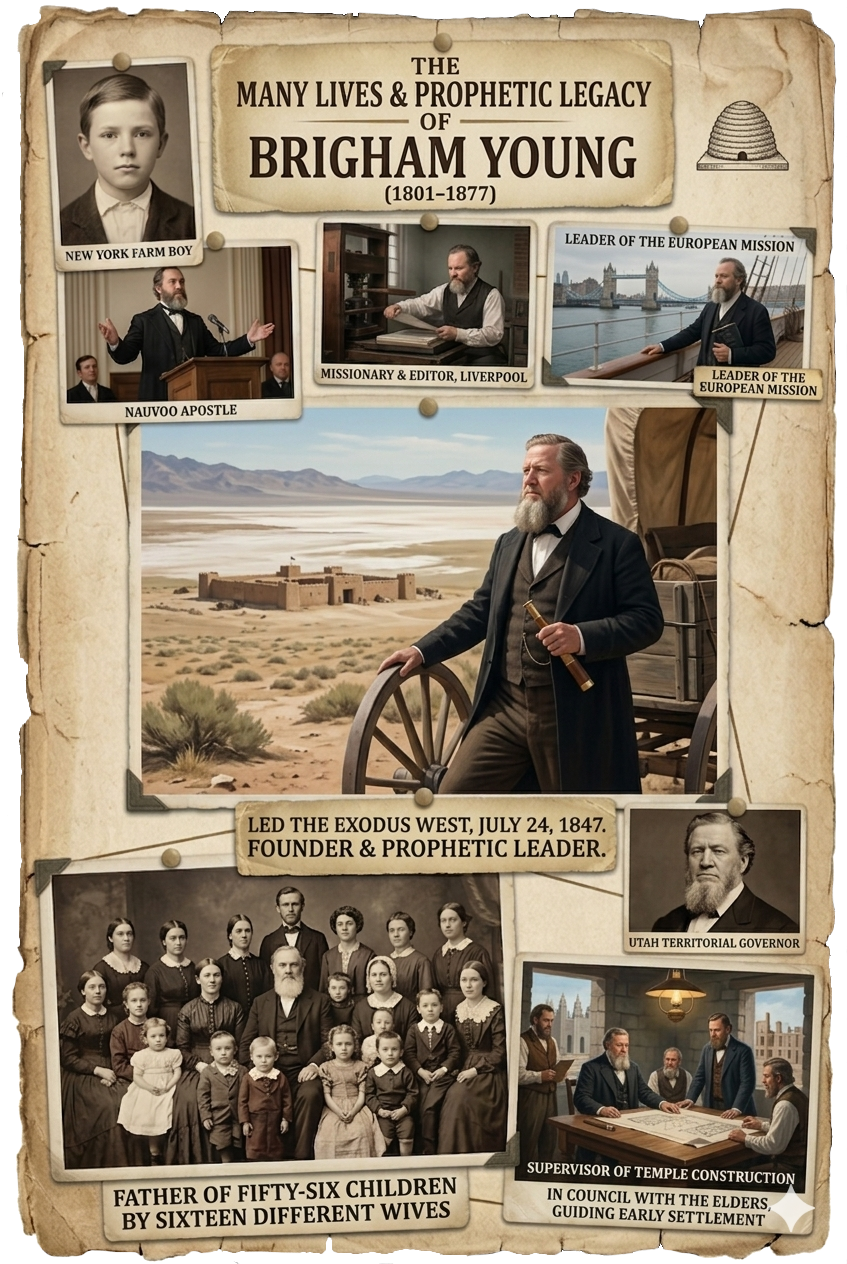
EARLY MORMON PERSONALITIES SERIES — POST 2
The Man Who Built a Kingdom — And the Theology That Could Not Bear Its Weight
❦ ❦ ❦
Prologue: The Lion in Winter
It was the evening of August 29, 1877, in Salt Lake City, and the late-summer heat still pressed against the city like a weight. In the Lion House, the broad beehive-roofed residence Brigham Young had built for his family, the aging prophet lay dying after a week of grave illness. Contemporary accounts describe a severe bowel inflammation that had steadily weakened him. His daughter Zina was at his side. And, according to later reports, his final words were the name of Joseph Smith, repeated three times in a kind of fading litany: “Joseph, Joseph, Joseph.”
The moment carries a stark symbolic power. The man who had become the principal architect of post-Joseph Mormonism was dying in the house that embodied his domestic, religious, and political world. Brigham Young was not simply a church president. He was the organizing force behind the Latter-day Saint migration to the West, a territorial governor in all but name, and the builder of a mountain commonwealth that reflected his will in its settlements, institutions, and social order. Converted in 1832, he rose to lead the Saints after Joseph Smith’s death and then spent the rest of his life extending, defending, and institutionalizing the movement Joseph had begun.
By the time he reached his final days, Young had already become one of the most consequential and polarizing figures in nineteenth-century America. Revered by followers as the “Lion of the Lord,” he was also a man of sharp edges, deep conviction, and immense authority. He could speak with warmth about family, covenant, and divine purpose, yet rule with a firmness that left little room for dissent. He helped shape an entire region—its cities, its religious culture, its social patterns, and its political identity—and his imprint remained long after his death. Even his reported final call to Joseph Smith seems to capture the central drama of his life: not a man inventing something wholly new, but one determined to preserve, extend, and harden the legacy he believed he had been given.
What follows is the story of the man — and the long, sober question of what to make of him.
❦ ❦ ❦
I. A Vermont Boyhood in the Shadow of Want
Brigham Young was born on June 1, 1801, in Whitingham, Vermont, into a large, struggling family shaped by frontier poverty and hard physical labor. He was the ninth of eleven children born to John Young and Abigail “Nabby” Howe, and his early life was marked by repeated moves, limited schooling, and the constant pressure of making a living from difficult land. His father had served in the Revolutionary War, but the family’s prospects remained modest, and Brigham grew up in a world where survival depended on work, discipline, and endurance.
As a child, Young was swept into the broader New England migration into upstate New York, where the family settled in the Sherburne area of Chenango County. There, he spent his boyhood chopping wood, clearing land, and helping with farm labor instead of attending school in any sustained way. He later said that his formal education was minimal and that he learned far more from labor than from classrooms. Those early experiences gave him a practical, unsentimental outlook that later shaped his style as a church leader and colonizer.
Religiously, however, he did receive a deep and lasting formation. His upbringing took place in the midst of the revival culture of early nineteenth-century America, where Protestant piety, family discipline, and moral urgency were all part of the air he breathed. That background, combined with frontier hardship, helped produce a man who would later become one of the most forceful and consequential figures in Latter-day Saint history.
The Methodist Crucible
John and Abigail “Nabby” Young raised their children in a strict New England Protestant household shaped by the moral intensity of early nineteenth-century Methodism. Brigham later recalled that his upbringing left him with narrow allowances for recreation: he said he was kept within “very strict bounds” and was not allowed to walk more than half an hour on Sundays for exercise, adding that “the proper and necessary gambols of youth were denied me.” He also remembered that he did not hear a violin until he was eleven, and that the sound struck him as dangerously worldly.
That severity mattered. Brigham grew up in a family that prized obedience, labor, and sobriety, and he later described his parents as insisting on Bible reading and moral discipline. His mother died of tuberculosis in 1815, when he was fourteen, and by sixteen he had left home and entered apprenticeship as a carpenter, glazier, and painter. Those trades gave him practical skills that later proved crucial in the building of Utah settlements and the institutional life of the LDS Church.
Out of that childhood came two enduring tendencies. First, he developed a lifelong impatience with religion that seemed confined to rules without power, and second, he learned to discipline his own feelings behind duty and work. The boy who was warned against the violin later became the man who promoted music, dancing, and theater in the Salt Lake Valley. The contrast was not accidental; it was one of the defining tensions of his life.
❦ ❦ ❦
II. The Reluctant Seeker
In October 1824, Brigham Young married Miriam Angeline Works in Cayuga County, New York. She was eighteen, he was twenty-three, and the marriage joined two people who would spend the next several years living by hard labor in western New York. The couple settled for a time near Auburn and later in Mendon, where Brigham built a home and workshop on his father’s property, within the orbit of the same religious and social world that also shaped the young Joseph Smith family. Miriam’s health declined steadily, and she died of tuberculosis in 1832 at age twenty-six after the couple had two daughters.
The religious setting mattered as much as the domestic one. Young later said he was slow to commit to a denomination, but by 1824, he had joined the Methodist Church, and contemporary accounts place him among the Reformed Methodist or similar dissenting Methodist currents soon afterward. He emerged from a highly charged revival culture in upstate New York, where emotional religion, itinerant preaching, and repeated calls to conversion were common. That environment did not give him peace so much as sharpen his dissatisfaction with ordinary Protestant piety.
I saw them get religion all around me — men were rolling and holloring and bawling and thumping but it had no effect on me. I wanted to know the truth that I might not be fooled — children and young men got religion, but I could not.
— Brigham Young, Recollection (Brigham Young Papers, Minutes, 8 January 1845)
What he seems to have wanted was not simply morality, but authority. His later recollections suggest a man who watched revival meetings carefully, judged them insufficient, and looked for something more direct: a prophet, revelation, and open communication with God. The familiar line about people “rolling and hollering and bawling and thumping” belongs to those retrospective memories and should be treated as a later recollection rather than a contemporaneous diary entry. Still, the point is clear enough: Young was searching for certainty that Methodist earnestness could not provide.
That is the deeper pattern that makes his eventual attraction to Joseph Smith intelligible. Mendon put him close to the Smith family’s world, but more importantly, the burned-over district had already trained him to expect that truth might arrive through extraordinary claims. Young’s background made him receptive to a movement that offered not just reform, but restored priesthood, continuing revelation, and a living prophet who claimed to speak for God.
He longed, he later said, not for a preacher of morals but for a prophet — a man with revelations, to whom the heavens were opened, who knew God and could tell him plainly what to do to be saved. He testified that he would have crawled around the world on his hands and knees to find such a man. The hunger was not for ethics; it was for direct, unmediated divine knowledge. It was a hunger common to thousands of religious seekers in the burned-over district of upstate New York during the Second Great Awakening. And it was the hunger that would ultimately make him perfectly receptive to the message Joseph Smith was beginning to preach a few miles north of his home.
Encountering the Book of Mormon
In late 1830, not long after the Book of Mormon appeared in print, Brigham Young first encountered it through his brother Phineas. Samuel Smith, Joseph Smith’s younger brother, had been traveling through the New York countryside as one of the church’s earliest missionaries, carrying copies of the new book and offering them to curious listeners. Phineas later recalled receiving a copy from Samuel at the Tomlinson Inn near Mendon. Brigham was intrigued, but not immediately convinced. He read carefully, watched others, and held back for nearly two years.
That caution is one of the most revealing features of the story. Young was not the sort of man to rush headlong into a movement on excitement alone. He consulted family and friends, and several of them entered the new faith before he did, including his brothers and sisters and, eventually, his close friend Heber C. Kimball. He seems to have approached the Book of Mormon as a practical-minded skeptic, testing the claims before yielding to them.
What finally moved him, according to his later recollections, was not rhetoric but testimony. He heard Eleazar Miller, an unpolished local believer, bear a simple witness of the Book of Mormon, and that, more than argument or eloquence, persuaded him. Brigham later said that the Spirit accompanying Miller’s words opened his understanding and made the claims of the new faith feel alive and immediate. He was baptized in Mendon in April 1832 and was ordained an elder soon afterward.
The domestic cost of that decision was already mounting. Miriam Works, his first wife, had been declining for some time and would die of consumption later in 1832. Their two daughters were taken in and cared for by Heber and Vilate Kimball, an act of practical fellowship that reflected the close-knit character of the early movement. When Brigham left for Kirtland after baptism, he did so as a young widower in all but the legal sense, ready to bind his future to the unstable but astonishingly consequential church Joseph Smith was building.
❦ ❦ ❦
III. Discipleship
In November 1832, Brigham Young, his brother Joseph, and Heber C. Kimball made the long trip from Mendon to Kirtland, Ohio, where they met Joseph Smith for the first time. The meeting became one of the most important in early Latter-day Saint history. Later retellings add vivid details—Smith chopping wood, the handshake, the informal evening gathering—but the secure historical core is simpler: the newcomers spent several days in Kirtland, and the encounter left a deep impression on everyone involved.
During one of those meetings, Brigham Young spoke in tongues, and Joseph Smith reportedly affirmed the gift as of God. That moment mattered because it aligned Brigham with the charismatic, revelatory side of the early movement. He was not simply meeting a church leader; he was entering a religious world in which gifts of the Spirit, prophecy, and direct divine witness were treated as living realities.
The relationship that followed was close and enduring. Brigham would later become one of Joseph Smith’s most loyal defenders and eventually his successor, but that outcome was still ahead of him in 1832. What the Kirtland visit shows, above all, is not instant certainty but a powerful spiritual recognition: Brigham found in Joseph Smith the kind of revelatory authority he had been searching for.
I had but one prayer, and I offered it all the time, and that was that I might be permitted to hear Joseph speak on doctrine, and see his mind reach out untrammeled to grasp the deep things of God.
— Brigham Young, Discourse, 8 October 1866
It is impossible to understand Brigham Young apart from this discipleship. He was not, as some critics have caricatured him, a calculating opportunist who saw in Smith’s church a vehicle for personal advancement. The man who closed his business and followed Joseph into Missouri was not chasing power; he was chasing a prophet. As Latter-day Saint historian Ronald K. Esplin has written, the relationship was one of utter, unwavering devotion. Brigham followed Joseph into Zion’s Camp in 1834 — that disastrous, blistering 900-mile march from Ohio to Missouri that left many of its participants demoralized and several dead of cholera. He came back stronger in his loyalty than when he had left. “I would not exchange the knowledge I have received this season,” he told a skeptical Kirtland audience, “for the whole of Geauga County.”
Apostle, Defender, Confidant
On February 14, 1835, in the upper room above Newel K. Whitney’s store in Kirtland, Joseph Smith oversaw one of the decisive institutional moments in early Mormon history: the selection and ordination of the Quorum of the Twelve Apostles. The setting itself was modest—an upstairs meeting room over a merchant’s store—but the consequences were enormous. Twelve men were chosen to carry priesthood authority abroad, and Brigham Young, though not yet the most senior by date of ordination, was among them and would soon become one of the quorum’s most formidable members.
From that day forward, Young increasingly emerged as one of Joseph Smith’s most dependable lieutenants. He was not the most polished speaker in the Church, nor the most intellectually refined, but he possessed qualities Smith valued dearly: loyalty, practical intelligence, administrative force, and a nerve that held under pressure. In the years that followed, he would prove himself not simply a subordinate, but a man capable of acting when institutions were shaking apart.
That test came in 1837, when the collapse of the Kirtland Safety Society deepened disillusionment and fed a bitter factional revolt against Smith. Dissidents gathered in the Kirtland Temple and pressed to replace him, even floating David Whitmer as an alternative leader. Brigham Young answered them with hard, defiant language, insisting that they could not destroy Smith’s divine appointment by railing at him. Accounts also preserve a dramatic confrontation with Jacob Bump, who allegedly lunged at Young, prompting Young’s cool response that Bump could lay hands on him if it gave him any relief. Whether remembered with exact precision or sharpened by retelling, the episode captures Young’s place in the conflict: he was the enforcer who refused to blink.
The crisis forced movement. By December 1837, threats against Young had become serious enough that he fled Kirtland for Missouri. He was among the first major Mormon leaders driven from the area, and the departure marked a turning point in the transfer of leadership from Kirtland to the wider, more precarious Mormon frontier.
In Missouri, Young found himself in a quieter but no less consequential role. While Joseph Smith and other senior leaders were imprisoned in Liberty Jail, Brigham became one of the key figures helping organize the Saints’ escape from collapse. He worked not as a prophet in the public imagination, but as a logistics man of astonishing usefulness—helping move people, protect resources, and keep the movement intact. From jail, Joseph Smith wrote to the Twelve in language that effectively recognized their practical responsibility in his absence, and Brigham’s leadership during that period helped establish his credibility as more than merely a loyal apostle.
His mission to Britain in 1839–1841 cemented that reputation on a larger stage. With Heber C. Kimball and other apostles, Young preached in industrial towns and textile districts, organized branches, supervised publication efforts, and helped oversee the conversion and migration of thousands of British Saints. The mission transformed him. He returned rough-spoken and unsentimental, but now seasoned by transatlantic work, administrative responsibility, and the experience of shepherding a far-flung faith community.
By the time he returned to Nauvoo, Joseph Smith had drawn the Twelve into the center of church authority, and Brigham stood near the front of that circle. He was brought into the movement’s most guarded structures—the Anointed Quorum, the Council of Fifty, and eventually the practice of plural marriage—signaling that Smith trusted him not just with public labor but with the inner machinery of the kingdom. In the hard arithmetic of early Mormon leadership, Brigham Young had become indispensable.
❦ ❦ ❦
IV. Six Days in August
On June 27, 1844, Joseph and Hyrum Smith were murdered at Carthage Jail in Hancock County, Illinois, by an armed mob that overwhelmed the jail and shot them to death. Brigham Young was not in Nauvoo when the blow fell. He was in Peterborough, New Hampshire, traveling east with other church leaders on church business when the news reached him on July 16. The shock was visceral. He later said it felt “as tho my head wo[ul]d crack.” In that instant, grief and panic gave way to a harsher, more decisive realization: if Joseph was dead, then the priesthood keys could not have died with him. “The keys of the kingdom [are] here,” he declared. The Twelve held them. He held them. The work would continue.
When Brigham reached Nauvoo in early August, the Saints were standing on the edge of fracture. Sidney Rigdon had arrived from Pittsburgh and was pressing his claim to be appointed “guardian” of the Church. Emma Smith, still grieving and increasingly at odds with the Twelve, was aligning herself with Rigdon and with Nauvoo Stake president William Marks. Other claimants and future rivals hovered nearby: Lyman Wight, James Strang, William Smith. The movement Joseph had built was suddenly exposed as a house of competing loyalties, and the question of who held authority was no longer theoretical. It was the difference between continuity and collapse.
Then came August 8, 1844, one of the most famous and contested days in Mormon history. In the grove east of the unfinished Nauvoo Temple, Sidney Rigdon spoke in the morning meeting, arguing for his own role in the Church’s future. Brigham Young, exhausted and late to the gathering, stepped into the center of the crisis and redirected the crowd toward the Twelve. At the afternoon meeting, the Saints sustained the Quorum of the Twelve as the governing authority of the Church. For a moment, the succession struggle stopped being an open wound and became an outcome.
Later generations wrapped that day in a miracle. They said Brigham’s face changed, his voice sounded like Joseph’s, his body seemed transfigured before the people. The tradition is powerful, and it has become central to Latter-day Saint memory. But the historian’s caution matters here: the most dramatic “transfiguration” accounts are retrospective, and the contemporary record does not clearly support a supernatural metamorphosis. What is beyond dispute is that Brigham’s presence, timing, and force of will helped hold the Saints together at the moment they were most likely to splinter.
Wilford Woodruff was right to call it a pivot. After that day, Mormon history turned into a different story—one in which Brigham Young, not Sidney Rigdon, would carry Joseph Smith’s legacy west and make himself the indispensable architect of the Utah Church.
❦ ❦ ❦
V. The Lion of the Lord
Between 1846 and 1847, Brigham Young led the Latter-day Saints out of the ruins of Nauvoo, across Iowa in mud, cold, and exhaustion, through the refugee camp at Winter Quarters on the Missouri, and finally over the mountains into the Great Basin. The scale of the migration was staggering. It was not a single wagon train but a rolling exodus, followed over time by tens of thousands of Saints who would fan out across the intermountain West.
The trail was costly from the beginning. Disease, exposure, hunger, and delay all took their toll, and the losses would later be remembered with special bitterness in the disaster of the Willie and Martin handcart companies in 1856, when early snow trapped hundreds in Wyoming, and many died before rescue could reach them. Young’s migration was therefore both triumph and tragedy: a people preserved, but at enormous human cost.
When Brigham Young arrived in the Salt Lake Valley on July 24, 1847, he was still weak from what the pioneers called “mountain fever,” and he is remembered as having looked across the valley and said, “It is enough. This is the right place.” Whether rendered as “This is the right place” or “It is enough,” the meaning was the same: after years of displacement, he believed the Saints had finally reached their refuge.
What followed was one of the most ambitious colonization projects in nineteenth-century America. Young directed the founding of settlements across the Wasatch Front and far beyond it, sending colonists into southern Utah, Idaho, Nevada, Arizona, California, and even into what is now northern Mexico. By the late nineteenth century, hundreds of settlements had been established under church direction, many of them laid out in a deliberate pattern that linked farming, trade, defense, and church oversight.
Young also governed in both sacred and civil spheres. He served as the first territorial governor of Utah from 1851 to 1858 and as superintendent of Indian affairs, wielding unusually broad authority over the territory’s political life. Under his leadership, roads were cut, irrigation ditches dug, settlements planted, and cooperative enterprises organized, including mills, factories, and communications infrastructure. He also presided over the early development of the University of Utah and the later founding of Brigham Young Academy, which would become BYU.
The result was a society that was at once visionary and coercive. Brigham Young did not merely lead a religious migration; he built a quasi-theocratic commonwealth and ruled it with immense personal authority. That is why the Moses comparisons endured: he was not just a pioneer leader but the architect of a people’s new world.
I have Zion in my view constantly. We are not going to wait for angels, or for Enoch and his company to come and build up Zion, but we are going to build it.
— Brigham Young, sermon, in Teachings of Presidents of the Church: Brigham Young (1997)
What he was building, however, was something more than a frontier territory. He was building a kingdom — in the literal, theocratic, eschatological sense in which the Council of Fifty had used the word — and that kingdom would put him on collision courses both with the United States government (the Utah War of 1857-58) and with the moral conscience of the broader American republic. To understand the controversies that follow, one must first understand that Brigham Young did not see Utah as a state-in-waiting. He saw it as a refuge for the Lord’s people in the last days, a millennial polity whose laws came down from God through His mouthpiece. That self-understanding made him magnificent as a colonizer. It also made him impossible as a republican governor. And it provided the theological rationale for the gravest moral failures of his career.
❦ ❦ ❦
VI. The Architect of Plural Marriage
Joseph Smith introduced plural marriage privately in Nauvoo, teaching it to a small inner circle in the early 1840s while continuing to deny its public practice. That secrecy was not accidental; it was necessary to protect the movement from scandal, prosecution, and further violence. Brigham Young learned the principle in Nauvoo and initially recoiled from it, but he eventually became its most determined public champion. By 1852, after years of concealment, the leadership of the church had decided to go public. Orson Pratt delivered the formal announcement, and the effect outside Utah was immediate and furious.
Brigham did not back away from the backlash. He leaned into it. In his hands, plural marriage became more than a tolerated practice or a private accommodation; it became a theological banner. He defended it as a divine commandment and tied it to exaltation, eternal increase, and the highest order of celestial glory. That move matters because it shows that Young was not merely preserving Joseph Smith’s secret teaching. He was systematizing it, radicalizing it, and making it central to the identity of the Utah church.
The scale of his own polygamy underscores how fully he lived inside that system. Historians generally place the number of his wives in the mid-50s, and he fathered more than fifty children by a subset of them; the exact totals vary by source because of sealings, divorces, and uncertain records. The Lion House and Beehive House were built to house part of that sprawling domestic world, though the romantic image of a beehive motif for each wife is more symbolic than securely documented. What is beyond dispute is that the household was large, hierarchical, and often fragmented, with some wives living separately and several marriages ending in divorce.
That is why plural marriage is not a side issue in any honest account of Brigham Young. It was one of the clearest tests of his prophetic self-understanding. He did not present it as an emergency exception, a temporary concession, or a merely cultural arrangement. He presented it as revelation, as divine law, and as a path to exaltation. In that sense, polygamy is not just one chapter in Young’s career; it is one of the sharpest windows into the kind of authority he believed he possessed.
The only men who become Gods, even the Sons of God, are those who enter into polygamy. Others attain unto a glory and may even be permitted to come into the presence of the Father and the Son; but they cannot reign as kings in glory.
— Brigham Young, Journal of Discourses 11:269
Now, if any of you will deny the plurality of wives, and continue to do so, I promise that you will be damned.
— Brigham Young, Journal of Discourses 3:266
These are not the qualified statements of a fallible man speculating about a contested doctrine. They are absolute prophetic declarations, made in the name of God, claiming eternal weight. And they were directly and explicitly reversed in 1890 by the Manifesto of Brigham’s third successor, Wilford Woodruff. The Church Brigham Young led now teaches monogamy — and the university bearing his name maintains an honor code that would have, by his own standard, damned its president on the spot. The biblical question is unavoidable. The Apostle Paul wrote in 1 Timothy 3:2 that an overseer must be “the husband of one wife.” By the New Testament’s plain qualification for spiritual office, the patriarch of the Lion House does not qualify.
❦ ❦ ❦
VII. The Curse of Cain
If Brigham Young’s polygamy unsettled nineteenth-century America, his theology of race ought to unsettle every honest reader of his sermons today. Joseph Smith had, in fact, ordained at least one Black man — Elijah Abel — to the Mormon priesthood, and the early church had been racially mixed. It was Brigham Young, in February 1852, addressing the Utah Territorial Legislature, who turned what had been an ambiguous practice into a fixed, eternal doctrine. The priesthood and temple ordinances would be denied to all those of African descent. The reason, he declared, was the curse of Cain. Black skin was the divinely appointed mark of an inferior premortal estate.
Now then, in the kingdom of God on the earth, a man who has the African blood in him cannot hold one jot nor tittle of Priesthood; Why? Because they are the true eternal principals the Lord Almighty has ordained, and who can help it — men cannot, the angels cannot, and all the powers of Earth and Hell cannot take it off.
— Brigham Young, Address to the Utah Territorial Legislature, 5 February 1852
He went further. In a sermon delivered on March 8, 1863, he declared that miscegenation between a white Latter-day Saint and a person of African blood would result, under the law of God, in “death on the spot.” In the October 1859 General Conference, he described Black people as “uncouth, uncomely, disagreeable and low in their habits.” He signed legislation in 1852 — the same year he announced the priesthood ban — making Utah one of the few non-Southern American territories to legalize African slavery. He framed all of these positions as revealed eternal truths.
The 1978 revelation under Spencer W. Kimball that opened the priesthood to all worthy male members regardless of race did not merely modify Brigham’s policy. It directly contradicted his explicit prophetic declaration that no power in heaven, earth, or hell could ever change it. The 2013 Gospel Topics Essay on “Race and the Priesthood,” issued by the modern LDS Church, formally disavows “the theories advanced in the past that black skin is a sign of divine disfavor or curse” — language so direct that it can only be read as a repudiation of the central theological claims of the man whose name still adorns the church’s flagship university. The Brigham Young who preached the curse of Cain has been institutionally erased without ever being institutionally named.
The standard apologetic — that he was “a product of his time” — collapses on examination. The 1850s produced not only Brigham Young but also Frederick Douglass, Harriet Beecher Stowe (whose Uncle Tom’s Cabin appeared the very year of the priesthood ban), William Lloyd Garrison, and the entire abolitionist movement. The argument that no one could have known better in 1852 ignores the contemporaries who knew better without claiming any divine revelation at all. And, more devastatingly, Brigham Young’s racism was not framed as cultural opinion. It was framed as eternal, irrevocable, divinely ordained truth.
❦ ❦ ❦
VIII. The Culture of Violence
On September 11, 1857 — a date whose later resonance would not be lost on commentators — a wagon train of approximately 120 emigrants from Arkansas was lured under a white flag of truce out of a defensive corral at a place called Mountain Meadows in southern Utah and systematically slaughtered. The dead included men, women, and older children. Only seventeen children, all under the age of seven, were spared and later returned to their relatives. The killers were a combination of local Latter-day Saint militiamen acting under the orders of Bishop John D. Lee and a group of Paiute warriors recruited to provide cover. The motives were a fevered mixture of paranoia about the approaching U.S. Army during the Utah War, retaliation for old grievances against “Missourians” (the train was actually from Arkansas), and the specific, recently-revived rhetoric of the Mormon Reformation of 1856-57, in which Brigham Young and his counselor Jedediah Grant had preached blood atonement, the Oath of Vengeance, and the duty of vigilante violence against “entemies of God’s people” from the pulpit.
Brigham Young’s direct culpability for ordering the massacre has been debated for over a century and a half. The best contemporary evidence — including Lee’s own diary entries — indicates that Young’s express written instructions, which arrived two days after the killings, had been to let the emigrants pass unmolested. But this exoneration on the question of direct command does not exonerate him on the question of moral and theological responsibility. He had built, over the prior decade, exactly the rhetorical, theological, and institutional climate in which a frontier bishop could conclude that slaughtering 120 unarmed civilians was a religious duty. And four years after the event, in May 1861, John D. Lee recorded in his diary an extraordinarily damning conversation:
Pres. Young said that the company that was used up at the Mountain Meadows were the Fathers, Mothers, Brothers, Sisters & connections of those that Murdered the Prophets. They Merited their fate, & the only thing that ever troubled him was the lives of the Women & children, but that under the circumstances [this] could not be avoided.
— John D. Lee’s Diary, May 1861
This is not the language of a man horrified by an atrocity committed in his name. It is the language of a man who has filed it under necessary collateral damage. The historian D. Michael Quinn, himself a Latter-day Saint scholar of impeccable archival credentials before his excommunication, characterized Brigham Young’s Utah as having developed what he called a “culture of violence” — a religiously legitimized framework in which murder could be understood as a spiritual duty against “antagonistic outsiders, common criminals, LDS apostates, and even faithful Mormons who committed sins worthy of death.” The doctrine of blood atonement — the teaching that some sins were so grievous that the sinner’s own blood, not Christ’s, must be shed for forgiveness — was the explicit theological scaffolding of this culture. Brigham preached it, in plain terms, from the pulpit:
There are sins that men commit for which they cannot receive forgiveness in this world, or in that which is to come, and if they had their eyes open to see their true condition, they would be perfectly willing to have their blood spilt upon the ground, that the smoke thereof might ascend to heaven as an offering for their sins.
— Brigham Young, Journal of Discourses 4:53-54, September 21, 1856
The biblical writer of Hebrews answers, with the finality of inspired Scripture, that “by a single offering he has perfected for all time those who are being sanctified” (Hebrews 10:14), and the Apostle John, that “the blood of Jesus his Son cleanses us from all sin” (1 John 1:7). Blood atonement was not merely a theological eccentricity. It was a denial of the sufficiency of Christ’s atoning work — a different gospel — and it produced, in nineteenth-century Utah, real corpses. Whatever else Brigham Young was, he was the architect of a religious frontier in which men could believe they were doing God’s work by killing other men.
❦ ❦ ❦
IX. The Adam-God Doctrine
Among the strangest of Brigham Young’s theological pronouncements — and among the most thoroughly disowned by his successors — was the teaching he first delivered publicly on April 9, 1852, in the General Conference of the Church. It is now known as the Adam-God doctrine. Brigham declared, in plain prophetic terms and without qualification, that Adam, the first man, was the literal Father in Heaven of the human family and was the physical father of Jesus Christ:
Now hear it, O inhabitants of the earth, Jew and Gentile, Saint and sinner! When our father Adam came into the garden of Eden, he came into it with a celestial body, and brought Eve, one of his wives, with him. He helped to make and organize this world. He is MICHAEL, the Archangel, the ANCIENT OF DAYS! about whom holy men have written and spoken — HE is our FATHER and our GOD, and the only God with whom WE have to do.
— Brigham Young, Journal of Discourses 1:50, April 9, 1852
This was not a passing speculation. He preached it repeatedly across more than two decades. In 1873, in the Deseret News, he insisted on its revealed character: “How much unbelief exists in the minds of the Latter-day Saints regarding one particular doctrine which is revealed to them, and which God revealed to me — namely that Adam is our father and God.” He pressed it upon the Saints with prophetic authority. He taught it in the temple. He defended it against critics within his own quorum, including Orson Pratt.
And then, in 1976, a century after Brigham’s death, President Spencer W. Kimball stood before the Church and pronounced the doctrine officially heretical. “We denounce that theory,” he said, “and hope that everyone will be cautioned against this and other kinds of false doctrine.” The man who had been a sustained prophet, seer, and revelator of the Lord’s only true Church had, on a doctrine he had repeatedly identified as direct revelation, simply been wrong. The FAIR Latter-day Saints apologetic site today lists “Approach #4: Brigham was wrong” among the available framings, alongside more strenuous attempts at contextual reinterpretation. Brigham himself foreclosed those options when he rejected, in his lifetime, every effort by his fellow apostles to soften or reformulate what he had said. He insisted it was a revelation. The institution he led now insists it was an error. Both positions cannot be true.
❦ ❦ ❦
X. Eyewitnesses to the Lion
The character of any historical figure emerges most vividly through the testimony of those who saw him in the ordinary moments of life. Brigham Young was a complicated subject for his contemporaries. Some adored him; some feared him; many did both. A sampling of contemporary observations gives us the texture of the man as those around him knew him.
Wilford Woodruff, his closest friend in the apostleship and his eventual successor as president, recorded a private moment in 1852 — the same year of the priesthood ban — when Brigham, addressing the Saints, declared his views on race in language that left no room for retreat:
Any man having one drop of the seed of Cain in him cannot hold the priesthood & if no other Prophet ever spake it Before I will say it now in the name of Jesus Christ. I know it is true & they know it.
— Wilford Woodruff’s diary, recording Brigham Young’s remarks, 7 February 1852
John D. Lee, one of the principal participants in the Mountain Meadows Massacre and the only man ultimately tried, convicted, and executed for it, later recorded a private conversation that reveals how Brigham Young and his circle could talk when the public record was not watching. In May 1861, when Lee visited Salt Lake City to report on conditions in the south, Young’s response to the massacre’s dead—especially the women and children—was chillingly utilitarian. Their deaths, he said, “could not be avoided.” That is the language not of remorse, but of an administrator explaining an unpleasant necessity.
The larger context matters. Mountain Meadows was not an isolated eruption of frontier panic so much as the bloody convergence of territorial fear, martial rhetoric, and a culture taught to see outsiders as enemies. By 1861, Brigham Young had spent more than a decade building a highly centralized Mormon commonwealth in Utah, one that fused ecclesiastical authority with civil rule. In that setting, violence could be rationalized as defense, secrecy could be reframed as prudence, and moral catastrophe could be folded into the language of providence.
That fusion is nowhere clearer than in the documented record of Young’s policy toward the native peoples of the Great Basin. John G. Turner’s Brigham Young: Pioneer Prophet devotes a full and unflinching chapter to it. The Saints had arrived in 1847 carrying a Book of Mormon theology that identified Native Americans as the “Lamanites” — the dispersed remnant of Israel destined for redemption — and Young’s first instinct, repeatedly, was restraint. When Mormon settlers began calling for reprisals against Ute cattle raiders in late 1848, he reproved them: “They are the Children of Abraham, the descendants of Israel.” But the conciliatory note did not hold. By February 1849, after Little Chief’s appeal for help against rival Ute bands, Young authorized an expedition that tracked a refusing party and killed every man save a sixteen-year-old boy. A year later, when the Utah Valley settlers reported that the Indians said “the Mormons have no captain,” Young responded with three words that Turner records without commentary, because the words require none: “I say go and kill them.” He then sealed the expedition with the highest available religious sanction, invoking Joseph Smith’s prophecy that “many of the Lamanites will have to be slain, many of them by us.”
What followed at Table Point on the southern end of Utah Lake on February 13, 1850, was not a battle but a premeditated execution. Mormon militiamen, under orders from Daniel H. Wells to take no hostile prisoners, induced a band of Utes to come in under a pledge of friendship, disarmed them, and the next morning shot all the men. Lieutenant John Gunnison of the U.S. Topographical Engineers, present as an outside observer, recorded the sequence plainly. Young praised the operation upon receiving Wells’s dispatch: “Let it be peace with them or extermination.” When the killing was over, an Army surgeon decapitated the slain warriors so that their heads could be shipped east for medical research. Several dozen Indians died in the campaign, including some former Mormon allies. Young’s own retrospective explanation reveals the inner logic that made the carnage possible. “[M]y natural disposition and taste,” he confessed to a council a few months later, “it loathes the sight of those degraded Indians.” The theological “Lamanite” of the Book of Mormon could not, finally, withstand the encounter with the actual Ute in front of him.
The pattern hardened over the following decade and a half. Young oscillated between his “cheaper to feed than to fight” maxim and the authorization of lethal force, but the lethal force was never far away. In the Black Hawk War of the mid-1860s, Mormon militia under Young’s overall authority committed what Turner identifies as a string of atrocities. The “Squaw Fight” near Sanpete left more than a dozen Ute men, women, and children dead. An 1866 hostage-taking scheme — devised under Young’s authorization to force the chief Sanpitch to betray Black Hawk’s whereabouts — produced the executions of three alleged raiders at Nephi, the murder of a Ute woman and boy, and Sanpitch’s own death after a jailbreak. Young defended the scheme afterward in writing: he did not know that any better course could have been taken. The Circleville Massacre of April 1866, in which settlers slaughtered roughly sixteen disarmed captive Utes after a council vote (sparing only four small children), was condemned only retrospectively and superficially, with no investigation or reprimand of the responsible commanders. Speaking with the Pahvant chief Kanosh that same month, he warned in chilling terms that uncooperative friendly bands would have to be “cut all off.” And in a remarkable July 1866 sermon at Springville, Young revealed his own internal current with unusual candor: “I could take the elders of Israel and slay them all,” he admitted of his episodic impulses toward total war against the Indians, restraining himself only because he feared the curse such wholesale murder would bring upon his people.
These were not abstract rhetorical flourishes. Real corpses fell. And Turner’s reading is exacting: Young was not, by frontier standards, the worst of the territorial governors. He sometimes restrained settlers angrier than himself; he funded relief shipments to starving Ute bands; he insisted that the killing of innocent Indians was murder requiring blood for blood. But he also, repeatedly and on the record, ordered the deaths of native peoples and provided the prophetic scaffolding to make those deaths feel righteous. The Lamanite theology that promised redemption could, when convenience required, be reversed into a warrant for slaughter. That reversal was not the work of a rogue subordinate or a frontier vigilante. It was the work of the territorial governor, the church president, and the man who claimed his every sermon was Scripture.
And yet the record of Brigham’s life is not exhausted by the massacre or by the cold logic that can be glimpsed in Lee’s recollection. Elizabeth Wood Kane, who traveled with the Young household in the winter of 1872–73, observed a Brigham who could be unexpectedly warm: attentive to children, solicitous to guests, and capable of genuine domestic affection. Her experience does not cancel the harder record; it complicates it. Brigham could indeed be tender, playful, and hospitable. But tenderness in the household did not prevent ruthlessness in the pulpit or in the political life of the territory.
John G. Turner’s Brigham Young: Pioneer Prophet is valuable precisely because it refuses to flatten those contradictions. Turner portrays Young as sharp-tongued, vindictive, and authoritarian, yet also intensely industrious and genuinely pastoral in moments of need. One of Turner’s most revealing judgments is that Young ran his domain with the habits of modern statecraft while claiming the mantle of divine order. That is the uncomfortable truth at the center of his career: he was not merely a believer with flaws, but a ruler who could sanctify coercion and call it revelation.
❦ ❦ ❦
XI. The Theological Departure
From the standpoint of historic biblical Christianity, the theology Brigham Young proclaimed and defended represents a comprehensive departure at virtually every foundational point. This is not the assessment of a sectarian critic. It is the assessment that emerges from setting Brigham’s own published sermons and discourses alongside the plain text of Scripture and the historic creeds of the Christian church.
On the Nature of God
Brigham taught, repeatedly and unambiguously, that God the Father is a physical, embodied being who was once a finite man and who progressed to godhood. He preached that God has “head, hair, eyes, ears, nose, mouth, cheekbones, forehead, chin, body, lower limbs; that he eats, drinks, talks, lives and has a being, and has a residence.” He insisted that “it appears ridiculous to the world, under their darkened and erroneous traditions, that God has once been a finite being.” Scripture answers, through Isaiah: “Before me no god was formed, nor shall there be any after me” (Isaiah 43:10). Through John: “God is spirit” (John 4:24). Through Paul: God “alone has immortality, who dwells in unapproachable light, whom no one has ever seen or can see” (1 Timothy 6:16). The God of Scripture has always been God. He was never a man. He has no embryonic state. He has no progression. He is the eternal, self-existent, transcendent Creator. Brigham’s deity is a different deity altogether.
On the Destiny of Man
Brigham taught with equal emphasis that human beings are gods in embryo, destined to become gods themselves. “The Lord created you and me for the purpose of becoming Gods like Himself,” he preached in 1856. He extended this so far as to apply the title “King of kings and Lord of lords” to faithful Mormon men in their progressive state — a title Scripture reserves exclusively for Jesus Christ (1 Timothy 6:15; Revelation 19:16). The serpent’s promise in Genesis 3:5 — “you will be like God” — is, for biblical theology, the original lie. Brigham elevated it to revealed eschatology. Whatever else this is, it is not the gospel that the apostles preached, the church confessed, or the Scripture teaches.
On the Atonement
And Brigham preached, against the explicit testimony of Hebrews and 1 John, that there are sins for which the blood of Christ is not sufficient. The doctrine of blood atonement was not, as some apologists have argued, mere rhetorical hyperbole. It was preached in plain language, in solemn assembly, and it produced — at Mountain Meadows and in lesser-known killings across territorial Utah — actual deaths. The author of Hebrews has the final word: “For by a single offering he has perfected for all time those who are being sanctified” (Hebrews 10:14). One offering. For all time. Without supplement. Brigham’s gospel was, by Paul’s standard in Galatians 1, “another gospel.”
❦ ❦ ❦
XII. A Character Study in Iron and Mortar
What kind of man was Brigham Young? After all the ledgers are tallied, after all the sermons are weighed, after all the wives are counted and all the cities mapped, the question remains. He was, plainly, a man of extraordinary practical intelligence and natural authority, with a genius for organization that approached the genius of an industrial captain. He was also, plainly, a man of bottomless self-confidence whose certainty that he spoke for God allowed him to declare as eternal truth ideas that the institution he founded has had to spend a hundred and fifty years quietly disowning.
He was capable of remarkable kindness — to his children, to bereaved widows, to faithful collaborators — and capable of remarkable vindictiveness toward those he perceived as opponents. He could weep at a deathbed and authorize, on the same afternoon, a sermon calling for the throats of dissenters to be cut. He could spend Christmas Eve dancing with the children of his household and Christmas Day denouncing apostates from the pulpit. He was, in the deepest sense, a man whose religion fused with his personality and his prerogatives until none of the three could be separated. “I have never yet preached a sermon and sent it out to the children of men,” he told a Salt Lake congregation in 1870, “that they may not call Scripture.” This was not a metaphor. He meant it. And the troubling thing about Brigham Young is that, given his role and his claims, he had no choice but to mean it.
There is in him something of King David, something of the prophet Samuel, something of King Saul, and something of Cromwell — a Puritan-bred autocrat governing a covenant people in the wilderness, certain of God’s hand, blind to his own. He is not a cartoon villain. He is, at his best, magnificent — the only American religious leader of the nineteenth century who can be honestly compared, in scope of accomplishment, to figures of the order of Joseph Smith or perhaps Moody. He is, at his worst, the architect of a theology and a culture whose moral bills the Latter-day Saint movement is still paying. To understand him fully is to feel both the tug of admiration and the weight of moral horror, often in the same paragraph. The historian who simplifies him in either direction has gotten him wrong.
❦ ❦ ❦
XIII. The Sanitized Saint
No serious assessment of Brigham Young is complete without confronting the way the institutional Church has managed his memory since his death. The pattern is not hard to see. The church now distances itself from the most controversial doctrines associated with Young, softens the language around his more notorious actions, and presents him in a carefully edited form that modern believers can admire without having to defend the full record. That is not historical innocence; it is institutional curation.
The church’s own Brigham Young history page is a case study in that process. It does acknowledge plural marriage, but in a manner that drains the doctrine of its most explosive implications. It says he was initially hesitant and later became an advocate, but it does not squarely foreground the way Young publicly tied plural marriage to exaltation and eternal increase. It mentions Mountain Meadows, yet the treatment is narrow and cautious, emphasizing his instruction to leave emigrants alone while avoiding the darker aftermath and the later remarks Brigham allegedly made to John D. Lee about the victims’ fate.
Likewise, the church’s public summary of Young can mention “over 50 women” without forcing readers to confront the implications of a household structured around serial sealings, divorces, and separate domestic arrangements. It can note the 1852 priesthood restriction without lingering over the fact that Brigham publicly announced it and that the policy’s racial theology became entangled with his broader vision of divine order. It can acknowledge the existence of controversial teachings like Adam-God only by omission, leaving the most doctrinally explosive material outside the official frame altogether.
That omission is the point. The church is trapped between two incompatible needs: it must preserve Brigham Young as a prophet-succession pillar, yet it cannot openly defend many of the teachings that made him distinctive. So it preserves the office and trims the theology. It celebrates the colonizer, the organizer, the city-builder, and the family man, while quietly retiring the prophet who taught doctrines the modern church can no longer safely claim as its own.
The result is not simply embarrassment; it is a sustained act of narrative management. The 2013 Gospel Topics essay on race and the priesthood is revealing here. It explicitly disavows the racist theories once used to justify the ban, but it avoids centering the man who did more than any other to popularize them, and it leaves untouched the larger problem of how prophetic authority can be invoked for doctrines later declared false or uninspired. In other words, the church has learned how to condemn the teaching while protecting the institution that produced it.
That strategy may be understandable as public relations. It is not intellectually tidy. If Young’s most distinctive theological claims are now repudiated, minimized, or left unmentioned, then the church must explain how his prophetic status remains intact. It has never really done so. Instead, it has chosen the safer path: keep Brigham Young on the pedestal, but sand down the parts of the pedestal that offend contemporary taste.
❦ ❦ ❦
XIV. Legacy: The Beehive and the Empty Throne
Salt Lake City still bears Brigham Young’s grid. The Tabernacle and Temple at the heart of Temple Square still echo with the work of his hands. Brigham Young University, named in his honor, hosts more than thirty thousand students and produces graduates of every profession. Streets, monuments, statues, and high school yearbooks across the Mountain West carry his name. The Lion House, with its row of beehives over the doors, is now a banquet venue. The state seal of Utah carries the beehive — Deseret, the land of the honeybee — that Brigham himself selected as the symbol of cooperative industry. By any measure of organizational achievement, the man’s legacy is enormous and enduring.
But for the Christian observer — for the apologist, the seeker, the LDS member willing to honestly reexamine the foundations of his or her faith — the question that finally matters is the question Scripture itself sets forth. Deuteronomy 18:20-22 establishes the test: when a prophet speaks in the name of the Lord and what he says does not come to pass, that prophet has spoken presumptuously, and “thou shalt not be afraid of him.” Apply that test, with patient honesty, to the prophetic record of Brigham Young. He declared the priesthood ban an eternal principle that no power in heaven or on earth could remove. It was removed. He declared plural marriage essential to the highest celestial glory. It was abandoned. He declared Adam to be God the Father by direct revelation. It was denounced. He declared the United States government would be swept away. It was not. He declared the Civil War would engulf all nations. It did not. He declared his every sermon to be Scripture. The institution he led has spent its entire post-1877 history disavowing, in detail, the contents of those sermons.
What does it mean, then, that the man’s last word was “Joseph”? At one level, it is simply the testament of a faithful disciple to the one who had set him on his course — a beautiful, even moving, gesture of lifelong devotion. At another level, it is, perhaps, an unwitting confession. Brigham Young’s authority, his prophetic claims, his entire theological system, rested ultimately not on the God of Israel revealed in Jesus Christ, but on the man Joseph Smith. When the carpenter from Vermont reached for his last word, he reached not for the name above every name, but for the name of the prophet whose mantle he had inherited. It is a haunting end. And it suggests, perhaps more than the dying man intended, where the foundation of the system actually lay.
There is one more thing, however, that must be said. Brigham Young, for all his contradictions, for all his failed prophecies, for all his moral catastrophes, was not a stupid man, and he was not, in the simple sense, a fraudulent man. He was a man whose hunger for God was real, whose hunger to find a prophet was sincere, and whose energy and will, once committed, were extraordinary. The tragedy of his life is not that he was a charlatan. It is that he gave the absolute weight of his intelligence, his loyalty, his courage, and his enormous practical gifts to a foundation that could not bear them. The historic Christian gospel — the gospel of the eternal, uncreated God who became flesh in Jesus Christ, who died once for all sins, who saves by grace alone through faith alone — was available to Brigham Young. He turned aside from it for a different gospel. The Lion of the Lord, in the end, was a lion who roared in the wrong wilderness.
And the call to those who follow him still — sincerely, faithfully, often beautifully — is not the call of contempt. It is the call of compassionate honesty. It is the call to set Brigham’s claims, gently but plainly, against the standard of Scripture and the test of history. It is the call, in the language of 1 Peter 3:15, to give an answer for the hope that is in us, with meekness and fear. It is the call to remember that the one whose word never failed, whose blood never required supplement, whose kingdom rests on no carpenter’s labor but His own, has built a house that no winter will ever close.
And it is the call, finally, to keep looking. Brigham Young is one figure — towering, formidable, inescapable — in a much larger story. The Early Mormon Personalities series will continue in installments still to come, taking up the other lives that converged in the rise of the Latter-day Saint movement: the witnesses upon whom the Book of Mormon’s credibility was meant to rest; the wives whose lives bore the weight of doctrines they did not write; the apostles whose loyalty held the system together in its moments of greatest fragility; the dissenters and rivals whose voices have been quietly edited out of official memory; and the successors who, prophet by prophet, have walked back the very revelations Brigham declared eternal. Each of them deserves the same patient examination we have offered here. Each will be set against the same standard. Each will be approached in the same spirit — neither contemptuous nor credulous, but plain, compassionate, and unblinking. The story is wide. The work is unfinished. And the long, charitable comparison of human claim with the changeless Word of God will continue, essay by essay, as long as the questions deserve answers and the saints who ask them deserve our care.
❦ ❦ ❦
Primary Sources & References
The following primary and secondary sources informed this essay. The most important biographical authority for the modern reader remains John G. Turner’s 2012 Harvard biography. Critical historical perspectives are anchored in Will Bagley, D. Michael Quinn, and Richard S. Van Wagoner. Latter-day Saint sympathetic perspectives are drawn from the Religious Studies Center at BYU, the Church’s own Newsroom and History Topics, and the Joseph Smith Papers project.
• John G. Turner, Brigham Young: Pioneer Prophet (Harvard University Press, 2012) — harvard.edu/belknap
• LDS Church History Topics: Brigham Young — churchofjesuschrist.org/study/history/topics/brigham-young
• Esplin, “Discipleship: Brigham Young and Joseph Smith” — rsc.byu.edu/joseph-smith-prophet-man/discipleship-brigham-young-joseph-smith
• Walker, “Six Days in August: Brigham Young and the Succession Crisis of 1844” — rsc.byu.edu/firm-foundation/six-days-august-brigham-young-succession-crisis-1844
• Robbins, “Blood, Bigotry, and False Prophecy” (The Righteous Cause) — novus2.com/righteouscause/2026/03/31/blood-bigotry-and-false-prophecy
• Will Bagley, “Brigham Young’s Culture of Violence” (CESNUR 2002) — cesnur.org/2002/slc/bagley.htm
• LDS Gospel Topics Essay: Race and the Priesthood — churchofjesuschrist.org/study/manual/gospel-topics-essays/race-and-the-priesthood
• Mormonism Research Ministry: The Faith of Brigham Young — mrm.org/brigham-young
• Got Questions: Who was Brigham Young? — gotquestions.org/Brigham-Young.html
• Institute for Religious Research: What Did Brigham Know? — mit.irr.org/what-did-brigham-know-and-when-did-he-know-it
• Dialogue Journal: The Life of Brigham Young: A Biography Which Will Not Be Written — dialoguejournal.com/articles/the-life-of-brigham-young-a-biography-which-will-not-be-written
• BYU Studies: Brigham Young Unfiltered — byustudies.byu.edu/article/brigham-young-unfiltered-his-life-conversion-and-faith-in-his-own-words
• Mountain Meadows Massacre archive — mountainmeadows.unl.edu
• Wikipedia: Brigham Young — en.wikipedia.org/wiki/Brigham_Young
• Christianity StackExchange: How did Brigham Young become known? — christianity.stackexchange.com/questions/9192
• LDS Quotations: Brigham Young vs. Joseph Smith — ldsquotations.com/blog/brigham-young-vs-joseph-smith
• Standard-Examiner: Brigham Young Biography Portrays a Great Leader and an Unpleasant Man — standard.net/opinion/2012/oct/05/brigham-young-biography
• BYU Studies: A Man of God and a Good Kind Father — byustudies.byu.edu/article/a-man-of-god-and-a-good-kind-father-brigham-young-at-home
• Grunge: The Untold Truth of Brigham Young — grunge.com/1447227/untold-truth-brigham-young
A Note on Research Methods and Accuracy
In recent years, some have voiced concern that artificial intelligence may distort facts or introduce inaccuracies into serious research. That criticism deserves acknowledgment. However, AI has now evolved into the most powerful research instrument available to any dedicated scholar—capable of analyzing vast datasets, cross‑referencing historical records, and surfacing overlooked connections across sources. This work represents a collaboration between the author’s investigative inquiry, verified primary documentation, and the advanced analytic capabilities of AI research tools. Here, AI was not used as a ghostwriter or a shortcut for scholarship, but as a disciplined research partner devoted to rigor, accuracy, and transparency.
Every factual claim in this work has been subjected to active verification. Where AI‑generated content was used as a starting point, it was tested against primary sources, peer‑reviewed scholarship, official institutional documentation, and established historical records. Where discrepancies were found—and they were found—corrections were made. The author has made every reasonable effort to ensure that quotations are accurately attributed, historical details are precisely rendered, and theological claims fairly represent the positions they describe or critique.
That said, no work of this scope is immune to error, and the author has no interest in perpetuating inaccuracies in the service of an argument. If you are a reader—whether sympathetic, skeptical, or hostile to the conclusions drawn here—and you identify a factual error, a misattributed source, a misrepresented teaching, or a claim that cannot be substantiated, you are warmly and genuinely invited to say so. Reach out. The goal of this work is not to win a debate but to get the history right. Corrections offered in good faith will be received in the same spirit, and verified corrections will be incorporated into future editions without hesitation.
Truth, after all, has nothing to fear from scrutiny—and neither does this work.