
Lesson 1
The Journey of How the Bible Was Made and Preserved
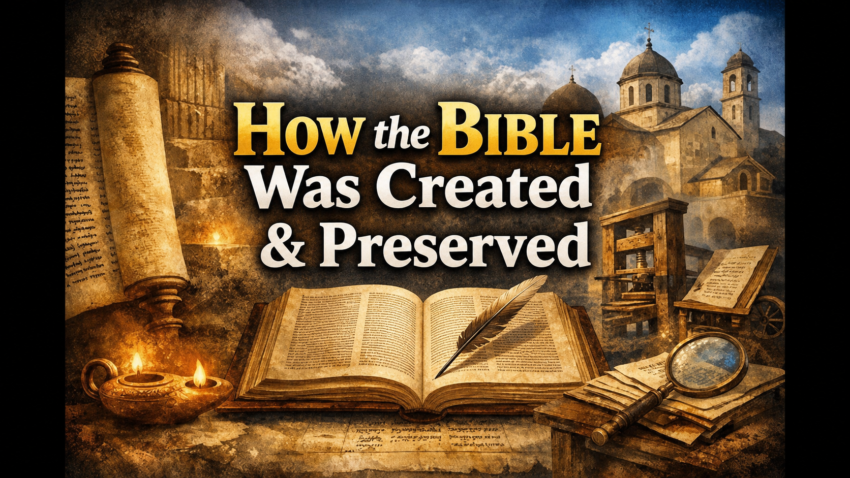
The lesson opens a six-week study designed to deepen confidence in the Bible by tracing the remarkable path it traveled to reach modern hands. Pastor Joey reminds the class that Scripture did not fall from the sky, leather-bound and gilt-edged — it came through divine inspiration and centuries of human sacrifice. Drawing on 2 Timothy 3:16 and 2 Peter 1:20–21, the study affirms that God breathed out His words while using real men, real personalities, and real languages to record them.
From there, the journey unfolds. God spoke in Hebrew, then Aramaic, and finally Koine Greek — the common street language carried across the Roman Empire by Alexander’s conquests. His Word was inscribed first on stone, then on fragile papyrus, then on costly parchment requiring entire flocks of sheep. The scroll gave way to the codex, a quiet first-century revolution that early persecuted Christians embraced for its portability and ease of cross-reference. Behind every page stood the meticulous scribes, counting each letter and destroying entire sheets over a single error.
A Wes Huff video reinforces manuscript reliability, illustrated by the Dead Sea Scrolls’ near-perfect agreement with today’s Isaiah.
Summary:
Introduction and Purpose of the Study
Pastor Joey opens a six-week informational series intended to strengthen the class’s confidence in the Bible as God’s Word before transitioning to a longer “real-life discipleship” study. The aim is not deep theology but historical literacy: helping believers articulate not only what Scripture says but how the book in their hands actually arrived there. Joey illustrates the need with a sobering anecdote about a prison volunteer chaplain who professed Christianity yet rejected the Pauline epistles, dismissing them in favor of “Jesus’s words.” That conversation exposed the gap many Christians have between affirming the Bible and understanding why every part of it carries divine authority. The class is encouraged to supplement the lesson by reading Dennis’s blog, which traces the story even further back into the prehistory of writing itself.
• How We Got Our Bible – The Story of Canonization
• From Clay to Canon: The Epic Journey of Writing from Cuneiform to the Biblical Record
• Tracing the Journey of Scripture Through the Ages
• James White: But it IS Translated Correctly!
• Standing Firm: How You Can Be Certain the Bible is the Word of God
The Divine Origin of Scripture
Every great story begins somewhere, and the Bible begins in the mind of God. Citing 2 Timothy 3:16 (“breathed out by God”) and 2 Peter 1:20–21 (“men spoke from God as they were carried along by the Holy Spirit”), the teacher emphasizes the dual nature of inspiration: the words originated in God’s own breath, yet He used real men with real personalities, guiding them as wind drives a ship. Because God is reliable, the Bible is reliable. One of its more striking features is its honesty — God does not edit out the failures of His own people. Unlike the sanitized biographies commissioned by kings for themselves, Scripture preserves the sins, doubts, and missteps of patriarchs, prophets, and apostles. That candor is itself a mark of authenticity.
The Languages God Chose
God did not deliver His Word in mystical or angelic code. He spoke in the everyday tongues of ordinary people. Initially, that meant Hebrew, the rugged ancestral language of Israel. As empires rose and fell, Aramaic became the spoken language of Jesus’s disciples and of the broader Middle East. When the gospel was ready to expand worldwide, the apostles wrote in Koine Greek — not the polished, literary Greek of philosophers but the common street-level Greek that spread through Alexander the Great’s conquests and dominated the Roman Empire. Just as English now serves as today’s global second language, Koine Greek was the lingua franca of its time, and God used that providential reach to make His message accessible to the common man.
Writing Materials and the Technology of Permanence
Pastor Joey invites the class to imagine themselves as ancient Israelites tasked with preserving a divine message. The earliest medium was stone — durable, but immobile. The Ten Commandments and the Code of Hammurabi alike were carved into rock, but a stone Bible would be impossible to carry. Because God intended His story to travel, human ingenuity stepped in. Along the Nile, Egyptians cut papyrus reeds, pressed and dried them into inexpensive writing sheets. For more lasting documents, scribes used parchment, made from the painstakingly washed, scraped, and stretched skins of sheep or calves. A complete Bible in parchment would consume an entire flock — a tangible reminder that God’s Word was costly in time, money, and sacrifice.
From Scroll to Codex
For centuries, written works were stored as scrolls — long sheets sewn together and rolled on wooden sticks. The book of Isaiah alone stretched roughly twenty-four feet, with no chapters or verses to aid navigation. When Jesus stood in the synagogue at Nazareth, He had to unroll the scroll by memory to find Isaiah 61. Then, in the first century, came a quiet revolution: someone cut a scroll into pages, stacked them, and bound them along one edge. The result was the codex — what we now simply call a book. Early Christians embraced the codex enthusiastically. Persecuted believers could conceal a small codex beneath a robe where a bulky scroll would have betrayed them, and the codex’s two-sided pages and easy navigation made cross-referencing messianic prophecies far simpler. In a real sense, the book was invented for the Bible.
The Faithful Scribes
None of these technologies would have mattered without the unsung heroes of the story — the scribes. A vivid picture is painted: a man hunched over a table in a cold stone room, candle flickering, copying Scripture letter by letter with a quill. The scribal disciplines were strict. Nothing could be written from memory. Every letter was counted. A single error, even near the end of a long page, meant destroying the entire sheet and beginning again. Generations of scribes gave their lives to this tedious labor, and because of their obsessive care, God’s Word survived intact across millennia.
Reliability of Manuscript Transmission
A Wes Huff video from the Can I Trust the Bible? series anchors a discussion of manuscript reliability. The class addresses the common objection that copying must have corrupted the text like a giant game of telephone. The evidence says otherwise. The Great Isaiah Scroll, recovered among the Dead Sea Scrolls, is virtually identical to the Isaiah we read today, with only minor punctuation differences. The qualifications of the New Testament writers — apostles or close associates such as Mark, Luke, James, and Jude — also came up, alongside an interesting contrast with Islamic claims that an illiterate Muhammad miraculously received the Quran. Far from undermining the Bible, the steady stream of new manuscript discoveries functions like additional pieces of a 10,000-piece puzzle: more pieces yield greater confidence in the completed picture.
Translation Through History
The Old Testament was eventually translated into Greek as the Septuagint, and the New Testament into Latin as the Vulgate. Each translation reflected the missionary reach of the church into new cultures. Modern translations, the teacher emphasizes, are not stages in a telephone chain but committee-based scholarly works going directly back to the original Hebrew, Aramaic, and Greek. The King James Version remains valuable, but newer translations benefit from manuscripts unavailable in 1611 and from the natural evolution of English usage.
Closing Reflections
The session ends with a brief mention of Bibles smuggled behind the Iron Curtain — a modern echo of the ancient sacrifices that brought Scripture to ordinary readers — followed by a closing prayer. The takeaway is clear: the Bible did not fall from the sky, leather-bound and gold-edged. It came through divine inspiration, human courage, costly materials, painstaking copying, and providential preservation, and that journey is itself a reason to trust the book.