
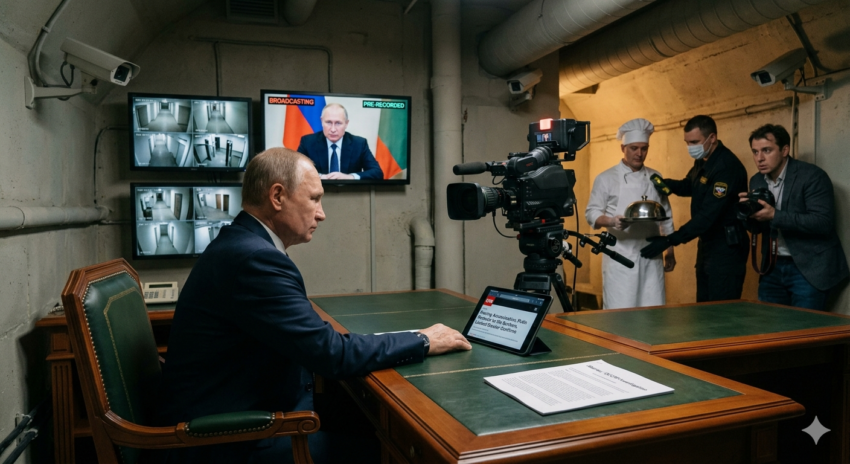
Image: An AI- generated image from Google Gemini imagines
Vladimir Putin protected in his underground bunker.
Inside the Sealed Hatch
How a Leaked European Dossier Cracked Open Putin’s Court
An Investigative Analysis • May 2026
When the Theater Hides the Truth
For four years, the defining image of Vladimir Putin’s wartime rule has been one of orchestrated retreat: a leader broadcasting from underground hardened complexes, his public events pre-recorded, his inner circle policed by quarantines and surveillance cameras as though every cook and photographer might be a potential assassin. In early May 2026, that image acquired sudden, granular specificity. On May 4, three editorial teams on three continents — CNN in the United States, the Russian investigative outlet Important Stories (iStories), and the global Organized Crime and Corruption Reporting Project (OCCRP) — simultaneously published the contents of a leaked dossier prepared by an unnamed intelligence service of a European Union member state. By the morning of May 5, John Sexton at HotAir had distilled the cascade for an American readership under the headline “Fearing Assassination, Putin Retreats to His Bunkers.”
The dossier’s claims are remarkable. The fact that it was leaked — and how it was leaked — is more remarkable still. Whoever passed the document to Western newsrooms wanted Vladimir Putin to read every paragraph. And by now, he has.
How the Document Reached Daylight
The provenance matters. Roman Anin, founder of Important Stories, justified publishing a fully anonymous intelligence product because several of its claims had been independently corroborated by his own reporting and his government source occupied an official European post and would be ruined professionally if the dossier turned out to be disinformation. CNN’s veteran security correspondent Nick Paton Walsh independently obtained the same document. OCCRP, the global investigative consortium and an iStories partner, published a parallel report by reporter Ilya Lozovsky. Three editorial teams chose simultaneously to publish a single, anonymously sourced intelligence product — a coordination that strongly suggests the leakers wanted maximum velocity on the news cycle.
“Security measures of unprecedented severity have been instituted in the Kremlin in recent weeks.”
— Ilya Lozovsky, OCCRP, May 4, 2026
OCCRP’s framing is unsparing. Its full investigation is at https://www.occrp.org/en/news/security-tightens-around-putin-amid-coup-and-assassination-fears-according-to-european-intel-agency. CNN’s reading is more pointed: by leaking the file, the European service effectively forewarns the Kremlin of a possible coup, making the destabilization of Putin’s confidence the operational objective.
Inside the Sealed Hatch
Stripped of speculation, the dossier inventories an unusual security architecture. Putin and his family no longer visit their longstanding residences in the Moscow region or at Valdai. He has not appeared at any military facility in 2026. State media rely on pre-recorded footage to project routine activity. He spends weeks at a time in renovated bunkers, particularly near Krasnodar on the Black Sea coast. Visitors to the Presidential Administration undergo two layers of body screening by FSO officers. Personnel working in proximity — cooks, photographers, bodyguards — are barred from public transit, equipped only with internet-disabled phones, and have surveillance cameras installed in their homes. FSO units patrol the Moscow River with canine teams in case of a drone approach.
The text of the dossier itself, published in full by Important Stories, frames the rationale plainly. Concerned about a leak of sensitive information and the risk of an internal plot, Putin
“fears the use of drones for a possible assassination attempt.”
— EU intelligence dossier, via Important Stories
The full text of the document and the ten generals named for elite FSO protection are at https://istories.media/en/stories/2026/05/04/vladimir-putin-fear/.
None of this began this spring. Pyotr Kozlov’s 2024 reporting in The Moscow Times documented that Putin had begun wearing concealed body armor at outdoor events as far back as 2023, with snipers from the Presidential Security Service (SBP) deployed on the rooftops of the Kremlin and the GUM department store during Victory Day. The dossier of May 2026 does not invent a new posture; it documents the maturation of a defensive architecture that has been thickening for years.
The Shoigu Shadow
The most consequential single name in the dossier is Sergei Shoigu — Russia’s longtime Defense Minister, sidelined in May 2024 to the post of Secretary of the Security Council after the Prigozhin mutiny exposed Russia’s military command crisis. The European report identifies Shoigu as a potential destabilizing actor who, despite his demotion, retains significant influence inside the military high command. The arrest on March 5, 2026 of Ruslan Tsalikov — Shoigu’s longtime first deputy and personal ally — on charges of embezzlement, money laundering, and bribery is interpreted in the dossier not as a routine corruption case but as the breach of an unwritten elite pact.
That interpretation is significant precisely because it is unprovable. CNN’s Paton Walsh underscored the point: the dossier offers no evidence for the Shoigu allegation, and a defection by Shoigu — long viewed as one of Putin’s closest confidants — would represent a remarkable inversion of his political trajectory. But the absence of evidence is not the absence of effect. Once the suggestion is in print, the security apparatus must act on it. And Putin must wonder. That is the genius of the leak: whether or not Shoigu is plotting, he is now a marked man inside his own state.
A Spat Among the Siloviki
The dossier’s most journalistically substantive passage describes a tense closed-door meeting on December 25, 2025 — three days after the assassination of Lieutenant General Fanil Sarvarov in Moscow, presumably by Ukrainian agents. Around the table sat Chief of the General Staff Valery Gerasimov, FSB Director Alexander Bortnikov, and National Guard chief Viktor Zolotov. According to the document, Gerasimov sharply criticized the FSB and other intelligence services for failing to anticipate the killing. Bortnikov defended his service and pushed back, blaming the Defense Ministry for lacking its own protective detail. Zolotov flatly refused to commit National Guard resources and offered Gerasimov unsolicited operational security advice that, in the dossier’s phrasing, provoked the Chief of the General Staff’s anger.
The Russian word for these men of force is siloviki. Andrew Roth’s pre-war Guardian profile of the type, drawing on political analyst Tatyana Stanovaya, captured what they bring to Putin’s table:
“…dominate the agenda, fuel Putin’s anxieties and provoke and escalate tension.”
— Tatyana Stanovaya, quoted by Andrew Roth, The Guardian, Feb. 4, 2022
Roth’s full piece on the Russian security elite is at https://www.theguardian.com/world/2022/feb/04/putin-security-elite-siloviki-russia. The siloviki are Putin’s truest constituency — the men he selected, promoted, and entrusted with what he could not personally control. The dossier’s portrait of them turning on each other in front of him — finger-pointing, sniping, refusing to share resources — describes the rupture of that trust. Putin’s response was characteristic: he called for calm, ordered each man to submit written proposals within a week, and quietly extended the FSO’s elite protection to ten additional senior generals.
What Operation Spiderweb Made Permanent
The psychological context for all of this is the Ukrainian deep-strike drone campaign — particularly Operation Spiderweb, the mid-2025 series of attacks that struck Russian airfields beyond the Arctic Circle. Combined with the December 22, 2025, killing of Lt. Gen. Sarvarov in Moscow itself, these strikes shattered the geographic premise of Russian elite security: the assumption that distance from the front equaled safety. CNN reports Western estimates of roughly 30,000 Russian dead and wounded each month, with limited territorial gain, and that even the pro-Putin urban bourgeoisie now feels the war through repeated cell-phone outages in major cities.
The Kremlin’s May 9 Victory Day parade tells the same story: this year’s commemoration goes forward without heavy weaponry on Red Square. Spokesman Dmitry Peskov publicly cited the terrorist threat of long-range Ukrainian strikes as the reason. According to iStories, not a single Duma deputy received an invitation to this year’s parade — an unprecedented signal that the regime no longer trusts even its own legislators on Red Square. The bunker is no longer a metaphor.
A Note on the Maduro Reference
A clarification on a fact that has prompted some confusion in early commentary. The Financial Times, quoted by HotAir, reports that Putin’s anxiety has been further sharpened by a January 2026 event: the U.S. military seizure of Venezuelan strongman Nicolás Maduro. Some early analyses dismissed this as fabrication. It is, however, well-attested in the public record: in the predawn hours of January 3, 2026, U.S. special forces captured Maduro and his wife Cilia Flores in Caracas; they were transferred to the USS Iwo Jima, then to Stewart Air National Guard Base in upstate New York, and arraigned in a Manhattan federal court on January 5 on superseding narco-terrorism and drug trafficking charges, to which both pleaded not guilty. Maduro is currently held at the Metropolitan Detention Center in Brooklyn. Vice President Delcy Rodríguez was sworn in as acting president of Venezuela that same week.
Whatever one’s view of the Trump administration’s Venezuela policy, the demonstration effect on every authoritarian leader on earth — that an entrenched strongman could be physically removed from his own capital and flown out — is precisely the kind of object lesson that re-engineers a paranoid mind. The HotAir narrative on this point is not contradicted by the public record; it is confirmed by it.
What HotAir Got Right — and What It Missed
John Sexton’s HotAir piece captures the central irony with admirable economy:
“this paranoia goes beyond social media.”
— John Sexton, HotAir, May 5, 2026
Sexton’s full report is at https://hotair.com/john-s-2/2026/05/05/fearing-assassination-putin-retreats-to-his-bunkers-n3814624. He correctly identifies the leak’s strategic purpose — that the European service released the dossier precisely to capitalize on Putin’s existing paranoia. He stops short, however, of the broader implication. The crackdown on Telegram, the push toward the FSB-monitored MAX app, the surveillance of cooks and photographers, the ten generals newly placed under FSO protection, the empty seats at Victory Day where Duma deputies were not welcome — these are not the actions of a confident state. They are confessions, in concrete and code, that the regime no longer trusts its own.
The Cracks That Cannot Be Sealed
There is a temptation, particularly in Western coverage, to treat each new revelation about Russia’s interior life as proof of imminent collapse. That temptation should be resisted. Authoritarian regimes are durable in ways that confound liberal forecasting; Putin has survived crises that would have ended most leaders. He survived Yevgeny Prigozhin’s June 2023 mutiny by waiting it out. He may yet survive 2026.
But three things appear simultaneously true in the wake of this dossier. First, the architecture of Putin’s personal protection now reflects the reality that the gravest danger comes from inside his own building, not from beyond it. Second, the unwritten code that protected Russia’s elite from one another — the tacit protection agreements the EU report cites — is breaking down. Third, the leak itself reveals that European intelligence services believe the regime has become brittle enough that a well-aimed nudge might tip it. Roman Anin, in his accompanying iStories column, framed the moment with stark concision:
“the transition of the Russian regime into a fundamentally different state.”
— Roman Anin, iStories, quoted in OCCRP, May 4, 2026
The bunker, in the end, is not where Vladimir Putin is hiding from Ukraine. It is where he is hiding from the men he chose. Whether they remain loyal — and whether the men he chose to watch them remain loyal — is the question on which the next chapter of the Russian state will turn. The hatch may be sealed. The fissures, as this dossier reminds us, are above ground, in plain view.
Primary Sources
1. John Sexton, “Fearing Assassination, Putin Retreats to His Bunkers,” HotAir, May 5, 2026.
https://hotair.com/john-s-2/2026/05/05/fearing-assassination-putin-retreats-to-his-bunkers-n3814624
2. Nick Paton Walsh, “Unsettled Kremlin tightens security around Putin amid assassinations and coup fears,” CNN, May 4, 2026.
https://www.cnn.com/2026/05/04/europe/putin-russia-security-intelligence-intl
3. Roman Anin, “Vladimir Putin fears an assassination attempt and a coup,” Important Stories (iStories), May 4, 2026.
https://istories.media/en/stories/2026/05/04/vladimir-putin-fear/
4. Ilya Lozovsky, “Security Tightens Around Putin Amid Coup and Assassination Fears,” OCCRP, May 4, 2026.
https://www.occrp.org/en/news/security-tightens-around-putin-amid-coup-and-assassination-fears-according-to-european-intel-agency
5. Pyotr Kozlov, “Bulletproof Vests on Red Square: Kremlin Secretly Beefs Up Putin’s Personal Security,” The Moscow Times, June 4, 2024.
https://www.themoscowtimes.com/2024/06/04/bulletproof-vests-on-red-square-kremlin-secretly-beefs-up-putins-personal-security-a85303
6. Andrew Roth, “Putin’s security men: the elite group who ‘fuel his anxieties’,” The Guardian, February 4, 2022.
https://www.theguardian.com/world/2022/feb/04/putin-security-elite-siloviki-russia
7. “Presidential Security Service (Russia),” Wikipedia.
https://en.wikipedia.org/wiki/Presidential_Security_Service_(Russia)
8. Dossier Center, “Putin’s Men.”
https://dossier.center/putinmen-en/
9. The Sun, “Russian Minister Flees U.S., Dodges FSB.”
https://www.the-sun.com/news/16307436/russian-minister-flees-us-dodges-fsb/
10. New York Post, “Here’s how Putin protects himself from assassins and coups,” March 4, 2022.
https://nypost.com/2022/03/04/heres-how-putin-protects-himself-from-assassins-and-coups/
A Note on Research Methods and Accuracy
In recent years, some have voiced concern that artificial intelligence may distort facts or introduce inaccuracies into serious research. That criticism deserves acknowledgment. However, AI has now evolved into the most powerful research instrument available to any dedicated scholar—capable of analyzing vast datasets, cross‑referencing historical records, and surfacing overlooked connections across sources. This work represents a collaboration between the author’s investigative inquiry, verified primary documentation, and the advanced analytic capabilities of AI research tools. Here, AI was not used as a ghostwriter or a shortcut for scholarship, but as a disciplined research partner devoted to rigor, accuracy, and transparency.
Every factual claim in this work has been subjected to active verification. Where AI‑generated content was used as a starting point, it was tested against primary sources, peer‑reviewed scholarship, official institutional documentation, and established historical records. Where discrepancies were found—and they were found—corrections were made. The author has made every reasonable effort to ensure that quotations are accurately attributed, historical details are precisely rendered, and theological claims fairly represent the positions they describe or critique.
That said, no work of this scope is immune to error, and the author has no interest in perpetuating inaccuracies in the service of an argument. If you are a reader—whether sympathetic, skeptical, or hostile to the conclusions drawn here—and you identify a factual error, a misattributed source, a misrepresented teaching, or a claim that cannot be substantiated, you are warmly and genuinely invited to say so. Reach out. The goal of this work is not to win a debate but to get the history right. Corrections offered in good faith will be received in the same spirit, and verified corrections will be incorporated into future editions without hesitation.
Truth, after all, has nothing to fear from scrutiny—and neither does this work.