
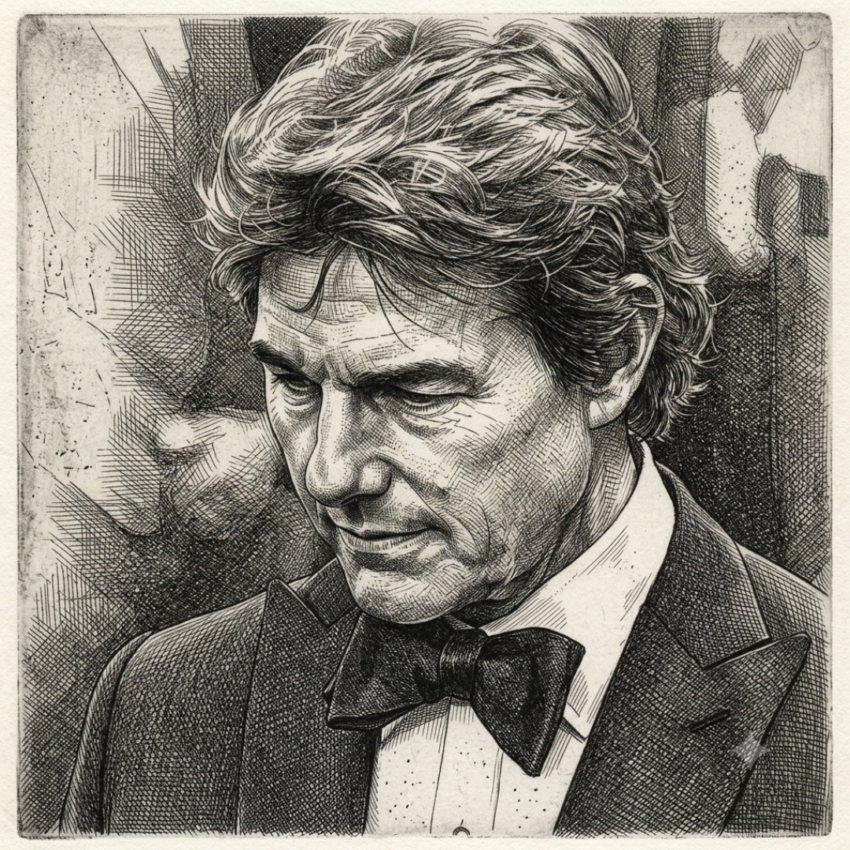
Stardom, Faith, and the Price of the Hero Myth
❖ ❖ ❖
Introduction: The Man Who Refused to Fall
On a warm August evening in 2024, a sixty-two-year-old man leapt from the roof of the Stade de France, abseiled into a packed Olympic stadium, took an American flag from a gymnast and a mayor, and rode off on a motorcycle toward a plane bound for Los Angeles. The stunt closed the Paris Games and announced the 2028 host city. It could only have been Tom Cruise. No other figure in modern cinema so completely fuses spectacle, persistence, and personal myth — the willingness to physically hurl himself at the audience, decade after decade, daring them to look away.
Cruise has been a fixture of American popular culture for more than forty years, his films grossing in excess of thirteen billion dollars worldwide and placing him among the highest-grossing actors who have ever lived. He holds the Guinness World Record for the most consecutive hundred-million-dollar films. In November 2025, the Academy handed him an Honorary Oscar for a career spanning forty-five years. By any conventional measure, he is one of the most successful entertainers in history.
And yet the smile that has sold a thousand magazine covers carries, for many viewers of a certain age, a faint uncanniness — a sense of something held just out of frame. Cruise is at once the most visible movie star alive and one of the most carefully guarded. The contradiction at the center of this biography is precisely that tension: between the Hollywood hero who saves the world three times a decade and the intensely private man whose deepest commitments — to a controversial church, to a friendship with that church’s leader, to a vision of himself as a destined savior — remain largely sealed off from public scrutiny.
This is an attempt to hold both truths at once: to trace the chronology of an extraordinary career, to follow the arc of his marriages and romances, and to examine his decades-long association with the Church of Scientology and his friendship with its leader, David Miscavige. The aim is neither hagiography nor exposé, but understanding — the fullest and fairest portrait the public record allows.
❖ ❖ ❖
Part One — Origins: Chaos and Escape
In the summer of 1962, as the country hummed through the final days of its postwar confidence, a boy named Thomas Cruise Mapother IV was born in a small hospital in Syracuse, New York. His father, Thomas Cruise Mapother III, was an electrical engineer who could fix a circuit but never quite fixed the temper that lived inside him. His mother, Mary Lee Pfeiffer, taught special education, pouring patience into children the world had overlooked. The family carried the old names of Kentucky, the old blood of England, Germany, and Ireland, and the old weight of a life that had never quite settled.
Syracuse was the beginning, but it was not the place. By the time Tom was halfway through third grade, the family was pulled up and sent to Ottawa, Canada, where his father had taken defense work. The move came in winter, and in the white silence of that city, a boy learned to watch. He learned that when something went wrong, someone got kicked. He learned that safety could be a lure, and then, suddenly, a trap.
He described his father later as a merchant of chaos, a bully, a coward. He said the man would lull you in, make you feel safe, and then—bang. For Tom, the lesson was simple: there’s something wrong with this guy. Don’t trust him. Be careful.
The family moved again. Again. Again. By the time he was older, he had counted fifteen schools in fourteen years. Schools that were not homes, classrooms that were not places of rest, neighbors that were not people you stayed with. He was small for his age, sad, and bullied by other children. He was raised Catholic, and the church was the only place that seemed to hold steady while everything else spun.
For a season, he thought he might become a priest. He took a scholarship to St. Francis Seminary in Cincinnati and imagined the Franciscan order, the quiet rhythm of prayer and work. But the seminary was a place of rules, and Tom was a boy of motion. He left after a year.
He found football instead. He played varsity linebacker, a big job for a small body, until he was cut for drinking before a game. That was the end of that. The next turn on the road was a school stage. He starred in Guys and Dolls at Glen Ridge High School in New Jersey, and that was the moment. He graduated in 1980.
At eighteen, with his mother and stepfather’s blessing, he moved to New York to act. He busied tables to survive. He slept where he could. He auditioned. He took what he could get. He went west.
His first film was in 1981, a small role in Endless Love. Then Taps, then The Outsiders. Then Risky Business, the film that made him a star. The boy who had moved so much, who had learned to stay alert, who had learned to watch the door, now played a man who could walk into a room and make the lights come on.
He was not the boy from Syracuse anymore. He was Tom Cruise, the actor, the star, the man who could run across a roof and hang from a plane and make it look like courage was easy. But the boy was still there, in the way he watched the world, in the way he kept moving, in the way he never forgot that safety could be a lie.
And the father was still there too, in the way Tom learned to be careful, to be ready, to be the one who never let something go wrong and then get kicked for it. He became the man who controlled the moment, who made the scene, who made the world hold still while he walked through it.
That is the story of Thomas Cruise Mapother IV: the boy who moved fifteen schools in fourteen years, the boy who tried the priesthood, the boy who got cut from football, the boy who found the stage, the boy who went to New York, and the man who became Tom Cruise.
He was the kind of person where, if something goes wrong, they kick you. It was a great lesson in my life — how he’d lull you in, make you feel safe and then, bang! For me, it was like, ‘There’s something wrong with this guy. Don’t trust him. Be careful around him.’
— Tom Cruise, Parade (2006)
He called his father “a merchant of chaos,” a “bully,” and a “coward.” When his parents’ marriage collapsed, his mother took Tom and his three sisters back to the United States from a stint in Ottawa, Canada, where his father had taken defense work. The elder Mapother died of cancer in 1984, by which point his son was already on the cusp of fame.
For a brief season, the young Cruise considered the priesthood, taking a scholarship to St. Francis Seminary in Cincinnati with aspirations toward the Franciscan order. He left after a year. He played varsity football as a linebacker until he was cut for drinking before a game, then found the school stage instead, starring in a production of Guys and Dolls at Glen Ridge High School in New Jersey, from which he graduated in 1980. At eighteen, with his mother and stepfather’s blessing, he moved to New York to act, bused tables to survive, and then went west.
❖ ❖ ❖
Part Two — The Ascent: From Risky Business to Icon
Tom Cruise’s arrival in Hollywood did not announce itself with fanfare. His screen debut came in Endless Love (1981), where he appeared briefly as a cocky high school student—barely a footnote in a film remembered more for its melodrama than its cast. But that same year, something more revealing happened. Cast in Taps as a volatile military academy cadet, Cruise brought such unpredictable intensity to the role that director Harold Becker expanded his part during production. Amid a cast that included rising talents like Timothy Hutton and Sean Penn, Cruise stood out—not as a conventional leading man, but as a force that seemed slightly dangerous, difficult to contain.
By 1983, he was moving within a new orbit. Francis Ford Coppola’s The Outsiders gathered a remarkable ensemble of young actors—Matt Dillon, Patrick Swayze, Rob Lowe, Emilio Estevez, C. Thomas Howell, and Diane Lane among them. Cruise’s role as Steve Randle was not central, but it placed him inside a generational moment: a cluster of future stars being shaped under a major director’s hand. He was no longer incidental; he was part of something forming.
That same year, Risky Business changed everything. As Joel Goodson, the suburban teenager who turns his parents’ absence into a reckless entrepreneurial adventure, Cruise fused charm, humor, and a sly edge of ambition. The now-iconic image—dancing in a dress shirt and socks—captured a specific American mood of the early 1980s: restless, opportunistic, and newly fascinated with wealth. Critics and audiences alike recognized it as a breakout. The film did not just make Cruise visible; it defined him as a leading man with both commercial appeal and a hint of subversion.
Then came 1986—the year the persona crystallized. In Tony Scott’s Top Gun, Cruise’s Pete “Maverick” Mitchell embodied a new cinematic archetype: hyper-competitive, emotionally guarded, yet irresistibly charismatic. The film’s kinetic style, glossy visuals, and militarized cool turned Cruise into a global superstar almost overnight. He was no longer simply an actor on the rise; he was an image—marketable, exportable, and emblematic of Reagan-era confidence.
Yet what made that year remarkable was not just mass appeal, but range. In Martin Scorsese’s The Color of Money, Cruise held his own opposite Paul Newman, playing the brash, gifted pool hustler Vincent Lauria. Where Top Gun projected control, this performance reveled in arrogance and raw talent. Critics noted the credibility of the pairing; their dynamic felt less like acting and more like a genuine clash of generations within the same profession. Cruise was not merely being elevated by association—he was proving he belonged in that company.
By the mid-1980s, the pattern was clear. Cruise’s ascent was not accidental or purely image-driven. It was built on a sequence of roles that revealed different facets of the same core intensity: volatility in Taps, ensemble credibility in The Outsiders, star-making charisma in Risky Business, blockbuster magnetism in Top Gun, and competitive dramatic presence in The Color of Money. The industry had not just found a star—it had found someone capable of shaping his own myth.
The Serious Actor
Tom Cruise’s rise could easily have calcified into something simpler: a bankable face, a reliable box-office draw, a symbol of 1980s charisma. But he resisted that trajectory. Instead, he began deliberately aligning himself with directors known for intensity, ambition, and risk—filmmakers who demanded more than charm.
In 1988, Rain Man paired him with Dustin Hoffman in what might have been a conventional star-and-mentor dynamic. Instead, Cruise played Charlie Babbitt as a man gradually stripped of his cynicism, forced into moral awareness by his autistic brother’s rigid, unyielding world. The film became a cultural and commercial phenomenon, winning four Academy Awards, including Best Picture. While Hoffman’s performance drew much of the awards attention—earning him the Oscar for Best Actor—Cruise’s work was widely recognized as essential to the film’s emotional architecture. He was no longer simply carrying films; he was anchoring them.
The transformation became undeniable a year later. In Oliver Stone’s Born on the Fourth of July (1989), Cruise took on Ron Kovic, the real-life Vietnam veteran who returned home paralyzed and disillusioned. The role demanded not only physical discipline but emotional exposure on a level Cruise had not previously attempted. The performance silenced many of his critics. Roger Ebert captured the shift with unusual clarity, writing:
Nothing Cruise has done will prepare you for what he does in Born on the Fourth of July … His performance is so good that the movie lives through it. Stone is able to make his statement with Cruise’s face and voice and doesn’t need to put everything into the dialogue.
— Roger Ebert, Chicago Sun-Times
Cruise won the Golden Globe for Best Actor and received his first Academy Award nomination, signaling that he had crossed into a different category of performer—one capable of carrying politically charged, psychologically demanding material.
Through the 1990s, he maintained an unusually precise balance between commercial appeal and artistic ambition. In The Firm (1993), he brought urgency and intelligence to the role of a young lawyer entangled in corruption, helping to elevate John Grisham adaptations into prestige territory. The following year, he took a risk that initially provoked backlash: his casting as Lestat in Interview with the Vampire (1994). Author Anne Rice had publicly criticized the choice before release, doubting Cruise’s suitability for the role. After seeing the film, she reversed herself dramatically—praising his performance and reportedly taking out a full-page advertisement in Daily Variety to acknowledge that he had captured the character’s essence.
By 1996, Cruise delivered one of his most culturally resonant performances in Cameron Crowe’s Jerry Maguire. As a sports agent undergoing a crisis of conscience, he combined vulnerability with the sharp instincts of a performer who understood audience connection at a granular level. The film earned him another Golden Globe and his second Academy Award nomination for Best Actor, and it produced lines and moments that embedded themselves in popular culture.
Then, at the decade’s end, came perhaps his most unexpected turn. In Paul Thomas Anderson’s Magnolia (1999), Cruise played Frank T.J. Mackey, a deeply wounded, aggressively misogynistic self-help guru whose bravado masks profound trauma. It was a role that dismantled his own star image, exposing something raw and unsettling beneath it. Critics took notice. Peter Travers of Rolling Stone called Cruise “a revelation … devastating,” recognizing the performance as one that redefined what audiences thought he could do. The Academy agreed, awarding him his third nomination—this time for Best Supporting Actor.
By the close of the 1990s, Cruise had accomplished something rare. He had not abandoned stardom to gain credibility, nor sacrificed credibility to maintain stardom. Instead, he had fused the two—building a career that moved fluidly between blockbuster visibility and demanding, often uncomfortable roles. The heartthrob had not disappeared; he had been repurposed into something far more durable.
The Franchise Architect
In 1996, Tom Cruise made a move that subtly but permanently altered his position in Hollywood. With Mission: Impossible, he did not simply take on the role of Ethan Hunt—he acquired it. Partnering with Paula Wagner, Cruise produced the film through their company, effectively transforming himself from star to stakeholder. The choice of director, Brian De Palma, signaled ambition rather than routine franchise-building, and the film’s success—both critical and commercial—laid the groundwork for something larger than a single hit.
What followed was not immediate domination, but careful construction. The early sequels shifted tone with each installment—John Woo’s stylized Mission: Impossible 2 (2000), J.J. Abrams’ more character-driven Mission: Impossible III (2006)—as Cruise refined the series into a vehicle tailored to his strengths: intensity, precision, and physical commitment. By the time Ghost Protocol (2011) arrived, featuring Cruise scaling Dubai’s Burj Khalifa, the franchise had found its identity. Each subsequent entry—Rogue Nation (2015) and Fallout (2018)—was received not merely as spectacle, but as a demonstration of escalating craft. Critics increasingly treated the series as a benchmark for practical action filmmaking in a digital age.
Cruise’s insistence on performing his own stunts became central to the brand. It was no longer a behind-the-scenes detail but a selling point woven into marketing and reception alike: the actor hanging from aircraft, enduring high-impact jumps, and executing complex sequences with minimal reliance on doubles. This approach reinforced a sense of authenticity that distinguished the films from their competitors.
Observers such as film historian and economist Edward Jay Epstein have argued that Cruise represents a rare category of star whose involvement can anchor high-budget filmmaking in an era otherwise dominated by intellectual property. While the “billion-dollar guarantee” is more shorthand than literal certainty, the broader point holds: Cruise became synonymous with a certain kind of theatrical event, particularly within the Mission: Impossible series, whose later installments routinely approached or surpassed 800 million dollars globally, with Fallout becoming the franchise’s highest-grossing entry at the time.
The most striking validation of his enduring draw came decades after his initial ascent. Top Gun: Maverick (2022), a sequel arriving 36 years after the original, premiered at the Cannes Film Festival, where Cruise was awarded an Honorary Palme d’Or—an unusual recognition for a figure so closely associated with mainstream cinema. The film went on to gross approximately 1.49 billion dollars worldwide, making it the highest-grossing film of his career and one of the defining theatrical successes of the post-pandemic era. Reports of Cruise’s earnings vary, but credible industry estimates suggest he earned tens of millions upfront and potentially over 100 million dollars when backend participation is included—reflecting a compensation model he had refined over decades.
As the Mission: Impossible saga moved toward its later chapters—marketed as a two-part conclusion beginning with Dead Reckoning Part One (2023) and continuing with The Final Reckoning (released in 2025)—the question was less whether Cruise could still open a film, and more whether anyone else could do so at the same scale without reliance on established franchises or cinematic universes. Even within a franchise, his presence functioned as the primary draw.
By this stage, Cruise had become something increasingly rare: not just a movie star, but a durable institution. His name did not merely appear above the title—it defined the terms under which the film would be experienced, marketed, and, more often than not, trusted by audiences to deliver spectacle worth leaving home for.
❖ ❖ ❖
Part Three — The Romances: Love in the Public Eye
Cruise’s private life has drawn nearly as much attention as his films, in part because his three marriages each intersected, in some way, with the religion that would come to define his public identity.
Mimi Rogers
In the early years of his rise, Tom Cruise’s romantic life itself became a metric of how quickly he was moving from obscurity to centrality in Hollywood. Before his first marriage, he had been linked to a series of women whose names signaled both the breadth of his reach and the speed of his ascent: Rebecca De Mornay, whom he met while filming Risky Business and with whom he was involved from 1982 to 1985; a brief but notable romance with Cher in 1985, during which the singer famously called him one of her “top five best lovers”; and an earlier teenage relationship with actress Melissa Gilbert, the future Little House on the Prairie star, when both were still in their teens.
But the relationship that would reshape his life in ways both personal and institutional began in 1986. Cruise met actress Mimi Rogers at a dinner party in Los Angeles that mutual friends had arranged. Rogers, born in 1956, was seven years older than Cruise and already an established actress with roles in films like The Return of the Secaucus 7 and The Goonies. Cruise described her in a 1986 Rolling Stone interview as “extremely brilliant,” and a whirlwind romance followed. They married quietly on May 9, 1987, in upstate New York, at a time when Cruise was 24, and Rogers was 31, just as Top Gun was transforming him into a global phenomenon.
It was through Rogers that Cruise first encountered the Church of Scientology. Rogers had grown up within the religion: her father, civil engineer Philip C. Spickler, was close to Scientology founder L. Ron Hubbard, and Rogers herself had been raised in Scientology and worked as one of its “auditors”—a practitioner who helps others navigate the church’s counseling process known as “auditing.” When Cruise became Rogers’ client in Scientology sessions, he was introduced to the church’s core practices, including the use of the E-meter, a device that measures minute electrical changes in the body as individuals respond to spiritual questions.
The Church of Scientology, founded by Hubbard in the 1950s after his earlier publication of Dianetics: The Modern Science of Mental Health (1950), had evolved from a self-help movement into an organized religion with a complex cosmology centered on the concept of the “thetan”—the individual’s immortal spiritual self. By the 1980s, the church had established a significant presence in the United States, with major centers in Los Angeles, Clearwater (Florida), and Los Angeles’s Gold Base, which became Scientology’s international headquarters. Rogers’ introduction of Cruise to the church marked a pivotal moment in the organization’s history: the arrival of a young actor whose star power would eventually amplify Scientology’s visibility far beyond its existing circles.
During their marriage, Cruise and Rogers became a fixture in Hollywood’s social scene. In August 1987, they were photographed dining with pop star Madonna in London, a moment that captured the orbit of celebrity now gathering around Cruise. Yet the relationship was not without its tensions. Rogers told People magazine that she struggled to maintain her individuality, noting that “no matter what the article is, it’s ‘Tom Cruise’s wife.'” She later joked to Playboy in 1993 that Cruise “was seriously thinking of becoming a monk,” suggesting that Scientology’s growing centrality in his life was already creating distance.
The marriage ended less than three years after it began. Cruise’s legal team filed for separation on December 9, 1989, during the production of Days of Thunder, and the couple announced their divorce on January 16, 1990—less than a week after a Rolling Stone interview reaffirmed their affection. The divorce was finalized in February 1990. Rogers received a reported $4 million settlement, a fortune at the time and equivalent to roughly $9.1 million in 2024 dollars. The settlement became the subject of public discussion when Rogers made a joke about it, prompting reports that she had been told speaking about the relationship would compromise the agreement. She later retracted some statements, though Cruise never publicly addressed the issue.
Rogers left Scientology shortly after the divorce, eventually being declared a “suppressive person” by the church—a designation for individuals the organization views as hostile to its interests. Cruise, however, remained deeply committed. By the time he married Nicole Kidman in December 1990, he was not just a member but one of the church’s most prominent figures, a position that would define both his public image and his private life for decades.
The introduction of Scientology into Cruise’s life through Rogers marked a turning point that extended far beyond a single marriage. It positioned him within an organization that would shape his career choices, his relationships, and his public persona in ways that would become increasingly difficult to separate from the man himself.
Nicole Kidman
The meeting that would produce Hollywood’s most powerful 1990s power couple occurred during a moment of professional recalibration for Tom Cruise. In 1989, Cruise was filming Days of Thunder, a rain-drenched race-car drama directed by Michael Mann and co-starring Fred Coury and Randy Quaid. The film was intended to capitalize on the same formula that had made Top Gun a billion-dollar phenomenon—extreme sports, bromantic tension, and high-octane spectacle—but it was already struggling to find its footing. On the set, Cruise met Nicole Kidman, an Australian actress just 22 years old, who had been cast as Dr. Laurel Dayton, a fertility specialist and the film’s romantic lead. Their connection was described by both as immediate; Kidman later recalled being struck by Cruise’s appearance during her audition, saying their bond was “instant.”
The courtship that followed was swift and intense. By late 1989, Cruise and Kidman were inseparable, and their relationship quickly became the subject of tabloid fascination. Her background was markedly different from his: born in 1967 in Canberra, Australia, Kidman had grown up in a secular household; her father, Graham Kidman, was a clinical psychologist and biomedical engineer, a profession Scientology viewed with deep suspicion. The church considers psychiatry one of its primary enemies, an ideology rooted in the writings of L. Ron Hubbard, who claimed that mental illness was a fabrication designed to control people.
On December 24, 1990, Cruise and Kidman married in an intimate Christmas Eve ceremony in Telluride, Colorado. Cruise was 28; Kidman was 23. The wedding was held in a small chapel, attended by fewer than 50 guests, including Mimi Rogers (Cruise’s first wife), who allegedly traveled to the ceremony despite her own estrangement from Scientology. The couple had barely begun their marriage when they returned to work on Far and Away (1992), a Robert Redford-directed Western co-starring the couple as Irish immigrants in 19th-century America. The film, though critically received as uneven, represented their first attempt to build a shared cinematic identity.
During their eleven-year marriage, the couple adopted two children. In December 1992, they adopted their daughter Isabella Jane “Bella” Cruise, reportedly after Kidman suffered an ectopic pregnancy that prevented her from conceiving naturally. In February 1995, they completed their family by adopting their son, Connor Antony Cruise. Both children were raised within Scientology, attending church-run schools and participating in auditing sessions from a young age. Isabella and Connor would later become increasingly private figures, rarely appearing in public and maintaining near-total distance from their mother after the divorce.
The couple’s most significant artistic collaboration came with Stanley Kubrick’s Eyes Wide Shut (1999), the legendary director’s final film. Kubrick, known for his obsessive perfectionism, imposed strict rules on the married actors: they were to remain separated as much as possible when not required on set, to maintain the theme of physical and psychological alienation their characters felt. Kubrick directed each with their own set of notes that they were forbidden to share. The production became infamous for its length—filming stretched over 15 months, from January 1998 to April 1999—and for a controversial sequence in which Kidman filmed six days of sex scenes with actor Sándor Bárczi, portraying her character’s sexual fantasy. She was required to perform 50 different sexual positions and was forbidden to discuss any aspect of the process with Cruise on or off-set.
The marriage unraveled during this period of intense professional collaboration. By late 2000, tensions had grown. Cruise and Kidman quietly separated in December 2000. On February 5, 2001, the couple announced their separation after 11 years together, citing “the difficulties involved with two acting careers and the amount of time spent apart while working.” Cruise filed for divorce, citing irreconcilable differences, and the divorce was finalized in August 2001. Kidman retained primary custody of both children, though the arrangement remained private.
Kidman later reflected on the marriage with unusual candor. In a 2016 interview with The Evening Standard, she said: “I was a baby when I married Tom, but I don’t regret any of it.” In a 2025 interview with People, she elaborated: “I was a child who needed to grow up when we married.” She described the marriage as a period of intense personal development, though she acknowledged that the age gap and the pressure of Cruise’s celebrity had created dynamics she was not fully prepared to navigate.
The dissolution of the marriage would later become one of the most contested episodes in accounts of Cruise’s church involvement. Former Scientology executives, including onetime spokesman Mike Rinder, alleged that the organization actively worked to separate the couple. In his 2022 memoir, A Billion Years: My Escape From a Life in the Highest Ranks of Scientology, Rinder wrote that the church created a “distance” between Cruise and Kidman. He claimed that after Cruise began ignoring phone calls from church leader David Miscavige during the intense filming schedule of Eyes Wide Shut, church officials sent a top executive to the U.K. to “audit” him, redrawing him back into Scientology’s orbit.
Rinder further alleged that Scientology officials disapproved of Kidman because her father was a psychiatrist—a profession the church condemns—and that Miscavige and other leaders were so concerned about her “potential influence on Cruise” that they hired a private investigator to wiretap her phone. He wrote that “when Tom and Nicole divorced, Miscavige was happy that the ‘negative influence’ of Nicole was no longer dragging Tom away.”
Cruise’s former auditor, Mark Rathbun, testified in the HBO documentary Going Clear: Scientology and the Prison of Belief (2015) that Kidman’s phone was wiretapped at Cruise’s suggestion. According to Rathbun in the film, “Tom said he was worried about Nicole and suggested her phones be tapped. He related this idea to Marty [Rathbun], and Marty related it to David Miscavige.” The church slapped Kidman with the dreaded label “suppressive person,” a designation for individuals the organization views as hostile to its interests.
In response to these allegations, the Church of Scientology stated in September 2022: “The Church never ordered or participated in any illegal wiretapping. Mike Rinder is an inveterate liar who seeks to profit from his dishonesty. He supports himself by orchestrating the harassment of his former Church and its leader through false police reports, incendiary propaganda, and fraudulent media stories.” The church also called Rinder’s claim that Miscavige facilitated Cruise’s courtship with Kidman “utterly ludicrous.”
Cruise’s lawyer similarly denied the wiretapping allegation, stating that “Tom never suggested that Nicole’s phone be tapped.” The church’s defense emphasized that Rinder and Rathbun were former members who had been declared “suppressive persons” and had built careers attacking Scientology.
Cruise thereafter became more fervent in his vocal public support of Scientology and Miscavige. The divorce marked a turning point in his relationship with the church; he would soon marry Katie Holmes in 2006, and their 2012 separation became another episode in which Scientology’s influence was alleged to have played a role.
Penélope Cruz and the “Auditions” Allegation
Tom Cruise’s relationship with Spanish actress Penélope Cruz began in the wake of his divorce from Nicole Kidman, marking a transitional period in both his personal life and his public image. The two met on the set of Vanilla Sky (2001), a psychological thriller directed by Cameron Crowe and co-starring Julia Roberts and Kanye West. Cross, born in 1973 in Madrid, was already an established actress in Europe and had gained U.S. recognition with her role in Vivir Queriendo (Talk Her), which would later earn her an Academy Award for Best Supporting Actress in 2004.
Their relationship unfolded quietly, away from the tabloid frenzy that had surrounded Cruise’s marriage to Kidman. The couple dated from 2001 to 2004, marking nearly three years of romance. People magazine confirmed the split in March 2004, though the pair had actually broken up in late January 2004. Cruise’s publicist described the breakup as “amicable,” while Cruz’s representative noted, “They remain good friends and still care for each deeply.” The timing coincided with Cruise’s growing public visibility and the beginning of his next major chapter.
Following the breakup with Cruz, a widely discussed September 2012 Vanity Fair article by special correspondent Maureen Orth reported explosive allegations about the Church of Scientology’s involvement in Cruise’s romantic life. The article claimed that, after Cruz’s departure, church figures allegedly conducted a top-secret project to find Cruise a new partner—a series of “auditions” of Scientologist actresses that would determine who was suitable to be his girlfriend.
According to Orth’s reporting, the British-Iranian actress Nazanin Boniadi was selected from a group of devout Scientologist actresses as the candidate to play the real-life role of Cruise’s girlfriend. Boniadi, born in 1980 in London and raised in Irvine, California, was a medical student at the time who had been a member of Scientology since childhood. The Vanity Fair article reported that she went through a month-long preparation process before meeting Cruise for the first time in November 2004. During this vetting period, Boniadi was allegedly “told to lose her braces, her red highlights and her boyfriend,” according to the magazine.
The relationship between Cruise and Boniadi allegedly lasted from November 2004 until January 2005, approximately two to three months. According to Orth’s sources, the relationship ended when Boniadi was deemed insufficiently affectionate with Cruise in public, and Cruise believed she was disrespectful to David Miscavige, the leader of Scientology. Three months after the breakup, Cruise appeared in public with Katie Holmes, beginning what would become his third marriage.
The article then reported that Boniadi, after the failed relationship, was reportedly sent to a Scientology center in Clearwater, Florida, where she broke down and revealed her relationship with Cruise to a friend—violating her confidentiality agreement. As punishment, Vanity Fair alleged that her chores included “scrubbing toilets with a toothbrush, cleaning tiles with acid, and digging ditches in the middle of the night.” The magazine also claimed she was later assigned to sell L. Ron Hubbard’s Dianetics on street corners near the church’s headquarters.
Boniadi, who is now a spokesperson for Amnesty International UK and no longer involved with Scientology, later compared her experience to a form of servitude. According to film director Paul Haggis, an outspoken critic of Scientology who featured her in his 2010 film The Next Three Days, Boniadi’s testimony to the FBI included claims of being forced to dig ditches and scrub tiles. Haggis stated that he had learned about Boniadi’s situation three years prior and found it “very credible,” saying, “I have a strong aversion to bullies.”
The allegations in the Vanity Fair article were met with forceful denials from both the Church of Scientology and Cruise’s representatives. Cruise’s lawyer, Bert Fields, told ET Online that the article was “long, boring and false,” calling it “a rehash of tired old lies previously run in the supermarket tabloids.” A rep for Cruise told ABC News, “Lies in a different font are still lies—designed to sell magazines.”
The Church of Scientology issued a statement denying the allegations: “The entire story is hogwash. There was no project, secret or otherwise, ever conducted by the Church to find a bride (audition or otherwise) for any member of the church. The allegation and entire premise of the Vanity Fair article is totally false . . . We have been denying this ridiculous tale now since it first appeared in print four years ago.” The church characterized the sources Orth interviewed—including Haggis and former member Mike Rinder—as “liars” and “apostates” attempting to “grab headlines and falsely slander his former religion.”
The church further stated that David Miscavige and Tom Cruise declined to be interviewed by the magazine, and that none of the sources Orth used had been current members at the time of the alleged events. Vanity Fair maintained that it stands by the story and denied claims that it paid its sources.
The reader should weigh these as serious but contested allegations, denied by the parties named. The Vanity Fair report relied on interviews with several former Scientology members and critics, including Haggis, who had been declared “suppressive persons” by the church. The church has consistently characterized all such sources as disgruntled apostates seeking to profit from their dishonesty.
What remains clear is that Boniadi subsequently left Scientology. She is now an internationally recognized human and women’s rights activist with a focus on Iran, serving as an Amnesty International UK Ambassador. She has appeared in notable films, including Iron Man 2 (2010) and the television series How I Met Your Mother (2007-2013), and is set to star in Amazon’s upcoming Lord of the Rings series. Boniadi has not spoken publicly about the allegations in recent years and did not respond to ABC News for comment in 2012.
The controversy surrounding Cruise’s romantic relationships and Scientology’s alleged involvement became one of the most persistent narratives about the actor’s private life, echoing similar allegations about his marriage to Kidman and foreshadowing claims about his relationship with Katie Holmes.
Katie Holmes
In April 2005, Tom Cruise began dating actress Katie Holmes, a relationship that would become the most publicized chapter of his romantic life and the one most deeply intertwined with Scientology’s institutional influence. Holmes, born on March 18, 1978, in Toledo, Ohio, was 26 years old at the time—16 years younger than Cruise. She had been raised Catholic in a middle-class family; her father, Gary Holmes, was a businessman who ran a steel company, and her mother, Sylvia, was a homemaker. Holmes had gained national fame as Joey Potter on Dawson’s Creek, the teen drama that ran on Warner Bros. Television from 1998 to 2003 and became a cultural touchstone for millennial audiences.
The two met on the set of Mission: Impossible III (2006), where Cruise starred as Ethan Hunt, and Holmes played Dr. Lucy Telesco, a CIA analyst. They first sparked romance rumors when they were spotted holding hands in Rome in April 2005. For their first official public appearance together, they attended the premiere of Mission: Impossible III in Rome, where Cruise, 42, and Holmes, 26, were photographed together for the first time as a couple.
The romance — quickly dubbed “TomKat” by the media — became a media phenomenon almost immediately. The couple’s relationship was characterized by an intensity that seemed to outpace normal courtship timelines. They were engaged within two months of meeting, in June 2005, and by the end of the year, they were expecting their daughter. Their first public appearance together was at the 2005 premiere of Mission: Impossible III in Rome, where they were photographed holding hands.
The moment that would mark a turning point in public perception came on May 23, 2005, during Cruise’s appearance on The Oprah Winfrey Show. The interview was intended to promote Mission: Impossible III, but it became infamous for a different reason. When Winfrey asked Cruise about his relationship with Holmes, he became visibly emotional. He dropped to his knees several times, raised his fists in excitement, grasped Winfrey’s hands, and ultimately jumped onto the couch with both feet, shouting, “I’m in love!” The audience reveled in his joy, and the couch-jumping incident became a landmark moment in television history that continues to inspire podcasts, articles, and discussions among pop culture enthusiasts.
According to publicist Tim Menke, who was Cruise’s representative at Paramount Pictures, the incident led to his firing from Paramount in 2005. “These solidified special place my heart… 2006, after dozen years Paramount, I was unceremoniously let go largely due to, well, to make a long thing short, a couch incident on [The Oprah Winfrey Show],” Menke shared, eliciting “oohs” and laughter from the packed audience.
The moment, replayed endlessly, marked a turning point in public perception. As one account put it, from then on, “his popularity plummeted, his reputation was tarnished, and he almost lost the Mission: Impossible franchise.” The couch jump became a symbol of what critics saw as Cruise’s erratic behavior and his apparent loss of control over his public image. It also cemented the perception that Holmes was a pawn in Cruise’s larger world, a younger woman caught in the orbit of a powerful, older man.
Holmes began studying Scientology shortly after they began dating. According to Vanity Fair, Holmes was introduced to the church by Cruise in the spring of 2005, and she became a member by the time of their marriage. She was reportedly active in the church’s Celebrity Centre in Los Angeles, where Cruise was a regular attendee. Holmes’s Catholic upbringing and Cruise’s deep Scientology convictions created a complex dynamic in their relationship, with some observers noting that Holmes seemed to be adapting to Cruise’s world rather than the reverse.
The couple’s daughter, Suri Grace Cruise, was born on April 18, 2006, at New York’s Lenox Hospital. The name “Suri” is reportedly derived from the Arabic word for “rose.” Cruise was 43 years old at the time, and Holmes was 28. The birth of their daughter intensified the scrutiny on their relationship, with critics questioning whether Holmes was being pressured to adapt to Cruise’s beliefs for the sake of their child.
That November, on November 18, 2006, Cruise and Holmes married in a lavish Scientology ceremony at the 15th-century Odescalchi Castle near Bracciano, Italy, about 30 miles northwest of Rome. The castle, owned by Prince Victor Odescalchi, was chosen for its historical significance and its proximity to the church’s European headquarters. The wedding was attended by approximately 150 guests, including Hollywood celebrities such as John Travolta, Janet Jackson, and Elisabeth Shue. Cruise’s father, Thomas Cruise, was also present, marking a rare public appearance by the man who had been estranged from his son for much of Cruise’s career.
David Miscavige, the leader of Scientology and the church’s chairman of the Religious Technology Center, served as best man at the wedding. Miscavige, born in 1960 and raised in Scientology, had taken control of the church in the early 2000s after the death of its previous leader, Hubbard’s daughter. His presence at the wedding reinforced the perception that the ceremony was not just a personal event but an institutional one, with the church playing a central role in the couple’s union.
There was widespread speculation, never proven, that the marriage had been arranged by the church. Some observers pointed to the rapid timeline of the relationship — from meeting to engagement to marriage in less than two years — and the church’s apparent involvement in selecting Holmes as Cruise’s partner. The Vanity Fair article from 2012 reported that the church had been actively seeking a suitable partner for Cruise after his breakup with Penélope Cruz, with Holmes being selected as a traditional Catholic who could be converted to Scientology.
In June 2012, Holmes filed for divorce. The timing was significant: it came after nearly six years of marriage and shortly before the release of Mission Impossible – Ghost Protocol, which Cruise had been filming overseas. Holmes filed in New York, where the state’s divorce laws are more favorable to women seeking custody, and she requested sole legal custody and primary residential custody of their 6-year-old daughter, Suri.
By several accounts, her central motivation was protecting Suri from Scientology. People close to Holmes described her apprehension about the church and fear for her daughter’s future within it. According to People, a source told the magazine that Holmes “filed for sole custody fearing the organization’s growing influence on their daughter Suri’s life.” Another source told ABC News that Holmes was “worried about the growing influence of Scientology on Suri’s life.”
Cruise himself later stated that Holmes had divorced him in part to shield Suri, and that the girl was no longer a practicing member of the organization. In November 2013, during a deposition in his court battle against tabloid headlines, Cruise was asked if Holmes left him in part to protect their daughter, Suri, from Scientology. Cruise was seemingly bothered by the question and said, “Did she say that? That was one of the assertions, yes.” Cruise also stated that Holmes was a practitioner of Scientology before and during their marriage, but left the church once she divorced him in June 2012.
After the divorce, Holmes returned to the Catholic Church. She has not publicly discussed her religious beliefs since the divorce, but her return to Catholicism was confirmed by sources close to her. She retained custody of their daughter, and the couple settled less than two weeks after she filed. The contents of the agreement are confidential, but Holmes’s legal team stated, “We are thrilled for Katie and her family and are excited to watch as she embarks on the next chapter of her life.”
Suri Cruise, now 19 years old, has maintained a private life and has not been publicly photographed with her father since the divorce. Holmes has kept her daughter out of the public eye, and there is no public information about Suri’s current religious affiliation.
The divorce marked a significant turning point in Cruise’s public image, reinforcing the perception that Scientology had played a central role in his romantic life and that his relationships were subject to institutional control. It also solidified Holmes’s reputation as a woman who had prioritized her daughter’s well-being over her own career, a narrative that has defined her post-divorce public persona.
❖ ❖ ❖
Part Four — The Faith: Scientology and the Savior Narrative
No account of Tom Cruise is complete without grappling with Scientology, the belief system founded by science-fiction writer L. Ron Hubbard in the 1950s. Hubbard, born March 13, 1911, in Tilden, Nebraska, was an American novelist and former Navy officer who introduced his ideas to the general public in Dianetics: The Modern Science of Mental Health (1950). His stated goal was to analyze humankind’s mental aberrations and offer a means for overcoming them. Initially stemming from his bestselling book, Hubbard’s ideas attracted a substantial following, leading to the establishment of numerous churches worldwide.
In 1953, Hubbard founded the Church of Scientology, which, by one 2014 estimate, had around 30,000 members. The Church of Scientology was founded in 1954, and Hubbard struggled to gain recognition of it as a legitimate religion, often at odds with government authorities and psychiatrists. Scientology’s worldview combined elements of psychology, Eastern religion, and spirituality, positioning individuals as immortal spiritual beings capable of overcoming their past to achieve higher states of awareness.
To its adherents, it is a religion of self-betterment and spiritual technology; to many critics and former members, it is, in the words of one student journalist surveying the public record, “suspected of being an abusive cult, with former members reporting forced labor and human trafficking.” In 2022, three individuals who were raised in Scientology and forced to work in its service from childhood filed a groundbreaking lawsuit against Scientology’s leader, David Miscavige, and five Scientology-affiliated corporations, alleging violation of the Trafficking Victims Protection Reauthorization Act. The filing details the horrific mistreatment the plaintiffs endured under the control of Scientology, including forced labor, verbal and physical abuse, intimidation, and coercion at Scientology’s primary hub of activity in Clearwater, Florida, and for more than a decade on board Scientology’s cruise vessel, the Freewinds.
Cruise has been, for a quarter century, its most famous face. His advocacy of Scientology, which the church claims has some 10 million members around the world, has sometimes landed him in hot water. German authorities were initially reluctant to allow the makers of Cruise’s latest film, Valkyrie—about a plot to kill Adolf Hitler—to use German military sites because the actor is a Scientologist.
Conversion and Commitment
Converted by Mimi Rogers in 1986, when Cruise was 23 years old, he has credited the church’s “Study Technology” with helping him overcome dyslexia. Cruise told Spain’s XL Semanal magazine he was “labelled” with having a learning disability when he was seven. He said he used to wonder if he was “normal or an idiot,” adding that he would try to concentrate but his memory was short, and he felt “anxiety, frustration, boredom.” He said he was “functionally illiterate” when he graduated from school in 1980. “Nobody gave me a solution, and I wanted to know why the system had failed. Finally, as an adult, I learned to read perfectly through the technology method of L. Ron Hubbard.”
Cruise revealed to People that he used Hubbard’s three-pronged “Study Technology” method, which pinpoints three barriers to learning, to overcome his dyslexia. Soon, Cruise became one of the most prominent and vocal advocates of Scientology. His beliefs have generated various controversies, particularly when he criticized psychiatry and contemporary medicine. Nonetheless, he has stated that Hubbard’s teachings have bolstered his discipline and concentration, aiding his ascent to stardom in landmark films such as Top Gun and the Mission: Impossible franchise.
His involvement in the organization was leaked by the tabloid Star in 1990, and he publicly confirmed he followed Scientology in a 1992 interview with Barbara Walters. According to Janet Reitman’s Inside Scientology: The Story of America’s Most Secretive Religion (2011), several years into his study, the church promised to reveal certain advanced secrets—including the story of the galactic ruler Xenu—at which point Cruise reportedly “freaked out” and stepped back during the making of Eyes Wide Shut, before being coaxed back into active participation.
Xenu, also called Xemu, is a figure in the Church of Scientology’s confidential upper-level teachings, where he appears in material known as Operating Thetan (OT) Level III. According to Scientology doctrine, Xenu was a galactic ruler who, 75 million years ago, teamed up with other rulers to conquer Earth. He is said to have captured billions of people and transported them to Earth in rockets, where he injected them with a substance called “thetan” that would make them immortal. The “thetans” then became trapped in human bodies, and their souls are still trapped on Earth today, causing all the problems in the world.
For a time after this, Cruise removed himself from the Church, spending two years in London working on the film Eyes Wide Shut and only contacting the Church by phone. He began promoting Scientology in earnest, saying that Hubbard’s methods had cured his dyslexia. He fired his publicist and replaced her with someone from the Church of Scientology. By 2004, his allegiance was complete. “Scientology was ‘the s— man,’ Cruise told Rolling Stone’s Neil Strauss in the summer of 2004. ‘Some people, well, if they don’t like Scientology, well, then f— you. Really, f— you. Period.'”
The Savior Persona
One explanation for the depth of Cruise’s devotion lies in the narrative the church is said to have offered him. As the Laguna Beach High School student newspaper, Brush and Palette, summarized the dynamic in a 2024 article:
“Scientology teaches that the world is under attack from evil forces that can only be stopped by one good man who sees past the rules of society. The Church told Cruise that he was destined to save the world, and Cruise believed it.”
— Lili Bazargan, Brush and Palette (2024)
It is a narrative that maps almost perfectly onto the heroic roles that made him famous—the lone, principled man who defies authority to save everyone else. From Rick Nelson in Top Gun, the Maverick pilot who challenges his superiors to protect the squadron, to Ethan Hunt in Mission: Impossible, the spy who operates outside the system to prevent global catastrophe, to Jerry Maguire, the sports agent who risks his career to do what’s right, the savior persona became inseparable from the public figure. Whether life imitated art or art reinforced faith, the convergence created something that transcended both.
The book and the film both state that the Scientology organization groomed romantic partners for Cruise and that Cruise used Sea Org and Rehabilitation Project Force workers as a source of free labor. According to Janet Reitman’s Inside Scientology, the organization helped him tap his ex-wife Nicole Kidman’s phone. Arguably, most disturbingly, when Cruise wanted a new love interest, they recruited a Church member, gave her a makeover to Cruise’s specifications, and later “broke up with her for him when he tired of her”—referring to Nazanin Boniadi.
Scientology provides Cruise with the reasoning behind his “chivalrous” manner. As their central public figure, the Church works hard to keep Cruise happy. David Miscavige, the church’s leader since 2005, has been particularly devoted to maintaining Cruise’s loyalty. In a 2005 New York Times article, it was reported that Cruise was “assiduously courted for the cause by Scientology’s most powerful leader, David Miscavige.” Cruise publicly invited film executives involved in the distribution of his upcoming summer film, The War of the Worlds, to partake in a four-hour visit to three separate Scientology facilities in Los Angeles.
It is clear that Cruise enjoys being told he is the hero; clearly, the savior persona that the Church has invented for Cruise has gone to his head. Cruise told Rolling Stone‘s Neil Strauss in the summer of 2004: “Scientology was ‘the s— man.’ Some people, well, if they don’t like Scientology, well, then f— you. Really, f— you. Period.”
The courtroom drama that unfolded in the years following the Katie Holmes divorce would reveal the extent of this dynamic. Cruise’s former auditor, Mark Rathbun, stated in the HBO documentary Going Clear (2015) that he had personally witnessed efforts to convince Cruise’s children that Nicole Kidman was dangerous, that she was a “suppressive person” who needed to be excluded from their lives. This maneuver, according to Rathbun, was orchestrated by Miscavige himself, who blamed Kidman personally for the divorce and called her a “negative influence.”
Cruise worked hard to reshape his image in the decade after his divorce from Katie Holmes. He cut down on talking about Scientology and kept making movies. This strategy became his lifeline. By 2013, he had essentially stopped discussing the church in public interviews, adopting what became known as a “silence strategy.” His condition for any interview was that Scientology would not be mentioned. If journalists violated this agreement, he would terminate the interview and threaten legal action.
Today, at 63 years old, he is seen as one of the last great movie stars and is experiencing what many call a “late-career Renaissance.” Top Gun: Maverick was the biggest hit of 2022, earning $1.49 billion globally and bringing moviegoers back to theaters after the pandemic. The Mission: Impossible franchise is still ongoing and continues to be one of the most adored film franchises of all time. Cruise’s latest movies utilized aggressive marketing tactics that garnered views from new generations of fans. At 63, Tom Cruise is still jumping off cliffs, flying F1 jets, and running for his life across the silver screen.
According to a Rolling Stone article from July 2023, Cruise “effectively replaced Scientology with a different public-facing religion: The Movies.” His strategy became straightforward: remain silent and produce films—films that turned out to be successful. Through collaboration with writer/director Christopher McQuarrie, he reinvigorated the Mission: Impossible series and produced several audience favorites, such as Jack Reacher and Edge of Tomorrow.
Steven Spielberg made the decree at the 2023 annual Oscars luncheon, telling Cruise he “saved the entire theatrical industry.” The claim has regained traction now that the star has joined negotiations with SAG-AFTRA to protect actors from being replaced by artificial intelligence—never mind the fact that he has declined to join the picket line for the unions’ ongoing strike. Like his character, Cruise is fighting to preserve reality by tackling AI, merging his persona with his performance, and reinforcing himself as the movie messiah.
Eventually, the star learned to shut up about Scientology, entering a newly reticent era and becoming known for turning down in-depth interviews. Who he is now and what he gets up to has become so mysterious that the New York Times recently went on its own “impossible mission” to find him in the wild. His increasingly private life and determination to keep making movies have essentially repaired his hurt reputation.
The conflation has bolstered the star’s allure and ability to bring people to theaters, as his deep lore and real heroics draw people to see him, and specifically him, in films—and we eat it up. This is not to suggest that The Movies have replaced Scientology in Cruise’s personal life. Despite his public persona, there is no evidence that he has distanced himself from the Church or plans to leave it.
This presents a complex situation: Tom Cruise, Action Hero, has always been a reliable distraction from Tom Cruise, Scientologist; now, as Cruise, Hero of The Movies, he garners even more attention. And this is because, while Cruise, Hero of The Movies, is undoubtedly advantageous PR, it also reflects his true self. Regardless of his beliefs, he remains a steadfast believer in The Movies.
At 63, Cruise continues to be the world’s biggest movie star, a position he has maintained for two decades despite the controversies. His secret has been simple: never talk about Scientology, and always deliver.
The Controversies
Cruise’s advocacy repeatedly spilled into public controversy, creating a series of moments that became cultural touchstones for the tension between celebrity power and public health responsibility. In January 2004, Cruise made a controversial statement during an interview with People magazine: “I think psychiatry should be outlawed. I can’t believe it. I think it definitely does more harm than good.” The statement reflected Scientology’s longstanding opposition to mental-health medicine, which views psychiatry as a form of social control rather than a legitimate medical practice. L. Ron Hubbard, Scientology’s founder, wrote extensively about psychiatry as a “pseudo-science” and described it as a tool used by governments to suppress dissent.
Further controversy erupted in 2005 after he openly criticized actress Brooke Shields for using antidepressants to treat postpartum depression. The incident became one of the most infamous moments in Cruise’s public life. On June 23, 2005, during an interview on The Today Show promoting War of the Worlds, Cruise clashed with host Matt Lauer in a now-infamous exchange that would be replayed endlessly in news coverage and later documentaries.
When Shields published her memoir Down Came the Rain in 2005, she discussed her struggle with postpartum depression and her decision to take antidepressants, including Paxil. Cruise responded publicly, calling her use of antidepressants “irresponsible.” During the Today Show interview, Lauer challenged Cruise about his critical comments. Cruise said, “Before I was a Scientologist, I never agreed with psychiatry. And when I started studying the history of psychiatry, I understood more and more why I didn’t believe in psychology… and I know that psychiatry is a pseudoscience.”
Disputing the effectiveness of antidepressants generally, Cruise said, “All it does is mask the problem. There is no such thing as a chemical imbalance.” When Lauer asked about Paxil for postpartum depression, Cruise spoke plainly: “Let me tell you something: it is not a cure, and it is actually lethal. These drugs are dangerous. There is a hormonal thing that is going on that is scientifically you can prove that. But when you talk about emotional chemical imbalances in people, there is no science behind that.”
The American Psychiatric Association (APA) sharply criticized Cruise for the televised remarks. The Mental Health Community responded through NAMI (National Alliance on Mental Illness), stating: “While we respect the right of individuals to express their own points of view, they are not entitled to their own facts. Mental illnesses are real medical conditions, just like diabetes or heart disease.”
The Lancet, the prestigious medical journal, judged that, whatever the merits of his concern about overmedication, “he is wrong, as a celebrity, to add to the burden of those with a mental illness.” The journal published an editorial titled “Tom Cruise is dangerous and irresponsible,” arguing that his statements could discourage people from seeking necessary treatment.
A year after the incident, in 2006, Cruise apologized to Shields at her house. He sent her an annual Christmas cake for several years following the apology. In April 2024, Shields said she’s glad Tom Cruise publicly criticized her use of antidepressants, stating that the incident had become a teaching moment for mental health awareness. As she told Business Insider: “It was a wake-up call for me. I think it started a conversation that was needed.”
Other episodes accumulated during this period. The post-9/11 promotion of a Scientology “detoxification” program for rescue workers drew criticism from medical professionals. Cruise co-founded the New York Rescue Workers Detoxification Project in 2002, with the stated purpose of treating rescue workers for toxins inhaled from the smoke of the September 11 attacks. The project uses the Purification Rundown, a detoxification program invented by L. Ron Hubbard as part of Scientology’s Bridge to Total Freedom.
Medical professionals have judged the method to be unproven, ineffective, and/or potentially dangerous. A report for the Department of Health in California described the mega-doses of vitamins as “hazardous” and “in some cases lethal.” None of the doctors who evaluated the program endorsed its effectiveness, and some explicitly described it as dangerous. According to Deputy Fire Commissioner Frank Gribbon, doctors investigating the program on behalf of the Fire Department concluded that it was not detoxifying. University of Georgia bioterrorism expert Cham Dallas also denied that the procedure could detoxify, saying, “It sounds great and they mean well, but it just doesn’t work.”
The lobbying of European officials for the church’s recognition as a religion led the Council of Paris to bar further dealings with him. Cruise traveled to Europe multiple times to lobby for Scientology’s recognition, meeting with officials in France, Germany, and the United Kingdom. In 2005, the Council of Paris officially barred further dealings with Cruise after his repeated attempts to promote Scientology as a legitimate religion.
A leaked 2008 promotional video of Cruise discussing his faith became a viral emblem of the church’s intensity. Two days before Tom Cruise: An Unauthorized Biography, a biography written by journalist Andrew Morton, was released in the United States, what appeared to be a video of the actor championing his commitment to Scientology appeared on video-sharing sites including YouTube, Gawker.com, and others. In the videos, Cruise says it’s the responsibility of Scientologists to “educate, to create that new reality” and “bring peace and unite cultures” because they’re the only ones “that can really help.” He talks about how the religion changed his life, how “there is nothing better than going out there and fighting the fight.” Some outlets say they’re church promotional videos taped in 2004, others claim they’re from a 2006 Scientology awards ceremony where Cruise accepted a “Freedom Medal of Valor” award and saluted the portrait of L. Ron Hubbard in front of the most powerful members of Scientology.
In August 2006, Paramount publicly ended its fourteen-year relationship with him. Viacom’s Sumner Redstone cited the damage from his “controversial public behavior”: “As much as we like him personally, we thought it was wrong to renew his deal. His recent conduct has not been acceptable to Paramount.” The Wall Street Journal reported that Paramount believes that Cruise’s behavior hurt box office receipts of the most recent Mission: Impossible movie, which was released in May 2006.
However, analysts suspected the split also turned on hard-nosed disputes over DVD revenue. According to economist Jay Epstein, what really ended that relationship was that Cruise out-negotiated Paramount. When Paramount decided to reinvent its TV series Mission: Impossible as a movie, Cruise not only starred in it, but he (along with partner Paula Wagner) produced it. In return for deferring his salary, he negotiated a deal for himself almost without parallel in Hollywood. To begin with, he got 22 percent of the gross revenues received by the studio on the theatrical release and the television licensing. Nobody in Hollywood ever really gets “gross revenue” because the studio accountants funnel the money through various entities to work around any gross revenue obligations. Well, Cruise wouldn’t stand for that. He insisted on—and received—“100 percent accounting,” which means that the studio, after deducting the out-of-pocket manufacturing and distribution expenses, paid Cruise his 22 percent share of the total receipts.
As a result, Cruise earned more than $70 million on Mission: Impossible, and he opened the door for stars to become full partners with the studio in the so-called “back-end.” For Mission: Impossible 2, Cruise’s cut of the theatrical gross increased to 30%, and he also got 12% of the total video/DVD receipts with no expenses deducted by Paramount. If Mission: Impossible sold $320 million worth of DVDs and videos (which it did), Cruise’s cut would be $38.4 million. In return for this amazing deal, Cruise agreed to pay the only other gross participant, the director John Woo, out of his share.
The movie went on to be an even bigger success than the original, earning more than half a billion dollars at the box office and selling over 20 million DVDs. Cruise’s share amounted to $92 million—and he was now the key element in Paramount’s most profitable franchise. Cruise got the same deal for Mission: Impossible 3 with Paramount giving him $1.80 per every DVD sold (assuming the DVD retailed for $15). Better yet, Cruise was the only gross participant in the movie, meaning he didn’t have to pay anyone their share as he did with John Woo on MI:2.
Still, Cruise had his lucrative contract, and in the end, Sumner Redstone realized Cruise was now making more from the Mission: Impossible franchise than Paramount. The fact that he was also undergoing a public relations meltdown, which hurt the studio’s MI3 promotions, decided to part ways that much easier.
The breakup was described by ABC News as “Ugly Divorce: Paramount and Tom Cruise Sever Ties.” The deal in recent years paid Cruise and Wagner up to $10 million a year to develop films and operate an office on the Paramount lot. The relationship ended on August 22, 2006, with Reuters reporting that Viacom Inc.’s Paramount Pictures unit was ending its 14-year relationship with Tom Cruise’s film production company because of the actor’s off-screen behavior.
❖ ❖ ❖
Part Five — The Friendship: Cruise and David Miscavige
At the heart of Cruise’s life in Scientology sits his decades-long friendship with David Miscavige, the church’s leader since shortly after Hubbard died in 1986. Born in 1960, Miscavige was introduced to Scientology by his father, Ron Miscavige, at age five. By the time David Miscavige was 15 years old, his father said his son wanted to be fully committed to the Church of Scientology. He rose to a leadership role by the early 1980s and was named “chairman of the board” of RTC (Religious Technology Center) in 1987, the year after Hubbard’s death.
Miscavige — chairman of the board of the Religious Technology Center, known within the church as “COB” and “captain of the Sea Org” — rose through the organization as a teenage prodigy and consolidated control after Hubbard’s passing. He has been, by turns, celebrated by the church as Hubbard’s “trusted friend” and accused by numerous former members of grave abuses, allegations the church categorically denies. According to the official Church biography, “Following L. Ron Hubbard’s passing in 1986, it was Mr. Miscavige who steered Scientology through those difficult days; for as history demonstrates, the true test of any religion is to survive the passing of its Founder.”
The Church of Scientology website states that “it was Mr. Miscavige who secured that survival by obtaining full religious recognition in the United States and ushering Scientology onto the global stage.” David Miscavige has steadfastly carried forth L. Ron Hubbard’s legacy, until Scientology now stands as the only major religion to emerge in this modern age, growing faster than any other religion.
However, former insiders present a different picture. Multiple former Scientologists have relayed accusations that Miscavige has repeatedly betrayed Cruise, including openly ridiculing him when he was not present and discussing information from Cruise’s personal auditing files in public. Claire Headley, a former church member, recounts witnessing Miscavige discussing information Cruise provided during what were supposed to be confidential auditing sessions on numerous occasions throughout her years with the church.
Around the time Cruise was beginning his relationship with Mimi Rogers in 1986, Miscavige is reported to have told a church rally:
“The most important recruit ever is in the process of being secured. His arrival will change the face of Scientology forever.”
— David Miscavige, as recounted in Scientology histories
That prophecy, if accurately reported, proved correct. Cruise became the church’s marquee figure, and the two men grew strikingly close. By 2004, his allegiance was complete. Miscavige served as best man at Cruise’s weddings to both Nicole Kidman and Katie Holmes. At Cruise’s November 18, 2006, wedding to Katie Holmes at the 15th-century Odescalchi Castle in Bracciano, Italy, “The best man was Cruise’s best friend David Miscavige, and the matron of honor was Holmes’ sister Nancy Blaylock,” according to Today.com.
Former staff described a genuine camaraderie — and an almost worshipful regard on Cruise’s part. Cruise’s former personal chef, Sinar Parman, characterized it vividly in a 2015 Daily Mail interview:
“It was a bromance — cigar-smoking, playing tennis, doing exercise together, out macho-ing each other … It was who could outdo the other.”
— Sinar Parman, former chef, via Daily Mail
The two men were known to have what Marc Headley, a former Scientologist who claims to have worked alongside Miscavige for 15 years, dubbed “the most intense, costly bromance in history.” Cruise reportedly kept a villa near Miscavige’s residence at the church’s California “Gold Base,” and former security staff recalled the two traveling to Las Vegas to gamble. According to former staff member Mitch Pouw: “‘Dave would go and have fun with Tom, it was really odd. I thought: ‘It’s gambling, you know, here we are in a church, that’s weird.’ But if Dave was doing it, it was okay.'”
Yet former insiders have also questioned the friendship’s foundation. John Brousseau, once Miscavige’s brother-in-law and a former member who worked on Tom’s vehicles and properties, offered a darker read in a 2025 Tony Ortega Substack article:
“Tom thinks Miscavige is the greatest person in the world. He worships him like a god. Miscavige would pretend that Tom was his best friend, but you could see it was horse[manure]. Tom couldn’t see it.”
— John Brousseau, former Scientology insider, via Village Voice
Brousseau and the others who worked on Cruise’s vehicles and properties were paid only about $50 a week by the church, even as they provided services for one of Hollywood’s most bankable actors.
Mike Rinder, the church’s former spokesman and senior executive who left Scientology in 2008, suggested that Miscavige’s affection was contingent on what Cruise could provide — access to Hollywood, money, gifts, and star power. In his 2022 book A Billion Years: My Escape From a Life in the Highest Ranks of Scientology, Rinder writes: “Rinder describes Cruise as ‘really guy’ he first, but notes that over time, he adopted more of Miscavige’s characteristics. ‘In Scientology, it’s referred to as being in someone’s valence,’ Rinder explains. ‘Cruise has absorbed many of Miscavige’s traits.'”
Rinder also notes that “If accurate, being in Miscavige’s valence could explain Cruise’s unwavering loyalty to him, even in light of what former Scientologists claim are Miscavige’s repeated betrayals.” Multiple sources have indicated that Miscavige openly ridiculed Cruise when he was not present and discussed information from Cruise’s personal auditing files.
Cruise has never spoken publicly about Miscavige in any detail. On October 22, 2009, his attorney Bert Fields issued a brief statement to ABC News’ Nightline that Cruise was aware of the former members’ allegations against Miscavige and “does not believe them.” Fields described the actor as “a man of spirit, intelligence, and independence.” He remarked, “Mr. Cruise is aware of the allegations made against Mr. Miscavige by former church members. He does not believe them.”
The friendship, as far as the public can see, endures. Cruise continues to be the organization’s most powerful spokesman, fueling its growth worldwide. Calling Cruise “the most dedicated Scientologist I know,” Miscavige presented him with the church’s first Freedom Medal of Valor at a Scientology gala in England. “Thank you,” Cruise said in response.
This personal tie between the star and his spiritual leader helps explain Cruise’s transformation from just another celebrity parishioner into the public face of the church. The bond remains evident in Cruise’s unwavering loyalty, even as former members continue to raise questions about the foundation of their relationship.
❖ ❖ ❖
Part Six — The Reinvention and the Legacy
By the early 2010s, Cruise’s public standing had cratered. The damage from the 2005 controversies lingered, compounded by the Katie Holmes divorce saga and the HBO documentary Going Clear (2015), which spelled out in no uncertain terms Cruise’s pivotal involvement in an organization that continues to perpetuate abominable human rights abuses unchecked. One account traced his fall from the 11th most-liked celebrity to the 197th in a matter of months, according to a USA Today/Gallup poll from 2006.
In June 2005, 60% of men and 56% of women had a favorable view of Cruise. By May 2006, just 35% of both groups rated him favorably, while 51% had an unfavorable opinion. His favorable rating among those aged 18 to 49 had dropped from 61% to 32%, a decline of 29 percentage points. Among older Americans (those aged 50 and older), his favorable rating declined 13 points, from 54% to 41%.
What followed is among the most disciplined image rehabilitations in modern celebrity history. Cruise largely stopped discussing Scientology in public, restricted interviewers from raising it, and simply kept making movies — spectacular, theatrical, physically audacious movies that reminded audiences why they had loved him in the first place. Since around 1986, the same year Top Gun was released, Cruise has identified as a Scientologist, reportedly introduced to the Church by his first wife, Mimi Rogers.
Over the years, numerous controversies have emerged, including serious allegations against the Church itself—such as abuse and forced labor—that it has consistently denied, along with various claims regarding Cruise’s connections to it, including allegations about arranged romantic relationships, which the Church has also refuted. Despite the swirling controversies, none have significantly impacted Cruise’s career.
His strategy became straightforward: remain silent and produce films—films that turned out to be successful. Starting with Edge of Tomorrow (2014), Jack Reacher (2016), and continuing through the Mission: Impossible franchise, he reinvigorated the series under director Christopher McQuarrie. His commitment to embodying characters like Ethan Hunt or Pete “Maverick” Mitchell helps divert attention from inquiries about L. Ron Hubbard, Xenu, or Shelly Miscavige, and even from concerns regarding his relationship with his daughter.
The strategy worked. Top Gun: Maverick was the biggest hit of 2022, earning $1.49 billion globally and bringing moviegoers back to theaters after the pandemic. The Mission: Impossible franchise is still ongoing and continues to be one of the most adored film franchises of all time. Cruise’s latest movies utilized aggressive marketing tactics that garnered views from new generations of fans. At 63, Tom Cruise is still jumping off cliffs, flying F1 jets, and running for his life across the silver screen.
In this current climate, action films have allowed Cruise to distance himself from the negative public perception associated with Scientology. Top Gun: Maverick restored him to the summit of the industry and earned him the reputation of “one of the last great movie stars.” Steven Spielberg made the decree at the 2023 annual Oscars luncheon, telling Cruise he “saved the entire theatrical industry.”
Honors accumulated over the following years. The U.S. Navy’s highest civilian award came in December 2024: Cruise accepted the Distinguished Public Service Award for “outstanding contributions to the Navy and the Marine Corps” and posed with Secretary of the Navy Carlos Del Toro, who presented the award at Longcross Studios in London. The DPS Award is the highest civilian honor bestowed by the U.S. Navy, and Cruise was already the U.S. Navy’s 36th Honorary Naval Aviator.
A British Film Institute Fellowship came in 2025. On Monday, May 12, the actor, 62, received the British Film Institute’s BFI Fellowship while attending the annual BFI Chair’s Dinner in London. The award recognized the Mission: Impossible star’s work as an actor and producer, “who has chosen to shoot numerous films on location in the U.K., supporting significant growth of our film industry and infrastructure, showcasing and investing in British craft expertise and bringing a huge influx of jobs, skills and training to people across the country.”
An Honorary Academy Award came that November. The actor, 63, received an Academy Honorary Award on the evening of Nov. 16 and was presented the gong by Alejandro G. Iñárritu, who is directing Cruise in an upcoming, as-yet-untitled film set to be released in Oct. 2026. During the Governors Awards held on November 16, “Making films is not what I do, it is who I am,” Tom Cruise said while accepting an honorary Oscar at the Academy of Motion Picture Arts and Sciences’ 16th Governors Awards on Sunday Night.
In an age of franchises and algorithms, Cruise made the case that the human star — the body in real jeopardy, the smile that fills a screen — still mattered. His gospel has been the power of the individual, the power of the individual to make decisions, to change things, to make a difference. Spielberg’s words at the 2023 Oscars luncheon captured the moment: Cruise “saved the entire theatrical industry.”
The complexities of his association with Scientology cannot be overlooked. The Church has faced a long-standing history of alleged misconduct and abuses, with Cruise being its most visible advocate, holding a high-ranking position and having close ties to the leader, David Miscavige. Even filmmaker Alex Gibney, who directed the critical Scientology documentary Going Clear, expressed surprise that Cruise has not faced any serious consequences.
In the New Yorker, Ian Crouch proclaims that “Tom Cruise, risen from the depths of his public-relations disasters of the last decade, seems to be back in full cultural favor.” Crouch, too, pays lip service to Cruise’s involvement in Scientology, but sees it as just one side of the coin.
And yet the unresolved tension remains. The same student writer who chronicled his fall noted that, even amid the triumphant return, “something is still off … a certain uncanny strangeness around Cruise’s image, something false behind his famous movie star smile.” As the Laguna Beach High School student paper, Brush and Palette observed in 2024: “Despite this rebirth of popularity, to many, something is still off. There continues to be a certain uncanny strangeness around Cruise’s image, something false behind his famous movie star smile.”
It is an impression others have voiced: that in the years of controversy, Cruise’s persona lost something it has never quite recovered. While most people have forgotten the scandals of the 2000s and 2010s, Cruise’s persona lost something during that time, leaving an emptiness he may never be able to fill.
This presents a complex situation: Tom Cruise, Action Hero, has always been a reliable distraction from Tom Cruise, Scientologist; now, as Cruise, Hero of The Movies, he garners even more attention. And this is because, while Cruise, Hero of The Movies, is undoubtedly advantageous PR, it also reflects his true self. Regardless of his beliefs, he remains a steadfast believer in The Movies.
This is not to suggest that The Movies have replaced Scientology in Cruise’s personal life. Despite his public persona, there is no evidence that he has distanced himself from the Church or plans to leave it. Over the past decade, he has effectively dedicated himself to his craft, substituting Scientology with a different public-facing religion: Movies.
The conflation has bolstered the star’s allure and ability to bring people to theaters, as his deep lore and real heroics draw people to see him, and specifically him, in films—and we eat it up. At 63, Cruise continues to be the world’s biggest movie star, a position he has maintained for two decades despite the controversies. His secret has been simple: never talk about Scientology, and always deliver.
Within the industry, he is seen as one of the last real movie stars the industry has left. Even as action films have allowed Cruise to distance himself from the negative public perception associated with Scientology, the entire situation remains complex. With Tom Cruise, society has yet to reach a tipping point of outrage, crying out, “He can’t keep getting away with this!” He remains immensely popular, not in a troubling or uncomfortable way like some other controversial figures.
A Final Assessment
How, then, to weigh the life? On one side stands an undeniable record of achievement: the discipline, the craft, the refusal to coast, the singular ability to draw audiences across four decades. From Rick in Endless Love (1981) to Maverick in Top Gun: Maverick (2022), from Ron Kovic in Born on the Fourth of July (1989) to Frank T.J. Mackey in Magnolia (1999), Cruise has delivered a catalog of performances that spans genres, eras, and emotional registers. He has earned three Academy Award nominations, won the BFI Fellowship, received an Honorary Oscar, and the U.S. Navy’s highest civilian honor. Mission: Impossible and Top Gun: Maverick have grossed over $3 billion combined.
The discipline is legendary. At 63, he is still jumping off cliffs, flying F1 jets, and running for his life across the silver screen. His commitment to embodying characters like Ethan Hunt or Pete “Maverick” Mitchell involves months of training, physical conditioning, and performing stunts that would endanger most people half his age. He has become synonymous with practical action filmmaking in a digital age. His gospel has been the power of the individual, the power of the individual to make decisions, to change things, to make a difference.
On the other stands the harder reckoning — the deep entanglement with an organization that stands accused of serious harms, the friendship with a leader facing grave allegations, the personal relationships shadowed by faith, and the private self kept resolutely out of view. The Church of Scientology continues to perpetrate abominable human rights abuses unchecked, according to numerous former members and investigators. Three individuals who were raised in Scientology and forced to work in its service from childhood filed a groundbreaking lawsuit in 2022 against Scientology’s leader, David Miscavige, and five Scientology-affiliated corporations, alleging violation of the Trafficking Victims Protection Reauthorization Act. The filing details forced labor, verbal and physical abuse, intimidation, and coercion at Scientology’s primary hub in Clearwater, Florida.
The friendship with David Miscavige, the church’s leader since shortly after Hubbard died in 1986, remains central to Cruise’s life. Miscavige served as best man at Cruise’s weddings to both Nicole Kidman and Katie Holmes. Former staff described a genuine camaraderie — and an almost worshipful regard on Cruise’s part. Cruise’s former personal chef, Sinar Parman, characterized it as “a bromance — cigar-smoking, playing tennis, doing exercise together, out macho-ing each other.”
Yet former insiders have questioned the friendship’s foundation. John Brousseau, once Miscavige’s brother-in-law, offered a darker read: “Tom thinks Miscavige is the greatest person in the world. He worships him like a god. Miscavige would pretend that Tom was his best friend, but you could see it was horse[manure]. Tom couldn’t see it.” Mike Rinder, the church’s former spokesman, suggested that Miscavige’s affection was contingent on what Cruise could provide — access to Hollywood, money, gifts, and star power.
The personal relationships have been shadowed by faith. Cruise’s first marriage to Mimi Rogers ended in 1990 after she was declared a “suppressive person” by the church. His second marriage to Nicole Kidman ended in 2001, with former Scientology executives alleging the organization actively worked to separate the couple. His third marriage to Katie Holmes ended in 2012, reportedly after she filed for divorce to protect their daughter Suri from Scientology. Cruise himself later stated that Holmes had divorced him in part to shield Suri, and that the girl was no longer a practicing member of the organization.
The private self remains resolutely out of view. Cruise has never spoken publicly about Miscavige in any detail. In 2009, his attorney Bert Fields issued a brief statement that Cruise was aware of the former members’ allegations against Miscavige and “does not believe them.” Since around 2007, Cruise has effectively stopped discussing Scientology in public interviews, adopting what became known as a “silence strategy.” His condition for any interview is that Scientology would not be mentioned. If journalists violated this agreement, he would terminate the interview and threaten legal action.
Perhaps the most honest conclusion is that Tom Cruise is precisely the hero his church told him he was destined to become — and that the cost of believing it has been the very interiority that makes a person knowable. The Church told Cruise that he was destined to save the world, and Cruise believed it. Scientology teaches that the world is under attack from evil forces that can only be stopped by one good man who sees past the rules of society. Whether life imitated art or art reinforced faith, the savior persona became inseparable from the public figure.
He has given the public everything except himself. The leap from the stadium roof is real; the man who lands is still, after all these years, a figure we watch without quite seeing. That may be the final achievement, and the final mystery, of the last movie star.
The comparison to other celebrity figures who faced similar controversies reveals something distinctive about Cruise’s trajectory. Unlike Mel Gibson, whose career was nearly destroyed by his antisemitic remarks and alcoholism before a slow, partial recovery, or like Robert Downey Jr., who transformed his public image from “most unhirable actor” to beloved icon through authenticity and self-awareness, Cruise has maintained his status without ever publicly acknowledging the controversies. Unlike John Travolta, who remains a vocal Scientology advocate but has never achieved Cruise’s level of sustained commercial success, Cruise managed to separate his public persona from his personal beliefs.
Unlike correspondents who have faced similar scrutiny, Cruise has not been asked about Scientology in interviews. He remains immensely popular, not in a troubling or uncomfortable way like some other controversial figures. While most people have forgotten the scandals of the 2000s and 2010s, the entire situation remains complex. Within the industry, he is seen as one of the last real movie stars the industry has left.
The future may hold more Mission: Impossible films, though Cruise has billed The Final Reckoning (2025) as his farewell to Ethan Hunt. He is set to appear in an upcoming, as-yet-untitled film directed by Alejandro González Iñárritu, set to be released in October 2026. At 63, he continues to be the world’s biggest movie star, a position he has maintained for two decades despite the controversies.
Perhaps the mystery is the point. We watch Cruise not to know him, but to witness him — to see what a human body can do, to feel the thrill of the impossible made real, to recognize in his grin something that feels like American optimism itself. The price of that spectacle is a man who has never quite let us see beneath the surface. And that may be the rarest thing in Hollywood: a star who remained a star, not by becoming more accessible, but by becoming more enigmatic.
The final achievement, and the final mystery, of the last movie star is that Tom Cruise remains Tom Cruise — a figure we can watch, admire, and celebrate, but never fully know. In an age of accessibility, oversharing, and constant revelation, he offers the opposite: a performance of perfection, a body in motion, a smile that fills the screen. We see everything except the person behind it. And perhaps that is the most American thing about him: the belief that the exterior — the image, the performance, the spectacle — is enough.
❖ ❖ ❖
Primary Sources & Further Reading
This biography draws on the public record, including encyclopedic reference works, investigative journalism, and the testimony of former Scientology members. Principal sources consulted include the following:
• Wikipedia — Tom Cruise https://en.wikipedia.org/wiki/Tom_Cruise
• Wikipedia — David Miscavige https://en.wikipedia.org/wiki/David_Miscavige
• Wikipedia — Katie Holmes https://en.wikipedia.org/wiki/Katie_Holmes
• Wikipedia — Tom Cruise filmography https://en.wikipedia.org/wiki/Tom_Cruise_filmography
• Britannica — Tom Cruise https://www.britannica.com/biography/Tom-Cruise
• Brush and Palette (Bazargan) — How Scientology Almost Destroyed Tom Cruise’s Career https://lbhsnews.com/6632/showcase/how-scientology-almost-destroyed-tom-cruises-career/
• Grunge (Mendoza) — Miscavige’s Relationship With Tom Cruise https://www.grunge.com/635504/the-truth-about-the-leader-of-scientology-david-miscaviges-relationship-with-tom-cruise/
• Vanity Fair — Tom Cruise, Scientology, and the Katie Holmes Marriage https://www.vanityfair.com/news/2012/09/tom-cruise-scientology-marriage-katie-holmes
• The Hollywood Reporter — Cruise & Miscavige: The Ultimate Bromance https://www.hollywoodreporter.com/business/business-news/cruise-miscavige-ultimate-bromance-371452/
• NPR — Tom Cruise’s Scientology Connection https://www.npr.org/2006/08/23/5697916/tom-cruises-scientology-connection
• Los Angeles Times — Tom Cruise and Scientology https://www.latimes.com/news/la-fi-scientology18dec18-story.html
• Rolling Stone — Tom Cruise, Scientology, and the Movie-Star Savior https://www.rollingstone.com/tv-movies/tv-movie-features/tom-cruise-scientology-mission-impossible-dead-reckoning-movie-savior-1234789015/
• Vox — Tom Cruise, the Movie-Star Smile, and Scientology https://www.vox.com/culture/23178527/tom-cruise-top-gun-maverick-movie-star-smile-scientology
• Newsweek — Tom Cruise, Scientology’s “Number One Victim” (Brisker interview) https://www.newsweek.com/tom-cruise-scientology-number-one-victim-mitch-brisker-interview-1845232
• Going Clear (Lawrence Wright) & Inside Scientology (Janet Reitman) https://en.wikipedia.org/wiki/Going_Clear_(book)
A Note on Research Methods and Accuracy
In recent years, some have voiced concern that artificial intelligence may distort facts or introduce inaccuracies into serious research. That criticism deserves acknowledgment. However, AI has now evolved into the most powerful research instrument available to any dedicated scholar—capable of analyzing vast datasets, cross‑referencing historical records, and surfacing overlooked connections across sources. This work represents a collaboration between the author’s investigative inquiry, verified primary documentation, and the advanced analytic capabilities of AI research tools. Here, AI was not used as a ghostwriter or a shortcut for scholarship, but as a disciplined research partner devoted to rigor, accuracy, and transparency.
Every factual claim in this work has been subjected to active verification. Where AI‑generated content was used as a starting point, it was tested against primary sources, peer‑reviewed scholarship, official institutional documentation, and established historical records. Where discrepancies were found—and they were found—corrections were made. The author has made every reasonable effort to ensure that quotations are accurately attributed, historical details are precisely rendered, and theological claims fairly represent the positions they describe or critique.
That said, no work of this scope is immune to error, and the author has no interest in perpetuating inaccuracies in the service of an argument. If you are a reader—whether sympathetic, skeptical, or hostile to the conclusions drawn here—and you identify a factual error, a misattributed source, a misrepresented teaching, or a claim that cannot be substantiated, you are warmly and genuinely invited to say so. Reach out. The goal of this work is not to win a debate but to get the history right. Corrections offered in good faith will be received in the same spirit, and verified corrections will be incorporated into future editions without hesitation.
Truth, after all, has nothing to fear from scrutiny—and neither does this work.