
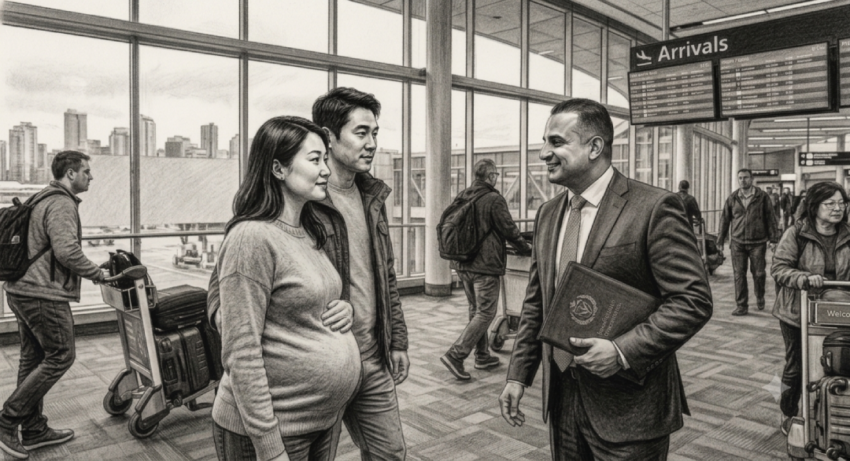
26,000 Babies and a Booming Industry: The Real Scale of Birth Tourism
A Standalone Companion to “Born of the Soil, or Born of Consent?”
❖ ❖ ❖
The Morning After: A Loss at the Court, a New Front at the Department
The ink on the Supreme Court’s decision was scarcely dry. On the morning of June 30, 2026 — in the 250th year of American independence — the Court, in Trump v. Barbara, upheld birthright citizenship by a vote of six to three, striking down the executive order that would have withheld automatic citizenship from children born on American soil to parents unlawfully or temporarily present. Chief Justice Roberts, joined by Justice Barrett and the Court’s three more liberal members, wrote that such children “are citizens at birth.” The administration had lost the constitutional argument and lost it decisively. What happened next is the subject of this companion piece.
Within hours of the ruling, the Justice Department opened a second front. Rather than accept the practice its critics had long decried, the Department moved to attack the fraud and abuse that have grown up around one narrow but symbolically potent corner of the citizenship debate: the phenomenon known as “birth tourism.” If the Constitution, as the Court now reads it, would not permit the government to redefine who is a citizen, the government would instead prosecute those who, it alleged, obtain that citizenship by deceit. The companion essay to this one argued that the Court answered the wrong constitutional question. This segment takes up a narrower and more immediate matter — what the executive branch may lawfully do now that the constitutional question has, for the moment, been answered against it.
❖ ❖ ❖
The McDonald Memorandum: Prosecution as Policy
Hours after the decision was announced, Assistant Attorney General Colin McDonald — head of the Justice Department’s fraud division — circulated a memorandum to Department employees and posted it publicly. Its language was unambiguous. The memo directed all United States Attorneys and the Criminal Division to coordinate with the Department of Homeland Security to prioritize the investigation and prosecution of what it called “birth tourism schemes.”
The Department of Justice will investigate and hold accountable those who engage in this unlawful conduct, as well as those who solicit and sell these criminal services to others. … The Department of Justice will zealously protect the sanctity of United States citizenship by investigating and prosecuting those who fraudulently exploit our immigration system. Together, we will bring illegal birth tourism to an end and those responsible to justice.
— AAG Colin McDonald, DOJ Memorandum, June 30, 2026
The legal theory of the memorandum deserves careful attention, because it reveals both the reach and the limits of what the administration can accomplish without the executive order the Court struck down. Birth tourism, as such, is not the offense; the offense is fraud. The memo instructs prosecutors to consider the full range of existing criminal statutes where the evidence supports them — visa fraud, wire fraud, money laundering, and identity theft. The predicate, as McDonald framed it, is deception at the threshold: foreign nationals who enter on tourist visas after misrepresenting the true purpose and duration of their visit, and the businesses that coach them to conceal a pregnancy from immigration officers and market the entire arrangement as a paid service.
This is a crucial distinction, and honesty requires stating it plainly. The Department is not prosecuting the birth of a child, nor the citizenship that follows from it. A child born on American soil under the rule the Court reaffirmed is a citizen, and nothing in the memorandum purports to alter that. What the Department targets is the fraud — the false statement on the visa application, the concealment, the commercial scheme — that, in the government’s telling, precedes and enables the birth. As McDonald observed in the memo, “the benefits of United States citizenship require little explanation,” and it is precisely because those benefits are so valuable that a market in fraudulent access to them exists at all.
“A Booming Industry”: The Acting Attorney General Speaks
The following afternoon, Acting Attorney General Todd Blanche elaborated on the Department’s intentions at a news conference. His framing was candid about both the scale of the practice and the constraints the ruling imposed. Enforcement, he acknowledged, would now have to run through the tools that remained — chiefly the visa process — rather than through a redefinition of citizenship the Court had foreclosed.
There’s more that DHS can do and the federal government can do in the visa process and the application process to try to minimize or limit the opportunity of folks coming here not to visit, not to do what they say they’re going to do on their visa, but just to have a baby that can be a U.S. citizen. … Everybody should agree that it’s a violation of our laws if your intent in coming here is to have a child to become a United States citizen.
— Acting Attorney General Todd Blanche, July 1, 2026
Blanche described birth tourism as “a booming industry” and said the Department would direct its prosecutors, its Homeland Security Investigations partners, and the FBI to focus on stopping it. His remarks are notable for what they concede as much as for what they promise. They concede that the Supreme Court’s decision limits the administration’s ability to change birthright citizenship through executive action — the very point pressed in the companion essay’s critique of the ruling. And they pivot, accordingly, to the enforcement of laws already on the books. This crackdown did not arise from nothing; it builds on a DHS “Birth Tourism Initiative” launched in April 2026, and on a handful of prosecutions in prior years that focused primarily on visa fraud. What is new is the priority, the coordination, and the breadth of the statutes now to be brought to bear.
❖ ❖ ❖
How Large Is the Problem? A Sober Look at the Numbers
A responsible examination must resist the temptation to inflate. The rhetorical power of “birth tourism” far exceeds its demonstrated scale, and an argument that rests on exaggeration invites its own refutation. The honest figures are these.
Reliable data on birth tourism is genuinely hard to obtain, because the conduct is by design concealed. The most expansive — and contested — estimate, derived from a review of U.S. Census Bureau data, suggests that as many as 26,000 babies born in the United States each year might be attributable to birth tourism. That number should be handled with care in two directions at once. It is, on the one hand, a meaningful figure: 26,000 is not trivial, and each case the government can prove represents a real fraud on the immigration system. On the other hand, it is a tiny fraction of the more than 3.5 million children born in the United States annually — well under one percent. Birth tourism is a real abuse, but it is a narrow one, and any claim that it drives the broader immigration picture would be an overstatement the evidence cannot support.
The comparative context is likewise worth stating accurately. According to the Pew Research Center, the American rule of near-universal birthright citizenship is uncommon by global standards: only thirty-two other countries — most of them in the Western Hemisphere, including Canada, Mexico, and Brazil — extend automatic citizenship to nearly everyone born on their soil. Most nations in Europe, Asia, and the Middle East instead tie citizenship to a parent’s nationality or legal residence. This does not, by itself, establish that the American rule is wrong; a policy is not mistaken merely because it is unusual. But it does refute the frequent claim that the American approach is the world’s norm, and it locates the birth-tourism problem in its proper frame: the very generosity that makes American citizenship uniquely valuable is what creates a market for obtaining it by fraud.
❖ ❖ ❖
The National-Security Dimension
Beyond the immediate question of immigration fraud lies a concern that both the McDonald memo’s defenders and the administration’s critics have acknowledged from opposite sides: the national-security implications of a citizenship that attaches automatically, without regard to allegiance or intent. A child who receives citizenship at birth may, decades later, become eligible for positions involving sensitive government, defense, or technology work. The overwhelming majority of such children will never pose any threat whatsoever, and it would be both unjust and analytically lazy to suggest otherwise. But the structural vulnerability is real, and it does not depend on impugning any individual.
The concern has been voiced across the spectrum. Justice Alito, in his dissent from the Barbara ruling, warned of the national-security stakes. Briefs before the Court raised the prospect that a hostile intelligence service could arrange for an expecting mother to bear a child on American soil, thereby securing for a future asset the access and cover that citizenship confers. Reporting on the phenomenon has focused particular attention on sophisticated birth-tourism operations linked to foreign states, including concerns about the Chinese Communist Party’s interest in cultivating long-term access inside the United States. The point is not to indulge alarm or to paint every family with a broad brush — it is to observe that a rule of membership indifferent to allegiance is, at the margin, a rule indifferent to the very concern the framers wrote into the word “jurisdiction.” That is the constitutional argument the companion essay develops at length; here, it is enough to note that the enforcement response and the constitutional critique rest on the same underlying worry.
❖ ❖ ❖
The Wider Response: Congress, Critics, and the Limits of Enforcement
The Department’s move did not occur in a vacuum, and a fair account must include the range of reactions and the objections raised against the crackdown.
The congressional and executive response
On Capitol Hill, the ruling drew calls for legislative and constitutional action. House Speaker Mike Johnson told reporters that birthright citizenship had been “overused and abused” and signaled continued attention to the issue. Representative Andy Ogles introduced the “Anchors Away Act,” and Senator Markwayne Mullin — following what he described as a lengthy White House conversation — pointed specifically to the misuse of tourist visas to give birth. Within the administration, adviser Stephen Miller suggested that the government might scrutinize, or even restrict, the entry of pregnant visitors. President Trump himself, while calling the decision “too bad for our Country,” urged Congress to take up the matter through legislation, insisting that no “long and unwieldy Constitutional Amendment” would be necessary. Whether that is legally correct is itself contested, and Justice Kavanaugh’s concurrence pointedly noted that Congress “has not yet” enacted any such exception.
The objections, fairly stated
Critics of the crackdown raise several points that deserve a hearing rather than a dismissal. The first is a concern about proportion: if birth tourism accounts for well under one percent of American births, is a Department-wide prosecutorial priority a measured response, or does it risk expending scarce enforcement resources on a symbolic target? The second is a concern about method: prosecuting under fraud, wire-fraud, and money-laundering statutes conduct whose gravamen is a misrepresentation of intent invites difficult questions of proof, for intent at the border is notoriously hard to establish, and an aggressive reading risks sweeping in visitors whose plans changed after arrival. The third is a concern about scope creep: proposals to bar pregnant travelers outright would burden lawful visitors and raise their own legal and humanitarian questions.
These objections have force, and the honest response is not to wave them away but to answer them. On proportion: the value of enforcement here is not measured only by the raw number of cases but by the integrity of the system and the deterrence of an organized, commercialized fraud — the memo targets not the individual mother so much as the businesses that “solicit and sell these criminal services.” On method: the requirement that the government prove fraudulent intent is a safeguard, not merely an obstacle; it confines prosecution to cases where deception can actually be established and leaves the visitor whose circumstances genuinely changed outside the statute’s reach. On scope creep: the concern is a reason to watch the implementation closely and to insist that enforcement remain tethered to demonstrable fraud, not a reason to abandon the enforcement of laws that already exist. Even John Yoo — a defender of the traditional constitutional rule — has argued that the better course is precisely to “more vigorously enforce visas and to shut down businesses that encourage and enable birth tourism.” That a prominent defender of birthright citizenship endorses this very remedy suggests the enforcement response occupies more common ground than the heated rhetoric on either side would imply.
❖ ❖ ❖
Conclusion: The Question Has Not Gone Away
The Supreme Court has, for now, settled the constitutional question of who is a citizen. It has not — and could not — settle the deeper political question of what a self-governing people owes to the integrity of its own citizenship. The Justice Department’s turn to birth tourism is, in one sense, a modest and defensible response: it prosecutes fraud that has always been unlawful, it targets the commercial schemes rather than the children, and it does so through statutes long on the books. It is not a redefinition of citizenship by the back door, and it should not be mistaken for one.
In another sense, the crackdown is an admission — an acknowledgment that the executive branch, having lost the argument it most wanted to win, will now do what remains within its lawful power. The companion essay to this piece argued that Trump v. Barbara left an open question rather than closing one, and the response of the political branches confirms as much: a Speaker declaring the practice abused, a bill named for anchor babies, senators and advisers weighing further limits, and a President directing the matter to Congress. A decision that draws such a response is not the final word.
What the birth-tourism enforcement makes clear is that the debate over citizenship has shifted, not ended. The constitutional front is quiet for now; the enforcement front, the legislative front, and — in this 250th year of American independence — the deeper argument about what citizenship means remain very much alive. The Court preserved birthright citizenship in its broadest form. It did not resolve the question of whether that form is the one the Founders intended, nor the question of how a nation protects a status this valuable from those who would obtain it by fraud. Those questions belong now to the people and their representatives — which is, perhaps, where they always belonged.
❖ ❖ ❖
Primary Sources and Citations
The following sources were consulted for this segment. Direct quotations are kept brief and attributed to their speakers and publications; readers are encouraged to consult the originals in full.
• Elizabeth Stauffer, “DOJ Takes Aim at Birth Tourism After Supreme Court Upholds Birthright Citizenship,” Legal Insurrection (July 2, 2026): https://legalinsurrection.com/2026/07/doj-takes-aim-at-birth-tourism-after-supreme-court-upholds-birthright-citizenship/
• “DOJ to Prioritize ‘Birth Tourism’ Probes Following Supreme Court’s Birthright Citizenship Decision,” TIME (July 1, 2026): https://time.com/article/2026/07/01/doj-birth-tourism-birthright-citizenship-supreme-court/
• “Federal prosecutors directed to prioritize ‘birth tourism’” — The Hill (DOJ response, incl. 26,000 estimate): https://thehill.com/regulation/court-battles/5949859-birthright-citizenship-ruling-doj-response/
• Pew Research Center, “U.S.-style birthright citizenship is uncommon around the world” (Mar. 31, 2026): https://www.pewresearch.org/short-reads/2026/03/31/us-style-birthright-citizenship-is-uncommon-around-the-world/
• SCOTUSblog, “Supreme Court strikes down Trump’s order ending birthright citizenship” (Trump v. Barbara, 6–3): https://www.scotusblog.com/2026/06/supreme-court-strikes-down-trumps-order-ending-birthright-citizenship/
• Executive Order 14160, “Protecting the Meaning and Value of American Citizenship” (Jan. 20, 2025): https://www.whitehouse.gov/presidential-actions/2025/01/protecting-the-meaning-and-value-of-american-citizenship/
❖ ❖ ❖
A Note on Research Methods and Accuracy
In recent years, some have voiced concern that artificial intelligence may distort facts or introduce inaccuracies into serious research. That criticism deserves acknowledgment. However, AI has now evolved into the most powerful research instrument available to any dedicated scholar—capable of analyzing vast datasets, cross‑referencing historical records, and surfacing overlooked connections across sources. This work represents a collaboration between the author’s investigative inquiry, verified primary documentation, and the advanced analytic capabilities of AI research tools. Here, AI was not used as a ghostwriter or a shortcut for scholarship, but as a disciplined research partner devoted to rigor, accuracy, and transparency.
Every factual claim in this work has been subjected to active verification. Where AI‑generated content was used as a starting point, it was tested against primary sources, peer‑reviewed scholarship, official institutional documentation, and established historical records. Where discrepancies were found—and they were found—corrections were made. The author has made every reasonable effort to ensure that quotations are accurately attributed, historical details are precisely rendered, and theological claims fairly represent the positions they describe or critique.
That said, no work of this scope is immune to error, and the author has no interest in perpetuating inaccuracies in the service of an argument. If you are a reader—whether sympathetic, skeptical, or hostile to the conclusions drawn here—and you identify a factual error, a misattributed source, a misrepresented teaching, or a claim that cannot be substantiated, you are warmly and genuinely invited to say so. Reach out. The goal of this work is not to win a debate but to get the history right. Corrections offered in good faith will be received in the same spirit, and verified corrections will be incorporated into future editions without hesitation.
Truth, after all, has nothing to fear from scrutiny—and neither does this work.