
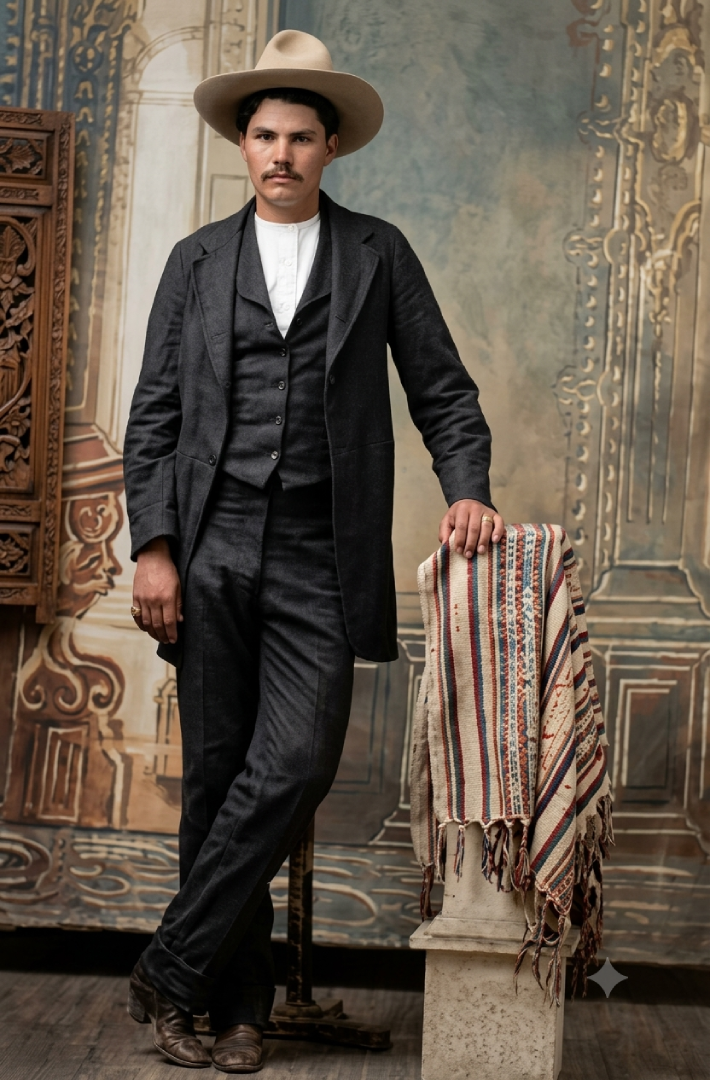
The True Story of John Wesley Hardin: A Narrative History (1853 ~ 1895)
✦ ✦ ✦
A Preacher’s Son in a Burning Land
He was named for a man who spent his life trying to save souls, and he spent his own taking lives. The irony was not lost on the people of Texas, and it would not be lost on the boy himself. John Wesley Hardin—christened after the founder of Methodism, the great English revivalist whose hymns and sermons had stirred two continents—grew into the deadliest pistol-fighter the Texas frontier ever produced. By the time a constable’s bullet caught him in the back of the head in an El Paso saloon, contemporaries and historians alike struggled to count his dead. He claimed more than forty. Newspapers of his own day credited him with twenty-seven. Sober modern scholarship can verify perhaps eleven beyond dispute, while conceding the true number likely ran past twenty and may have approached the higher figures.
That uncertainty is itself the beginning of the story. Hardin is one of those rare historical figures who left us his own confession—a jailhouse autobiography, written in a clear and self-justifying hand—and yet the document deepens the mystery rather than resolving it. He was, as one Texas chronicler put it, an unusual type of killer: a handsome, gentlemanly man who considered himself a pillar of society. To read him is to meet a man permanently convinced of his own innocence, a gunman who quoted Scripture and kept a ledger of grievances against a world he believed had wronged him first.
This is not a simple tale of a black hat against the white hats. The frontier that made Hardin was a place of genuine moral chaos—occupied Texas under Reconstruction, where the lines between law and lawlessness, justice and vengeance, were drawn and redrawn by whoever held the most guns on a given afternoon. To understand him, we have to hold two things at once: the romantic American myth of the lone shootist, master of his own fate, and the squalid, bloody reality of a young man who killed his first human being at fifteen and never stopped until he was stopped. The space between those two pictures—the legend and the corpse-count—is where the real John Wesley Hardin lived and died.
✦ ✦ ✦
Origins: The Circuit Rider’s Boy
John Wesley Hardin was born on May 26, 1853, near Bonham, in Fannin County, Texas. His father, James Gibson “Gip” Hardin, was a Methodist preacher and circuit rider who also taught school and read law—a man of standing in his community who rode a wide loop of central Texas bringing the Gospel to scattered settlements before fixing his family at Sumpter, in Trinity County. Hardin’s mother, Mary Elizabeth Dixson, he would later describe in tender, idealized terms, writing that charity predominated in her disposition. The boy was the second surviving son among ten children, and the family was no rough clan of drifters: the Hardins were Southerners of political prominence, with congressmen and colonels among their kin.
It mattered enormously that Hardin came of age exactly when the South lost the Civil War. He was a boy of nine when his father was elected a Confederate captain, and nine when he first tried to run away to join the Confederate army. He reached adolescence in the defeated, occupied South of Reconstruction—a Texas patrolled by a Union-allied state police force in which former slaves now wore badges and carried rifles. Hardin absorbed the resentments of his people whole. Britannica states the matter plainly:
Reaching adolescence as the defeated South entered the Reconstruction period, Hardin was virulently antiblack and anti-Yankee and, in 1868 at the age of 15, killed his first man, an ex-slave.
— Encyclopædia Britannica, “John Wesley Hardin”
His violence announced itself in the schoolhouse. In 1867, taunted by a classmate named Charles Sloter who accused him of writing insulting graffiti about a girl, Hardin denied it, was charged at with a knife, and stabbed the other boy nearly to death. He was almost expelled. The pattern—an insult, a flash of rage, a blade or a barrel answering it—was already set. The preacher’s son had a temper that no sermon could reach.
✦ ✦ ✦
First Blood: The Killing of Maje
In November 1868, fifteen years old, Hardin wrestled and threw a freedman known as Maje—Major Holshousen, who had taken the name of his former owner. By Hardin’s account, the humiliated man ambushed him on the road the next day, waving a stick and grabbing his horse’s bridle, and Hardin shot him loose. In the autobiography, he tells it as something close to self-defense, even pausing to note that he rode for help. Maje died three days later. Hardin’s own words, preserved by the gun-writer Massad Ayoob, render the killing in the flat, justifying cadence that would mark every confession he ever made:
He struck me, and as he did it I pulled out a Colt’s .44 six-shooter and told him to get back. By this time he had my horse by the bridle, but I shot him loose. He kept coming back, and every time he would start I would shoot him again and again until I shot him down.
— John Wesley Hardin, quoted in American Handgunner
It is worth pausing here, because this first killing already contains the whole problem of Hardin’s life. There is another version. A Freedmen’s Bureau agent recorded that Hardin shot Maje simply because the freedman had objected to being abused. After all, a Black man had dared to stand up for himself before a white boy who, a few years earlier, could have expected the protection of the old order. The historian cannot finally adjudicate between the two accounts. But the divergence is the point: from his very first corpse, Hardin narrated his violence as a response to provocation, while the surrounding record suggests a young man steeped in the racial fury of his time and place, killing because he could and because he believed he would face no consequence.
He was wrong about the consequences. With Reconstruction authorities looking for him, his father sent him into hiding, convinced the boy could never get a fair hearing in a Union-occupied state. Thus began the central condition of Hardin’s existence: he was a fugitive at fifteen, and he would be a fugitive, in one form or another, for nearly the whole of his adult life. He claimed that soldiers sent to arrest him met his shotgun and pistol at a creek crossing, and that by the fall of 1868, he had killed four men. Crucially, the military records do not name him as a suspect in any such ambush. Here is the historian’s caution, marked plainly: much of what Hardin tells us of these earliest killings cannot be confirmed, and some of it conflicts with the documentary record. We are already in the territory where the legend outruns the evidence.
✦ ✦ ✦
The Chisholm Trail and the Making of a Gunman
Unable to stay home, Hardin drifted into the work that the post-war Texas economy offered a young man on the run: he became a cowboy, joining cousins among the Clements family who suggested he could make money driving cattle north to Kansas. In the spring of 1871, at seventeen, he went up the Chisholm Trail toward Abilene as a trail hand—soon, by his own telling, as a trail boss. The drive north was, in the mythology, a rite of passage. For Hardin, it was a corridor of killing.
Along the route, he tangled with Mexican vaqueros whose herd crowded his own. After an exchange of shots in which his worn cap-and-ball pistol nearly failed him, he borrowed a working revolver and hunted the man down. He claimed five or six dead in the running fight that followed; contemporary Kansas newspapers confirm that three Mexican herders were killed near Park City—a smaller, grimmer number than the legend, and a characteristic gap between Hardin’s arithmetic and the record’s. The History Channel’s account of his arrival at Abilene captures both the brutality and the youth of the killer:
During the cattle drive, a Mexican herd crowded Hardin’s animals from behind. Hardin complained to the Mexican in charge of the other herd, and when the exchange grew heated, shot him through the heart.
— HISTORY, “John Wesley Hardin arrives in Abilene”
It was in Abilene that Hardin’s path crossed the most famous lawman of the age, and produced the single most disputed episode in his entire saga.
✦ ✦ ✦
Wild Bill Hickok and the Border Roll
James Butler “Wild Bill” Hickok was the town marshal of Abilene in 1871, a celebrated gunfighter whose reputation Hardin both envied and coveted. The young Texan was operating under an alias—”Wesley Clemmons,” though the townspeople knew him better as “Little Arkansaw,” a nickname Hickok himself may have bestowed. By Hardin’s account, when Hickok confronted him over the town ordinance against carrying guns and demanded his pistols, Hardin handed them over butt-forward and then spun them in a single fluid motion until the muzzles stared Hickok in the face—the maneuver later romanticized on film as the “border roll” or “Curly Bill spin.” Hardin’s own dialogue, as he set it down, has Hickok surrendering with grace:
Bill said, “You are the gamest and quickest boy I ever saw. Let us compromise this matter and I will be your friend. Let us go in here and take a drink, as I want to talk to you and give you some advice.”
— John Wesley Hardin, The Life of John Wesley Hardin As Written by Himself
Did it happen? Here, the responsible storyteller must step back and show his hand. The episode is among the most contested in Western history, and the disagreement is instructive about the whole problem of Hardin as a source. Some who knew the principals defended the tale: Hardin’s friend Fred Duderstadt claimed to have witnessed it, and a friend of Hickok’s, George Coulter, said Hickok spared Hardin only because he noticed the young man had not cocked his revolvers. Yet many historians are equally certain it was Hickok who disarmed Hardin, not the other way around, and some hold that the famous showdown never occurred at all.
The writer Jesse “Wolf” Hardin—no relation, but a careful student of frontier gunmanship—lays out the common-sense case against the legend with real force, and his reasoning deserves to be heard in full:
Had it happened the way described, the loss of face would have demanded timely retribution, not Bill supposedly saying, “Let us compromise this matter, and I will be your friend.” A frontier gunman’s chances of surviving the week depended as much as anything else on their perceived invulnerability, and no lawman could keep the peace after being seen publicly backing down.
— Jesse L. “Wolf” Hardin, Legends of America
What is generally conceded is the quieter and more telling fact underneath the duel: Hickok knowingly let the young Texan go armed in a town where guns were forbidden to everyone else. Dr. Richard Marohn, a psychiatrist who studied Hardin closely, read the relationship as hero-worship—the cocky teenager idolizing the celebrated marshal, the older man respectful enough not to force a fatal confrontation over pride. Hardin’s own verdict on Hickok was admiring: he had a fine sense and was a splendid judge of human nature. The legend of the border roll may be false in its particulars and still true in what it reveals—that Hardin needed, above all, to believe he had bested the best.
✦ ✦ ✦
The Man Who Was Shot for Snoring
If one anecdote made Hardin immortal in American folklore, it was this one—the killing so casually cruel that it became a punchline in twentieth-century television commercials. On the night of August 6, 1871, Hardin and his cousin Gip Clements bedded down at the American House Hotel in Abilene after a long evening of drinking and gambling. In the adjoining room, a man named Charles Couger snored. Hardin shouted at him to roll over. When the snoring continued, the drunk and irritated gunman fired several bullets through the shared wall—and one of them struck Couger in the heart, killing him instantly in his bed.
Whether Hardin meant only to startle the man awake or simply did not care is a question his own contradictory accounts cannot settle; in his autobiography years later, he omitted the snoring entirely and recast the death as self-defense against a knife-wielding burglar. What is certain is that he fled half-dressed across the hotel roof, terrified that Hickok would kill him on sight, and hid in a haystack until dawn. His reasoning, recorded later, is a small masterpiece of self-dramatizing fear:
I believed that if Wild Bill found me in a defenseless condition, he would take no explanation, but would kill me to add to his reputation.
— John Wesley Hardin, quoted by HISTORY
The killing of Couger gave rise to the line that would outlive every other thing Hardin ever said—his weary, almost aggrieved correction of the growing legend, which manages to be both a denial and the most damning confession imaginable:
They tell lots of lies about me. They say I killed six or seven men for snoring. Well, it ain’t true. I only killed one man for snoring.
— John Wesley Hardin
It is the perfect Hardin utterance: defensive, self-pitying, and casually homicidal all at once. He is offended by the exaggeration and entirely untroubled by the fact at its core. That single sentence does more to illuminate his psyche than any biographer’s analysis, because in it we hear a man who has so thoroughly normalized killing that he can quibble over the body count of a sleeping stranger as though correcting a misremembered card score.
✦ ✦ ✦
Blood and Kin: The Sutton–Taylor Feud
Back in Texas, Hardin married Jane Bowen in early 1872 and tried, in fits, to settle. A son and two daughters came out of the marriage. But settling was never in him. He was drawn, by blood and temperament, into the Sutton–Taylor feud, one of the longest and bloodiest of the Reconstruction-era Texas vendettas, allying himself with the Taylor faction against the Sutton forces and their allies in the hated state police.
His notoriety in the feud rested above all on the killing of two lawmen tied to the Suttons. On July 18, 1873, he killed DeWitt County deputy J.B. Morgan, and that same day shot down Sheriff Jack Helm, a former state police captain and a man widely loathed among ex-Confederates as a Union loyalist hard on Southern men. The Helm killing, tellingly, won Hardin applause rather than condemnation in his own community. The frontier’s moral arithmetic ran on faction: the same act that made a man a murderer to one side made him a champion to the other. The Texas State Historical Association traces his entanglement soberly:
He broke jail in October and began stock raising but was drawn into the Sutton-Taylor Feud in 1873–74. He aligned himself with Jim Taylor of the anti-Reconstruction forces and killed the opposition leader, Jack Helm, a former State Police captain.
— Leon C. Metz, Handbook of Texas Online
But the killing that would finally undo him was of a different kind—not a hated partisan, but a popular man.
✦ ✦ ✦
Comanche, 1874: The Killing That Could Not Be Forgiven
On May 26, 1874—his twenty-first birthday—Hardin was in Comanche, Texas, flush with winnings from the horse races and drinking hard, when Brown County deputy sheriff Charles Webb appeared. Accounts of what passed between them differ, as everything about Hardin differs, but the result does not: Webb lay dead, shot in the gunfight that erupted, with Hardin’s companions Jim Taylor and Bud Dixon firing into him as he fell. Hardin’s own version, predictably, casts him as the man who merely answered a drawn pistol:
As I turned around, I saw Charles Webb drawing his pistol. He was in the act of presenting it when I jumped to one side, drew my pistol, and fired. … My aim was good and a bullet hole in the left cheek did the work.
— John Wesley Hardin, quoted in American Handgunner
Whatever the precise truth, the killing of Webb was Hardin’s ruin, for a reason that had nothing to do with law and everything to do with sentiment. Helm had been hated; Webb was liked. As Jesse Hardin observes, the populace that had cheered the death of a Union man recoiled at the death of a popular one, and the support that had sheltered Hardin for years evaporated. The vengeance fell not on Hardin, who escaped, but on his kin. A lynch mob seized and hanged his brother Joe and his cousins Bud and Tom Dixon. As many as eight of his friends and family would die in the aftermath—scapegoats for a man the mob could not catch.
In one of the rare passages where the mask of self-justification slips, Hardin grieved the wreckage his life had left among the people who loved him—a confession of consequence, if never quite of guilt:
[My acts had] drove my father to an early grave … almost distracted my mother … killed my brother Joe and my cousins Tom and William … left my brother’s widow with two helpless babes … to say nothing of the grief of countless others.
— John Wesley Hardin, The Life of John Wesley Hardin As Written by Himself
It is as close to remorse as he ever came. And even here, note what is absent: any admission that he might have chosen otherwise. The grief is real; the responsibility remains, in his telling, somehow always someone else’s.
✦ ✦ ✦
The Long Hunt and the Snagged Suspender
Now came the years of flight. Texas posted a reward of four thousand dollars for him, dead or alive—the largest the state had yet offered for a single man. Hardin moved his family to Florida and Alabama and became, to his new neighbors, one “J. H. Swain,” a name he borrowed from a marshal who had married into his family. For a time, the alias held. What broke it was not detective work but a drunken brawl: his brother-in-law Brown Bowen, beaten in a fight, blustered that his friend Swain was really the notorious Hardin and would come to avenge him. Word reached the authorities, and a trap was set.
On a train at Pensacola in August 1877, Texas Ranger John Armstrong and a body of local lawmen closed in. Hardin reached for the .44 he had hidden too well beneath his leather suspenders—and the hammer snagged. The most dangerous quick-draw artist of the frontier was clubbed unconscious before he could clear leather, while a companion who did manage to fire was shot through the heart. The detail is almost unbearably ironic, and it would echo at the very end of his life: the man whose entire identity rested on the speed of his hands was twice betrayed by his own clothing. The old west site recounts the scene:
Hardin reached into his coat to draw his weapon but it got tangled in his suspenders. … In retaliation, Armstrong shot him through the heart. … the Ranger countered by pistol-whipping the desperado in the head. Wes Hardin fell unconscious and was captured at long last.
— OldWest.org, “8 Murderous Facts about John Wesley Hardin”
He was tried at Comanche for the murder of Charles Webb—the one killing, of all his many, that the state could make stick—and on September 28, 1878, sentenced to twenty-five years at hard labor in the penitentiary at Huntsville. He was twenty-four years old.
✦ ✦ ✦
Huntsville: The Outlaw Who Studied Law
Prison did not break Hardin so much as slowly, partially remake him. The early years were defiant—repeated escape attempts, floggings, solitary confinement, a litany of disciplinary citations for mutinous conduct and conspiracy. He was once part of a scheme that tunneled to within reach of the prison armory before it was discovered. But over seventeen years, the fever cooled. He read theological books and became superintendent of the prison Sunday school—the preacher’s son surfacing, improbably, in a convict’s cell. And he studied law, with the discipline of a man who had finally found a fight he could win with his mind.
The sorrows of those years were heavy. His mother had died during his imprisonment; his young son died in early 1893; and his faithful wife Jane, who had endured poverty and separation without complaint, died in November 1892—only a little more than a year before his release. The letters he wrote her from prison show a tenderness that sits strangely beside the body count, a man capable of genuine devotion to the few he loved, even as he dealt death to strangers over a snore or a card game:
Do you think that it would be impossible for me to forget you, one whom you well know I love and adore above all others …? I remain your true and devoted husband. Until death.
— John Wesley Hardin, prison letter to his wife Jane
On February 17, 1894, having served roughly seventeen years of his sentence, Hardin walked out of Huntsville with a new suit and a state check for just under fifteen dollars. A month later, on March 16, the governor pardoned him; in July, he passed the Texas bar examination and was licensed to practice law. The transformation seemed, on paper, complete: the deadliest gunman in Texas history was now an attorney and an officer of the court. It would not last a year and a half.
✦ ✦ ✦
El Paso: The Lawyer at the Card Table
The free world that received Hardin in 1894 was not the one he had left. The open frontier was closing; the Indian wars were ending; electric lights, telephones, and railroads were knitting the West into the modern nation. A man whose entire capital was a reputation for face-to-face violence found that capital suddenly worthless—worse than worthless, a liability. His own children, who had grown up without him, wanted little to do with the reformed convict. A brief marriage to a fifteen-year-old girl named Callie Lewis collapsed within weeks.
He drifted to El Paso, hung out his shingle, and discovered that few respectable clients would trust their affairs to an ex-convict gunman. The law practice withered; the whiskey and the gambling tables did not. Jesse Hardin’s portrait of these last months is among the most affecting in the literature—a study of a man stranded by history, reaching for the only tools that had ever made him feel powerful:
Guns became the buddies that would never let him down, the girlfriend that would never leave, the wife that would never be taken away from him by disaster or disease.
— Jesse L. “Wolf” Hardin, Legends of America
His undoing in El Paso came, as so often, through a woman and a quarrel. He took as his lover Beulah M’Rose (the name appears as Mroz, McRose, and Morose in various records), the wife of a client—a cattle thief who had fled to Mexico. When M’Rose was killed in a controversial border encounter by lawmen, including Hardin’s acquaintances, rumor held that Hardin himself had arranged the killing. Then young officer John Selman, Jr., arrested Beulah for carrying a pistol in violation of El Paso’s new firearms ordinance, and Hardin, enraged—and perhaps jealous—made it loudly known that he was out for the younger Selman’s blood.
Word of the threat reached the young officer’s father, Constable John Selman, Sr., himself an aging and formidable gunman who had killed the rogue ex-Ranger Bass Outlaw. The stage was set, and Hardin—who had survived two decades of men hunting him—seemed almost to be daring the end to come.
✦ ✦ ✦
“Four Sixes to Beat”: The Acme Saloon
On the night of August 19, 1895, John Wesley Hardin stood at the bar of the Acme Saloon, rolling dice, his back to the swinging doors. His last recorded words were a wager: “Four sixes to beat.” Shortly before midnight, John Selman, Sr., entered, walked up behind him, and shot him in the back of the head. As Hardin lay on the floor, Selman fired three more rounds into his body. The deadliest pistoleer of the Texas frontier died without clearing his own gun—his hand, witnesses said, found only on the grip of a revolver tucked in his waistband.
The end recapitulated the irony of his capture two decades earlier. Some students of the killing believe Hardin glimpsed Selman in the great saloon mirror and went for his weapon, only to have the hammer snag once more on his clothing; if so, the two hours of daily quick-draw practice his landlady reported availed him nothing at the final test. Massad Ayoob records the grim local epitaph that fixed the ambiguity forever—the question of whether Hardin was shot from the front or behind dissolving into dark frontier wit:
An El Paso minister famously said at the time if Hardin was shot from the front, it was remarkably good marksmanship, and if he was shot from behind, it was remarkably good judgment.
— Massad Ayoob, American Handgunner
Selman claimed self-defense, was tried, and—after a hung jury—was never retried; he was himself killed in a gunfight with a U.S. marshal the following spring. An El Paso jury, the History Channel notes drily, apparently felt that Selman had done the town a favor and acquitted him of any wrongdoing. Hardin was buried the next day in Concordia Cemetery, El Paso, where his grave remains—the subject, a full century later, of a bizarre legal tug-of-war between descendants who wished to move his body and locals who fought to keep it, each side accused of coveting the tourist revenue a dead gunman still generated.
✦ ✦ ✦
The Reckoning: Myth, Memory, and the Shootist
What are we to make of him? The temptation, on both sides, is to flatten Hardin into something simpler than he was—either the dashing shootist of the dime novels and the Time-Life commercials, or a mere psychopath with a fast hand. The truth resists both. The most penetrating modern reading comes from Dr. Richard Marohn, the psychiatrist-biographer, who concluded that Hardin displayed the classic signs of narcissistic personality disorder—a man whose flamboyant reputation as a killer defined his life, not only to historians but to himself as he lived it. The autobiography, on this reading, is not merely an apologia but a symptom: the compulsive self-justification of a man who could never once locate the fault in himself.
And yet to leave it at pathology is to miss what the frontier itself contributed. Hardin was, in a real sense, a product of his moment—a Southern boy radicalized by defeat and occupation, handed a culture in which personal honor was enforced at gunpoint, and the machinery of law was itself an instrument of one faction against another. The “shootist” was a recognized type, neither bushwhacker nor assassin, who acted out of a kind of moral certainty—adhering to his own code even while breaking the law. Hardin embodied that type to its logical and lethal extreme. He genuinely believed, to the end, what the Handbook of Texas records as his creed:
He was a handsome, gentlemanly man who considered himself a pillar of society, always maintaining that he never killed anyone who did not need killing and that he always shot to save his own life.
— Leon C. Metz, Handbook of Texas Online
There is the whole tragedy in a sentence. He always shot to save his own life—and he was rarely not in a situation where his own choices had put his life at risk. The self-defense was real to him precisely because he could not see the man holding the gun. The deeper tension that runs beneath the myth of every gunfighter runs beneath Hardin most of all: the legend promises mastery, autonomy, a man who bends fate to his will; the reality delivers a fugitive’s loneliness, a trail of grieving widows and lynched kinsmen, and a death from behind in a saloon, gun snagged in his waistband, dice still rattling on the bar.
For the reader who comes to Hardin looking for a hero, he disappoints; for the reader who comes looking for a monster, he unsettles—because the monster quoted Scripture, loved his wife until death, ran a prison Sunday school, and passed the bar. He is finally most valuable not as a hero or a villain but as a mirror held up to a violent age and to the violence that any age can rationalize. The preacher’s son spent his life insisting he had only ever done right. The forty graves, real and disputed, say otherwise. And in the unbridgeable distance between his testimony and those graves lies the enduring, troubling fascination of John Wesley Hardin—the man named for a saint who became the gospel of the gun.
✦ ✦ ✦
Primary & Reference Sources
The following sources were consulted in the preparation of this narrative. Direct quotations are attributed in the text; the documentary record was cross-checked across multiple sources wherever Hardin’s own autobiography was the sole or doubtful authority.
• Wikipedia, “John Wesley Hardin” https://en.wikipedia.org/wiki/John_Wesley_Hardin
• Jesse L. “Wolf” Hardin, “John Wesley Hardin & The Shootist Archetype,” Legends of America https://www.legendsofamerica.com/we-johnwesleyhardin/
• Leon C. Metz, “Hardin, John Wesley,” Handbook of Texas Online (Texas State Historical Association) https://www.tshaonline.org/handbook/entries/hardin-john-wesley
• “John Wesley Hardin killed in Texas,” HISTORY (This Day in History) https://www.history.com/this-day-in-history/august-19/john-wesley-hardin-killed-in-texas
• “Old West outlaw John Wesley Hardin arrives in Abilene,” HISTORY https://www.history.com/this-day-in-history/june-1/john-wesley-hardin-arrives-in-abilene
• “John Wesley Hardin,” Encyclopædia Britannica https://www.britannica.com/biography/John-Wesley-Hardin
• Massad Ayoob, “The Lessons of John Wesley Hardin,” American Handgunner https://americanhandgunner.com/discover/the-lessons-of-john-wesley-hardin/
• Austin Harvey, “The Wild Story of John Wesley Hardin,” All That’s Interesting https://allthatsinteresting.com/john-wesley-hardin
• “8 Murderous Facts about John Wesley Hardin,” OldWest.org https://www.oldwest.org/john-wesley-hardin/
• John Wesley Hardin, The Life of John Wesley Hardin As Written by Himself (Seguin, Tex.: Smith & Moore, 1896) https://archive.org/details/lifeofjohnwesley00hard
A Note on Research Methods and Accuracy
In recent years, some have voiced concern that artificial intelligence may distort facts or introduce inaccuracies into serious research. That criticism deserves acknowledgment. However, AI has now evolved into the most powerful research instrument available to any dedicated scholar—capable of analyzing vast datasets, cross‑referencing historical records, and surfacing overlooked connections across sources. This work represents a collaboration between the author’s investigative inquiry, verified primary documentation, and the advanced analytic capabilities of AI research tools. Here, AI was not used as a ghostwriter or a shortcut for scholarship, but as a disciplined research partner devoted to rigor, accuracy, and transparency.
Every factual claim in this work has been subjected to active verification. Where AI‑generated content was used as a starting point, it was tested against primary sources, peer‑reviewed scholarship, official institutional documentation, and established historical records. Where discrepancies were found—and they were found—corrections were made. The author has made every reasonable effort to ensure that quotations are accurately attributed, historical details are precisely rendered, and theological claims fairly represent the positions they describe or critique.
That said, no work of this scope is immune to error, and the author has no interest in perpetuating inaccuracies in the service of an argument. If you are a reader—whether sympathetic, skeptical, or hostile to the conclusions drawn here—and you identify a factual error, a misattributed source, a misrepresented teaching, or a claim that cannot be substantiated, you are warmly and genuinely invited to say so. Reach out. The goal of this work is not to win a debate but to get the history right. Corrections offered in good faith will be received in the same spirit, and verified corrections will be incorporated into future editions without hesitation.
Truth, after all, has nothing to fear from scrutiny—and neither does this work.