
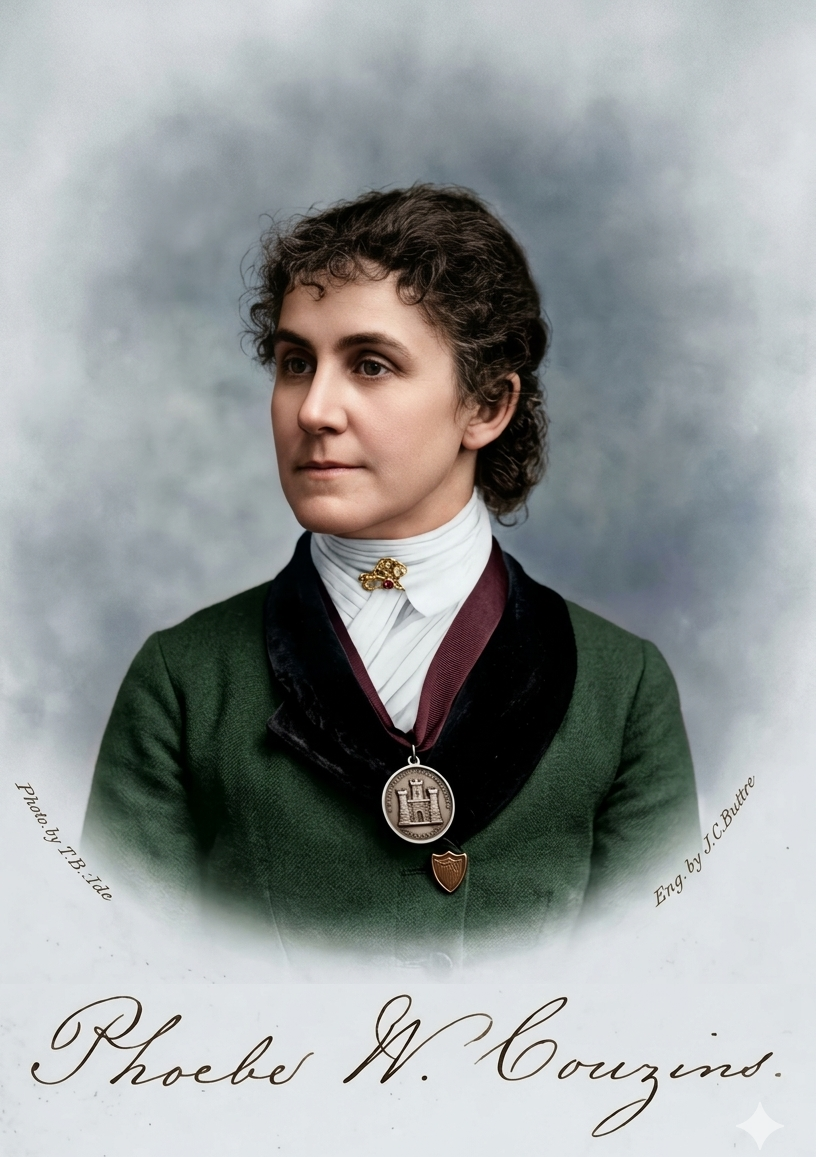
The Improbable Life of Phoebe Couzins — Lawyer, Lawwoman,
and the West’s Unlikeliest Pioneer
1842 – 1913
❦ ❖ ❦
A Star Pinned to a Silent Blouse
On a raw December morning in 1913, six mourners gathered at Bellefontaine Cemetery in St. Louis to bury a woman the nation had once strained to hear. Inside the casket, pinned to the breast of a body wasted by arthritis and poverty, glinted a small metal star — the badge of a United States Marshal. She had asked to be buried wearing it, and the request was honored even though almost nothing else in her final years had been. The mourners were her brother and a handful of friends; a childhood acquaintance had paid for the grave. There was no eulogy from the suffrage sisterhood she had marched beside for forty years, no delegation of lawyers, no civic dignitaries. The first woman in America to earn a law degree from a chartered university and the first woman to wear a federal marshal’s star was laid to rest in an unmarked plot.
That image — the silver badge against a still heart, surrounded by emptiness — is the riddle of Phoebe Couzins. How does a life so loud end so quietly? How does a woman who once held audiences of three thousand spellbound die in an unoccupied house on Pine Street, forgotten by the very movement she helped to build? To answer that is to tell the story of a remarkable American: brilliant, theatrical, principled, exasperating, and finally tragic. It is also to tell the story of a frontier idea of justice — that the law might one day belong to women as fully as to men — carried into being by a single, dazzling, difficult person who never lived to see it triumph.
This essay reconstructs that life from the documentary record. Where the sources agree, the narrative follows them closely; where they disagree — and on Phoebe Couzins, they sometimes do — the disagreement is noted rather than smoothed over. The embellishments here are of texture, not of fact: the weather, the hush of a courtroom, the feel of a frontier capital. The milestones are real, and the documents are cited.
❦ ❖ ❦
I. A Child of Epidemics and War
Phoebe Wilson Couzins was born in St. Louis on September 8, 1842, into a household where civic duty was not a sentiment but a habit. Her father, John E. D. Couzins, was variously an architect, a builder, and — when the times demanded it — a man of public office. Her mother, Adaline Weston Couzins, was a force of her own: a charity worker, a battlefield nurse, and a suffragist before the word carried weight. To grow up Couzins was to grow up watching one’s parents run toward danger.
The lesson arrived early and brutally. In 1849, when Phoebe was six, cholera swept through St. Louis and killed thousands. While much of the city recoiled, John and Adaline, Couzins led the local relief effort, organizing care for the dying in a metropolis paralyzed by fear. The image of parents who stepped forward when others stepped back imprinted itself on the child.
At an early age, Phoebe learned the value and importance of public service from her parents. In 1849, when she was just six years old, a horrific cholera epidemic swept through St. Louis. Thousands of the city’s residents died. John and Adaline Couzins led the local relief organization responsible for helping cholera victims.
— Kimberly Harper, Historic Missourians, State Historical Society of Missouri
Then came the Civil War, and with it a second, longer education. John Couzins served as St. Louis chief of police and acting provost marshal of Missouri, a member of the Committee of Public Safety determined to keep a bitterly divided border state inside the Union. Adaline did something rarer still for a woman of her station: she went to the front. As a nurse with the St. Louis Ladies’ Union Aid Society — a partner of the Western Sanitary Commission — she tended the wounded at Wilson’s Creek, Shiloh, and Vicksburg, and at Vicksburg in July 1863, she took a wound to the knee herself.
Phoebe nursed alongside her mother, and the experience hardened into conviction. The bloodletting she witnessed persuaded her that war was the diseased fruit of a world governed by men alone. If women held political power, she reasoned, they might prevent such carnage. The Marriott Library at the University of Utah preserves the heart of that conversion: as a young woman tending sick and wounded soldiers, “the experience convinced her that if women possessed political power, they could prevent war.”
It is worth pausing on the strangeness of this. Many reformers came to the woman’s cause through abstraction — through pamphlets, lectures, the slow accretion of argument. Couzins came to it through blood. Her suffragism was forged in field hospitals, and it would always carry that urgency, that refusal to treat the question as merely theoretical.
❦ ❖ ❦
II. The Gates of the Law
After the war, Phoebe and Adaline both joined the St. Louis Woman Suffrage Association, and Phoebe quickly drew notice as a public speaker — a young woman who could hold a room. But she wanted more than a platform. Encouraged by Professor John M. Krum, she set her sights on something nearly unthinkable for a woman in 1869: a formal education in the law.
Washington University in St. Louis had just opened its law school, and it became one of the first institutions in the nation to admit a woman to the study of jurisprudence. Couzins applied. The sources record that her application was accepted by all sixteen members of the admissions board — a clean sweep that cracked open a door long bolted shut. In 1869, she began her studies; in 1871, she earned her Bachelor of Laws, one of only nine graduates in her class and the first woman ever to take a law degree from the university.
The precise ranking of her “first” depends on how one counts, and the sources are honest about the ambiguity. She is variously described as the first woman in the United States to graduate from a law school, the second, and — as the Missouri Encyclopedia carefully phrases it — “the second woman in the United States to graduate from law school, the second admitted to a bar association, and the third allowed to practice law nationwide.” The discrepancy is real and not worth pretending away; what is beyond dispute is that she stood among a tiny vanguard of women who had forced their way into the profession at all.
At her graduation, a banquet was held in her honor, and there, Couzins gave the public the credo that would define her. She had not sought the law for money, nor for the ordinary practice of it. She had sought it as a key.
[Spurred] solely by a desire to open new paths for women, enlarge her usefulness, widen her responsibilities and to plead her case in a struggle which [she] believed surely was coming. . . . I trust the day is not far distant when men and women shall be recognized as equal administrators of that great bulwark of civilization, law.
— Phoebe Couzins, on receiving her law degree, 1871
Read that again with the dust of the period on it. Couzins is not asking to be tolerated at the edge of the courtroom. She is claiming the law itself — “that great bulwark of civilization” — as the common inheritance of men and women alike. In 1871, when a married woman in much of the country could not own property in her own name or keep her own wages, this was not a modest ambition. It was a manifesto.
❦ ❖ ❦
III. “Gentlemen, I Present to You Our Sister at the Bar”
Couzins was admitted to practice in a startling sweep of jurisdictions — Missouri, Arkansas, Kansas, the federal courts, and the territories. But it is the West that gives her story its frontier flavor, and Utah that gives it one of its most luminous scenes.
On September 1, 1872, in Salt Lake City, Phoebe Couzins became the first woman admitted to the bar of Utah Territory. Governor George Lemuel Woods presided over the moment, and a correspondent for the Salt Lake Herald captured the electric strangeness of a woman stepping inside the legal fraternity’s sacred circle.
Toward the close of the regular business of the session, several ladies were introduced and invited to seats within the sacred circle where sat our legal fraternity…ready to hurl forth the ponderous thunderings of the law. The effect of this introduction of beauty and wit into the ranks of chivalry was electrical, and a subdued murmur of applause ran around the room.
— Salt Lake Herald, September 22, 1872
The phrase that gives this section its title — “Gentlemen, I present to you our sister at the bar” — belongs to that frontier theater of admission, the ritual by which a male establishment formally acknowledged a woman as one of its own. There is something quintessentially Western in the scene: a raw territorial capital, a chamber full of men accustomed to thunder, and a young woman walking calmly into the middle of it. The frontier liked to imagine itself as a place where the old rules bent. In Couzins’s admission, for one electric afternoon, they did.
And yet — and this is the first of the story’s great ironies — Couzins largely declined the practice she had fought so hard to enter. The Missouri Encyclopedia notes flatly that she “never practiced law professionally beyond a two-month period in 1884.” The bar admissions were real; the courtroom career was not. She had unlocked the door and then chosen a different room. The question is why, and the answer is that she had found a louder instrument than litigation.
❦ ❖ ❦
IV. The Golden-Tongued Champion
That instrument was her voice. Even before her studies began, Couzins had served as Missouri’s delegate to the American Equal Rights Association, and in October 1869, she was a delegate to the association’s convention in St. Louis, where she met Susan B. Anthony and Elizabeth Cady Stanton. When Stanton and Anthony broke away to found the more radical National Woman Suffrage Association, Couzins went with them — choosing, characteristically, the wing that demanded more and compromised less.
She began writing for The Revolution, the militant suffrage paper whose masthead promised “Principle, Not Policy; Justice, Not Favors.” She aligned with Stanton and Anthony in opposing the Fifteenth Amendment unless it included women — a stance that split the movement and revealed Couzins’s temperament: she would rather hold the harder line than accept a half-loaf. And then she took to the road.
As a lecturer, she was extraordinary. Described again and again in the sources as a “riveting orator,” she drew audiences of three thousand or more and became especially celebrated in the West. A later admirer would call her the “Golden-Tongued Champion of Equal Rights.” For a movement that lived and died by its ability to move a crowd, Couzins was a weapon — and she knew it.
The set pieces accumulated. In July 1876, at the nation’s centennial in Philadelphia, she stood beside Susan B. Anthony as Anthony delivered the “Declaration of Rights of the Women of the United States,” and Couzins drew on her mother’s wartime sacrifice to argue that women had earned their place in the republic in blood as well as words. That same year, on the opening day of the 1876 Democratic National Convention in St. Louis, she addressed the male delegates directly on behalf of the National Woman Suffrage Association, imploring them to write women’s suffrage into the party platform.
They refused. The women who had come to the convention watched the proceedings from the balconies — present, attentive, and denied. It is a tableau worth holding: Couzins on the floor, pleading the case she had trained for; the galleries above filled with women who could not vote for any of it. The lawyer had finally found her courtroom, and it was the whole country. The verdict, for now, went against her.
In 1884, she carried the argument into the marble heart of the federal government, testifying before the U.S. House Judiciary Committee on the legal status of women. She had become, without ever maintaining a practice, one of the most visible legal minds for the women’s cause in America — a barrister whose brief was an entire sex.
❦ ❖ ❦
V. The Star: First Woman to Wear the Marshal’s Badge
The turn that secured Couzins a permanent place in the history of the American West came not through suffrage but through her father — and through the violent, contested politics of the Gilded Age ballot box.
In 1884, President Chester A. Arthur appointed John E. D. Couzins United States Marshal for the Eastern District of Missouri. The marshals of that era carried a charged responsibility: on election days, they policed the polls, and in a nation where Black men had recently won the vote, and white officials schemed to suppress it, that duty was incendiary. The National Archives preserves the story of how John Couzins waded into the fray of the turbulent 1884 election — and how he brought his daughter with him.
Marshal Couzins took it upon himself to appoint several special deputies for the sole purpose of monitoring the legality of all votes cast and maintaining order. He issued a pamphlet with explicit instructions for his deputies (among them, daughter Phoebe), including orders to immediately arrest anyone casting an illegal vote, to prevent illegal votes from being submitted at all costs, and to arrest anyone who caused any disturbance in the polling area.
— Katie Beaver, “The Text Message,” U.S. National Archives
So Phoebe Couzins entered federal law enforcement not as a curiosity but as a working deputy in one of the most fraught civic duties of the age: guarding the integrity of the vote. The aggressive deputizing drew fire — critics called it unconstitutional overreach, an intrusion of federal marshals into elections already watched by state supervisors — and the controversy helped end John Couzins’s tenure. But Phoebe, the Archives notes, “remained in the service at the request of several St. Louis citizens.” She had earned her place.
Then, in the late summer of 1887, came the moment the legend would remember. John Couzins lay dying. The Missouri Encyclopedia records a detail almost unbearable in its devotion: Phoebe attended her father on his deathbed, cooling him with five hundred pounds of ice in the August heat. He died, and President Grover Cleveland named Phoebe interim United States Marshal in his place, making her the first woman ever to hold the office.
She held it for two months. Then she was replaced by a man — John W. Emerson — and the badge passed out of her hands. Two months. It is tempting to read the brevity as a footnote, a fluke of inheritance. That reading misses the point. For two months, in a country that would not let her cast a ballot, a woman commanded the enforcement arm of a federal court. The star she would carry to her grave was not a sentimental keepsake. It was proof.
A note on the record is owed here. One contemporary reference work compresses her tenure to “served for 2 years,” and a few accounts blur the sequence of her father’s dismissal and death. The weight of the evidence — the Missouri Encyclopedia, Historic Missourians, the National Archives — supports the account given above: a deputyship from 1884, an interim appointment on her father’s death in 1887, and a term of roughly two months before a male successor took the post. Where the sources conflict, this narrative follows the archives and the state historical record.
❦ ❖ ❦
VI. The Unraveling
Here, the story darkens, and the same qualities that had made Couzins formidable began to work against her. She was brilliant, certain, and combative — a person who held the harder line as a matter of principle and who did not bend easily to the management of committees or the diplomacy of coalitions.
In 1890, the two great suffrage organizations she had helped to shape — the radical National and the more moderate American — merged. Couzins remained loudly loyal to the old National leadership, and her outspokenness “antagonized women in both organizations, locally and nationally.” She resented, too, what she saw as a new breed of suffragist: younger, wealthier, fighting for the cause on terms she found alien to its origins. The movement was changing, and Couzins — a woman of working-class roots who had neither fortune nor patrons — felt herself being left behind by it.
The collision came at the Board of Lady Managers of the 1893 World’s Columbian Exposition in Chicago. Appointed a Missouri representative and elected the board’s secretary — a paid post she badly needed — Couzins tried to run the proceedings her own way. A Chicago Tribune writer caught the alarm she provoked among the men and women she meant to lead.
If Col. Couzins could almost scare them to death by her apparition on their threshold, what will become of them if she once gets her clutches on a seat in their midst and proceeds to run things in her wild St. Louis way?
— Chicago Tribune, on Couzins and the Board of Lady Managers
The board fired her, locked her out of the building, and weathered her lawsuit for reinstatement, which she lost. The press had taken to calling her “Colonel” Couzins — a half-mocking, half-admiring nod to her father’s military rank and her own commanding manner — though she herself, the record suggests, preferred to be addressed as Marshal. The honorifics tell the story: a woman too large for the rooms she was given, admired and resented in the same breath.
Then came the act that the movement could not forgive. By the late 1890s, embittered and broke, Couzins did the unthinkable: in 1897, she publicly renounced women’s suffrage and temperance, and took a salaried position as a lecturer and lobbyist for the United Brewers’ Association, campaigning against prohibition. To the suffragists, temperance and the vote were nearly inseparable causes; to see their golden-tongued champion now arguing the brewers’ brief was a betrayal that made headlines. “The nation’s newspapers and those who believed women did not deserve the right to vote,” one account observes, “were delighted with this turn of events, and she received more publicity than ever before.”
Why did she do it? The sources are candid about the most likely answer: money. “It is assumed that she took up the job because her funds were rapidly dwindling.” A woman of her origins had no inherited cushion, no network of wealthy friends to underwrite a life of unpaid advocacy. The brewers paid. The tragedy is not that she abandoned her principles for comfort — she never reached comfort — but that she was forced to choose between her principles and her survival, and the movement she had served offered her no third path.
❦ ❖ ❦
VII. “We Belong in Kindergarten”
There is a coda to the betrayal that the harsher tellings leave out, and it is the most human moment in the whole story. In 1902, on crutches and racked by the arthritis that was steadily disabling her, Phoebe Couzins took back her renunciation. At the Church of the West in Kansas City, she stood before an audience and confessed her shame.
She said she felt “shame” for “slurring” those “noble women” of the movement. And then, summoning the old eloquence one more time, she delivered a sentence that reached past her own century into ours:
Until we are large enough to think of mind, of genius, of ability without the consciousness of sex, we are yet in the infancy of our development, we belong in kindergarten.
— Phoebe Couzins, Kansas City, 1902
It is an astonishing line to find at the bottom of so much wreckage — a woman who had lost her movement, her income, and her health, articulating with perfect clarity the standard by which equality would one day be measured: not tolerance, not accommodation, but the capacity to weigh a mind without first weighing the sex of the person who carried it. She had pleaded many cases. This was her closing argument, and history has largely ruled in her favor.
She also looked back, in those last years, on the gap between the republic’s promises and its practice, observing that even as the nation rounded out its first century with “woman figuratively representing freedom — and yet all free, save woman.” The lawyer’s eye for hypocrisy never dimmed, even as everything else gave way.
❦ ❖ ❦
VIII. The House on Pine Street
The brewers kept her on the payroll until 1908, then let her go. She was about sixty-eight, in failing health, and unable to work. She returned to St. Louis and began the long humiliation of asking for help: appealing to the federal government for a position, pleading with the Brewers’ Association for aid, soliciting old friends for whatever they could spare. Surviving letters in the Herbert Spencer Hadley Papers show her trying to reclaim a salary agreement she believed she was owed. The help, when it came, came too little and too late.
Phoebe Wilson Couzins died on December 6, 1913, in an unoccupied house at 2722 Pine Street in St. Louis, penniless, mourned at the end by her brother and a few faithful companions. Six people came to the funeral. A friend from childhood paid for her burial at Bellefontaine Cemetery, where, on December 8, she was interred with her United States Marshal’s badge pinned to her chest, exactly as she had asked.
For thirty-seven years, the grave lay unmarked. Then, in 1950, the Women’s Bar Association of St. Louis — the professional daughters of the path she had cleared — placed a simple stone monument upon it, an act of restitution from women who could practice law because Phoebe Couzins had first proved a woman could earn the right. In 2000, Washington University endowed the Lemma Barkeloo and Phoebe Couzins Professor of Law, fixing her name permanently to the institution that had once dared to admit her.
❦ ❖ ❦
IX. The Verdict of Time
What are we to make of Phoebe Couzins now, in an age newly hungry for the West and freshly arguing over what justice means and to whom it belongs?
Resist the easy moral. The temptation is to file her as a straightforward heroine, or — noting the brewers, the lawsuits, the alienated allies — as a cautionary tale of a gifted woman undone by her own temperament. Both readings flatten her. Couzins was neither saint nor cautionary tale. She was a pioneer in the truest and least comfortable sense: someone who goes first, pays the full price of going first, and does not always live to enjoy the country she opens.
Her significance as a role model lies precisely in that complexity. She secured concrete, irreversible firsts — first woman to graduate from her university’s law school, among the first women admitted to the bar in multiple states, first woman to wear a federal marshal’s star. She demonstrated, in an era that insisted otherwise, that a woman could master the law and command its enforcement. And she did so while remaining recognizably, exasperatingly human: principled past the point of prudence, eloquent past the point of tact, loyal to the harder cause even when the softer one would have served her better.
The frontier she helped to open was not the frontier of cattle and gunsmoke that the popular imagination loves, but a subtler and more lasting one — the frontier of who may stand inside the sacred circle and speak the thunderings of the law. When she walked into that Salt Lake chamber in 1872, she walked into territory no woman had held. That she was sometimes difficult in the holding does not diminish the conquest. It humanizes it.
Her closing argument still stands. To judge a mind “without the consciousness of sex” — to weigh ability before identity — remains the unfinished work of the republic she scolded for leaving “all free, save woman.” Phoebe Couzins did not live to vote. She died seven years before the Nineteenth Amendment. But the star pinned to her silent blouse was a promissory note, and the women who placed a stone on her grave in 1950, and the professor who bears her name today, are the slow redemption of it. The sister at the bar was right about the day she could not see.
❦ ❖ ❦
Sources & Bibliography
• “Phoebe Couzins.” Wikipedia.
https://en.wikipedia.org/wiki/Phoebe_Couzins
• “Phoebe Wilson Couzins (1842–1913).” Missouri Encyclopedia.
https://missouriencyclopedia.org/people/couzins-phoebe-wilson
• Harper, Kimberly. “Phoebe Couzins.” Historic Missourians, State Historical Society of Missouri.
• “Phoebe Couzins.” History of American Women (womenhistoryblog.com), Aug. 8, 2017.
https://www.womenhistoryblog.com/2017/08/phoebe-couzins.html
• Alexander, Kathy. “Phoebe Couzins – Lady Law.” Legends of America.
• “Couzins, Phoebe Wilson (1842–1913).” Dictionary of Women Worldwide, via Encyclopedia.com.
https://www.encyclopedia.com/women/dictionaries-thesauruses-pictures-and-press-releases/couzins-phoebe-wilson-1842-1913
• Kirkham, Tina. “‘Gentlemen, I present to you our sister at the bar.’” J. Willard Marriott Library Blog, University of Utah.
• Griggs, Winnie. “Phoebe Couzins – First Female U.S. Marshal.” Petticoats & Pistols, Feb. 4, 2019.
• Beaver, Katie. “Elections and Connections: The Appointment of Phoebe Couzins, the First Female Marshal.” The Text Message, U.S. National Archives, Oct. 17, 2011.
Elections and Connections: The Appointment of Phoebe Couzins, the First Female Marshal
• “Phoebe Couzins.” Alchetron, The Free Social Encyclopedia.
https://alchetron.com/Phoebe-Couzins
❦ ❖ ❦
A Note on Research Methods and Accuracy
In recent years, some have voiced concern that artificial intelligence may distort facts or introduce inaccuracies into serious research. That criticism deserves acknowledgment. However, AI has now evolved into the most powerful research instrument available to any dedicated scholar—capable of analyzing vast datasets, cross‑referencing historical records, and surfacing overlooked connections across sources. This work represents a collaboration between the author’s investigative inquiry, verified primary documentation, and the advanced analytic capabilities of AI research tools. Here, AI was not used as a ghostwriter or a shortcut for scholarship, but as a disciplined research partner devoted to rigor, accuracy, and transparency.
Every factual claim in this work has been subjected to active verification. Where AI‑generated content was used as a starting point, it was tested against primary sources, peer‑reviewed scholarship, official institutional documentation, and established historical records. Where discrepancies were found—and they were found—corrections were made. The author has made every reasonable effort to ensure that quotations are accurately attributed, historical details are precisely rendered, and theological claims fairly represent the positions they describe or critique.
That said, no work of this scope is immune to error, and the author has no interest in perpetuating inaccuracies in the service of an argument. If you are a reader—whether sympathetic, skeptical, or hostile to the conclusions drawn here—and you identify a factual error, a misattributed source, a misrepresented teaching, or a claim that cannot be substantiated, you are warmly and genuinely invited to say so. Reach out. The goal of this work is not to win a debate but to get the history right. Corrections offered in good faith will be received in the same spirit, and verified corrections will be incorporated into future editions without hesitation.
Truth, after all, has nothing to fear from scrutiny—and neither does this work.